A Snake Among Swans Summary, Characters and Themes
A Snake Among Swans by Hannah Kaner is a political fantasy centered on conquest, resistance, inherited trauma, forbidden magic, and the destructive demands of power.
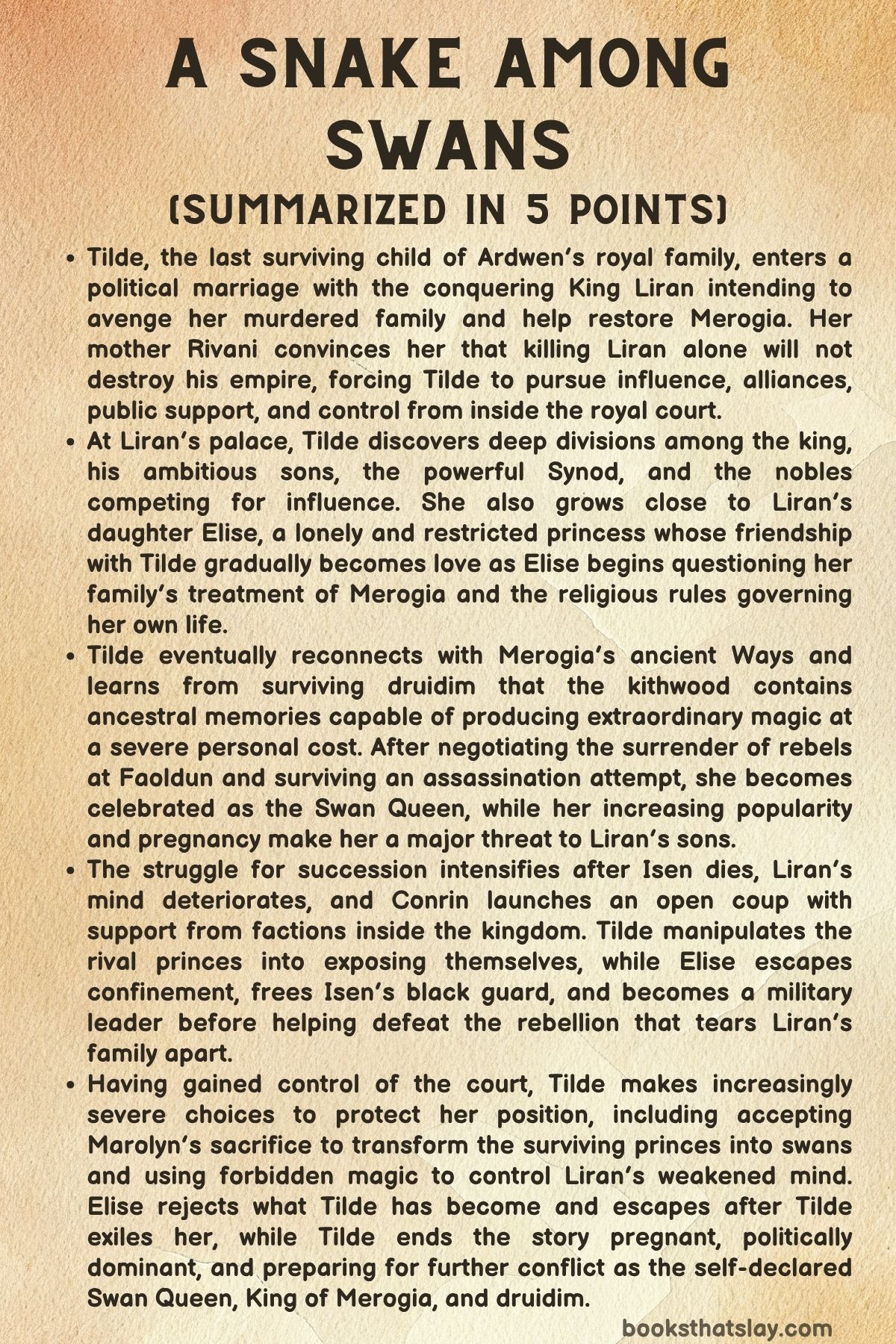
Tilde, heir to a conquered Merogian kingdom, enters the household of King Liran intending to destroy the ruler responsible for her people’s suffering, only to discover that killing one man cannot dismantle the empire he created. Her path becomes closely connected to Liran’s neglected daughter Elise, whose growing awareness of her family’s brutality challenges everything she has been taught. Their relationship develops alongside rebellion, succession struggles, ancient forest magic, betrayal, and increasingly difficult choices about what freedom is worth.
Summary
Tilde’s struggle begins when she is fourteen, during Merogia’s desperate attempt to resist Liran, the conquering king of Cynghal. At the final kingsmoot, Gevera betrays the other Merogian nations and allows Cynghal soldiers into the encampment. Tilde races through the fighting in search of Sanafin, the young Kanaanite heir she loves, only to watch an arrow strike Sanafin through the throat.
Sanafin’s death awakens something ancient inside Tilde. The nearby kithwood responds to her grief, sending roots, thorns, and flowers from the earth until Sanafin’s body disappears beneath them. Tilde realizes that the forgotten magic of Merogia still exists, although she has no idea how she summoned it.
Six years later, Tilde is the last surviving child of King Rivani of Ardwen. Her siblings have been killed, her kingdom has been stripped of land and resources, and Liran’s empire appears stronger than ever.
When Liran’s wife Isabella dies, the king seeks a Merogian bride who can reinforce his authority over the conquered territories. Tilde deliberately makes herself available because she intends to marry him, enter his household, and assassinate him.
Rivani recognizes the plan almost immediately. She warns Tilde that killing Liran could simply unleash civil war among his sons while leaving the structures of conquest intact, so Tilde must think beyond vengeance and consider how influence, alliances, inheritance, and reputation could eventually place Merogia in a stronger position.
Before Tilde leaves Ardwen, Rivani gives her a ring containing aquamarine and a concealed hawthorn thorn. The ring can expose poison, but it also carries a strange connection to the old Merogian Ways.
Tilde travels toward Liran’s court with Hadiah and Marolyn. Along the road, Merogian rebels attack her Cynghal escort and offer her a chance to escape into the kithwood, where the surviving druidim supposedly still command ancient power.
Although Tilde desperately wants to join them, she refuses because a small rebel force cannot defeat the empire. The decision forces her to accept an ugly reality: she may have to appear loyal to the enemy while people fighting for the same freedom regard her as a traitor.
At Liran’s palace, Tilde meets Princess Elise, one of the king’s daughters. Elise lives under severe religious and social restrictions, envies the freedoms given to her brothers, carries scars from harming herself during moments of distress, and longs to escape into monastic life.
Liran orders Elise to become Tilde’s companion and teach her Cynghal customs. Neither woman initially welcomes the arrangement, yet both quickly become fascinated by the other.
Tilde immediately observes serious divisions within the royal household. Liran’s sons compete for his approval, High Priest Dagobert tries to control political decisions through religion, nobles resent one another, and the conquered Merogians have never truly accepted Cynghal rule.
During Tilde’s wedding, she deliberately wears Merogian clothing rather than allowing herself to be presented as a replacement for Isabella. By carefully manipulating the disagreement between Liran and Dagobert, she begins establishing herself as someone capable of surviving the court rather than merely submitting to it.
The wedding night destroys any illusion that Tilde’s mission will remain abstractly political. Liran recognizes her hatred and even gives her an opportunity to attack him, knowing the consequences would almost certainly include her own death and another war.
Tilde chooses not to kill him. Liran then forces himself upon her, making clear that he expects her body, obedience, and future children to serve his dynasty.
Afterward, Tilde commits herself to a longer campaign. She begins studying the court, improving her public reputation, cultivating relationships with influential women, and looking for weaknesses among Liran’s children and advisers.
Her connection with Elise also changes. Tilde returns possessions belonging to Isabella, gives Elise a recovered page linked to her mother, and turns a childish prank involving a fish into a joke that finally makes Elise laugh.
Their conversations expose the different histories they have been taught. Elise has grown up believing that Merogian resistance represented treachery, while Tilde sees Cynghal rule as occupation maintained through violence.
A confrontation in a Merogian town pushes Elise toward a new moral position. After Conrin’s brutality leads to the execution of an innocent man and threatens further punishment, Tilde kneels in protest with other women.
Elise eventually joins them. By opposing her brothers publicly, she begins separating her conscience from her family’s authority.
The royal party later reaches Faoldun, where rebels have seized part of the city behind a gigantic wall of living thorns. Tilde recognizes proof of the old Ways and enters the rebel territory as Liran’s negotiator.
There she meets Guwetha and Yoldan, surviving druidim who explain that the kithwood contains countless fragments of memory, longing, and ancestral power. Druidim can direct that force through pain and sacrifice, but every extraordinary act exacts payment.
Tilde learns that the magic which buried Sanafin came from the same source. She also discovers that the rebels are too weak to defeat Liran militarily, leaving her with another terrible compromise.
Tilde persuades them to surrender so that at least part of the Merogian resistance can survive. Guwetha accepts the arrangement, but when Liran alters the surrender conditions, she uses the Ways to attack him.
Tilde places herself between Liran and the magical assault and is wounded. Alar immediately turns her survival into political spectacle, raising her hand and calling her the Swan Queen.
The title spreads. Tilde becomes admired as the woman who ended the siege and protected the king, giving her the public legitimacy Rivani had told her she would need.
Her rising power makes her a target. At a feast, Tilde is poisoned with a substance that attacks both body and mind, driving her toward self-destruction.
Elise recognizes similarities to an earlier poisoning involving her sister Isuire and helps Hadiah and Marolyn keep Tilde alive. Tilde eventually activates the hidden thorn in Rivani’s ring, discovering that her mother stored memory and blood inside it through the old Ways.
The magic restores her mind. More importantly, Elise hears the same magical voice, proving that she too can perceive the kithwood.
Their emotional bond soon becomes physical. Elise kisses Tilde, and although fear initially causes them to retreat from what happened, their attraction remains.
The royal situation meanwhile becomes more unstable. During a hunt, Liran’s eldest and most dependable son Isen dies under suspicious circumstances involving the forest, Conrin, and a hidden figure.
Isen’s death devastates Elise and accelerates the succession crisis. Liran becomes increasingly confused, volatile, and unable to distinguish past from present.
Elise finally tells Tilde about another terrible family secret: Alar had poisoned Isuire years earlier as part of his efforts to manipulate the royal bloodline. The revelation confirms that Liran’s children have been harming one another long before Tilde entered the court.
Tilde and Elise become lovers. For Elise, their relationship represents an act of personal independence after years of being told what a daughter, princess, and faithful woman should want.
For Tilde, Elise provides one of the few experiences of intimacy untouched by political duty. Yet Tilde cannot separate herself permanently from her larger plan.
When the royal party becomes trapped inside a hostile section of the kithwood, Tilde uses the Ways to guide everyone to safety. She disguises what she has done as a miracle of the Wing, and the surviving court accepts the explanation.
The act costs Tilde pieces of her memory. It also strengthens her image as a queen protected by divine power.
By this point Tilde is ready to move directly against Liran. Using forbidden Cynghal magic, prepared smoke, carefully chosen clothing, and Liran’s worsening confusion, she begins influencing his perceptions and encouraging his fears about his sons.
She also announces that she is pregnant. The unborn child gives her an even stronger claim to remain at the center of the dynasty.
Elise, however, wants something completely different. She gathers money and proposes that they escape together, abandoning the royal household before succession violence destroys them.
Tilde refuses. She believes every death, violation, compromise, and sacrifice she has endured would become meaningless if she walked away when power was finally within reach.
Their argument exposes the deepest difference between them. Elise imagines freedom as escape from systems of control, while Tilde imagines freedom as gaining enough authority that nobody can control her again.
An assassination attempt gives Tilde the opportunity to force Conrin’s faction into the open. She spreads the false story that she has been killed, knowing Conrin will move against Liran if he believes the pregnant queen is no longer a threat.
The coup begins shortly afterward. Conrin’s grey faction, Alar’s supporters, Liran’s guards, and Tilde’s allies take positions throughout the palace.
Tilde walks directly into Conrin’s gathering alive and manipulates him into exposing his intentions. Conrin finally declares himself the new Swan King, turning conspiracy into open rebellion.
Elise simultaneously rejects the passive role assigned to her. After escaping confinement, she frees Isen’s black guard and takes command of soldiers who recognize that she has earned authority through action.
She arrives during the central confrontation and orders the princes arrested. Fighting breaks out among the competing factions, and the royal family begins destroying itself.
Liran kills Alar after discovering his involvement in Isen’s death. Conrin’s coup collapses, several important supporters die, and Gaisa, Egil, Conrin, and Hein are taken into custody.
Nobles then kneel before Tilde. She has successfully transformed herself from a conquered bride into the central political force holding the surviving government together.
Tilde still considers Liran’s surviving sons an unacceptable threat. Hadiah warns that publicly executing them would create martyrs, while Marolyn argues that keeping them alive would allow future conspirators to rally around them.
Tilde turns to the Ways for another answer. She decides to transform the imprisoned princes into literal swans, destroying their usefulness as claimants without publicly executing them.
The magic requires an enormous sacrifice. Marolyn voluntarily gives herself to the kithwood, dying as the princes’ bodies change into birds.
Elise secretly witnesses the transformation. Horrified by Marolyn’s death and by Tilde’s willingness to use magic against her brothers, she realizes that the woman she loves has crossed a boundary she cannot accept.
Tilde then secures control over Liran himself. Ziyan continues administering magical substances that keep the king confused and suggestible until Liran accepts Tilde as the person who defines reality for him.
When Elise enters, Liran no longer recognizes his daughter. Tilde deliberately tells him that Elise is a stranger and traitor, destroying the last remaining foundation of Elise’s relationship with her father.
Tilde refuses to kill Elise, claiming instead that exile will give her the freedom she once wanted. Elise rejects this as an act of kindness because once again someone else has chosen her future for her.
By the end, Tilde writes secretly to Rivani explaining what she has accomplished. Liran remains alive but controlled, the princes have been removed, Tilde carries the expected heir, and her public identity as the Swan Queen has become politically powerful.
Yet her position remains uncertain. Rebellion is spreading, Merogia is still not free, Elise has escaped, and Tilde has paid for her victory with Marolyn’s life, pieces of her own memory, and the destruction of the relationship that gave her genuine happiness.
She sends Rivani a coded request to come armed and demands answers about her mother’s hidden knowledge of the Ways. Tilde finally names herself not simply as Liran’s wife, but as Swan Queen, Child of the Forest, daughter of the snake, King of Merogia, and druidim—a ruler who has entered the enemy’s dynasty and seized control of its symbols without forgetting the conquest that brought her there.
Characters
Tilde
Tilde is the political and emotional center of A Snake Among Swans, beginning as a traumatized heir whose desire for vengeance gradually becomes an ambition to control the political system that destroyed her homeland. Sanafin’s death gives her hatred a deeply personal foundation, while the destruction of her family and Ardwen’s subjugation turn that hatred into a national mission.
Her greatest strength is her ability to learn from circumstances she initially despises. She enters Liran’s household wanting a simple assassination, but Rivani forces her to recognize that an empire supported by soldiers, religion, wealth, noble alliances, settlers, and competing heirs cannot be destroyed by removing a single ruler.
Tilde therefore becomes increasingly patient and calculating. She uses clothing, stories, public appearances, songs, mercy, sacrifice, motherhood, and even her enemies’ prejudices about women to construct an image that allows her to gain influence without openly announcing her ambitions.
This political development also creates her central moral conflict. Every compromise she makes can be defended as necessary for Merogia, yet each one makes the next compromise easier, until she is willing to manipulate Liran’s mind, sacrifice Marolyn, transform prisoners through magic, and exile Elise.
Tilde nevertheless remains capable of tenderness. Her relationships with Hadiah, Marolyn, Sanafin, Hein, and especially Elise reveal that she is not naturally indifferent to suffering; the tragedy is that she increasingly treats personal pain as a price that leadership requires.
Her ending is deliberately uncomfortable. Tilde has defeated many people who considered her powerless, but she has also adopted some of the logic of empire: other lives can now become resources in pursuit of the future she believes she alone can secure.
Elise
Elise experiences the most profound personal awakening in A Snake Among Swans. She begins as a neglected princess who has internalized the religious, social, and familial rules surrounding her so completely that even her own desires appear shameful to her.
Her longing for Liran’s approval defines much of her early behavior. Because affection from her father is scarce, even minor recognition has enormous emotional power, leaving her vulnerable to a family structure in which daughters are valued far less than sons.
Elise’s development begins when proximity to Tilde forces her to see conquest from another perspective. She gradually understands that the comfortable political history she inherited describes her own family as civilizers while ignoring the experience of the people whose lands, beliefs, and autonomy were taken.
Her courage develops through action rather than sudden transformation. Kneeling against Conrin, helping save Tilde from poisoning, questioning her brothers, taking up a bow, freeing Isen’s guard, and eventually commanding soldiers all reveal a woman discovering abilities she was trained never to recognize.
Her relationship with Tilde initially expands that freedom. Loving another woman allows Elise to choose desire for herself, while Tilde’s insistence that she stop apologizing for other people’s crimes encourages her to imagine an identity independent of Isabella, Liran, and the Wing.
The relationship later becomes another challenge to autonomy when Tilde decides that political victory matters more than the life Elise wants. Elise’s final anger is therefore important because she refuses to replace obedience to her father with obedience to her lover.
Liran
Liran is the central imperial figure in A Snake Among Swans, yet the novel gradually strips away the aura of invincibility surrounding him. He first appears as the conqueror who defeated Merogia, destroyed Tilde’s family, and built a dynasty powerful enough to determine the lives of entire nations.
His authority depends heavily on fear. He humiliates relatives, strikes his sons, ignores the needs of his daughters, uses marriage as policy, and treats Tilde’s body and future children as property belonging to his dynasty.
Yet Liran is not presented as a ruler whose empire rests solely upon his personal strength. His authority is supported by the Synod, military officers, conquered elites, economic dependence, family alliances, and the expectation that everyone around him will preserve the order he established.
His decline exposes the weakness beneath that system. As grief, age, trauma, and magical influence damage his mind, the sons who once competed for his approval begin openly competing for his throne.
His relationship with Elise is particularly damaging because he gives her just enough recognition to keep her emotionally dependent. Even after years of neglect, a small gesture from him can restore her hope that she might finally become the daughter he values.
His final condition reverses his earlier dominance over Tilde. The woman he once treated as powerless becomes the authority through which he understands reality, leaving the conqueror alive but politically and psychologically conquered.
Marolyn
Marolyn is one of the clearest representations of personal loyalty in A Snake Among Swans. She follows Tilde into enemy territory knowing that assassination, rebellion, imprisonment, or execution may follow, and her commitment is based on regarding Tilde as the rightful king of her people rather than merely a princess entering a political marriage.
Her temperament contrasts sharply with Hadiah’s caution. Marolyn reacts emotionally to humiliation, injustice, and threats, often expressing the anger that Tilde must conceal while playing the obedient queen.
This makes Marolyn an important moral mirror for Tilde. As Tilde becomes more willing to accept compromise, Marolyn repeatedly questions whether survival and political calculation are changing the person she originally chose to serve.
The accusation that Tilde is becoming like Merovin is particularly significant. Marolyn recognizes before Tilde fully admits it that sacrificing some people for a distant political objective can resemble the same reasoning used by collaborators and conquerors.
Yet Marolyn ultimately carries loyalty beyond criticism into self-sacrifice. She voluntarily becomes the price of transforming Liran’s sons, believing the oath she gave Tilde requires her to make even death useful.
Her death is therefore both an act of devotion and a judgment on Tilde’s transformation. Tilde gains security through the sacrifice, but the cost is one of the people who loved her before she possessed power.
Rivani
Rivani provides the political philosophy that shapes Tilde throughout A Snake Among Swans. Unlike her daughter, she has already learned through defeat that courage and military resistance are not sufficient when the enemy commands greater resources and when repeated rebellions only produce more dead Merogians.
She recognizes Tilde’s assassination plan without needing to be told. Rather than forbidding it from fear, Rivani challenges the strategic weakness behind it and forces her daughter to ask who will rule, what alliances will survive, and whether Merogia will actually benefit after Liran dies.
Her decision to send Tilde into the marriage is painful because Rivani understands what her daughter may endure. She nevertheless accepts a strategy in which personal happiness is subordinate to dynastic survival and national restoration.
The hidden thorn inside the ring reveals another side of her character. Rivani has concealed knowledge of the Ways and possesses enough understanding of old magic to preserve blood and memory within an object.
That secrecy complicates Tilde’s trust in her. Rivani teaches her daughter to think beyond immediate vengeance while withholding information that might have changed many of Tilde’s decisions.
By the ending, Rivani remains both mother and political predecessor. Tilde still seeks her help and demands her answers, suggesting that the relationship between them will become increasingly important as Tilde tries to turn control of Cynghal into actual liberation for Merogia.
Sanafin
Sanafin appears only briefly in person, but her death influences almost every major decision Tilde later makes. She represents Tilde’s first experience of love, the lost possibility of a life before conquest fully consumed her, and the moment when the kithwood first responds directly to Tilde’s emotions.
Her final attempt to send Tilde into the forest suggests that she understood more about Merogia’s surviving power than Tilde did. When she dies and the forest takes her body, grief becomes permanently connected in Tilde’s mind with magic.
Sanafin also survives as a moral and emotional memory. Tilde repeatedly measures later experiences against what she lost, especially when she confronts the difference between freely chosen love and relationships imposed by political duty.
Her memory eventually becomes something Tilde can spend when directing the Ways. This gives the magic a particularly cruel quality: power does not merely demand pain in the present but can consume the memories through which the dead remain part of the living.
Hadiah
Hadiah serves as one of Tilde’s most dependable advisers and provides a practical counterweight to both Tilde’s ambition and Marolyn’s anger. She understands that survival inside Liran’s court requires control, patience, and the ability to endure insults without allowing every provocation to determine the next action.
Her loyalty is neither blind nor passive. Hadiah repeatedly questions decisions that place Tilde in unnecessary danger and becomes increasingly disturbed when the queen begins considering magical manipulation and irreversible sacrifices.
She also understands court society particularly well. When Tilde is ostracized by noblewomen after opposing Conrin’s violence, Hadiah explains that moral righteousness does not automatically protect someone from the social consequences of violating accepted behavior.
Her reaction to Marolyn’s final sacrifice shows the emotional cost of Tilde’s political development. Hadiah remains beside Tilde, but survival no longer means that their original household has survived intact.
King Liran’s Son Isen
Isen initially appears to be the most stable and capable of Liran’s sons. Unlike several of his brothers, he can show genuine concern for Elise, and he often behaves as though maintaining the dynasty matters more than personal indulgence.
His apparent responsibility makes his compromises more significant. Isen has accepted the idea that ruling requires sacrifices, including silence about terrible acts committed within his own family.
His response to Isuire’s poisoning demonstrates that protecting the dynasty has repeatedly taken precedence over full truth or justice. Even his care for Elise exists within a system he does not fundamentally challenge.
His death removes the son most capable of maintaining continuity after Liran. That absence allows the rival ambitions of Conrin, Alar, Gaisa, and others to become much more dangerous.
Isen consequently represents the weakness of stability based on suppression. He holds the family together for a time, but he never repairs the forces destroying it from within.
Conrin
Conrin embodies entitlement without restraint. He expects royal status to shield him from consequences and interprets opposition as an insult rather than as a legitimate response to his behavior.
His conduct during the summer games establishes this pattern. When people die because of his recklessness, he resents compensation rather than showing responsibility.
His later actions become more brutal. The killing associated with Falhin, violence in the Merogian town, manipulation surrounding Isen’s death, and his eventual coup reveal someone who increasingly treats fear and force as natural extensions of princely authority.
Conrin is also politically impatient. Tilde defeats him partly because she understands how to provoke that impatience, leading him to expose himself before his position is secure.
His failed rebellion demonstrates the difference between believing oneself entitled to rule and actually possessing the discipline required to build lasting power.
Alar
Alar is dangerous because he combines intelligence, ruthlessness, and experience. His earlier exile has not eliminated his ambitions, and his return immediately destabilizes relationships among Liran’s other sons.
His responsibility for Isuire’s poisoning reveals how long he has been willing to manipulate his own family for dynastic advantage. He treats kinship as secondary to succession.
Unlike Conrin, Alar often recognizes political realities quickly. He understands Tilde’s value, sees opportunities created by her rising popularity, and knows when other people’s mistakes can be used against them.
His willingness to use Tilde as a hostage confirms that apparent cooperation never becomes genuine loyalty. Even when his interests temporarily align with hers, he remains focused on obtaining the throne.
Liran ultimately kills him after learning the extent of his involvement in family betrayal. His death turns the dynasty’s internal violence into literal patricidal and fratricidal destruction.
Gaisa
Gaisa spends much of the story aligned with the masculine culture of Liran’s sons, participating in their mockery and political maneuvering while expecting his status to protect him. He rarely displays the raw impulsiveness of Conrin, but he remains part of the system that allows such behavior to continue.
His role during the succession conflict shows a prince accustomed to defining political legitimacy through male inheritance. Tilde’s pregnancy and growing influence therefore threaten not only his personal prospects but his assumptions about who is entitled to power.
Gaisa’s eventual imprisonment and transformation remove another possible claimant. His fate illustrates how Tilde destroys the dynastic structure by attacking the symbolic identity of the swan princes themselves.
Egil
Egil is more complicated than Conrin because he possesses some emotional awareness and maintains a meaningful bond with Elise. He warns her about the coming succession struggle and appears genuinely concerned that he may not be able to protect her.
At the same time, he assumes that protection gives him authority over her. Elise’s refusal to accept orders from a younger brother becomes an important moment in her recognition that affection does not erase inequality.
Egil understands that Tilde and her unborn child threaten the expectations of Liran’s existing sons. His awareness does not lead him to reject the system, but it makes him less blindly confident than several of his brothers.
His final fate places him among the princes transformed into swans. For Elise, this makes Tilde’s act particularly difficult to accept because Egil was neither innocent nor equivalent to the worst members of the family.
Hein
Hein is one of the younger and more vulnerable royal children. His relationship with Elise is comparatively warm, and their prank involving the dead fish briefly allows both of them to behave like ordinary siblings rather than pieces in a political dynasty.
His youth exposes another cost of the succession struggle. Even characters who have not yet become major political actors are pulled into fear, conspiracy, and collective punishment.
Tilde often behaves gently toward Hein, particularly when he is injured, demonstrating that her hatred of Liran’s dynasty does not automatically extend to every individual child. This makes the later decision to include him among the transformed princes morally harsher.
For Elise, Hein remains someone she especially wants to protect. His fate contributes strongly to her horror at what Tilde eventually becomes willing to do.
Dagobert
Dagobert represents institutional religious power rather than private spirituality. As High Priest, he repeatedly uses the Wing to determine acceptable behavior, regulate women, influence succession, and strengthen his own political position.
His conflict with Tilde begins almost immediately because she refuses to accept his authority as absolute. She notices that Liran himself resents priestly interference, allowing her to exploit the division between throne and Synod.
Dagobert later supports Conrin and participates in conspiracies against Tilde. His religious language therefore becomes increasingly difficult to separate from ordinary political ambition.
Tilde’s decision not to execute him after the failed coup shows her growing strategic discipline. Killing a high priest could unite the Synod, while publicly humiliating him allows her to present him as the religious figure who corrupted politics.
Odon
Odon is first understood through Tilde’s memory as Nefka, the feared general associated with atrocities during Ardwen’s conquest. His presence therefore forces her to confront someone personally connected to the destruction of her family.
In the present, Odon defines himself through loyalty to Liran. He sees the preservation of the king and the empire as a duty that excuses threats, violence, and the concealment of royal wrongdoing.
His central weakness is his refusal to believe how far Liran’s sons will go. Having spent years protecting the dynasty from consequences, he becomes unable to recognize that those hidden crimes have helped create the eventual coup.
Odon illustrates how loyal servants can preserve destructive regimes without personally seeking the throne. His devotion gives the system continuity while preventing necessary truths from being addressed.
Merovin
Merovin initially represents everything Tilde despises about political compromise. His Geveran background connects him to the betrayal at the kingsmoot, and Tilde sees collaboration with Cynghal as an unforgivable abandonment of Merogian solidarity.
Merovin does not deny that betrayal. Instead, he argues from survival, explaining that conquest destroyed his own family and that remaining politically useful was one way to endure.
His advice to Tilde is uncomfortable because it resembles Rivani’s. He urges her to become indispensable, build popularity, survive long enough to produce an heir, and turn public perception into a political weapon.
Tilde gradually adopts many of these methods even while resisting Merovin personally. Their relationship therefore demonstrates how easily resistance can come to resemble collaboration when both operate inside the institutions of the conqueror.
Guwetha
Guwetha provides Tilde with her clearest understanding of the surviving Ways. She is simultaneously Kanaanite, Merogian, rebel, and druidim, allowing her identity to cross the political categories imposed by conquest.
Unlike people who romanticize old magic, Guwetha understands its cost. She has seen what the kithwood can accomplish and what it can destroy in those who attempt to direct it.
Her willingness to trust Tilde during the siege is significant because she recognizes that continued resistance without sufficient strength could simply waste more lives. Surrender becomes a strategy for survival rather than an acceptance of Cynghal legitimacy.
Her final attack on Liran also demonstrates the limits of that compromise. When the surrender terms appear corrupted, Guwetha returns to direct magical resistance even though it may cost her everything.
Yoldan
Yoldan represents the devastating personal cost of using the Ways. His creation of the enormous thorn barrier protects the rebels and demonstrates astonishing power, but the act damages his mind so severely that he struggles with basic memory.
Through him, magic becomes something very different from an effortless source of advantage. Every act of protection can remove part of the person who performs it.
His condition foreshadows what later happens to Tilde when the forest takes pieces of her memory. Yoldan therefore functions as a warning that power drawn from the past can gradually consume the individual trying to command it.
Ladbh
Ladbh represents distrust within the resistance. Unlike Guwetha, he does not readily accept that Tilde’s position inside Liran’s family can genuinely serve Merogia.
His suspicion is understandable because Tilde outwardly behaves like the conqueror’s queen and asks rebels to surrender while she continues building her political position. From Ladbh’s perspective, the distinction between infiltration and collaboration is dangerously uncertain.
His disappearance into the forest preserves an unresolved strand of resistance. Not every druidim accepts Tilde’s authority, meaning her eventual claim to represent Merogia remains open to challenge.
Ziyan
Ziyan enters the story as an outsider whose foreign connections make Tilde’s household suspicious. His medical knowledge, however, becomes increasingly useful as physical illness, poison, pregnancy, and magical substances become part of the political conflict.
His later cooperation with Tilde in administering old Cynghal magic to Liran places him inside her most ethically troubling strategy. He helps keep the king alive while weakening his ability to make independent decisions.
Ziyan therefore occupies an ambiguous position between healer and political accomplice. His skills can preserve life, but they can also be redirected toward controlling it.
Miras
Miras demonstrates the political power of narrative. Tilde recognizes that events alone do not create legitimacy; people must also be told what those events mean.
His songs turn the surrender at Faoldun into a public triumph and help transform Tilde into the Swan Queen. Exaggeration becomes a weapon as effective in its own way as military victory.
Through Miras, the novel shows that rulers gain power partly by controlling memory. A complicated compromise can become heroism once repeated in the form most useful to those who benefit from the story.
Isabella
Although Isabella dies before the main events, she remains deeply present through Elise’s memories, belongings, family trauma, and Liran’s declining mind. Elise remembers both affection and rejection, making Isabella difficult to reduce to either loving mother or cruel parent.
Her rooms and possessions become contested spaces after Tilde arrives. Tilde’s willingness to return meaningful objects to Elise rather than claiming them as a new queen helps establish the first real trust between them.
Liran’s later confusion between Tilde and Isabella suggests that his relationships with women have long been shaped by possession, dynasty, and memory. Isabella consequently remains part of the emotional structure from which both Tilde and Elise must escape.
Cynefel
Cynefel represents women who survived conquest through accommodation. Tilde initially struggles to understand such women because compromise can look like weakness when viewed from outside.
Her willingness to kneel and offer herself during the violent confrontation in the Merogian town complicates that judgment. Cynefel has not necessarily forgotten conquest simply because she learned how to survive inside its social order.
Through her, Tilde begins recognizing that resistance can take forms other than open rebellion. This realization helps prepare Tilde for her own increasingly complicated position as both Merogian ruler and Cynghal queen.
Gundobar
Gundobar introduces the contempt embedded within Cynghal rule. During negotiations with Rivani and Tilde, he openly dismisses female authority and treats Merogian customs as inferior.
His behavior shows that conquest is not only military occupation but also a hierarchy of culture, gender, and legitimacy. He expects the defeated people to accept Cynghal assumptions as naturally superior.
Later accusations against Tilde reveal his readiness to use charges of witchcraft when political circumstances turn dangerous. His hostility toward her remains consistent even as her formal status increases.
Captain Perin
Captain Perin becomes an important symbol of Tilde’s growing independent power. His service shows that her security is no longer provided solely because she belongs to Liran.
His presence during the coup demonstrates the militarization of Tilde’s political faction. By then, she has supporters who will fight for her position rather than merely tolerate her as the king’s wife.
Perin’s death also emphasizes the human cost of the conflict Tilde helps accelerate. Even successful political strategy leaves loyal people dead.
Torna
Torna serves Elise during the later crisis and reflects the suspicion many Cynghals feel toward Tilde. When Elise prepares to flee after witnessing the transformation of her brothers, Torna admits that she never trusted the Merogian queen.
Her response is important because Elise’s fear does not develop in isolation. The cultural and religious warnings surrounding Merogian magic give her horror an existing framework through which Tilde can quickly become a threatening figure.
Ademar
Ademar belongs to the network surrounding Conrin’s conspiracy and becomes part of the evidence that the struggle for succession has developed beyond private resentment. The assassination attempt linked to that faction convinces Tilde that she can force her enemies to expose themselves.
His fate demonstrates the ruthless speed with which the coup consumes its participants. Once hidden plotting becomes open conflict, individuals who previously operated through schemes become immediate military targets.
Themes
Power, Resistance, and the Corruption of Purpose
A Snake Among Swans repeatedly asks whether resistance remains morally distinct from oppression when it begins using the same logic as the system it opposes. Tilde starts with an apparently straightforward goal: avenge her family and free Merogia from the ruler who conquered it.
Experience quickly teaches her that meaningful political change requires more than killing Liran. She needs allies, public legitimacy, military protection, control over competing claimants, access to institutions, and a future capable of surviving the king’s death.
That realization produces genuine strategic maturity, but it also gives Tilde increasingly broad permission to justify harmful acts. She accepts forced marriage, manipulates public stories, turns Liran’s paranoia against his sons, uses magic to weaken his mind, sacrifices Marolyn, and removes the princes through transformation.
Each step can be explained as necessary for Merogia, which is precisely what makes the theme unsettling. The language of necessity becomes capable of excusing almost anything when the desired future is considered important enough.
The novel never reduces Tilde to a simple tyrant because her goals remain connected to real historical suffering. Instead, it shows how righteous causes can create dangerous certainty when one person begins believing that only she can decide which sacrifices are acceptable.
Freedom and the Right to Choose
Freedom means something very different to Tilde and Elise. Tilde believes that freedom comes from possessing enough power that nobody can force her, her family, or her country into submission again.
Elise increasingly understands freedom as the ability to decide what kind of life she wants without fathers, brothers, priests, dynasties, or lovers defining that life for her. Her dream of escaping with Tilde therefore represents a rejection of the entire political system.
Their romance initially seems capable of reconciling these two ideas. Tilde encourages Elise to reject shame and recognize her own desires, while Elise gives Tilde an experience of affection in which her body is not simply part of a political arrangement.
The conflict appears when Tilde refuses to leave. She believes abandoning power would betray Merogia and make earlier sacrifices meaningless, while Elise sees the refusal as another example of politics consuming personal choice.
The ending makes the contradiction harsher. Tilde claims that exiling Elise is a gift because it gives her the life away from court she once wanted, but Elise correctly recognizes that imposed freedom is still an imposed fate.
Her autonomy requires more than physical escape. It requires the right to choose even when her choice conflicts with the plans of someone who believes she knows what is best.
Memory, Magic, and the Cost of the Past
The magic in A Snake Among Swans is built around memory, ancestry, pain, and sacrifice rather than simple supernatural ability. The kithwood contains traces of innumerable lives, allowing the past to remain active within the present.
This creates a direct relationship between history and power. Merogia’s conquered people cannot simply forget what happened because the landscape itself holds memories of loss, betrayal, love, and resistance.
Tilde’s first encounter with the Ways occurs through Sanafin’s death. The forest responds to unbearable grief, establishing that magic is activated through experiences powerful enough to mark both the person and the land.
Later uses reveal the cost. Yoldan loses much of his mental identity after creating the thorn wall, while Tilde loses memories after guiding the royal party through the forest.
Marolyn’s death takes this logic to its extreme. Transforming Liran’s sons requires a life, making political magic inseparable from human sacrifice.
Rivani’s hidden thorn also shows that memory can be deliberately preserved and passed between generations. The older generation may conceal knowledge, but it cannot prevent the consequences of that knowledge from reaching its children.
The theme therefore treats memory as both protection and burden. Remembering gives Merogia identity and resistance, but drawing power from the past can consume the very people trying to preserve it.
Gender, Religion, and Inherited Authority
The societies surrounding Tilde and Elise impose different traditions, but both women confront political systems in which gender determines who is expected to rule, fight, speak, inherit, obey, or reproduce. Elise feels these limits most directly because she grows up watching brothers receive opportunities denied to her regardless of their ability or character.
The Wing reinforces this hierarchy by presenting social expectations as religious order. Dagobert attempts to regulate Tilde’s clothing, behavior, diet, marriage, and public identity, while Elise has been taught to interpret desires outside approved expectations as sinful.
Tilde challenges this structure by learning how to use the roles forced upon her. She enters Cynghal as a bride expected to produce a son, yet eventually turns pregnancy and queenship into sources of political authority.
Elise’s rebellion follows another path. She stops asking whether she has permission to act, takes up weapons, frees soldiers, commands Isen’s guard, and discovers that leadership can arise from competence rather than male inheritance.
Their experiences expose authority as something sustained by collective belief rather than natural law. Liran’s sons are treated as rulers because tradition says princes should rule, while women with equal or greater ability are expected to support them.
Once those expectations are challenged publicly, they become much less stable. The story ultimately portrays gender hierarchy, religious authority, and dynasty as human systems maintained through obedience—and therefore systems that can also be resisted, redirected, or destroyed.