A Killer for Christmas Summary, Characters and Themes
A Killer for Christmas by Kim Harrington is a holiday mystery that turns the cheerful traditions of a small Maine tourist town into the setting for a series of increasingly disturbing crimes.
The book follows Kelsey Hendricks, a social media professional seeking a fresh start after losing both her relationship and her career in Boston. Christmasville initially seems like the perfect place to rebuild her life, but suspicious deaths, threatening messages, and public displays of violence soon destroy that sense of safety. Beneath the murder mystery, the novel also examines belonging, grief, personal freedom, judgment, and the danger of forcing happiness onto people whose private struggles remain unseen.
Summary
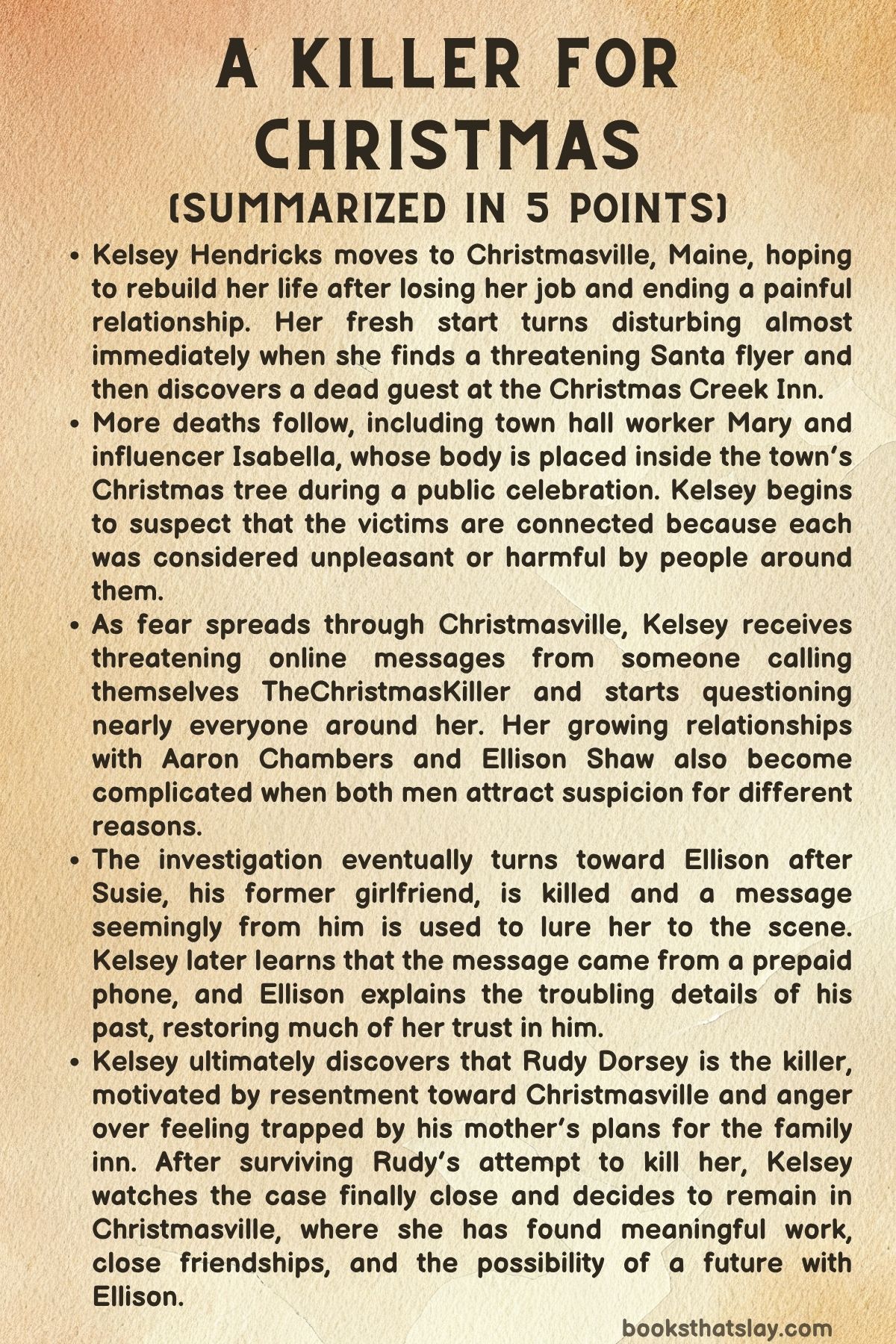
Kelsey Hendricks arrives in Christmasville, Maine, after a disastrous period in Boston has left her unemployed, newly single, and unable to afford her apartment. She has accepted a job as the town’s social media manager, hoping that the Christmas-themed community she remembers fondly from childhood can offer her both professional stability and an emotional reset.
Her first impression of Christmasville is almost exactly what she hoped for: snow, lights, decorations, welcoming residents, and an atmosphere built around permanent holiday cheer. That comforting illusion is disrupted almost immediately when she finds a homemade flyer showing a knife-wielding Santa accompanied by the threatening message “SANTA’S GONNA GET YOU,” although she assumes it is merely a tasteless prank and destroys it.
At the Christmas Creek Inn, where Kelsey will initially stay, she meets owner Grace Dorsey, Grace’s teenage son Rudy, handyman Jack, and housekeeper Angelica. Before Kelsey can even settle into her assigned room, she discovers the naked body of traveling salesman Dennis Sudbeck lying dead in the bathtub, apparently having broken his neck in an accidental fall.
Sheriff Kris Whitman and Officer Nick Coleman investigate, and nothing immediately proves Dennis was murdered. Dennis had also behaved unpleasantly toward people at the inn, particularly Angelica, but Kelsey has no concrete reason to connect his death with the threatening Santa flyer she found outside.
As Kelsey begins work at town hall, Mayor Carol Meyer enthusiastically assigns her the task of modernizing Christmasville’s online presence. Carol is deeply invested in maintaining the town’s cheerful image because its economy depends heavily on tourism, and Kelsey gradually realizes that protecting that image influences how Carol reacts to anything that could frighten visitors.
Kelsey also begins forming relationships around town. She becomes friends with bakery owner Holly Hernandez, grows close to bookstore owner Ellison Shaw, and attracts the attention of wealthy businessman Aaron Chambers, whose family is considering building a large hotel in Christmasville.
The possibility that Dennis’s death was not accidental first becomes more serious when Holly observes that the shower was not running when Kelsey found him. Before Kelsey can decide what she believes, another death occurs when she and Aaron hear a scream near the creek and discover Mary, the unfriendly town hall assistant, lying dead in the water with a head wound.
Aaron becomes an early suspect because he had been near the creek and because his family’s hotel project creates a possible financial motive involving property values. Kelsey defends him publicly but privately recognizes that his decision to pull Mary from the water also contaminated evidence and conveniently explained why his DNA might be found on her.
Carol continues insisting that the town should not publicly treat the deaths as murders without proof. When Kelsey proposes acknowledging Mary on Christmasville’s social media pages, Carol refuses because she believes the accounts should attract tourists rather than announce tragedy.
Meanwhile, Kelsey’s personal life becomes increasingly complicated. She grows attracted to both Aaron and Ellison, but her fresh start is threatened when Isabella, the influencer who slept with Kelsey’s former boyfriend Trent, arrives in town after Carol hires her to promote Christmasville.
Kelsey attempts to remain professional, but Isabella behaves with the same arrogance and cruelty that helped destroy Kelsey’s previous life. Their hostility eventually becomes public during a Santa event at the inn, forcing Kelsey to admit to Carol that Isabella had betrayed her by becoming involved with Trent and then deliberately making sure Kelsey discovered the affair.
Around the same time, a mysterious person begins communicating through Christmasville’s social media presence. A comment asking whether Kelsey liked the commenter’s “artwork” makes her wonder whether the account is connected to the threatening Santa imagery and other acts of vandalism around town.
Christmasville’s tree-lighting ceremony turns those vague suspicions into genuine terror. When the enormous tree is illuminated before a crowd of residents and tourists, Isabella’s murdered body is discovered hidden among its branches, transforming a major public celebration into a crime scene.
Because Kelsey had publicly argued with Isabella, Sheriff Kris immediately considers her a suspect. Kelsey refuses to allow herself to be intimidated and points out that the police have no physical evidence against her, but the investigation makes it clear that her attempt to rebuild her life has now become inseparable from a series of violent deaths.
Ellison supports Kelsey during this period, particularly when she becomes drunk after the pressure overwhelms her. Rather than exploiting her vulnerability, he looks after her and gets her safely into bed, strengthening her growing belief that he is someone she can trust.
Kelsey gradually notices a possible pattern among the victims. Dennis had behaved badly toward people at the inn, Mary had a reputation for being unpleasant, and Isabella had openly mistreated others, suggesting that someone might be targeting people considered morally objectionable rather than choosing victims according to age, gender, or profession.
Her suspicions become more disturbing when someone constructs a snowman made to resemble murdered Isabella, complete with simulated wounds and a knife. Shortly afterward, Kelsey becomes frightened by someone secretly following her in the hedge maze, making the danger feel increasingly directed at her personally.
An online account calling itself TheChristmasKiller begins commenting on the town’s posts and eventually implies that Dennis, Mary, and Isabella were all murdered. Although Nick explains that the messages alone cannot legally identify the person responsible, Kelsey becomes convinced that someone is deliberately using her social media work to prolong the fear surrounding the killings.
Her romantic uncertainty also reaches a turning point. Aaron kisses her, but Kelsey realizes that her feelings are stronger for Ellison, prompting Aaron to warn her that she is choosing the wrong man.
Thanksgiving gives Kelsey a temporary experience of belonging when she joins Holly, Nick, and Ellison for dinner. During the gathering, Nick reluctantly reveals confidential information confirming that Mary was murdered: her head injury did not kill her, and evidence shows that someone deliberately held her underwater until she drowned.
Kelsey and Ellison finally kiss, and their relationship begins moving beyond flirtation. At the same time, the investigation grows more frightening because the police now know that at least Mary and Isabella were intentionally killed, while Dennis’s death remains suspicious.
At another holiday event, Kelsey notices that Jack moves far more easily than his supposed back problems should allow, briefly making him a serious suspect. Jack eventually admits that he exaggerates his condition simply to avoid heavier work at the inn, removing one apparent mystery without bringing Kelsey any closer to identifying the murderer.
Susie, Ellison’s jealous former girlfriend, then apologizes to Kelsey and admits she was the person who frightened her in the hedge maze. Before that confession can bring much relief, Susie falls from a rooftop during the holiday concert and dies in front of the crowd.
Police determine that Susie was deliberately lured onto the roof by a message supposedly sent by Ellison. His difficult history with Susie gives authorities a motive, and he is publicly arrested while insisting to Kelsey that he is innocent.
Evidence later shows that the message came from a prepaid phone rather than Ellison’s regular number, suggesting someone may have impersonated him. Still, Kelsey’s trust is shaken again when Aaron reveals that a private investigator discovered Ellison has a criminal conviction for assault and battery and that his former bookstore burned in an arson fire.
When Ellison is released, Kelsey confronts him directly. He explains that the assault occurred after he intervened when a neighbor was abusing his girlfriend, while the destroyed bookstore may have been part of retaliation because the abusive man was a police officer; Nick has independently investigated enough of Ellison’s account to believe it is credible.
Kelsey accepts that Ellison withheld painful information rather than actively deceiving her about who he is. Their relationship survives the revelation, but the worsening snowstorm leaves Christmasville increasingly isolated just as Kelsey begins to reconsider people much closer to the crimes.
At the inn, Grace reveals that a chef’s knife has disappeared from the kitchen. Since Isabella was killed with an ordinary household knife and Dennis died inside the inn, Kelsey realizes that the killer could be someone with direct access to the building.
She begins mentally reconsidering Rudy and Jack, both of whom have opportunities to move through the inn and town without attracting suspicion. Before she can warn Nick, however, the hot chocolate she has been drinking makes her dizzy and exhausted, and someone suddenly grabs her from behind while pressing a knife against her back.
The attacker is Rudy. He drugged Kelsey’s drink and forces her into the storm, finally explaining that his resentment toward Christmasville began because he felt trapped by Grace’s expectation that he would eventually inherit the struggling inn.
Rudy reveals that his father’s fatal fall was caused during an argument between them. Although he maintains that he never meant to kill his father, he hoped the death would convince Grace to sell the inn, only to discover that grief made her even more determined to preserve the family business.
Wanting tourism to collapse so that Grace would finally abandon Christmasville, Rudy began vandalizing the town and creating threatening Santa imagery. When those tactics failed, he escalated to murder and developed a moral justification for his victims, convincing himself that the people he killed deserved punishment.
Dennis was targeted because of his behavior toward people at the inn, Mary because Rudy considered her unpleasant, Isabella because he witnessed how cruelly she treated Kelsey, and Susie became another victim in his campaign. Rudy also created TheChristmasKiller account and deliberately manipulated Christmasville’s holiday imagery to terrify both residents and visitors.
Rudy intends to abandon Kelsey in the snow after drugging her so that her death will appear accidental. Kelsey manages to slash his face with a sharp piece of wood, and when Grace’s distant voice interrupts them, Rudy leaves Kelsey outside and assumes exposure and the drugs will kill her.
Ellison finds Kelsey barely conscious in the snow and carries her back to safety. The police arrest Rudy, whose facial wound helps expose his lies, and he ultimately confesses to the murders, vandalism, threats, and attempts to destroy Christmasville’s tourism.
Grace is devastated not only by her son’s crimes but also by realizing how deeply unhappy and resentful he had become after his father’s death. She finally decides to sell Christmas Creek Inn, while Aaron considers turning the property into a smaller boutique spa and inn instead of pursuing the massive hotel project that residents originally feared.
Kelsey ultimately chooses to stay in Christmasville. Despite everything that has happened, the town has given her meaningful work, close friendships, a possible apartment, an emerging relationship with Ellison, and a sense of belonging she had lost long before arriving there, allowing her fresh start to survive even after the comforting illusion of a perfectly cheerful Christmas town has been permanently destroyed.
Characters
Kelsey Hendricks
Kelsey is the central character of A Killer for Christmas, and much of the book’s emotional development comes from the contrast between the life she expects to build in Christmasville and the danger she actually encounters there. She arrives emotionally bruised by Trent’s betrayal, professionally uncertain after leaving her job, and eager for a place where she can regain control over her identity.
Her strongest quality is her refusal to ignore contradictions simply because accepting easy explanations would be more comfortable. She questions Dennis’s death, notices inconsistencies in the behavior of potential suspects, recognizes the moral connection between the victims, and eventually pieces together the importance of the missing kitchen knife and the inn’s connection to the crimes.
Kelsey is not presented as fearless; she becomes frightened, drinks excessively when overwhelmed, worries about being watched, and repeatedly questions her own judgment. That vulnerability makes her persistence more meaningful because she continues thinking critically even when uncertainty, romantic feelings, police suspicion, and physical danger make certainty almost impossible.
Her emotional arc is equally important. Christmasville gradually gives her something she lacked in Boston: friendships that are not transactional, professional praise that is not manipulative, and relationships in which other people value her independently of what she can do for them.
By the end, staying in town is not an act of denial about what happened there. It represents Kelsey’s ability to distinguish between the false promise of a perfect place and the genuine possibility of creating a fulfilling life among imperfect people.
Rudy Dorsey
Rudy is the hidden antagonist of A Killer for Christmas, and his role depends heavily on the difference between how other people imagine his future and what he actually wants. For much of the book, he appears to be a teenager helping his widowed mother maintain the inn while preparing for adulthood, making him seem more burdened than dangerous.
His resentment, however, has been growing beneath that cooperative appearance. Grace assumes he will continue the family legacy, whereas Rudy dreams of escaping Christmasville, even secretly considering college in California rather than following the future his mother has effectively chosen for him.
His father’s death becomes the defining point in Rudy’s moral collapse. He caused the fatal fall during an argument without intending the ultimate result, but instead of dealing honestly with guilt and grief, he becomes focused on the possibility that the tragedy might finally free him from the inn.
When Grace responds by becoming even more committed to preserving the business, Rudy turns his frustration outward. His vandalism is initially designed to frighten tourists away, but when fear alone fails to destroy the local economy, he begins killing people and convinces himself that his victims deserve what happens to them.
Rudy’s most disturbing characteristic is therefore not simple anger but self-authorization. He turns personal resentment into a moral system that allows him to judge Dennis, Mary, Isabella, and Susie while ignoring the cruelty of his own actions, and his attempt to murder Kelsey proves that his supposed concern with punishing “bad” people disappears whenever his own survival is threatened.
Ellison Shaw
Ellison is both Kelsey’s primary romantic interest and one of the book’s most effective false suspects. In A Killer for Christmas, his kindness, intelligence, and easy connection with Kelsey initially make him appear almost too reassuring in a town where hidden motives increasingly dominate her thinking.
His conduct when Kelsey is drunk is especially important because he protects rather than exploits her vulnerability. His friendships with Holly and Nick also show that he has built meaningful relationships in Christmasville before Kelsey entered his life.
The revelation of his criminal record complicates that image. Ellison once severely injured a man and later lost his bookstore in an arson fire, facts that sound alarming when presented without context and allow Aaron, the police, and eventually Kelsey herself to question whether his quiet current life hides something violent.
Ellison’s explanation changes the moral meaning of those facts rather than denying them. He says the assault occurred when he intervened against an abusive neighbor, and Nick’s independent investigation supports important parts of his account, suggesting that Ellison’s past reflects morally complicated intervention rather than predatory violence.
His eventual rescue of Kelsey confirms the difference between him and the person the investigation temporarily imagines him to be. Ellison therefore represents the danger of judging character through isolated facts, while his relationship with Kelsey develops through the difficult process of deciding when trust is justified rather than simply assuming that attraction equals safety.
Grace Dorsey
Grace is one of the most tragic figures in A Killer for Christmas because much of what she does is motivated by love, loyalty, and grief, yet those same motivations prevent her from understanding what Rudy needs. After her husband’s death, preserving the Christmas Creek Inn becomes a way of preserving both their marriage and the life they built together.
Her determination has financial and emotional costs. The inn is struggling, Rudy carries responsibilities beyond those of many teenagers, and Grace assumes that continuing the family business is a shared goal rather than recognizing that her son experiences it as confinement.
This does not make Grace responsible for Rudy’s murders. Rudy deliberately chooses deception, intimidation, and violence, but the gap between Grace’s interpretation of family duty and Rudy’s private desperation helps explain how severe resentment could develop unnoticed inside a household outwardly devoted to hospitality.
Her final decision to sell the inn marks a painful transformation. Grace loses the future she was trying to protect, must accept the truth about both her husband’s death and her son’s crimes, and still intends to maintain contact with Rudy despite what he has done.
Her story shows how grief can cause a person to preserve something so intensely that preservation itself becomes damaging. She ultimately recognizes that honoring the past cannot justify sacrificing every possibility of a different future.
Mayor Carol Meyer
Carol is one of the most morally complicated supporting characters in A Killer for Christmas because her questionable decisions arise less from personal malice than from an obsessive commitment to the town. She genuinely appreciates Kelsey’s professional abilities and supports her new ideas, but she repeatedly tries to control how deaths and threats are publicly discussed.
Her reaction to danger is shaped by Christmasville’s dependence on tourism. Every murder threatens businesses, jobs, public events, and the identity on which the town survives, so Carol continually prefers explanations that allow ordinary life to continue.
That instinct becomes increasingly dangerous. She refuses to use official social media to acknowledge Mary, resists connecting suspicious events, and worries constantly about reporters and public panic, meaning that economic protection sometimes receives more of her attention than the possibility that residents are genuinely unsafe.
Yet Carol is not simply a cold public-relations figure. She develops respect for Kelsey, praises her work, allows her to remain employed after the confrontation with Isabella, and continues trying to hold the community together after Rudy is exposed.
Her character represents institutional denial in a sympathetic but critical form. She shows how leaders can convince themselves that maintaining confidence is the same as protecting people, even when reality increasingly demands openness about danger.
Holly Hernandez
Holly quickly becomes one of Kelsey’s strongest allies and provides both friendship and investigative energy. From early in the story, she is much more willing than official authorities to entertain the idea that Dennis, Mary, and the later victims are connected.
Her greatest strength is that she takes Kelsey seriously without constantly encouraging panic. When Kelsey feels isolated or frightened, Holly gives her somewhere to go, includes her in Thanksgiving plans, helps her think through suspects, and makes her feel like a genuine member of a social circle rather than the newcomer everyone is observing.
Holly is also highly curious and occasionally careless with confidential information, particularly when she pressures Nick into discussing details of the police investigation. Her enthusiasm sometimes runs ahead of caution, but it also prevents important questions from disappearing beneath official reluctance.
Her friendship with Kelsey marks one of the clearest measures of Kelsey’s growing attachment to Christmasville. The shift from calling her “New Girl” to “Kels” signals that Kelsey is no longer merely a temporary employee but someone Holly considers part of her life.
Officer Nick Coleman
Nick occupies a useful position between official police procedure and Kelsey’s informal investigation. Unlike Sheriff Kris, he is rarely presented as openly hostile toward Kelsey, yet he repeatedly reminds her and Holly that suspicion is not the same as evidence.
His discussion of TheChristmasKiller account demonstrates this distinction. Nick understands why the messages frighten Kelsey but explains that disturbing online comments alone do not provide sufficient grounds to identify the account holder through legal demands for private information.
Nick’s friendship with Ellison later becomes important because he does not blindly accept Ellison’s account of his past. Instead, he independently checks parts of the story and finds evidence supporting it, showing that personal loyalty does not completely replace professional skepticism.
He also serves as a connection between the investigation and Kelsey’s friendship circle, sometimes reluctantly sharing information he knows he should keep private. Nick consequently represents the tension between formal evidence and personal trust that shapes nearly every major suspicion in the book.
Aaron Chambers
Aaron is introduced as a charming businessman whose wealthy family may reshape Christmasville through a major hotel development. His attraction to Kelsey is genuine, but his family’s plans immediately place him in conflict with residents who fear that a large corporate property could damage independent businesses.
His proximity to Mary’s death initially makes him suspicious. Because he had been walking near the creek and then physically removed her body from the water, his apparently heroic behavior also has the effect of disturbing potential evidence.
Aaron’s romantic role becomes more interesting once he realizes that Kelsey prefers Ellison. Although disappointed, he does not retaliate against her, and his warning about Ellison eventually proves to be based on genuine information rather than merely jealousy.
His decision to order a private background investigation is invasive and understandably angers Kelsey, but the results reveal real facts that Ellison had withheld. Aaron ultimately leaves without demanding anything from Kelsey in exchange for the warning, making him less of a romantic antagonist than an alternative path Kelsey chooses not to take.
His later interest in converting Grace’s property into a smaller boutique business also shows some movement away from the enormous hotel project that residents originally feared. He ends the story as a complicated but largely well-intentioned figure whose judgment is sometimes intrusive even when his motives are protective.
Isabella
Isabella personifies the life Kelsey is trying to leave behind. Her affair with Trent was not merely a private betrayal because Isabella deliberately made sure Kelsey would discover it, turning personal cruelty into something performed through the social-media culture in which both women worked.
Her arrival in Christmasville therefore threatens Kelsey before any physical danger is involved. Kelsey is forced to cooperate professionally with someone connected to her worst recent humiliation while hiding that history from Carol.
Isabella remains antagonistic during their work together, insulting Kelsey and treating the town largely as material for her own personal brand. Yet her unpleasant behavior never justifies what happens to her, and Rudy’s decision to kill her after witnessing her cruelty demonstrates the terrifying flaw in his idea of moral punishment.
Her body being displayed in the town Christmas tree changes the entire investigation because the death is unmistakably deliberate and spectacular. Isabella consequently becomes the victim whose murder makes denial almost impossible.
Susie
Susie initially appears to be little more than a jealous former girlfriend who refuses to accept that Ellison is moving on. She confronts Kelsey, warns her that she does not fully understand Ellison, and deliberately follows her through the hedge maze in an attempt to frighten her away.
Her later apology complicates that impression. By admitting what she did, Susie separates her own cruel behavior from the far more dangerous acts being committed by the killer and briefly allows Kelsey to understand that one frightening incident had an ordinary human explanation.
Her death immediately afterward is therefore particularly effective. Rudy uses Susie’s continuing emotional attachment to Ellison against her, arranging a message that appears to come from him and luring her onto the roof.
Susie also becomes the means through which Ellison is framed. Her history with him supplies a believable motive, demonstrating how the killer repeatedly exploits existing tensions among other people to redirect suspicion.
Jack
Jack functions primarily as a false suspect. His position as handyman gives him access to the inn, his physical presence places him near several important events, and his supposed back problems initially seem to limit what crimes he could realistically commit.
Kelsey’s discovery that he can move with far greater ease than expected suddenly destroys that assumption. For a brief period, his exaggerated disability looks like a deliberate disguise that could hide the physical ability required to overpower victims and move bodies.
The actual explanation is much less sinister. Jack admits that he exaggerates his pain because otherwise Grace would give him more difficult work, making his dishonesty selfish but unrelated to the murders.
His role illustrates a recurring principle of the mystery: suspicious behavior does not automatically equal murderous behavior. Nearly everyone has secrets, but only some secrets matter to the crimes.
Sheriff Kris Whitman
Sheriff Kris represents the official investigation and often clashes with Kelsey because of his aggressive approach to suspects. He focuses on Aaron after Mary’s death, later questions Kelsey intensely following Isabella’s murder, and eventually arrests Ellison after evidence appears to connect him to Susie.
His suspicions are not entirely unreasonable. Aaron was near Mary’s death scene, Kelsey had publicly fought with Isabella, and Susie received a message appearing to come from Ellison, meaning Kris usually acts on facts even when his conclusions are incomplete.
The problem is that his style makes Kelsey feel accused before enough evidence exists. Her decision to demand either a formal arrest or release after Isabella’s murder demonstrates that she refuses to let his authority substitute for proof.
Kris therefore embodies the danger of premature conclusions within a legitimate investigation. He is not corrupt or secretly involved in the murders, but the shifting suspect list repeatedly shows how convincing circumstantial evidence can point toward innocent people.
Mary
Mary appears only briefly before her death, but she becomes essential to the developing pattern behind the killings. She is described as unfriendly and difficult, characteristics Rudy later uses as part of his private justification for choosing her as a victim.
Her death initially resembles a possible accident because she is found in the creek with a head injury. The autopsy later establishes that the injury did not kill her and that bruising around her neck indicates someone held her underwater until she drowned.
This revelation is one of the investigation’s major turning points. Once Mary is confirmed as a murder victim, Isabella’s death can no longer be treated as an isolated crime, and Kelsey’s theory about someone judging supposedly unpleasant people becomes far more convincing.
Dennis Sudbeck
Dennis is the first apparent victim and therefore the death around which nearly all early uncertainty develops. As a traveling salesman staying at the Christmas Creek Inn, he has no obvious connection to Kelsey, the town government, or the later victims.
His behavior, however, gives Rudy a motive within his warped system of judgment. Dennis is rude and inappropriate toward people at the inn, particularly women, allowing Rudy to classify him as someone who deserves punishment.
Because Dennis is found in a bathtub with a broken neck, the death is initially accepted as an accident. The fact that the shower was not running creates one of the first inconsistencies that encourages Kelsey and Holly to question the official assumption.
Dennis’s importance lies in how ordinary his death initially appears. Only after Rudy confesses does the earliest disturbing event become clearly identifiable as the beginning of a deliberate killing campaign.
Angelica
Angelica is the housekeeper at the Christmas Creek Inn and one of the people subjected to Dennis’s inappropriate behavior. Although she remains a relatively minor figure, her experience contributes to Rudy’s decision to view Dennis as morally deserving of punishment.
She also belongs to the intimate group of employees surrounding Grace and Rudy, reminding the reader how many people move routinely through the inn. That environment allows the real killer to remain hidden because access to the property is shared among several familiar faces.
Angelica’s limited role is therefore less about personal development than about establishing the social structure around the inn. She helps make Dennis’s unpleasant behavior credible while also broadening the early pool of people with possible motives or access.
Trent
Trent never becomes part of the murder investigation, but his betrayal explains Kelsey’s emotional condition when she arrives in Christmasville. His affair with Isabella destroys Kelsey’s trust in both her romantic relationship and the professional world in which she had been working.
Kelsey’s decision to unfollow him soon after arriving in town is a small but important act of separation. Her eventual ability to form relationships with Holly, Ellison, Carol, and others shows that leaving Trent behind means more than ending one romance; it requires rebuilding her ability to trust her own choices.
Trent therefore functions as the representative of Kelsey’s former life. The farther she moves from the emotional power of his betrayal, the more capable she becomes of deciding what she actually wants rather than defining herself through what happened to her.
Shawn Hendricks
Shawn is Kelsey’s brother and provides an important connection to the family life she has temporarily left behind. After Isabella’s murder, Kelsey contacts him before the news can reach him through the media, showing that despite her desire for independence, she still relies on him when events become overwhelming.
His later anger after discovering how dangerous Christmasville has become reveals genuine concern. He is disturbed that Kelsey minimized the earlier deaths and continued living in an environment where a possible serial killer was operating.
Shawn’s role is relatively small, but he offers an outside perspective on Kelsey’s behavior. What feels to Kelsey like determination and growing attachment to Christmasville understandably looks to her brother like an alarming willingness to remain inside an increasingly dangerous situation.
Billy
Billy is briefly considered as a possible suspect because of his reputation for making women uncomfortable. Holly views that reputation as enough reason for Nick to investigate whether he could be involved with the killings.
The suspicion quickly collapses when investigators discover that Billy was already in police custody when Isabella was murdered. His brief appearance reinforces the book’s repeated warning against treating disliked or suspicious people as automatically guilty.
Billy also indirectly reflects Rudy’s dangerous worldview. The investigation can consider troubling behavior while still requiring actual evidence, whereas Rudy believes his personal judgment gives him the authority to impose punishment.
Themes
The Difference Between Appearance and Reality
Christmasville is constructed around appearance. In A Killer for Christmas, nearly every street, event, business, and tradition contributes to the image of an endlessly cheerful holiday community, making the town seem like a refuge from the messiness of ordinary life.
Kelsey initially responds strongly to that image because she needs a place that feels separate from Boston, Trent, Isabella, unemployment, and professional disappointment. Yet the first threatening Santa flyer immediately introduces the possibility that something hostile exists beneath the decorations.
The murders intensify that contrast by transforming symbols of celebration into instruments of fear. Isabella is displayed inside the Christmas tree, a grotesque snowman reproduces her death, Susie falls during a holiday concert, and threatening Santa imagery turns a traditionally comforting figure into a sign of danger.
The same contradiction exists within individual characters. Jack seems physically incapable but exaggerates his weakness, Ellison appears to have a frightening criminal history until the circumstances are explained, and Rudy appears to be a dutiful son while secretly carrying profound resentment.
Even Carol’s public optimism functions as a kind of performance. Her constant attempts to protect Christmasville’s image show how easily maintaining appearances can become a substitute for confronting reality.
The novel ultimately does not argue that the town’s warmth is entirely false. Kelsey’s friendships and decision to stay demonstrate that real community exists there, but it can only become meaningful once she stops confusing attractive appearances with genuine safety.
Judgment, Punishment, and Moral Authority
Rudy’s crimes are built around the belief that some people deserve punishment because they have behaved badly. Dennis is rude and inappropriate, Mary is unpleasant, Isabella is cruel, and Rudy interprets these flaws as permission to decide that their lives have less value.
That logic allows him to recast murder as moral correction. Instead of confronting his own anger, guilt, and desire to escape, he creates a system in which violence becomes easier to justify because he tells himself he is removing people who have harmed others.
The danger is exposed most clearly when Kelsey becomes his intended victim. Rudy initially chooses people he considers “bad,” but Kelsey has done nothing that fits his supposed pattern; she simply discovers too much, so his moral rules disappear as soon as they inconvenience him.
The investigation repeatedly provides a healthier alternative to Rudy’s thinking. Aaron, Ellison, Kelsey, Jack, Susie, and Billy all look suspicious at different moments, yet evidence gradually separates bad decisions, private secrets, and social flaws from actual guilt.
Ellison’s past is particularly important because isolated facts can make him appear violent and dangerous. Learning the surrounding circumstances does not erase the assault, but it demonstrates why moral judgment requires context rather than a quick verdict based on one frightening detail.
The story therefore treats judgment as dangerous when personal certainty replaces evidence, proportion, and accountability. Rudy’s greatest moral failure is not merely believing that some actions are wrong; it is believing that his private judgment gives him the right to decide who deserves to live.
Grief, Control, and the Fear of Letting Go
Grace and Rudy respond to the same family tragedy in opposite ways. After her husband dies, Grace holds more tightly to the Christmas Creek Inn because preserving the business allows her to preserve a connection to the man and the family life she lost.
Rudy experiences the inn differently. For him, it represents obligation, confinement, guilt, and a future that seems to have been chosen on his behalf, so Grace’s determination to preserve the property becomes increasingly unbearable to him.
Their conflict demonstrates how grief can create opposing needs inside the same family. Grace seeks stability because change feels like another loss, while Rudy longs for change because continuing the old life feels like losing his independence.
Neither speaks openly enough about those needs before resentment becomes destructive. Grace assumes Rudy shares her vision, while Rudy responds with secrecy, vandalism, manipulation, and eventually murder rather than honestly asserting that he wants a different future.
Kelsey faces a healthier version of the same challenge. She also arrives carrying the emotional remains of a previous life, but instead of trying to preserve her relationship with Trent or return to her former career, she gradually accepts that moving forward requires allowing those things to end.
Grace reaches a similar understanding only after devastating circumstances force it upon her. Selling the inn becomes an acknowledgment that love for the past cannot require permanent obedience to it, making the ability to let go one of the book’s most painful forms of growth.
Belonging, Reinvention, and Choosing a Future
Kelsey arrives in Christmasville believing she primarily needs escape, but A Killer for Christmas gradually changes that desire into something deeper. She does not simply want distance from Boston; she wants a life in which her work, relationships, and sense of self are no longer controlled by betrayal and disappointment.
At first, Christmasville seems valuable because it is familiar and comforting. As the murders destroy that comforting image, Kelsey is forced to decide whether her attachment to the town depends on fantasy or whether genuine reasons remain for her to build a life there.
Those genuine reasons emerge through relationships. Holly becomes a close friend, Nick treats her concerns seriously, Carol values her professional creativity, Grace trusts her, and Ellison gives her the possibility of a romantic relationship based on mutual care rather than the humiliation she experienced with Trent.
Her professional growth matters just as much as romance. Kelsey develops successful promotional ideas, creates the mural campaign, receives praise from Carol, and begins seeing herself as capable rather than as someone whose former career ended in embarrassment.
Rudy provides the darker contrast to this theme. He believes his only path toward freedom is to destroy the place that confines him, whereas Kelsey creates change by making difficult choices, leaving unhealthy circumstances, forming new relationships, and allowing herself to imagine a different identity.
Her final decision to remain in Christmasville therefore does not restore the innocent version of the town she first imagined. She chooses it after seeing its fear, violence, denial, grief, and imperfection, which makes her decision a genuine act of belonging rather than an attempt to hide inside a holiday fantasy.