Wild Reverence Summary, Characters and Themes
Wild Reverence by Rebecca Ross is a mythic fantasy told through the eyes of Matilda, a girl born from two rival divine bloodlines. Raised in the Underling realm beneath the earth, she grows up hidden and wary, taught that even gods may hunt her for her stars and power.
Her fate is unusual: she is a herald meant to carry messages between realms, binding her to movement, danger, and choice. As war among mortals shakes the balance of divine courts, Matilda is pulled into politics, love, and the uneasy border between immortal rules and human longing.
Summary
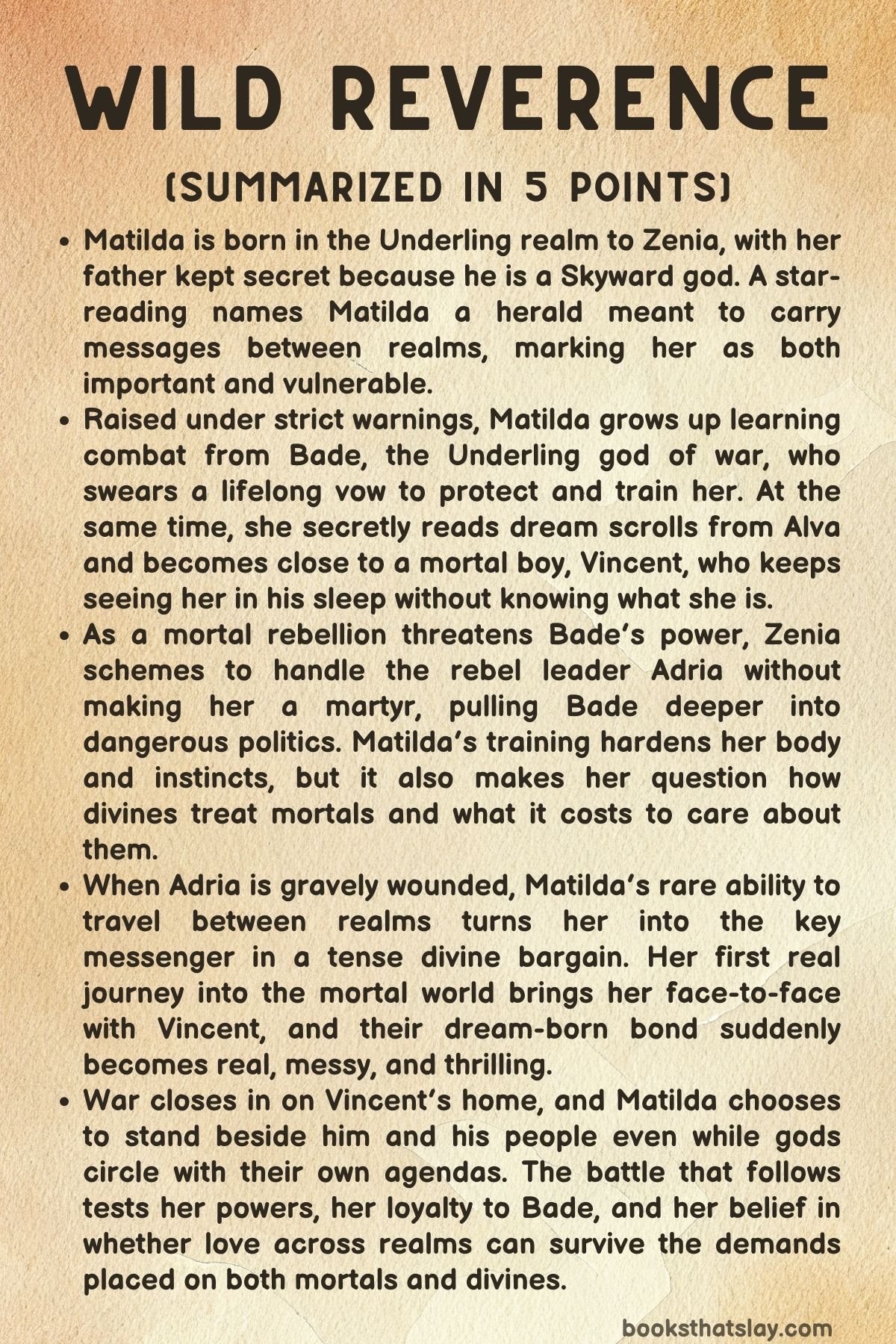
Matilda is born in the Underling realm, where gods live in shadowed burrows beneath the earth.
Her mother, Zenia, keeps her birth secretive and tense, because Matilda’s father is a Skyward god—an enemy clan that rules the winds and upper world.
Bade, the Underling god of war and Zenia’s closest ally, is present at the birth and names the child Matilda, hoping she will be strong enough to survive what her mixed blood will bring.
Zenia hides her for days, then brings her to Orphia, goddess of death, to read the stars.
Orphia forces truth from Zenia and learns the father cannot be named without risking Matilda’s safety.
The scrying reveals a small six-point constellation, marking Matilda as a herald.
She is destined to move between realms and carry tidings, yet she cannot fully belong to either clan.
Zenia is relieved at the smallness of the sign but alarmed by the role.
Orphia hints that the stars also show something darker ahead.
Matilda grows fast in a childhood shaped by caution.
Zenia teaches her that divines may kill her to seize her constellation.
Her world is limited to Zenia’s burrow and a few trusted gods: Bade, Phelyra the goddess of revelry and coin, and Alva goddess of dreams and nightmares.
Alva secretly gives Matilda scrolls recording mortal dreams.
Matilda becomes fascinated by them, especially by one boy who appears again and again: Vincent.
His dreams show both longing and fear, and in one he drowns while trying to fight for a rebel queen named Adria.
When Bade returns from the mortal war troubled by Adria’s rise, Zenia advises him not to kill her but to woo her and weaken her from within.
She lends him a stolen constellation of cunning and, in return, demands a salt vow to Matilda: he must always protect her, train her, and never betray her.
Bade agrees, though the words feel heavy even to a child.
Training under Bade is brutal.
Matilda learns how gods can die—by a blow to the fault line of heart or mind—yet she keeps failing and fleeing in frustration.
She also discovers her mother’s quiet lawbreaking.
Zenia and Phelyra trade eithral wyvern scales for Skyward coins.
The scales are rare, dangerous objects that can pierce even divine flesh and mind. Zenia burns the coins for the music trapped within and makes Matilda swear silence.
The dream scrolls deepen.
Vincent begins to dream of Matilda not as a divine but as a mortal girl, and over many sennights they become friends inside his sleep.
They run riverside paths, climb ruins, and speak as equals. Matilda cannot give her true name, so the bond stays half-hidden.
Still, it changes her.
While Bade tries to harden her against mortals, Vincent’s dreams show her their softness, stubborn courage, and fragile hope.
When Matilda is nearly thirteen, Bade arrives in the Underling hall carrying Adria, grievously wounded by an eithral.
He begs Dacre, god of healing, to save her.
Dacre refuses unless Bade surrenders his forge, weapons, and mortal vassal. Orphia warns that if Adria is healed this way, she will belong to Dacre.
Instead, Orphia offers four of her own stars to make Adria half-immortal, but Adria needs more stars from Rowena, Orphia’s estranged Skyward sister.
Only Matilda, as a herald, can cross all realms safely.
She accepts the mission.
Matilda enters the mortal world through ruined moors and war-scarred fields. Near a river she is attacked by eithrals and hides beside a real boy—Vincent, alive outside dreams.
He recognizes her as “Red,” the nickname from sleep.
Together they drive off the eithrals.
Their joy turns into a brief, startled kiss.
But Vincent’s brothers and soldiers arrive in grief, believing Adria dead, and Matilda senses the danger of being captured or used.
She runs, and Shale, a Skyward wind god, sweeps her into the upper realm.
Rowena’s welcome is cold.
She is unsettled by Matilda’s mixed blood and demands secrecy from her court.
After reading Orphia’s letter, Rowena cuts her own palm and gives Matilda a five-star constellation to complete Adria’s salvation.
Matilda rides the trade winds back and delivers the stars.
Orphia and Rowena’s ichor sink into Adria, who steadies into new life as the Underling goddess of peace.
Bade is both grateful and marked by gossip for loving a mortal enough to break divine pride.
Troubled by Vincent’s dreams and the weight of her role, Matilda wanders and discovers a wasted doorway—one that leads to a strange wasteland between life and paradise.
There she meets the Gatekeeper, a giantess with one milky blue eye.
The Gatekeeper says the eye-moonstone on Matilda’s belt belongs to her and was planted at Matilda’s birth.
The wasteland is where dead souls travel, and where living souls drift in dreams.
Matilda watches the Gatekeeper judge souls by the weight of the most consequential deed in a life, learning that death is not only an end but a measured passage.
Matilda returns to the mortal realm and becomes entwined with Vincent’s people at Wyndrift, a fortress threatened by Grimald’s army.
She travels with Vincent’s caravan, protects them from a rogue eithral, and meets Hugh of Delavoy, Vincent’s ally.
To keep Hugh from claiming her as a prize, Matilda declares herself Vincent’s wife, shocking everyone, even Vincent.
She returns to Wyndrift alone to stand with Vincent’s brother Nathaniel while Vincent rides for reinforcements.
Warin, a Skyward god attached to Grimald’s cause, pressures Matilda to join him. She rejects him in full view of the siege lines.
The assault comes before Vincent returns.
Fury Bridge becomes a slaughter.
Nathaniel’s defenses hold until Warin melts the iron gate, letting the battering ram through.
Matilda and Nathaniel fight upward as the first tower falls.
Then Bade arrives from shadow, bound by his vow to Matilda, and leads them back into the fight.
When the rogue eithral dives at the bridge, Matilda uses forbidden Skyward magic to borrow its sight.
Her mind fuses with the beast.
Through it she turns the tide, ripping enemy knights from the bridge and terrorizing Grimald’s men.
But she loses herself in the eithral’s rage and crashes into the tower, collapsing it into rubble.
The wreckage traps the attackers and forces surrender.
Vincent arrives in time to pull Matilda back to herself.
But victory costs everything.
Nathaniel is mortally wounded and dies in Vincent’s arms as Orphia gathers his shadow. Matilda follows his soul through a wasted door, entering the wasteland after him.
There she burns through her strength and dies, yet Bade, dying too, walks beside her until they reach a doorway back to life.
Bade crosses and survives, but Matilda cannot carry her own soul through.
The Gatekeeper claims her for seven years of service.
In the mortal world, Vincent keeps vigil over Matilda’s corpse until the sepulcher is sealed.
He learns Hugh is dead and quietly suspects Nathaniel arranged it to spare him a public execution.
Seasons pass.
Wyndrift rebuilds, and Vincent gives Nathaniel the crown, leaving to live alone in a small cottage that once held his happiest days with Matilda.
In the wasteland, Matilda serves as herald and scribe, recording the lives of the dead.
She sees how hard it is to return souls: some slip away, some are killed again.
Near the sixth year, a small boy arrives at the gate repeating Vincent’s name. Matilda escorts him home and realizes how much time has passed.
She sends Vincent a letter through a wasted door, telling him she will return when autumn comes if he will wait.
Vincent’s quiet life grows into community.
Neighbors teach him to farm; he bonds with their son Tristan.
When Tristan dies of fever and then returns alive at dusk, Vincent knows Matilda’s hand has reached across death.
He rides back to Wyndrift to understand her bargain, and soon finds her letter.
He waits through the seventh year.
At the turning of that autumn, Matilda awakens in her sepulcher, remade.
She finds Vincent at the cottage, older and worn but still hers.
They share the years they lost, and their reunion is plain, hard-won, and real. Much later, in a changed mortal age, Matilda lends her magic to Enva to bind new machines that carry messages.
Enva reflects that myths will keep shifting, but Matilda’s story—of love that crossed realms and labor that guided souls—must be remembered.
Characters
Matilda
Matilda is the liminal heart of Wild Reverence, defined from birth by being both Underling and Skyward, and therefore never wholly safe in either world.
Her early life is shaped by secrecy and survival: Zenia’s fear teaches her to see power as both inheritance and target, so Matilda grows alert, guarded, and intensely self-controlled.
Yet her destined role as a herald pulls her in the opposite direction—toward movement, connection, and empathy across realms.
The dream-bond with Vincent becomes her first experience of unguarded companionship, and it quietly rewires her sense of mortals from fragile pawns to real souls with gravity.
As she trains under Bade, Matilda learns violence as craft and necessity, but her deeper conflict is not about fighting; it is about choosing who she will be loyal to when loyalty costs her safety.
Her forbidden use of Skyward magic during the siege shows both her daring and her dangerous capacity to dissolve into wrath when she feels cornered, and the devastation afterward forces her to confront that even righteous power can leave ruins.
In the wasteland, she matures into the fullest version of her horoscope: a messenger who carries more than news—she carries souls, stories, and consequences.
Her service to the Gatekeeper is a long education in grief, limits, and moral weight, and when she finally returns to life, she is no longer a girl trying to belong but a goddess who has accepted that love, duty, and loss are braided together for her.
Zenia
Zenia is an Underling goddess whose love is fierce, pragmatic, and anxious, and she embodies the paradox of a parent trying to protect a child from a world she herself distrusts.
Her decision to hide Matilda’s father and raise her in near-isolation is driven by real danger, but it also reveals Zenia’s controlling streak and willingness to bend truth, law, and even her daughter’s independence to keep her safe.
Zenia’s alliances with Bade, Phelyra, and Alva show her as socially shrewd and politically collaborative, yet the contraband trade in eithral scales and Skyward coins exposes a risk-taking side that contradicts the caution she preaches.
This hypocrisy is not shallow; it suggests Zenia’s private hunger for beauty, leverage, and autonomy in a realm where fear is currency.
Her slap of Matilda is one of the story’s clearest portraits of parental terror curdling into harm.
Zenia is not a villain—she is a strategist who has survived long enough to know that tenderness can be fatal, and she tries to carve a narrow path where Matilda might live long enough to choose her own future.
Bade
Bade, the Underling god of war, begins as a figure of steel and doctrine—proud, disciplined, and emotionally blunt—yet his arc is one of slow, destabilizing humanization.
He names Matilda in the moment of her birth, and that act does two things at once: it foreshadows her martial strength and binds Bade to her fate before he understands what that will cost.
His salt vow to Matilda is central to his character; war gods are often written as loyal to principle more than people, but Bade promises loyalty to a child whose future might place her against his own clan.
His struggle with Adria undermining his worship reveals his vulnerability to story and belief, and Zenia’s plan to woo the Poet Queen forces Bade to fight on a terrain he doesn’t control—politics, persuasion, intimacy.
His tenderness toward Adria, and later his commitment to Matilda during the siege, show that his concept of war expands into sacrifice for individuals, not just victory for causes.
When he warns Matilda that loving mortals demands sacrifice, it comes from bitter experience, not cold ideology.
Bade’s death and return through the wasted door underscore his liminal relationship with fate: he can cross back because Matilda carried him, while she cannot carry herself, making him both beneficiary of her power and witness to her cost.
Orphia
Orphia, goddess of death, radiates ancient authority and chilling clarity, and she functions as the story’s moral horizon.
Her ritual use of bittertongue on Zenia shows that even among gods, truth is extracted rather than offered; Orphia rules through inevitability, not persuasion.
In reading Matilda’s stars, she is both midwife of destiny and reluctant prophet, recognizing that mixed-blood divinity cannot sit cleanly inside any one myth.
Her faint disturbance at the scrying hints that Orphia sees more than she says, and her silence later—when she collects Nathaniel’s shadow and challenges Matilda with the possibility of pursuit—captures her essence: death does not comfort, but it does offer doors.
Orphia’s act of giving Adria four stars is also revealing.
She is not sentimental about mortals, yet she respects balance; she will invest her own power when it preserves a necessary order in the realms.
Throughout, Orphia does not bend to love or panic, but she is not cruel for cruelty’s sake.
She is the keeper of a system where every life has weight, every ending has meaning, and even gods must bow to consequence.
Phelyra
Phelyra, goddess of revelry and coin, is the story’s bright edge of appetite and cunning.
She appears first as Zenia’s friend in pleasure and plotting, and her presence signals that survival in the Underling realm is not only about fear—it is also about joy, luxury, and the small rebellions that keep the spirit alive.
Phelyra’s enchanted belt for Matilda is a maternal act by proxy, giving Matilda practical protection while also introducing her to secret power.
Her partnership with Zenia in trading wyvern scales to Skywards shows her opportunism and a shrewd understanding of value across cultures.
Phelyra is a reminder that gods, even those born in darkness, have desires that exceed their roles.
She is not deeply transformed by the plot, but she quietly shapes Matilda’s early world by modeling a version of divinity that can laugh, barter, and risk everything for a moment of exquisite music hidden inside a coin.
Alva
Alva, goddess of dreams and nightmares, is a liminal figure like Matilda but older and more accepting of her threshold nature.
Her gift of dream scrolls is both a kindness and a subtle initiation into the dangers of crossing mortal-divine boundaries.
Alva’s domain makes her gentle but not naïve; she understands that dreams are not entertainment, they are the soul’s secret corridors.
When Matilda becomes alarmed that a mortal boy is dreaming of her, Alva offers a truth without drama: connection leaks through time, and meaning often arrives before explanation.
She never orders Matilda to stop reading; instead she warns her to guard herself, acknowledging that the cost of intimacy is not always avoidable. Alva therefore serves as Matilda’s first spiritual mentor, teaching her that to witness a mortal’s interior life is to risk being changed by it.
Adria / Enva
Adria, the mortal Poet Queen who becomes the Underling goddess of peace Enva, is a living example of the power of story to overthrow even divine warfare.
As Adria, she defeats Bade not by arms alone but by rewriting myth, siphoning belief away from him and proving that gods are vulnerable to narrative hunger.
Her rebellion is grounded in political brilliance and charismatic conviction, yet she is also fierce enough to survive being torn open by eithral and brought into the divine hall bleeding.
The transformation into Enva is not a reward so much as a reshaping of role: the war she forced to end too soon becomes the peace she must embody forever.
Her new divinity binds her to the Underlings, making her both trophy and stabilizer, and the gossip about Bade’s disgrace reveals how disruptive her ascent is to divine hierarchy.
In the epilogue, Enva’s focus on preserving Matilda’s story through new technologies shows that she remains a poet-queen at heart, believing that remembrance is a form of governance and that myths must evolve or die.
Vincent
Vincent begins as a mortal boy whose longing to matter is expressed through dreams of drowning and war, and his relationship with Matilda becomes the quiet axis of his growth.
In dreams, he learns trust, adventure, and tenderness with a girl he calls Red, and those recurring encounters soften his terror until life itself feels possible.
When he meets Matilda in the flesh, his shock turns quickly to recognition, implying that the bond between them is not infatuation but a kind of soul memory. Vincent’s love is marked by devotion without possession; he never tries to capture Matilda, and his refusal of political logic—especially Hugh’s insistence on heirs and strategy—defines him as someone who prioritizes personhood over power.
In battle, he becomes a hinge between worlds: his voice and touch rescue Matilda from the eithral’s mind, embodying the story’s idea that love can call a self back from annihilation. After her death, Vincent’s grief is not a dramatic spiral but a slow reorganization of life around absence.
He abdicates, chooses quiet labor, and lets community re-teach him how to exist, yet he never relinquishes hope.
His endurance across seven years of waiting is not romantic stubbornness alone—it is fidelity to a truth he felt long before he could name it.
When Matilda returns, the reunion is not a reset; it is the joining of two people who have lived entire lifetimes in the gap between their touches.
Warin
Warin, a Skyward spring god tied to Grimald’s cause and to Matilda’s past, represents predatory entitlement masked as governance.
His first appearance in Rowena’s orchard suggests he is used to being obeyed, and his interrogation of Matilda underscores his suspicion toward hybridity and uncontrolled movement between realms.
In the siege, Warin’s magic is strategically cruel: melting the iron portcullis is an act that weaponizes spring’s transformative power against a fortress’s last defense. His presence among mortal knights also shows his willingness to blur divine and human violence to serve an agenda.
Matilda’s near-killing of him while fused with the eithral highlights how deeply he threatens her, not only militarily but symbolically as a Skyward link to the father and clan she has been trained to fear.
Shale
Shale, the wind god who carries Matilda Skyward, functions as an agent of transition rather than a fully explored psyche.
His swift intervention saves Matilda from the mortal camp’s danger and establishes that Skyward forces are watching her movements.
Shale’s demeanor is cool and procedural, suggesting a god who sees the world in currents and commands rather than attachments.
He is less a character-driven presence and more a reminder that Matilda’s travel between realms is never invisible.
Rowena
Rowena, Orphia’s estranged Skyward sister, is sharp-edged, proud, and wounded by old divine fractures.
Her immediate recoil from Matilda’s mixed blood shows how rigid Skyward identity can be, and her hostility is not merely prejudice—it reads as an extension of familial bitterness with Orphia and the Underlings.
Yet Rowena still participates in the bargain that will save Adria by giving five of her stars, proving that beneath her contempt is a sense of cosmic responsibility or perhaps curiosity about Matilda’s role.
Her act is swift, bloody, and unromantic, revealing a goddess who believes help should cost something real.
She remains distant afterward, reinforcing the truth that Matilda’s Skyward inheritance offers power, not belonging.
Dacre
Dacre, god of healing, is a portrait of divine bureaucracy turned vindictive.
His refusal to heal Adria without extracting Bade’s forge, weapons, and vassal shows that even healing gods can be transactional, and that mercy in this world is often a battlefield of leverage.
He mocks Bade for killing an eithral, implying a protective proprietorship over his creations that overrides compassion for a dying mortal.
Dacre’s stance pushes the plot toward Orphia and Rowena’s solution, but more importantly, it exposes a divine culture where power is hoarded and help is weaponized.
Xan
Xan, god of iron, appears briefly yet memorably as a divinity already dead, walking toward judgment.
His shorn throat and calm acceptance of death frame him as a soldier-figure of the gods—someone whose life has been shaped by duty, violence, and the quiet exhaustion that follows them.
By recounting his life to the Gatekeeper, Xan demonstrates the wasteland’s law: even gods are weighed by their most painful and consequential deeds, and immortality offers no exemption from reckoning.
The Gatekeeper
The Gatekeeper is the wasteland’s sovereign judge, and she embodies a cosmic justice that is neither kind nor cruel—only exacting.
Her one milky blue eye, planted into Matilda’s belt at birth, marks her long-term claim on Matilda’s destiny, turning a childhood gift into a silent tether.
She governs the threshold between dreams, nightmares, and paradise, making her less a character in interpersonal drama and more the embodiment of moral weight in Wild Reverence.
Her balancing scale and method of judgment suggest that what matters most is not the sum of a life but the heaviest deed it carried.
When she announces Matilda’s seven years of service, she does so without malice; arrangements in her realm are contracts of fate, not negotiations of feeling. Yet she also permits Matilda agency within that fate, letting her choose which souls to carry and what stories to preserve, so the Gatekeeper’s sternness contains a strange respect for will.
Hugh of Delavoy
Hugh is loyalty complicated by ambition, an older lord who has survived long enough to distrust idealism.
He spots Matilda’s divinity at once and responds with political reflex, seeing her as a strategic anomaly rather than a person.
His private conversation with Vincent reveals his worldview: marriages are alliances, heirs are obligations, and power must be stabilized through lineage. Hugh does honor his oath to Vincent’s father by sheltering Wyndrift’s refugees, which shows that he is not faithless, just practical to the point of coldness.
After death, his bitterness at the gate and his crude desire to use Matilda expose the rot beneath his valor; he wants the prestige of a goddess without the humility to see her as sovereign.
His condemnation to wander the wastes is therefore not tragedy but consequence, and Matilda’s refusal to escort him back is her final rejection of being reduced to someone else’s political instrument.
Nathaniel
Nathaniel is steadiness made mortal, and his contrast with Vincent highlights two kinds of leadership.
Where Vincent is heart-driven and restless, Nathaniel is methodical, protective, and rooted in responsibility to Wyndrift.
His conversation with Matilda before the siege shows emotional intelligence: he recognizes Vincent’s history in dreams and warns Matilda not to reopen an old wound casually.
In battle he stands his ground with courage, but his death by a throat wound is brutally human, underscoring the story’s insistence that mortals pay the ultimate price in divine wars.
His later return—explained through Matilda’s acts in the wasteland—positions him as a figure whose worth is measured not only by how he ruled but by the love and sacrifice others were willing to make to bring him back.
Grimald
Grimald is the human face of conquest in the mortal realm, a warlord whose threat is framed through scale and inevitability rather than intimate characterization.
His five thousand men, his battering ram, and his slow, grinding strategy at Fury Bridge make him a force that tests every bond Matilda and Vincent have built.
He is important less as a nuanced individual and more as the engine of mortal suffering that drags gods into visible intervention and exposes the costs of their rivalries.
Hem
Hem, Bade’s mortal blacksmith-vassal, quietly complicates Matilda’s early understanding of divine-mortal relations.
His presence demonstrates that gods depend on humans even when they deny it, and Matilda’s instinctive sympathy toward him is one of her first rebellions against Bade’s doctrine of emotional distance.
Hem is not a plot driver, but he is a moral artifact: proof that divinity is never as self-sufficient as it pretends to be.
James and Lara
James and Lara are ordinary mortals who become extraordinary through sustained kindness.
By teaching Vincent farming and sharing their home knowledge without questions, they offer him a life not structured by war or divinity.
Their generosity is not romanticized into sainthood; it is practical neighborliness that slowly rebuilds Vincent’s sense of belonging.
They also become the emotional bridge that shows how love persists in the mundane: raising sheep, repairing thatch, grieving a child, and still finding room to care for a broken former king.
Tristan
Tristan, James and Lara’s son, embodies innocence touched by the supernatural. Vincent’s love for him is paternal in feeling if not in blood, and Tristan’s sudden fever-death becomes a devastating proof that even far from battle, mortality is ruthless.
His inexplicable return to life is the clearest sign of Matilda’s unseen labor in the wasteland, turning Tristan into a living testament to her herald work.
He is less a developed personality and more a symbol of what Matilda’s sacrifice can restore—small lives that matter immensely to the people who hold them.
Henriette
Henriette appears as the possibility of a future Vincent could choose if he were willing to let Matilda go.
She is not presented as a rival or temptation but as a gentle representation of normal human continuity—marriage, family, moving on.
Her presence clarifies Vincent’s inner truth: he is not unable to love again; he is simply unwilling to betray the love that defines him.
Edric and Anton
Edric and Anton function as part of Wyndrift’s loyal circle, helping Nathaniel and Vincent survive the years after the siege.
Their delivery of Matilda’s letter situates them as keepers of memory and community, the kind of mortal support network that makes waiting and rebuilding possible.
They are minor figures, but their steadiness reinforces the story’s faith in collective endurance.
Themes
Identity in the In-Between
Matilda’s life begins as a negotiation with contradiction.
She is born of Underling mother and Skyward father, and that mixed blood shapes every relationship she enters.
From the first days, Zenia teaches her that belonging is dangerous because each clan sees her as a threat or a prize.
It isn’t simply that Matilda is “both”; it is that she is “not fully either,” and the story keeps pressing on the cost of that condition.
In Underling spaces she must hide the Skyward trace in her, and in Skyward spaces she is treated as a trespasser whose very body breaks old boundaries. Even her constellation, small yet singular, marks her as a being meant to cross lines others cannot.
That role gives her mobility, but also denies her rest.
The warning Orphia gives at her birth—that she cannot claim either clan’s name fully—echoes through her coming of age as a slow unmooring from easy identity.
The narrative shows how this fracture becomes internal.
Matilda absorbs Zenia’s fear and Bade’s harsh rules, yet she also collects mortal dreams that soften her.
She is trained to think like a god, but she learns to feel like a human.
That tension is not resolved by choosing a side; instead, she must build a self that can survive contradiction without collapsing into shame.
The belt moonstone planted by the Gatekeeper becomes a literal symbol of her bound fate, but it’s also a reminder that parts of her story were chosen by others before she could consent.
Her eventual service as herald and scribe in the wasteland is where identity shifts from inheritance to practice.
She becomes herself not by bloodline labels, but by what she does for souls and for Vincent.
Wild Reverence uses her mixed nature to argue that identity is not a pure lineage or fixed category.
It is a restless, lived position made through choices, losses, and loyalties, especially when the world insists you must be one thing or the other.
Power, Fear, and the Ethics of Divine Authority
Divine power in the story is never clean or purely heroic.
It arrives with bargains, violence, and the constant threat of misuse.
Zenia’s parenting is rooted in terror of what other gods might do to Matilda’s constellation points, and that fear becomes a kind of weaponized love. The child is protected, but also controlled, taught suspicion before curiosity.
Bade embodies another edge of power: war-logic that treats mortals as pieces on a board.
His concern over prayers and myths makes clear that gods feed on belief, so authority is not only physical but narrative.
When Adria rewrites myths and turns prayers away, she destabilizes the divine order by shifting the story people tell.
That makes power feel less like destiny and more like a fragile economy maintained through control of memory.
Matilda’s growth shows how power tests morality.
Her training teaches her how a god can die through heart or mind, making lethality intimate and psychological.
She learns the mechanics of force, but awkwardly stumbles into the human stakes behind it.
Later, during the siege, her choice to borrow the rogue eithral’s sight is a turning point in ethical risk.
She saves Wyndrift, but the cost is that she enters a consciousness built for killing. The moment illustrates how power can protect and corrupt in the same breath, especially when drawn from forbidden channels.
Her horror afterward is not performative guilt; it is recognition that even justified violence can rewrite the self.
The wasteland arc deepens this theme by showing authority in the realm of death. The Gatekeeper’s judgment is not about rank or glory but about the weight of painful deeds.
Souls are measured by consequence, not by how impressive they once seemed. Matilda’s work as scribe and herald forces her to confront power as responsibility rather than privilege.
She cannot rescue everyone safely; some returned souls are lost again, and her yearning to fix outcomes meets the limits of what any being, even divine, can do. Wild Reverence treats power as morally complicated: necessary for protection, tempting for domination, and always tied to the stories others believe about you.
The theme insists that authority without empathy becomes cruelty, while empathy without restraint becomes self-destruction, and Matilda’s arc is the struggle to hold both.
Love Across Realms and the Price of Attachment
The relationship between Matilda and Vincent is built first in dreams, then in flesh, and that structure matters: their bond begins without bodies, without politics, and without full truth.
In dreams, Vincent meets a girl who saves him from drowning and offers companionship in a world of war.
For Matilda, the dreams are the first place she is not treated as a risky hybrid or a future tool.
Their intimacy grows in a space where names can’t be spoken and truth is partial, so love forms under constraint.
When they finally meet in the mortal realm, the recognition is immediate, as if the dreams have already trained their hearts to trust each other’s presence.
Yet the story refuses to romanticize this border-crossing love as simple triumph.
From the start, Matilda cannot fully trust mortals, and Vincent cannot truly understand divine stakes.
Their affection is real, but always shadowed by the danger of capture, mythic politics, and the incompatibility of lifespans.
The cost of attachment appears repeatedly.
Bade warns Matilda that loving mortals demands sacrifice, not as an old cliché but as a lived prophecy.
She experiences the cost in the siege where Vincent’s voice is the only thing that can pull her back from the eithral mind.
Love becomes both anchor and vulnerability.
Immediately after that rescue, she loses Nathaniel, and grief forces her into a choice between staying with Vincent’s sorrow or racing into death’s territory.
That refusal to let go results in her own death and seven years of service.
Love here is not a reward; it is a force that compels decisions with consequences that outlast the moment.
Vincent’s waiting mirrors that cost from the mortal side.
He rejects replacement comfort, gives up a crown, and chooses a life of labor and solitude because hope for Matilda’s return is the one thread he will not cut.
His devotion is not framed as naïve purity; it is framed as endurance shaped by grief.
When Matilda returns after seven years, reunion is tender but also altered by time.
They are older, changed, and learning to live again with the weight of what love demanded.
Wild Reverence portrays cross-realm love as transformative and sustaining, but inseparable from loss.
Attachment gives meaning to mortality and divinity alike, yet it also becomes the doorway through which suffering enters.
The theme argues that love is worth the price precisely because it is costly, and because it redefines what each character believes a life is for.
Storytelling, Myth, and the Struggle Over Memory
The book makes narrative itself a battleground.
The mortal war is not only fought with steel and eithral talons but with songs, prayers, and rewritten legends.
Adria’s power to weaken Bade by reshaping myth shows that belief is a material resource, and that the gods’ authority depends on how mortals speak of them. This flips the usual direction of divine influence.
Instead of gods solely shaping human history, human storytelling shapes divine survival.
The Underlings’ anxiety about who Matilda’s father is also sits in this space: names and lineage are stories that confer power, danger, and future allegiance.
Matilda’s role as herald sharpens this theme.
She is fated to carry tidings between realms, meaning she exists inside the flow of information.
Her early exposure to Alva’s dream scrolls teaches her that stories are not only public myths but private visions.
Dreams connect souls beyond time, letting narrative act as a bridge when geography and death cannot.
The wasteland library later becomes the ultimate monument to this idea.
The Gatekeeper judges souls by their life stories, and Matilda records them so that their weight can be understood and remembered.
In that work, narrative is not decoration; it is moral accounting.
A life becomes legible through the telling of it, and judgment follows the shape of that telling.
The epilogue extends this struggle into a modern industrial age where Enva binds typewriters to transmit messages.
This is a quiet but potent image: technology becomes a new altar for mythmaking.
Enva’s reflection that Matilda’s story deserves remembrance is the book’s clearest statement that myths must be actively preserved or they shift into erasure.
In Wild Reverence, memory is not stable.
It is fought over by rebel queens, jealous gods, and even by time itself.
The theme suggests that what survives is not only who wins wars, but who controls the version of events that people repeat.
Matilda’s life becomes a myth in motion, and her power is ultimately tied to language, record-keeping, and the insistence that some stories must not be lost.
Duty, Vows, and Choosing What You Owe
From Bade’s salt vow to Matilda’s seven-year service, the story is saturated with debts that bind.
Vows are not background customs; they are active forces shaping fate.
Bade’s pledge to Matilda begins as Zenia’s condition for lending her constellation, a protective move rooted in distrust of divine alliances.
Yet once sworn, the vow takes on a life of its own.
Bade hesitates because he does not know the goddess he is binding himself to, and that hesitation highlights the seriousness of obligation in this world.
The vow later becomes the reason he wakes and comes to her aid at Fury Bridge, proving that duty can override pride, politics, and even anger.
Matilda’s attitude toward obligation evolves.
Early on, she obeys Zenia’s rules without understanding the full moral landscape.
As she matures, she starts questioning what she owes to clans, to mortals, and to herself.
Her choice to carry Orphia’s message to Rowena is partly duty to Bade and to a wounded Adria, but also a step into the fate written for her as a traveler between realms.
Later, when she tries to release Bade from the vow in fury, the narrative shows how obligations are not fully hers to sever once they’ve shaped reality.
The bond lingers, suggesting that responsibility cannot always be dismissed just because feelings change.
Her service to the Gatekeeper is duty in its harshest form.
She is not asked; her seven years begin as consequence of failing to carry her own soul back.
Yet within that enforced obligation, she chooses how to act.
She refuses Hugh’s bargain despite the chance to send a letter through him, showing a moral boundary inside duty.
She risks escorting souls home even after witnessing how perilous it is.
She sends Vincent a letter through a wasted door, a voluntary act that goes beyond her assigned role.
These choices show a distinction between debt imposed by fate and debt chosen by conscience.
The theme circles back to autonomy.
Obligations in Wild Reverence are unavoidable, but the story asks which ones are worth honoring.
It frames duty not as blind loyalty to a system, but as a series of decisions about care: who you protect, who you refuse, and what kind of person you become while paying what you owe.