An Unlikely Coven Summary, Characters and Themes
An Unlikely Coven by A.M. Kvita is an urban fantasy set in a modern New York where witches, vampires, fae, and other “Moon Creatures” live alongside humans under fragile political rules. The story follows Joan Greenwood, heir to one of Manhattan’s ruling witch families, who comes home after years away and lands in the middle of a crisis that shakes magical society: a human has been turned into a witch.
Joan is smart, stubborn, and morally restless, and her return exposes how much she’s changed—and how badly her family wants control. The book mixes family power games, street-level magic, and found-family loyalty into a fast, character-driven conflict about who gets to wield magic and at what cost.
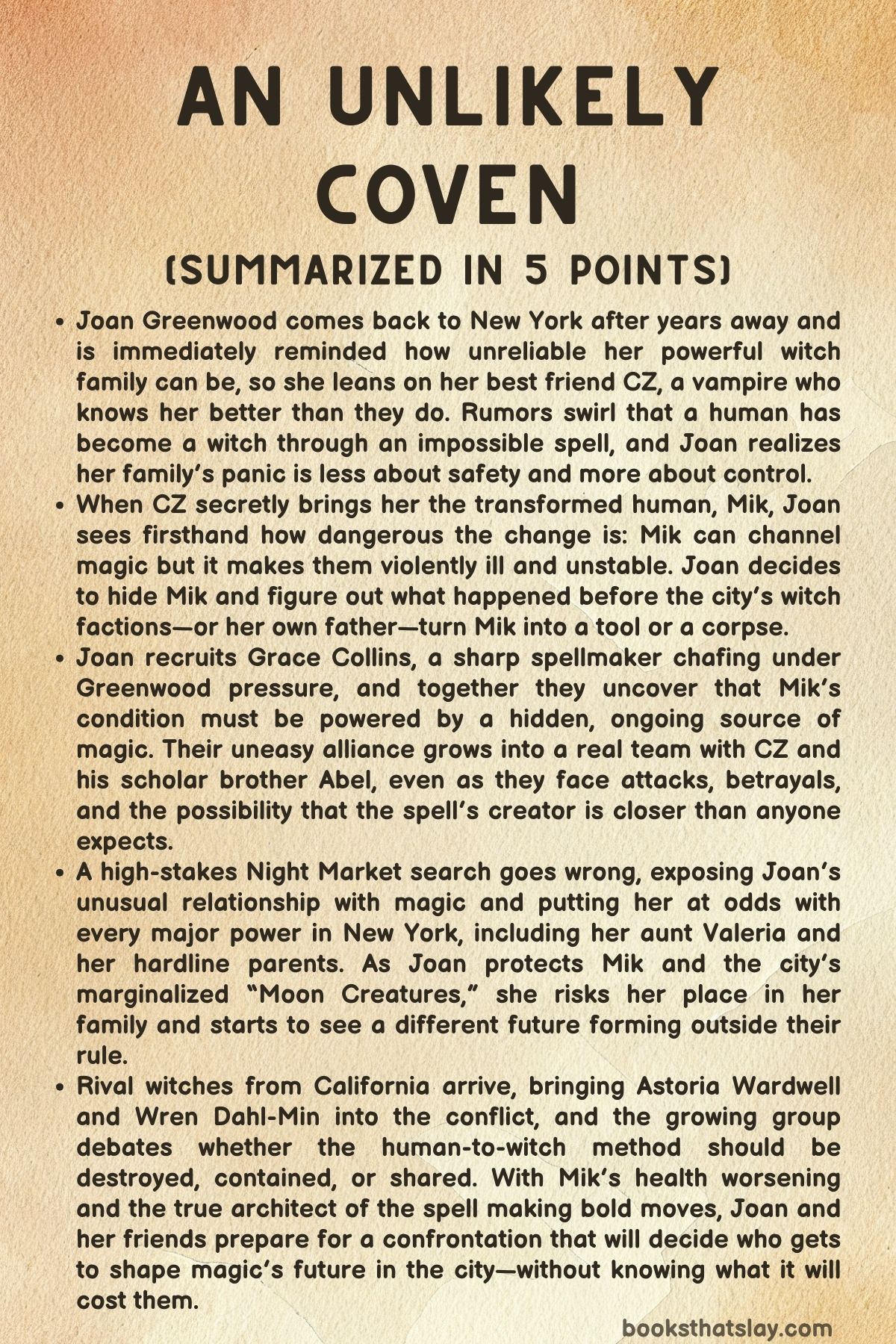
Summary
Joan Greenwood returns to New York after nearly seven years of school and training away from home. She arrives at Grand Central expecting her family to pick her up, but no one shows.
Her father Merlin, her mother Selene, and her sister Molly all forgot. The neglect hurts more than Joan wants to admit, and she calls her closest friend CZ, a vampire from the LaMorte line.
CZ appears quickly, having guessed her family would flake out. He takes her for food, keeps her company, and gives her a quick read on the city’s mood.
The magical world is tense, and rumors are moving fast.
Molly finally calls with an emergency: witnesses claim a human has “ascended,” gaining witchhood through a spell and successfully casting magic. In their society, witchhood is inherited; humans are assumed unable even to channel power.
If the rumor is true, it threatens every rule that keeps witches on top. Joan heads to the Greenwood Mansion via HERMES, a portal subway for witches, and hears gossip on the way.
Some witches already suspect the Greenwoods are involved. At home she finds the estate locked down and filled with anxious allies.
In Valeria Greenwood’s study—aunt Valeria is High Witch of Manhattan and leader of the New York covens—the family meets with spellmakers Grace Collins and her mentor Fiona Ganon. Valeria confirms what they know: a human lit a spell near the Night Market, then vanished inside it.
Merlin pushes hard, accusing Grace of being tied to Brooklyn’s high witch, Wista Redd, and demands proof. Grace agrees to a truth spell and states she didn’t create the transformation, doesn’t know who did, and believes it should be impossible to grant permanent channeling to humans because spells decay over time.
Valeria still orders Grace to try recreating it, fearing that if they don’t, rivals will. Joan notices how quickly her family shifts from fear to ambition.
She realizes their priority isn’t safety—it’s ownership.
That night CZ calls Joan in panic and says he needs help because he “stole a person.” Joan sneaks out of the mansion. Valeria catches her but lets her leave with a warning.
At CZ’s apartment, Joan meets Mik Batbayar, a human who is violently sick and surrounded by unstable magic. CZ admits Mik is the ascended human everyone is hunting.
Mik explains they visited the Night Market with a coworker, blacked out, woke in a strange tent, escaped, and later accidentally produced light when wishing for it. Since then, magic has poured into their body in uncontrolled waves, causing collapse and vomiting.
Joan sees that Mik is channeling without any barrier or control. She understands that every faction—her family included—would dissect Mik to learn the method.
She and CZ decide to hide Mik while searching for a way to undo the spell.
The next morning Joan learns the crisis is escalating: California’s powerful Wardwell witches are sending Astoria Wardwell, heir to their line, to New York to compete for the spell. The Greenwoods plan a formal party to welcome and intimidate Astoria.
Joan visits Molly, now living with her boyfriend Nate, and asks for Grace’s contact information under a flimsy excuse. She wants real answers without her family listening.
Joan meets Grace at a café. Grace is sharp, proud, and furious at the Greenwoods’ arrogance.
Off the record, she explains what the family missed: a transformation like Mik’s would require a continuing power source, meaning Mik is likely draining magic from somewhere or is tethered to the original caster, who could track that flow. She adds that humans aren’t built to handle magic long-term, which explains Mik’s poisoning.
The simplest fix is to seal Mik’s magic completely, but that normally takes several witches working together. Grace also points out Joan’s own odd condition: she has no barrier to magic and lets power pass through her unchanged—an anomaly in witch biology.
Grace suspects the Greenwoods want the spell for mass use on humans and storms off, accusing Joan of being another tool of her family.
Joan later watches Mik at CZ’s place. Mik asks her to cast something so they won’t feel alone.
Joan tries a simple origami spell, but her magic surges wildly, shredding and reforming the paper into a dangerous spinning mass that cuts both of them. CZ arrives and easily subdues it, and Joan realizes how unpredictable her own casting has become.
She heads to the Greenwood party and overhears that Valeria is considering a raid on the Night Market to seize the spell’s source before California can. Valeria admits she’ll do whatever it takes to secure control.
Joan leaves furious and rattled.
At the party she dances with Astoria Wardwell, who is polite but probing. Joan senses an interrogation, lashes out, and storms away.
Astoria’s companion Wren Dahl-Min, a half-fae witch, approaches privately. Wren reveals she wants Moon Creatures to gain casting rights rather than keeping magic exclusive to witches.
Joan sees a possible ally there, even if she doesn’t trust California.
Joan, CZ, and CZ’s scholar brother Abel go to Owl’s Head Park and enter the Night Market, a warded space where witches can’t channel. Abel confirms the ascension spell has no known precedent.
While they investigate, Joan is attacked by a memory-invasion spell inside a pocket realm. Grace appears, breaks the attack, and confronts Joan.
Joan confesses they’re hiding Mik, that Mik was transformed against their will, and that Mik is sick. Grace is horrified but believes her and agrees to help.
Realizing the attacker may now know Mik’s location, they move Mik to Grace’s heavily warded Bay Ridge apartment, where a blunt ghost named Billy shares the space. Grace pulls a portion of Mik’s magic out to reduce the poisoning, but says a full seal still needs more witches.
Soon after, another attempt to trace the spell’s source goes wrong in the Night Market. Grace uses a powerful ring spell that releases a crushing flood of magic.
Joan opens herself to the surge and takes in far more power than anyone should. She becomes intoxicated by it and only realizes too late that their joined spellwork is poisoning Grace.
Joan tears herself free at terrible physical cost, but both collapse as the tent burns. Joan wakes in a hospital a week later.
Astoria found her and Grace and brought them to the Greenwoods for healing. The market raid failed and Owl’s Head Park was scorched, but no one died.
Joan admits she was the one who shut down witches’ casting during the raid to stop it. Selene is enraged, accusing her of risking their rule.
Joan refuses to feel guilty for protecting Moon Creatures.
Back at home, Valeria bars Joan from acting publicly as a Greenwood. Merlin demands she blame Moon Creatures for the chaos.
Joan refuses, and Merlin tells her she is no longer family. He seals the mansion doors to trap her, but Molly breaks his spell and lets Joan leave.
Joan formally breaks from the coven and goes to CZ, shaken but relieved to be out.
Grace tracks Mik using a spell on Mik’s shirt, and Joan follows Mik’s credit card trail to a luxury hotel. There they find Mik safe with Astoria and Wren, who had tracked Mik independently.
After tense debate, the group agrees to work together. With multiple witches present, they seal Mik’s magic over the heart, stabilizing the poisoning.
They suspect Fiona Ganon is behind Mik’s transformation and the memory wipe, and plan to draw her out.
Before they can act, Valeria arrives with enforcers, seizes Mik through a portal, and hauls them to the Greenwood Mansion for a public tribunal. Joan, Astoria, and Wren chase after her.
Joan bursts into the hearing and accuses the Greenwoods of using Mik as a political prop while ignoring Fiona’s threat. Merlin tries to restrain Joan, but Astoria puts a sword to his throat in front of the crowd, forcing him back.
Then the mansion wards fail. Fiona crashes in, swollen with stolen magic, and invokes formal duel law against Valeria.
Joan warns Valeria that Fiona can absorb spells, but Valeria accepts to avoid looking weak.
In the duel, Fiona’s defenses nullify Valeria’s attacks and feed on them. Valeria is nearly crushed until Molly throws up a protective shield to save the crowd.
The broken barrier lets Mik intervene. In panic and anger, Mik hurls heavy objects at Fiona, disrupting her focus.
Valeria strikes through Fiona’s chest, and Fiona falls—but begins regenerating, still drawing power from the living magic of New York.
Grace proposes a desperate move: partially untether Joan from life so she can channel more safely. Wren and Astoria help cast it, slowing Joan’s heart and making her ghost-like.
Joan then reaches into the city’s ancient consciousness and persuades New York’s magic to flow into her instead of Fiona. Armed with that tide, Joan overloads Fiona’s stolen reservoir until it ruptures.
Fiona tries to detonate a final blast, but Joan nullifies it with the city’s help. Fiona is reduced to ash.
Afterward Joan refuses to rejoin her family. Valeria, wounded but practical, negotiates a ceasefire: the Greenwoods will not pursue Mik or the others, will not blame Moon Creatures, and will offer reparations for the market raid.
Joan and CZ demand recognition of Moon Creature sovereignty, and Valeria agrees while silencing Merlin. Joan, Mik, and CZ choose to live with Grace in Brooklyn.
Astoria and Wren return to California, bound to secrecy; Joan and Astoria share a quiet goodbye, acknowledging the connection that couldn’t survive politics. In the epilogue, the Greenwoods search Fiona’s lair but miss her hidden research, which slips into the river along with a prophecy hinting that New York’s balance—and the Greenwood empire—may face a larger reckoning soon.
Characters
Joan Greenwood
Joan is the emotional and moral center of An Unlikely Coven, shaped as much by abandonment as by power. Her return to New York begins with a small cruelty—her family forgetting her at Grand Central—which crystallizes the pattern of neglect that has defined her place in the Greenwood dynasty.
That hurt quickly hardens into a quiet stubbornness: Joan refuses to be treated as disposable, and she refuses to accept the family’s political reflexes as morality. Magic-wise, she is an anomaly.
Grace’s observation that Joan has “no barrier” and that magic passes through her unchanged positions Joan as both a living loophole in witch biology and a symbolic challenge to inherited supremacy. This strangeness fuels her deepest fear—losing herself to power—especially in the Night Market overload where exhilaration and horror coexist inside her.
Joan’s arc is a continual choosing: choosing Mik over tradition, Moon Creatures over propaganda, and chosen family over blood. Even her coven-break is less teenage rebellion than an ethical severing from a system that demands complicity.
By the end, Joan becomes something like a civic witch—aligned with New York’s sentient magic rather than any one coven—suggesting her identity is not inherited but negotiated through care, sacrifice, and refusal to dominate.
CZ (LaMorte vampire)
CZ is Joan’s anchor, the steadiness that lets the story breathe when witch politics turns vicious. His first appearance—arriving because he assumes her family will abandon her—shows a sharp, protective realism that contrasts with Joan’s residual hope for parental decency.
As a LaMorte vampire who doesn’t eat human food and must leave to feed, CZ lives with a constant reminder of difference, which makes him unusually empathetic to outsiders like Mik and Moon Creatures. He balances teasing warmth with decisive action: stealing Mik to save them, warding his apartment, and pulling Abel into the crisis without fuss.
Importantly, CZ never tries to own Joan’s choices. He supports her even when she’s reckless, not by praising recklessness but by trusting her agency and offering practical help.
His love is shown through logistics—safe beds, groceries, body-guarding grief—and that makes him one of the few characters whose care isn’t conditional on power. In a world obsessed with control, CZ models commitment without coercion.
Mik Batbayar
Mik is the human-turned-witch fulcrum on which every faction’s fear pivots. Their transformation is not a triumphant awakening but a violation—memory-wiped, dumped into a tent, and tethered to unstable channeling that poisons their body.
Mik’s early nausea and uncontrolled light spell underline the cost of being made into something their physiology can’t safely hold. Yet Mik is never reduced to a victim.
They are curious, funny, loyal, and surprisingly brave in chaos—asking Joan to cast so they won’t feel alone, laughing even after being cut by her runaway spell, and later stepping into a tribunal prepared to speak for themselves. Their loyalty to Joan in the Night Market, measured in those twenty-three seconds of hesitation, becomes a small but decisive moral beat: Mik chooses people over safety even before anyone grants them legitimacy.
By sealing their magic, the group stabilizes Mik physically, but the larger stabilization is social—Mik is no longer “the rumor” but a person protected by chosen bonds. They embody the book’s argument that belonging should not be determined by birthright.
Molly Greenwood
Molly begins as the sister who forgets Joan at the station, but that lapse is less malice than a symptom of being marinated in Greenwood emergency culture. She has absorbed the family’s habit of treating crises as political problems first and personal ones second.
Still, Molly’s arc quietly bends toward loyalty and courage. She moves out with Nate, signaling a desire for a separate life, yet she remains entangled in Greenwood duty through babysitting Astoria and attending tribunals.
Her magic—luck magic that later saves the crowd—reveals a subtle kind of power: not flashy domination, but protective intervention at exactly the right moment. The decisive turning point is when she blocks Merlin’s paralysis of Joan and opens the door for her to leave.
That act is both familial love and ideological defection; Molly chooses Joan’s humanity over Greenwood unity. She continues to walk a dangerous line, warning the family about Fiona without betraying Mik, which shows she is learning a new ethics: one that values people over reputation.
Valeria Greenwood
Valeria is the most politically competent witch in New York and, in many ways, the tragedy of inherited rule. As High Witch of Manhattan, she carries a genuine sense of civic responsibility, but it is welded to an aristocratic belief that control must remain in “the right hands.” Her plan to raid the Night Market and secure the ascension spell before California does is framed as prevention, yet her refusal to promise restraint gives away the underlying impulse to monopolize power.
Valeria’s relationship with Joan is complex: she teases her affectionately, lets her sneak out, and later negotiates a peace that protects Mik and Moon Creatures. She is not a cartoon tyrant; she is a ruler who believes good ends justify coercive means.
The duel with Fiona exposes both her bravery and her blind spot—she cannot afford to appear weak, so she accepts a fight she is not prepared to win. Her eventual deal with Joan shows adaptability: Valeria will bend to survive, and perhaps to preserve a larger order.
She represents the possibility of reform from within power, but only when power is forced to reckon with its limits.
Merlin Greenwood
Merlin is the clearest embodiment of authoritarian Greenwood ideology. He is petty in the personal sense—criticizing Joan’s appearance and choices—and ruthless in the structural sense, treating people as pieces in a political game.
His interrogations of Grace and obsession with recreating the ascension spell reveal a mindset that sees unprecedented power not as a moral crisis but as an opportunity to dominate the rules of inheritance. Merlin’s hostility toward Moon Creatures and insistence that Joan publicly blame them show how scapegoating maintains Greenwood legitimacy.
When Joan refuses, he escalates to magical imprisonment and physical paralysis, illustrating that his authority ultimately rests on violence. Yet Merlin is not merely cruel; he is terrified of losing status in a shifting magical landscape.
That terror makes him reactive, punitive, and incapable of empathy. His role in the story is to define what Joan must reject: a lineage that confuses control with safety and obedience with love.
Selene Greenwood
Selene’s antagonism is quieter than Merlin’s but often more emotionally wounding. She operates as the enforcer of family consequence, focusing on optics, rule, and stability while belittling Joan’s moral reasoning as reckless sentiment.
Selene’s fury when Joan admits she nullified witches’ magic in the raid stems from fear of destabilization, but also from a belief that Greenwood rule equals social order. She sees Joan’s protection of Moon Creatures as a threat to that order and, by extension, to their identity.
Her silent treatment after Joan’s discharge is classic conditional love: affection is available only to the obedient. Selene’s character highlights how power sustains itself not only through overt coercion, but through emotional withdrawal and shame.
She is a portrait of someone who may love her family, but loves the system more, and cannot imagine morality outside hierarchy.
Grace Collins
Grace is brilliance under pressure, a spellmaker whose talent makes her valuable and therefore vulnerable. She arrives in New York trying to establish herself, yet finds herself trapped by Greenwood expectation and political gravity.
Her frustration with the family is not jealousy but exhaustion at being treated like a tool. Technically, Grace is the story’s most precise thinker about magic.
She asks the missing question—where the spell’s power comes from—and understands that Mik’s channeling implies a tether and a drain. She also sees Joan’s strangeness clearly, noticing the absence of a barrier and recognizing what it might mean for magic poisoning, power transfer, and fate.
Emotionally, Grace is guarded, prickly, and honest to the edge of cruelty, because that is how she survives in a world that rewards compliance. Her horror upon learning Mik was transformed against their will reveals a strong moral core beneath her cynicism.
The Night Market collapse is a crucible for her: she risks herself, is nearly killed by the magic surge, and later continues fighting alongside Joan anyway. Grace becomes part of Joan’s found coven not because she is soft, but because she chooses solidarity over isolation.
Fiona Ganon
Fiona is the architect of the catastrophe and a chilling study in ambition without restraint. As Grace’s mentor, she holds institutional credibility and technical mastery, which she weaponizes by experimenting on humans and shattering taboos about inheritance.
Fiona’s magic is built on parasitism—stealing power, tethering renewal, absorbing spells through pocket-realm shielding—so her very method embodies extraction and domination. She is not motivated by a clean ideological mission to democratize magic; rather, she wants to prove she can override nature and rule the consequences.
Her formal challenge under Scales Law shows she understands power theatrically as well as practically, using public ritual to legitimize predation. The way she regenerates and draws on New York’s living magic suggests a kind of magical empire-building: she seeks not only dominance over witches but ownership of place itself.
Fiona’s final defeat requires not a bigger spell but a different relationship to power—Joan aligning with the city rather than consuming it. Fiona therefore functions as the dark mirror of Joan: what Joan might become if she ever decided exhilaration mattered more than care.
Astoria Wardwell
Astoria arrives as California’s heir and apparent rival, but quickly reveals a more nuanced interior. She is trained in a centralized, hierarchical witch system, and carries herself like someone raised to represent an empire: formal, observant, and always gauging advantage.
Her probing questions to Joan at the party and her tracking of Mik could read as predatory, yet her later choice to shelter Mik and help seal their magic shows a boundary between strategy and cruelty. Astoria is also deeply loyal to Wren, to the point that her political choices are braided with personal devotion.
Her sword practice and willingness to put a blade to Merlin’s throat in front of the tribunal emphasize that her ethics are action-based; she will not hide behind protocol if someone is being harmed. The kiss with Joan exposes her vulnerability and the cost of duty: she wants connection but has already committed her heart elsewhere.
Astoria leaves New York with a taste of another way to govern magic, and the story hints she may carry that destabilizing idea back to California.
Wren Dahl-Min
Wren is a bridge character—half-fae, half-witch, and politically half-insider, half-insurgent. Unlike Astoria’s institutional loyalty or the Greenwoods’ inherited supremacy, Wren’s allegiance is to a moral future: she wants Moon Creatures to gain casting ability and for power to stop being hoarded.
Her refusal to join the Night Market raid, and her confrontation with Merlin, mark her as someone who will not collaborate with oppression even when it benefits her faction. Wren is also pragmatic; she works with Astoria’s political machinery when necessary, shelters Mik quietly, and helps cast the sealing and untethering spells.
That blend of idealism and tactical patience makes her a genuine revolutionary rather than a slogan. For Joan, Wren represents the possibility of alliance across lines of species and region, and of building power that is shared instead of inherited.
Abel
Abel plays the role of scholar and stabilizer within the coven. His expertise in magical lore gives the group a historical lens, allowing him to confirm that Mik’s ascension is unprecedented and likely newly invented.
Abel’s temperament is careful, evidence-driven, and protective; he thinks in systems and probabilities, which complements Joan’s instinctive moral drive and CZ’s action-first pragmatism. He is also quick to accept the stakes without trying to seize leadership, which suggests a humility rare among powerful magical figures.
Abel’s value is not only knowledge but the way he uses it: to keep people alive rather than to consolidate influence.
George
George is a quiet witness to Greenwood decay. As the family’s ghost chauffeur, he inhabits the liminal space between servant and sentinel, household and afterlife.
His presence reminds readers that Greenwood power has a long history and a long cost—people literally remain bound to the estate after death. George is polite and steady with Joan, providing a rare sense of continuity that isn’t manipulative.
When he later reports Fiona’s breach of the wards, he functions as an alarm bell for the mansion’s vulnerability. Though secondary, George symbolizes the old Greenwood order: loyal, spectral, and increasingly unable to prevent catastrophe.
Billy
Billy is comedic on the surface—blunt, intrusive, and haunting Grace’s apartment like an annoyed roommate—but his role sharpens in the epilogue. He forms a kind of deadpan chorus, puncturing tension and forcing emotional honesty by refusing to perform deference.
His presence also ties Grace to the ghostly world as a resource for knowledge about magic poisoning. In the final scene, Billy’s choice to keep silent about Fiona’s lost research is a moral act: he protects Joan’s fragile new life by delaying the next storm.
Billy represents a different kind of loyalty than the Greenwoods’: not obedience to blood, but guardianship of possibility.
Janet Proctor
Janet serves as a conduit for social intelligence within witch society. Her mention of Valeria’s possible raid isn’t just gossip; it’s a glimpse into how power circulates through informal channels as much as official decrees.
Janet’s role underscores that politics in this world is not confined to high witches and tribunals—it’s carried by networked observers who can tip events with a single warning. She is minor in page time but significant in function: the human texture of a society built on whispers.
Nate
Nate is Molly’s boyfriend and, by association, a soft landing away from the Greenwood mansion. He appears in moments of recovery and domesticity, showing Molly’s attempt to inhabit a world not defined by family crisis.
Nate’s quiet support during Joan’s hospital days indicates decency and stability, a contrast to the Greenwood emotional climate. He doesn’t drive the plot, but he helps reveal Molly’s drift toward a life where care is not contingent on rank.
Ronnie
Ronnie’s arrival at the duel aftermath is brief but crucial. As a healer who stabilizes Valeria’s soul and calls for reinforcements, Ronnie represents the functional, community-facing side of witchcraft—service rather than rule.
In a story full of power grabs, Ronnie’s competence is a reminder that survival depends on people who practice magic as caretaking. They help ground the climax in bodily stakes, not just political ones.
Wista Redd
Wista never appears directly, but her shadow shapes Merlin’s paranoia and the larger political chessboard. As Brooklyn’s high witch and a suspected rival, she becomes a scapegoat candidate in the rumor mill and a symbol of regional factionalism.
Merlin’s attempts to pin the ascension spell on Wista show how threats to power are often personalized into convenient enemies. Even absent, Wista functions as a reminder that authority in this world is distributed and contested, not monolithic.
Themes
Power, Access, and the Politics of Gatekeeping
From Joan’s first day back in New York, power is shown as something owned, guarded, and rationed by those at the top. The Greenwood family’s panic over Mik’s sudden channeling isn’t only fear of danger; it’s fear of losing a monopoly that props up their status and rule.
Witchhood is presented as a birthright that justifies social hierarchy, and the rumor of a human becoming a witch threatens the story that keeps that hierarchy stable. Valeria’s determination to secure or recreate the spell before California does reveals that power, in this world, is treated like a resource to be captured in competition, not a responsibility shared for the common good.
Merlin’s suspicion of Grace, his eagerness to control the narrative, and his willingness to coerce Joan into blaming Moon Creatures show how gatekeeping is maintained through intimidation and propaganda. The tribunal for Mik is staged as “protection,” but its real function is to make Mik legible to a system that can punish or exploit them.
Even the Night Market raid is less about safety than about asserting state control over a space where elite witches cannot channel. Against this structure, different characters argue about what access to power should mean.
Wren imagines widening casting to Moon Creatures as liberation. Astoria sees how control corrodes her home system and is tempted by New York’s messier freedom.
Grace, a technical outsider in politics, recognizes how the Greenwoods would weaponize a breakthrough. Mik, whose body becomes the battleground, embodies the human cost of gatekeeping: when access is decided by elites, the vulnerable become experiments.
An Unlikely Coven keeps returning to the question of who gets to hold power, who decides the rules of belonging, and how quickly “order” becomes oppression when a ruling class feels threatened.
Family Legacy, Control, and the Struggle to Define the Self
Joan’s conflict with the Greenwoods is not a simple rebellion; it is the slow, painful process of realizing that love and control have been braided together in her upbringing. Her family forgets her at Grand Central, and that small cruelty sets the emotional baseline: she is valued as a Greenwood symbol more than as a person.
Merlin’s immediate criticism of her appearance and life choices continues a long pattern of conditional acceptance. Selene’s anger after the Market raid shows how family loyalty is framed as obedience to political necessity.
Valeria’s teasing permission to leave at night looks permissive on the surface, but later she weaponizes authority by dragging Mik away and barring Joan from the family name. The book suggests that legacy can function like gravity, pulling children into roles that serve the family’s power rather than their own moral compass.
Joan’s inability to cast normally and her strange way of channeling mark her as different even within her bloodline, and that difference becomes a mirror for her deeper alienation. The coven-break moment is therefore not a tantrum; it is a refusal to let identity be defined by inherited status.
Molly acts as a foil to Joan, showing another possible response to legacy: partial compliance mixed with private doubt. Her choice to stop Merlin’s spell and open the door is a subtle but decisive act of love that rejects the family’s worst instincts.
Joan’s friendships and alliances offer an alternative lineage based on chosen bonds rather than blood. By the end, her separation from the Greenwoods is not portrayed as loss alone, but as the first honest step toward a self built from values she selected, not duties assigned.
An Unlikely Coven frames family legacy as both shelter and cage, and shows that becoming oneself often requires walking out even when the door is sealed.
Belonging, Found Family, and Cross-Faction Solidarity
While official society in the novel is built on strict species lines and political blocs, the emotional heart of the story grows in the spaces between those lines. Joan’s closest anchor is CZ, a vampire who understands her long before her own relatives do.
His immediate appearance at Grand Central, based on knowing her family might fail her, establishes a gentler form of loyalty grounded in attention and care. As Mik enters their orbit, protection becomes a collective act rather than a family duty.
The group that forms around Mik is messy, distrustful at first, and stitched together out of necessity, but it gradually becomes a real community. Grace, initially wary and resentful, chooses to help after learning Mik’s transformation was against their will; her ethics are not imposed by tradition but invented through empathy.
Abel adds scholarship without domination, offering knowledge as service. Astoria and Wren arrive as potential enemies, yet turn into partners once they witness how the Greenwood system treats Mik and Joan.
These relationships matter because they cross boundaries that the old order insists are permanent. Each bond is built on chosen trust, not on shared blood or faction loyalty.
The buddy system the group adopts is small but symbolic: it recognizes vulnerability as universal and care as a discipline. Even the ghosts, like George and Billy, complicate ideas of who belongs in a household or a cause.
By living together, sharing danger, and negotiating differences, the characters show a model of solidarity that undermines the politics of separation. This alternative belonging is also political: it is the only reason Mik survives as a person instead of a specimen.
In An Unlikely Coven, found family is not sentimental decoration; it is the method by which marginalized people outlast institutions that were never designed for their safety.
The Ethics of Transformation and Consent
Mik’s forced ascension turns the story into an extended argument about what makes change ethical. The spell is brilliant in craft, but its violation is clear: Mik did not choose this body, this power, or the sickness it brings.
The Greenwoods and their rivals treat the transformation primarily as a strategic problem, focusing on how it works and who can control it. Joan and her allies, in contrast, never separate technique from consent.
The book repeatedly shows that any magic affecting identity becomes moral territory. Grace’s horror when she learns about Mik’s lack of choice repositions her from offended contractor to committed protector.
The attempt to recreate the spell under Greenwood orders illustrates how scientific curiosity and political ambition can slide into exploitation when the subject is reduced to a tool. Mik’s magic poisoning makes the cost visible: power without a body prepared to hold it becomes suffering.
The sealing spell later is a counterexample of ethical intervention, done collaboratively with Mik present, with the goal of stabilizing rather than harvesting. Another layer appears in Grace’s proposal to “untether” Joan partially from life.
The act is risky and frightening, and the group debates it openly, centering Joan’s willingness. This parallel shows that even desperate choices can respect consent if people are treated as owners of their own fate.
Fiona is the darkest mirror of this theme. Her experiments, memory invasion, and torture strip others of agency to feed her power, and her partnership with stolen city magic is a form of parasitism.
Her defeat comes only when Joan appeals to New York’s consciousness as a partner rather than a battery. Over and over, An Unlikely Coven asks not whether transformation is possible, but who gets to choose it, who pays for it, and whether progress that ignores consent is progress at all.
Moral Courage, Responsibility, and the Cost of Defiance
Joan’s arc is defined by the difference between rule-following and responsibility. She repeatedly chooses what she believes is right even when it endangers her status, safety, and family ties.
Her decision to hide Mik is not framed as heroic certainty; it is a gamble taken with incomplete information because the alternative is to hand a vulnerable person to systems that would harm them. The Night Market confrontation shows how moral courage can be complicated by power: Joan’s channeling surge saves Mik and stops the raid, but nearly kills Grace and reveals the part of Joan that is thrilled by strength.
The book doesn’t let courage become purity. It insists that responsibility includes learning how to handle one’s own capacity for damage.
Joan’s later refusal to lie for Merlin, even under threat of exile, is another step: she accepts the cost of honesty because she won’t purchase belonging with betrayal. Molly’s quiet acts of resistance, from stopping Merlin’s paralysis spell to shielding the crowd during the duel, show a different form of courage, one that operates inside the system while still refusing its cruelty.
Valeria’s duel with Fiona highlights the danger of pride disguised as duty; she accepts a fight she cannot win because public weakness is politically unacceptable. Fiona’s attack brings the theme to a climax, where responsibility becomes collective.
Joan accepts Grace’s risky plan, the group coordinates without perfect trust, and Mik—still powerless after sealing—chooses to intervene physically at great personal risk. The final deal with Valeria is also an act of defiance that turns into governance: Joan doesn’t just escape, she negotiates reparations and sovereignty for Moon Creatures, pushing moral courage into structural change.
In An Unlikely Coven, defiance is expensive, sometimes messy, and never fully safe, but it is presented as the only path that keeps people human in a world that rewards obedience over conscience.