Bog Queen Summary, Characters and Themes
Bog Queen by Anna North is a dual-timeline novel set on a peat bog in Ludlow, England, where a startling archaeological find collides with a modern murder confession. The story follows Agnes Linstrom, an American forensic anthropologist trying to identify a remarkably preserved body, while activists battle to stop industrial peat cutting.
Running alongside this contemporary investigation is the voice of an Iron Age druid woman whose journey across the same moss reveals older systems of power, belief, and survival. Through these braided eras, the book asks who gets to speak for the dead, what land remembers, and how women’s lives are shaped by forces that outlast them.
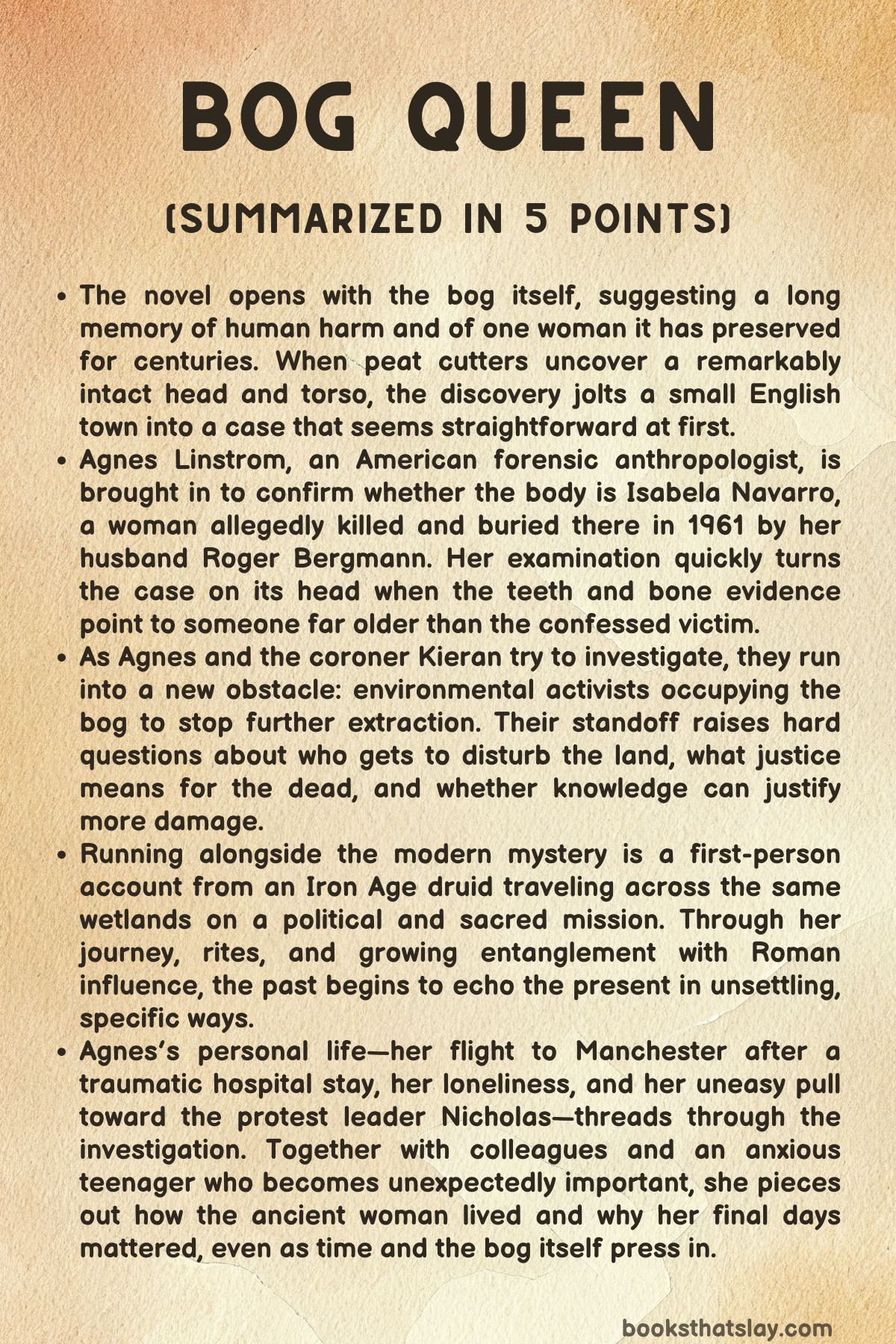
Summary
A peat bog in Ludlow is introduced through an unusual lens: a moss colony narrates its own long existence. It recalls thriving for centuries, then being shredded and dried by industrial harvesting.
When the machines finally ease off, people arrive in panic to pull a female body from the peat. The moss suggests it has protected this woman across vast time, releasing her only now because her purpose is due.
Agnes Linstrom, a young American forensic anthropologist and dental specialist living in Manchester, is called to Ludlow to help the coroner, Kieran, examine the remains. The case seems straightforward at first.
Roger Bergmann has confessed that he killed his wife, Isabela Navarro, in 1961 after a basement argument. He claims she attacked him, he pushed her, and she died falling down stairs.
He buried her in the bog and has carried guilt ever since. Agnes’s job is to verify identity and cause of death, not to judge his story.
In the coroner’s exam room, Agnes sees why the body has unsettled everyone. From the waist up it looks almost alive: skin, lashes, and features intact, stained black-brown by the bog.
The lower leg is mostly skeletal and part of a foot is missing. Agnes notes a childhood scar and a deep puncture wound below the ribs.
X-rays show a small but preserved brain and a skull with fine fractures on the frontal bone. The pattern could fit a fall, but something about it nags at her.
She turns to the teeth, expecting to match them with Isabela’s records.
The only surviving dental file is from Isabela’s childhood in Spain. It shows early decay that should have left fillings or damage in adulthood.
Yet the bog body’s teeth are perfect—no cavities at all—and the molars are ground nearly flat, a kind of wear Agnes has seen in ancient remains who ate gritty, stone-milled foods. The conclusion hits hard: these aren’t Isabela’s teeth.
Agnes tells Kieran that the body cannot be Isabela and may be centuries old.
Dorotea Navarro soon arrives, expecting to take her aunt Isabela home. She is furious when told the remains are not Isabela’s.
Bergmann confessed, the body was where he said, so how can it be wrong? Agnes stands firm: the preservation, tooth wear, and other markers point to a burial around two thousand years old.
Dorotea demands answers about where Isabela is, but Agnes and Kieran have none. Dorotea, unconvinced by Agnes’s age and calm certainty, refuses to leave and vows to push for the truth.
Agnes and Kieran go to the bog. The land has been carved into a bleak grid of black peat and water pits, with only scattered green patches trying to return.
Workers explain that environmental activists are camped there to stop extraction. Their leader, Nicholas Bailey, insists the bog is common land, crucial for wildlife and carbon storage, and that the peat company is gutting it before selling the area for luxury housing.
Agnes argues they need to excavate properly to understand the burial and death. Nicholas counters that restoration comes first and any request must be voted on by the camp.
Kieran threatens arrest, but Nicholas points out that detaining peaceful protesters would be a public disaster.
Between these present-day scenes, a first-person voice from the Iron Age speaks. A young druid travels across the same moss toward Camulodunon to meet a new king.
She makes offerings to local gods, including sinking a fine sword into a dark pool. She also asks for justice for unsettled dead already hidden in the bog.
Along the road, armed men loyal to Sego, a powerful northern leader, warn her that the southern king is tied to Rome and dangerous to trust. She rides on anyway.
Agnes’s own recent past is also revealed. She had been hospitalized after an accident that left her feeling estranged from her body.
Everyone in her life—her adviser, father, and boyfriend Colin—expected her to stay near home for a safe academic job. Instead, newly shaken and hungry for distance, she applied to the farthest postdoc she could find and moved to Manchester without warning Colin.
The choice shattered their relationship. Though she tries dating afterward, she feels repelled by men who don’t understand her, and she carries a quiet grief for the bond she broke.
Back in 2018, Agnes consults with Sunita Patel, a bioarchaeologist, after carbon dating confirms the bog body is around two millennia old. Sunita wants to focus on the burial context and any objects left with the dead.
Agnes keeps returning to cause of death. The activists, including Nicholas and a woman named Leah, are blocking the dig and plugging drainage pipes to reflood the bog, even suggesting the body should have stayed buried.
Fiona from the peat company says she can’t remove the protesters without looking like a villain, and hints that press strategy matters.
As excavation proceeds in fits, Agnes and Sunita search the peat for clues. The bog is dry and tough from years of cutting, yet small patches of bright moss begin regrowing once machines stop.
After days of careful work, a scrap of thin material appears—possibly lambskin or leather. They send it to Jesper Claasen for analysis.
A graduate assistant notes theories about bog burials: ritual offerings, punishments, or ways to preserve a body so it could be found later.
The Iron Age druid reaches Camulodunon and meets the southern king. He gives her a Roman priest’s robe and shows her a painted map of faraway lands.
The idea that the world can be drawn astonishes her. He urges alliance against Sego and offers knowledge and prestige through Roman ties.
At a feast, a Roman diviner reads goat organs to judge the god Mars’s favor. The druid, despite her own taboos, tastes raw liver with the king and declares it sweet, signaling agreement.
She leaves with gifts and a warning from the queen that alliance will make enemies. On the journey home, her party is ambushed.
She is wounded, uses gifted oil jars to burst fire into the night and frighten attackers, and recognizes Sego’s mark on their swords. Feverish, she realizes Sego wants her silenced.
Modern tensions grow. A pathologist, Danielle Muller, examines the bog body and finds the side wound was old and healing; head trauma also shows healing, so neither explains death.
Danielle suggests a sudden collapse, perhaps heart-related, but can’t be sure. Press attention increases, and Nicholas says their legal fight depends on flooding the bog, meaning the dig must end.
Agnes, frantic at losing her only chance to solve the death, tears up living moss in anger and throws it at Nicholas, ashamed of herself even as she feels cornered.
In May, Agnes can’t sleep and pore over tissue images again. She notices a segmented structure in a skin sample and writes Danielle seeking clarity.
She visits the peat plant, where Fiona shows her a blueprint for a mixed-income housing estate planned across the bog. Fiona promises a protected dig site and future memorialization, hoping the discovery will boost tourism.
Agnes feels uneasy about being used, but also sees it might be her only way to keep working there.
The Iron Age druid, still recovering from the ambush, tries to keep her village aligned with the southern king and Rome. Many resent her authority; even her brother Aesu doubts her.
Yet she argues Rome’s reach is inevitable and they must choose how to meet it. At a solstice festival she drinks a sacred mead-and-mushroom draught, falls into a vision, and sees the moss as a dark wasteland, then bursting with distant lights.
She takes it as a sign that change will come whether welcomed or not.
Agnes drafts a preservation plan to limit digging and protect peat, but Nicholas tells her the court case is lost. The bog is deemed too damaged to save; harvesting will restart, housing begins in fall, and remaining protesters will be arrested after June 1.
Agnes feels stranded, and her father urges her to return to the U.S., which she fears would end her career and sense of purpose.
Another mystery presses in: Dorotea must rebury Isabela’s newly confirmed remains after toxicology disproves Bergmann’s claim that drugs caused Isabela’s death. Agnes helps retrieve a sample, and Dorotea insists on whatever truth bones can still offer.
Jesper then reports on the ancient artifacts. The lambskin scrap is coated with soot and gum arabic, a Roman ink binder, and a hollow metal tube found nearby is a pen.
The dead woman likely traveled to Roman Camulodunon and made the lambskin herself. Ruby, Sunita’s anxious teenage daughter, is hospitalized after a panic attack and keeps theorizing about Roman poisons.
Her obsession prompts a toxicology screen on the Iron Age body; it reveals opiate poisoning, pointing to Roman contact and a fast collapse as the cause of death.
With machines about to return, Agnes and Nicholas hold a farewell ceremony on the moss. Agnes speaks aloud the woman’s reconstructed story—her travel, her alliances, her poisoning—while Nicholas leads a protest walk that echoes a Beltane rite.
In heavy rain, Ruby recognizes the lambskin as a map of the bog and spots a marked place in the southeast. Flooding ends most digging that night.
After others leave, Agnes and Nicholas stay in a tent together and sleep with one another, an intimacy built from shared loss and anger. At dawn, following the map, Agnes digs in the southeast and uncovers the ancient pommel of a sword, proof that the bog still holds more history than anyone has yet been allowed to uncover.
Characters
Agnes Linstrom
Agnes is the modern spine of Bog Queen, a young American forensic anthropologist whose professional rigor is inseparable from her personal restlessness. She arrives in Ludlow carrying the outward markers of competence—specialized dental expertise, calm methodical observation—but also an inner volatility shaped by loss and bodily estrangement after a recent hospitalization.
Her insistence on evidence over confession drives the plot when she rejects the easy narrative of Roger Bergmann’s guilt, and that same insistence becomes her moral compass: to Agnes, determining cause of death is not voyeurism but a duty to the dead. Emotionally, she is a person who repeatedly chooses distance as a kind of survival.
Her abrupt move to Manchester, the self-sabotage of her relationship with Colin, and her wary entanglement with Nicholas all echo a pattern of fleeing containment, even when she aches for connection. Over the course of the excavation, Agnes’s cool empiricism is tested by power struggles, ecological collapse, and the humiliation of not knowing; her eventual collaboration in the farewell ceremony shows her growing capacity to hold uncertainty without abandoning care.
She ends the story still hungry for truth, but less naive about who gets to define what truth is for a body, a landscape, or a life.
Nicholas Bailey
Nicholas is the protest leader whose intelligence and restraint make him a credible rival to Agnes’s authority. He is an environmental lawyer who speaks in histories and ecosystems, positioning the bog as a living archive that capitalism is actively erasing.
His moral center is restoration: he believes the land’s survival outweighs any forensic inquiry, and he is willing to weaponize public optics and legal strategy to hold that line. Yet Nicholas is not a simple zealot.
His conversations with Agnes show curiosity about her work and an emerging respect for her devotion, even while he remains frustrated by what he sees as scientific tunnel vision. Their bond grows in the liminal space between duty and desire, and the butterfly hatching scene captures his capacity for wonder, not just argument.
Nicholas’s arc tilts from confident organizer to someone confronting defeat and compromise when the court case collapses. The farewell ceremony and his night with Agnes expose a softer, more personal grief beneath the political posture: he is mourning a landscape, a community’s loss, and perhaps his own limits.
He ends as a figure who has not abandoned activism, but who has learned that preserving the future sometimes means making room for the past to speak first.
Sunita
Sunita is a bioarchaeologist who broadens Bog Queen from a murder puzzle into a debate about meaning, context, and stewardship. Professionally, she is grounded in the archaeological ethic that a body without its site is a story ripped in half, so she pushes for soil evidence and artifacts that can explain motive, ritual, or social world.
Her collaboration with Agnes is productive but tense, revealing two scientific temperaments: Sunita seeks narrative through environment and culture, Agnes through anatomy and pathology. Personally, Sunita carries the quiet strain of parenting a daughter in crisis while trying to remain fully present at the dig.
Her worry about Ruby’s refusal of school and fear of illness leaks into her work, making her impatient at times, but also deeply empathetic toward Agnes’s own bodily unease. Sunita’s steadiness helps keep the excavation humane; she treats the bog woman as a person with a social life, not just a specimen.
Even when the project is curtailed, her commitment to interpretation ensures the dead woman’s journey is reconstructed with dignity rather than lost to institutional defeat.
Dorotea Navarro
Dorotea is a modern avatar of unresolved grief and the politics of remembrance. She arrives assuming the bog body is her aunt Isabela, and when Agnes contradicts that assumption, Dorotea’s anger reads as both familial desperation and justified suspicion of outsiders controlling her family’s story.
She is sharp, skeptical of credentials, and unwilling to be soothed by institutional process; her refusal to go home after being dismissed underscores her determination to reclaim agency over Isabela’s fate. Dorotea’s confrontation with Leah shows her strategic side: she is willing to bargain with publicity to get what she wants, using the language of modern optics as deftly as Nicholas does.
Later, when toxicology results clear Isabela of drugs, Dorotea’s grief shifts from rage to a stern demand for whatever truth bones can still provide. She functions in the novel as a reminder that forensic certainty is not an abstract pursuit; it lands in the lives of the living, and Dorotea insists on that cost being acknowledged.
Kieran
Kieran, the coroner, represents institutional order and pragmatic authority, but he is also a character who learns to trust expertise beyond hierarchy. From the start he treats Agnes with professional seriousness despite her youth, giving her space to lead the identification process.
His impatience with the protesters is rooted in duty—evidence is time-sensitive, procedure matters—and he is willing to threaten arrests to defend that duty. At the same time, Kieran does not cling to certainty; when Agnes says the body is not Isabela, he adjusts the official narrative without defending the confession as convenient closure.
His role is less emotionally exposed than Agnes or Nicholas, but his steady support makes him a quiet ally in a story filled with competing claims over the dead.
Roger Bergmann
Bergmann is a presence felt through confession and aftermath more than direct action, and his characterization hinges on ambiguity. He admits to killing his wife Isabela in 1961, describing it as an accidental push during a fight, and his decades of guilt and nightmares suggest he believes his own story.
Yet the discovery that the bog body is ancient destabilizes him as a simple villain or penitent. He becomes a symbol of how confession can be self-serving even when it is sincere: relief at the body being found may be less about justice for Isabela than absolution for himself.
His later attempt to paint Isabela as addicted and violent exposes a defensive instinct to reframe memory when legal stakes return, further complicating whether his remorse is moral reckoning or fear of consequence.
Isabela Navarro
Isabela exists largely through the frames others try to impose on her—victim, abuser, ghost of a confession—but the narrative keeps her partially unknowable, which is itself a statement. Dorotea’s fierce loyalty paints Isabela as someone owed dignity and a proper burial, while Bergmann’s shifting account threatens to reduce her to a tactic.
The negative toxicology result becomes a late reclamation of her integrity, rejecting the story that she died because of weakness or vice. Isabela’s absence, contrasted with the ancient woman’s hyper-presence, sharpens one of Bog Queen’s central tensions: which dead are granted stories, and which are left as blanks for the living to exploit.
Ruby Patel
Ruby is Sunita’s teenage daughter, a brilliant, anxious mind whose relationship with the body and with history is painfully intimate. Her fear of illness and her panic attack suggest a young person who experiences the world as a threat inside her own skin, mirroring Agnes’s earlier detachment from her body.
Yet Ruby’s speculative obsession with Roman poisons becomes essential to the case; she is the one who keeps asking the question others dismiss, and her intuition triggers the toxicology screen that finally explains the druid’s death. Ruby therefore embodies a paradox: vulnerability that is also perceptiveness.
She is a generational bridge, someone whose personal terror of mortality helps unlock the truth of a two-thousand-year-old death.
Fiona
Fiona is the peat company representative who masks corporate extraction with the language of opportunity. She is savvy about public relations, advising Agnes on activists’ optics and offering the reporter’s card as a tool.
Her proposal for a housing estate and tourism economy reveals her core motive: to convert the bog’s destruction into a marketable story of renewal, with the ancient body as centerpiece. Fiona is not cartoonish; she can be genuinely helpful and even respectful toward Agnes’s work, but her help is always strategic, aimed at folding science into development plans.
She represents the novel’s sharpest critique of capitalist realism: that even grief, preservation, and discovery are quickly reframed as revenue streams.
Danielle Muller
Danielle is the pathologist whose disciplined slowness frustrates Agnes but grounds the medical reality of the investigation. She refuses to be rushed, rebuking Agnes’s impatience and reminding her that soft tissue does not yield truth on command.
Her findings complicate the narrative repeatedly: healing skull fractures, a healing side wound, no sepsis, only a vague heart possibility. Later, she collaborates on toxicology when Ruby pushes the idea, showing that she is not closed-minded, only careful.
Danielle stands for the limits of science and the ethics of process, ensuring the dead are handled with competence rather than haste.
Colin
Colin appears in Agnes’s memories as a quiet craftsman whose steadfastness once anchored her. His reaction to Agnes’s abrupt departure—holy anger, then silent withdrawal—suggests a man who feels betrayal deeply but expresses it through action rather than spectacle.
That he is building an air-jet loom from scratch underscores a personality devoted to patience, structure, and making things work, in contrast to Agnes’s impulsive leap toward distance. Colin’s lingering presence in her thoughts marks him as a lost home she cannot quite stop mourning, and his role helps explain why her later bond with Nicholas is both attraction and attempt at reinvention.
Leah
Leah is a key voice within the protest camp, less polished than Nicholas but equally committed to restoration. She articulates the belief that the dead should have stayed buried, positioning excavation as another kind of violence against the bog.
Her interaction with Dorotea reveals her community-first ethic; she does not agree to anything alone, insisting on collective decision. Leah functions as a counterweight to Nicholas’s legal pragmatism, emphasizing affective, spiritual, and communal claims over the land.
Oliver
Oliver is one of the diggers whose practical curiosity adds texture to the excavation. His discovery of the leather-like scrap and his reference to the Danish “Jutland Queen” show him as someone who knows the lore of bog bodies and enjoys the speculative thrill of comparison.
He is not central to the emotional arcs, but he helps situate the Ludlow find within a wider archaeological imagination.
Jesper Claasen
Jesper is the materials expert whose analysis shifts the ancient narrative from mystery to biography. By identifying soot and gum arabic, and linking the metal tube to a Roman pen, he provides the evidence that the druid woman was a traveler and maker, someone who carried Roman technology back into her own world.
Jesper’s role highlights how tiny material details can re-animate a life, not just solve a case.
Melinda
Melinda, Kieran’s secretary, is a brief but grounding presence at the coroner’s office. She represents institutional continuity and the everyday labor that surrounds dramatic discoveries, helping establish the procedural world Agnes steps into.
Aesu
Aesu is the druid narrator’s brother and moral sounding board, devoted to her safety and to communal stability. He admires her gifts but fears her bluntness will fracture alliances, warning her to be more diplomatic after the paternity judgment.
His skepticism about her political strategy later reflects a protective conservatism, yet he ultimately stands with her when the village faces Rome’s advance. Aesu embodies the cost of leadership within family: love expressed through caution, and loyalty that must wrestle with disagreement.
Crab
Crab is the druid’s companion whose family network offers hospitality and access to village life. He is steady, practical, and loyal, fighting beside the druid and Aesu during ambush.
Crab’s presence underscores that the druid’s authority is not solitary; it is supported by friendships and kin ties that make her mobility possible.
Sego
Sego is the ancient antagonist, a local strongman whose power rests on violence and resistance to shifting alliances. His armed men attempt to intimidate the druid away from Camulodunon, and the later ambush bearing his mark confirms him as someone willing to kill to control the political narrative.
Sego represents the internal threats of the druid’s world, the dangers that come not only from Rome but from homegrown patriarchy and fear of change.
Enica
Enica is the fifteen-year-old girl at the center of the paternity dispute, portrayed with a stark dignity. Her consistent testimony, her attempt to seek an abortifacient, and her family’s social precarity place her in a vulnerable position, yet she refuses to be silenced or shamed into disappearance.
Through Enica, the druid’s justice is tested against communal bias, and Enica’s vindication becomes one of the clearest examples of the druid using power to protect the marginalized.
Linu
Linu is Enica’s lover who denies responsibility under pressure, evasive and repetitive during the dispute. His family’s generosity contrasts with his moral cowardice, and the divination exposing him as the father forces him into accountability.
Linu illustrates how social standing can enable denial until power, ritual, or law intervenes.
Bel
Bel is the poor hog-farmer friend used as a scapegoat in the dispute. He is socially weaker than Linu and thus an easy target for blame, which reveals the village’s class dynamics.
Even without much direct characterization, Bel’s role shows how truth is often bent along lines of status.
Themes
Land as Witness and the Cost of Extraction
From the first pages, the bog is not a backdrop but a presence that has endured injury. The moss colony remembers industrial tearing and drying, and the modern landscape shows the aftermath: furrowed blackness, drained pools, and machines poised to keep taking.
This sets up a long argument about what happens when land is treated as a resource rather than a living system. The peat company frames the moss as economic fuel and as future real estate, while activists insist that its value is ecological, communal, and historical.
The conflict is not just legal; it is about which story of the land gets to matter. Agnes enters with a different priority: the land as evidence.
She needs the bog intact long enough to read what it holds. The protesters need the bog rehydrated to keep it alive.
These goals collide because the same physical conditions that preserve human remains are also what allow the ecosystem to function. Bog Queen keeps returning to that tension: the act of uncovering truth can resemble the act of destruction, even when the motives differ.
The moss’s patient preservation of the Iron Age woman adds another layer. It suggests that land carries obligations across centuries, holding both carbon and bodies, both climate futures and human pasts.
When Agnes tears up living moss in frustration, her outburst shows how quickly even a careful scientist can slip into the posture of taking. The novel refuses a clean solution.
Restoration arrives too late for the dig, while extraction resumes despite protest. What remains is the idea that land is a witness with its own timelines, and that human urgency—whether for profit or for knowledge—often fails to respect those timelines.
The final discovery of the sword after flooding hints that history and ecology are not separate archives: they are the same archive, and damaging one damages the other.
Preservation, Uncertainty, and the Desire to Speak for the Dead
A body emerging from peat is a physical paradox: death held so gently that eyelashes remain, yet identity is erased by time. The discovery that the remains are not Isabela shatters the neat story created by Bergmann’s confession.
In its place comes a more unsettling truth: even when the dead are found, they may not answer the questions the living have prepared. Agnes’s work is built around classification, measurement, and cause of death, but the bog body resists those tools at every turn.
Teeth that do not match records, wounds that are healing, fractures that are old, a toxin that appears only after persistent doubt—each detail shifts the story. Bog Queen uses this process to show how fragile certainty is, and how much interpretation is required to make bones and tissues become narrative.
Dorotea’s grief and anger embody another side of this theme. She wants the dead to be named and placed among family, and the failure to locate Isabela makes preservation feel like cruelty rather than care.
Meanwhile, the Iron Age druid sees the bog as a sacred repository, a place where offerings and unsettled dead require attention. Her prayer for justice for those buried there mirrors Agnes’s insistence that the cause of death matters because it is owed to the dead.
The two women, separated by two thousand years, share the same impulse: to keep the vanished from being reduced to silence. Yet the novel also argues that speaking for the dead is risky.
Agnes’s reconstructions are provisional; they depend on incomplete context, lab access, and time that politics can revoke. The druid’s rituals also rely on belief and social acceptance that can turn against her.
Preservation, then, is not only about keeping bodies intact. It is about whether the living can hold space for ambiguity without giving up on care.
The bog preserves perfectly, but meaning still has to be negotiated among fallible humans. The ending—Agnes recording the woman’s story in a farewell ceremony—accepts that closure may be partial, and that respect can mean telling the truest story available even when it is unfinished.
Female Power, Credibility, and the Burden of Mediation
Both timelines center women who are asked to mediate conflicts larger than themselves. Agnes arrives as a young expert in a setting that doubts her.
Dorotea challenges her youth; Kieran warns her about obstacles; protesters treat her mission as secondary. Again and again she must assert competence in rooms where authority is assumed to belong to older men or to institutions with money.
Her expertise is real, but it does not protect her from being tested. The Iron Age druid faces parallel pressure.
She is a ritual specialist and political envoy, yet her judgments provoke resentment, and her actions make enemies. When she rules on Enica’s pregnancy dispute, she carries the village’s social order in her decision, and her brother worries she lacks the diplomatic softness expected of her.
Later, her alliance with a Roman-linked king places her at the center of a conflict between tradition, survival, and outside power. Bog Queen shows how women’s authority is often tolerated only so long as it serves competing male interests.
The druid’s knowledge is valued when it stabilizes community life, then threatened when it reshapes political loyalties. Agnes’s forensic skill is welcomed when it seems to confirm a confession, then resisted when it disrupts a convenient narrative or slows the activists’ cause.
Each woman also carries the burden of translation. Agnes translates the dead into evidence and story for courts, families, and the public.
The druid translates between gods and people, between rival factions, and eventually between her own culture and Roman methods. The novel is clear that mediation requires personal cost.
Agnes’s isolation in Manchester, her lingering injury-related detachment, and her uneasy longing for Colin all tie to a life built around choosing autonomy over comfort. The druid’s wound, fever, and visions show the physical toll of constant responsibility.
Neither woman is presented as a flawless hero. They are stubborn, sometimes harsh, sometimes impulsive.
Yet their persistence is what keeps fragile truths from disappearing. Female power here is not a symbol of purity; it is labor under suspicion, exercised in messy conditions, and still necessary.
Knowledge Systems in Conflict: Science, Ritual, Law, and Story
The novel stages repeated clashes between different ways of knowing. Agnes trusts imaging, dental records, carbon dating, toxicology, and careful inference.
Sunita adds archaeological context, arguing that objects and soil tell a story that bones alone cannot. Nicholas and Leah approach knowledge through ethics and collective decision-making, insisting that what matters is ecological survival and community mandate.
Dorotea seeks truth through family memory and the moral clarity of confession. In the past timeline, the druid works through divination, social observation, oath-making, and sacred exchange, and she experiments with foreign practices like the milk-and-blood test.
None of these systems is mocked. Instead, Bog Queen shows each as partial, shaped by what its community needs.
Science can name poisoning, but only because Ruby and Danielle push beyond initial assumptions. Ritual can settle disputes, but only because the druid is willing to threaten force when consensus fails.
Law can protect land, but only if a court believes the bog is still worth saving. Story can honor the dead, but only if listeners accept uncertainty.
The friction between Agnes and the protesters makes this theme especially sharp. To Agnes, stopping excavation feels like abandoning a person.
To Nicholas, excavation feels like repeating extraction under a different banner. Both positions claim moral grounding, yet they are based on different definitions of harm.
The past timeline echoes that structure. The druid’s alliance with Rome offers maps, travel, and opiate medicine—forms of knowledge that expand horizons—yet it also invites violence and erodes older loyalties.
The novel argues that knowledge is never neutral. Every method comes with power dynamics, blind spots, and consequences.
What matters is how people negotiate among them without pretending any single one is complete. Agnes’s final ceremony, mixing forensic findings with a public rite on Beltane, suggests a tentative synthesis: science can provide detail, ritual can provide meaning, and story can help a community carry both.
The point is not to merge systems into one truth, but to let them correct and deepen each other so the living do not mistake their preferred lens for reality itself.
Bodies, Trauma, and the Search for Autonomy
Physical bodies in Bog Queen are sites of history, fear, and control. Agnes’s hospital stay leaves her feeling detached from her own body, and that estrangement propels her toward distance, work, and reinvention.
Her sudden move to Manchester is a bid to reclaim choice after vulnerability, yet it also fractures intimacy and leaves a lingering ache she cannot name cleanly. Her professional comfort with corpses contrasts with her private uncertainty about living bodies—hers, Colin’s, the men she dates, Ruby’s anxious teenage body, even the preserved Iron Age woman who looks almost alive.
The novel keeps showing how trauma reshapes perception: Agnes’s childhood encounter with the dead finch turns fear into curiosity, while her adult injury turns familiarity with death into a need for motion and proof. Ruby’s panic attacks and fear of illness present another angle, where the body feels like a trap rather than a home.
Sunita’s stress around parenting and work adds the everyday dimension of bodily care and exhaustion. In the past timeline, the druid’s body is political.
Her coming-of-age authority is accepted, yet her gendered body is still vulnerable to ambush, fever, and the consequences of her choices. Even the Iron Age woman’s death by opiate poisoning ties body to empire: a drug moved through Roman systems ends up inside her and ends her life.
The bog body itself crystallizes the theme. Her preservation makes the boundary between body and artifact unstable.
She becomes a battlefield for modern agendas—tourism, ecology, science, family grief—none of which she can consent to. Agnes struggles with this, arguing that the dead deserve a story, not because stories restore autonomy, but because refusing to look can be another kind of control.
The closing image of Agnes and Nicholas discovering a sword after their farewell underscores how autonomy is always incomplete. Bodies carry what people do to them, but also what they survive, what they keep hidden, and what they reveal in their own time.
The novel’s emotional current rests on that idea: recovery is not erasing fracture; it is making choices inside it, even when the world keeps trying to decide for you.