Julia Song is Undateable Summary, Characters and Themes
Julia Song is Undateable by Susan Lee is a refreshing and heartfelt story that explores love, family expectations, and self-discovery. At the center is Julia Song, a successful CEO of Starlight Cosmetics, who feels pressured not only by the demands of her growing business but also by the persistent expectations of her family, especially her grandmother, to get married.
As she navigates the delicate balance between career ambitions and personal life, Julia’s path crosses with her childhood friend, Tae, who agrees to help her with her family’s matchmaking endeavors. But as their relationship evolves, both Julia and Tae must confront their own fears, uncertainties, and hidden emotions.
Summary
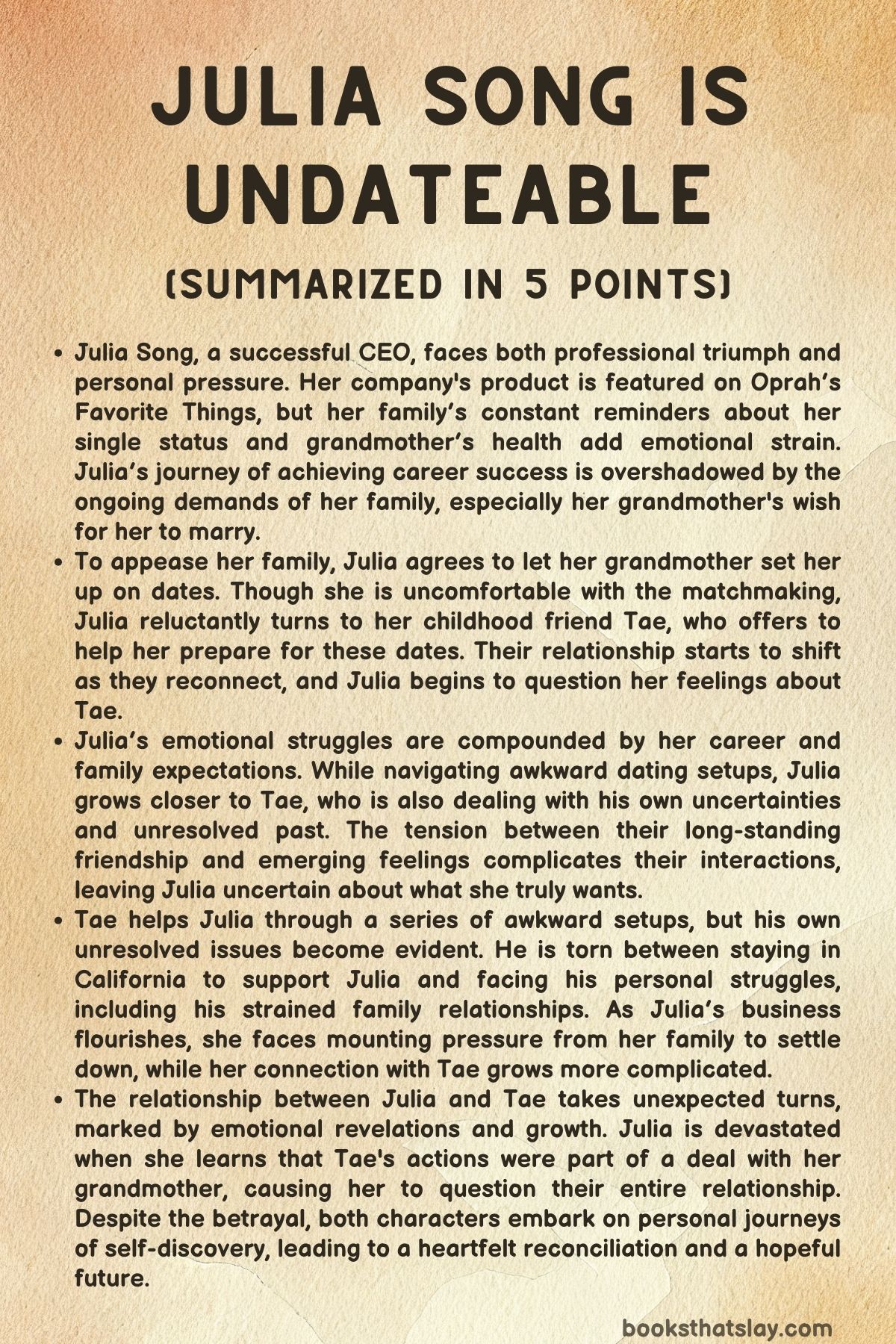
Julia Song, the ambitious CEO of Starlight Cosmetics, is celebrating her company’s big achievement: its product, Lotus Bamboo Essence, was chosen for Oprah’s Favorite Things. This recognition has set the stage for a surge in sales and media attention.
While Julia is proud of her success, she is constantly reminded of her family’s expectations, particularly her grandmother, Halmoni, who insists on seeing her married before she passes. Julia is 30, financially secure, and accomplished, but the pressure to find a husband weighs heavily on her, causing personal conflict.
Julia’s assistant, Annette, advises her to address her family dynamics, especially her dating life. Julia, however, is more focused on securing investors for her company’s global expansion.
Her grandmother’s constant nagging about marriage is a sore subject, but Julia reluctantly agrees to let her family set her up on a few dates, just to ease their concerns. Her friends, Sonia and Rachel, offer support, encouraging Julia to keep an open mind about the situation, though Julia is resistant to the idea of a forced relationship.
During a visit to her grandmother’s birthday party, Julia is bombarded with critiques about her single status. She tries to distract her relatives with expensive skincare gifts, but it only intensifies their judgment.
Halmoni pulls Julia aside to talk about her health, urging her once again to marry before it’s too late. The family pressure continues to build, and Julia’s personal life becomes an uncomfortable topic of conversation.
The situation takes a turn when Tae, a childhood friend, unexpectedly returns to the picture. He’s all grown up, confident, and back in Southern California after caring for his father, who is now in remission.
Halmoni asks Tae to help Julia by becoming her “dating coach,” a role he accepts, though reluctantly. Julia initially feels awkward and resistant, but she agrees to let Tae guide her through the process of preparing for her arranged dates.
As the two reconnect, they reminisce about their childhood and share their struggles. Tae reveals his own personal uncertainties about his life, as he’s still unsure about his future after leaving Chicago.
Julia, in turn, opens up about the pressure she feels from her family and society to settle down. Though their connection is strong, Julia is determined to keep things platonic, insisting that she and Tae are just friends.
Despite Julia’s reservations, Tae continues to help her prepare for the matchmaking process. They meet at a Korean restaurant where Tae coaches Julia on how to handle conversations during dates, giving her tips on managing nerves and staying authentic.
Over time, Julia begins to appreciate Tae’s support and his calming influence, although she remains unsure about the idea of a relationship with him.
Julia’s first official setup date is with Young Kim, a famous K-pop singer. The date is a disaster—Young talks endlessly about his career and fans without showing any interest in Julia’s life.
She ends the date early, venting to Tae about her frustrations. Tae reassures her, offering comfort and humor as she processes her disappointment.
The next setup involves Joshua Park, a doctor from Korea, but it too is a failure. Julia and Joshua have little chemistry, and Tae’s role as an interpreter only highlights the lack of connection between them.
Julia realizes that she’s more drawn to Tae than to any of the men her family has set her up with. However, her feelings are complicated by the fear of ruining their long-standing friendship.
As Julia spends more time with Tae, she begins to question her own feelings. She’s drawn to him, but she’s afraid of opening up to the possibility of a relationship.
Tae, too, is struggling with his own emotions. His relationship with his family is strained, and he’s grappling with his past decisions, especially his breakup with his ex-girlfriend, Kari.
He’s unsure about what he wants from life and where he belongs.
In the midst of these personal dilemmas, Julia’s family continues to push her into dating. Her mother presents her with yet another potential suitor, but the date is just as uninspiring as the previous ones.
Julia begins to realize that no one measures up to Tae, and she feels conflicted about her growing attraction to him.
As Julia and Tae’s friendship deepens, their emotional connection becomes harder to ignore. However, a surprise visit from Kari, Tae’s ex-girlfriend, creates tension between Julia and Tae.
Julia is left feeling insecure, questioning whether her feelings for Tae are reciprocated.
Despite the emotional turmoil, Julia continues to focus on her business and career. She also starts to reflect on her own growth and self-worth, separate from her family’s expectations.
Tae, on the other hand, starts to come to terms with his own identity and what he wants from his life.
The story takes a dramatic turn when Julia discovers that Tae’s involvement in her dating life was part of a deal between him and her grandmother. Julia feels betrayed and humiliated, and she struggles to reconcile her feelings for Tae with the hurt caused by his actions.
However, she also understands that Tae was motivated by his own financial needs, and she grapples with the complexity of the situation.
As Julia focuses on her work, preparing for a business trip to Korea, she grows more self-assured. During her time in Korea, Julia finds clarity about her future and begins to prioritize her own happiness, independent of any romantic entanglements.
In a final twist, Tae arrives in Korea to make amends, having sought therapy to work through his emotional issues. He apologizes for his actions, and they have an honest conversation about their feelings.
Though Julia is initially hesitant, she acknowledges that Tae has grown and is ready to take responsibility for his mistakes. Their reunion signals the potential for a new chapter in their relationship, though both realize they need time apart to work through their own personal journeys.
By the end of the story, Julia has grown into a more confident and self-reliant person, and while the future of her relationship with Tae is still uncertain, she is open to the possibility of love when the time is right. Both Julia and Tae are on paths of self-discovery, with the potential for personal growth and a future together if they can overcome their individual insecurities.
Characters
Julia Song
Julia Song, the CEO of Starlight Cosmetics, is a driven, successful businesswoman in her early 30s. Despite achieving financial independence and securing her company’s place in the spotlight with their product being featured in Oprah’s Favorite Things, she is continuously burdened by the expectations placed on her by her family, especially her grandmother.
Julia’s story is marked by a balance between her career accomplishments and the pressure to meet societal and familial standards, particularly in regard to her single status. She is financially secure, yet emotionally conflicted, as her grandmother’s insistence on her getting married before passing intensifies her anxiety.
Her professional life flourishes, but her personal life, dominated by family pressures and dating setups, leaves her feeling trapped. Julia’s journey revolves around self-discovery as she contemplates what she truly wants in a partner and whether she can balance her independence with the love and acceptance she seeks from her family.
Throughout the story, she is a relatable figure who faces many of the dilemmas modern women experience: balancing career success with personal happiness, navigating family expectations, and questioning her romantic desires.
Tae
Tae, Julia’s childhood friend and neighbor, has returned home to Southern California after leaving his life in Chicago to care for his ailing father. His sense of purpose is unclear, and he struggles with feelings of lost direction, compounded by strained relationships with his family, particularly his older brother, Min.
Tae’s life is in flux as he faces uncertainties regarding his future and his relationships, including his unresolved breakup with his ex-girlfriend, Kari. When he is asked by his mother to help Julia with her family’s matchmaking efforts, Tae agrees to become her “dating coach,” despite his own misgivings about relationships.
As Julia’s guide through the awkward process of dating setups, Tae’s emotional journey parallels hers. While helping her navigate the matchmaking process, Tae also deals with his own feelings of inadequacy, stemming from his family dynamics and his unresolved issues from the past.
Tae is a compassionate and loyal friend, yet he struggles with his own fears of failure and the weight of his family’s expectations. Over time, his relationship with Julia evolves from one of friendship into something more, though his insecurities and emotional baggage prevent him from fully embracing his feelings for her until much later.
His character arc is a journey of self-discovery and reconciliation, as he confronts his past mistakes, seeks therapy to address his emotional struggles, and works toward building a healthier relationship with Julia.
Halmoni
Halmoni, Julia’s grandmother, is a pivotal figure in the story, representing the older generation’s traditional values and expectations. Her primary concern for Julia is her marital status, which she believes is crucial for Julia’s happiness and fulfillment.
Halmoni’s insistence on seeing Julia married before her death casts a heavy shadow over Julia’s life, placing immense pressure on her. Despite this, Halmoni is not just a symbol of traditional family values; she is also a loving, albeit stern, figure who deeply cares for Julia’s well-being.
Her health issues add a layer of urgency to her desire for Julia to find a partner, as she fears her passing without witnessing this key milestone in Julia’s life. Halmoni’s character is complex—she embodies both love and control, pushing Julia to conform to familial expectations while simultaneously offering moments of vulnerability that hint at her own fears and desires for Julia’s future.
Throughout the narrative, Halmoni’s insistence on marriage becomes a source of internal conflict for Julia, who must navigate her love for her grandmother while trying to assert her own desires for independence.
Sonia
Sonia is one of Julia’s best friends, offering a balance of humor and support throughout the narrative. While she is playful and often lighthearted, Sonia is also deeply empathetic, recognizing the weight of the pressures Julia faces from her family.
Sonia’s role in the story is to provide a sense of normalcy and comic relief, especially when Julia is overwhelmed by the dating setups and family expectations. She encourages Julia to embrace her achievements and to see beyond the familial pressure, pushing Julia to be more open to new possibilities, including the idea of a relationship with Tae.
Sonia’s character is a reminder of the importance of friendship and personal connections, as she provides Julia with much-needed moments of fun and relaxation amidst the chaos of her personal life.
Rachel
Rachel is another of Julia’s best friends, serving as both a sounding board and a practical support system for Julia. While Sonia offers humor and lightness, Rachel is more grounded and thoughtful, often providing a more serious perspective on Julia’s situation.
Rachel encourages Julia to consider the idea of being with Tae, even suggesting that their deep friendship could evolve into something more. She sees the connection between Julia and Tae, even when Julia is hesitant to acknowledge it herself.
Rachel’s character highlights the importance of having friends who push you out of your comfort zone, especially when it comes to relationships. Through her interactions with Julia, Rachel embodies the supportive, sometimes challenging role of a best friend who wants what’s best for you, even if it means confronting uncomfortable truths.
Min
Min, Tae’s older brother, represents the voice of reason and responsibility within his family. Min’s life is focused on career success, and he often criticizes Tae for his perceived lack of direction and his decision to return home to Southern California.
Min’s character embodies the high expectations placed on children in immigrant families, where success and achievement are paramount. His strained relationship with Tae reflects the pressures of comparison and the tension that can arise between siblings when one feels the other is not living up to their potential.
While Min’s intentions come from a place of wanting the best for Tae, his critical nature often adds to the emotional weight Tae carries, further complicating his journey toward self-acceptance and resolution.
Kari
Kari, Tae’s ex-girlfriend, represents the unresolved chapter in Tae’s life that he has been avoiding. Their breakup leaves Tae with lingering feelings of guilt and emotional confusion, making it difficult for him to move forward.
Kari’s character is crucial in understanding Tae’s reluctance to commit fully to any relationship, especially with Julia. While Kari’s role in the story is relatively minor, her presence serves as a reminder of the emotional baggage Tae must unpack in order to move forward with his life and his feelings for Julia.
Joshua Park
Joshua Park, the handsome doctor introduced by Julia’s mother, represents another suitor in the long line of setups orchestrated by Julia’s family. While physically attractive, Joshua lacks emotional depth and fails to engage with Julia in a meaningful way.
His character is used to illustrate the contrast between Julia’s family’s expectations of an ideal partner and her growing realization that true connection cannot be forced. The awkwardness of their date highlights Julia’s increasing awareness that she needs someone who understands her on a deeper level, not just someone who meets superficial standards.
Annette
Annette, Julia’s assistant, plays an integral role in helping Julia balance the pressures of her professional and personal life. Though her role is primarily supportive, Annette offers valuable advice and emotional guidance, often providing a pragmatic perspective when Julia feels overwhelmed.
Annette’s humor and tough love serve as a grounding influence, reminding Julia of what truly matters and encouraging her to remain true to herself amidst the noise of family and societal expectations.
Themes
Family Expectations and Pressure
Julia’s journey is heavily shaped by the expectations her family places on her, particularly in regard to her relationship status. Her grandmother’s insistence on seeing Julia married before her death becomes a focal point of the narrative, creating a source of emotional turmoil for Julia.
While Julia has achieved great success in her career as the CEO of Starlight Cosmetics, her family’s relentless pressure regarding her personal life complicates her happiness. The weight of these expectations grows more intense as her family’s attempts to match her with eligible bachelors, including the awkward and uninspiring dates, demonstrate how family influence permeates every aspect of Julia’s existence.
Julia’s struggle is not just about finding love but also about reconciling her own desires with the cultural and familial obligations placed upon her. Her sense of identity is entangled with her family’s views, especially her grandmother’s vision of her life.
The theme of family expectations speaks to the broader pressure many individuals face, especially in tight-knit cultural contexts where personal achievements can feel secondary to fulfilling family wishes. Through Julia’s reflections and the tension she experiences, the narrative explores how cultural traditions and the need for familial approval can create deep internal conflict, forcing individuals to choose between personal autonomy and family loyalty.
Self-Discovery and Independence
Julia’s development throughout the novel is largely driven by her journey toward self-discovery and independence. Initially, she is defined by her career achievements, and her worth seems to be based solely on her professional success.
However, as the story progresses, Julia begins to confront the deeper, more personal aspects of her identity, particularly when she faces the immense pressure of her family’s expectations regarding marriage. Her experiences with the various dating setups become a tool for introspection, challenging her to understand what she truly desires in a partner, rather than simply seeking to appease her family’s wishes.
Julia’s time in Korea, where she immerses herself in her cultural heritage, marks a significant turning point. It’s here that she experiences growth and starts to see her life and work as valuable independently of her relationship status.
This shift is crucial in Julia’s evolution, as she learns to navigate her own needs and desires. Her growth into a more self-assured version of herself is not just about rejecting her family’s control but also about accepting her own worth, separate from romantic or societal expectations.
The theme of self-discovery speaks to the universal experience of questioning one’s purpose and identity, especially in the context of modern life where the pressure to conform often overshadows the pursuit of individual fulfillment.
Friendship and Emotional Support
Julia’s relationships with her friends Sonia and Rachel, and her evolving connection with Tae, highlight the theme of friendship and emotional support throughout the novel. While Julia navigates the complexities of her career and familial expectations, her friends play a crucial role in grounding her, offering advice, humor, and a sense of security.
Sonia and Rachel’s unwavering support and their lighthearted teasing offer Julia both comfort and a reality check, reminding her of her worth outside of her familial obligations. These friendships also provide a safe space for Julia to share her fears and frustrations, which are not solely related to her professional success but to the emotional weight she carries because of her family’s demands.
The novel also explores the more nuanced dynamics of Julia’s friendship with Tae, which begins with a professional or supportive tone but gradually deepens into something more. Despite the tension created by Tae’s role in the dating setup, their growing emotional bond becomes a crucial element of Julia’s self-realization.
Tae’s emotional support, especially as he helps her navigate the awkward world of matchmaking, shows how friendships can evolve into something deeper and more complex. The theme of friendship emphasizes the importance of having strong emotional connections to help weather the emotional storms that life often brings.
Love, Vulnerability, and Emotional Growth
The evolving relationship between Julia and Tae embodies the themes of love, vulnerability, and emotional growth. At the outset, Julia is hesitant to entertain any romantic feelings for Tae, seeing him only as a childhood friend and a dating coach.
However, as they spend more time together, Julia begins to realize the depth of her feelings for him. Her initial resistance stems from her fears of complicating their friendship, and she is also wary of being hurt.
Tae, on the other hand, grapples with his own emotional baggage, particularly his unresolved feelings regarding his ex-girlfriend and his complicated relationship with his family. Their bond is rooted in a history of friendship, which allows them to be more vulnerable with one another than they might be with others.
As they share their respective struggles, they begin to understand the emotional scars each has carried, and this mutual understanding fosters a stronger emotional connection. The theme of vulnerability in love is explored as both characters confront their fears and insecurities.
Their relationship is not without its challenges—particularly when the truth about Tae’s initial involvement in Julia’s dating life comes to light. Yet, their willingness to confront their issues head-on and take responsibility for their actions demonstrates emotional growth.
Through this, the narrative illustrates how love can be transformative when it is built on trust, mutual support, and the courage to embrace vulnerability, even at the risk of emotional pain. Julia and Tae’s journey shows that true emotional growth comes from opening up to one another and allowing themselves to be imperfect and honest about their desires and fears.
Cultural Identity and Heritage
Cultural identity plays a significant role in the characters’ lives, especially for Julia, who grapples with balancing her Korean-American heritage and the pressures it brings. Julia’s family constantly reminds her of her cultural roots, but the traditional expectations associated with her heritage conflict with her modern aspirations.
This tension becomes particularly evident in the way her family pressures her to marry and fulfill the cultural ideal of familial duty, despite her own sense of self and accomplishments. Julia’s experience in Korea serves as a pivotal moment in her journey to connect with her heritage on her terms.
Her immersion in Korean culture and the time spent reflecting on her identity allows her to embrace a deeper understanding of herself. Rather than feeling constrained by cultural expectations, Julia begins to see her cultural background as a source of strength, one that can coexist with her independent ambitions.
Tae’s journey, too, is influenced by his cultural identity, particularly as he struggles with the expectations placed on him by his family. His decision to stay in California rather than return to his life in Chicago highlights the internal conflict many immigrants or first-generation individuals face in navigating the balance between familial duty and personal desires.
Through Julia and Tae’s experiences, the novel highlights how cultural identity shapes personal choices and relationships and how reconciling one’s heritage with individual aspirations is a constant, evolving process.
Career and Personal Fulfillment
The theme of career and personal fulfillment is central to Julia’s character arc, particularly as she balances the responsibilities of being a CEO with her need for personal happiness. Julia’s success in building Starlight Cosmetics and receiving recognition from Oprah represents the culmination of years of hard work and sacrifice.
However, her professional achievements are consistently overshadowed by the constant pressure to meet her family’s personal expectations, particularly regarding her romantic life. Julia’s career offers her financial independence and validation, yet she finds herself questioning whether these accomplishments are enough to bring her happiness if she is not able to meet the emotional and familial demands placed on her.
The tension between career success and personal fulfillment becomes even more apparent when Julia struggles with loneliness and emotional dissatisfaction, even as she enjoys professional victories. The theme of career versus personal fulfillment speaks to the reality many people face in contemporary society, where professional success does not always equate to emotional contentment.
Julia’s eventual realization that her work and life should be fulfilling on their own, outside of romantic expectations, underscores the importance of finding a balance between professional and personal growth. The novel suggests that true happiness comes when individuals are able to integrate their career aspirations with their personal needs and desires, rather than viewing them as competing or conflicting forces.