All Eyes on Him Summary, Characters and Themes
All Eyes on Him by Iliana Xander is a fast-paced psychological thriller set in a world of wealth, secrecy, and manipulation. The story follows Natalie Olsen, an ordinary young woman pushed into extraordinary danger when her best friend falls into a mysterious coma after a night out.
Determined to uncover the truth, Natalie takes a risky job inside the lavish mansion of tech celebrity Geoffrey Rosenberg. What begins as a personal mission soon becomes a frightening discovery of hidden surveillance, poisoned victims, false identities, and a criminal scheme far larger than she imagined.
Summary
Seven years ago, a woman named Emily tries to escape a controlling partner who attempts to force her into an abortion. After she refuses the procedure, she flees in his car, hoping to disappear and protect her unborn child.
But on a mountain road, her brakes fail, and she realizes too late that the crash may not be an accident.
In the present day, Natalie Olsen sits beside her best friend Cara in a hospital room. Cara is unconscious, barely showing brain activity, and doctors warn she may never fully recover.
Detective Lesley Dupin explains that Cara’s condition was caused by a powerful illegal drug, far stronger than typical date-rape substances. Similar cases have happened before, and two other women never woke up.
Natalie recounts that Cara was last seen leaving a nightclub with a red-haired man from the VIP section.
A few days later, Natalie’s life shifts when she saves a stranger named Nick from being hit by a speeding car. They talk over coffee, and Natalie soon notices a magazine cover featuring Geoffrey Rosenberg, a famous crypto CEO.
Natalie recognizes him immediately as the man Cara left with that night. Nick reveals that Rosenberg is his employer and that he works as his personal driver.
Natalie, already grieving the loss of another friend to cancer, cannot bear the thought of losing Cara too. Driven by desperation, she agrees to take a temporary job as a housekeeper at Rosenberg’s New Jersey estate, known as The Splendors.
She hopes being inside the mansion will help her uncover evidence.
From the moment she arrives, the atmosphere is tense. The guards are aggressive, the staff is wary, and the house manager Julien enforces strict rules: no phones, no alcohol, no wandering, and no contact with Rosenberg himself.
Cameras are everywhere, making Natalie feel as though she is constantly being watched.
Natalie meets Rosalie, the head housekeeper, and Walter, the gardener, who openly dislikes her. She also hears unsettling hints about the previous housekeeper, Darla, who supposedly had a seizure while intoxicated.
Natalie suspects the truth is far darker.
During her first days, Natalie overhears staff whispering about a woman in critical condition and warnings about getting too close to Rosenberg. One night, she sees a man outside the gates shouting that Rosenberg must speak to him or he will go to the police.
Security forces him away, but the encounter leaves Natalie shaken.
Soon, Rosenberg unexpectedly demands to meet Natalie. She brings food into his office and finds him cold, charismatic, and unsettling.
He studies her closely, calls her “Natalia,” and comments on her appearance. Natalie forces herself to play along, hoping to stay close enough to learn something.
While cleaning the mansion, Natalie discovers disturbing details. The library books are fake.
Hidden whiskey cups suggest Rosenberg drinks secretly despite the strict rules. Worst of all, Natalie accidentally breaks an object and finds a concealed camera inside.
Someone is spying from within the house.
That same night, Natalie receives a warning note slipped under her door. A stranger urges her to stay away from Rosenberg and provides a phone number.
When she calls, a man claims he has evidence that could destroy Rosenberg and wants Natalie to act as his inside contact. He offers money, but Natalie demands answers instead.
The mansion hosts a major business party as IxResearch prepares to go public. Wealthy guests flood the estate.
Natalie watches Rosenberg drink heavily and flirt with a young woman. Later, she hears shouting from behind a closed door, followed by a scream and a gunshot.
Panic spreads through the staff, but everything is quickly silenced.
Natalie finally contacts Detective Dupin, revealing that she believes Rosenberg is connected to Cara’s case. Dupin warns her that without proof, Natalie could be accused of stalking or slander, especially given Rosenberg’s influence.
Natalie is told not to return, but she feels she has no choice.
Soon after, Natalie realizes she is being followed. Someone breaks into her apartment, leaving behind a sealed envelope meant for Rosenberg.
The mysterious caller insists she must deliver it. Natalie reluctantly agrees, hoping it will lead her closer to the truth.
Back at The Splendors, Natalie learns Darla has died, apparently poisoned in the same way Cara was. Fear grows, but Natalie continues her investigation.
She drugs Rosenberg with sedatives to search his phone, only to discover it is almost empty: no real history, no records, no personal footprint. It is as if Rosenberg barely exists.
Natalie meets the blackmailer in person, a man named Rich. He reveals a shocking claim: Geoffrey Rosenberg is not who he says he is.
The real mastermind is someone else, and “Rosenberg” is only a front. Before Rich can explain further, he is killed in a sudden street attack.
Natalie calls Nick for help, but during their ride, she notices Nick wearing the same shoes as the fleeing figure from the murder scene. Her terror spikes.
Nick injects her with the same drug used on Cara, leaving her paralyzed.
Natalie wakes bound inside the guest house at The Splendors. Walter, revealed not to be a simple gardener, frees her.
Julien appears as well, and Natalie learns the truth: Nick is the real criminal behind IxResearch. “Rosenberg” is actually Phil Crain, an alcoholic gambler posing as a CEO.
The real Geoffrey Rosenberg is dead.
Julien and Walter have been running a long operation to stop Nick, but they need access codes to recover stolen funds. Natalie overhears recordings confirming Nick has harmed multiple women and plans to vanish once he drains the company’s wealth.
Julien captures Nick and interrogates him brutally for the passkeys. Natalie interrupts, refusing to let torture continue.
Outside, she discovers Nick’s keychain hides the missing access device. She hands it over, allowing Julien to unlock Nick’s offshore accounts.
Nick escapes briefly with Phil, but Phil turns on him, injecting Nick with his own poison. Nick collapses into a coma.
Julien secures the stolen money and prepares to disappear. As they flee, The Splendors mansion erupts in an explosion, staged as an accident to erase evidence.
Julien drops Natalie at home, paying her for silence and warning her that authorities could easily frame her if she speaks out.
Natalie learns that Detective Dupin is not truly a detective but Julien’s sister, and their mission was deeply personal: Nick once caused a staged crash that left her injured and cost her a pregnancy.
In the aftermath, Phil is arrested and presented publicly as a victim. Nick later dies in a coma.
Cara survives and begins recovering.
A year later, Natalie is in Santorini when she encounters Julien again, now using the name Luke. He reveals they recovered Nick’s hidden crypto fortune, now worth far more.
He plans to distribute it quietly, including support for Darla’s family. Natalie, changed forever by what she survived, agrees to sit down with him, stepping into an uncertain but freer future.
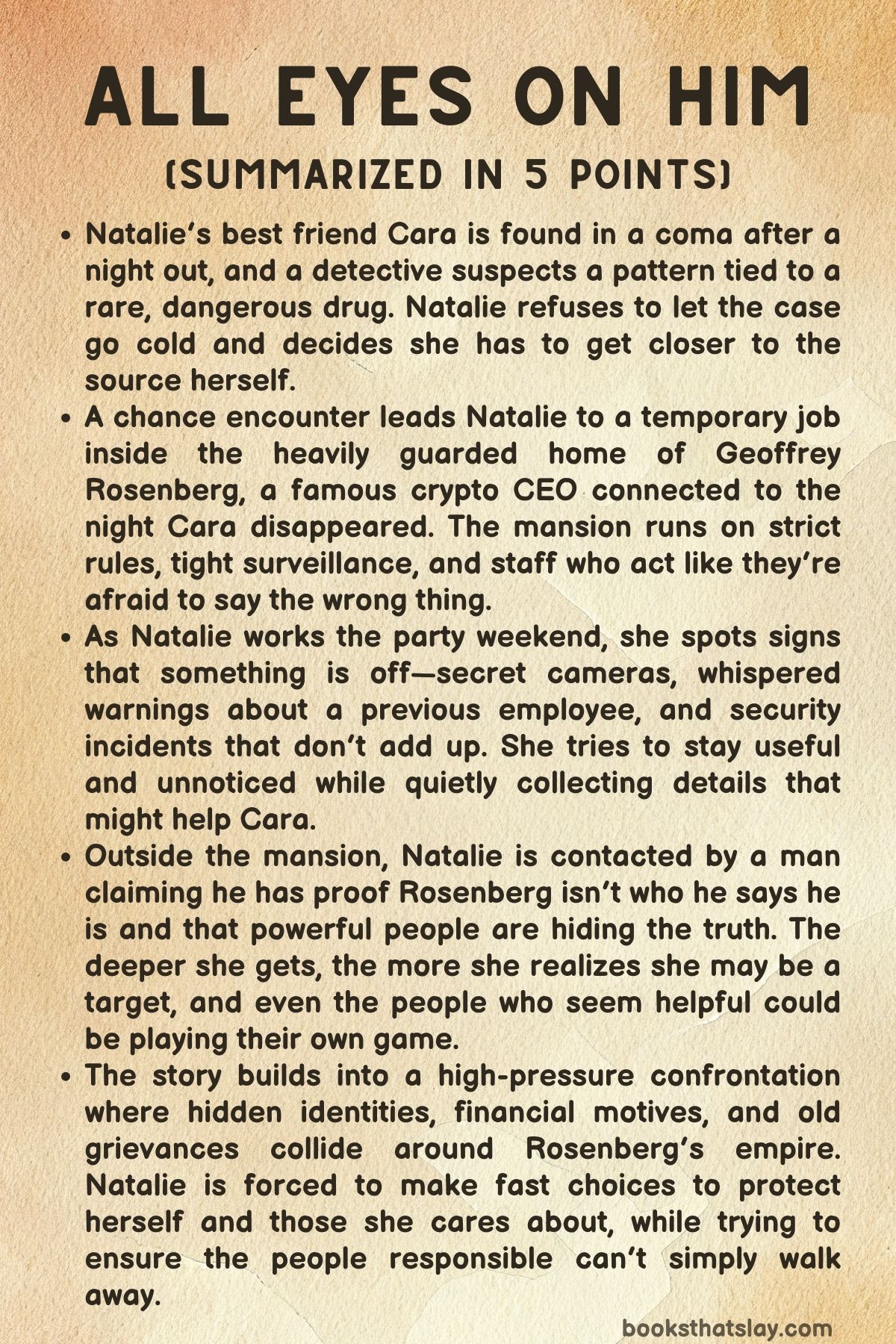
Characters
Natalie Olsen
Natalie Olsen is the emotional and moral center of All Eyes on Him. She begins as an ordinary young woman weighed down by grief, instability, and fear, but she is driven by fierce loyalty when her best friend Cara is left in a coma.
Natalie’s character is defined by persistence and desperation—she cannot accept helplessness, so she forces herself into the dangerous world of Geoffrey Rosenberg’s mansion to search for answers. What makes Natalie compelling is her combination of vulnerability and courage: she is constantly frightened, frequently overwhelmed, yet she keeps moving forward.
Her arc is one of survival and awakening, as she gradually realizes that the danger around her is far more complex than a single villain. Natalie also represents the theme of how easily innocence can be manipulated, as she is repeatedly watched, used, and threatened, yet still manages to reclaim agency by the end.
Cara
Cara serves as the catalyst for the entire story, even though she spends most of it unconscious. Her coma symbolizes the silent suffering of victims whose voices are taken away, and her condition becomes Natalie’s driving motivation.
Cara’s role is not only personal but thematic—she represents how predatory systems can destroy lives without leaving obvious evidence. Even in absence, Cara’s presence looms heavily over Natalie’s choices, reminding readers that the mystery is not abstract but deeply human.
By the end, the revelation that Cara may have had deeper connections to Phil Crain complicates her role, suggesting she may not have been only a victim but also someone with her own hidden knowledge and motives.
Geoffrey Rosenberg / Phil Crain
The figure presented as Geoffrey Rosenberg is one of the most layered characters in All Eyes on Him, because the identity itself is a performance. Phil Crain, the man acting as Rosenberg, embodies fraud, weakness, and self-destruction.
He is not the mastermind but a puppet, trapped in addiction and fear while playing the role of a powerful CEO. Phil’s alcoholism and recklessness make him dangerous, but also pitiable, as he is clearly manipulated by forces stronger than him.
His character explores the theme of illusion—how wealth, charisma, and status can be manufactured, and how easily society accepts the mask. Phil ultimately becomes both villain and victim, punished for crimes that were not entirely his own.
Nick
Nick is the true predator of the novel, hiding behind charm, professionalism, and the role of a loyal driver. His character is defined by control—he orchestrates druggings, disappearances, financial crimes, and identity manipulation with chilling precision.
Nick represents the terrifying reality of someone who blends seamlessly into the background while holding immense power. What makes him especially disturbing is his ability to appear supportive and even flirtatious with Natalie, using trust as a weapon.
Nick’s downfall comes not from sudden weakness, but from the inevitable collapse of arrogance and cruelty. He is the embodiment of exploitation, proving that the most dangerous monsters are often the ones who seem ordinary.
Julien / Luke
Julien is one of the most morally complex characters in All Eyes on Him. Introduced as a cold, rigid house manager, he gradually reveals himself as part of a covert mission against Nick.
Julien operates in shades of gray—his goal is justice, but his methods are ruthless, including surveillance, intimidation, and torture. His protectiveness toward Natalie shows that he is not without conscience, yet he remains willing to sacrifice ethics for results.
His personal connection to the false Detective Dupin adds emotional depth, showing that revenge and grief fuel his actions. By the epilogue, when he reveals his real name as Luke, he becomes a symbol of reinvention and unfinished morality, leaving readers uncertain whether to trust him fully.
Walter
Walter initially appears as a hostile gardener, but his true identity as an operative makes him far more significant. He represents the hidden machinery behind Julien’s mission, someone willing to do the brutal work others hesitate to perform.
Walter is pragmatic, hardened, and driven by the belief that extreme threats require extreme responses. His readiness to escalate torture shows how justice can blur into vengeance.
Walter’s character highlights the unsettling idea that even those fighting evil can become frightening themselves, suggesting that morality is fragile under pressure.
Rosalie
Rosalie is the embodiment of fear and survival within the mansion. As head housekeeper, she has seen too much, knows too much, and lives under constant threat.
Rosalie’s warnings to Natalie reveal her protective instincts, but also her resignation—she believes silence is the only way to stay alive. Her panic when Natalie discovers the hidden camera shows how deeply trapped she feels.
Rosalie represents the bystanders who are forced into complicity, not because they are evil, but because they are terrified. Her character adds emotional realism, showing the cost of living inside a controlled and abusive environment.
Detective Lesley Dupin (False Identity)
The detective initially appears as a figure of law and order, but the later twist that she is not truly a detective transforms her role entirely. Dupin becomes a symbol of manipulated authority, showing how easily trust can be exploited.
Her connection to Julien reveals that she is part of a personal revenge operation rather than an official investigation. Her past trauma—loss, miscarriage, and staged violence—adds depth to her motives, making her less a deceiver for deception’s sake and more someone shaped by pain.
She reflects the theme that justice in this world is not clean or institutional, but personal and messy.
Rich
Rich is the desperate whistleblower figure whose presence introduces the truth about Phil Crain’s fake identity. He is reckless, motivated by money and revenge, but also one of the few who tries to expose Nick’s crimes.
Rich represents the danger of knowing too much—his sudden death reinforces how quickly threats are erased in this world. Though not heroic, Rich plays a crucial role as the bridge between Natalie’s suspicions and the deeper conspiracy, showing how information itself can be fatal.
Darla
Darla exists mostly as an absence, much like Cara, but her story adds weight to the pattern of victims. She is the previous housekeeper who suffered the same drug-induced fate, proving that Cara was not an isolated case.
Darla’s implied death becomes one of the strongest warnings Natalie receives, and her tragedy symbolizes how disposable vulnerable women are to powerful predators. Even in death, Darla matters because the epilogue suggests restitution through financial compensation for her family, acknowledging the human cost of the conspiracy.
Emily
Emily appears only in the opening, yet her story sets the psychological foundation of the novel. Her escape from forced abortion and the staged car crash reveal the extreme violence of control and coercion.
Emily represents the long history of women being manipulated, sedated, and stripped of autonomy. Her fate is haunting, and her presence frames the novel as not just a thriller but a story about bodily agency, survival, and the terror of intimate betrayal.
Lindsey
Lindsey, Natalie’s friend who died of cancer, is a quieter but important influence. She represents Natalie’s accumulated grief and explains why Cara’s condition feels unbearable.
Lindsey’s death shapes Natalie’s desperation—she cannot endure losing another friend. Though Lindsey is not part of the central conspiracy, she is essential emotionally, grounding Natalie’s actions in genuine love and fear rather than simple curiosity.
Lilly
Lilly, Natalie’s neighbor, plays a small but meaningful role as a symbol of ordinary kindness. By lending Natalie her phone, she becomes part of Natalie’s fragile support system outside the mansion’s surveillance.
Lilly represents the normal world Natalie is fighting to return to, contrasting with the paranoia and control of The Splendors.
Dave and Steve
Dave and Steve, the mansion guards, represent the outer layer of Rosenberg’s constructed security. Their hostility and secrecy reinforce the sense that The Splendors is less a home than a fortress.
Dave’s violent confrontation with the outsider trying to expose Rosenberg shows how aggressively the estate protects its secrets. They function as reminders that danger is enforced not only through masterminds like Nick, but through everyday men doing paid work for the system.
Trixy
Though only a pet rat, Trixy carries symbolic weight. Her escape and the moved cage object confirm Natalie’s apartment has been violated, reinforcing the theme that nowhere is safe.
Trixy also reflects Natalie’s vulnerability—small, trapped, dependent—yet still alive and fighting, much like Natalie herself.
Themes
Control, coercion, and the violence of “choice”
Emily’s opening crisis establishes how control can hide behind the language of practicality and care. The partner who insists they are “not ready” frames the pregnancy as a problem to manage, then escalates from persuasion into physical domination through sedation, scheduling, and transportation.
The horror is not only the threatened procedure but the engineered removal of Emily’s ability to consent in any meaningful way. That same logic of forced compliance returns in the present through the drug used on Cara and other women: a chemical shortcut that turns a person into an object that can be moved, silenced, and discarded.
The story keeps returning to the gap between what powerful people claim is voluntary and what is actually arranged through pressure, surveillance, money, and fear. Natalie’s experience at The Splendors shows coercion in a more corporate form: rules that sound like workplace policy but function as isolation, confiscation of communication, and restriction of movement.
Even the “paid in cash” detail suggests an environment designed to reduce traceability and reduce a worker’s options for recourse. Across these situations, bodily autonomy is not treated as a private right but as contested territory, and the cost of resisting control is immediate retaliation—mechanical sabotage, stalking, threats, and the ever-present risk of being drugged.
The theme lands hardest in the way the victims are denied a public narrative: if they survive, they may wake without memory; if they do not, the system absorbs them as unfortunate incidents. Coercion is not a single villainous act but an operating model that thrives when social authority, wealth, and plausible deniability can be used to make domination look like normal decision-making.
Surveillance and paranoia as an everyday environment
The mansion is less a home than an instrument. Cameras appear where they should not exist, and even decorative objects can be hollowed into tools of observation.
Natalie’s discovery that an ornament contains a hidden camera reframes every room as a space where someone else may be watching, judging, or recording. This isn’t presented as flashy gadgetry; it is presented as a psychological climate that forces people to self-edit.
Staff members enforce rules with a fear that feels trained rather than chosen, and the building’s routines reward obedience while punishing curiosity. The watcher perspective deepens the theme by showing how surveillance creates a hierarchy of knowledge: those who see do not have to explain themselves, while those who are seen must constantly justify their presence.
Natalie begins to live the logic of monitored life outside the mansion too—cars that may be following her, an apartment that may have been entered, phone calls treated as traceable, and instructions to use alternate devices. The result is a shrinking of safe space.
Work, commute, and home become equally penetrable, so the mind learns to expect intrusion as normal. This pressure distorts relationships: Nick’s flirtation feels like a lure because intimacy can be another form of access, and Rosalie’s warnings feel like betrayal because fear has taught her to protect herself by limiting what she shares.
The theme also points to a modern kind of power that does not rely on brute force in public. It relies on invisibility, recording, selective disclosure, and the ability to make someone doubt their own perception.
In All Eyes on Him, surveillance is not just a plot device; it is the atmosphere that makes abuse sustainable, because it teaches everyone in the system that the safest behavior is silence.
Gendered vulnerability and predation hidden inside glamour
The setting frequently places danger inside scenes that are supposed to signal success: nightclubs, VIP sections, mansion parties, polished investor events. Women are invited into proximity with power and luxury, then harmed in ways that are hard to prosecute and easy to deny.
The drug functions as a predatory tool that avoids visible violence, and the absence of assault evidence becomes part of the perpetrator’s shield. The narrative also highlights how quickly a woman’s credibility becomes contested.
Natalie’s observations can be reframed as jealousy, fixation, or slander; victims can be framed as intoxicated, reckless, or unreliable. Even workplace roles become gendered vulnerabilities: a housekeeper is expected to be present but unseen, close to intimate spaces yet socially powerless.
Rosenberg’s comments on Natalie’s appearance and his demand for a massage show how quickly employment can be sexualized when the employer assumes entitlement. The presence of heavy security does not protect women; it protects the event’s image and the boss’s access.
Rosalie’s fear and Darla’s fate show what happens when a woman in the system is labeled “a problem.” At the same time, the story complicates victimhood by revealing motives and hidden histories, suggesting that survival sometimes requires tactics that look morally messy from the outside. In the story, glamour is not a contrast to danger; it is the cover that makes predation easier, because it persuades outsiders that nothing truly bad could be happening in such expensive, curated spaces.
Technology, money, and the fragility of modern trust
The crypto company’s rise, the IPO, and the offshore transfers place financial systems at the center of the thriller’s stakes. What looks like innovation becomes a mechanism for theft, and the excitement of “the next big thing” becomes a distraction that discourages scrutiny.
The “ghost” phone and near-empty digital footprint show a deliberate strategy: the absence of records is itself a weapon, because modern accountability depends on logs, messages, and traceable history. The passkeys function like the story’s version of a master key to reality; without them, authorities can arrest a person and still fail to recover what was taken or prove how it was done.
This creates a world where crime is not only physical but infrastructural, and where the public’s trust is a resource to be harvested quickly before skepticism catches up. Even the identity fraud is tied to technology’s culture of hype: if markets reward story over verification, a convincing figurehead can open doors that should require deeper checks.
The theme also extends to personal technology: Natalie’s phone becomes a liability, calls become potential tracking vectors, and recording becomes both evidence and risk. In All Eyes on Him, technology is not shown as inherently evil; it is shown as amplifying whatever intent sits behind it.
When intent is predatory, tech makes the predator faster, harder to trace, and more capable of hiding behind complexity while victims are left trying to prove harm in a world that treats missing data as reasonable doubt.