An Arcane Inheritance Summary, Characters and Themes
An Arcane Inheritance by Kamilah Cole is a dark academic fantasy set at Warren University, a prestigious Ivy League school with an unsettling reputation. The story follows Ellory Morgan, a scholarship student determined to succeed in law, who begins experiencing strange gaps in reality, haunting déjà vu, and impossible events on campus.
As her rivalry with wealthy senior Hudson Graves shifts into an uneasy alliance, Ellory uncovers secrets tied to Warren’s founding families and a hidden magical order. What begins as an unsettling mystery becomes a fight for memory, identity, and survival.
Summary
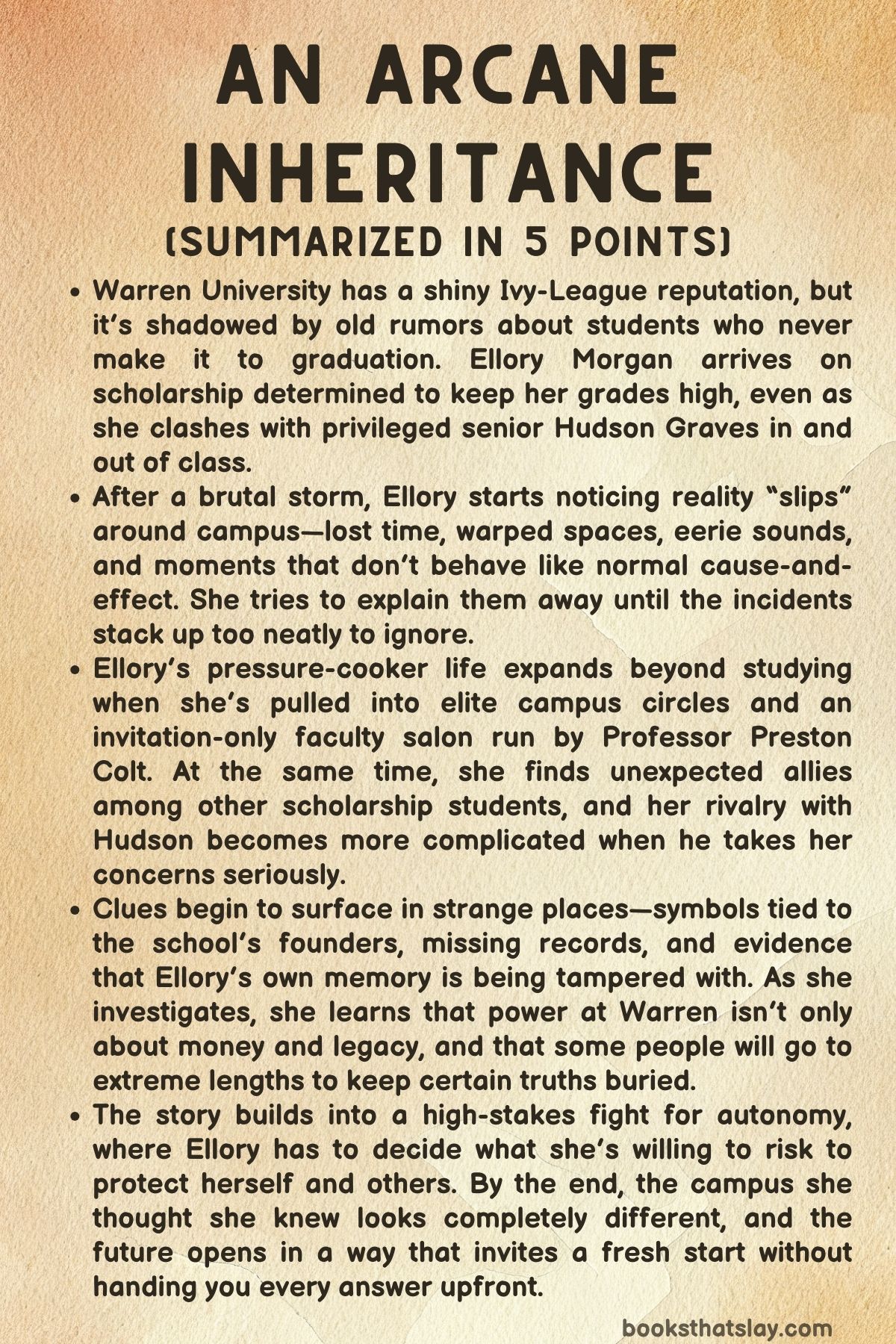
Ellory Morgan arrives at Warren University with everything riding on her success. As a first-year student studying constitutional law, she knows her scholarship is her only chance at the future she wants.
Warren is intimidating in every way: its wealthy student body, its competitive academic culture, and its long history of rumors about students who disappear before graduation. Ellory tries to ignore the ghost stories and focus on her work, but almost immediately, something feels wrong.
She spends long hours studying in Graves Library, a towering building with eerie underground levels that make her uneasy. Ellory avoids the lower floors, sensing something oppressive beneath the school’s polished surface.
It is there that she repeatedly clashes with Hudson Graves, a senior from one of Warren’s richest legacy families. Hudson is arrogant, sharp, and always seems to be watching her.
Their debates in class become personal, pushing Ellory to prove she belongs at Warren as much as he does.
One day, after leaving the library during a violent storm, Ellory realizes she has forgotten her textbook. Hudson returns it to her, but their exchange quickly turns into another argument.
As Ellory walks back to her dorm, the storm intensifies unnaturally. The campus shifts into something unfamiliar, as if landmarks are erased and the world has tilted sideways.
Ellory becomes lost in a place she should recognize, hearing strange laughter in the distance. Just as panic takes over, her sense of direction suddenly snaps back, and she finds herself safely at Moneta Hall.
This moment echoes something from Ellory’s childhood, when she once became lost on a street that seemed stretched beyond reality. She had spoken with a shop owner who should not have been alive, only to learn later that the woman died in a fire.
Since then, Ellory has trained herself to dismiss such experiences as imagination. But at Warren, the distortions keep happening.
Soon, Ellory experiences another impossible event. A soccer ball is kicked toward her at high speed, but before it can strike, a blinding flash erupts and the ball stops short.
The ground cracks in a perfect circle around her feet. Other students stare, and Hudson looks shaken, warning her to be careful.
Ellory cannot explain what happened, but she knows it was real.
Her anxiety grows, especially under pressure from her aunt, who insists Ellory must focus only on becoming a lawyer. Still, Ellory is drawn toward the elite student newspaper, the Warren Communiqué, even though she believes she cannot afford distractions.
Her friend Tai convinces her to attend a party for a break, only for Ellory to realize it is being held at Hudson’s house.
At the party, Ellory meets Liam Blackwood, a charming student who introduces her to other scholarship kids struggling to survive Warren’s culture. Later, Ellory wanders upstairs and accidentally enters Hudson’s bedroom, finding it filled with books.
She is surprised to see a well-worn copy of bell hooks among them, revealing a side of Hudson she did not expect. Their conversation feels oddly familiar to Ellory, as if it has happened before.
Before she can leave, Hudson invites her to an exclusive October salon hosted by Professor Preston Colt, a powerful figure among Warren’s elite. Ellory accepts cautiously, suspecting some kind of trap, but curiosity wins.
At Colt’s mansion, Ellory is surrounded by wealthy students and influential adults who interrogate her background with thinly veiled prejudice. Overwhelmed, she retreats to the bathroom, where she discovers something terrifying: a tattoo on the back of her neck that reads “RemƎmber” in her own handwriting, marked with a backward E. When she tries to photograph it later, the tattoo vanishes completely, even from her phone.
Determined to understand what is happening, Ellory searches for answers in books about memory and the occult. She finds a hidden note written in her own hand that says Hudson will help.
Furious and frightened, she confronts Hudson, finally telling him everything: the déjà vu, the visions, the disappearing marks, and the reality glitches. Hudson believes her.
He admits he witnessed the soccer field incident and has no explanation. Together, they begin investigating Warren’s history.
Ellory learns about Warren’s founders, the “Lost Eight” students who vanished across decades, and symbols tied to legacy families. She begins to suspect the university was never just an Ivy League school, but something else entirely.
As Ellory’s experiences worsen, Hudson suggests the truth may be even stranger: Ellory might be using magic herself. She refuses to believe it until she experiments alone on Bancroft Field.
By focusing on restoring the damaged grass, she succeeds, but at a cost. Her head aches, her neck burns, and she realizes she cannot remember what the field looked like before.
Her magic alters reality by consuming her memories.
Ellory’s fear turns into anger when a masked attacker appears outside her dorm. She fights back, but the attacker uses unnatural force against her.
Hudson arrives and unleashes vivid magical fire, destroying the attacker. Hudson is as shocked as Ellory, admitting he did not know he could do that.
Their bond deepens, but so does Ellory’s distrust. Hudson has been hiding things.
Ellory discovers connections between Warren’s occult history and her roommate Stasie’s powerful family. She also learns Hudson’s family has magical ties, and that Hudson manifested power as a child before losing memory of it.
Ellory begins to understand that memory loss is not just a side effect, but part of the system trapping them.
Then everything collapses. Ellory tries to meet Colt for answers, but Hudson disappears.
Suddenly, Hudson and Boone Priestley are erased from reality. No one remembers them.
Records change. Even Hudson’s own roommate insists Hudson never existed.
Ellory is the only one who still knows the truth.
Ellory storms back to Colt’s mansion, where she discovers the horrifying reality. Colt and the Old Masters, Warren’s secret magical order, have been keeping powerful students in enchanted sleep, siphoning their magic.
Ellory has been trapped in a constructed dream for three years, reliving an artificial Warren while her power is drained.
Tai and others are imprisoned in glowing spheres, their bodies suspended. Ellory escapes into the hidden schoolhouse near the lake, pursued by the Old Masters.
Liam reveals he is part of the dream, created to distract her, yet he confesses real feelings for her. Ellory refuses to give up.
In the tower, Ellory finds her true body floating in an orb alongside other trapped students. The spirits of the Lost Eight appear, explaining they were drained until death, but Ellory is different because she fought to uncover their stories.
They offer their power to help her wake and destroy the Old Masters’ cycle.
On the rooftop, Ellory confronts the Old Masters and discovers Hudson standing among them. Hudson has been used as part of the reset mechanism, a familiar figure meant to guide her through repeated loops.
In a brief private moment, Hudson helps Ellory hold on to her memories and break free.
Ellory awakens fully, power surging through her. With the Lost Eight beside her, she shatters the orbs, freeing the students and collapsing the Old Masters’ operation.
Warren returns to ordinary life, though scars remain beneath the surface.
In the aftermath, Ellory begins rebuilding. She keeps watch over Warren, determined that the hidden order will never rise again.
The story closes with Ellory meeting Hudson once more in the library, now strangers again, trading familiar banter and exchanging numbers, hinting at a future beyond the broken cycle.
Characters
Ellory Morgan
Ellory Morgan is the emotional and moral center of An Arcane Inheritance: a scholarship student trying to outwork every disadvantage while quietly carrying a lifelong relationship with the uncanny. Her intelligence shows up as discipline and structure—she thinks in arguments, evidence, and cases, so when reality starts glitching she does not collapse into superstition.
She documents, cross-references, tests hypotheses, and treats fear like a problem to solve. That rigor also becomes a vulnerability, because she has been trained to rationalize what she experiences, especially after childhood adults dismissed her encounter with Miss Claudette.
Ellory learns to mistrust her own perception, which makes the Old Masters’ manipulation especially effective. As her magic reveals itself, her defining conflict sharpens: she can change reality, but the cost is memory—identity itself.
Her bravery is not just running toward danger, but choosing to keep searching even when that search may erase the very reasons she began. Her arc moves from survival through explanation to agency, as she refuses erasure and becomes someone capable of carrying other people’s stories, not just her own, into the waking world.
Hudson Graves
Hudson begins as a polished antagonist figure—wealthy, entitled, academically combative—and the narrative deliberately uses that first impression to make his later complexity feel earned. His sharpness in class and his habit of correcting Ellory’s assumptions read as arrogance, but they also signal a personality built around control.
He manages rooms, manages narratives, and manages himself. When Ellory’s reality fractures, Hudson becomes both witness and problem: someone who sees enough to be useful, but whose place inside Warren’s legacy networks makes him impossible to fully trust.
He is defined by compartmentalization. He can be protective in small, precise ways while still withholding larger truths, including from himself.
The revelation that he manifested magic as a child during domestic violence reframes his earlier stiffness; the formal diction, obsession with knowledge, and reflex to police social space all become coping mechanisms. His most tragic dimension is that he is both victim and instrument: tied to the reset machinery and used to stabilize Ellory’s looping year, yet still capable of real care.
The final separation matters because he helps her preserve memory and choice even though it costs him his place in her world.
Stasie O’Connor
Stasie operates as an everyday, cutting counterpoint to Ellory’s spiraling interiority, and her sharpness is more than simple roommate friction. It is an early, mundane mask for how power hides in plain sight.
Her coldness, boundaries, and impatience with Ellory’s distress initially read as self-centered pragmatism, but the narrative gradually turns that affect into a clue: she belongs to a lineage with proximity to Warren’s buried architecture of control. Her refusal to “see” the tattoo—supported by photographic absence—makes her an unwilling collaborator in gaslighting, whether she means to be or not.
That ambiguity is crucial. She can be both a normal student who does not want drama and a person whose family system benefits from keeping certain truths unspoken.
When Ellory later maneuvers her into providing a path toward contacting her family, it highlights Ellory’s growth: she stops begging to be believed and starts strategizing around the structures that deny belief. Stasie embodies how institutional harm often feels in daily life—not like open villainy, but like dismissal, inconvenience, and a door quietly closing.
Taiwo Daniels
Taiwo is Ellory’s anchor, the friend who insists she is more than a GPA and more than a problem to be solved. As a resident assistant and a highly competent student, Tai has her own form of authority, but she uses it relationally—checking in, pushing Ellory toward rest, ensuring safety, and staying present after emotional collapse.
She is also the story’s social bridge. She gets Ellory out of isolation and into messy human spaces where the supernatural does not get to define everything.
Importantly, Tai is not naïve. Once Ellory confesses the truth, Tai believes her without turning it into spectacle, and even admits she has sensed reality bending too.
That matters because it prevents Ellory from becoming a lone chosen-one figure. Tai’s belief is a form of resistance against the system’s primary weapon: making its targets feel irrational and alone.
When Tai is later trapped in an orb, the stakes become intimate. The enemy is no longer abstract; it is consuming the people who love Ellory, making the fight about protection as much as survival.
Liam Blackwood
Liam is written as charm with an edge, and what makes him compelling is that his warmth feels real even after the plot complicates what “real” means. At first, he functions as relief and possibility.
He notices Ellory, feeds her, introduces her to other scholarship students, and offers a version of campus life that is not only competition and legacy hierarchy. His flirtation is easy, but not shallow.
He listens, lingers, and creates space for Ellory to be liked rather than evaluated. That is why his later role lands so effectively: he becomes the embodiment of seductive comfort as a trap, an affection that asks Ellory to stop searching and accept a softer prison.
The twist that dream-Liam is a construct designed to distract her could have flattened him into pure manipulation, but the narrative keeps him emotionally legible by giving him a sincere confession of love and a choice to help her anyway. That makes him tragic rather than disposable: both tool and person, both designed and desiring.
Boone Priestley
Boone is charisma, gatekeeping, and narrative control rolled into one. As editor-in-chief of the Warren Communiqué, he decides what becomes story and what remains rumor—an authority that mirrors the Old Masters’ larger power to decide what becomes history and what gets erased.
His humor and breezy vulgarity make him seem approachable, even liberating compared with the stiff elite culture, which is precisely why he is dangerous. He can invite someone in while quietly controlling the terms of inclusion.
His involvement in stretched-time moments and the reset mechanism frames him as an engineer of perception, someone who can literally create the space where a private conversation happens while the world is paused. Yet he is not portrayed as a simple monster.
His hesitation in the tower matters. It suggests a person who has learned to obey a machine larger than himself and perhaps convinced himself his role is necessary.
Ellory knocking him out with a flashlight is symbolically fitting: she refuses to debate the editor of reality and instead chooses action over rhetorical entanglement.
Professor Preston Colt
Colt’s menace is interpersonal before it is magical, which is what makes him so chilling. He does not threaten first; he comforts.
His salons look like intellectual prestige—lavish dinners, curated conversation, access—and that aesthetic of refinement becomes camouflage for predation. His most frightening power is his ability to soothe Ellory into doubting herself, to make her feel rude for being afraid, irrational for asking direct questions, and childish for mistrusting kindness.
The story treats this dynamic as grooming. He creates intimacy through attention and then leverages it into control, including subtle manipulation of Ellory’s body when she confronts him.
Once the Old Masters are revealed, he becomes the public-facing priest of the operation: translating exploitation into tradition, siphoning into scholarship, and captivity into care. Even after the collapse, he still appears outwardly normal, which underscores the unsettling point that systems like his often survive through social legitimacy.
Gaia Hammond
Gaia is the Old Masters’ violence made visible. She functions as the enforcement arm that turns institutional control into immediate physical terror.
The blank white mask strips personhood from the threat, which is why her reveal lands so well: the attacker is not some faceless monster from the dark, but a named participant who chose her role in the machine. Her power expresses itself as force—gusts that slam Ellory down, the boot poised to stomp—suggesting a worldview in which dominance is the clearest truth.
Against that, Hudson’s fire becomes a moment of inverted shock: both the elite heir and the masked enforcer are capable of violence, but one acts from panic and protectiveness while the other acts with disciplined cruelty. Her disappearance after the confrontation reinforces how the system erases evidence.
It is not just trying to hurt Ellory; it is trying to make the hurt unprovable.
Cody
Cody appears in fewer scenes, but he is used efficiently as a marker of Ellory’s ordinary life and a reminder that her crisis unfolds amid real work, real schedules, and real people who can become collateral damage. As the coworker who covers the counter while Ellory experiments with magic behind the shop, he helps not through belief in the supernatural but through simple solidarity.
That normalcy matters because it shows that her isolation is conditional, not absolute. She does have a world outside Warren’s prestige games, and the decision to later trap Cody confirms that the antagonists see that world as a threat.
By capturing him alongside Tai, they demonstrate that anyone close to Ellory can be used to pressure her back into compliance.
Aunt Carol
Aunt Carol represents the practical pressures shaping Ellory long before the occult does. She embodies a believable, painful kind of love: caretaking that becomes control.
Her insistence that Ellory focus on becoming a lawyer, and her dismissal of the newspaper as impractical, are not villainous on the surface. They come from fear of scarcity and from a worldview that treats security as the only acceptable dream.
But the effect on Ellory is constricting. It teaches her that wanting anything beyond survival is irresponsible, that rest is indulgence, and that selfhood must always be optimized.
That is why their call ends in tears. Ellory is not just sad; she is being asked to shrink.
On a thematic level, Carol mirrors the institution itself: both offer upward mobility on the condition that Ellory mute parts of herself.
Miss Claudette
Miss Claudette is a brief presence with enormous weight because she serves as Ellory’s origin wound: the first time she learns that the world can bend and that adults will deny it to protect their own reality. Claudette’s instruction to go home becomes a haunting paradox.
Either Ellory hallucinated, or she encountered someone already dead, or time folded in on itself—but in every version, the result is the same: a child carries the truth alone. The fire that kills Claudette turns that memory into guilt and confusion, while her parents’ dismissal teaches Ellory the habit that later endangers her at school—explaining away warning signs until it is almost too late.
Claudette therefore functions less as a ghost-story figure than as a template for the novel’s recurring pattern: supernatural perception arrives, authority denies it, and the cost of denial is paid in lives.
Imani
Imani sharpens the social reality of Warren by giving Ellory a peer who understands the scholarship-student grind without romanticizing it. Within the group Liam introduces, she contributes to a shared vocabulary of frustration about pretension, intensity, and being treated like an outsider inside an institution that claims to be meritocratic.
Her presence matters because it keeps Ellory’s struggle from feeling purely personal. It is structural as well.
Even when Imani is not central to the occult plot, she strengthens the critique of elite spaces by showing that they do not merely test students academically; they test whether those students will accept humiliation as the price of entry.
David
David functions similarly within the scholarship-student circle, helping establish that Ellory’s social world includes people who can name the institution’s absurdities out loud. He contributes to the sense of a parallel campus reality: one inhabited by legacy families and secret salons, and another inhabited by students who are constantly calculating time, money, and exhaustion.
His role reinforces the idea that prestige is built not only on wealth and access, but on the quiet extraction of labor and emotional endurance from those without a safety net.
Addison “Red”
Red is sketched with a distinctive nickname and a sharp, communal energy that makes the scholarship group feel lived-in rather than generic. Their main function is tonal: they offer irreverence that punctures Warren’s self-serious mythology.
In a story where reality is manipulated and memories are consumed, that irreverence becomes meaningful. It is a tiny refusal to treat the institution as sacred.
Even without driving major plot turns, Red helps illustrate what Ellory risks losing: not only memory, but also the chance to build a life containing laughter, ease, and comradeship.
Ximena
Ximena adds another angle on outsiderhood, broadening the scholarship group’s sense of difference and making clear that Warren’s pressures are experienced collectively, not in isolation. Her presence underscores that fit at the university is policed through culture as much as through grades: how you speak, what you know, where you have traveled, and what you can afford to treat as normal.
Like the others in the group, she helps keep the magical stakes tethered to the social stakes of class, race, and belonging.
Farrah Mayhew
Farrah functions as a social hinge character, connecting party-world proximity to real consequences—especially Malcolm Mayhew’s death and the fact that people are still quietly asking about him. Her confession that Ellory is only the second person to ask about Malcolm that week becomes a clue with emotional force.
The dead are not just lore at Warren; they are unresolved stories someone is trying to manage. Farrah’s distance from the details matters too.
She is family, but still excluded from full knowledge, which echoes how secrecy works in elite lineages: even insiders are given only curated truths.
Malcolm Mayhew
Malcolm is more absence than presence, but his death functions as a warning flare that the school’s ghost stories are not metaphorical. He represents the kind of person an institution can lose and then narrativize away—tragedy turned into rumor, fear turned into folklore.
The fact that questions about him are rare, and that Hudson has also been asking, positions Malcolm as part of the suppressed record Ellory is trying to reconstruct. He helps move the missing-students motif from atmospheric to political: someone benefits from forgetting, and the cost of forgetting is measurable in bodies.
Cairo Graves
Cairo matters less for page time than for what he reveals about Hudson’s family ecosystem. As the brother who has always known about the family’s magic, he embodies inherited secrecy—knowledge treated like property, passed down according to hierarchy and convenience.
His existence emphasizes that Hudson’s memory loss is not just personal repression but part of a family culture that decides what the next generation is allowed to know. Cairo clarifies why Hudson’s trust is so complicated: he comes from a world where truth is strategic, not communal.
Nathaniel Graves
Nathaniel represents the Graves family’s deeper entanglement with Warren’s controlling apparatus. His presence among the Old Masters at the climax signals that the Graves name is not just a donor plaque but a functioning part of the machine that resets, erases, and siphons.
That implication darkens Hudson’s early entitlement in retrospect. It is not only personal arrogance, but the posture of someone unconsciously shaped by a system that has always bent reality to suit itself.
Nathaniel stands for the cold continuity of that system and its ability to reproduce itself across generations under the name of tradition.
Arthur “Artie” O’Connor
Artie O’Connor sits at the intersection of respectable institutional history and hidden brutality. As a former dean tied to occult projects and the Old Masters’ mythology, he symbolizes how authority can legitimize the unnatural.
When power wears an academic title, predation can pass for research, and coercion can pass for mentorship. His connection to Stasie makes the threat feel domestic and immediate.
Ellory is not investigating a distant cabal; she is living alongside a bloodline that may have helped build the cage.
Themes
Memory as the Price of Survival
Ellory’s experience at Warren University is shaped by a constant tension between what she knows and what she can hold on to. From the beginning, her reality feels unstable: moments of déjà vu, distorted spaces, missing time, and visions that others dismiss as stress or delusion.
These episodes are not simply frightening interruptions, they represent the way memory becomes the foundation of identity. Ellory tries to ground herself through logic, documentation, and academic discipline, but the world around her keeps proving that rational explanation is not enough.
In An Arcane Inheritance, memory is not only personal history, it is currency. Ellory’s magic works by consuming pieces of what she remembers, meaning every act of power demands sacrifice.
This creates a devastating dilemma: to protect herself and others, she must give up parts of the very self she is fighting to preserve. The disappearing tattoo, the notes written in her own handwriting, and the way photographs fail to capture evidence all reinforce the idea that memory is fragile and easily manipulated.
The Old Masters’ control depends on erasing people, rewriting narratives, and trapping students inside constructed cycles where forgetting is enforced. Ellory’s resistance is rooted in her refusal to let her experiences be dismissed or erased, even when no one else can confirm them.
Her determination to remember becomes an act of rebellion. The Lost Eight are significant because they represent what happens when stories are forgotten entirely: lives reduced to rumors and missing records.
Ellory’s struggle shows that survival is not only about escaping physical danger, but about holding on to truth in a system designed to make truth disappear.
Power, Privilege, and Institutional Control
Warren University presents itself as prestigious, elite, and progressive, yet underneath that polished surface is a structure built on exploitation. The campus is filled with legacy families, wealth, and entitlement, embodied most clearly in characters like Hudson Graves and Boone Priestley.
Ellory enters this environment as a scholarship student, constantly reminded that her place is conditional. Conversations at Colt’s salon expose how deeply class and race shape belonging, as Ellory is forced to justify her presence while wealthy students treat success as inheritance rather than effort.
In An Arcane Inheritance, privilege is not only social, it is supernatural. The Old Masters represent an extreme version of institutional power: a hidden group that literally siphons magic from others in order to maintain dominance.
Their system mirrors the way elite institutions often sustain themselves by taking from vulnerable people while presenting themselves as benefactors. Ellory’s academic ambition, her desire to join the newspaper, and her drive to become a lawyer all exist within this pressure to prove she deserves access.
Even Hudson, who initially appears untouchable, is revealed to be trapped by his family’s expectations and by the legacy system that shaped him. The university’s reputation, its ghost stories, and its missing students become symbols of how institutions bury uncomfortable truths to protect their image.
The Old Masters erase students from memory and records, demonstrating the ultimate power of authority: deciding who counts as real. Ellory’s fight against them becomes larger than personal survival, it is a confrontation with an entire structure that thrives on control, secrecy, and the exploitation of those without protection.
Reality, Manipulation, and the Fear of Being Disbelieved
Ellory’s journey is marked by the unsettling sense that reality itself cannot be trusted. Early distortions, shifting landmarks, eerie laughter, and impossible घटनाएँ suggest that the world is unstable, but the deeper horror comes from the way others respond.
Ellory has been trained since childhood to doubt herself, especially after the traumatic incident with Miss Claudette. Her parents’ dismissal taught her that even true experiences can be labeled hallucinations.
This fear follows her into Warren, where supernatural events are consistently denied, minimized, or erased. In An Arcane Inheritance, manipulation is psychological as much as magical.
The Old Masters’ greatest weapon is not violence, but control over perception. They create a constructed reality, remove people from existence, and make entire communities forget.
When Hudson and Boone vanish, Ellory is left isolated, carrying knowledge that no one else can confirm. This reflects a real terror: being the only person who remembers something true.
The dream revelation intensifies this theme, showing that Ellory’s life has been shaped inside a prison made of illusion. The world she trusted becomes a tool of captivity, and even relationships, like Liam’s, are complicated by the possibility of fabrication.
The novel highlights how easily systems can distort truth when they control information. Ellory’s insistence on evidence, her Word file, her research, and her confrontation with Colt are all attempts to reclaim certainty.
The story suggests that reality is not only what is seen, but what is agreed upon, and when powerful forces can rewrite that agreement, resistance begins with refusing to accept forgetting as normal.
Trust, Connection, and Choosing Each Other in a Hostile World
Amid the paranoia and erasure, relationships become both dangerous and necessary. Ellory’s connection with Hudson begins in rivalry and resentment, shaped by class difference and misunderstanding.
Yet as strange events escalate, trust becomes a slow, fragile process. Hudson’s belief in Ellory is significant because it offers her something she rarely receives: validation.
At the same time, Hudson’s secrecy and fear show how difficult honesty is when survival depends on hiding. In An Arcane Inheritance, trust is never simple.
Tai represents steady friendship, pushing Ellory toward balance and reminding her she does not have to face everything alone. Liam complicates the theme further, embodying comfort and affection while also being part of the constructed dream meant to distract Ellory.
His love feels real, but it exists inside manipulation, forcing Ellory to confront how connection can be weaponized. The Old Masters isolate students by making them forget each other, proving that community is a threat to control.
Ellory’s ultimate strength comes not only from magic, but from her refusal to abandon others. She cares about the Lost Eight, about Tai and Cody, about students whose stories were erased.
Her ability to fight back is tied to remembering relationships and choosing solidarity over isolation. Even the ending, where Ellory and Hudson meet again as strangers, suggests that connection can be rebuilt outside cycles of exploitation.
Trust becomes an act of courage, a decision to keep reaching for others even when reality itself has been shaped to break bonds apart.