To Ride A Rising Storm Summary, Characters and Themes
To Ride A Rising Storm by Moniquill Blackgoose is a political fantasy novel about a young dragoneer, Anequs, and the world that tightens around her as her bond with a rare dragon becomes impossible to ignore. Returning home for summer, she finds her island reshaped by Anglish authority, surveillance, and fear—while her own community wrestles with practical survival, cultural continuity, and the cost of defiance.
The story follows Anequs as she balances love, loyalty, and responsibility, moving between family life, academy demands, and rising unrest that soon turns into open conflict.
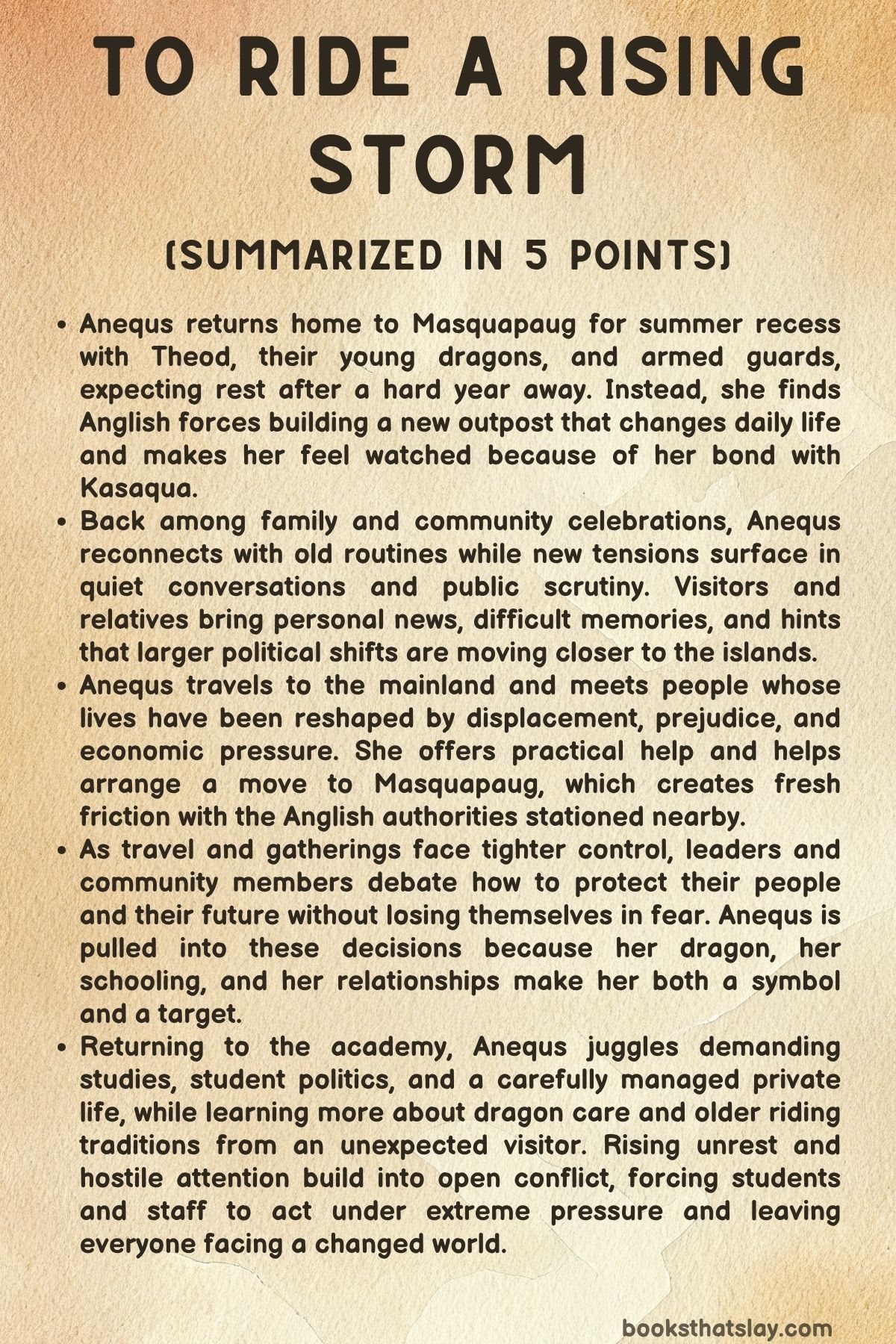
Summary
Anequs returns by boat from Kuiper’s Academy to Masquapaug for summer recess, traveling with Theod, their dragons Kasaqua and Copper, and guards arranged by the jarl’s office. The homecoming is jarring.
A new Anglish thanegard encampment has appeared, along with construction of a large outpost near the road from the docks—an assertion of control that Masquapaug never wanted. Anequs learns the decision followed an assassination attempt on the jarl on May 9, when a Raven of Joden fired at Anequs and Kasaqua.
Kasaqua killed the attacker, and the Ministry of Dragon Affairs used the incident as justification to force an outpost onto Masquapaug, despite treaty limits. Anequs recognizes the unspoken truth: the outpost exists because she is Nampeshiweisit, bonded to Kasaqua since the dragon hatched, and because Anglish officials are eager to judge whether a dragon’s companion is “fit.”
Home offers comfort as well as tension. Anequs reunites with her mother and siblings for the first time since Nikkomo, settles back into familiar routines, and enjoys meals, beach gathering, and the quiet pleasures of being known.
The village welcomes her and Theod warmly, and the dragons splash and play along the shallows. Yet Anglish eyes are everywhere.
During a large welcoming feast and dance, outpost men arrive to watch, question, and take note of visitors—especially people arriving by canoe from Naquipaug. Anequs tries to focus on family and friends, but the scrutiny sits like grit in her teeth.
The celebration brings personal matters to the surface. Theod is pulled into dances he barely understands, and Hekua teases him into participating, threatening he’ll owe her a massive “boon” if he refuses.
Afterward, Theod tells Anequs plainly that she’s the only girl he’s interested in, leaving her flustered and uncertain about what comes next. Anequs also learns from her cousin Mishona that she may be pregnant, a private worry set against the public stress of the new outpost.
Sachem Tanaquish explains why the community accepted the outpost at all: the jarl praised Anequs and Theod and pushed formal integration, and recognition as a district came with strings attached. Masquapaug chose the least harmful option, even if it still burns.
As the early summer days pass, Anequs reads piles of letters and telegrams: invitations, condemnation from strangers, praise from others, and a note from Ingrid Hakansdottir—whose father died in anti-nackie violence—inviting Anequs for tea. Anequs decides to go.
When she makes the trip arrangements, Theod meets her and warns that Naquipaug is tense: Nack Port is closed to nackies, rumors swirl about dragoneers, and a dragonhall is being built that may not be meant for them. At the Masquapaug ferry office, Captain Trov Johansen requires travelers to sign a guestbook listing names and purposes.
Anequs signs, furious at being turned into a record.
In Catchnet, Ingrid and her brother Aksel greet them and guide them through neighborhoods where reactions to the dragons range from fear to fascination. Ingrid’s family lives in cramped conditions after being displaced.
Over tea, Ingrid’s mother reveals she now goes by Wigdis and speaks carefully about ancestry, old wars, and a Confederation of the First People—something authorities label dangerous. Wigdis can’t find work and asks how one might petition to live on Masquapaug.
Anequs offers money for ferry fare and promises to introduce her to Sachem Tanaquish. Back on Masquapaug, the sachem agrees to ask households whether anyone can host Wigdis and her children.
Masquapaug prepares for Strawberry Thanksgiving with berry gathering and preserving, a season of shared labor and abundance. Wigdis, Ingrid, and Aksel arrive and sign the guestbook under the watch of the outpost, while Anglish laborers step off the same ferry to build structures meant to dominate the island.
The sachem arranges lodging with an elder, Chansompsqua, who welcomes the newcomers with warmth and dignity. Over days, the visitors learn local crafts, fish, and gather berries alongside Anequs’s family.
Ingrid is especially delighted to be close to Anequs and to see Kasaqua daily, as if proximity to the dragon offers a kind of safety she never had on the mainland.
At the Strawberry Thanksgiving feast, talk turns to alarming news: Anglish dragons and riders have appeared on Naquipaug near Nack Port. Plans for new councils and meetings circulate, along with dread about what they might mean.
During the gathering, Ingrid asks awkwardly why Anequs’s great-aunt Mamisashquee is dressed “like a woman.” Anequs explains that Mamisashquee is mupauanakausonat and regarded as a woman, then helps Ingrid ask her directly for a story. Mamisashquee tells a creation tale of islands formed, people settling, and the jealous pukwadjisuk being cast away to become enemies who still bring harm.
The story lands as more than entertainment; it is a warning about old grudges and ongoing danger.
After the celebration, Anequs and Theod finally talk about courting. Theod confirms his love for her.
Anequs admits she cares for him and is open to courting, but explains her people’s customs differ from Anglish expectations: relationships can be plural, marriage is not the only honorable structure, and children can be raised outside marriage without shame. Then she tells him the truth she’s been carrying—she also has feelings for Liberty.
Anequs wants honesty and consent, not secrets and betrayal. She suggests Theod and Liberty meet, and imagines a future where all three could choose each other openly, according to mutual agreement.
Theod is shaken, says he needs time, and leaves, shutting down the conversation. He returns to Naquipaug early and refuses to explain, and Anequs is left angry that “thinking” can become a way to avoid speaking.
Wigdis and her children soon move permanently to Masquapaug with almost nothing. Chansompsqua embraces them as family.
The Anglish outpost reacts badly. Captain Johansen confronts Sachem Tanaquish, demanding to know how people can register as residents intending to stay.
The sachem forces him to admit there’s no clear law being broken. Johansen storms off, promising to report it.
Worse, Wigdis’s relatives begin contacting the sachem about moving too, turning one family’s refuge into a larger test of Anglish control.
A meeting is called by Sachem Wompinottomak of Naquipaug. Sachem Tanaquish and Anequs travel by canoe instead of ferry, refusing to feed the guestbook system.
Naquipaug bears deep scars from massacre and resource theft, and the Anglish continue to take land they claim is “unused,” cutting forests and tearing at the island for coal. Anequs arrives to find North Village fortified, built for defense rather than comfort.
Wompinottomak himself is visibly marked by past resistance: a lame arm, heavy scars, and an eyepatch. He is stunned to see Kasaqua in person, as if the dragon is proof that old possibilities have returned.
Inside the meetinghouse, the mood is dangerous and charged. Elders dominate the room, and representatives of the Confederation of the First People are present, making the gathering feel like a line has been crossed.
Wompinottomak speaks of what the Anglish have done—ruining whales, forests, land, and lives—and frames unity as the only path forward. He points to his own wounds as evidence of what resistance costs, and invokes the memory of 1825 as both warning and fuel.
Kasaqua and Copper are treated not as curiosities but as signs and potential weapons, whether Anequs wants that role or not.
Then the thanegards arrive. A whistle screams, dragons land outside, and armed men enter backed by two silberdraches stationed at the door.
They declare the assembly unlawful and order everyone to disperse or be arrested. When asked what crime has been committed, they claim the gathering signals future violence and label attendees agitators and separatists.
They force everyone to give names, residences, and travel methods, and no one dares refuse with silberdraches blocking the exit. The message is clear: they can’t yet punish everyone, but they can identify, track, and intimidate.
Afterward, movement tightens across the region. Thanegards coordinate between islands to prevent nackies from traveling or relocating.
The Masquapaug ferry office is effectively shut down except for mail and telegrams, guarded by armed men. Anequs tries to contact the jarl, suspects interception, and instead routes messages through allies to Frau Kuiper.
The jarl responds with official travel permissions and a public telegram affirming citizens’ right to travel within Vaster’s Hold. With that posted, Anequs and Theod secure passage to attend Marta’s garden party and spend several days at Sjokliffheim, where social rituals continue even as political pressure grows.
Back at the academy, Anequs settles into a new term shaped by schedule complications and increased scrutiny. She studies al-jabr in directed sessions and continues dragon training as Kasaqua’s body changes—wings growing, antlers itching, instincts sharpening.
A saddler evaluates Kasaqua and designs custom tack that won’t damage her wing bases. Anequs also joins the Disorder of the Grinning Teeth, a rowdy student group that argues about ideas and tries, with mixed success, to act like a society of equals rather than a boys’ club with oaths.
Anequs’s personal life remains tangled. Liberty and Anequs meet cautiously, aware of the danger in being seen.
Liberty brings her into a women’s salon linked to the Society for Friendless Girls, which helps girls trapped in indenture and discusses the brutal thralldom practiced elsewhere. Liberty reveals the salon’s leader also runs a house of pleasure, adding another layer of secrecy and risk.
Anequs wants a shared relationship with Liberty and Theod; Liberty insists any romance must remain hidden to avoid scandal and punishment, and argues Anequs and Theod should marry publicly. Theod accepts the plan, choosing devotion to Anequs while treating Liberty as an ally.
They agree on a future that looks respectable from the outside, while trying to keep a truer life alive underneath it.
A new figure arrives: Sadsong Flies, a Haudenoshownee emissary riding a fully grown Nampeshiwe named Eatsfeathers. Her entrance causes a commotion, with soldiers and officers challenging her legitimacy until Frau Kuiper verifies her passage.
Sadsong insists she’s not anyone’s “Frau” and makes clear she came for Anequs and Theod. She teaches them that Anglish tack is poorly suited to Nampeshiwe bodies and offers to show Anequs how to make Misigennebeg gear.
More importantly, she introduces a deeper approach to dragon companionship—calls and cues tied to an older instinctive language, and the idea that dragons are not tools to be mastered but partners with their own choices. Under supervision, Anequs begins a directed study with Sadsong, learning patterns, methods, and a different way of listening.
As autumn advances, city unrest worsens and rumors multiply: riots, arrests, hostile talk in papers, and growing attention on the academy’s “savages” and their dragons. Anequs receives troubling news from home and tries to leave; she’s refused because the Ministry orders dragons to stay on campus.
Inequality stings as others with influence travel freely while she cannot. Still, she holds onto brief moments with Liberty and steadier companionship with Theod and Sadsong.
The term moves toward Valkyrjafax, the academy’s grand ball. Dresses are fitted, guests arrive, dance cards fill, and for a few hours the academy pretends the world outside can be ignored.
Then catastrophe breaks into the celebration. Jarl Joervarsson arrives injured, carrying his sobbing son, and announces the palace and dragonthede barracks have been attacked—loyal men and dragons slaughtered in their stalls.
He names Sveni Audulfsson as leader of the attackers and reports that the Ravens have infiltrated the dragonthede, with many enemy dragons under their control. The academy has less than an hour before the enemy reaches them.
Orders snap into place. Dragons are secured, students grouped, and anyone who leaves the grounds is assumed disloyal.
Captain Einarsson demands those with Raven family ties step forward; some do, pledging loyalty under pressure. Defensive lines form.
Skilled students are assigned to craft weapons like säure and flamestuff. Scouts report the Ravens have commandeered a train and gathered near the station with hundreds of men, guns, and dragons.
The Ravens demand the jarl, Kuiper, “the savages,” and their dragons. Kuiper refuses.
Battle erupts—rifle fire, thrown flasks, dragonfire, and aerial clashes that send bodies and ash into the air. Anequs is targeted by a kesseldrache and flees with Kasaqua.
In a desperate moment, Kasaqua manages her first real lift into the sky, clumsy but enough to save them from a lethal strike. Reinforcements arrive under Herr Gerdasson on Tamsyn, hitting enemy dragons hard and forcing the attackers to pull back.
Students retreat to the dragonhall where injured dragons and riders regroup. Theod arrives with Copper wounded but alive, and he and Anequs reunite amid chaos and smoke.
News comes fast: the Ravens retreat toward the station, not defeated but repositioning. More loyal riders are coming, yet the dragonthede and thanegards have been taken, and Audulfsson has declared himself Wroughtjarl “until order is restored.” Captain Einarsson draws the conclusion no one wants to speak aloud but everyone feels in their bones.
By sunrise, the conflict is no longer rumor or threat. It is war.
Characters
Anequs
Anequs sits at the center of To Ride A Rising Storm as both a deeply personal protagonist and a political flashpoint. Her bond with Kasaqua makes her Nampeshiweisit, which is not only spiritually and emotionally defining for her but also turns her into a living argument against Anglish control over dragons and Indigenous autonomy.
At home on Masquapaug, she longs for ordinary life—family food, shore routines, laughter at community dances—yet she cannot return to “ordinary” because the outpost, guestbooks, restrictions, and rumors all orbit around her presence. Anequs’s strengths are her moral clarity and her willingness to speak plainly: she challenges Osvald’s contempt for her people’s lore, names the surveillance for what it is, and insists on consent and honesty in love.
Her vulnerability is the cost of that honesty—she asks for a relationship structure that can hold both Liberty and Theod with dignity, but she learns how quickly the world punishes complexity, especially when authority is already hunting reasons to control her.
Theod
Theod is a bridge character: he is personally devoted to Anequs, increasingly sympathetic to her people, and yet shaped by Anglish norms of propriety, hierarchy, and conflict avoidance. His affection shows up in simple, sincere moments—being dragged into dances, blurting that Anequs is the only girl he has his eye on, flying across the sound to warn her, and ultimately standing beside her when danger turns into open war.
But Theod’s biggest conflict is internal: he loves Anequs, yet he freezes when her truth demands he reimagine love beyond the single sanctioned script. His “I need time to think” is not cruelty so much as an educated reflex—processing privately, avoiding public rupture—but it feels like abandonment to Anequs because her culture and the moment demand conversation, not retreat.
Over time he becomes steadier, treating Liberty as an ally rather than a rival, which marks real growth: he moves from possessive romantic expectations toward a more communal understanding of loyalty, even if he never fully becomes fluent in it.
Kasaqua
Kasaqua is not a symbol in the background; she is an agent with desires, preferences, intelligence, and fear, and the narrative repeatedly emphasizes her personhood rather than treating her as property. Her playful behaviors—wrestling tug-of-war with her antlers, splashing in shallows, testing her growing wings—show a young creature learning her body and negotiating affection through physical games.
At the same time, Kasaqua’s abilities repeatedly exceed the assumptions of Anglish handlers: she opens latches, reads danger before humans do, and ultimately saves Anequs by lifting them into the air for the first time during battle. The more others try to categorize her as a weapon to be regulated, the more the story insists she is a companion choosing relationship.
Her bond with Anequs becomes a model of mutuality that quietly indicts the empire’s approach to dragons as instruments.
Copper
Copper functions as Theod’s counterpart to Kasaqua: a dragon whose relationship with her companion reveals temperament, trust, and the pressures of the world closing in. Copper appears steadier and more guarded than Kasaqua, often watchful in tense situations, which mirrors Theod’s own cautious social instincts.
When political heat rises—rumors, restrictions, dragonhall building, armed oversight—Copper becomes part of the couple’s vulnerability and strength: she enables travel, provides presence at gatherings where dragons alter power dynamics, and later returns wounded but alive from the battle, making the cost of their role in the conflict unavoidable. Copper’s loyalty underscores that these dragons are not interchangeable assets; each bond carries its own emotional style and its own risks.
Captain Trov Johansen
Captain Johansen embodies the bureaucracy of occupation with a soldier’s confidence that administration is morality. His insistence on guestbooks, travel justification, and registration is framed as “procedure,” but it functions as intimidation and a mechanism to make Indigenous movement legible, punishable, and ultimately stoppable.
Johansen’s frustration when he cannot cite a law against Wigdis’s residency reveals the empire’s reliance on power first and legal rationalization second; when law fails him, he escalates by threatening to “report” upward, showing how control is maintained through networks rather than any single rule. He is dangerous precisely because he can plausibly present himself as orderly and reasonable while implementing coercion that suffocates daily life.
Sachem Tanaquish
Sachem Tanaquish is pragmatic leadership under siege, balancing survival with sovereignty in impossible conditions. He consents to the outpost not because he believes in it but because recognition as a district is framed as a lever that might protect Masquapaug, illustrating how colonial states force Indigenous leaders into “choices” that are really constrained negotiations.
His calm firmness with Johansen—demanding legal grounding, refusing intimidation—shows political skill, while his willingness to help relocate Wigdis and her children shows a moral commitment to community that extends beyond bloodlines. Tanaquish also understands the symbolic stakes of travel; choosing canoe over ferry is a deliberate rejection of surveillance, and his willingness to take that risk signals that he sees resistance as something practiced in ordinary decisions, not only in speeches.
Mishona
Mishona appears briefly but with emotional weight: her suspected pregnancy is not treated as scandal but as a private, intimate reality shared with Anequs in trust. That disclosure subtly reinforces the cultural difference Anequs later articulates—relationships, marriage, and childrearing do not map neatly onto Anglish shame systems.
Mishona’s role helps anchor the story’s domestic stakes: while politics rages, bodies still bleed or don’t, futures quietly change, and the community holds these changes with a different kind of dignity than the empire’s moral policing would allow.
Hekua
Hekua brings out the tension between playful social custom and the seriousness beneath it. Her insistence that Theod dance—teasing him with the threat of owing a “boon”—shows how Masquapaug’s traditions socialize people into reciprocity and accountability through humor rather than coercion.
She also functions as a mirror for Theod: he is awkward and uncertain, but the community’s structure makes room for him without surrendering its own ways. Hekua’s presence signals that cultural continuity is not only preserved in councils and treaties but also in dances, jokes, and the rules of celebration.
Marta
Marta represents elite social power inside Anglish society, but she is not merely a shallow aristocratic figure; she is a node where politics, culture, and personal alliances intersect. Her garden party and estate are spaces where dragons are displayed and discussed as status and strategy, and where the academy’s tensions echo in genteel conversation.
In the Disorder of the Grinning Teeth meeting, Marta’s sharp reprimand exposes how quickly “philosophical” groups can reproduce masculine posturing and authoritarian ritual, and her intervention reframes competence and seriousness as a shared responsibility. She is a person who understands that reputation is a weapon and a shield, which is why her invitations matter: being welcomed into her circle offers temporary protection even as the larger state grows more predatory.
Liberty
Liberty is both love interest and political strategist, and her defining trait is an unromantic clarity about danger. She loves Anequs, but she refuses to let love pretend the world is safe; she insists their relationship must remain secret because scandal and punishment are not abstract threats but foreseeable consequences.
Liberty’s strength is her ability to plan—salons, networks of women, future shops, cover stories—turning survival into an art form. Yet that same caution costs tenderness: she leaves without a goodbye kiss, not because she lacks feeling but because she refuses to feed the empire evidence.
Liberty’s presence expands the story’s understanding of resistance beyond open conflict: secrecy, mutual aid, and economic independence become forms of defiance as meaningful as weapons.
Ingrid Hakansdottir
Ingrid is introduced through grief and displacement, carrying the trauma of anti-nackie violence and a murdered father, but she refuses to remain only a victim. Her invitation for tea is a brave act of contact across fear, and once on Masquapaug she becomes a study in how safety can reawaken joy; she is thrilled by daily proximity to Kasaqua and by belonging to a community that does not treat her lineage as a stain.
Ingrid also embodies the painful learning curve of cross-cultural understanding: her nervous question about Mamisashquee’s gender presentation is not malicious, but it reveals how rigid norms can persist even among marginalized people shaped by Anglish categories. The story allows her growth by giving her space to ask, listen, and reframe rather than punishing her for not already knowing.
Aksel
Aksel functions as a quieter marker of family fragility and resilience. He travels through upheaval with a child’s limited agency, yet his presence pressures Masquapaug to decide what kinship means: not just who belongs by birth, but who belongs by care.
The narrative places him within the island’s daily life—learning crafts, fishing, berry gathering—so that his integration feels tangible, and his safety becomes part of why surveillance and intimidation by the thanegards feels so violating. Aksel’s role is a reminder that political systems harm children first by destabilizing home.
Wigdis
Wigdis, formerly Ingrid’s mother under a different public identity, embodies how colonial violence forces people to rename themselves to survive. Her careful speech about ancestry and the Confederation of the First People shows someone trained to measure every word because the wrong sentence can bring consequences.
At the same time, Wigdis is active rather than passive: she asks about petitioning to live on Masquapaug, accepts help without surrendering pride, and chooses relocation with almost nothing because safety and dignity matter more than possessions. Her arrival triggers Johansen’s anger precisely because she reveals the weakness of the occupation’s control: if people can move and settle through community consent, then the empire’s categories of who is “allowed” begin to unravel.
Chansompsqua
Chansompsqua embodies elder authority expressed through generosity rather than command. By hosting Wigdis and her children and treating them like family, she turns hospitality into political action: every shared meal and sleeping space becomes a refusal of the empire’s attempt to isolate, impoverish, and scatter people.
Her role also shows how Masquapaug’s resistance is community-based; leadership is not only in sachems and councils but also in elders who choose to make room, literally, for the displaced.
Mamisashquee
Mamisashquee is a crucial figure for cultural teaching and for challenging imported binaries. As a mupauanakausonat regarded as a woman, she expands the story’s definition of womanhood beyond Anglish expectations, and Anequs’s explanation to Ingrid frames this as normal, respected life rather than controversy.
When Mamisashquee tells the creation story—Masquasup shaping islands, the first people settling, pukwadjisuk becoming enduring enemies—she functions as a living archive, using story to bind the community’s present danger to a longer moral and cosmological history. Her presence shows that tradition is not nostalgia; it is a framework for interpreting threats, resilience, and identity.
Sachem Wompinottomak
Wompinottomak is resistance with scars, a leader whose body is evidence of what defiance costs under Anglish expansion. His injuries and eyepatch are not just characterization; they are a warning and a rallying point, transforming personal suffering into communal memory.
He speaks in sweeping historical terms—whales depleted, forests destroyed, land hollowed for coal—to frame colonialism as environmental and cultural devastation, not merely political domination. Yet his meeting is also a trap laid by power: the thanegards’ raid reveals how quickly any serious organizing is branded unlawful, and Wompinottomak’s call for unity becomes, in the state’s mouth, proof of “separatism.” He embodies the dangerous dilemma of leadership: speak too softly and lose everything slowly; speak loudly and invite immediate repression.
Valteri Arnerson
Arnerson represents technical expertise that can either serve domination or accommodate life. As a saddler, he approaches Kasaqua with a craftsman’s respect for anatomy and function, noticing her unusual gait and designing a saddle that fits her body rather than forcing her body into a standard.
In a world where Anglish systems often treat dragons as standardized military assets, Arnerson’s practical humility is a quiet countercurrent. His rushed but workable saddle also shows how pressure compresses care; even good intentions get bent by deadlines, surveillance, and the looming threat of conflict.
Professor Mesman
Mesman is institutional authority within the academy’s dragon system, and his defining trait is discomfort when dragons exceed control. He reacts strongly to Kasaqua’s ability to escape her stall, as if intelligence in a dragon is a liability rather than a wonder, revealing how the academy’s “care” is inseparable from containment.
Yet he is not purely obstructive: he permits Anequs’s directed study under Sadsong with conditions, suggesting a mindset that can bend toward learning when pressured by legitimacy and oversight. Mesman illustrates how institutions can contain both genuine expertise and deep fear of anything that undermines hierarchy.
Frau Kuiper
Frau Kuiper is the academy’s commanding center—administrator, protector, and political actor—and she makes decisions with the hard clarity of someone who knows the building is a target. Her verification of Sadsong’s writ shows procedural rigor, but her later wartime orders reveal her true role: she is effectively a defensive commander managing loyalty, discipline, and survival.
Kuiper’s strength is her refusal to pretend neutrality; when the Ravens demand her and “the savages,” she understands the stakes and chooses resistance. Her harsh rule that anyone leaving grounds is presumed disloyal demonstrates how war corrodes trust, forcing even protective leaders to adopt measures that resemble the coercion they oppose.
Sander
Sander functions as a steady ally in Anequs’s orbit, often appearing in practical acts rather than grand speeches. Routing a message through him to reach Frau Kuiper and the jarl shows his role as connective tissue, someone positioned to move information when official channels are compromised.
In the battle preparations, his inclusion among the strongest skiltakraft students marks him as competent under pressure, the kind of friend who becomes crucial when systems collapse. Sander’s character underscores a theme of the book: survival depends on networks—people who can be trusted to carry messages, hold lines, and show up.
Jadi
Jadi, also known as Jadzia Wozniakowa, brings a contrasting cultural rhythm and a grounded realism to Anequs’s life at the academy. Her schedule comparisons, library habits, and discussions of husbandry and skiltakraft establish her as disciplined and socially connected, and her survival of city riots by barricading in a temple adds a layer of lived political danger to what might otherwise be campus drama.
She moves between worlds—academy routines, city family life, religious observance—and her relative freedom to travel during holidays exposes inequality: influence buys safety, even among friends. Jadi’s presence keeps the narrative honest about how privilege operates inside multi-ethnic communities under an empire.
Dynah
Dynah appears as part of broader dragon society and later as a fast-arriving reinforcement, making her a figure of capability and reach. Her presence at Marta’s gathering suggests she is embedded in networks that matter, and her quick response during the siege implies competence, resources, and a willingness to act.
Dynah functions as a reminder that not all power is aligned with the Ravens or the Ministry; there are loyalists, allies, and competing centers of force, and in crisis those relationships can decide who lives.
Osvald
Osvald is a small but sharp embodiment of cultural contempt. His dismissal of Anequs’s reading and North Markesland lore is not merely rude; it reflects an ideology that treats Indigenous knowledge as inferior, decorative, or nonexistent.
Anequs’s confrontation with him becomes a moment of self-definition: she refuses to translate her world into his approval and instead asserts the depth and naming power of her stories. Osvald’s role is important because it shows that colonial violence is not only armed; it is also epistemic, enacted in classrooms and casual insults.
Professor Nazari
Nazari represents structured learning and the academy’s attempt to manage exceptional students through bureaucratic solutions like directed study. His al-jabr lesson—angles, area—might seem mundane, but it underscores how life continues inside systems even as war approaches.
Nazari’s presence grounds Theod and Anequs in the discipline of study, suggesting that knowledge itself is part of the contested world: who gets educated, what they learn, and how institutions accommodate or constrain them all matter.
Professor Ibarra
Ibarra’s lore lectures on how folklore and erelore mix and how gods change meaning across cultures create one of the story’s most pointed intellectual mirrors. The subject matter implicitly validates Anequs’s insistence that lore is deep and dynamic, and it also frames cultural exchange as something that can be respectful or exploitative depending on power.
In a narrative where Anglish rule attempts to freeze Indigenous identity into categories it can manage, Ibarra’s academic framing offers a counter-idea: meaning changes, stories travel, and no empire gets to be the final author of a people’s gods.
Ernst
Ernst’s attempt to run the Disorder of the Grinning Teeth with rigid ritual exposes his hunger for control and status. He mistakes theatrical seriousness—oaths, enforced silence, “elixirs”—for legitimacy, and when challenged he escalates rather than adapting, revealing insecurity underneath the authority pose.
Ernst matters because he shows how quickly young people recreate the structures they live under; even in a rebellious or intellectual society, authoritarian habits can slip in unless actively resisted.
Kam Hagelin
Kam is blunt, anti-posture, and willing to puncture false solemnity, which makes him a disruptive but necessary presence. He calls out Ernst’s ritual as essentially meddyglyn dressed up, pushing the group toward honesty about what they are doing and why.
Later, when loyalty is demanded and Raven ties become a dangerous stigma, Kam stepping forward to pledge loyalty shows courage under suspicion; he becomes a figure who can handle conflict on both social and existential levels. Kam embodies a hard truth of wartime society: people can be judged for their origins, and integrity is proven in what they choose when fear is loud.
Valteri Arnerson
Arnerson’s craftsmanship is a hinge point between Anglish tack traditions and Indigenous dragon knowledge. By recognizing Kasaqua’s body as specific—low withers, limited space near wing bases—he implicitly rejects the idea that a standardized military approach fits every dragon.
His willingness to “make it work” buys Anequs time and functionality, but it also sets up the later contrast with Sadsong’s critique, showing how Anglish solutions can be well-meaning and still fundamentally mismatched to Nampeshiwe nature.
Hallmaster Henkjan
Henkjan appears as the academy’s chaperoning authority, a figure tasked with controlling access and propriety even when extraordinary events demand flexibility. Escorting Sadsong and managing discussions places him in the role of gatekeeper, reinforcing how institutions respond to Indigenous visitors: with supervision, suspicion, and insistence on protocol.
His gift of a ridiculous marriage manual to Theod also reveals the academy’s social agenda—training not only riders but “proper” citizens—making him a symbol of soft coercion wrapped in etiquette.
Niquiat
Niquiat is a vital link between Anequs’s personal life and the broader economic violence of the state. Exhausted by rent increases and overwork, he represents how oppression often arrives through “ordinary” financial mechanisms, squeezing communities until collapse looks like personal failure.
His warning to keep Kasaqua safe reveals that hostility is rising not just on borders but in newspapers, reputations, and city rumor. Niquiat’s consideration of building a workshop on family land to strengthen a claim shows the strategic thinking required to survive in a world where property and legitimacy are constantly contested.
Frau Brinkerhoff
Brinkerhoff embodies institutional discipline and the tightening fist of policy when crisis grows. Her warning not to bring guests into the dining hall reflects a system that polices contact and visibility, and her refusal to let Anequs leave campus later—citing ministry orders and danger—shows how quickly personal need becomes subordinate to control.
Brinkerhoff’s authority is not flamboyant; it is procedural, and that is precisely what makes it effective as repression. She represents the kind of official who can sincerely believe she is protecting order while steadily shrinking the space where humans can care for each other.
Frau Xixi
Frau Xixi is a charismatic organizer whose salon blends mutual aid, political networking, and morally complicated survival economies. As leader within Liberty’s circle, she speaks directly about indenture and the brutal thralldom in Berri Vaskos, positioning herself as someone who sees exploitation clearly and wants practical pathways out for girls trapped by it.
The revelation that she runs a house of pleasure does not erase her advocacy; instead it complicates it, showing how women sometimes build power in the narrow spaces society allows, then use that power to shield others. Xixi challenges simplistic judgments and highlights how resistance networks can form in stigmatized places.
Sadsong Flies
Sadsong is a catalytic figure: an emissary with a fully grown Nampeshiwe who arrives carrying legitimacy from outside Anglish norms and forcing the academy to confront Indigenous dragon tradition as real, advanced, and politically significant. Her refusal of the title “Frau” is a small act of sovereignty, and her calm insistence on speaking with Anequs and Theod marks her as someone who operates with purpose under scrutiny.
Sadsong’s most transformative impact is epistemic: she critiques rigid Anglish tack, introduces older dragon-responsive language, and reframes the relationship with Nampeshiwe as companionship rather than mastery. She is both teacher and warning—her talk of schism and violence in the north suggests the storm is not local but continental in scale.
Eatsfeathers
Eatsfeathers, Sadsong’s Nampeshiwe, is an embodied rebuttal to Anglish assumptions about dragons and control. Fully grown and confident, he demonstrates that escape and autonomy are not “behavior problems” but inherent capacities—he can leave whenever he wishes, and that fact terrifies institutional minds trained to equate safety with confinement.
His easy interaction with Kasaqua expands Kasaqua’s world beyond the academy’s framework and gives Anequs a glimpse of a lineage of dragon relationship that is older and less compromised. Eatsfeathers is, in effect, living proof that another way of being with dragons exists and can endure.
Captain Einarsson
Einarsson represents the militarized edge of academy authority, quick to interrogate legitimacy and later responsible for perimeter defense and loyalty enforcement. His questioning of Sadsong’s arrival shows suspicion as default policy, while his demand that those with Raven ties step forward reveals a wartime shift from individualized trust to collective risk assessment.
Einarsson’s approach is bluntly practical: he assumes infiltration, assumes escalation, and prepares accordingly. He is effective, but the cost of his method is paranoia, and the narrative shows how even justified caution can fracture community when fear becomes the governing logic.
Jarl Joervarsson
Joervarsson appears as the apex of legitimate rule under attack, and his injured arrival carrying his sobbing son transforms political tension into undeniable catastrophe. He is not presented as distant royalty; he arrives bleeding, naming names, describing slaughter in the dragon stalls, and admitting infiltration and betrayal.
His declaration that Sveni Audulfsson has effectively seized power by force makes him a tragic figure of collapsing authority—someone who can still command attention but may no longer command the state. Joervarsson’s presence clarifies that the conflict is no longer simmering dissent; it is open war with dragons, soldiers, and succession at stake.
Sveni Audulfsson
Audulfsson functions as the emerging face of the enemy: a leader who has captured dragons, seized institutions, and declared himself Wroughtjarl “until order is restored.” That phrasing reveals the classic authoritarian move of framing a coup as temporary necessity, a moral cover for permanent power. Audulfsson’s control over “at least twenty enemy dragons” makes him terrifying not because he is personally present in every scene, but because his shadow defines the new reality: loyalty can be slaughtered in its stalls, and the state can be claimed by whoever can hold the dragons.
Herr Gerdasson
Gerdasson is the arrival of competent relief in the middle of chaos. Leading reinforcements and giving clear orders—strike enemy dragons, force hesitation, fall back to the dragonhall—he embodies experienced command that contrasts with student panic and institutional confusion.
His presence suggests that loyal dragon forces still exist and can act decisively, but the fact that he must arrive at all underscores how vulnerable every “secure” place has become.
Tamsyn
Tamsyn, as Gerdasson’s dragon, represents disciplined power deployed in defense rather than domination. In battle she is described through effect—striking enemy dragons, changing momentum—which gives her a reputation-like presence: she is not only a creature but a force that others must account for.
Tamsyn’s role emphasizes that dragons are strategic actors in war, and that survival often depends on which dragons arrive, not only which humans.
Professor Schreiber
Schreiber appears when intellectual training becomes battlefield necessity. Gathering top skiltakraft students to craft säure and flamestuff shows a teacher converting classroom skill into immediate defense, and it highlights one of the sharper tensions in To Ride A Rising Storm: education is never neutral in a militarized society.
Schreiber’s leadership is pragmatic and urgent, and it places students like Anequs in a morally heavy position—using learned craft to harm others—underscoring how war pulls even the young into lethal responsibility.
Courier Haglund
Haglund serves as the messenger who confirms the worst and prevents denial. By bringing news of loyal riders coming while also stating that the dragonthede and thanegards have been taken, Haglund gives the battle its political meaning: this is not just an assault; it is a shift in governance.
In stories like this, couriers are often the hinge between rumor and reality, and Haglund’s update locks the characters into a new world where “tomorrow” means war, not school.
Masquasup
Masquasup appears within Mamisashquee’s story as a creator figure whose shaping of the islands frames the land as sacred origin rather than exploitable resource. In the context of Anglish extraction—coal, forests, whales—Masquasup’s presence is not decorative mythology; it is a competing claim about what land is and what humans owe it.
The story’s inclusion gives the community a deep-time narrative that counters imperial narratives of “disused” land and “development.”
Requeiska
Requeiska, invoked through the hurricane story Anequs tells for Sadsong, functions as a cultural touchstone connecting dragon language, ancestral memory, and the moral structure of storytelling. The act of telling the story matters as much as its content: it demonstrates that knowledge is transmitted relationally, through trust and shared context, rather than through institutional lecture alone.
Requeiska therefore symbolizes a living tradition that can teach even across nations when approached with respect.
Themes
Colonial Control, Surveillance, and the Bureaucracy of Domination
Anequs’s return to Masquapaug is immediately framed by a physical marker of power: a new Anglish outpost rising on land where a treaty was supposed to limit Anglish presence. The outpost is not presented as an abstract policy decision; it is experienced as an intrusion that changes daily life, movement, and even the meaning of community gatherings.
The assassination attempt on the jarl becomes a convenient justification, but the logic behind the response is revealing: the Ministry of Dragon Affairs treats Masquapaug as a “problem” requiring oversight because Anequs is Nampeshiweisit, and because Anglish authorities reserve the right to decide who is “fit” to be close to dragons. That framing places Indigenous people and their relationships under constant evaluation, as though their legitimacy must be granted by an occupying administration.
The effect is not only fear, but also a steady erosion of autonomy through paperwork, registers, permissions, and a constant demand to explain oneself.
The guestbook at the ferry office captures how domination often operates through routine procedure. Signing a name and purpose sounds harmless until it becomes clear that the guestbook is a net: it turns ordinary travel into a traceable act and makes movement feel conditional.
When Anequs and Sachem Tanaquish choose canoe travel to avoid reporting, the act becomes politically meaningful—proof that even choosing a route can be a form of refusal. The later tightening of travel restrictions after the Naquipaug meeting shows how quickly “security” measures can expand into collective containment.
The Anglish claim they are preventing violence, yet their actions—forced identification, armed intimidation with silberdraches, and coordinated restrictions across islands—treat a people’s right to assemble and relocate as suspect by default.
The book also shows how bureaucracy can be weaponized selectively. When Wigdis and her children arrive and intend to stay, Captain Johansen’s fury is not grounded in a clear law; he is angry because the community has asserted the power to receive and shelter displaced people without seeking approval.
His inability to cite a rule highlights a central mechanism of colonial governance: it depends on creating an atmosphere where officials are obeyed even when they cannot justify their demands. The tension escalates precisely because Masquapaug responds with calm practicality rather than panic, exposing how fragile official authority becomes when it is met with collective confidence.
Across these moments, control is maintained not only by soldiers and dragons, but by forms, permissions, and the constant attempt to make Indigenous life legible to an external power that assumes the right to decide what is allowed.
Kinship, Hospitality, and Community as Political Strength
The story repeatedly treats home life, food, and celebration as more than comfort; they are the infrastructure that keeps a threatened community intact. Anequs’s relief in returning to familiar routines—beach gathering, shared meals, the village’s welcome—has a quiet urgency because it happens under pressure.
The welcoming feast and dance are not just social events; they are public affirmations that Masquapaug remains itself. Anglish men arrive to watch and question why people are assembling, and that detail matters: it shows that even joy is monitored, and that community presence is perceived as potentially dangerous.
In that setting, the very act of gathering becomes a statement that the community is not dissolving into isolation simply because it is being observed.
Hospitality in the book carries risk and moral weight. Anequs meets Ingrid and Aksel and learns how displacement squeezes people into cramped spaces, changes names, and strips opportunities.
Wigdis’s request—how to petition to live on Masquapaug—turns the island into a possible refuge, and Anequs’s response is immediate and material: money for ferry fare, introductions, a promise to help. When Wigdis and her children arrive, the host arrangement with Chansompsqua is presented as something joyful rather than burdensome.
That warmth matters because it is the opposite of the outpost logic. The outpost sees bodies as entries to record and categorize; Masquapaug sees people as relations to be held, fed, taught, and protected.
Even when this triggers confrontation with the thanegards, the community’s response is not to withdraw hospitality but to insist it is normal and rightful. The captain’s anger grows as more relatives ask about moving, because the community’s willingness to share space threatens the colonial preference for scattering people and keeping them administratively manageable.
Kinship is also shown as flexible and resilient rather than narrow and rule-bound. Anequs’s conversation with Theod about courting makes this explicit: Masquapaug’s customs allow plural relationships, children raised outside marriage, and a broader view of what makes a household.
That flexibility is not portrayed as chaos; it is portrayed as a coherent system that reduces shame and expands care. It also becomes a point of friction when Theod, shaped by Anglish propriety, struggles with the idea that love can be negotiated openly rather than hidden behind rigid scripts.
Later, Liberty’s insistence on secrecy and public respectability shows another aspect of community survival: sometimes people must build “cover stories” to avoid punishment, even when their private bonds are honest.
Traditional storytelling reinforces this communal strength by anchoring identity in shared memory. Mamisashquee’s story about the islands and the enemies that still harm people functions as more than a mythic diversion; it offers a language for understanding enduring threat and the costs of jealousy, violence, and displacement.
Through feasts, hosting, shared work like strawberry gathering, and the passing of stories, the community does something that the outpost cannot: it creates belonging that is not granted by a ministry. That belonging becomes a form of defense, because people who know they are held by others are harder to intimidate into compliance or silence.
Dragons as Companions, Symbols, and a Source of Contest over Power
From the start, dragons are not simply impressive creatures; they are a contested relationship that forces every political tension to become personal. Anequs recognizes that the outpost exists partly because she is bonded to Kasaqua, and because Anglish authorities treat dragons as assets that require oversight and regulation—especially when bonded to someone they label “unfit.” That term carries an entire worldview: it assumes dragons belong, ultimately, to the state’s authority, and that companionship must be approved.
Anequs’s bond with Kasaqua challenges that worldview because it is rooted in intimacy, mutual recognition, and a kind of shared life that does not map neatly onto property or command.
The book repeatedly emphasizes dragons’ agency in ways that unsettle institutional control. Kasaqua’s behavior—playing in the shallows, growing into her wings, itching antlers, learning how to lift a latch and open her stall—signals intelligence and will.
Mesman’s disturbance when he learns Kasaqua can escape, and Sadsong’s calm confirmation that Eatsfeathers can also leave whenever he wishes, exposes the academy’s underlying assumption: they want dragons that can be contained. If dragons can choose, then the entire structure of training, discipline, and ownership becomes unstable.
Sadsong’s teachings push this destabilization further by shifting the framework from dominance to relationship. Her critique of rigid Anglish tack is not only technical; it suggests that Anglish methods are designed around control rather than comfort and mutual movement.
The Misigennebeg approach—language calls that reach something “older,” gear that matches Nampeshiwe bodies—presents a different ethic: dragons respond because they recognize, not because they are forced.
Dragons also transform how people see Anequs and Theod, and that attention is double-edged. In Catchnet, stares and whispers follow them until they reach a more nackie neighborhood; dragons become moving symbols that reveal social borders.
In Naquipaug, rumors of dragons and dragoneers near Nack Port generate fear and anticipation, while the building of dragon infrastructure hints at preparations that may exclude or target certain groups. At the meeting called by Sachem Wompinottomak, Anequs realizes her presence and Theod’s presence are partly about what dragons represent in a moment of possible conflict.
Dragons become a kind of leverage, and that reality is dangerous because it invites authorities to treat Anequs and Theod less as students or young people and more as strategic pieces.
The climax at Kuiper’s Academy makes the stakes unmistakable. The Ravens’ attack, the slaughtered dragons, and the demand for “the savages” and their dragons turn the bond into a flashpoint of violence.
Dragons are not background to the war; they are central targets and central weapons. Kasaqua’s first flight, awkward but life-saving, shows companionship under extreme pressure: survival comes through trust and quick mutual adaptation, not perfect training.
Even the academy’s defensive measures—locking dragons, grouping students, presuming anyone leaving is disloyal—show an institution responding to crisis by tightening control over bodies and relationships. Across these moments, dragons amplify every conflict: they make surveillance harsher, resistance more urgent, and identity more visible.
They also keep raising the same question: are dragons partners with their own choices, or tools to be managed? The answer shapes everything from saddles to rebellion.
Love, Desire, and the Cost of Respectability in a Hostile Society
Romance and desire in To Ride A Rising Storm are never separate from politics because the characters live in a world where intimacy is regulated by culture, class, and the threat of punishment. Anequs’s feelings are not presented as a simple triangle; they are presented as an honest attempt to build relationships with consent and clarity across different customs.
Her conversation with Theod under the tree is a key moment because she refuses to treat desire as something that must be hidden or simplified to fit Anglish expectations. She explains that her people’s approach to partnership does not automatically equate love with exclusivity, and she speaks plainly about her feelings for Liberty as well.
That openness is not meant to shock; it is a practical attempt to prevent betrayal and misunderstanding by naming what is true before anyone gets hurt.
Theod’s reaction shows how deeply norms can shape emotional behavior. He is overwhelmed and retreats into needing time to “think,” which frustrates Anequs because for her the issue is better handled through direct conversation rather than withdrawal.
His silence becomes its own form of power, not necessarily intentional, because it delays resolution and leaves Anequs carrying uncertainty alone. The emotional tension here is not only about jealousy; it is about different social training.
Theod has learned that propriety and careful pacing protect reputations, while Anequs has learned that clarity protects relationships. Their mismatch becomes a small-scale version of the broader cultural conflict in the book: whose rules set the terms of what is acceptable?
Liberty’s position exposes the harshest reality: even when feelings are mutual, safety is not guaranteed. She insists that any relationship with Anequs must remain secret to avoid scandal and official punishment.
Her caution is not moral judgment; it is survival knowledge. In a society where non-Anglish people are already scrutinized, and where the academy and the wider political climate are tightening, being publicly linked to a relationship outside accepted norms can become a weapon for enemies.
Liberty’s proposal—that Anequs and Theod marry publicly while Liberty later lives on Masquapaug as a “friend”—shows how love sometimes has to be built with visible masks. The plan is both tender and painful: it offers a future where they can remain close, but only by accepting that their truth must be partially hidden.
The salon and the Society for Friendless Girls deepen this theme by showing how intimate life is often shaped by economic vulnerability. Conversations about indenture, thralldom, apprenticeships, and a house of pleasure highlight that for many women, romance and sex are never purely personal choices; they are bound up with housing, safety, work, and who has leverage.
Liberty’s world includes both activism and risk, care and secrecy, and it makes sense that she approaches love with careful boundaries. Even Anequs’s desire to protect friends and build alternatives—offering apprenticeships, imagining Liberty’s shop and flat—shows that affection becomes practical planning in a precarious environment.
By the time war breaks out, the emotional stakes feel even sharper. Relationships are not only about happiness; they are about who you can trust, who will stand with you, and what you are willing to risk being known for.
The story’s treatment of love refuses to make it sentimental or purely tragic. Instead, it presents desire as something that can be honest and generous while still constrained by social punishment, surveillance, and class power.
The cost of “respectability” is measured not only in reputations but in the daily choices people make to keep each other safe, even when that safety requires silence, strategy, and the acceptance that public life may never match private truth.