The Awakening of Roku Summary, Characters and Themes
The Awakening of Roku by Randy Ribay is a fantasy adventure novel set in the world of Avatar, following the early journey of Avatar Roku as he struggles to grow into his role. The story shows Roku traveling far from home, facing political manipulation, spiritual danger, and a spreading sickness that twists both animals and people into violent threats.
Alongside friends and unexpected allies, Roku learns that being the Avatar is not only about mastering bending, but also about making difficult choices to protect balance. The book explores responsibility, trust, and the cost of power.
Summary
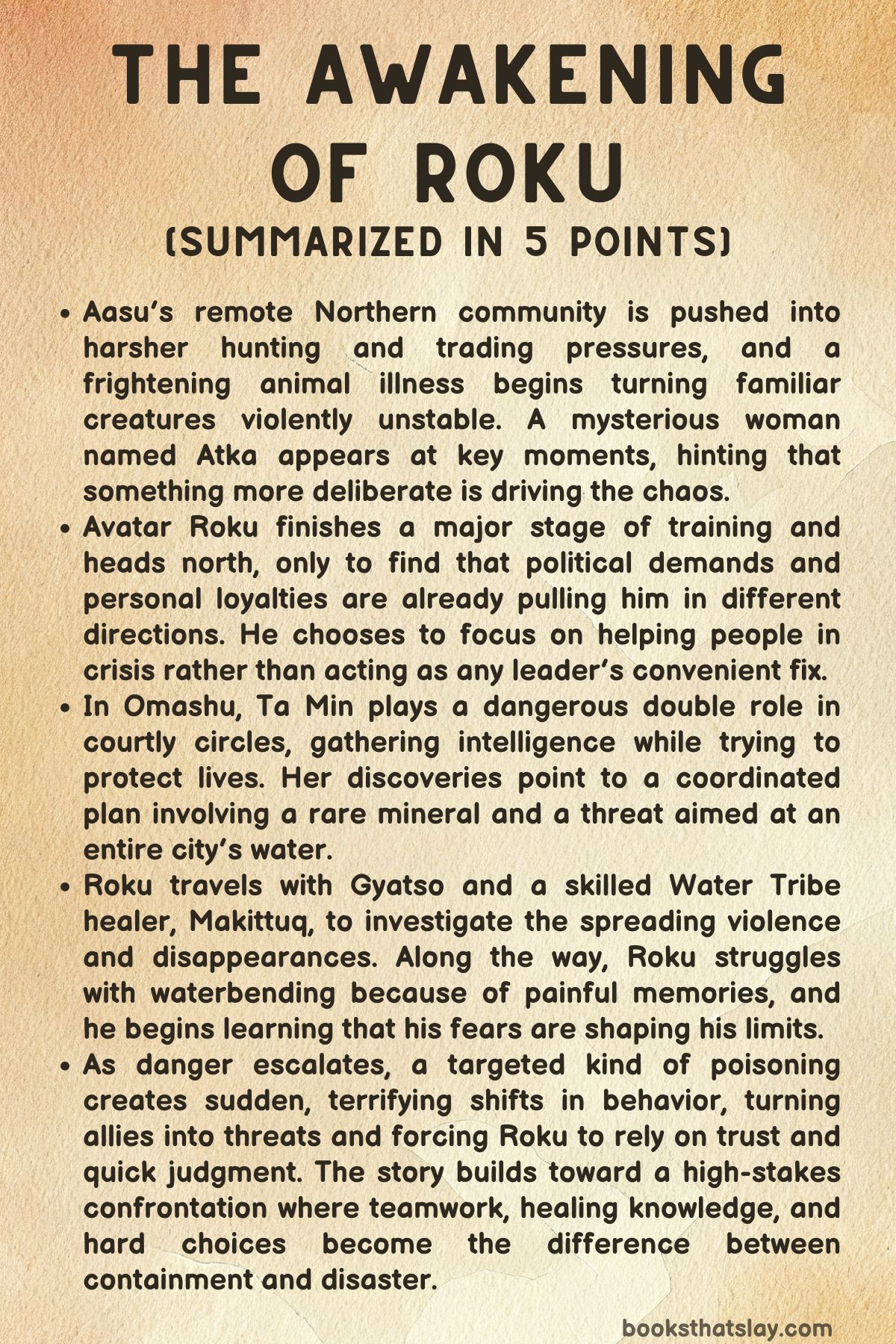
The story begins in the far North, where a young hunter named Aasu and his father, Qarsoq, search for food on a frozen lake as a brutal blizzard approaches. Their community has been pushed into harsher conditions by trading companies that control hunting demands.
When they finally find a breathing hole for a turtle-seal, the creature erupts with unnatural aggression. It attacks Qarsoq, leaving him gravely injured, and even Aasu’s harpoon cannot pierce its shell.
The animal collapses soon after, covered in strange purple bruises. As the storm closes in, a cold and distant woman named Atka appears, examines the dead creature with disappointment, and disappears without offering help.
Far away, Avatar Roku prepares to leave the Southern Air Temple after years of training. He has mastered airbending, but he feels uncertain about what kind of Avatar the world needs.
His mentor reminds him that many people will try to shape him into a weapon for their own goals, and that his duty is to choose harmony over personal pressure. Roku receives a letter from Ta Min, a close friend, hinting at political trouble in Omashu and sensitive information she will only share in person.
Roku departs with Gyatso, his loyal companion.
In Omashu, Ta Min attends a formal gathering while carrying out secret work as an informant for Prince Sozin. She meets Dalisay, a Fire Nation scientist connected to Sozin, who gives her a dangerous task: discover why Omashu’s Minister of Peace is meeting with Ba Sing Se’s counterpart.
Ta Min realizes she must spy on a highly guarded conversation without support.
Roku briefly returns to the Fire Nation capital and reunites with his parents, sensing hidden worries. At the Royal Palace, Fire Lord Taiso treats Roku harshly and orders him to intervene in Northern Water Tribe interference with Fire Nation ships.
Taiso even offers to erase Roku’s family’s financial troubles if Roku obeys. Roku refuses, shaken by how quickly political leaders try to use the Avatar for advantage.
Meanwhile, Sozin grows frustrated as his father’s strange mental lapses worsen, creating uncertainty about the future of the throne.
Roku and Gyatso eventually reach a struggling Northern encampment where hunger and illness are widespread. Trade companies have overhunted resources, healers have been drawn away by high wages in the capital, and medicine is controlled by Agna Qel’a, leaving villages helpless against outbreaks.
They also hear reports of animals becoming feral, marked by purple sores and deadly rage. Atka is revealed to be watching closely, testing a metallic poison meant to corrupt and kill.
When an infected beast attacks the camp, Roku and Gyatso try to stop it without killing it, but it dies from the sickness. A young Waterbender healer named Makittuq arrives and demonstrates powerful healing abilities.
Roku realizes the crisis is urgent and invites Makittuq to travel with them. She agrees, intrigued by the company rather than payment.
As they investigate further, Roku, Gyatso, and Makittuq travel to remote trade outposts where hunters have vanished in nearby mountains. Rumors speak of spirits, but Roku suspects something more.
During their journey, Makittuq attempts to teach Roku waterbending, but he repeatedly fails. Roku admits he associates water with death because of personal losses in his past.
Makittuq challenges him to see water as life instead.
Back in Omashu, Ta Min risks her life to spy on the ministers’ secret meeting. She learns of a project involving poison and a rare mineral called Lambak, meant to contaminate Omashu’s water supply.
Nearly suffocating while escaping, she becomes determined to warn the queen and Roku.
Roku soon faces infected wolves in the mountains. The pack attacks with foaming mouths and purple sores.
The group fights desperately, trapping some wolves in ice, but no remedy works and the animals die. Roku senses the problem is deeper than ordinary illness.
He begins seeking answers through Avatar Kuruk, whose spirit appears in strange dreams.
Roku experiences a terrifying vision of a massive wolf-headed spirit corrupted by dark energy. Inside the spirit’s grasp, Roku realizes he cannot fight through force alone.
By adapting and flowing with the motion, he finally waterbends successfully, escaping. Kuruk explains that spirits do not truly die, but this corruption is unnatural, caused by a dark entity that inverts energy itself.
Soon after, the corruption strikes close: Gyatso becomes infected, marked by purple bruises and violent behavior. He attacks Roku with savage airbending.
Roku refuses to harm him, and Makittuq uses healing water to force Gyatso’s chi back into its natural flow. She explains that his energy had been completely reversed.
Makittuq discovers evidence that someone is deliberately spreading this poison. The culprit is Atka, who has spent years perfecting poisoncraft using Lambak mineral.
Her hatred comes from losing her village after Agna Qel’a refused to share life-saving medicine during an outbreak. In a confrontation, confusion leads Roku to briefly mistrust Makittuq, allowing Atka to escape toward the Northern capital.
Roku travels alone to Agna Qel’a to warn Chief Tiguaa. Security is raised, but the chief grows skeptical without proof.
During the Festival of First Light, Roku spots Atka in the crowd but cannot catch her. Despite his warnings, the celebrations continue.
At dawn, disaster strikes. Chief Tiguaa and his advisors are found dead, poisoned by Spirit Oasis tea.
Roku’s own Waterbender guards turn feral under Atka’s influence and attack him. Roku fights alone, freezing them under ice.
Atka reveals she has poisoned food and drink across the city, seeking revenge even at the cost of her own life.
Chaos spreads through Agna Qel’a as infected citizens attack one another. Roku struggles to contain the violence until help arrives: Gyatso distributes a sedating powder through airbending, while Makittuq and Ta Min bring the completed remedy.
Ta Min reveals she stole the Lambak mineral from Omashu, providing the key ingredient needed to counter the poison permanently.
After the city begins to recover, Ta Min explains Sozin ordered her to stay silent, but she acted anyway. Roku vows to clear her name and stop further schemes.
In the Fire Nation, Sozin distances himself, sending only empty replies, and Roku realizes their friendship is beginning to fracture under ambition and secrecy.
By the end, Roku continues his journey in the North with Makittuq, carrying the weight of what he has learned: balance is fragile, corruption can come from human choices, and being the Avatar means standing against both sickness and the misuse of power.
Characters
Aasu
Aasu is introduced as a young hunter forced into adulthood by scarcity and by the way trading companies have reshaped his people’s survival into a quota-driven obligation. He is observant and patient—spotting the tiny breathing hole that finally produces a seal—yet the moment turns into trauma that brands his worldview with helplessness.
The attack on Qarsoq and Aasu’s inability to pierce the creature’s shell establish a pattern that follows him and others through the story: traditional skill and courage are no longer enough against a new, unnatural threat. Aasu’s brief role matters because he embodies the human cost of the “purple sickness” before the political and spiritual layers are revealed, making the crisis feel intimate rather than abstract.
Qarsoq
Qarsoq represents the older generation caught in a collapsing moral economy: he is still expected to provide like an elder hunter, but the world around him has been converted into a supply chain controlled by distant interests. His injury and death are not framed as a simple accident of the wild; they are the first clear signal that something is fundamentally wrong with nature itself, and that the community’s suffering is being amplified by systems of extraction and neglect.
Qarsoq’s vulnerability also exposes the cruel arithmetic facing relocated families—when a provider falls, the household’s stability collapses with him—tightening the emotional stakes for everything that follows.
Atka
Atka is the story’s most volatile intersection of grief, ideology, and methodical cruelty, and her power lies in how human her motive remains even as her actions become monstrous. She begins as a mysterious figure in the blizzard—cold, disappointed, and withholding aid—signaling someone who has severed ordinary bonds of community.
As her arc unfolds, she becomes the agent who weaponizes suffering into “justice,” using rare Lambak mineral and poisoncraft to invert chi and trigger feral violence. What makes her especially dangerous is her patience and experimental mindset: she does not just want revenge, she wants a repeatable mechanism that proves a point and spreads fear.
Her resentment toward Agna Qel’a is rooted in real abandonment—her village dying after being denied medicine—yet she chooses a punishment that mirrors that cruelty on a massive scale, contaminating trust itself through food, drink, and sacred spaces like the Spirit Oasis. Even her self-poisoning underlines how completely vengeance has replaced self-preservation; she is willing to die as long as the capital feels the same terror and helplessness her people endured.
Avatar Roku
Roku is portrayed not as a fully-formed savior but as a young Avatar still negotiating what authority means when every faction wants to aim him like a spear. His training arc is inseparable from his moral education: he is repeatedly placed in situations where the “correct” action is politically convenient for someone else, from Fire Lord Taiso’s attempt to barter away his clan’s debt to the Northern leadership’s dismissal of Roku’s warnings.
Roku’s internal conflict around water is central to his development—he associates it with death because of personal loss and past violence, which blocks his bending until he reframes water as life and motion rather than drowning and guilt. That reframing becomes practical survival as well as spiritual growth, because learning waterbending through shelter-building, propulsion, and fishing ties the element to endurance instead of trauma.
Roku’s greatest strength is his refusal to reduce people to targets, seen in his attempts to restrain infected animals and even Gyatso without killing, and later in his fight against corrupted Waterbenders where he immobilizes rather than executes. At the same time, his suspicion and haste create blind spots: he misreads Makittuq’s confrontation with Atka and briefly becomes the obstacle to his own rescue.
By the end, Roku has stepped into leadership under pressure—coordinating defenses, enduring isolation, and absorbing betrayal—while also realizing that harmony is not just balance among nations, but protection of the vulnerable from both political schemes and spiritual corruption.
Gyatso
Gyatso functions as Roku’s anchor to joy and perspective, but his role is far more than comic relief. He embodies the Air Nomad approach to care: lightness without indifference, humor as a way to keep compassion intact in grim conditions.
His refusal to enter the Royal Palace signals strong intuition about corrupt environments, and his steady presence helps Roku resist becoming a weapon in Taiso’s hands. The poisoning incident is pivotal because it desecrates what Gyatso represents—an Airbender driven into razor-edged violence—showing how the chi inversion attacks identity itself, not merely the body.
When he returns to action later, distributing the remedy with precision and calm, Gyatso becomes proof that kindness can be operational, not passive; he turns airbending into mass relief, spreading antidote and sedation across chaos. His relationship with Roku also becomes a measure of strain in the wider world: if even their bond can be twisted by poison and then tested by political betrayal, no connection is safe unless it is actively defended.
Sister Disha
Sister Disha is a quietly powerful mentor figure who frames the Avatar’s challenge as ethical, not merely technical. She understands that mastery of airbending is not the endpoint; the harder work is resisting being claimed by others’ definitions of “right.” Her warning that people will try to use Roku like a weapon establishes a thematic lens through which Taiso’s demands, Sozin’s ambitions, and even the Water Tribe’s internal politics can be understood.
Disha’s guidance is especially significant because it does not offer easy rules—she emphasizes discernment and harmony—preparing Roku for a world where choices are never clean, only consequential.
Ta Min
Ta Min is a character built around duality: she genuinely enjoys diplomacy and observation, yet she is also operating as a covert asset in a political game she does not control. Her competence is concrete rather than glamorous—she gathers impressions, cultivates access, and takes physical risks like hiding beneath a heated floor for hours—showing the unromantic labor of espionage.
What defines her is the moment she refuses complicity when Sozin orders inaction; she chooses conscience over allegiance, even though that decision strips her of protection and makes her a fugitive. Ta Min’s arc also highlights how truth is treated as a liability in court politics: without proof, she cannot reach the queen; with proof, she becomes the target of a trap.
Her trek north, improvising survival through work and trade, mirrors Roku’s own survival-learning and reinforces that heroism in The Awakening of Roku is not reserved for benders. By bringing the Lambak mineral that completes the remedy, Ta Min becomes the hinge between political intrigue and public salvation, proving that moral courage and persistence can redirect history even when those in power choose silence.
Prince Sozin
Sozin is depicted as charismatic and strategic, but increasingly defined by selective empathy—he cares intensely about certain bonds and outcomes while treating other lives as acceptable losses. His frustration with Taiso’s control and his anxiety about the throne make him understandable, yet his defining choice is not driven by ignorance or panic; it is calculated withholding.
When presented with Ta Min’s intelligence, Sozin recognizes that warning Omashu would serve stability, but he prefers a scenario that benefits Fire Nation leverage, even if it means letting an entire city be poisoned. His decision to lie by omission as Taiso forgets is a moral pivot that foreshadows a leader willing to manipulate truth, allies, and catastrophe for strategic advantage.
The later blank letter to Roku crystallizes his approach to relationships: connection is maintained only on terms that preserve control. In Awakening of Roku, Sozin’s danger is not that he is openly cruel at all times, but that he can compartmentalize cruelty behind statecraft and personal ambition.
Fire Lord Taiso
Taiso embodies the brittle violence of authority under threat—threat from rivals, from rumor, and ultimately from his own failing mind. His harsh reception of Roku and attempt to bargain away the Avatar’s autonomy reveal a ruler who views people as instruments, including a figure meant to serve the whole world.
Yet the story complicates him through his condition: his lapses are frightening not only because they destabilize the nation but because they expose how power panics when it cannot control its own body. Taiso’s insistence on secrecy and suppression of rumors shows a governance style that treats perception as reality, preferring denial over preparation.
Even when he orders Sozin to warn Omashu, it is partly because Omashu is a useful buffer—his choices are consistently filtered through state advantage. The tragedy of Taiso is that his authority is eroding at the same time his grip tightens, creating a volatile environment where heirs learn that deception is rewarded and vulnerability is punished.
Lady Hazei
Lady Hazei plays the role of the family’s internal realist, willing to name what everyone else wants to avoid. She brings the healer’s prognosis into the open and tries to impose boundaries of secrecy that are meant to protect the throne, but her presence also underscores how royal families become cages: truth can be spoken only in private, and even then it is rationed.
Hazei’s function is less about direct action and more about revealing the emotional architecture of the palace—fear, denial, and calculation—and showing how illness becomes political currency when succession is at stake.
Zeisan
Zeisan is positioned as the dissenting voice within the royal family, pushing against the idea that power should simply pass and concentrate without question. Her interest in fringe treatments suggests both desperation and a willingness to look outside sanctioned authority, and her suggestion of more equal power-sharing marks her as either idealistic or strategically provocative.
The fact that Taiso immediately punishes and banishes her from his sight demonstrates how threatening even mild reform sounds in an authoritarian court. Zeisan’s character matters because she reveals that alternative paths exist inside the Fire Nation’s elite, but they are structurally suppressed, which helps explain why more ruthless ambition—like Sozin’s—finds fewer internal checks.
Dalisay
Dalisay is the embodiment of technocratic complicity: a scientist whose proximity to power makes innovation indistinguishable from leverage. Her spider-lily robes mark her as the sanctioned channel between Sozin’s intelligence needs and the machinery that can fulfill them.
She provides Ta Min with instructions but refuses help, reinforcing an institutional culture where agents are used and discarded. Later, her role in supplying Huaji with the Lambak mineral in exchange for technical knowledge shows how science becomes a tradable weapon when ethics are subordinated to advancement.
Dalisay’s arrest also reveals the regime’s pragmatism: when a scandal threatens Sozin’s positioning, accountability becomes selective, and the technocrat becomes expendable.
Minister Huaji
Huaji is a political antagonist who treats mass harm as a managerial project, disguising atrocity behind diplomacy and policy language. His calm discussion of contaminating Omashu’s water supply shows a mindset that has crossed from coercion into extermination as strategy, and his ability to set traps—tracking Ta Min through soot and using a shirshu—demonstrates a predatory patience similar to Atka’s.
Huaji is not merely corrupt; he is organized, networked, and ideological, coordinating with counterparts like Pushi while maintaining a respectable public face. In The Awakening of Roku, Huaji represents the institutional version of Atka’s rage: where she seeks revenge for neglect, he seeks control through destabilization, and both converge on poison as the tool that collapses society from the inside.
Minister Pushi
Pushi appears as the polished partner in the conspiracy, offering the legitimacy and reach of Ba Sing Se’s political apparatus. The meeting’s tone—hours of small talk before frank admissions—shows how elite violence is often preceded by performative civility, and Pushi’s presence signals that the threat is not isolated to one city or one fanatic.
Even with limited direct action on-page, Pushi’s role expands the scope of the conflict: Omashu’s poisoning is part of a broader contest of influence where ministries of “peace” orchestrate suffering while preserving plausible deniability.
Chief Tiguaa
Chief Tiguaa embodies the vulnerability of leadership that prioritizes public calm over uncomfortable preparation. His initial response to Roku’s warning—heightened security and sensible precautions—suggests competence, but as the days pass without incident, he reduces defenses and begins to treat Roku’s urgency as paranoia.
That swing from caution to dismissal becomes fatal, and his death through poisoned Spirit Oasis tea carries symbolic weight: when leaders treat sacred or communal resources as safe by default, they become easy targets for those who weaponize trust. Tiguaa is tragic because his failure is not malice but miscalibrated judgment under social pressure, and the cost is paid by his people.
Makittuq
Makittuq is the story’s ethical and spiritual counterweight, combining practical healing with an awareness of the spirit world that Roku desperately needs. She is introduced as decisive and capable—subduing the infected caribou-bear and healing a broken arm—immediately establishing that her power is restorative rather than theatrical.
Her deeper significance lies in how she reframes Roku’s relationship with water, challenging his trauma-centered association and pushing him toward a life-centered understanding that unlocks his growth. Makittuq’s perception of spirits and her ability to recognize chi inversion make her uniquely suited to confront a crisis that is neither purely medical nor purely spiritual.
She also carries a subtle social critique: she knows what scarcity and controlled medicine do to villages, and she recognizes that injustice breeds extremism like Atka’s. When Roku doubts her during the confrontation, Makittuq becomes a test of his maturity—whether he can trust wisely rather than reflexively—and her eventual partnership in crafting and distributing the remedy positions her as a model for what healing leadership looks like: attentive, collaborative, and willing to enter danger not to punish, but to restore balance.
Avatar Kuruk
Kuruk functions as both mentor and warning, appearing through dreams and spiritual encounters that blur memory with present danger. His explanation that spirits do not truly die but disperse and reform shifts the conflict away from simple defeat and toward long-term imbalance, implying that solutions must be restorative rather than annihilative.
Kuruk’s admission that he never learned how to rebalance corrupted spirits—only how to drive the dark spirit back through a portal—adds weight to Roku’s burden: the previous Avatar’s methods may not be enough for this new kind of infection. Kuruk’s presence expands the crisis from political poisoning into metaphysical contamination, linking the feral animals and inverted chi to a deeper rupture between worlds.
Lola
Lola, the sky bison, is more than transportation; she represents continuity, companionship, and the Air Nomad way of moving through the world without conquering it. Her need for rest forces pauses that become opportunities for character intimacy and learning, and her reappearance during the crisis enables the rapid distribution of the remedy across Agna Qel’a.
Lola’s role underscores a recurring idea in The Awakening of Roku: survival and salvation are collective efforts that depend on relationships with living beings, not just on power or status.
Queen Guo Xun
Though she remains mostly offstage, Queen Guo Xun is a gravitational figure in the political storyline, representing the legitimacy Ta Min tries to reach and the authority that could counter Huaji’s plot if properly informed. The fact that Ta Min cannot secure an audience without proof highlights how even well-intentioned rulers are insulated by bureaucracy and gatekeepers, creating openings for conspiracies to thrive.
Queen Guo Xun’s importance is therefore structural: she is the symbol of what could be protected, and also of how difficult protection becomes when information is controlled, delayed, or manipulated.
Kozaru
Kozaru appears as a practical lifeline rather than a heroic centerpiece, providing the tunnel map and resources that enable Ta Min’s escape and northward journey. His presence emphasizes the role of local knowledge and everyday alliances in resisting powerful conspirators.
In a narrative filled with bending and royal politics, Kozaru’s contribution underlines that the struggle also depends on ordinary people who know the city’s hidden arteries and are willing to share them at personal risk.
Themes
Power, Exploitation, and the Cost of Control
From the opening scenes of hunting under trading company pressure, the world of The Awakening of Roku shows how power often operates through systems rather than direct violence. Aasu and Qarsoq are not simply struggling against nature; they are trapped inside an economy that forces communities to hunt according to outside demands instead of survival rhythms.
This shift turns traditional life into labor, and the consequences appear immediately through hunger, desperation, and unsafe risks. The Northern villages are drained of healers because high wages pull Waterbenders into the capital, leaving poorer settlements without medicine during outbreaks like Northern Pox.
Control over resources becomes control over life itself.
The same pattern exists in political centers. Fire Lord Taiso tries to use Roku as a tool, offering financial relief in exchange for intervention.
Roku’s refusal highlights how rulers attempt to shape morality through reward and punishment, treating the Avatar’s duty as another asset of the state. In Omashu, diplomacy is also weaponized.
Ta Min attends gatherings not as a free participant but as a spy, showing how politics often turns people into instruments for hidden agendas. The poison project reveals the extreme endpoint of this mentality: leadership willing to sacrifice entire populations by contaminating water supplies in order to destabilize rivals.
Atka’s revenge is born from this same structure of exploitation. Her village was abandoned by the capital’s decisions, and she answers systemic cruelty with personal cruelty.
The theme makes clear that power, when centralized and hoarded, creates cycles of suffering that spread outward into ordinary lives. The story’s crises are not random; they grow from institutions that prioritize dominance, secrecy, and profit over human responsibility.
Corruption, Infection, and Moral Inversion
The violent animal sickness and chi inversion in The Awakening of Roku operate as more than physical threats. They represent a world where balance can be deliberately reversed, where something natural becomes distorted into aggression.
The infected turtle-seal that attacks Qarsoq is terrifying not only because it is strong, but because it behaves against its own nature. Purple sores, foaming mouths, and feral rage show corruption as a force that transforms familiar life into danger.
This idea expands beyond animals into spirits and people. Kuruk’s explanation that a guardian spirit was altered by an unknown dark presence suggests that corruption is not always born from anger or imbalance alone, but can be imposed, spread, and engineered.
Atka’s poisoncraft takes this spiritual concept into human hands. By using Lambak mineral to invert chi, she turns individuals into weapons against their own communities.
Gyatso’s infection is especially painful because it shows how corruption attacks trust itself. Roku is forced into a fight where the enemy is not a stranger but a friend whose inner flow has been reversed.
The theme also works on a moral level. Sozin’s choice to lie and withhold warning mirrors chi inversion in political form.
His decision flips duty into self-interest, showing how corruption does not always arrive as sickness; it can arrive as a quiet refusal to act. The story repeatedly asks what happens when natural order—whether bodily, spiritual, or ethical—is turned backward.
The danger is not only death, but the loss of what makes people and societies recognizable. Healing, then, becomes not only physical restoration but the struggle to return the world’s direction to its rightful course.
Duty, Identity, and the Burden of Being the Avatar
Roku’s journey in The Awakening of Roku is shaped by the tension between who he is and what the world demands from him. He leaves the Southern Air Temple with affection for the life he has built, yet he cannot remain in comfort because the Avatar’s role requires movement, responsibility, and sacrifice.
Sister Disha’s warning that people will try to use him as a weapon becomes immediately real when Fire Lord Taiso pressures him to solve merchant conflicts for political gain. Roku’s refusal shows his desire to define duty on his own terms rather than accept a ruler’s definition of “right.”
His struggle is also internal. Waterbending becomes difficult because Roku associates water with death, tied to personal loss and past violence.
This psychological barrier demonstrates that duty is not only about external action but about confronting memory and fear. Makittuq’s insistence that Roku must see water as life pushes him toward a more complete identity, one that can hold grief without being ruled by it.
Roku’s duty repeatedly forces impossible choices. He wants to focus on training, yet hunger and sickness demand immediate help.
He wants to trust Makittuq, yet betrayal feels possible in a world of spies and poison. He wants to protect Gyatso without harming him, even when attacked.
These moments show the Avatar’s burden as deeply human: the need to act without certainty, to protect without becoming cruel, and to carry responsibility without losing compassion. Roku is not portrayed as a symbol but as a person learning what it means to stand in the center of competing needs.
His growth comes through survival, healing, and moral decision, showing duty as something lived, not simply inherited.
Secrecy, Betrayal, and the Fragility of Trust
Trust in The Awakening of Roku is constantly tested because so much of the world operates through secrecy. Ta Min’s role as both diplomat and spy places her in a morally unstable position, forced to gather truths while hiding her own.
Her discovery of the poison plot in Omashu reveals how deeply hidden schemes can shape public life. Ministers speak politely above heated floors while planning mass contamination below the surface, showing how danger often hides behind ceremony.
Sozin embodies betrayal through omission. His decision to lie to Taiso and allow Omashu to fall is not an act of open violence, but it fractures trust just as sharply.
Roku continues writing to him, unaware that distance is being chosen deliberately. The blank letter Sozin eventually sends becomes a symbol of silence as betrayal, a refusal to meet friendship with honesty.
Roku’s own mistrust nearly destroys an alliance when he misreads Makittuq’s confrontation with Atka. In that moment, secrecy has already poisoned perception, making even a healer appear suspicious.
The theme suggests that when societies normalize spying, manipulation, and withheld truths, relationships become unstable. Even acts of help can be doubted.
Atka’s revenge plot also relies on secrecy, slipping poison into tea, infecting defenders, and striking during a festival meant for unity. Her ability to weaponize trust—people sharing drinks, celebrating together—shows how fragile communal bonds can be when fear and resentment take root.
Yet the resolution also shows trust being rebuilt through action: Ta Min risking everything to warn Roku, Makittuq creating remedies, Gyatso distributing aid, and Roku refusing to abandon the city. The story presents trust as both vulnerable and necessary, something that must be chosen again and again despite betrayal.
Healing, Community, and the Choice to Protect Life
Against sickness, political cruelty, and spiritual corruption, The Awakening of Roku emphasizes healing as a moral commitment. Makittuq’s water healing is not simply a skill but a philosophy that life must be restored even when destruction seems easier.
Roku and Gyatso initially try to subdue infected animals without killing them, showing respect for life even in danger. This approach contrasts with the poisoners, who see bodies as tools for destabilization.
Makittuq’s healing of Gyatso becomes one of the most powerful expressions of this theme. The infection is described as chi fully inverted, and her exhaustion afterward highlights that healing requires cost, patience, and vulnerability.
It is not effortless goodness; it is labor against despair. Roku’s gradual learning of waterbending through survival also ties healing to daily practice, suggesting that restoration is built through small acts as much as dramatic victories.
Community becomes essential when the crisis overwhelms any single hero. Roku cannot save Agna Qel’a alone, and the city collapses into chaos until collective defense emerges.
Gyatso spreading sedative powder, Makittuq stabilizing victims, and Ta Min providing the mineral ingredient show that protection depends on cooperation across nations and roles. Even someone branded a spy becomes a lifesaving ally.
Atka’s tragedy reinforces the theme’s urgency. Her village suffered because healing was withheld, and she transforms that wound into vengeance.
The story suggests that refusing care creates future violence, while sharing care prevents it. Healing is portrayed not as weakness but as resistance against systems of exploitation and corruption.
In the end, the choice to protect life—through remedies, solidarity, and moral courage—becomes the strongest answer to the inverted forces threatening the world.