Bed Chemistry Summary, Characters and Themes
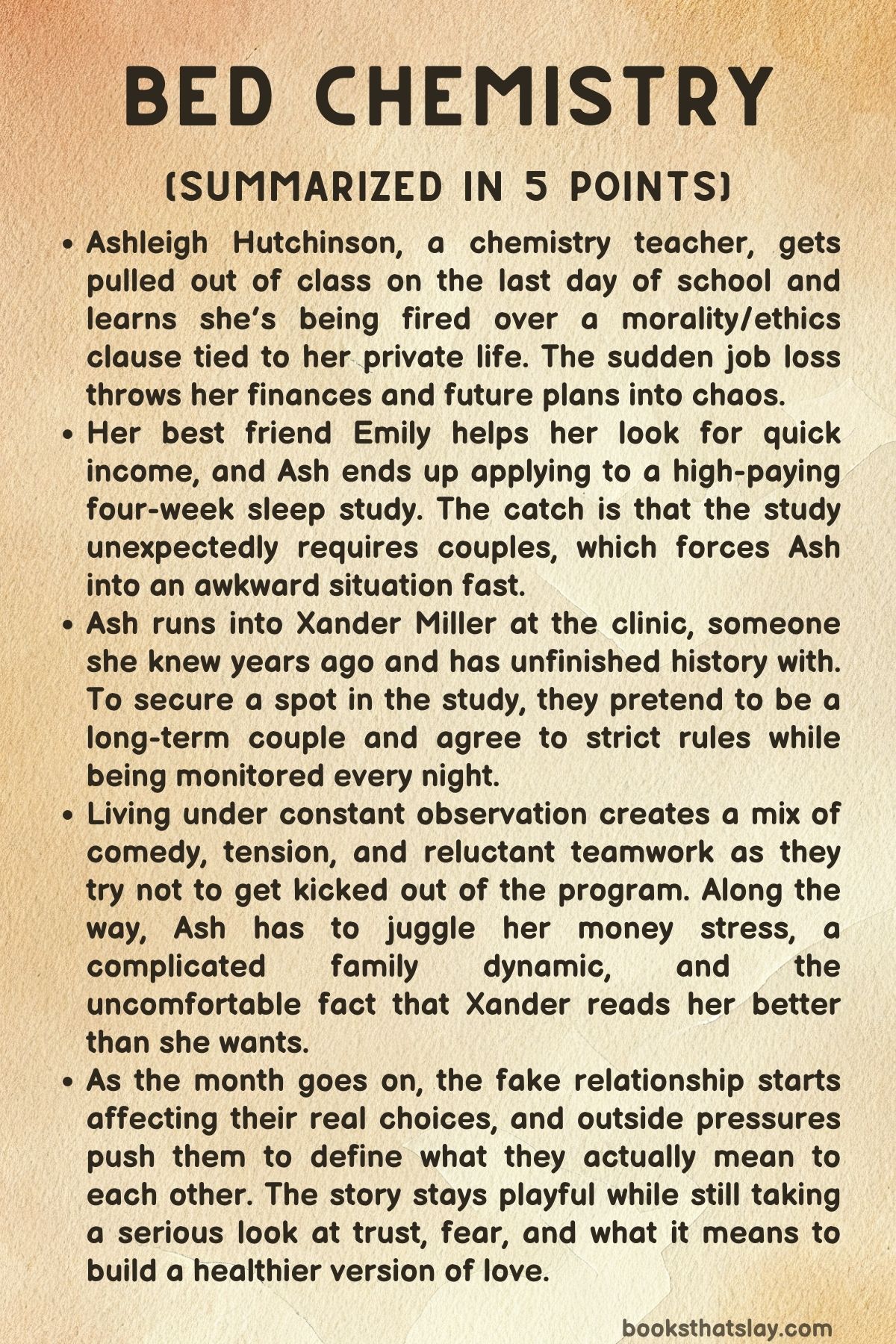
Bed Chemistry by Elizabeth McKenzie is a contemporary romantic comedy that blends humor, vulnerability, and emotional growth. The story follows Ashleigh Hutchinson, a chemistry teacher whose life unravels after she’s fired over a scandal involving her private dating life.
Desperate for rent money, she joins a high-paying sleep study, only to be paired with Xander Miller, a man from her past and the one person who unsettles her carefully built rules about love. Through forced proximity, witty clashes, and unexpected tenderness, Ashleigh must confront her fears about intimacy, trust, and what real connection means.
Summary
Ashleigh Hutchinson is finishing her last day of school as a chemistry teacher when she’s unexpectedly called to the principal’s office. She assumes it might be praise or recognition, but instead she is confronted with accusations about her personal life.
Principal Holland claims complaints have been made about her “out-of-school activities,” specifically her use of a casual hookup app. He points to an ethics clause in her contract and fires her immediately, leaving Ashleigh stunned, humiliated, and terrified about her future.
The next morning, Ashleigh wakes up hungover beside her best friend Emily, who stayed over to help her cope. Over breakfast, Ashleigh panics about rent and the fact that nearby schools are not hiring.
Emily refuses to let her spiral for long and finds a flyer advertising a four-week sleep study that pays $8,000. Seeing it as the perfect temporary solution, Emily signs Ashleigh up for an interview.
Ashleigh’s complicated family life adds to her stress. Her mother, Hillary Hutchinson, is famous as a relationship expert with bestselling books and a Netflix show, yet Ashleigh has always felt damaged by her mother’s cynical views on love.
Ashleigh keeps her firing a secret, unwilling to admit failure or ask for financial help.
At the sleep lab interview, Ashleigh arrives flustered and embarrassed. To her shock, she runs into Xander Miller, someone she knew at UCLA eleven years earlier.
They had once shared an intense one-night encounter, after which Ashleigh disappeared without explanation. Their reunion is awkward, charged, and full of unfinished tension.
The study director announces a sudden change: they now only need couples. In a split-second decision, Xander claims that he and Ashleigh are together.
Ashleigh is forced to play along because she desperately needs the money. They lie their way into the program, inventing a long-term relationship history.
Dr. Waitley, the director, informs them they must sleep in the same bed for thirty consecutive nights while being monitored, and they are instructed not to have sex during the study.
Ashleigh is horrified at the idea of sharing a bed with Xander for a month. The first nights are uncomfortable and full of sharp banter.
Things become even worse when Ashleigh wakes up from a vivid sexual dream and realizes she was touching herself in her sleep while Xander watched. She is mortified, and Xander teases her relentlessly, though he also protects her privacy when the lab assistant Ben hints at reviewing the footage.
Ashleigh’s stress grows as she struggles with unemployment, family pressure, and her confusing attraction to Xander. Emily pushes her to admit what’s obvious: Ashleigh wants him.
Ashleigh resists, clinging to her long-standing rules about keeping love and sex separate.
As the nights continue, Ashleigh and Xander’s dynamic shifts. They argue, joke, and begin to open up.
Xander admits he suffers from severe insomnia and doesn’t know why. Ashleigh starts seeing beyond his cocky exterior, noticing his loneliness and sincerity.
One night, when the air conditioning fails, they share a quiet moment in the dark that leads to an impulsive kiss. They stop before going too far, but the tension only builds.
Their heart-rate monitors keep triggering alarms, and Ben repeatedly walks in, assuming Ashleigh is having nightmares.
Dr. Waitley eventually confronts them about disrupting the study with their fighting and constant spikes in arousal. Believing their relationship needs repairing, she orders them to go on a date as a condition of staying in the program.
Their first official date takes place at a carnival. Ashleigh expects to hate it, but she ends up laughing, flirting, and enjoying herself.
They escape a chaotic moment in a haunted house and share an exhilarating closeness on a Ferris wheel. For the first time, Ashleigh feels what it’s like to be carefree with someone else.
As their connection deepens, Ashleigh becomes frightened of her own feelings. She has spent years believing relationships are doomed, shaped by her parents’ messy history and her mother’s public stance against love.
Yet with Xander, she feels warmth, safety, and desire all at once.
Their next date leads them to Santa Barbara, where Ashleigh meets Xander’s mother, Eva. Ashleigh is unsettled when Xander’s ex, Scarlett, appears and seems deeply integrated into his family.
Jealousy surprises Ashleigh, forcing her to acknowledge that she wants more than casual intimacy.
Xander continues challenging Ashleigh’s emotional walls. He points out how she avoids messiness in life the same way she avoids “animal style” fries—refusing what she wants because it feels complicated.
Ashleigh begins to realize she has been using her rules as armor.
Xander takes her back to UCLA, where they first met. He reveals he wanted a do-over, a chance to truly know her instead of being left behind again.
The moment is tender, and Ashleigh can no longer deny how much he matters to her.
Their relationship turns physical, but emotional stakes rise quickly. At Ashleigh’s father’s wedding, Xander confronts Hillary’s toxic influence.
Hillary mocks Ashleigh for never bringing anyone home, implying she is incapable of love. Xander pushes back, criticizing Hillary’s worldview and insisting that lust and love can coexist.
Then, in front of everyone, he confesses that he feels both for Ashleigh.
Ashleigh panics. Terrified of vulnerability, she denies having feelings and reaffirms her old rules.
Xander, devastated, walks away.
The final nights of the sleep study are heavy with silence and longing. Xander’s sleep has improved dramatically, showing that their closeness has helped him, but Ashleigh feels emptier than ever.
After the study ends, they part with a painful hug.
Ashleigh spirals until she finally confronts her mother. Hillary admits her relationship advice was born from heartbreak, not truth, and she confesses she would still choose love again despite the pain.
Ashleigh realizes her entire belief system was built on fear.
Trying to return to old habits, Ashleigh goes on a terrible date with another man, but it only confirms what she already knows. Xander storms in, furious, and pulls her back into the reality she’s been avoiding.
During deposition prep for Ashleigh’s wrongful termination case, Ashleigh finally breaks. She admits she has loved Xander since the day they met, and that her one-night rule was never freedom—it was protection.
Xander sends everyone else out, and Ashleigh confesses fully. This time, Xander stays.
Ashleigh wins her case and returns to the school not only reinstated but promoted to principal. She rebuilds her career with confidence and emotional honesty.
Xander, still struggling to sleep alone, finds comfort in knowing Ashleigh chooses him completely.
A year later, Ashleigh plans to propose, only to discover Xander has beaten her to it. They both say yes, laughing at their shared certainty.
Together, they embrace a future where love and desire exist side by side, no longer separated by fear.
Characters
Ashleigh “Ash” Hutchinson
Ashleigh begins Bed Chemistry as a woman who looks competent and in control on the surface—she’s a chemistry teacher trusted enough to leave her best student running an experiment—yet her private life is built around strict emotional containment. Being fired for what the school frames as “out-of-school activities” doesn’t just threaten her finances; it attacks the carefully separated compartments she relies on: respectable professional identity over here, casual pleasure over there, and feelings nowhere.
Her reliance on rules—no dating, no sex with meaning, never falling in love—reads less like empowerment and more like a self-protective lab protocol designed to prevent emotional burns. She’s witty, reactive, and frequently uses humor, deflection, and a performative boldness (apps, hookups, crude jokes) as insulation against vulnerability, but the narrative keeps revealing how tender she actually is: she became a teacher because she wanted kids to have at least one adult “betting on them,” which quietly exposes the abandoned-child logic underneath her swagger.
Across the forced proximity of the sleep study, Ash’s core conflict isn’t whether she’s attracted to Xander—she obviously is—but whether she can tolerate the loss of control that comes with being known, chosen, and loved. Her arc resolves when she stops treating love like a contaminant and starts seeing it as a chemistry she can survive, then builds a life that matches her values: not only reconciling with intimacy, but also reclaiming power through her case and ultimately becoming principal, which turns her need for safety into something she can offer others.
Xander Miller
Xander enters Bed Chemistry as the embodied counterforce to Ash’s compartmentalization: persistent, emotionally direct, and unwilling to treat intimacy like an accident. On paper he’s sharp and privileged—BMW, law career, confidence in confrontation—but the story positions his real vulnerability in his insomnia and in the humiliation he still carries from Ash ghosting him after their one-night connection years earlier.
His decision to claim they’re a couple to keep the study slot is manipulative on the surface, yet it’s also revealing: he’d rather risk awkwardness than lose proximity, because what he wants isn’t just sex or money, it’s access to the person who disappeared. He weaponizes teasing, banter, and provocation, but unlike Ash, his defenses often steer toward the truth instead of away from it; he pushes conversations into the places she avoids, especially around what she “wants.” As his sleep improves beside her, the book makes a symbolic point: his body can rest when his emotional life feels safe, and Ash becomes the variable that changes the outcome.
His big turning point is at the wedding, where he refuses to let Hillary frame Ash as broken or incapable of love; he speaks in her language—chemistry and neuroscience—and then stakes his own heart plainly. When he leaves after she reasserts her rules, it’s not punishment so much as a boundary: he won’t keep living in a half-relationship that only asks him to desire, never to matter.
By the end, he becomes both partner and advocate, helping her pursue justice, but also demanding reciprocity—sleeping improves with her, yet he still struggles alone, and the resolution isn’t that love magically “fixes” him, but that they choose companionship as a practice, including staying awake together when necessary.
Emily “Em”
Emily functions as both comic release and moral ballast, but her real role is sharper: she’s the truth-teller who refuses to let Ash romanticize self-sabotage as independence. Em’s loyalty is active rather than sentimental—she sleeps over after the firing, hunts for solutions, signs Ash up for the sleep study, feeds her, drinks with her, and shows up when Ash spirals—yet she also challenges Ash’s narratives without softness when softness would enable avoidance.
Her humor is a pressure valve, especially in moments like the “Sleep Wanker” aftermath, but beneath the laughter she’s tracking patterns: Ash runs from feelings, tries to replace pain with a new app match, and calls it “rules.” Em constantly reframes that behavior as fear, not identity. When she meets Xander, she instantly clocks their chemistry and sets a protective boundary—if he hurts Ash, there will be consequences—yet she’s equally ready to approve him when he demonstrates respect and emotional seriousness.
Importantly, Emily’s influence isn’t about pushing Ash into romance; it’s about pushing Ash into honesty, whether that honesty ends in love or not. Even the proposal setup later shows her as co-conspirator in Ash’s growth: she supports the grand romantic gesture because Ash is finally choosing it freely, not because she’s been cornered into it.
Dr. Waitley
Dr. Waitley represents institutional authority, but unlike Principal Holland, she’s authority with nuance. She’s pragmatic, deadline-driven, and protective of the study’s integrity, yet she’s not presented as cruel—she reads behavior through a clinical lens, not a moral one.
Her requirement that Ash and Xander go on a date as a condition of staying in the study is ethically murky in real-world terms, but narratively it reveals her function: she becomes the external force that transforms their fake couple performance into structured intimacy, turning the experiment into a kind of reluctant relationship container. Dr. Waitley also serves as a mirror: while Ash fears being watched and judged, Dr. Waitley mostly cares about data quality and compliance, which undercuts Ash’s shame and suggests the “surveillance” anxiety is internal as much as external.
By reporting that Xander’s sleep dramatically improves during the study, she provides the story’s scientific validation that emotional safety and physical outcomes are linked, reinforcing the book’s theme that bodies keep receipts for the truths people refuse to say out loud.
Ben
Ben is the story’s gentle foil to Xander’s intensity, and also a living trigger for Ash’s shame. He’s described as sweet and earnest, and his job makes him an inadvertent witness to Ash’s most private moments, including the night her vitals spike and the footage implies arousal.
Ben’s presence forces Ash to confront how humiliating it feels to be observed without consent, even when the observer isn’t malicious, and it highlights the difference between being “seen” clinically versus being “seen” emotionally. He’s also a steady reminder that Ash and Xander’s connection isn’t happening in a vacuum: their alarms, fights, and rule-breaking affect other people doing their jobs.
When Ben walks in mid-argument and warns them everyone can hear, the book uses him to puncture the romance bubble with real-world consequences. Yet Ben never becomes a villain; he’s more like a barometer of professionalism and boundaries, which makes Ash and Xander’s eventual choice to be honest feel like maturation rather than mere passion.
Principal Holland
Principal Holland is the clearest antagonist, not because he’s complex, but because he embodies punitive hypocrisy and institutional power used as moral policing. He fires Ash on the last day of school, frames the issue as ethics, and leverages a contract clause to convert a moment of personal life into professional annihilation.
What makes him narratively effective is how swiftly he collapses Ash’s stability: one intercom call, one meeting, and suddenly she’s financially desperate and socially exposed. He also reveals the gendered edge of the conflict—Ash is punished not for incompetence but for sexuality—so his role isn’t merely personal dislike, it’s a mechanism that forces Ash into the sleep study plot and into confronting the cost of living by “rules” that were never meant to protect her in the first place.
Even after he exits the day-to-day story, the consequences of his decision drive Ash’s legal fight and her eventual transformation from employee to leader.
Hillary Hutchinson
Hillary is the most psychologically influential character because she isn’t just Ash’s mother—she’s the architect of Ash’s fear dressed up as empowerment. As a famous relationship expert with books and a Netflix show, Hillary has built a public identity around controlling romantic risk, and Ash has internalized that ideology so deeply that it becomes her operating system.
Hillary’s charisma and composure mask a private wound: her marriage and heartbreak. The story’s key revelation is that Hillary’s “rules” were never objective truth; they were grief fossilized into a brand, then adopted by Ash as gospel.
At the wedding, Hillary weaponizes public humiliation, mocking Ash for never bringing a partner home and framing her as incapable of love, which shows how Hillary maintains control—through narrative dominance, not empathy. Yet her later confession complicates her: she admits she wrote from pain, never intended it to become a movement, and doesn’t truly believe love and lust must be separate.
That admission reframes her less as a cartoon villain and more as a cautionary example of how unresolved trauma can masquerade as wisdom. Hillary’s function is pivotal because Ash can’t choose Xander freely until she disentangles her own desires from her mother’s doctrine, and that disentanglement only happens when Hillary finally tells the truth: despite everything, she would still choose love again.
Keeley
Keeley appears primarily through the lens of the wedding, but her narrative role is symbolic: she represents the possibility of a “new chapter” that Ash resents because it threatens her carefully curated pessimism. Ash’s reaction to Keeley isn’t personal hostility so much as ideological irritation—if her father can stand at an altar looking sincere, then Ash’s certainty that love always collapses becomes harder to defend.
Keeley’s presence also amplifies Ash’s fear of repetition: she expects cheating to recur, which suggests she’s projecting a protective prediction onto this new bride. In that sense, Keeley functions as a mirror for Ash’s anxiety about being the person who believes, commits, and then gets hurt.
Annie
Annie, Hillary’s assistant, is a small but telling figure because she shows how Hillary’s life is managed like an enterprise. When the man with the bouquet tries to force his way in, Annie and security handle it seamlessly, and Hillary stays unfazed—an image of celebrity control.
Annie’s presence reinforces the idea that Hillary’s romantic chaos is curated, contained, and sanitized for public consumption, which indirectly helps explain how Hillary could sell a rigid philosophy while still living inside messy human desire. Even as a minor character, Annie helps the reader feel the machinery around Hillary’s persona, which is the same machinery that shaped Ash’s inherited beliefs.
Aaron
Aaron, the top student left in charge during the simple syrup experiment, appears briefly, but he’s important because he highlights what Ash is good at when she’s not drowning in shame. She trusts him, runs a classroom that functions even in her absence, and clearly commands respect academically.
Aaron’s presence underscores the injustice of her firing: she isn’t removed for incompetence, she’s removed for optics. He also strengthens Ash’s later explanation of why she teaches—because she wants students to have an adult betting on them—by demonstrating that she already does that effectively.
Eva
Eva, Xander’s mother, widens the emotional world of Bed Chemistry by showing what affectionate family attachment can look like without control or performance. She welcomes Ashleigh warmly, shares embarrassing stories about Xander, and creates an atmosphere where closeness is normal rather than dangerous.
For Ash, who comes from a family dynamic loaded with ideology and betrayal, Eva’s ease can feel both inviting and threatening—inviting because it’s kind, threatening because it implies belonging is possible. Eva also becomes the stage for Ash’s jealousy when Scarlett appears, revealing Ash’s growing investment: she isn’t just physically drawn to Xander, she’s starting to imagine herself in his life, including his family, and that realization scares her because it makes the stakes real.
Scarlett
Scarlett represents the kind of history Ash can’t compete with by being “cool.” In Bed Chemistry, Scarlett’s closeness with Eva triggers Ash’s insecurity not because Scarlett is overtly cruel, but because she fits naturally into a space Ash is only beginning to enter. Ash’s discomfort exposes how far she’s come: someone committed to “no feelings” shouldn’t care about an ex, yet Ash does, which is both humiliating and clarifying.
Scarlett also helps characterize Xander; his desire for a civil breakup and maintained family ties suggests emotional maturity and a refusal to burn bridges, contrasting with Ash’s pattern of disappearing to protect herself.
Morgan
Morgan functions as a narrative decoy—a convenient continuation of Ash’s old habits at the exact moment her life is collapsing. He’s less a fully formed person and more a symbol of the easy exit: the app match who offers attention with no vulnerability required.
By agreeing to meet him and later using matches as provocation, Ash reveals how she uses casual options to maintain the illusion of control, especially when she feels cornered by real intimacy. Morgan’s most important contribution is what he cannot provide: he highlights that Ash’s connection with Xander isn’t interchangeable, which makes her attempts to treat it as just another hookup feel increasingly dishonest.
Brad
Brad is the clearest example of Ash trying to relapse into emotional avoidance. The “douchey” date isn’t about Brad himself; it’s about Ash attempting to prove she can revert to her system and still function.
The date’s lack of chemistry becomes data—almost like a failed experiment—showing that Ash’s body and mind no longer accept the lie that any distraction will do. Brad’s presence also catalyzes the decisive interruption: Xander arrives, furious, and the story forces a choice between numb repetition and complicated truth.
Brad, in effect, is the control group that confirms the phenomenon: what Ash feels for Xander is singular.
Mrs. Kelly
Mrs. Kelly is a small but catalytic presence because her suspected witnessing and reporting of Ash’s hookup is the match that lights the plot. Even in absence, she represents surveillance, judgment, and the way women are often positioned as enforcers of sexual respectability within institutions.
Whether or not she intended harm, Ash experiences her as someone who converts a private moment into professional punishment, and that perceived betrayal intensifies Ash’s sense that desire is dangerous. Mrs. Kelly’s function is to show how quickly a woman’s autonomy can be reframed as misconduct when observed by the wrong eyes.
Themes
Reputation, Professional Boundaries, and Control Over Women’s Bodies
Ashleigh’s firing shows how quickly a workplace can claim moral authority over an employee’s private life while presenting it as “policy.” The ethics clause becomes a convenient tool, but the real force behind it is social judgment: a woman’s sexual choices are treated as evidence of unfitness, even when her classroom performance is praised and her students trust her. The timing matters too.
She is removed on the last day of school, when her ability to secure another position is weakest, turning discipline into economic punishment. That financial panic is not a side effect; it is part of the leverage.
The story also highlights how surveillance operates through ordinary people, not just institutions. A colleague’s glimpse, a report, a principal’s smug certainty—together they form a pipeline where speculation becomes “fact” and consequence arrives before proof.
Ash is forced to realize that privacy is fragile when you work in an environment that expects virtue to be legible at all times. What makes this theme sharp is that the school does not simply enforce a rule; it rewrites her identity.
She is no longer a skilled teacher and mentor, she is reduced to a rumor about desire. The book keeps returning to that imbalance: men can be discreetly complicated, while women are expected to be spotless, grateful, and silent.
Ash’s eventual legal victory and promotion does not erase the harm, but it reframes power. Her growth is not about becoming “respectable,” it is about refusing to let other people define what respectability is.
In Bed Chemistry, the question is never whether Ash has the right to want; it is why a system insists her wanting must come with a penalty.
Fear of Attachment and the Rules We Use to Stay Untouched
Ash does not avoid relationships because she lacks feeling; she avoids them because she feels too much and doesn’t trust what feelings can cost. Her rules—no dating, no sex with meaning, no love—function like emotional safety gear.
They allow her to experience closeness while pretending closeness does not count. That strategy looks confident from the outside, especially through the Bone It setup, but the story exposes it as a form of self-denial that is still shaped by longing.
Xander is a direct threat to those rules because he remembers her, notices her patterns, and refuses to accept the version of her that tries to stay casual. His presence forces her into honesty she cannot fully manage: she is drawn to him, she is affected by him, and she is frightened by how quickly affection makes her feel exposed.
The sleep study intensifies this because it removes her usual escape routes. She cannot leave in the morning and erase the night; she has to stay, return, and keep sharing space.
Small moments—waking up spooning, watching him finally sleep, calling Emily in panic because warmth feels dangerous—show how her body and mind disagree. Her instincts move toward connection while her beliefs pull her back.
The theme becomes even more personal when her mother’s influence is revealed. Ash’s rules are not just preferences; they are inherited coping methods, taught as wisdom and reinforced as identity.
Public Narratives Versus Private Truth in Family Life
Ash’s relationship with her parents is shaped by performance. Her mother Hillary has turned romantic cynicism into a brand, and her father stages a new beginning through a wedding that Ash can barely take seriously.
In both cases, love becomes something displayed and marketed—either as a cautionary tale or as a redemption story. Ash grows up caught between those competing scripts, and the result is a deep suspicion of sincerity.
She assumes her father will cheat because that expectation protects her from disappointment, and she resents her mother’s confidence because it feels built on control rather than care. What stings most is that Hillary’s message is not delivered quietly at home; it is broadcast, rewarded, and praised by strangers, which makes Ash’s personal pain feel like part of someone else’s content.
When Hillary mocks Ash at the wedding, it is not only cruel, it is strategic: a public jab that reinforces the persona Hillary profits from. The book uses these family dynamics to show how children often inherit not just trauma, but the storytelling style around trauma.
Ash learned to narrate love as a trap because that narration gave her a sense of mastery. The later confrontation with Hillary is crucial because it reveals that the persona is not the whole truth.
Hillary admits her book came from heartbreak and that she doesn’t fully believe the rigid separation she preached. That confession forces Ash to accept that her life has been shaped by a simplified story told too loudly for too long.
Lust, Love, and the Refusal to Treat Desire as Lesser
Ash’s world has been organized around the idea that lust is manageable and love is not. That belief is reinforced by her mother’s messaging and by Ash’s own experiences of disappointment.
Xander challenges it directly, not by shaming her desire, but by insisting that desire and devotion can exist together without one cancelling the other. Their chemistry is obvious from the beginning, yet the story repeatedly shows that physical attraction is not the enemy of emotional depth; avoidance is.
Their connection grows through care as much as heat: his offer to give her the money, his attention to her coffee order, his effort to understand why she became a teacher, his willingness to help with her legal case. Ash’s protectiveness toward him appears when she watches him finally sleep, and that tenderness feels just as intense as any sexual moment.
The wedding confrontation becomes the thematic turning point because it forces the debate into the open. Hillary dismisses what Ash and Xander have as a “lust phase,” reducing it to something temporary and unserious.
Xander refuses that framing and claims the right to experience both lust and love at once, without apology and without needing to “outgrow” desire to earn legitimacy. Ash’s eventual confession is powerful because it does not deny her sexual self; it integrates it.
She admits that the one-night rule was never freedom, it was armor, and that her longing has been stable for years. The ending, with proposals and the decision to stay awake with him when he can’t sleep, reinforces that commitment is not portrayed as the death of passion.
Restoration Through Accountability and Building Safer Systems
The resolution is not just romantic; it is institutional. Ash does not only “get her life back,” she changes the conditions that once harmed her.
Returning to the school as principal reframes her earlier humiliation: she becomes the person who can set standards, protect staff, and prioritize psychological safety. That shift matters because it treats her firing as a systemic failure, not merely a personal setback she survived.
The story suggests that resilience is incomplete if it ends at private happiness. Ash’s promotion and her focus on mindset and safety imply that she understands how easily environments become punitive, and she wants to prevent that for others—students and adults alike.
Her legal win also restores dignity by forcing the school to confront consequences for its actions, rather than letting it hide behind vague “ethics.” On the personal side, accountability shows up in quieter ways. Ash apologizes for ghosting Xander years earlier and finally names what she did instead of turning it into a joke.
Hillary admits she built a career out of pain and misrepresented her own beliefs, and while that does not erase what Ash absorbed, it opens the door for a more honest relationship between them. Even Xander, who can be sharp, learns to stop using teasing as his only shield and states plainly what he wants.
What emerges is a view of change that is both emotional and practical. People can unlearn rules that kept them safe once but harm them now, and institutions can be pushed—through pressure, truth-telling, and consequences—to become less cruel.
In Bed Chemistry, restoration is not presented as a magical reset. It is presented as an ongoing practice: choosing honesty, setting better boundaries, and creating environments where someone’s private life is not used as a weapon against their livelihood.