Audre and Bash Are Just Friends Summary, Characters and Themes
Audre & Bash are Just Friends by Tia Williams is a young adult romance about two Brooklyn teenagers who meet during a summer when both are trying to escape pressure, family pain, and the versions of themselves other people expect them to be. Audre is a high-achieving student who wants to write a self-help book for teens, but she is secretly dealing with panic attacks, family conflict, and fear after a traumatic prom incident.
Bash is a former track star with a painful past, a love for tattoo art, and a reputation that hides his gentleness. Their friendship becomes a space for risk, honesty, healing, and first love.
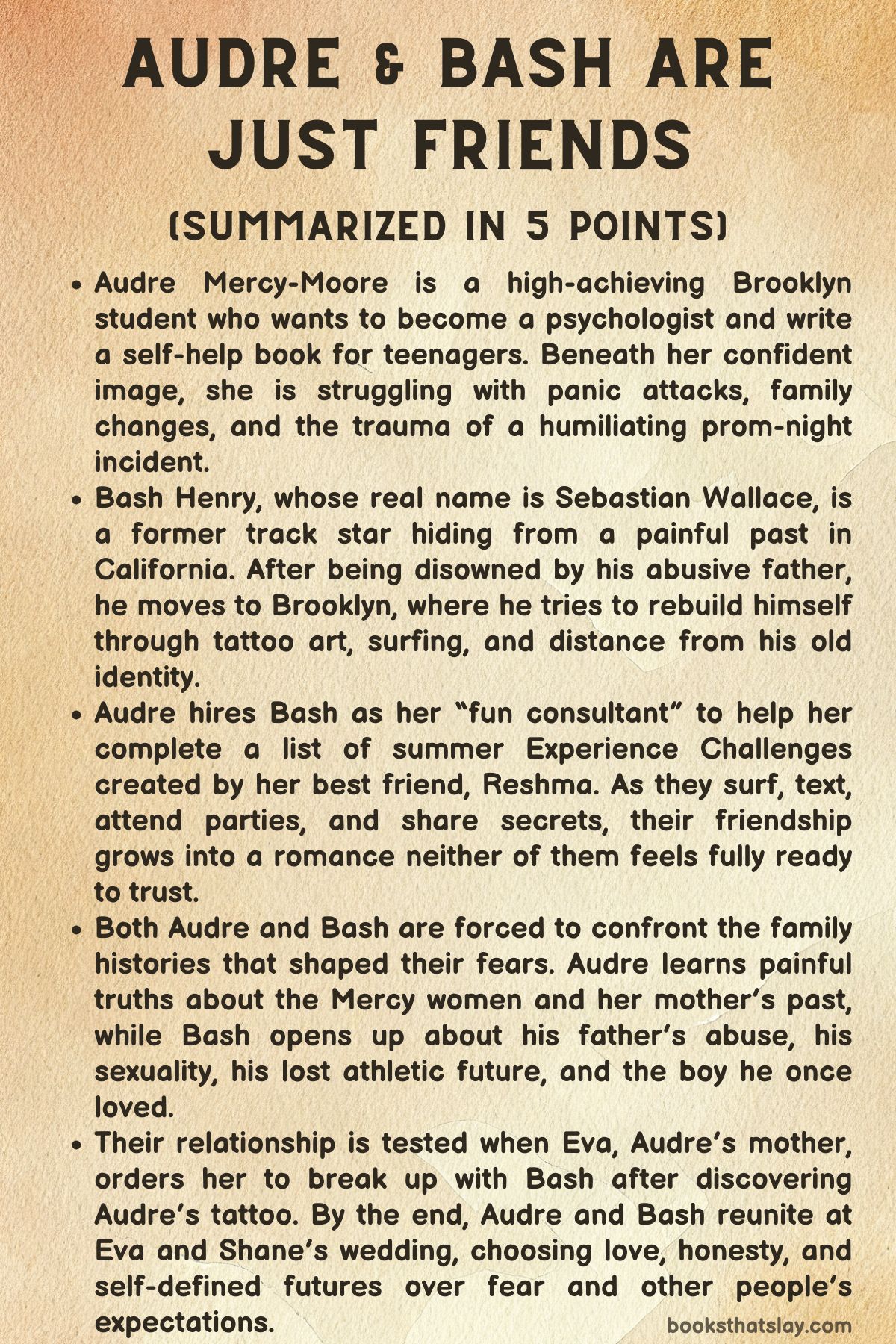
Summary
Audre Mercy-Moore is a junior at Cheshire Prep in Brooklyn, where she has built her identity around achievement, intelligence, and control. She is junior class president, debate team captain, and the unofficial therapist for her classmates.
She wants to become a famous psychologist and plans to strengthen her Stanford application by writing a self-help book for teenagers. On the last day of school, she attends a party at the home of her best friend, Reshma Wells.
While other students drink, vape, and flirt, Audre tries to counsel a classmate named Sparrow, who has a crush on Bash Henry, a mysterious senior from rival school Hillcrest Prep. Bash has only been in Brooklyn a few months, but rumors about his romantic life have already spread.
Audre tries to appear calm and wise, but she is shaken by a text from Ellison, her prom date from two months earlier. The message refers to a video that has supposedly been deleted and urges her not to tell anyone what happened.
The text triggers a panic attack, revealing that Audre’s controlled public image hides serious distress. At home, she feels displaced.
Her mother Eva and stepfather Shane have turned half of her room into a nursery for her baby sister Alice, leaving Audre sleeping on the couch. Audre feels ignored by Eva, who is busy with a new book, wedding plans, migraines, and motherhood.
Her father then tells her she cannot spend the summer in Malibu as planned because his wife Athena is expecting a baby and Audre’s room is being used. Audre feels replaced in both homes.
Bash Henry is also struggling with displacement. He used to live in California with his father, Milton, and was on track to become an Olympic sprinter.
Now he lives in Brooklyn with his mother Jennifer, a wealthy white woman who was absent for most of his life but presents herself as a rescuer of abandoned Black youth. Bash feels alienated from her and from the privileged students who gather at her apartment.
He hides behind an easygoing manner and lets rumors grow because they keep people from asking about his real pain. His only link to his old life is Clio Rhodes, a freshman at Cornell who urges him to contact Milton.
Audre and Bash meet in Prospect Park after Audre wanders there in distress. She sees Bash jogging and assumes he is another careless heartbreaker.
Their first conversation is sharp but charged. Bash surprises her with his kindness and his belief that change is part of life.
Audre is unsettled because she cannot read him as easily as she reads other people. Later, while babysitting Alice, she tells Reshma what happened at prom: Ellison got drunk, tried to pressure her into sex, laughed when she had a panic attack, and returned with other boys, one of whom filmed her.
Audre is haunted by fear that the video still exists. Reshma argues that Audre’s advice comes from books rather than experience and writes a list of Experience Challenges to help her live more boldly.
The challenges include risky physical activity, staying out late, buying a sex toy, kissing someone with real chemistry, and facing a fear. Audre and Reshma decide that Bash would make the ideal “fun consultant.”
Audre visits Bash at Just Because, the gift shop owned by his mother. She apologizes for judging him and asks him to help her complete the challenges as research for her self-help book.
Bash finds the idea strange but agrees. From his point of view, the job is another distraction from his lost track career, his father’s rejection, and his uncertain future.
He secretly wants to become a tattoo artist and runs a hidden tattoo space in the shop’s stockroom. He has sent his designs to respected tattoo shops, and Mack Rhodes of Fifth Angel Ink Designs in South Carolina invites him to do test art after he turns eighteen.
For the first challenge, Bash takes Audre surfing at Rockaway Beach. Audre is nervous, and when Bash stays underwater too long while searching the seafloor, she thinks he is drowning and rushes in to save him.
Bash panics over her safety and carries her ashore. The event sparks both fear and attraction.
Audre has a panic attack and runs away, but Bash follows gently and encourages her to talk. She tells him about her panic attacks, her fear of being replaced by Alice, and her hurt over her family.
Bash shares pieces of his own past, including his mother’s absence and his fame as a track star. Their friendship begins to deepen, and Audre starts to trust him.
However, she remains suspicious of his relationship with Clio, whose repeated calls make Audre think she may be his girlfriend.
Audre’s mother is furious when Audre returns home late from the beach after leaving her phone behind. Eva grounds her, but Audre continues texting Bash, and their bond grows through late-night messages.
Bash researches panic-attack grounding techniques for her, and Audre begins to feel seen by someone who understands her pressure to be perfect. At the same time, Reshma returns early from Argentina after a reckless romance with an older assistant.
She meets Clio in Prospect Park, is instantly drawn to her, and later begins pursuing her, partly because she thinks Clio is standing between Audre and Bash.
Audre and Bash complete another challenge by going to Target to buy a sex toy. Their awkwardness brings them closer, and they discuss success, failure, and the pressure to follow a predetermined path.
Bash tells Audre he does not plan to go to college and hopes to work as a tattoo artist. Audre congratulates him but also reacts with the tone of a guidance counselor, exposing how deeply she has absorbed conventional ideas of achievement.
Sparrow sees them together and becomes upset, believing Audre is getting close to the boy she likes.
As Audre and Bash keep texting, their romantic feelings become harder to ignore. Bash visits Audre’s window late one night, but Audre tells him they should stop flirting and remain friends because she fears getting hurt.
She is still bothered by his reputation and by Clio’s presence in his life. Bash wants to explain but leaves when she asks him to go.
Later, Audre tries to complete two challenges at once by staying out late and kissing another boy at a teen club called Chevalier. Bash reluctantly acts as her wingman.
Audre drinks too much, flirts with Manny Sanchez, and embarrasses herself by rapping. When she sees Ellison at the club, she breaks down and tells Bash that Ellison filmed her panic attack.
Bash, normally a pacifist, punches Ellison. Audre kicks Ellison, pulls Bash away, and runs with him through Brooklyn.
Away from the crowd, Bash tells her he wishes he could erase her bad memories and give her better ones. They kiss, crossing the line between friendship and romance.
The kiss changes everything, but it also increases Audre’s fear. After Bash brings her home just before curfew, Eva learns about the prom incident and the fight.
Audre and Eva argue because Audre feels neglected and judged. Bash makes a good impression on Shane, who speaks to him with patience and warmth, but Eva is suspicious.
Later, Bash tells Audre they should stop seeing each other outside the challenges because he likes her too much and is afraid of hurting her. Audre confronts him with the truth she found online: his legal name is Sebastian Wallace, and he was a nationally known sprinter.
Bash withdraws further.
Audre’s family questions intensify when she secretly reads part of Eva’s manuscript. She learns that Eva’s past and the Mercy family history are far darker than she knew.
Eva writes about addiction, family curses, absent fathers, and painful secrets. Shaken, Audre goes to Rockaway Beach and retrieves the Smurf lunchbox Bash had once searched for underwater, proving to herself that she can face fear for her own sake.
She sends it to Bash as payment for his work. When Jennifer breaks the lunchbox during an argument, Bash finally confronts his mother for abandoning him.
Bash meets Audre and tells her the full truth. Milton trained him harshly, abused him when he failed to win, mocked his softness, rejected his art and surfing, and disowned him after Bash kissed Jaden, a boy from a rival track team.
Milton’s church had strong antigay beliefs, and Bash’s relationship with Jaden led to scandal and separation. Bash also knows Milton is dying of prostate cancer.
He had tried to forget the past, but Audre has made him want a future instead of just escape. Audre, wanting something permanent and grounding, asks Bash for a tattoo.
He inks 333 on her wrist, a reference to the grounding method he taught her. Their intimacy grows, and Bash asks Audre to be his girlfriend.
She says yes.
Soon after, the truth about Clio is revealed. Clio is not Bash’s girlfriend; she is his half-sister, one of Milton’s children from other relationships.
Her calls were attempts to make Bash reconcile with their dying father. Clio had a boyfriend of her own, and Reshma’s pursuit of her began under false assumptions.
Both girls are hurt by the secrets between them. Audre then returns home to face Eva, who reveals the Mercy family’s painful history: Delphine suffered because her migraines were misunderstood and later killed her husband, Clothilde passed as white and died by suicide, and Lizette became an escort and moved Eva through unstable circumstances.
Eva also shares her own history of addiction, mental health crisis, and destructive behavior with Shane. Audre and Eva begin to understand each other, and Audre opens up about Ellison, panic attacks, and feeling replaced by Alice.
For a moment, they seem to heal. But when Eva sees Audre’s tattoo, she sees Bash as a bad influence and orders Audre to break up with him.
Audre obeys, though it devastates her.
Bash, meanwhile, repairs the Smurf lunchbox and decides to email Milton. He forgives his father but refuses to spend his life trying to repair a relationship that harmed him.
He also turns down Mack Rhodes’s South Carolina offer so he can stay in Brooklyn for Audre. When he tells Audre this, she breaks down and says they must end things because of Eva.
Bash is crushed.
Audre spends the following week heartbroken, but she begins writing honestly. She retitles her book What I Learned This Summer and realizes that life cannot be managed through rigid rules.
She returns to art, reconciles with Reshma, blocks Ellison, and decides to speak to her therapist about prom. At Eva and Shane’s wedding in Prospect Park, Audre is still miserable over Bash.
Then Bash arrives in a tuxedo. Shane has invited him after convincing Eva not to punish the young couple for the mistakes of adults.
Bash tells Audre he has joined Shane’s mentorship group, found work at a tattoo shop in Bed-Stuy, and written his own Experience Challenges. His final challenge is to tell the most important person in his life how he feels.
He tells Audre he loves her. She says she loves him too, and their summer of fear, honesty, and change ends with reconciliation and hope.
Characters
Audre Mercy-Moore
Audre Mercy-Moore is the central character of the book and one of its clearest portraits of high-achieving teenage anxiety. She is intelligent, ambitious, organized, and deeply invested in becoming a psychologist, but her desire to help others also works as a way to avoid facing her own wounds.
At school, she is respected as a leader and unofficial therapist, yet the role traps her in an image of maturity. She feels she must always know the right thing to say, always succeed, and always remain composed.
Her panic attacks after the prom incident with Ellison show how much pain exists beneath her polished exterior. Audre’s conflict is not simply romantic; it is also about identity.
She must learn that wisdom does not come only from books, speeches, or rules, but from living through confusion, fear, and mistakes. Her relationship with Bash helps her loosen her grip on perfection because he sees the vulnerable person behind the achiever.
Her family arc is just as important. She feels replaced by Alice, neglected by Eva, and unwanted by her father, but she eventually begins to understand how family history shaped her mother’s choices.
In Audre & Bash are Just Friends, Audre grows by accepting that being strong does not mean being untouched by fear.
Bash Henry / Sebastian Wallace
Bash Henry, whose legal name is Sebastian Wallace, is a former track prodigy trying to survive the loss of the future that was forced on him. He carries himself with relaxed charm, but that ease hides abuse, rejection, grief, and shame.
His father Milton treated him less like a son than a project, pushing him toward Olympic greatness and punishing him when he failed to meet impossible expectations. Bash’s disownment after kissing Jaden leaves him with a deep fear that his love can damage other people’s lives.
This is why he resists his feelings for Audre even when they are obvious. He is kind, artistic, protective, and emotionally perceptive, but he also uses secrecy as a defense.
His tattoo work is not a side interest; it is the first dream that truly belongs to him. Through Audre, he begins to believe that his softness is not a flaw.
His decision to email Milton, forgive him without returning to him, and stay in Brooklyn on his own terms marks a major step toward self-possession. Bash is romantic without being simple.
His flaws come from fear and avoidance, yet the book presents him as someone trying hard to choose honesty, gentleness, and healing.
Reshma Wells
Reshma Wells is Audre’s best friend, a bold and often chaotic presence whose confidence masks loneliness and insecurity. Adopted by British pop-star parents and raised in wealth, she has grown up feeling like an accessory in her parents’ lives rather than a fully seen daughter.
Her recklessness in Argentina and her quick attraction to Clio reveal her hunger for attention, risk, and emotional intensity. Reshma genuinely loves Audre, but she often confuses loyalty with interference.
Her plan to clear Audre’s path to Bash by seducing Clio shows both her devotion and her poor boundaries. She wants to solve Audre’s problems because that gives her a role and a sense of power, yet her meddling hurts the people she cares about.
Her romance with Clio forces her to face the difference between manipulation and real feeling. Reshma’s best qualities are her loyalty, humor, and courage, but she must learn humility.
By apologizing to Audre and Clio, she shows that she can take responsibility rather than hiding behind charm.
Eva Mercy-Moore
Eva Mercy-Moore is Audre’s mother, an acclaimed author, a new mother again, and a woman still shaped by a difficult past. To Audre, Eva often seems distracted, overprotective, and unfair.
She misses important moments, depends on Audre for childcare, and assumes danger when Audre is with Bash. Yet Eva’s behavior is rooted in fear.
Her memoir reveals a history of family trauma, addiction, mental health crisis, unstable parenting, and painful secrets. Eva wants Audre to inherit strength rather than damage, but she tries to protect her daughter by controlling information and behavior.
This creates distance instead of safety. Eva’s greatest mistake is assuming that hiding the past will prevent its effects.
Her anger over Audre’s tattoo shows how quickly her old fears can overpower her trust. Still, Eva is not uncaring.
When she learns about Ellison and Audre’s panic attacks, she responds with concern and practical help. Her arc is about learning that protection without listening can become another form of pressure.
Shane
Shane is Audre’s stepfather and Eva’s partner, and he serves as one of the book’s steadier adult figures. He has a history of addiction and destructive behavior with Eva, but in the present he is working to build a healthier life.
Audre sometimes resents the way he and Eva seem absorbed in their romance, the baby, and the wedding, yet Shane shows patience and emotional awareness when it matters. His conversation with Bash after the fight with Ellison is especially important because he speaks to Bash as a young person in pain rather than as a threat.
Bash recognizes in Shane the kind of adult guidance he never received from Milton. Shane’s mentorship group later gives Bash a place to process his past, and Shane’s intervention helps Eva reconsider her judgment of Bash.
He represents recovery, accountability, and the possibility that adults can grow beyond earlier mistakes.
Alice
Alice, Audre’s baby sister, is too young to act with intention, but she has major symbolic importance in the story. Audre initially calls her The Goblin in private and sees her as the reason her life has been pushed aside.
Alice’s arrival changes the family structure, takes over Audre’s room, demands Eva’s attention, and becomes a focus for Audre’s resentment. Yet Alice is not the real cause of Audre’s pain; she is the visible sign of Audre’s fear that everyone she loves is moving on without her.
By the wedding, Audre’s attitude toward Alice has softened. When she warns Alice about pressure and encourages her to be herself, Audre is really speaking from her own growth.
Alice represents the next generation of Mercy girls and the hope that old patterns might be interrupted.
Reshma’s Parents
Reshma’s adoptive parents are famous British pop stars whose neglect shapes Reshma’s behavior. They once enjoyed presenting her publicly as an adorable adopted child, but as she grew older, they became emotionally distant.
Their response to her Argentina scandal is disciplinary rather than deeply engaged. They send her home, but the larger pattern suggests they have not given her the steady attention she needs.
Their role in the book is brief but important because it explains why Reshma seeks validation through drama, flirtation, and bold gestures. She acts as though she needs no one, but her family background suggests the opposite.
Sparrow
Sparrow is a Cheshire Prep student who has a crush on Bash and seeks Audre’s advice at the opening party. She is insecure about whether she should change herself to attract him, which allows Audre to offer one of her early polished pieces of advice about being loved for one’s real self.
Sparrow also becomes a small but meaningful source of social tension when she sees Audre and Bash together at Target and feels betrayed. Her role highlights how rumors and crushes can distort perception.
Sparrow does not know Bash well, but she has built an emotional fantasy around him. Bash’s later intention to apologize to her shows that even minor misunderstandings deserve kindness.
Ellison
Ellison is Audre’s prom date and the source of one of her deepest wounds. His behavior at the prom after-party is cruel, selfish, and cowardly.
He pressures Audre sexually, laughs at her panic attack, and returns with other boys while one records her. His later texts are not expressions of remorse for hurting her; they focus on whether she will tell anyone and damage his college prospects.
Ellison represents the entitlement of someone more concerned with reputation than accountability. He is also the reason Audre’s anxiety becomes linked to phones, videos, parties, and public humiliation.
Bash punching him offers Audre a brief sense of vindication, but Audre’s real progress comes later when she blocks him and decides to speak to her therapist.
Jennifer
Jennifer is Bash’s mother, an independently wealthy white woman whose public values contrast sharply with her private failures. She travels the country working with underprivileged Black youth and speaks about abandoned children, yet she abandoned her own biracial son for most of his life.
This contradiction makes her one of the book’s more cutting portraits of performative care. Jennifer wants to see herself as generous and socially conscious, but Bash’s presence exposes what she refuses to acknowledge.
When Bash confronts her, he forces her to face the gap between her self-image and her motherhood. Her breaking of the Smurf lunchbox is emotionally significant because it shows her carelessness toward something Bash values.
Jennifer is not presented as purely evil, but she is deeply evasive and self-protective.
Milton Wallace
Milton Wallace is Bash’s father and one of the book’s most damaging forces. A former athlete whose own Olympic dream ended because of injury, he pours his ambition into Bash and treats his son’s talent as an extension of himself.
His abuse is physical, emotional, and psychological. He punishes Bash for losing, rejects his art and surfing, and tries to erase the parts of him that do not fit the image of a champion.
His antigay beliefs lead him to disown Bash after Bash kisses Jaden. Milton’s illness complicates Bash’s feelings because death creates pressure for reconciliation, but Bash eventually realizes that forgiveness does not require renewed closeness.
Milton’s role is essential because he shows how parental ambition can become violence when love depends on performance and obedience.
Clio Rhodes
Clio Rhodes is Bash’s half-sister and Reshma’s love interest. For much of the story, Audre and Reshma misread her connection to Bash as romantic, which creates jealousy and secrecy.
Clio is direct, attractive, independent, and somewhat mysterious. She wants Bash to contact Milton before it is too late, but her pressure also shows that she does not fully understand the depth of Bash’s pain.
In her relationship with Reshma, Clio is both sincere and flawed. She is drawn to Reshma but also admits she was dealing with a boyfriend and mixed motives.
Her anger at Reshma is justified because Reshma approached her under false pretenses, but Clio also has her own honesty to examine. She helps expose how assumptions can damage relationships before truth has a chance to appear.
Manny Sanchez
Manny Sanchez is a boy Audre knows through debate and chooses as a possible kissing partner during the party challenge. He is less emotionally central than Bash, but his scene matters because it shows Audre trying to force herself into a version of boldness that does not fit her.
Her flirtation with Manny is not really about desire; it is about proving she can move on from Bash and complete a challenge. Manny becomes part of the uncomfortable party sequence where Audre drinks too much and loses control of the image she works so hard to maintain.
He functions as a contrast to Bash because Audre’s interaction with him lacks the trust and emotional recognition she feels with Bash.
Fiona
Fiona appears at Chevalier and flirts with Bash after he denies that he and Audre are a couple. Her role is brief, but she sharpens Audre’s jealousy and insecurity.
Fiona’s presence reminds Audre of Bash’s reputation and of the fear that he may be kind and charming with everyone in the same way he is with her. She does not need extensive development to affect the scene; her importance lies in what she triggers inside Audre.
Through Fiona, the book shows how fragile Audre feels when she does not know where she stands with Bash.
Mack Rhodes
Mack Rhodes is the owner of Fifth Angel Ink Designs in Myrtle Beach and represents Bash’s professional dream. By inviting Bash to South Carolina for test art, Mack gives him validation from the tattoo world, something Bash has craved because his father dismissed his art.
Mack’s offer proves that Bash’s talent is real and that he can imagine a future outside track. Even though Bash later chooses not to pursue that particular opportunity, Mack’s role is still meaningful.
He opens a door that helps Bash see himself as an artist rather than a failed athlete. In Audre & Bash are Just Friends, Mack’s offer gives Bash a chance to decide what kind of life he wants.
Jaden
Jaden is the boy Bash kissed in California and a key figure in Bash’s backstory. He and Bash had been flirting for years through track competitions, and Jaden was in love with him.
Their kiss becomes the event that exposes Bash to Milton’s rejection and the judgment of a homophobic community. Jaden is also a reminder that Bash’s pain did not happen in isolation; another young person was hurt by the scandal and sent away.
Bash’s inability to reach Jaden leaves him with guilt and unresolved grief. Jaden represents both first queer desire and the cost of living in a world where that desire is punished.
Lizette
Lizette is Eva’s mother and Audre’s grandmother. She appears as a sharp, intoxicated presence during Eva’s wedding-dress selection, but her larger importance comes through the family history Eva reveals.
Once a model and pageant queen, Lizette later became an escort and repeatedly moved Eva whenever her circumstances changed. She is glamorous, cutting, and unstable, a woman shaped by survival and performance.
Audre has grown up hearing the Mercy women described as powerful, but Lizette complicates that legacy. Her life shows that strength can coexist with damage and that charisma does not erase the harm passed down to children.
Delphine
Delphine is Audre’s great-great-grandmother and one of the ancestral figures uncovered through Eva’s memoir research. Her migraines were misunderstood when she was young, and she was subjected to an exorcism because people around her interpreted illness through fear and superstition.
Later, she murdered her husband. Delphine’s story adds darkness and complexity to the Mercy family motto.
She is not simply an inspiring ancestor; she is a woman whose suffering was misread and whose life turned violent. Her presence in the family history helps Audre understand why Eva feared the past and why silence seemed safer to her.
Clothilde
Clothilde is Audre’s great-grandmother, another Mercy woman whose life complicates the family’s proud legacy. She entered affluent New Orleans society by passing as white, a choice that suggests both ambition and the brutal racial pressures of her time.
Her death by suicide reveals the emotional cost of living under concealment and social performance. Clothilde’s story mirrors the book’s larger concern with identity: what people hide to survive, what they lose by hiding, and how later generations inherit the silence.
For Audre, learning about Clothilde breaks the illusion of a simple heroic family story and replaces it with something more painful but more truthful.
Audre’s Father
Audre’s father is physically distant for much of the story but emotionally important because his choices deepen Audre’s sense of replacement. Her annual trip to Malibu with him has been a stable part of her life, so his decision to cancel it because Athena is expecting a baby feels like another abandonment.
He may not intend to hurt Audre, but his new family leaves her feeling pushed aside. His brief suggestion that Eva’s memoir may be causing stress helps Audre connect her mother’s behavior to hidden family history, but he does not provide the emotional steadiness Audre needs.
He represents a softer form of parental failure: not cruelty, but inattentiveness.
Athena
Athena is Audre’s stepmother and the mother of Audre’s soon-to-arrive half-brother. She does not play a large direct role, but her pregnancy changes Audre’s summer and contributes to Audre’s feeling that both parents are replacing her with new babies.
Athena’s mother staying in Audre’s room in Malibu also reinforces the sense that Audre no longer has a place in her father’s home. Athena matters less as an individual presence than as part of the family shift that sends Audre into the summer already hurt and unstable.
Baby Brother
Audre’s baby brother is not yet a developed character, but his impending birth is important to Audre’s emotional state. Like Alice, he represents a new child who seems to take priority over Audre.
When her father calls to discuss the baby’s arrival, Audre feels angry rather than excited because she is still wounded by the canceled Malibu trip. The baby brother’s role shows how Audre’s fear of replacement is not limited to one household.
She feels displaced in both branches of her family.
Eva’s Editor
Eva’s editor remains unnamed, but the planned meeting with the editor matters because it becomes part of the conflict after Audre’s beach outing with Bash. Eva relies on Audre to watch Alice so she can attend to her professional life, and Audre’s failure to return on time leads to a major argument.
The editor therefore represents the pressure of Eva’s career and the way adult responsibilities spill onto Audre. This unnamed figure is not personally developed, but the role helps show why Audre feels treated as dependable labor rather than as a teenager with needs of her own.
Themes
Perfection, Pressure, and the Right to Be Unfinished
Audre and Bash both begin the story trapped by excellence, though their worlds define success differently. Audre’s perfection is academic, social, and emotional.
She is expected to lead, advise, achieve, and remain mature beyond her years. Bash’s perfection is athletic and physical, created by Milton’s obsession with turning him into an Olympic champion.
Both teenagers have been praised for performance while denied room to be uncertain. Their romance matters because it gives them a relationship where they can be unfinished.
Audre can panic, misjudge, get jealous, make mistakes, and still be worthy of love. Bash can admit fear, pain, queerness, artistic ambition, and anger without being reduced to weakness.
Audre & Bash are Just Friends argues that perfection is often a mask young people wear to survive adult expectations. The healthier path is not failure for its own sake, but self-definition.
Audre’s revised book, What I Learned This Summer, captures this shift. She stops trying to write universal rules and begins writing from lived truth.
Bash’s choice to pursue tattooing rather than track also rejects inherited ambition. The theme is powerful because neither character becomes careless; instead, they become more honest about what they want and what they can no longer carry.
Family History, Secrecy, and Generational Pain
The Mercy family motto teaches Audre that the women in her family are extraordinary, but Eva’s memoir reveals that the truth is far more complicated. Delphine, Clothilde, Lizette, and Eva all survived circumstances marked by illness, racism, instability, secrecy, addiction, or mental health crisis.
Eva tries to turn this history into strength for Audre by hiding the most painful parts, but silence only creates confusion. Audre senses pressure without knowing its source.
She feels expected to uphold a legacy she does not fully understand. The same pattern appears in Bash’s family, where Milton’s failed Olympic dream becomes Bash’s burden and Jennifer’s abandonment is hidden beneath public virtue.
Family history in the story is not background decoration; it actively shapes how characters love, fear, and protect one another. The book suggests that secrecy may begin as protection, but it often leaves younger generations alone with consequences they cannot name.
Healing begins when Eva tells Audre the truth and when Bash names Milton’s abuse. The past cannot be erased, but it can be understood.
Once spoken aloud, inherited pain becomes something characters can respond to rather than unknowingly repeat.
Fear, Trauma, and Reclaiming the Body
Audre’s panic attacks after the prom incident show how trauma can make ordinary spaces feel unsafe. Parties, phones, videos, boys, and public attention become charged with fear because Ellison turned her vulnerability into a threat of humiliation.
Her Experience Challenges may appear playful at first, but they gradually become a way for Audre to reclaim choice. Surfing, staying out late, kissing, buying a sex toy, and diving for the lunchbox are not random acts of rebellion.
Each challenge asks her to return to her body and her desires after an experience that made her feel exposed and powerless. Bash also has a troubled relationship with his body.
Milton treated his body as an athletic machine, controlling food, rest, training, pain, and victory. Tattooing becomes Bash’s way of reclaiming the body as art rather than performance.
Audre’s 333 tattoo brings these arcs together. It marks her skin with a tool for grounding, turning fear into something she can see and touch.
The story does not pretend love alone cures trauma. Audre still needs therapy, honesty, and support.
Yet her bond with Bash helps her feel believed, defended, and present again, which makes recovery seem possible.
Love as Honesty, Not Rescue
The romance between Audre and Bash is built on care, but the story is careful to show that love cannot mean rescuing someone by force or fixing every wound. Bash wants to erase Audre’s bad memories, and Audre wants Bash to trust her with the truth, yet both must learn that love requires honesty rather than control.
Bash’s instinct to protect Audre leads him to punch Ellison, a moment that gives emotional satisfaction but also raises questions about anger and masculinity. His deeper growth comes when he tells Audre about Milton, Jaden, and his fear of hurting people.
Audre’s growth comes when she stops treating her feelings as problems to manage and admits what she wants. The adult relationships mirror this theme.
Eva tries to protect Audre by hiding family history and forbidding Bash, but that protection becomes harmful because it denies Audre’s judgment. Shane offers a better model by listening, mentoring, and helping Eva reconsider.
Love in the story is strongest when it gives people room to speak truthfully and choose for themselves. By the wedding, Audre and Bash reunite not because every problem has vanished, but because the people around them have begun to understand that care must include trust.