Ava’s Man Summary and Analysis
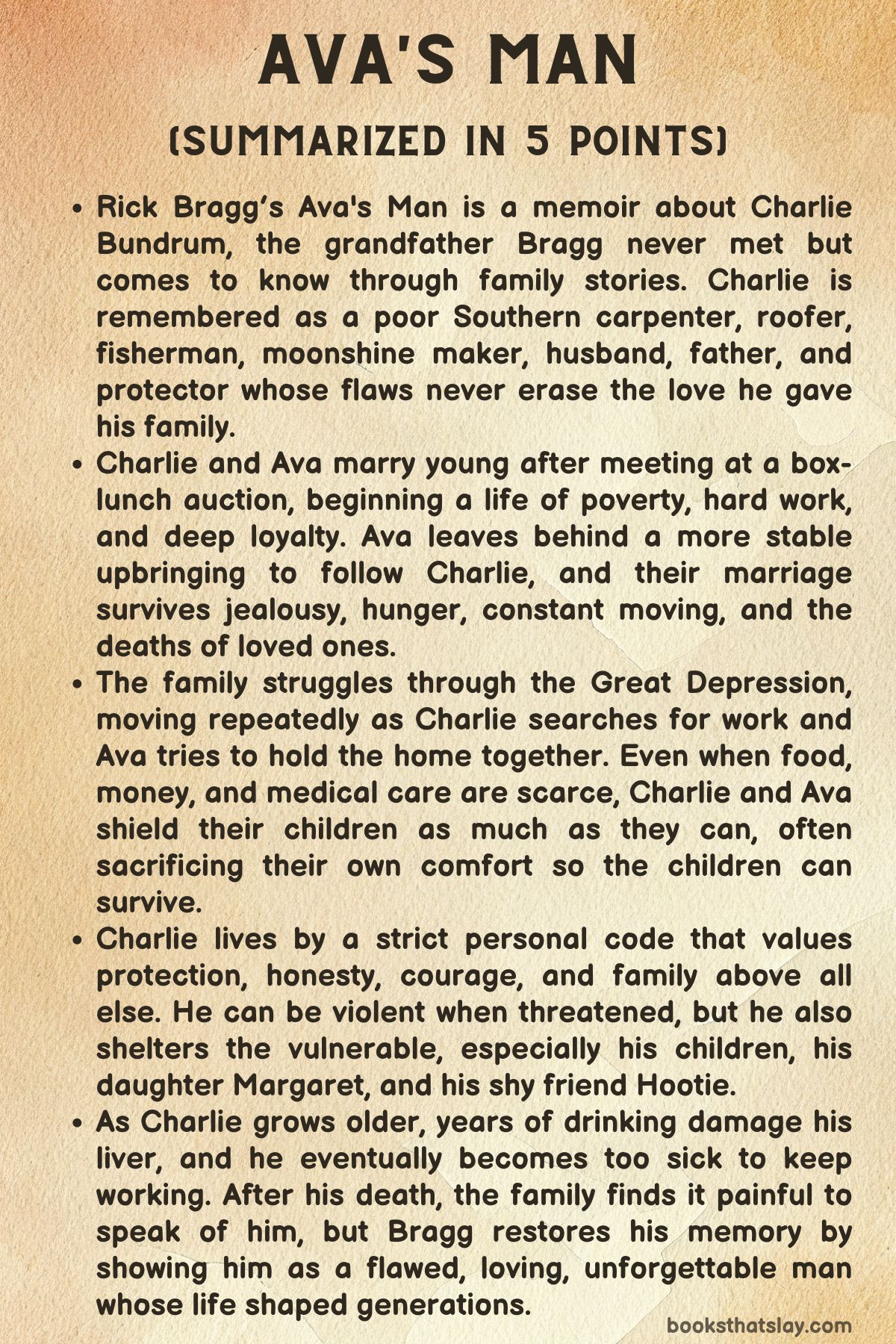
Ava’s Man by Rick Bragg is a family memoir centered on Charlie Bundrum, the grandfather Bragg never met but came to know through stories, memories, and the lasting devotion of the people who loved him. The book is not a traditional biography built from documents and dates; it is a portrait shaped by oral history, Southern memory, poverty, work, violence, loyalty, music, river life, and grief.
Through Charlie and Ava’s marriage, Bragg writes about a vanished rural South where people survived by skill, pride, stubbornness, and family bonds that hardship could not break.
Summary
Rick Bragg begins Ava’s Man with his grandmother Ava, an old woman whose sharp tongue, humor, and fierce spirit remain vivid in his memory. Ava has lived through terrible losses, including the deaths of two daughters, yet she still carries the force of the girl she once was.
When her grandchildren joke about her finding another man, she refuses because, in her mind and heart, she already had one: Charlie Bundrum. Charlie died before Bragg was born, so for much of Bragg’s life he exists only as a faint family presence, a man mentioned in fragments but not fully explained.
Bragg slowly learns that Charlie was a carpenter, roofer, fisherman, moonshine maker, fighter, hunter, river man, husband, father, and protector. He decides to write honestly about him, neither hiding his drinking and violence nor ignoring his generosity, courage, and love.
Charlie and Ava meet when they are teenagers at a box-lunch auction outside Gadsden, Alabama. Charlie is poor, skinny, and unable to read, but he has confidence and charm.
Ava comes from a more settled, churchgoing family and has intelligence, spirit, and a love of reading and music. She could have had a different life, but she chooses Charlie.
They lie about their ages and marry young, beginning a life marked by poverty, constant movement, hard labor, passion, and loyalty. Their marriage is not gentle in any polished sense, but it is strong.
Ava works beside Charlie, challenges him, loves him, and refuses to be reduced to a quiet wife. When another woman, Blackie Lee, appears too comfortably in Ava and Charlie’s home, Ava responds with fury, showing the possessive force of her love and the intensity of the life she has chosen.
The book reaches back into Charlie’s family history, tracing the Bundrum name to Jean Pierre Bondurant, a Huguenot whose descendants eventually move south and become part of the poor white world of Alabama and Georgia. Charlie’s father, Jimmy Jim, is a hard, violent, intimidating man known for his temper, whiskey, and disregard for law.
Charlie grows up in this rough world, shaped by poverty and by the loss of his mother, Mattie, who is injured by a cow and later dies when Charlie is still young. Her death wounds him deeply.
As a young man, Charlie roams the countryside, catching possums, working where he can, drinking homemade whiskey, and living by a personal code. He cannot read or write, but he knows how to build, measure, bargain, fish, and survive.
Charlie and Ava begin raising children in a world where danger is ordinary. Their first sons, James and William, are born with the help of a midwife, Granny Isom, who is paid in whatever poor families can spare.
Charlie becomes a father early, but he understands fatherhood with absolute seriousness. His rule is simple: nothing must happen to the weak and small who belong to him.
This code is tested when William is attacked by a vicious dog after an old man named Dempsey cruelly provokes the animal. Charlie does not kill Dempsey, though he believes the man deserves punishment.
Instead, he kills the dog, protecting his child while also thinking practically about prison and the survival of his family.
For a brief time after World War I, work is steady and Charlie’s family experiences a little comfort. They can afford small luxuries, decent food, photographs, and medical care.
Their daughter Edna is born during this better period. But the Great Depression destroys that stability, sending the family back into the woods and into severe poverty.
Ava gives birth to Emma Mae, whom Charlie nicknames Little Hoover in bitter reference to the hardship of the era. Emma Mae becomes ill with conditions that could have been treated if the family had money.
She dies, and because they cannot afford a proper marker, Charlie arranges rocks on her grave. The loss remains one of the great sorrows of Ava’s life.
During the Depression, Charlie’s family moves again and again as he chases work. Ava hates moving, especially because every move threatens the fragile sense of home she tries to hold together.
Her kerosene lamp becomes a symbol of safety and continuity, a small circle of light amid the instability. More children are born, including Gracie Juanita and later Margaret.
Though the family is poor, the children often remember their childhood as protected because Charlie and Ava absorb the worst of the hunger and fear. The parents wait to eat until the children are fed.
Charlie’s strength and humor keep poverty from fully defining the children’s memories.
Charlie also forms a deep friendship with Jessie Clines, known as Hootie, a shy, strange-looking man who lives near the river. Hootie is mocked by some and misunderstood by many, but Charlie recognizes his goodness.
After Hootie is beaten by people who believe he has hidden money, Charlie brings him into the Bundrum household. Hootie becomes part of the family, a quiet companion who listens to Charlie’s stories and joins him on the river.
Charlie’s kindness exists beside a capacity for sudden violence. When drunken men pound on his door and wake his babies, he chases them with a hammer and shoots one of them as they run.
When his son James is bullied, Charlie teaches him to strike back hard enough that the fight will end. In Charlie’s world, violence is sometimes treated as a necessary answer to threat.
Bragg does not excuse this world, but he presents it as part of the code by which poor, isolated people survived. Charlie is not cruel for pleasure.
His anger is tied to protection, pride, and a belief that weakness invites harm.
The family endures more hardship when Charlie is injured at work, falls from a scaffold, coughs blood, and still keeps working because there is no other choice. He later becomes sick with pneumonia and cannot pay rent.
His body is repeatedly spent for the sake of his family. Margaret, Bragg’s mother, is born into this life.
Charlie breaks family custom by walking the baby around himself, passing on his own strength and luck. Margaret grows into a gentle, timid girl, unlike the more combative Juanita, yet she carries a quiet endurance.
One of Margaret’s childhood traumas comes when her dress catches fire. Ava and Edna smother the flames with their hands, but Margaret is badly burned.
Charlie, drunk when he first sees her, underestimates the injury. When he returns sober and realizes how serious it is, he takes her to a doctor and feels lasting guilt.
This episode shows both the damage caused by his drinking and the love that brings him back to responsibility.
Moonshine is central to Charlie’s life. He makes it well, sells it, drinks it, and trusts his own product.
Drinking gives him pleasure, sociability, and stories, but it also damages his body. Bragg presents alcohol as Charlie’s great weakness, the habit that shortens his life and prevents his grandchildren from knowing him.
Yet Charlie is not a lazy drunk. He works, provides, and keeps going.
His drinking does not erase his labor or love, but it shadows them.
During World War II, Charlie is called for examination but rejected from service because too many children depend on him. Later, the family settles near the Reardens, a chaotic neighboring family drawn to fighting, whiskey, and trouble.
One Rearden son, Jerry, threatens Hootie and then Charlie. When Jerry shoots at Charlie, Charlie attacks him, takes control of the situation, and shoots Jerry’s girlfriend when she tries to intervene.
No law comes. In that place and time, such violence is treated as rough justice.
The family eventually settles more permanently in Alabama. The older children begin to marry and leave, though they remain close to Charlie and Ava.
The Depression ends, food becomes more reliable, the younger children go to school, and the family finally lives in a house that gives them some space, clean water, and a sense of rootedness. Charlie is proud not because he has become rich, but because his family is alive and together.
Charlie remains a force in his grown children’s lives. When James, drunk and angry, decides to kill a man named George, Charlie stops him by force, knocking him unconscious and reminding him that he has a wife and baby who need him.
James later understands that his father saved his life. The family also suffers another terrible loss when two of James and Phine’s children die in a house fire, a tragedy so painful that Bragg treats it briefly, reflecting the family’s habit of not speaking long about grief.
Charlie’s health worsens because of liver damage caused by years of drinking. He goes to the hospital and has part of his liver removed.
Though he continues to work, fish, and be with his family, time is narrowing. Meanwhile, the world around him changes.
Rivers are dammed, towns grow, roads improve, and old ways of drinking, fighting, fishing, and hiding whiskey stills become harder to maintain. Charlie belongs to an older South that is disappearing.
Margaret meets Charles Bragg, a handsome young man who goes to Korea and writes to her from the war. When he returns, he courts her with stolen flowers and eventually marries her.
Charlie likes him but senses danger in him. His fear proves justified.
Charles becomes an angry drinker and abuses Margaret. After Margaret gives birth to Sam, she leaves Charles and returns to Charlie and Ava.
Charlie does not force her choice; he simply holds the baby and lets his daughter decide. His presence gives her shelter.
Near the end of his life, Charlie has a religious experience. After years of refusing church, he tells Margaret that he heard heavenly music and a voice warning him that this was his last chance.
He says he has been saved and gives up drinking. Around the same period, Hootie decides to return to his own place by the river, though Charlie is sad to let him go.
Charlie takes a good-paying job in Clearwater, Florida, but he is very sick. Doctors tell him he is going to die.
He keeps working until he can no longer continue. He retrieves his tools from Florida, sleeping in the backseat while Juanita and William drive him.
Ava watches the man she has loved for decades fade away. Charlie chooses not to die at home in front of Ava and the younger children, so he stays with Edna.
One day he goes walking, collapses near a pasture, and dies.
His funeral is crowded with people who loved him. Even Charles Bragg, hardened by war and violence, cries.
Hootie does not attend, and soon after, he too is found dead near the river. After Charlie’s death, Ava continues working, and the family keeps going, but they avoid speaking of him because memory hurts too much.
Margaret eventually leaves Charles for good and returns to Ava with her children.
Years later, Ava visits Emma Mae’s grave and finds the rocks Charlie arranged still in place. The sight brings back the full weight of her life with him: love, hardship, loss, labor, and devotion.
Ava later loses her youngest daughter Sue to cancer and dies in old age. After her death, the family also struggles to speak of her, because remembering hurts.
Bragg ends by imagining the grandfather he never met. Through stories, he has made Charlie more than a faded photograph.
He pictures him in summer, on the river, in a homemade boat built from car hoods, moving across the water. At a family reunion, Bragg sees the old South and the new South standing side by side.
He recognizes that Charlie’s world is gone, but not fully lost, because it survives in memory, speech, family stories, and the pride of those who came from him.
Key Figures
Charlie Bundrum
Charlie Bundrum is the central figure of the book and the man around whom the family’s memory gathers. In Ava’s Man, he is presented as both flawed and deeply admirable: a moonshine maker, fighter, roofer, carpenter, fisherman, father, husband, and protector.
Charlie cannot read or write, but he is far from ignorant. He understands work, weather, tools, wood, roofs, rivers, bargains, animals, and people.
His intelligence is practical and physical, built from survival rather than schooling. He lives by a strict personal code that values loyalty, courage, honesty, and protection of the weak.
That code can turn violent, especially when his children or family are threatened, but his violence is not random cruelty. It grows from the harsh world that shaped him.
Charlie’s great weakness is whiskey. It gives him pleasure, income, and companionship, but it also damages his body and shortens his life.
What makes him unforgettable is the contrast within him: he can shoot, fight, curse, drink, and break the law, yet he can also hold babies, feed his family before himself, shelter Hootie, love Ava for decades, and stand between his daughter and an abusive husband. He is remembered as a man who made people feel safe.
Ava Bundrum
Ava is Charlie’s wife and Bragg’s grandmother, a woman of fire, wit, pride, and endurance. She begins life with more stability than Charlie, raised in a churchgoing family that values reading, learning, and music.
She could have followed a safer path, but she chooses Charlie and accepts the uncertainty that comes with him. Ava is not a passive wife.
She works in cotton fields, raises children, reads to Charlie, challenges him, fights for her marriage, and keeps the household alive through hunger, grief, and constant moving. Her love for Charlie is fierce rather than soft.
When threatened by Blackie Lee’s presence, she responds with physical fury, revealing both jealousy and the depth of her attachment. Ava’s kerosene lamp becomes a strong symbol of her character: she seeks a small, steady light in a life repeatedly shaken by poverty and loss.
She buries children, watches Charlie die, keeps working, and grows old with memory as both comfort and burden. In Ava’s Man, Ava is not simply the wife of a remarkable man; she is his equal in strength, the keeper of the family’s emotional center, and one of the reasons Charlie’s story survives.
Rick Bragg
Rick Bragg is the narrator, grandson, and collector of memory. He never meets Charlie, so his role in the book is shaped by absence.
Rather than writing from direct experience, he builds his grandfather from family stories, remembered sayings, emotional traces, and the silence that follows grief. Bragg’s presence is important because he understands that family history can disappear when pain makes people stop talking.
He approaches Charlie with affection but not blind worship. He admits the drinking, the fighting, the illegal whiskey, and the rough justice, while still showing why Charlie was loved.
Bragg also serves as a bridge between generations. He belongs to a later world but is drawn to the older language, customs, and values of his people.
His writing turns oral history into a lasting portrait. In Ava’s Man, Bragg is not only telling the story of one grandfather; he is also trying to recover a way of life that poverty, modernization, and silence have nearly erased.
Margaret Bundrum Bragg
Margaret, Bragg’s mother, is one of Charlie and Ava’s daughters and one of the emotional links between Charlie’s life and Bragg’s own. As a child, she is more timid and gentle than Juanita, believing that people might stop being cruel if she simply waits long enough.
Her childhood burn injury becomes one of the book’s most painful moments, partly because it exposes Charlie’s failure while drunk and his later guilt when sober. Margaret grows into a woman who suffers under Charles Bragg’s abuse, yet her father’s home gives her a place of refuge.
Charlie’s love for Margaret is especially tender, and he treats her as one of his favorite daughters. When she returns home with baby Sam, Charlie does not command her but protects her freedom to choose.
Margaret’s life shows how Charlie’s strength continues into the next generation, not as perfection, but as shelter. She also carries forward the family memory that allows Bragg to know the grandfather he never met.
Sam Bragg
Sam is Margaret’s first son and Rick Bragg’s older brother. He is especially important because Charlie lives long enough to know him, hold him, and protect him during the final period of his life.
Sam’s birth gives Charlie another reason to keep going even as illness weakens him. In the opening frame of the book, Sam’s remark about fish not biting on a bluebird day reminds Bragg of old Southern speech and of the kind of wisdom Charlie might have passed down.
Sam therefore represents the living thread between Charlie and the grandchildren who mostly did not know him. Through Sam, Bragg senses that Charlie’s voice has not fully vanished.
James Bundrum
James is Charlie and Ava’s first child, and his life shows how Charlie’s code is passed from father to son. As a boy, James is taught to defend himself with force after a bigger boy hurts him.
Charlie’s lesson is severe: when violence must be used, it must end the threat. Later, as an adult, James nearly repeats the destructive side of that code when he drunkenly decides to kill George for calling him a liar.
Charlie stops him, reminding him that he has a wife and child who depend on him. James’s later gratitude shows that he understands his father saved him from ruining his own life.
James also suffers devastating loss when two of his children die in a house fire. His character carries both inheritance and warning: he receives Charlie’s toughness, but he also learns that strength must sometimes mean restraint.
William Bundrum
William is Charlie and Ava’s second son and one of the children whose suffering reveals Charlie’s protective nature. As a small boy, William is attacked by Dempsey’s abused dog after Dempsey cruelly turns the incident into a game.
The attack is a turning point because it shows how seriously Charlie takes harm done to his children. Charlie brings William back to Dempsey’s place and kills the dog, making clear that he will not allow danger to stand unchallenged.
William later helps drive the dying Charlie to Florida to retrieve his tools, a quiet act that shows the grown children’s loyalty to their father. William’s role is not as outwardly dramatic as Charlie’s, but he is central to the book’s pattern of injury, protection, and family duty.
Edna Bundrum
Edna is Charlie and Ava’s first daughter and a steady presence in the family. Her birth occurs during a period when the family briefly has enough money for better medical care, marking one of the few brighter economic moments in Charlie and Ava’s early life.
As a child, Edna helps save Margaret when Margaret’s dress catches fire, rushing with Ava to smother the flames. This act places her inside the family’s pattern of urgent care, where children often have to grow up quickly and respond to danger.
Later, Charlie chooses to stay with Edna when he is near death because he does not want Ava and the younger children to watch him die at home. Edna’s home becomes the place from which Charlie takes his final walk.
Her character is associated with responsibility, closeness, and the sorrow of witnessing the end of her father’s life.
Emma Mae Bundrum
Emma Mae, nicknamed Little Hoover, is one of the book’s most painful symbols of Depression-era poverty. Her nickname carries bitter humor, connecting her birth to a time when many families felt abandoned by national leadership and crushed by economic failure.
Emma Mae’s illnesses are ordinary by modern standards but deadly in a family without money for medical treatment. Her death shows how poverty kills not only through hunger but through lack of access to care.
Charlie’s arrangement of stones on her grave is a humble but powerful act of love. Decades later, when Ava visits the grave and finds the stones still in place, Emma Mae’s brief life returns as a measure of everything Charlie and Ava endured.
She is less a developed character through action than a lasting wound in the family’s memory.
Gracie Juanita Bundrum
Gracie Juanita, often called Juanita, is one of Charlie and Ava’s daughters and is described as stronger and more combative than Margaret. Her survival as a baby matters deeply because Ava, after losing Emma Mae, fears sickness and death whenever a child grows weak.
Juanita grows into a capable and loyal daughter. She helps Charlie with roofing work and later drives him with William to Florida when he is too sick to retrieve his tools himself.
Her practical strength reflects Charlie’s influence, while her care for Ava later in life shows her attachment to her mother’s grief. When Juanita takes Ava to Emma Mae’s grave, she helps reopen a buried part of family memory.
Juanita stands as a daughter shaped by hardship but not broken by it.
Sue Bundrum
Sue is Charlie and Ava’s youngest daughter, born when Ava is nearly forty. Her birth comes during a more stable period for the family, when food is more plentiful, the children are healthier, and the family has begun to settle.
Sue represents the later stage of Charlie and Ava’s parenthood, when the worst Depression years have passed but hardship has not disappeared. Her later death from cancer is another heavy blow to Ava, who has already buried a baby and her husband.
The family delays telling Ava because they know how much pain the news will bring. Sue’s role shows that even after survival improves, grief continues to visit the family.
Jimmy Jim Bundrum
Jimmy Jim, Charlie’s father, is a severe and intimidating man whose temper and hardness shape the world Charlie comes from. He drinks, fights, carries a pistol, makes whiskey, and lives outside ordinary respect for law.
His personality is harsher than Charlie’s, and he seems to rule by fear more than affection. As a father, he is hard on his children and often absent because of trouble with law enforcement over his stills.
Yet he also belongs to the same rough economy of lumber, liquor, and survival that later shapes Charlie. Jimmy Jim matters because he shows the inheritance Charlie receives and partly transforms.
Charlie carries some of his father’s violence and whiskey-making, but he becomes a warmer, more protective, more loving man than Jimmy Jim appears to have been.
Mattie Mixon Bundrum
Mattie Mixon, Charlie’s mother, is a quieter but deeply important figure. Her injury from a cow leaves her physically damaged, yet she continues caring for her children without the steady support of her husband.
Her closeness to Charlie gives him one of the first strong emotional bonds of his life. When she dies while Charlie is still young, the loss crushes him and leaves a lasting mark.
Mattie’s character helps explain Charlie’s tenderness toward women and children, even in a world that rewards hardness. She represents suffering without complaint and maternal strength under brutal conditions.
Blackie Lee
Blackie Lee appears briefly but memorably as the woman whose presence in Charlie and Ava’s home provokes Ava’s rage. She is described as a painted woman, and the silk stockings on the clothesline become the sign that sends Ava rushing home from the cotton fields.
Blackie’s role is less about her individual personality than about what she reveals in Ava and Charlie’s marriage. Her presence threatens Ava’s claim on Charlie, and Ava’s violent response shows that her love is possessive, proud, and unwilling to be humiliated.
Blackie also reflects the rough social world around the couple, where boundaries are enforced directly and physically.
Jean Pierre Bondurant
Jean Pierre Bondurant is the distant ancestor connected to the Bundrum family line. As a Huguenot displaced by religious conflict, he represents an older history of movement, exile, and adaptation.
His descendants travel south, and the family name shifts from Bondurant to Bundrum. Though he is not a character in the active events of the story, he gives the family a historical root.
His presence suggests that being “run off,” displaced, or forced to start again is not only part of Charlie’s life but part of a longer family pattern.
Granny Isom
Granny Isom is the midwife who helps deliver Charlie and Ava’s early children. She belongs to a rural world where formal medical care is often unavailable or unaffordable, and where birth depends on local women, skill, experience, and barter.
Families pay her with food, quilts, or whatever they can spare. Her character represents the practical community systems that poor families relied on before doctors became reachable.
She also marks the difference between poverty and brief prosperity: when Edna is born, the family can finally afford a real doctor, showing how much Granny’s work is tied to economic necessity.
Dempsey
Dempsey is an old, cruel neighbor whose treatment of William reveals the danger that can come from casual meanness. As a dog fighter who keeps an abused animal chained in a barn, he already represents brutality.
His decision to frighten William for amusement leads to the dog attack, making him responsible for a child’s injury. Dempsey’s cowardice appears when Charlie confronts him and he gives in.
He is important because he tests Charlie’s moral limits. Charlie believes Dempsey deserves worse, but he chooses the punishment that will protect his family without taking him away from them.
Dempsey exposes the difference between cruelty and controlled violence.
Jessie “Hootie” Clines
Hootie is one of the most moving supporting characters in the book. Small, odd-looking, shy, and socially awkward, he is misjudged by people who do not understand him.
Charlie sees past his strangeness and accepts him as a friend. Their bond is built around river life, fires, fishing, whiskey, and listening.
Hootie does not need to match Charlie’s talkativeness; he gives Charlie the gift of attention. After he is beaten by men looking for imagined hidden money, Charlie brings him into the family, where he becomes almost kin.
Hootie’s later decision to return home and his death after Charlie’s passing suggest how deeply his life had been tied to Charlie. He represents friendship given without demand and the way Charlie’s protection extends beyond blood.
The Rearden Family
The Reardens are chaotic neighbors who bring conflict, noise, whiskey, and danger into the Bundrums’ world. They are not portrayed as wholly evil; most of them are decent enough as neighbors, but their household thrives on fighting and disorder.
For Charlie and Ava’s children, the Reardens are fascinating because they seem theatrical and unpredictable. Their presence shows the rough social environment around the family, where violence, illegal liquor, and law trouble are common.
They also set the stage for one of Charlie’s most dangerous confrontations, proving that even when Charlie tries to move his family toward stability, trouble can follow from nearby.
Jerry Rearden
Jerry Rearden is the most threatening member of the Rearden family. Unlike the others, who may be wild but not necessarily malicious, Jerry is mean enough to frighten Hootie.
His accusation that Hootie stole whiskey is both false and predatory, targeting a vulnerable man. When Jerry comes into Charlie’s yard with a gun and shoots at him, he crosses a line that Charlie cannot ignore.
Jerry’s role is to provoke Charlie’s protective violence. He shows how danger often enters the family’s life through men who mistake kindness or oddness for weakness.
Jerry Rearden’s Girlfriend
Jerry’s girlfriend appears during the confrontation between Jerry and Charlie. Hidden in the bushes, she attacks or attempts to attack Charlie, and he shoots her in the chest.
She is not developed in depth, but her role intensifies the danger of the scene. Her presence shows that violence in this world is rarely neat or limited to two men.
It spreads suddenly, pulling others into its consequences. She also helps reveal Charlie’s instinct in crisis: when threatened, he acts immediately and decisively.
Grace
Grace, Ava’s sister, represents the life Ava might have had if she had not chosen Charlie. Grace marries wealthier, dresses well, smokes, drinks, wears makeup, drives a fine car, and lives with comforts Ava does not have.
She is not presented as shallow; rather, she functions as a contrast. Through Grace, the reader sees that Ava’s poverty is not inevitable only because of birth.
Ava makes a choice for love, and that choice costs her ease, clothing, security, and rest. Grace’s polished life makes Ava’s harder life more visible, but it does not make Ava regret Charlie.
Charles Bragg
Charles Bragg, Margaret’s husband and Rick Bragg’s father, is handsome, charming at first, and marked by war. He courts Margaret after returning from Korea, bringing stolen flowers and appearing romantic.
Charlie Bundrum respects him but senses that he may have a mean side. That fear becomes true when Charles turns into an angry drinker and abuses Margaret.
Charles is important as a dark contrast to Charlie. Both men drink, both can be violent, and both come from hard worlds, but Charlie’s violence is tied to protection while Charles’s violence turns against his own wife.
Through Charles, the book makes clear that toughness without love becomes danger.
Linda
Linda, Edna’s daughter, is one of Charlie’s grandchildren and is nicknamed Flour Girl because she likes sneaking into flour. Her presence shows Charlie in his later years as a delighted grandfather.
He loves children, and they trust him instinctively. Linda’s nickname reflects the family’s humor and the affectionate language through which Charlie bonds with the younger generation.
Though her role is small, she helps show what was lost when Charlie died before most of his grandchildren could know him.
Phine
Phine is James’s wife and the mother of the two children who die in the house fire. Her role is connected to one of the book’s sharpest tragedies.
She is away at a neighbor’s home when the fire occurs, while James is at work, making the loss feel even more cruel because it happens in an ordinary gap of daily life. Phine is not described in great detail, but her grief is implied through the enormity of the event.
Her character reminds the reader that suffering in the family does not belong only to Charlie and Ava’s direct children; it reaches spouses and grandchildren too.
George
George is the man James intends to kill after being called a liar. He appears mainly as the trigger for James’s drunken rage.
His importance lies in the choice James almost makes and the intervention Charlie provides. George’s insult threatens James’s pride, and in the culture of the book, wounded pride can lead quickly to violence.
By stopping James before he reaches George, Charlie prevents an argument from becoming a murder. George is therefore less a developed personality than a crucial test of James’s self-control and Charlie’s fatherhood.
Preacher Jones
Preacher Jones is the man who marries young Charlie and Ava after they lie about their ages. His role is brief but significant because he formalizes the decision that changes Ava’s life.
Through him, their impulsive teenage love becomes a marriage that lasts through decades of poverty, children, labor, loss, and devotion. He represents the social and religious structure that allows their union to begin, even though their youth and circumstances make the future uncertain.
Jeanette
Jeanette is named in the later family material but is not described in enough detail in the provided account to allow a full personality study. Her inclusion signals the widening circle of Charlie’s descendants and the family’s religious language, especially through the phrase “Child of God.” Even with limited information, Jeanette’s presence belongs to the book’s broader movement from Charlie and Ava’s children to their grandchildren and extended kin.
She helps show that Charlie’s story is not sealed in the past but continues through a family network that remembers through names, nicknames, and stories.
Themes
Family as Protection Against Poverty
Poverty in Ava’s Man is not shown as a simple lack of money; it is a daily pressure that shapes where people sleep, what they eat, whether children survive illness, how often a family must move, and how much dignity they can preserve before the outside world. Charlie and Ava are poor for most of their marriage, but the book repeatedly shows that their children do not always feel the full force of that poverty because their parents stand between them and its worst effects.
Charlie and Ava wait to eat until the children have eaten. Charlie keeps working even when injured, sick, or exhausted.
Ava picks cotton, bears children, packs homes, and guards small objects like her lamp because they give her a sense of order. The family’s poverty is severe, but it does not erase pride.
Charlie’s children remember hunger and hardship through the larger memory of being protected. This theme is powerful because it refuses to romanticize poverty while also showing how love can create shelter inside it.
The family does not defeat poverty in any grand way; they endure it together, and that endurance becomes a form of inheritance.
Love as Labor, Loyalty, and Endurance
Charlie and Ava’s love is not presented as delicate or idealized. It is noisy, physical, jealous, stubborn, and tested by exhaustion.
Ava’s life with Charlie costs her comfort and security. She could have had more ease if she had followed a path closer to Grace’s, but she chooses a man who brings uncertainty along with devotion.
Their love is built through work: raising children, surviving hunger, moving from place to place, reading aloud at night, building homes out of temporary shelter, and remaining together after loss. Ava’s love includes anger, as seen in her reaction to Blackie Lee, but that anger grows from commitment rather than emptiness.
Charlie’s love is often shown through action rather than speech. He protects children, brings Hootie home, works through pain, and tries to spare Ava the sight of his death.
The book suggests that in their world, love is not mainly expressed through polished language. It appears in food saved for children, tools carried to work, graves marked with stones, and doors opened to those who need protection.
Love lasts because it is practiced under pressure.
Violence, Morality, and the Code of Survival
The book presents a world where law is distant, poverty is close, and danger often has to be answered immediately. Charlie’s morality does not always match formal law or church teaching.
He makes whiskey, drinks, fights, shoots, and sometimes acts with frightening force. Yet he is not portrayed as morally empty.
His code is clear: do not lie, do not steal, do not harm the weak, do not threaten his family, and do not mistake kindness for surrender. This creates one of the book’s central tensions.
Charlie can be gentle with children and merciless toward threats. He can be a sinner in the eyes of religious neighbors and still act with more honor than men who appear respectable.
The book does not ask the reader to approve of every violent act. Instead, it asks the reader to understand the conditions that shaped such acts: isolation, weak law enforcement, masculine pride, hunger, and a culture where being unable to defend oneself could invite further harm.
Charlie’s later decision to stop James from killing George is especially important because it shows growth within the code. He knows violence, but he also knows when violence would destroy a family rather than protect it.
Memory, Silence, and the Need to Tell
Much of the book exists because Charlie’s family loved him too much to speak of him easily after he died. Silence becomes a sign of grief.
The same pattern repeats after Ava’s death: those who loved her avoid memory because memory hurts. Bragg’s work pushes against that silence.
He understands that if stories are not gathered, people like Charlie can become as thin as old photographs, known only through a few sayings or rumors. Memory in the book is imperfect, emotional, and dependent on those who remain.
It preserves gestures, nicknames, family jokes, tragedies, and images: Ava’s lamp, Charlie’s boat, Emma Mae’s grave stones, Hootie by the river, Sam’s bluebird-day saying. The act of telling does not remove grief, but it gives grief shape.
Bragg’s reconstruction of Charlie’s life also preserves a vanishing rural South, with its speech, work, food, music, violence, religion, and pride. The theme matters because the book argues that ordinary people deserve to be remembered fully, not cleaned up into saints and not reduced to their worst habits.
Memory becomes a form of justice.