Awareness by Anthony de Mello Summary and Analysis
Awareness: The Perils and Opportunities of Reality by Anthony de Mello is a spiritual nonfiction work shaped from his spoken retreats and talks. Rather than offering a traditional story, it presents a direct challenge to the habits, labels, fears, attachments, and social conditioning that keep people mentally asleep.
De Mello’s voice is sharp, humorous, and often provocative. He uses jokes, parables, religious references, and psychological insight to argue that happiness is already present, but hidden beneath illusion. The book asks readers to stop trying to change the world first and instead observe themselves with honesty, clarity, and freedom.
Summary
Awareness is a work of spiritual teaching built around Anthony de Mello’s central claim that most people are asleep. They move through life believing they are awake, responsible, moral, loving, religious, and reasonable, yet their actions are largely shaped by conditioning.
For de Mello, true spirituality is not primarily about belief, ritual, discipline, or moral self-improvement. It is about waking up.
This awakening begins when a person sees how much of their identity, emotion, desire, and suffering is produced by ideas absorbed from society, religion, family, culture, and personal history.
The book opens with the image of an eagle raised among chickens. The eagle does not know what it is and therefore lives beneath its natural capacity.
This becomes a guiding image for the human condition. People possess freedom, clarity, and inner greatness, but they often live as if they are limited, needy, and dependent.
De Mello presents spirituality as the process of realizing this mistake. He does not promise comfort in a sentimental way.
He warns that waking up can irritate people because it threatens the illusions they cherish: status, approval, possessions, relationships, moral superiority, and fixed beliefs.
De Mello’s teaching repeatedly returns to the idea that people do not truly want happiness. They want their familiar conditions for happiness.
They believe they can only be happy if someone loves them, if they are successful, if their work is praised, if their religious identity is confirmed, or if life unfolds according to their preferences. He argues that this is not happiness but dependence.
Real happiness does not depend on an object, person, role, achievement, or outcome. It is a state of inner freedom that appears when illusions fall away.
A major part of this process is self-observation. De Mello asks readers to observe their thoughts, feelings, reactions, and bodily experiences as if they were happening to someone else.
He separates the observing “I” from the conditioned “me.” The “me” is made of labels, memories, emotions, ambitions, fears, and social roles. The “I” is the awareness that notices all of this.
Suffering begins when the “I” identifies with the “me.” A person says, “I am depressed,” “I am angry,” or “I am successful,” without seeing that these are passing states or labels rather than the deepest reality of the self. Emotions are compared to clouds moving across the sky; the sky remains, while the clouds come and go.
De Mello rejects the habit of judging feelings as good or bad. He believes that change comes through understanding, not condemnation.
If a person feels anger, jealousy, fear, guilt, or sadness, the task is not to suppress the feeling or blame the outside world. The task is to observe it, locate it within oneself, and understand the illusion that produced it.
Negative feelings, in his view, do not prove that the world is wrong. They reveal that something inside the person is attached, afraid, or falsely identified.
He applies this insight to relationships. People often think they love others, but de Mello argues that much of what is called love is dependency, need, possession, or attachment.
A person may say they love someone, yet what they really mean is that they need that person for emotional security. This creates fear, control, jealousy, and resentment.
True love, for de Mello, is non-clinging. It allows the other person to be free.
It sees reality clearly rather than projecting fantasies onto others. He insists that people often fall in love with their own idea of someone, not with the actual person.
This leads to his controversial treatment of selfishness. De Mello argues that all people act from self-interest, even when they appear charitable or noble.
Some people do good because it pleases them. Others do good because it makes them feel virtuous.
Still others do good because they want to avoid guilt. He does not present this as a reason for despair but as a reason for honesty.
Once people stop pretending to be morally pure, they can begin to see their hidden motives. He is especially suspicious of charity that is performed in order to feel good about oneself or to avoid feeling bad.
A saint, in his view, is someone who does good without being self-conscious about it.
Religious belief is another area he examines closely. Although de Mello speaks from within a Christian and Jesuit context, he criticizes empty religion, rigid ritual, and the use of words as substitutes for reality.
He argues that religious language can point toward truth, but it cannot contain truth. He cites mystical traditions that stress silence, unknowing, and direct experience.
Words like “God,” “love,” “virtue,” and “holiness” can become obstacles when people cling to them as concepts rather than encounter reality itself. He respects scripture and religious insight, but he warns that people can worship formulas while missing the living fire behind them.
The book also challenges cultural and political conditioning. De Mello points out that people inherit national loyalties, prejudices, class attitudes, and social definitions of success without realizing it.
A child raised in one culture may grow up hating another simply because the surrounding society programmed that reaction. Flags, borders, titles, and labels seem powerful because people invest them with emotional meaning.
De Mello wants readers to notice how words and labels distort reality. Once something is named, people often stop seeing it freshly.
They see the label instead of the living thing.
This critique extends to personal identity. People define themselves by profession, nationality, religion, family role, social status, appearance, intelligence, or reputation.
De Mello sees all these labels as unstable and secondary. They belong to the “me,” not the observing “I.” When people depend on these labels, they become anxious because every label can be threatened.
Praise and criticism gain power over them. Success inflates them; failure destroys them.
Permanent worth, he argues, does not come from achievement, beauty, approval, or virtue. It exists beneath all changing circumstances.
De Mello gives practical steps toward wisdom. First, a person must notice negative feelings.
Second, they must recognize that the feelings are inside them, not in external reality. Third, they must refuse to identify the self with these feelings.
Fourth, they must understand that they are the ones who need to change, not the world. This does not mean passivity in the face of injustice.
He allows that people must act to stop harm, such as protecting a child from abuse. But he insists that action is clearer and more effective when it is not driven by ego, rage, or self-righteousness.
Fear is presented as the root of violence. Anger, aggression, and hostility usually conceal fear: fear of loss, rejection, humiliation, failure, or powerlessness.
When people are afraid, they try to control others. When they are attached, they feel threatened.
When they are unaware, they blame the world for their inner distress. Awareness breaks this cycle by revealing the fear underneath the reaction.
The book repeatedly contrasts effort with insight. De Mello does not believe real transformation comes from willpower, forced virtue, or self-punishment.
Trying to become holy, loving, detached, or enlightened can become another ego project. People may renounce wealth, pleasure, or ambition only to become proud of being spiritual.
Instead, he teaches that when an illusion is fully seen through, it naturally loses power. A person does not need to heroically give up a false need; they simply stop believing in it.
He illustrates this with stories of priests, religious workers, students, friends, gurus, animals, and ordinary people caught in illusions. These stories show people mistaking words for reality, approval for love, habit for virtue, and attachment for happiness.
They also show how sudden insight can change behavior more effectively than advice. A smoker may know smoking is dangerous for years, but only when awareness strikes does the habit lose its hold.
A priest may call himself lazy, but when he understands the anger beneath his depression, his energy returns. A man may mistreat servants until he recognizes the shame that fuels his behavior.
Toward the end, de Mello urges readers to return to the senses and to life itself. Modern people chase schedules, gadgets, approval, and distractions while missing the immediate richness of existence.
He recommends listening, tasting, seeing, and experiencing life directly. He also recommends meditating on death, not morbidly, but to gain perspective.
Imagining oneself in a coffin or contemplating the vastness of the universe can make daily worries seem smaller and restore gratitude for being alive.
The book ends by returning to love, freedom, and awareness. Love cannot grow where there is need, fear, control, and dependency.
Awareness allows people to let go of worldly feelings based on winning, praise, and comparison, and to cultivate deeper feelings that arise from work, nature, solitude, and non-possessive connection. De Mello’s final message is that people do not need to manufacture happiness.
They need to wake up from the illusions that hide it.
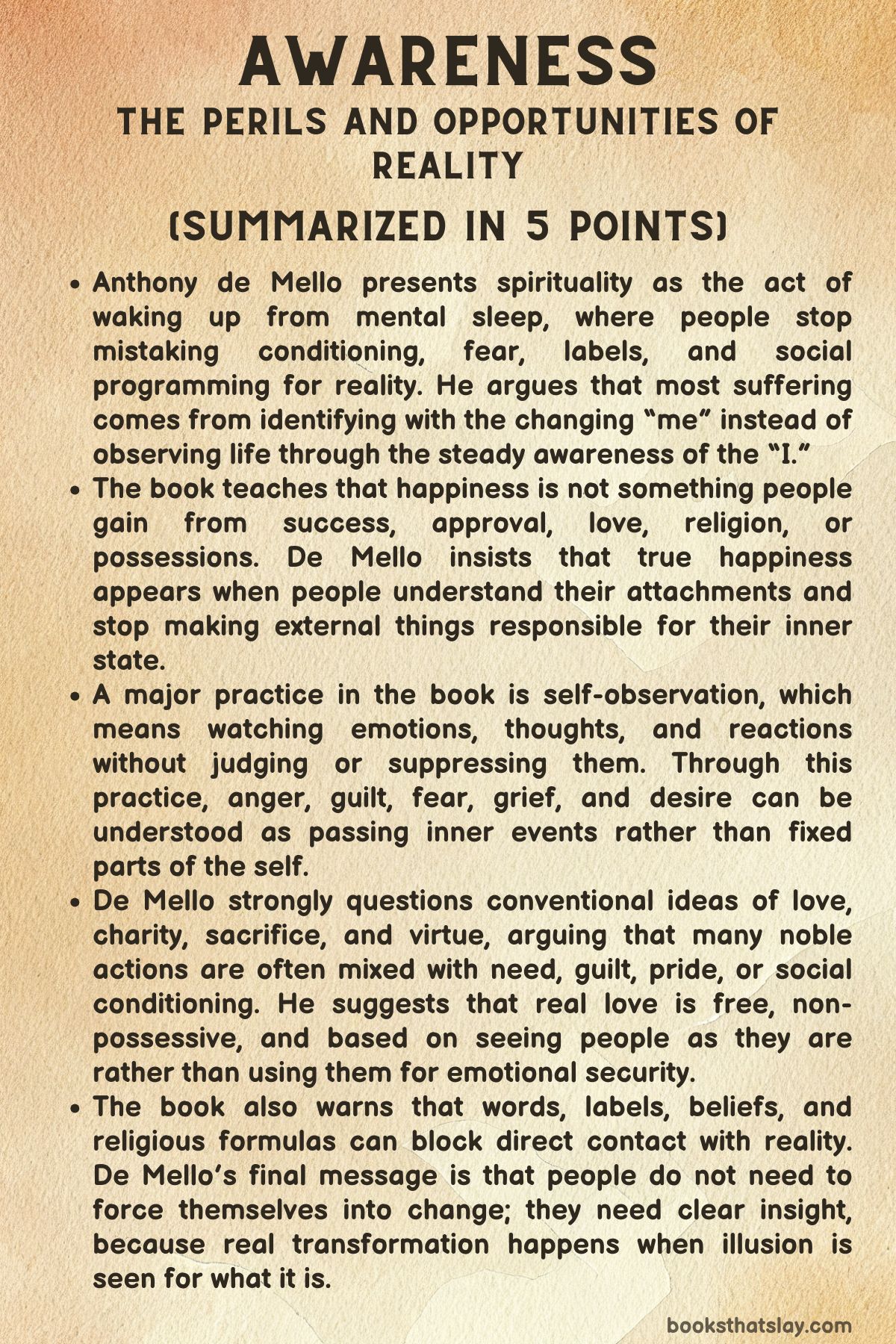
Key Figures
Anthony de Mello
Anthony de Mello is the central guiding presence in the book. Since Awareness is based on his talks, he functions less as a conventional character and more as teacher, provocateur, storyteller, and spiritual examiner.
His voice is direct and impatient with comforting illusions. He challenges listeners who want religion, psychology, charity, or self-improvement to confirm their existing identities.
De Mello’s personality comes through in his humor, his sharp reversals, and his refusal to flatter the audience. He often begins with familiar moral or religious ideas and then overturns them, arguing that much of what people call love, virtue, charity, and faith may actually be fear, conditioning, attachment, or ego.
He is also self-critical. He admits his own irritation, his failures in counseling, and his past reliance on shallow religious advice.
This willingness to expose himself gives his teaching more force, because he does not place himself above the human patterns he criticizes. In the book, he represents the demand for clear sight.
J. Francis Stroud
J. Francis Stroud appears in the foreword as a guardian of de Mello’s spoken legacy. His role is important because he frames the book as an attempt to preserve the spontaneity and force of de Mello’s original talks.
Stroud is also personally affected by de Mello’s teaching. When de Mello tells him the parable of the eagle raised among chickens, Stroud recognizes that the story applies to him.
This moment makes him more than a formal editor or introducer. He becomes an example of the very condition the book studies: a person who senses that social and mental conditioning has limited his awareness of his own nature.
Stroud’s presence gives the opening a personal tone and establishes the book as a record of living speech rather than a polished theoretical treatise.
Jaime
Jaime appears in one of de Mello’s early comic stories about waking up. At first, he seems to be a reluctant schoolboy whose father is trying to get him out of bed.
The joke is revealed when Jaime turns out to be a forty-five-year-old headmaster. Jaime’s significance lies in the reversal.
He represents the absurdity of spiritual sleep in adults who believe they are mature, responsible, and awake. His childish resistance to getting up mirrors the adult refusal to face truth.
The humor is gentle on the surface, but the point is severe: people may hold respected positions and still remain inwardly asleep. Jaime’s role is brief, yet he helps establish one of the book’s central claims: age, status, and authority do not equal awareness.
Jaime’s Father
Jaime’s father serves as the voice trying to wake another person. His role is simple but symbolically useful.
He represents external prompting, the call that comes from outside when someone is unwilling to rise. However, the story also shows the limits of such prompting.
The father can call, urge, and reason, but Jaime’s resistance remains. This reflects de Mello’s larger belief that no teacher, parent, priest, guru, or authority can force awakening upon another person.
The father can announce the need to wake up, but he cannot do the waking for Jaime.
Mary
Mary, the religious sister in the therapy group, is one of the clearest examples of emotional dependence in Awareness. She feels unsupported by her superior, and when de Mello role-plays as that superior and offers praise, she immediately feels better.
The twist is that the praise is false, which means her feeling of support comes not from reality but from her reaction to an imagined reality. Mary is not mocked; rather, she becomes a case study in how people create emotional states based on interpretations, fantasies, and projections.
Her need for approval shows how easily the mind can attach happiness to someone else’s words. Through Mary, the book demonstrates that people often suffer or feel comforted not because of what is real, but because of what they believe is real.
Mary’s Superior
Mary’s superior is mostly an absent figure, yet she is central to the emotional experiment. In Mary’s mind, the superior has the power to support or wound her.
When de Mello pretends to be the superior, the audience sees that the superior’s actual opinion matters less than Mary’s internal dependence on that opinion. The superior represents authority figures onto whom people project emotional needs.
Whether such figures approve, reject, praise, or criticize, their power grows when the individual depends on them for self-worth. In the book, this character helps expose the illusion that happiness is controlled by another person’s judgment.
The Man with the Banana in His Ear
The man with the banana in his ear appears in a joke about the difficulty of communicating with people who are blocked by the very condition they refuse to notice. Another person tries to tell him about the banana, but he cannot hear because of it.
He is comic, but he also captures a serious spiritual problem: people cannot receive truth when their conditioning prevents them from hearing it. His refusal is not argued philosophically; it is embodied in an absurd physical image.
He represents the person trapped in a problem that also prevents them from understanding the problem.
The Man Trying to Warn Him
The man trying to warn the banana-wearing figure represents the frustrated helper. He sees the obvious problem and tries to point it out, but his effort fails.
His role reinforces de Mello’s claim that trying to change someone who is not ready to understand is often useless. This character is not wrong; the banana really is there.
Yet correctness alone does not create communication. In the book, he shows the limits of advice, argument, and concern when the listener cannot or will not receive what is being said.
The Audience Member Who Believes Love Requires Sacrifice
This unnamed listener gives de Mello the claim that the test of love is sacrifice. The character represents a widespread moral belief: that love proves itself by suffering, giving oneself up, or choosing another person over one’s own happiness.
De Mello uses this view to challenge conventional ideas of nobility. The audience member is important because the statement allows de Mello to argue that mutual sacrifice can simply produce mutual misery.
This figure stands for inherited moral programming, especially the kind that makes unhappiness seem virtuous.
The Student Who Makes Cow-Dung Figures
The student who sculpts school authorities out of cow dung appears in one of de Mello’s jokes about psychology and institutional authority. His irreverence punctures the dignity of teachers, principals, and psychologists.
He represents the mischievous truth-teller who exposes inflated seriousness. The joke is crude, but it serves a purpose: de Mello uses it to challenge professional pride and to suggest that socially respected roles can be as absurd as any other label.
The student’s humor makes him an agent of deflation, cutting down the solemnity of authority.
The Teacher
The teacher in the cow-dung story is one of the authority figures the student satirizes. The character’s importance lies less in personality and more in function.
The teacher represents institutional respectability, the kind of role society trains people to obey and take seriously. By reducing the teacher to a comic sculpture, the story questions the emotional power people give to titles.
In the book’s larger argument, the teacher is one more label mistaken for reality.
The Principal
The principal is another authority figure in the same anecdote. As with the teacher, the principal stands for hierarchy, rank, and institutional importance.
The student’s treatment of the principal suggests that authority can be made ridiculous when stripped of the fear and reverence people project onto it. The principal’s role is brief but consistent with de Mello’s suspicion of status and social conditioning.
The Psychologist
The psychologist in the cow-dung joke becomes the punchline because the student claims he does not have enough material to make such a figure. De Mello uses this character to mock the prestige of psychology while also acknowledging his own background in it.
The psychologist represents a profession that may reduce suffering but still leave people spiritually asleep. The joke is not a full rejection of therapy; rather, it questions any system that becomes proud of itself or treats analysis as awakening.
The Indian Guru Who Speaks of Priests and Sex Workers
The Indian guru offers one of the book’s sharpest observations about renunciation. By saying that sex workers may long for God while priests may long for sex, he shows that the mind can become fixed on whatever it tries to reject.
His role is to expose the futility of suppression. He represents a wisdom that looks beyond moral categories and notices the mechanics of desire.
In the book, he helps de Mello argue that fighting temptation can keep the temptation alive, while understanding it can dissolve its power.
Sex Workers in the Guru’s Observation
The sex workers in this observation are not developed as individual people, and the source material uses outdated and offensive terminology for them. Within the book’s argument, they represent people whom society may label as morally fallen but whose inner longing may be spiritual.
Their role challenges external judgment. De Mello uses them to show that social categories do not reveal the whole truth of a person’s inner life.
They also help reverse the audience’s assumptions about holiness and desire.
Priests in the Guru’s Observation
The priests in the guru’s statement represent religious people whose outward role may conceal inner fixation. They are not condemned as uniquely hypocritical; rather, they illustrate a universal pattern.
The more someone tries to renounce a desire without understanding it, the more power that desire may gain. In the book, these priests expose the danger of confusing religious position with freedom.
The Elderly Jesuit
The elderly Jesuit who admits he may have been wrong his whole life becomes a model of spiritual openness. His importance lies in humility, but not the showy kind.
He is willing to release old beliefs and face the possibility that his lifelong certainties were incomplete or mistaken. De Mello praises him because true faith, in this context, is not rigid certainty but openness to truth.
The elderly Jesuit represents the courage to unlearn.
The Buddha
The Buddha appears as an authority invoked to support intellectual and spiritual independence. De Mello cites him to encourage listeners not to accept teaching merely because a teacher says it.
The Buddha’s role in the book is not decorative. He embodies the principle that truth must be tested in one’s own experience.
Through this figure, de Mello resists blind discipleship and places responsibility back on the listener.
Martyrs
Martyrs appear as examples of people whose actions may be less pure than they seem. De Mello provocatively suggests that some martyrs act from programming rather than awareness.
Their role is to challenge the assumption that dying for a cause automatically proves truth, love, or holiness. In the book, martyrs represent the danger of inherited ideas becoming so powerful that people surrender life itself without truly understanding what moves them.
Soldiers
Soldiers are treated similarly to martyrs. De Mello uses them to examine social programming, obedience, and the emotional glamour of sacrifice.
They represent people who may act bravely, yet still be driven by conditioning rather than awareness. The book does not study soldiers as military individuals; it uses them as examples of how institutions can train people to identify death, duty, and honor with unquestioned virtue.
The Parishioner De Mello Dislikes
The parishioner whom de Mello agrees to meet despite disliking him is important because he reveals de Mello’s own hidden motive. De Mello does not meet him from pure love; he meets him to avoid guilt.
The parishioner therefore becomes a mirror in which de Mello exposes self-interested charity. This character matters because he prevents the teacher from appearing above the lesson.
He shows that even religious service can be driven by emotional avoidance.
The People on the Raft
The people stranded on a raft and dying of thirst while floating on fresh water represent humanity’s tragic ignorance. They are surrounded by what they need but cannot recognize it.
De Mello uses them to show that happiness, peace, and reality are already present, but people miss them because of conditioning. Their suffering comes not from the absence of water but from unawareness.
In the book, they embody the absurdity of spiritual starvation amid abundance.
Terrorists
The book refers to “terrorists” as people who may be ready to die for adopted beliefs. De Mello’s concern is not to analyze political violence in detail but to show how borrowed convictions can possess the mind.
This figure represents ideological identification at its most dangerous. The terrorist, in the book’s argument, is someone who mistakes an idea for the self and then acts destructively in its name.
Saints
Saints appear in two contrasting ways. At times, de Mello honors true saintliness as unconscious goodness, a state in which a person does good without self-display.
At other times, he warns that people labeled as saints may also be driven by programming. This tension is central to his view.
A real saint does not know they are a saint; the moment holiness becomes self-image, ego has entered. Saints therefore represent both spiritual possibility and the danger of spiritual pride.
Jesus
Jesus is one of the most important religious figures in the book. De Mello presents him not mainly as an object of doctrinal belief but as a model of awareness, freedom, and non-attachment.
Jesus is shown as someone at home with sinners because he does not place himself above them in egoistic judgment. His teachings about leaving family, losing self, and living in the present are interpreted as invitations to drop dependency and illusion.
De Mello also warns against merely imitating Jesus externally. The point is not to copy Christlike behavior through effort, but to become aware as Jesus was aware.
In this way, Jesus represents transformed being rather than moral performance.
The Pharisees
The Pharisees are described not as evil but as unthinking. De Mello uses them to distinguish wickedness from unawareness.
Their role is to show that rigid religious correctness can coexist with spiritual sleep. They may follow rules, defend doctrines, and appear respectable, yet miss the living reality those forms are meant to serve.
In the book, they stand for the danger of external religion without inner awakening.
The Unhoused Dreamer
The unhoused person who dreams of rescue and then wakes up from the dream illustrates awakening as a break from illusion. The source material uses outdated terminology for such a person, but the role in the book is clear: he represents the human tendency to live inside imagined solutions rather than reality.
His awakening is not necessarily comfortable, but it is truthful. He helps de Mello show that many hopes are dreamlike projections.
The Man Escaping an Enemy in a Dream
This man faces a threatening enemy until he realizes the whole situation is dreamlike and can be escaped by waking up. He represents the possibility of freedom through a shift in consciousness.
The enemy seems powerful only while the dream is believed. Once the man wakes, the danger loses its reality.
In the book, he stands for the way awareness can dissolve fears that seemed absolute.
The Woman Who Hated Her Coworkers
The audience member who overcomes hatred for her coworkers is one of the book’s practical examples of self-observation. She does not solve the problem by forcing her coworkers to change.
Instead, she observes her own hostility and speaks without aggression. Her role shows how awareness can alter relationships without sentimental denial.
She represents the possibility of responding differently once a person stops identifying with negative feelings.
Her Coworkers
The coworkers are important because they are the objects of projected negativity. They may or may not have behaved badly, but the book’s focus is on the woman’s inner reaction.
They represent the external people whom individuals blame for their suffering. Through them, de Mello shows that the emotional problem often lies not in the other person but in the illusion one brings to the encounter.
The Abused Child
The abused child appears in a qualification to de Mello’s teaching about negative feelings. This figure is crucial because the book does not advocate passive acceptance of injustice.
The child represents real harm that must be stopped. De Mello’s point is that intervention can be firm and decisive without being driven by egoistic anger.
The child’s presence prevents the teaching from becoming indifference.
The Intervening Protector
The person who acts to stop abuse represents clear action without inner hatred. This character shows what de Mello means by effective response.
One can set boundaries, prevent harm, and make demands in practical situations while still refusing to let rage or ego dominate the act. The protector stands for awareness in action.
The Grieving Friend
The person grieving a friend’s death appears in de Mello’s discussion of attachment. This character represents the pain of personal loss.
De Mello’s analysis is severe: grief reveals that the mourner is mourning their own loss, not simply the reality of the friend. The grieving friend shows how even noble emotions can contain self-interest.
The point is not to shame grief, but to examine the attachment beneath it.
The Lost Friend
The friend who has died is less a developed character than the center of attachment. This figure represents the beloved person whom the mourner experiences through personal need and memory.
In the book, the lost friend reveals how love can become tied to possession and how death exposes dependence.
The Master Who Teaches Awareness
The master who tells a disciple that the only real wisdom is awareness serves as a concise expression of the book’s teaching. He represents spiritual authority stripped down to one essential insight.
His role is not to create dependence but to point the disciple toward direct seeing. In the book, the master stands for the kind of teacher who does not offer elaborate systems when a single truth is enough.
The Disciple Seeking Wisdom
The disciple who asks the master for wisdom represents the earnest seeker. This figure wants an answer, perhaps a doctrine or method, but receives a simple demand: awareness.
The disciple’s role is to show that spiritual seeking often becomes complicated because people expect secret knowledge, when the needed practice is immediate observation.
The Lion Raised as a Sheep
The lion raised as a sheep is one of the book’s strongest images of false identity. The lion believes it is weak, timid, and ordinary because its surroundings have taught it so.
When another lion shows it its reflection, it discovers its true nature. This character represents the human being conditioned into smallness.
Its awakening is not the creation of a new identity but the recognition of what was already true.
The Sheep
The sheep in the lion story represent the environment of false belonging. They are not villains; they simply live according to their own nature.
The problem arises when the lion takes their identity as its own. In the book, the sheep stand for social groups that unintentionally teach individuals to misrecognize themselves.
The Other Lion
The other lion functions as the awakener. It does not give the first lion a new nature; it helps the lion see what it already is.
This character represents the teacher, mirror, or encounter that reveals truth. In the book’s logic, the other lion cannot create awakening by force, but it can point toward self-recognition.
The Archer
The archer in the Chinese parable performs best when no prize is involved. Once reward enters, his attention divides and his skill declines.
He represents action free from attachment to results. The archer shows that anxiety about success or failure corrupts natural excellence.
In the book, he becomes a model for work done with full presence rather than ego investment.
Tranxu
Tranxu, the Chinese sage associated with the archer parable, serves as a source of wisdom about non-attachment. His role is to show that de Mello’s teaching is not confined to one religious tradition.
Tranxu represents the insight that the mind loses clarity when it becomes fixed on reward.
Angry People
Angry people appear as a broad human category rather than individual characters. De Mello treats them as frightened people.
Their anger is not the root emotion but a cover for fear. In the book, they represent the connection between fear, violence, and unawareness.
Their role is to shift moral judgment into psychological and spiritual understanding.
Teresa of Ávila
Teresa of Ávila appears as a mystic who experienced disidentification from the ego late in life. She represents the Christian contemplative tradition that confirms de Mello’s teaching about detachment from the “me.” Her role is important because she gives historical and spiritual weight to the book’s claim that freedom comes when one stops identifying with body, possessions, status, and personal drama.
Archbishop Carlo Maria Martini
Archbishop Carlo Maria Martini appears through a story about a priest disturbed by joy in a church setting. Martini’s role is to support de Mello’s criticism of rigid religious attitudes.
He represents a church figure capable of seeing the absurdity of lifeless piety. Through him, the book contrasts living joy with defensive religiosity.
The Priest Angered by the Wedding Reception
This priest is angered because a wedding reception brings noise and life into his church. He represents religious rigidity that values order over joy.
His irritation shows how rules and sacred spaces can become idols when they block human celebration. In the book, he stands for religion that has lost contact with life.
The Client in De Mello’s Counseling Course
The client in the counseling course helps reveal de Mello’s own lack of awareness. During a recorded session, de Mello does not notice his irritation, but others later point it out.
The client functions as a mirror. Through this person, the book shows that even trained helpers may be unaware of their reactions.
The client’s role is essential because it turns theory into self-exposure.
De Mello’s Classmates
The classmates who hear the counseling tape and point out de Mello’s irritation represent corrective community. They are not merely observers; they help reveal what he cannot see in himself.
In the book, they show that awareness can be aided by honest feedback, though the actual seeing must still happen within the person.
Socrates
Socrates appears through the idea that the unaware life is not worth living. He represents philosophical seriousness about self-examination.
His role links de Mello’s spiritual teaching to a broader tradition of inquiry. Socrates stands for the examined life, but de Mello adapts that spirit toward observation rather than argument alone.
The Lawyer
The lawyer in the plumber joke represents social status and professional identity. When he hires a plumber and discovers the plumber was once a lawyer, the story destabilizes assumptions about prestige.
The lawyer shows how people attach worth to profession. In the book, he becomes part of de Mello’s argument that jobs are roles, not the self.
The Plumber Who Was Once a Lawyer
The plumber who formerly practiced law is a comic challenge to status anxiety. His character shows that a person’s profession can change without altering their permanent worth.
He represents freedom from the belief that identity depends on title. In the book, he helps expose the emptiness of social ranking.
The Tribesman
The tribesman whose society treats ostracism as death represents dependence on belonging. Because he believes he cannot live outside social acceptance, exclusion destroys him.
His tragedy lies in accepting the group’s belief as reality. In the book, he shows how psychological dependence can become fatal when people believe they need approval, membership, or recognition in order to exist happily.
The Boy Who Frees the Crocodile
The boy who frees the crocodile begins as innocent and helpful. He expects gratitude, but the crocodile betrays him.
Later, after the rabbit saves him and is killed by the boy’s dog, the boy concludes that the crocodile was right about life’s cruelty. He represents the mind’s attempt to form a fixed formula from painful experience.
His story shows how suffering can harden into a worldview.
The Crocodile
The crocodile is a figure of betrayal and cynicism. After being rescued, it turns on the boy and claims that betrayal is the law of life.
It represents the bitter interpretation of reality that arises from pain and fear. Yet the story does not fully endorse the crocodile’s view.
Instead, the crocodile helps show that the mind’s formulas about life are unstable and incomplete.
The Other Animals
The animals who confirm the crocodile’s bleak view represent the chorus of experience that seems to support cynicism. They show how people gather evidence for whatever worldview they already fear may be true.
In the book, they help dramatize the mind’s habit of turning selected experiences into universal laws.
The Rabbit
The rabbit is clever, practical, and saving. It tricks the crocodile into releasing the boy.
Its death at the hands of the boy’s dog gives the story its painful irony. The rabbit represents wisdom that acts effectively but is not protected from the chaos of life.
Its fate also shows why de Mello resists easy explanations of suffering.
The Boy’s Dog
The dog kills the rabbit and turns rescue into tragedy. It represents unintended harm and the unpredictability of events.
The dog is not morally analyzed; its action functions as the shock that makes the boy accept the crocodile’s cynicism. In the book, the dog helps show that life cannot be reduced to a neat moral formula.
Meister Eckhart
Meister Eckhart appears as a mystical authority supporting the claim that being matters more than deeds. His role is to deepen the book’s criticism of action performed without inner transformation.
Eckhart represents the tradition of interior spiritual awakening, where the quality of one’s being shapes the quality of one’s action.
Paul the Apostle
Paul is invoked to support the idea that action without transformed being is insufficient. His presence gives Christian scriptural weight to de Mello’s teaching.
In the book, Paul represents the insight that external behavior cannot replace inward change.
The Mother Worried About Her Son’s Success
The mother who worries about moderating her son’s reaction to success represents the desire to control another person’s emotional life. Her concern may appear caring, but de Mello uses it to reveal the inner dictator that wants others to behave according to one’s preferences.
She shows how affection can become control when awareness is absent.
The Son
The son in this example represents the person whom another wants to manage. He is less developed than the mother, but his role is important because he shows how easily people become objects of someone else’s anxiety.
In the book, he stands for the other person whose freedom must be respected.
The Amateur Musicians
The amateur musicians begin with joy in music but lose that joy under the pressure of ambition. They represent natural pleasure corrupted by performance, comparison, and external standards.
In the book, they show how an activity loved for itself can become tense when controlled by ego and achievement.
The Ambitious Conductor
The conductor turns music into a project of ambition. He represents the part of the human mind that wants excellence, recognition, and control at the cost of joy.
His role is to show how leadership without awareness can kill the life in what it organizes.
The Disciple Who Tracks His Enlightenment
The disciple who reports his spiritual progress to his guru represents spiritual ambition. He wants awakening, but he also wants to measure and possess it.
His letters reveal pride in achievement. Only when he reaches the attitude of “What does it matter?” does the guru recognize real change.
This character shows that enlightenment cannot be treated like a career ladder.
The Guru Receiving the Disciple’s Letters
The guru in this story understands that the disciple’s earlier progress is still ego-driven. He waits until the disciple releases the need to claim attainment.
His role is to distinguish real awakening from spiritual self-importance. In the book, he represents patient discernment.
Parents
Parents appear as examples of people who may need to set practical rules and demands. De Mello uses them to clarify that non-attachment does not mean abandoning responsibility.
A parent can require behavior without making personal happiness depend on the child’s response. In the book, parents represent necessary authority when it is separated from emotional dependency.
Presidents
Presidents are used in more than one way. They represent practical authority, since a president may need to make demands for social order.
They also appear in the image of filtered reality, where leaders receive selective information rather than direct truth. In the book, presidents show both the need for functional roles and the danger of distorted perception.
Thomas Aquinas
Thomas Aquinas appears as the theologian who falls silent after mystical experience and as a representative of the “negative way” of approaching God. He is important because he shows the limits of language, even for a brilliant religious thinker.
In the book, Aquinas represents the humility of knowing that ultimate reality cannot be captured by concepts.
The Person Who Has Never Tasted a Green Mango
This person represents the limits of explanation. No matter how carefully someone describes a green mango, the listener cannot truly know the taste without direct experience.
In the book, this character shows why spiritual truth cannot be fully transferred through words. Awareness must be tasted, not merely defined.
The Two Blind Men Discussing Green
The two blind men arguing over the color green represent conceptual debate without direct perception. Their argument is not foolish because they lack intelligence, but because they lack access to the reality being discussed.
In the book, they show how people quarrel over words while missing experience.
The Guide Who Indulges the Napoleon Delusion
The guide who works with a man believing he is Napoleon represents a strategic helper. Rather than attacking the delusion directly, he moves with it until truth can be shown.
His role reflects de Mello’s belief that insight works better than force. In the book, the guide represents skillful guidance that leads someone toward reality.
The Man Who Believes He Is Napoleon Bonaparte
This man represents false identity in an extreme comic form. His delusion is obvious to others, but not to him.
De Mello uses him to show that ordinary identity can also be delusional when people mistake labels, roles, or images for the self. The Napoleon figure helps expose how fragile and absurd the ego can be.
God as Dancer
God as dancer is not a character in a conventional sense, but de Mello uses the image to suggest a reality beyond ego-centered identity. Creation is the dance, and God is the dancer.
This image shifts attention away from the self as center. In the book, it points to participation in a larger movement rather than possession of a fixed self.
Creation as Dance
Creation as dance complements the image of God as dancer. It represents the living movement of reality.
The individual is not separate from this movement or in control of it. This image helps de Mello express spiritual surrender without reducing it to doctrine.
Nasr-ed-Din
Nasr-ed-Din, who plays one guitar note repeatedly because he thinks he has found the right note, represents comic rigidity. He mistakes fixation for wisdom.
His role is to show that clinging to one experience, belief, or pleasure kills the music of life. In the book, he is a humorous figure of narrow certainty.
The Other Musicians
The other musicians, who play multiple notes, represent variety, movement, and openness. Nasr-ed-Din thinks they are still searching, but the joke reveals that they are actually making music.
Their role is to contrast living flow with rigid attachment.
The Woman Who Feels Nobody Loves Her
This woman takes delight in a movie and briefly forgets her belief that nobody loves her. When the movie ends, the belief returns and so does her unhappiness.
She represents the way people are trapped not by reality but by recurring mental stories. Her happiness appears when the story drops away, even temporarily.
In the book, she shows that suffering often depends on remembering and believing a painful self-concept.
The Long-Lost Friend
The long-lost friend whom one embraces raises de Mello’s question about whether people hug the real person or the memory of who that person used to be. This character represents the difference between reality and memory.
In the book, the friend shows how affection can be directed toward an image from the past rather than the living person in the present.
The Religious Sister Who Changes After Retreat
This sister returns from retreat inwardly changed, but her community continues to see her through an old image. Their expectations pull her back into the identity they remember.
She represents the fragility of transformation when surrounded by fixed social perception. In the book, she shows how other people’s labels can distort self-understanding.
The Sister’s Community
The community represents collective memory and social labeling. Its members cannot see the sister freshly because they cling to an old idea of her.
They are not necessarily malicious, but their fixed perception has real power. In the book, they show how groups preserve old identities and make change harder.
Jiddu Krishnamurti
Jiddu Krishnamurti appears in the discussion of naming and perception. He warns that once a child learns the word “sparrow,” the child may stop seeing each bird freshly.
His role is to support de Mello’s critique of concepts. Krishnamurti represents radical attention to reality before language reduces it.
The Child Learning “Sparrow”
The child who learns the word “sparrow” represents the beginning of conceptual conditioning. Naming helps communication, but it can also dull wonder.
In the book, the child shows how education can unintentionally replace seeing with labeling.
Dag Hammarskjöld
Dag Hammarskjöld appears as a voice warning against the loss of daily wonder. He represents mature public seriousness combined with spiritual sensitivity.
His role is to support the idea that people die inwardly when they stop encountering life with freshness. In the book, he stands for wonder as a form of aliveness.
C. S. Lewis
C. S. Lewis appears after the death of his wife, recognizing that some theological questions are wrongly framed. His role is to show how suffering can expose the limits of religious concepts.
Lewis represents faith tested by grief, where neat answers fail. In the book, he helps de Mello argue that words and beliefs must give way before reality.
Lewis’s Wife
Lewis’s wife appears through her death, which forces Lewis into a more honest confrontation with faith and loss. She is not developed as an individual in the book’s teaching, but her absence has force.
She represents the loved person whose death turns abstract belief into lived crisis.
The Indian Prisoner in Pakistan
The imagined Indian prisoner who reacts emotionally to being told that land before him is India represents national conditioning. His feelings are triggered by a label, not reality.
When the label changes, the emotional meaning changes. In the book, he shows how political identity can be manufactured by words and borders.
The American Baby Raised in Russia
This hypothetical child represents cultural programming. If raised in Russia, the American-born baby may grow up hating Americans.
The character shows that national hatred is learned, not natural. In the book, the child exposes the arbitrary nature of inherited loyalties.
The Jesuit Friend Who Gives Alms Compulsively
This Jesuit friend gives alms because of a habit learned from his mother. His generosity appears virtuous, but de Mello questions whether it comes from sensitivity or compulsion.
He represents the difference between true virtue and programmed behavior. In the book, he shows that good actions may still arise from unexamined conditioning.
The Jesuit Friend’s Mother
The mother who trained the Jesuit friend in almsgiving represents inherited moral programming. Her influence continues through his behavior.
She is important because she shows how family conditioning can masquerade as virtue. In the book, she stands behind the question of whether goodness is conscious or automatic.
The Friend with a Perfect Meditation Record
This friend has a flawless meditation record, yet de Mello questions whether the practice reflects freedom or compulsion. The character represents spiritual habit without necessarily having awareness.
In the book, this figure warns that even disciplined religious practice can be another form of conditioning.
The Pope
The pope appears in the analogy of filtered reality. Like a president, he receives selected information and may not encounter reality directly.
The pope represents high authority surrounded by mediation. In the book, this figure helps illustrate how everyone, not only leaders, receives reality through filters.
The Intimate Friend
De Mello’s intimate friend appears when he practices telling someone that he does not need them in order to be happy. This does not destroy the friendship; it improves it.
The friend represents the difference between love and attachment. In the book, this person helps show that relationships become freer when they are no longer burdened with the demand to provide happiness.
Mark Twain
Mark Twain appears through the joke about the thermometer and freezing. He represents comic intelligence used to expose confusion between symbols and reality.
His role is brief but effective. In the book, Twain helps de Mello show that people often mistake measurements, words, and representations for the actual world.
The Finnish Farmer
The Finnish farmer who chooses Finland over Russia to avoid a “Russian winter” is a comic figure trapped by labels. The weather does not change because a border or national name changes, but the farmer acts as though words alter reality.
In the book, he represents the absurdity of living under verbal illusions.
The Guru Who Insults and Apologizes
This guru demonstrates the power of words by insulting a man and then calming him with an apology. His role is experimental.
He shows that people’s emotions can be manipulated by language alone. In the book, he represents the teacher who reveals bondage by provoking it.
The Man Insulted by the Guru
The man who becomes angry at insults and calm after an apology represents emotional dependence on words. His mood changes not because reality has changed but because language has struck his ego.
In the book, he shows how people live on words rather than reality.
The Woman Stressed by Service Work and Traffic
This woman believes she can only be happy in peaceful settings. Her stress in work and traffic reveals an attachment to serenity.
She represents the person who turns even calm into a demand. In the book, she shows that the need for tension-free circumstances can become another obstacle to happiness.
The Enemy
The enemy in the teaching about turning the other cheek represents opposition. De Mello’s point is not submission to abuse but the refusal to give resistance the kind of emotional energy that strengthens it.
The enemy helps illustrate the difference between fighting from ego and responding through understanding.
The Person Tempted by a Billion-Dollar Check
This hypothetical person represents the ego’s attraction to wealth and the spiritual ego’s attraction to renunciation. If they reject the check in order to feel virtuous, greed has merely changed costume.
In the book, this character shows that seeing through illusion is different from performing self-denial.
People with Cultural Prejudices
These people believe things such as women being inferior or Russians being dangerous because they have been programmed that way. They represent prejudice as conditioning.
De Mello does not excuse harmful ideas, but he shifts attention from blame to understanding. In the book, they show how ideology can distort perception before a person knows it is happening.
George Bernard Shaw
George Bernard Shaw appears in connection with loneliness and aloneness. His role is to support de Mello’s distinction between needy isolation and free solitude.
Shaw represents a worldly literary intelligence that aligns with the book’s spiritual argument about independence.
Pedro Arrupe
Pedro Arrupe appears through the statement that systems are only as good as the people using them. His role is to temper purely structural solutions to human problems.
In the book, Arrupe represents the idea that reform without inner change remains limited.
The Lazy Priest
The priest who calls himself lazy discovers that his lack of energy is rooted in depression and anger over a failed exam that damaged his hopes. He represents the danger of moral labeling without insight.
Once he understands the cause of his condition, energy returns. In the book, he shows that self-condemnation blocks transformation while understanding releases it.
The Young Jesuit Who Bullies Employees
This young Jesuit has admirable qualities but abuses employees because of hidden shame about his mother’s menial work. He represents displaced anger.
His cruelty ends when he recognizes and speaks the truth beneath it. In the book, he is one of the clearest examples of insight producing change without force.
The Young Jesuit’s Mother
The young Jesuit’s mother is central to his hidden shame. Her work becomes, in his mind, a source of humiliation, and that humiliation is redirected toward servants.
She represents the personal history behind destructive behavior. In the book, her role shows how unexamined shame can injure others.
The Employees
The employees bullied by the young Jesuit represent the victims of displaced pain. They are not the real cause of his anger, but they suffer from it.
In the book, they show why inner unawareness is not merely private; it can become harmful behavior toward others.
The Saintly Jesuit After De Mello’s Ordination
This Jesuit sends de Mello to hear confessions after his ordination. His role is small but important because the experience that follows makes de Mello question the usefulness of pious advice.
The saintly Jesuit represents a traditional religious path that leads de Mello into a crisis of effectiveness.
The People Confessing Sins
The people who confess their sins leave de Mello depressed because he senses that his advice does not reach the root of their suffering. They represent spiritual pain being treated with formulas.
In the book, they help turn de Mello toward the search for real transformation.
The Man Who Says the Stop Injured Him
This man appears in an image about falling and hitting reality. His remark that the stop, not the fall, injured him illustrates how illusions hurt when they collide with what is real.
He represents the human tendency to misunderstand the source of pain. In the book, he shows that suffering often comes from false inner structures meeting reality.
The Eastern Sage
The Eastern sage who speaks of unobstructed senses, mind, and heart represents distilled wisdom about openness. His role is to show that perception, wisdom, and love arise naturally when barriers drop.
In the book, he supports de Mello’s emphasis on removing conditioning rather than manufacturing virtue.
A. S. Neill
A. S. Neill appears in the discussion of healthy and insecure children. He represents an educational and psychological voice supporting freedom from dependency.
His role is to show that confidence allows interest in life, while insecurity produces clinging.
Healthy Children
Healthy children, in Neill’s observation, are confident enough to be interested in the world. They represent natural vitality.
In the book, they support de Mello’s claim that happiness is already present before conditioning buries it.
Insecure Children
Insecure children cling to parents and remain trapped by dependence. They represent fear-based attachment at an early stage.
In the book, they show how dependency limits curiosity, freedom, and contact with reality.
Parents in Neill’s Example
The parents in this example represent the figures to whom insecure children cling. Their role is not necessarily negative; the issue is the child’s dependence.
In the book, they help explain how emotional security can become tied to another person’s presence.
Jean-Paul Sartre
Jean-Paul Sartre appears through the idea that “hell is other people.” De Mello uses this not as a rejection of human relationship but as a comment on dependency and social pressure. Sartre represents the tension created when people live under the gaze and judgment of others.
The Jesuit Friend Who Eats Sweets
This Jesuit friend once overindulged in sweets but later learns to enjoy a little intensely. He represents sensory awareness rather than excess.
In the book, he shows that slowing down and attending fully can transform pleasure from compulsion into appreciation.
The Priest Who Smokes
The smoking priest knows intellectually that smoking is dangerous, but only changes when medical evidence makes the danger real to him. He represents the difference between information and awareness.
In the book, he shows that knowledge alone often fails, while direct realization can change behavior immediately.
St. Ignatius
St. Ignatius appears through the idea of tasting and feeling the truth. His role is to support de Mello’s distinction between abstract analysis and lived awareness.
In the book, Ignatius represents experiential understanding within the Christian spiritual tradition.
The Astronomer Friend
The astronomer friend explains cosmic scale to de Mello and helps him see the sky differently. This character represents scientific knowledge becoming spiritual perspective.
In the book, the astronomer shows that information can become awareness when it changes perception.
The Man Who Invents Fire
The man who invents fire represents the original bringer of living truth. His discovery is practical, transformative, and direct.
Yet after his death, people honor his image instead of using the fire. In the book, he stands for teachers whose message is later converted into empty worship.
The Priests Who Kill the Fire-Maker
These priests kill the man who invents fire, preserve his portrait, and teach veneration while neglecting the actual fire. They represent institutional religion that honors the messenger while suppressing the message.
In the book, they are a strong image of ritual replacing transformation.
The People Who Venerate the Portrait
The people who venerate the portrait but do not make fire represent followers who worship symbols instead of practicing truth. They are not awake to the living reality behind the image.
In the book, they show how spiritual traditions can become lifeless when memory replaces practice.
Themes
Awakening from Conditioning
The central movement of Awareness is the movement from conditioned living to conscious seeing. De Mello presents ordinary life as a kind of sleep, not because people lack intelligence, but because they mistake programming for truth.
Family expectations, national identity, religious formulas, social ambition, class prejudice, and emotional habits all become part of the “me” that people defend as if it were their real self. The problem is that most people do not experience these forces as conditioning.
They experience them as loyalty, morality, love, success, duty, or common sense. De Mello’s teaching asks readers to become suspicious of their automatic reactions.
When a person feels offended, proud, guilty, patriotic, ashamed, needy, or morally superior, the feeling may reveal not truth but training. Awakening begins when the person can observe these reactions without immediately obeying them.
This theme is demanding because it removes easy excuses. It does not allow people to blame society alone, nor does it allow them to cling to inherited identity.
Freedom begins with seeing the machinery of conditioning at work inside the self.
Happiness Beyond Attachment
De Mello treats attachment as the great obstacle to happiness. People usually believe they are unhappy because they lack something: approval, love, money, success, spiritual progress, security, or control.
De Mello reverses this assumption. He argues that people suffer because they have convinced themselves they need these things in order to be happy.
Once something becomes a psychological necessity, fear enters. The person must protect it, pursue it, control it, or grieve it.
Even love becomes distorted when it is mixed with dependency. A person who needs another person for happiness cannot fully love that person; they use them as emotional support.
De Mello does not ask people to stop enjoying relationships, work, beauty, pleasure, or success. He asks them to turn desires into preferences.
A preference allows enjoyment without slavery. An attachment makes happiness conditional.
This theme gives the book its practical sharpness. It suggests that freedom is not found by arranging life perfectly, but by seeing that no external condition has the authority people give it.
The Difference Between Words and Reality
Again and again, de Mello warns that words, concepts, labels, and beliefs can block direct contact with reality. A label may be useful, but it can also become a substitute for seeing.
Once a child learns the word “sparrow,” the living bird may disappear behind the category. Once a person is labeled successful, sinful, foreign, holy, poor, intelligent, or difficult, the label can replace the actual person.
This theme reaches into religion as well. De Mello argues that even sacred words can become barriers when people cling to them instead of encountering what they point toward.
The word “God” is not God; a doctrine about love is not love; a moral formula is not awareness. Many conflicts, in his view, are conflicts over concepts rather than reality.
People defend flags, identities, reputations, and beliefs as if those symbols were living truth. By questioning language, de Mello is not rejecting thought altogether.
He is warning against mistaking the map for the place. Real seeing requires freshness, silence, attention, and humility before what cannot be fully captured in words.
Insight as the Source of Change
The book strongly rejects the idea that deep change comes mainly through willpower, self-condemnation, or forced discipline. De Mello believes that people have been trained to be dissatisfied with themselves, and this dissatisfaction produces inner conflict rather than freedom.
A person may try to become loving, holy, detached, generous, or brave, but such effort often strengthens the ego that wants to possess these qualities. Real change comes through insight.
When a person understands the root of a reaction, the reaction may lose its power naturally. The priest who thinks he is lazy changes when he sees the buried anger behind his depression.
The young Jesuit who mistreats employees changes when he recognizes the shame connected to his mother’s work. In these examples, no heroic self-punishment is required.
Awareness itself transforms. This theme is important because it replaces moral pressure with honest observation.
De Mello does not excuse harmful behavior, but he insists that condemnation rarely cures it. Understanding reaches the source, while effort often treats only the surface.