America is in the Heart Summary and Analysis
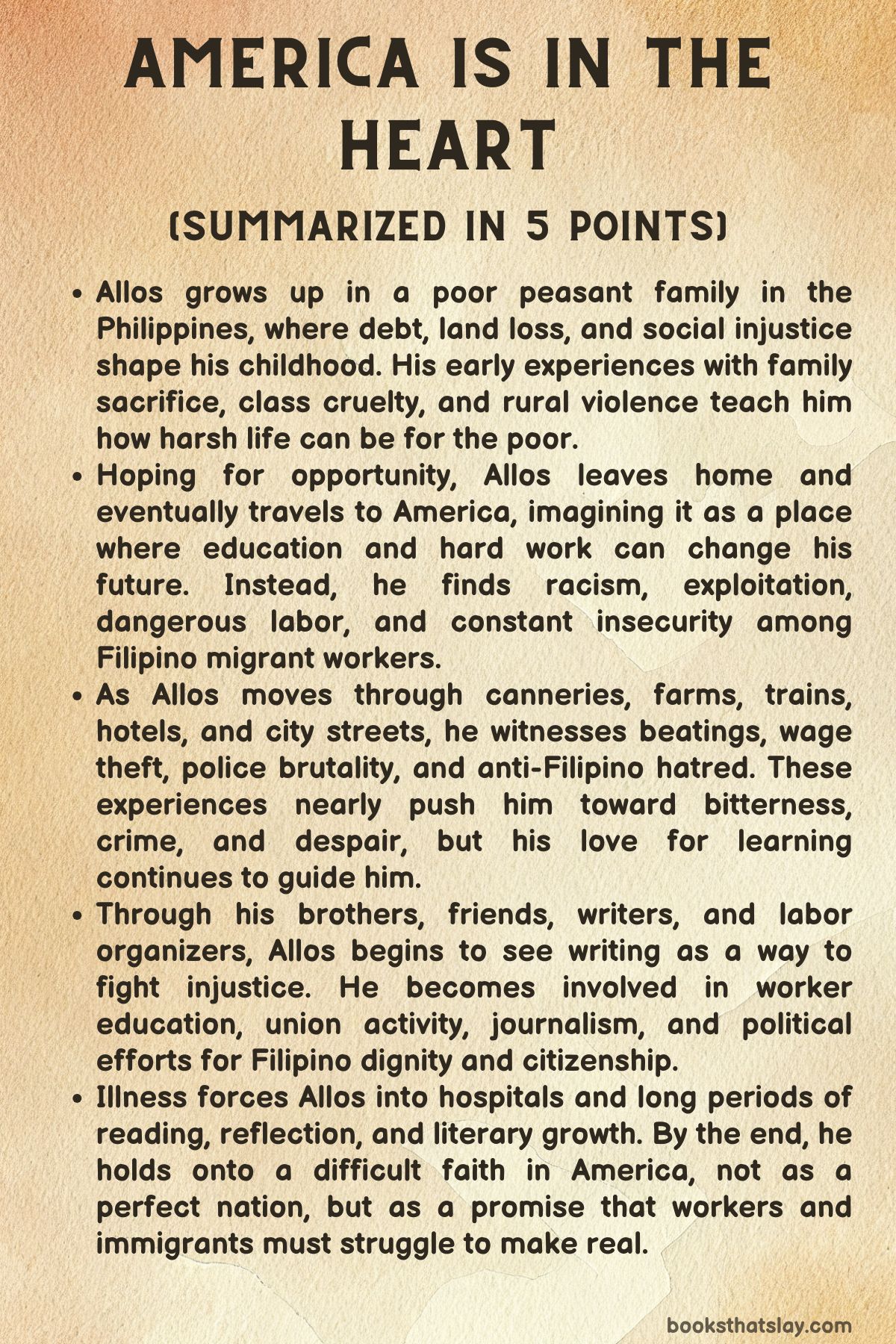
America is in the Heart is Carlos Bulosan’s autobiographical novel about Allos, a poor Filipino boy who grows into a writer and labor activist in the United States. The book follows his movement from rural hardship in the Philippines to racial violence, migrant labor, illness, political struggle, and artistic awakening in America.
It is both a personal life story and a record of Filipino immigrant experience in the early twentieth century. Bulosan writes about poverty, dignity, family, education, and the painful search for belonging in a country that offers hope while often denying justice.
Summary
America is in the Heart begins in Binalonan, a town in Luzon, where Allos grows up in a poor peasant family. His childhood is shaped by land, hunger, family duty, and the unequal power of landlords, moneylenders, church authorities, and the middle class.
His brother Leon returns from war and marries, but the wedding ends in violence when a cruel virginity ritual turns the townspeople against the couple. This early scene teaches Allos how quickly public joy can become public cruelty.
Allos’s family struggles to survive on their farm. His father works hard and sacrifices everything to educate Macario, one of Allos’s brothers.
Land is sold, debts grow, and the family’s hold on their farm weakens. Amado, another brother, leaves after being beaten by their father during a fight over a trapped carabao.
Yet even amid poverty, Allos begins to see education as a way toward a larger life. Books become a promise.
Macario reads to him, and Allos starts to connect learning with freedom, power, and self-respect.
The family’s decline continues. Peasant unrest spreads through the provinces as farmers rebel against landlords and hunger.
The revolts are crushed, and Allos sees how unorganized anger can be defeated by force. His family loses its land, and his father, once proud, is reduced to working for others.
Allos works at different jobs, helps his mother, and witnesses class humiliation when a wealthy girl insults his mother and knocks over her goods. The death of his sister Irene deepens his sense of helplessness and makes him dream of becoming a doctor.
Allos’s intellectual life grows through his brothers. Macario reads religious and literary texts to him.
Luciano teaches him to notice beauty and encourages him to read good books. When Luciano suggests that Allos might become a journalist, Allos privately vows to become a writer.
His desire to write is tied not only to ambition but also to justice: he wants words to help him answer the suffering he has seen.
At thirteen, Allos leaves Binalonan to find work in Baguio. There he works as a servant for an American woman connected to a library and begins learning English.
He reads about Abraham Lincoln and is amazed that a poor boy could become president of the United States. America begins to appear to him as a place where poverty might be overcome.
After returning home and finding the family scattered and weakened, he decides to leave for America.
The voyage is harsh. Allos travels in steerage with other poor passengers, confined below deck and treated as inferior by wealthier travelers.
Disease spreads among them, and a white woman’s racist insult prepares him for what he will meet in the United States. He arrives in Seattle with almost nothing.
Soon he learns that Luciano has died of tuberculosis. Almost immediately, Allos and other Filipinos are sold into exploitative labor in Alaska fish canneries, where they are cheated, abused, and treated like disposable workers.
After Alaska, Allos moves through the migrant labor world of the American West. In Washington, Oregon, California, Nevada, and elsewhere, he works in fields, rides trains, sleeps in poor lodgings, and sees Filipinos beaten, shot, cheated, and driven from towns.
White mobs attack Filipino workers. Police and detectives abuse them.
Labor contractors steal wages. Dance halls, gambling houses, bunkhouses, and railroad cars become places of danger as well as temporary shelter.
Allos also meets Filipinos who help him, including Marcelo, Julio, José, Claro, Doro, and others. These relationships give him moments of loyalty in a country full of hostility.
In California, Allos reunites with Amado and Macario. Amado has been hardened by America and pulled into bootlegging, gambling, and crime.
Macario is educated but cynical, aware of how deeply racism limits Filipino lives. Allos is saddened by both brothers: one has been morally damaged by lack of opportunity, and the other has been worn down by injustice.
Still, family remains one of the few forces that keeps him from complete despair.
Allos becomes increasingly angry. He is beaten because of his race, refused rooms, mocked for reading, and blocked from respectable work.
He sees Filipino men punished for relationships with white women and hears of camps burned by white mobs. His friend José is badly injured after falling from a train while fleeing detectives.
At times, Allos drifts toward theft, gambling, drinking, and violence. After learning that his father has died, he begins to believe that love may be useless in such a brutal world.
Yet writing slowly pulls him back. When he writes a long letter to Macario and realizes he can express himself clearly in English, he feels that no one will be able to silence him again.
His political and literary awakening deepens through Pascual, a socialist lawyer who runs a newspaper. Pascual teaches him that writing can fight for workers.
After Pascual’s death, Allos joins Macario, Nick, Felix, José, and others in literary and labor work. They publish a small magazine, organize workers, attend meetings, and try to unite Filipino and Mexican laborers against low wages and exploitation.
Their efforts are met with arrests, beatings, sabotage, and betrayal. Helen, José’s white girlfriend, is revealed as an agent working against the union.
In another attack, white men torture José, Millar, and Allos because of their organizing.
Allos’s body begins to fail. After years of poverty, violence, hunger, alcohol, and exhaustion, he is diagnosed with tuberculosis.
In the hospital, he enters a quieter but difficult period of reading, reflection, and literary growth. Alice Odell and her sister Eileen bring him friendship, books, and intellectual companionship.
He studies American, Russian, and European writers and begins to see literature as a way to understand both himself and the country that has wounded him. Illness limits his body, but it sharpens his mind.
After leaving the hospital, Allos returns to a racist housing market and unstable city life. He continues writing and organizing.
He works for Filipino citizenship rights, teaches workers American history, and helps form classes for laborers. He also struggles with despair, especially as Macario’s health and hopes decline.
At one point, Allos steals a ring to pay for Macario’s care, showing the moral pressure created by poverty and love. His relationship with Amado remains painful, but he comes to pity rather than hate him.
The final movement of America is in the Heart connects personal struggle to world events. After Japan attacks Pearl Harbor, Allos and other Filipinos try to enlist but are rejected because they are not naturalized citizens.
Allos helps push for the right of Filipinos to serve, and Filipino regiments are eventually formed. His own writing gains recognition when his poems are published and his first book, Letter from America, appears.
Amado and Macario both leave for military service, each giving Allos money and gestures of love.
The book ends with Allos looking at field workers from a bus and renewing his faith in America. This faith is not blind.
He has seen America’s cruelty, racism, greed, and violence. But he has also found workers, writers, friends, brothers, and acts of kindness that keep hope alive.
For Allos, America becomes not merely a nation but an unfinished idea: a place that must be remade by those who suffer in it and still believe in justice.
Key People
Allos
Allos is the central figure of America is in the Heart, and his growth forms the emotional and political center of the narrative. He begins as a poor Filipino child in Binalonan, shaped by hunger, family sacrifice, land loss, and the violence of rural society.
His early life teaches him that poverty is not only a lack of money but also a loss of dignity, security, and choice. As he grows older, his hunger for education becomes one of his strongest traits.
Books give him a way to imagine a different future, and writing eventually becomes his method of survival. In America, Allos is repeatedly exposed to racism, exploitation, police brutality, illness, and loneliness.
These experiences nearly turn him toward hatred and crime, but he never fully surrenders his moral self. His character is defined by conflict: he is angry but compassionate, wounded but hopeful, physically weak but intellectually determined.
By the end, Allos becomes a writer and labor activist who understands that personal suffering must be connected to collective struggle. His faith in America is not innocent; it is earned through pain, resistance, and the belief that ordinary workers can help create a more just country.
Macario
Macario is Allos’s educated brother and one of the most important influences on his intellectual development. In the family’s early life, Macario’s education costs the household dearly, as their father sells land and takes on debt to keep him in school.
This makes Macario both a symbol of hope and a source of pressure. He represents the family’s belief that education can lift them from peasant life, yet his schooling also contributes to their financial ruin.
Later, in America, Macario becomes a guide for Allos, introducing him to literature, politics, and the larger meaning of social struggle. He is intelligent, serious, and deeply aware of injustice, but he is also worn down by the limits placed on Filipinos.
His failed hopes reflect the painful reality that education alone cannot overcome racist laws and social exclusion. His illness and declining spirit show how oppression attacks both body and mind.
Still, Macario’s love for Allos remains steady. He sacrifices for him, supports his writing, and helps him believe that literature can give form to suffering.
Amado
Amado is one of the most tragic characters in the story. As a young man in the Philippines, he leaves the family farm after a violent conflict with his father.
In America, he reappears as a hardened, unhappy man involved in bootlegging, gambling, and criminal circles. Allos is disturbed by what America has made of him, but Amado is not presented as naturally corrupt.
His life shows how racism, poverty, and blocked opportunity can push a person toward survival by any available means. He is rough, unstable, and often morally compromised, yet he is still capable of tenderness.
His gestures toward Allos and Macario reveal that family loyalty remains alive beneath his damaged exterior. Amado’s character is important because he complicates the idea of blame.
He makes harmful choices, but those choices are shaped by an environment that denies him lawful dignity. Allos’s changing attitude toward him, from disgust to pity and understanding, marks Allos’s own moral growth.
Luciano
Luciano plays a gentler role in Allos’s childhood. After returning from military service, he teaches Allos practical skills and introduces him to a more beautiful way of seeing the world.
Through Luciano, Allos learns that birds, objects, and ordinary moments can carry meaning beyond their immediate usefulness. This matters because Allos’s early life is dominated by necessity: food, work, debt, and survival.
Luciano gives him a glimpse of imagination and emotional freedom. He also encourages Allos to read and suggests that he might become a journalist, planting the seed of Allos’s ambition to become a writer.
Luciano’s later death from tuberculosis casts a shadow over the family and foreshadows Allos’s own illness. His character remains associated with lost possibility, warmth, and the fragile beauty that poverty often threatens to destroy.
Leon
Leon’s brief but powerful role at the beginning of the narrative introduces Allos to the cruelty of social customs and public judgment. He returns from war as a figure of excitement and pride, and his marriage initially brings joy to the family and community.
That joy turns violent when his wife is subjected to a brutal virginity ritual and the townspeople attack both of them. Leon’s experience shows how tradition, when tied to shame and patriarchal control, can become savage.
For Allos, this event is unforgettable because it reveals the danger hidden inside collective morality. Leon’s departure from the family after the attack also shows how violence can sever people from home.
Though he does not remain central to the plot, his suffering becomes part of Allos’s early education in injustice.
Allos’s Father
Allos’s father represents the broken dignity of the Filipino peasantry. He is hardworking, proud, and devoted to his family, but he is trapped in a system that makes honest labor insufficient.
His decision to sell land and borrow money for Macario’s education shows both love and desperation. He believes in sacrifice, but the social order punishes him for it.
As the family loses its land, he loses the foundation of his identity. His decline into humiliation and alcoholism is not simply personal weakness; it reflects the crushing force of debt, landlord power, and rural exploitation.
He is stern and sometimes violent, especially toward Amado, yet he is also a man whose authority is being stripped away by poverty. In Allos’s memory, his father becomes a figure of sorrow, endurance, and unfinished duty.
Allos’s Mother
Allos’s mother is one of the strongest moral presences in the story. She lives under extreme poverty, yet she continues to work, trade, care for her children, and endure repeated losses.
Unlike the father, whose identity is tied closely to land ownership and public dignity, the mother survives through practical labor and emotional resilience. Her humiliation at the hands of a wealthy girl leaves a deep mark on Allos because it shows him the cruelty of class arrogance.
She is also connected to sacrifice: she watches her children leave, suffers the death of Irene, and carries the burden of a family slowly scattered by poverty. Her strength is quiet rather than dramatic.
She teaches Allos, through example, that survival itself can be an act of resistance.
Irene
Irene’s role is brief, but her death has a lasting effect on Allos. Her sudden illness and suffering expose the family’s helplessness in the face of poverty and inadequate medical care.
Allos’s desire to become a doctor grows from this loss, showing how personal grief can become ambition. Irene represents the vulnerability of children in poor families, where illness can become fatal because treatment is unavailable or delayed.
Her death also deepens the atmosphere of fragility around Allos’s childhood. In a family already threatened by debt, hunger, and displacement, Irene’s death confirms that poverty steals not only property but also futures.
José
José is one of Allos’s most important companions in America, especially in the world of labor organizing. He shares Allos’s anger at injustice and becomes part of the struggle for workers’ rights.
His experiences show the physical cost of resistance. He is injured, hunted, and targeted because he refuses to remain passive.
José is idealistic, but he is also vulnerable to manipulation, especially through Helen. His relationship with her reveals how anti-union forces exploit personal weakness and racial tension to damage worker unity.
José’s courage is genuine, though not always disciplined. As a character, he represents both the promise and danger of activism: the promise of solidarity and the danger of being destroyed by forces more organized and ruthless than the workers themselves.
Julio
Julio appears as an older Filipino worker who helps Allos understand the migrant world of America. He is experienced, tough, and alert to danger.
His advice to Allos about California shows that he knows how brutal life can be for Filipinos there. Julio’s disappearance after guiding Allos is painful, but it also suggests a rough form of care.
He tries to protect Allos from what he knows is waiting. Later, when he teaches Allos about gambling and picking pockets, he becomes a more morally complicated figure.
Julio’s character shows how survival knowledge can be both protective and corrupting. He understands the world as it is, not as Allos once imagined it, and that knowledge helps Allos see America without illusion.
Marcelo
Marcelo is one of Allos’s earliest companions after the journey to America. Their shared regional background gives Allos comfort during a frightening transition.
Marcelo’s presence shows how Filipino immigrants often relied on familiarity, language, and local identity to survive displacement. His grief after learning of Luciano’s death also connects the American experience back to the family losses Allos has already suffered.
Marcelo is not developed as deeply as some later characters, but he is important because he represents the first fragile bond Allos forms in America. Through him, the loneliness of immigration becomes less abstract and more human.
Pascual
Pascual is a major mentor in Allos’s development as a writer and political thinker. As a socialist lawyer and newspaper founder, he teaches Allos that writing is not merely personal expression; it can become a weapon for truth and worker dignity.
Pascual’s influence redirects Allos’s anger into discipline. He encourages him to observe, report, and give language to the suffering of laborers.
His deathbed instruction that Allos and José must continue writing for workers becomes a moral command. Pascual’s own physical decline gives his character a sense of urgency.
He knows he may not live to see justice, so he passes the responsibility to younger men. In this way, he becomes a bridge between personal talent and public duty.
Alice Odell
Alice Odell enters Allos’s life during his illness and becomes an important figure in his emotional and literary growth. She is drawn to his poetry and reaches out to him as a fellow writer.
Her attention gives Allos recognition at a time when his body is failing and his future feels uncertain. Alice represents a gentler side of America, one capable of literary sympathy and human connection across racial boundaries.
Yet her relationship with Allos is also marked by distance, fragility, and incompletion. She cannot rescue him from illness or social exclusion, but she helps confirm that his words matter.
Her presence strengthens Allos’s belief in himself as a writer.
Eileen
Eileen, Alice’s sister, is quieter and more practical than Alice. She visits Allos in the hospital, brings him books, and offers companionship that is intellectual rather than openly emotional.
Allos imagines meaning in the books she gives him, reading them almost as messages she cannot speak directly. Eileen represents disciplined care.
She does not transform his life through romance or dramatic sacrifice, but through steady attention. Her role also reinforces the importance of reading during Allos’s illness.
Through Eileen, books become a form of conversation, comfort, and survival. She helps sustain the mental life that allows Allos to endure physical weakness.
Marian
Marian gives Allos refuge after he survives a violent anti-labor attack. Her kindness is immediate and practical: she feeds him, shelters him, and helps him reach Los Angeles.
Their brief closeness suggests Allos’s deep need for tenderness after years of brutality. Yet Marian’s death from syphilis quickly turns this moment of hope into another encounter with loss.
She represents both compassion and the hidden damage carried by people living on society’s margins. Her money, which she gives Allos for education, shows faith in his future even though she has little future left herself.
Marian’s short presence leaves a lasting emotional mark because she offers care without demanding anything in return.
Helen
Helen is one of the clearest examples of betrayal in America is in the Heart. She presents herself as José’s partner and an ally to the labor cause, but she is later revealed to be working for anti-union interests.
Her role is to stir disorder, encourage violence, and weaken the credibility of the workers’ movement. Helen’s racism toward Filipinos exposes the false intimacy of her relationship with José.
She is dangerous because she uses personal closeness as a political weapon. Her character shows how labor movements can be attacked not only from the outside through police and employers but also from within through manipulation, distrust, and provocation.
Claro
Claro is a Filipino figure who helps Allos navigate some of the dangerous racial and ethnic tensions in California. His warnings about Chinese gambling powers and his later presence among strikers show a man shaped by both community loyalty and social conflict.
Claro’s perspective is not always free of prejudice, but it reflects the divided world in which immigrant groups are forced to compete for safety, money, and influence. His passion during labor activity shows that he still believes in action and collective struggle.
As a character, Claro reveals how oppressed groups can be pushed into rivalry, even while they share similar forms of exploitation.
Dalmacio
Dalmacio is important because he helps Allos connect language with possibility. As an Igorot houseboy in Baguio, he teaches Allos English and feeds his dream of America.
Through him, Allos encounters stories of Abraham Lincoln and begins to believe that a poor boy might rise through learning. Dalmacio’s role is modest but meaningful.
He becomes one of the first people to make America seem imaginable to Allos. At the same time, the contrast between the dream he helps create and the reality Allos later faces gives his role a bittersweet quality.
He helps open a door, but neither he nor Allos fully understands what waits beyond it.
Juan Cablaan
Juan Cablaan is a university student Allos meets on his way to Manila. He represents a more polished, urban Filipino identity and briefly helps Allos appear less like a peasant by giving him advice and shoes.
Yet Juan also exposes Allos to the moral confusion of city life when he brings him near prostitution. Allos’s distress in that moment shows his innocence and discomfort with the ways poverty, masculinity, and modern city culture collide.
Juan is not a villain, but he unsettles Allos because he combines generosity with a casual acceptance of exploitation. His character marks Allos’s transition from rural childhood toward a larger, more morally complicated world.
Miss Mary Strandon
Miss Mary Strandon gives Allos work in Baguio and connects him indirectly to books and the library. Her role is significant because she stands near the beginning of Allos’s education in English and American ideals.
She is part of the colonial world, but her home and workplace also give Allos access to learning. Through her, the American presence in the Philippines appears in a more refined and educational form, before Allos later encounters its racism and economic violence in the United States.
She helps create the conditions for Allos’s intellectual growth, even if the larger system she represents remains unequal.
Nick
Nick is part of Allos’s literary and political circle in Los Angeles. He helps create a world where Filipino writers and activists can discuss America, publish work, and think beyond immediate survival.
Nick’s importance lies in companionship and shared purpose. He is connected to the small magazines, political conversations, and workers’ meetings that give Allos a sense of direction after years of wandering.
He also appears during Allos’s darker emotional periods, when drinking, poverty, and despair threaten to overwhelm him. Nick represents the community of fellow thinkers and organizers who help Allos remain connected to his mission.
Felix
Felix appears first in connection with peasant unrest in the Philippines and later becomes part of Allos’s American political and literary world. His presence links the oppression of Filipino peasants at home to the labor struggles of immigrants abroad.
Felix’s character suggests that political resistance does not begin in America for Allos; it has roots in the Philippines, where land hunger, class injustice, and state violence already shaped his consciousness. In the United States, Felix helps form the intellectual circle around magazines and reform.
He represents continuity between homeland struggle and immigrant struggle.
Ronald Patterson
Ronald Patterson is an American poet who expands Allos’s access to leftist writing and progressive political meetings. His role matters because he helps Allos connect Filipino concerns to broader movements of minority unity and social change.
Ronald represents the kind of American ally who does not treat Allos as inferior but as a fellow thinker. Through him, Allos encounters political language that helps him understand his experiences in larger terms.
Ronald’s friendship shows that the United States is not made only of exploiters and racists; it also contains people willing to read, organize, and imagine equality.
Millar
Millar is a reporter who becomes involved with Filipino labor struggles. His willingness to meet with Allos, José, and other workers places him on the side of truth and civil liberties.
When he is attacked alongside them, he shares their danger rather than merely observing it. Millar’s character shows the importance of witnesses who can expose injustice to the public.
He also shows that solidarity can cross racial and professional lines when people are willing to risk comfort for justice. His presence strengthens the idea that writing, journalism, and labor activism are closely connected.
John Custer
John Custer is a young American patient Allos meets in the hospital. His illiteracy moves Allos deeply because it reverses the assumptions of racial superiority that surround him.
John is American-born, yet he lacks the education that Allos, a poor Filipino immigrant, has fought to gain. Allos’s letter to John’s mother becomes a compassionate act that also reveals his own growth as a writer.
Years later, John’s decision to educate himself confirms the power of Allos’s influence. John’s character broadens the book’s social vision by showing that poverty and ignorance also wound native-born Americans.
He helps Allos see common suffering across racial lines.
Themes
Poverty, Land Loss, and the Destruction of Peasant Life
Poverty in the narrative is not treated as a background condition; it is the force that shapes family structure, ambition, shame, and movement. Allos’s childhood begins in a rural world where land means dignity, inheritance, and survival.
When his family loses its farm through debt, unfair lending, and institutional pressure, the loss is spiritual as well as economic. His father’s decline shows how deeply peasant identity depends on the ability to work one’s own land.
Once that independence is taken away, he is forced into humiliation, and the family begins to scatter. The desire to educate Macario is noble, but it also shows the cruel terms of poverty: one child’s future must be purchased with the family’s security.
The poor are made to choose between hunger now and hope later. This theme continues in America, where migrant laborers are cheated by contractors, denied fair pay, and treated as replaceable bodies.
America is in the Heart shows poverty as a system maintained by landlords, employers, moneylenders, police, and racial law, not as a personal failure.
Racism, Violence, and the Immigrant Body
Racism in the story is physical, public, and repeated. Allos does not encounter prejudice only through insults, though those are common; he encounters it through beatings, shootings, housing refusal, labor exploitation, police abuse, and anti-Filipino hysteria.
The Filipino body becomes a target in restaurants, trains, fields, poolrooms, bunkhouses, and city streets. This constant danger changes how Allos understands America.
The country that once seemed like Abraham Lincoln’s land of opportunity becomes a place where a Filipino can be sold for labor, beaten for walking through town, or shot without consequence. Yet the violence is not random.
It protects an economic and racial order. Employers benefit when Filipino labor remains cheap and afraid.
Police and mobs enforce boundaries around race, citizenship, sexuality, and work. The attacks on Filipino men who interact with white women reveal how racism is tied to control over intimacy and public space.
Allos’s anger grows from this repeated bodily humiliation, but the narrative also shows the cost of hatred. Violence threatens to make him resemble the forces he despises, and his struggle is to resist without losing his humanity.
Education, Reading, and Writing as Liberation
Books first appear to Allos as objects of wonder. In childhood, reading is connected to Macario, Luciano, Dalmacio, and the dream of a life beyond peasant labor.
Literature gives Allos language for feelings that poverty has kept silent. His movement into English is especially important because English is both the language of colonial power and the tool he uses to speak back to power.
In America, writing becomes more than self-expression. Under Pascual’s influence, Allos learns that words can defend workers, expose injustice, and create political memory.
His letter to Macario, his journalism, his poems, and his later publications all mark stages in his transformation from victim to witness. During illness, reading becomes a form of survival.
Confined by tuberculosis, Allos enters the worlds of Wolfe, Faulkner, Whitman, Russian writers, and American radicals. These books help him think through suffering instead of being destroyed by it.
Writing also gives him permanence against a world that treats Filipino workers as disposable. Through language, Allos claims identity, dignity, and a public voice.
Solidarity, Labor, and the Unfinished Idea of America
The labor movement gives Allos a way to connect private pain with public action. At first, his suffering feels isolated: hunger, beatings, family loss, illness, and loneliness seem like personal misfortunes.
Through strikes, union meetings, worker education, and political organizing, he begins to understand that these wounds are shared by thousands of laborers. Solidarity becomes a practical and moral necessity.
Filipino workers, Mexican workers, writers, journalists, and sympathetic Americans all appear as possible partners in the struggle for dignity. Yet solidarity is difficult to maintain.
Employers use spies, racial division, wage competition, police violence, and fear to break worker unity. Helen’s betrayal shows how movements can be damaged from within, while attacks on organizers show how far the powerful will go to keep workers powerless.
Still, Allos does not abandon the dream. His final faith in America is not faith in the country as it exists, but faith in what workers, immigrants, writers, and the oppressed might build.
America becomes an unfinished promise, one that demands struggle rather than passive belief.