American Buffalo Summary, Characters and Themes
American Buffalo is a sharp, dialogue-driven play by David Mamet about small-time hustlers, shaky loyalty, and the false promises of “business.” Set almost entirely inside a cluttered resale shop, the story follows Donny, Teach, and Bobby as they plan to steal back a buffalo nickel that may be worth far more than its selling price.
What begins as a simple scheme exposes insecurity, greed, mistrust, and the fragile bonds between men who speak the language of friendship while treating one another as tools. The play is tense, darkly comic, and built around raw, restless conversation.
Summary
American Buffalo takes place in Don’s Resale Shop, a junk store filled with secondhand items, scraps, and objects of uncertain value. The shop belongs to Donny, a man in his late forties who presents himself as practical, experienced, and skilled in business.
With him is Bobby, a young man who seems to look up to Donny and depends on him for guidance. Their relationship is uneven but familiar.
Donny lectures Bobby often, but he also shows a kind of rough care toward him.
At the start, Donny is upset because Bobby failed to watch a customer leave the shop properly. Donny treats this failure as more than a small mistake.
To him, it shows that Bobby does not yet understand how business works. He explains that business requires action, awareness, and the ability to see chances before others do.
He speaks admiringly of Fletcher, a poker player whom he sees as clever and capable. Donny uses Fletcher as an example of the sort of man who could succeed even with almost nothing.
The conversation turns to the poker game from the night before. Donny says that Fletcher and Ruthie won a good amount of money, while Teach did badly.
Bobby mentions a story about Fletcher cheating Ruthie over a piece of pig iron, but Donny rejects the idea that this should be seen as betrayal. In Donny’s mind, business and friendship must be kept separate.
This distinction becomes important throughout American Buffalo, because the men repeatedly claim to value loyalty while preparing to deceive or use one another.
Teach soon enters the shop, angry about Ruthie, whom he has just seen at the nearby restaurant. He is offended by what he considers her insulting behavior over a piece of toast.
He complains that he treats his friends well, buys food and drinks during poker games, and does not demand praise for it. His anger is excessive, and it reveals how easily he feels disrespected.
Teach’s pride, bitterness, and need to prove himself quickly begin to shape the events of the story.
Donny sends Bobby to get breakfast from the restaurant. After Bobby returns, he says he has seen “the guy,” a customer who recently bought a buffalo nickel from Donny.
The customer had paid ninety dollars for the coin, though Donny had not known its true value. Because the buyer willingly paid so much, Donny assumes the nickel must be worth much more.
He now believes he was cheated, even though he agreed to the sale. Donny and Teach turn this assumption into a reason to steal the coin back.
The planned theft begins from a mixture of ignorance and greed. Neither Donny nor Teach truly knows the coin’s worth, yet both convince themselves that the customer has taken advantage of Donny.
Donny has already had Bobby watching the man so they can learn enough to rob him. Teach quickly inserts himself into the plan and argues that Bobby is not reliable enough for the job.
He suggests the robbery may be bigger than Donny realizes. There could be a safe, cash, and other valuable goods.
Teach presents himself as the right person for this work, confident that he can handle whatever happens.
Teach’s influence over Donny grows. He questions Bobby’s competence and pushes Donny to remove him from the plan.
Bobby asks Donny for fifty dollars as an advance for his part in the job. Donny, now uncertain because of Teach’s criticism, tries to send Bobby away with less money and tells him the theft is canceled.
Bobby leaves, and Teach is pleased. Donny still wants Fletcher involved as backup, believing Fletcher has street sense and useful skills.
Teach resists this, clearly wanting the job to belong to him, but he eventually agrees to meet Donny later that night.
When the action resumes, it is nighttime in the shop. Donny is waiting for Fletcher, who is late.
He grows impatient and makes phone calls, trying to find him. Bobby unexpectedly returns and says he needs money.
He has a buffalo nickel with him and says he got it from a man. Donny questions him and again begins explaining the need to know the value of an item before making a deal.
Bobby says he only wants what the coin is worth.
Teach arrives late and immediately wants to know why Bobby is there. He says his watch broke, which explains why he does not know the time.
When Teach learns Bobby has brought another buffalo nickel, he acts as if he is pleased, but his main goal is to get Bobby out of the shop. He gives Bobby a small amount of money and urges Donny to do the same.
Donny complies, and Bobby leaves again.
With Bobby gone, Teach becomes more aggressive in pushing Donny to carry out the robbery without Fletcher. Donny still thinks Fletcher is needed, especially if there is a safe to open.
Teach insists he can manage the task. He says safe combinations are often written down somewhere and that he could find one.
He also starts attacking Fletcher’s character, claiming Fletcher is dishonest and has cheated people, including Donny. Donny begins to believe him, though he asks why Teach never said these things earlier.
Teach avoids responsibility by saying he is not anyone’s keeper.
The men try to call the target’s home to find out whether he is there. Donny wants the call to seem like a wrong number, but Teach handles it clumsily and suspiciously.
The attempt shows how poorly planned the whole scheme is. Their confidence is mostly talk, and their supposed business sense is full of guesswork.
As the night continues, Teach grows more desperate and finally says he will go alone. When he moves to leave, a gun falls from his pocket.
Donny is startled and refuses to take part in a job involving a gun. Teach argues that it is needed for protection.
Bobby returns again, nervous and upset. He reports that Fletcher has been attacked and has a broken jaw.
Teach, already angry that Bobby has interrupted the robbery, accuses him of lying. He suggests that Bobby and Fletcher may have committed the robbery themselves and are now trying to trick Donny and Teach.
Donny asks where Fletcher is being treated and tries to call the hospital Bobby names, but Fletcher is not there. This makes Bobby look suspicious, though Bobby insists he may have remembered the hospital name incorrectly.
Teach’s suspicion turns violent. He strikes Bobby with an object from the shop, injuring him badly.
Bobby bleeds from the ear. The attack shocks the atmosphere of the play into something harsher and more tragic.
Donny then receives a call from Ruthie, who tells him Fletcher is actually at another hospital. Donny checks and learns that Bobby’s story was true: Fletcher has been admitted with a broken jaw.
Teach’s accusation was wrong, and Bobby has been hurt for no reason.
Donny is filled with regret and wants to get Bobby to the hospital. He declares the robbery finished.
Teach resists giving up, still clinging to the plan even after the violence and confusion have exposed its foolishness. Donny finally turns on Teach and beats him, rejecting his influence and anger.
The friendship between the men, already weak, collapses under pressure.
Bobby then admits the truth about his earlier actions. He never actually saw the man with the buffalo nickel leave his house.
The second nickel he brought was not stolen or found through clever work. He bought it at a coin store for fifty dollars because he wanted to make up for failing Donny.
His lie was not part of a major betrayal but an anxious attempt to repair his mistake and keep Donny’s approval.
By the end of American Buffalo, the robbery has failed before it even begins. The men have gained nothing, and their talk of business, loyalty, and friendship has led only to mistrust and injury.
Teach claims there is no right or wrong, no law, and no friendship, but his words sound less like wisdom than defeat. Donny sends him to get the car so Bobby can be taken to the hospital.
Bobby apologizes, and Donny tells him it is all right. The ending leaves Donny and Bobby in a damaged but human moment, while Teach stands exposed as a man driven by resentment and fear rather than strength.
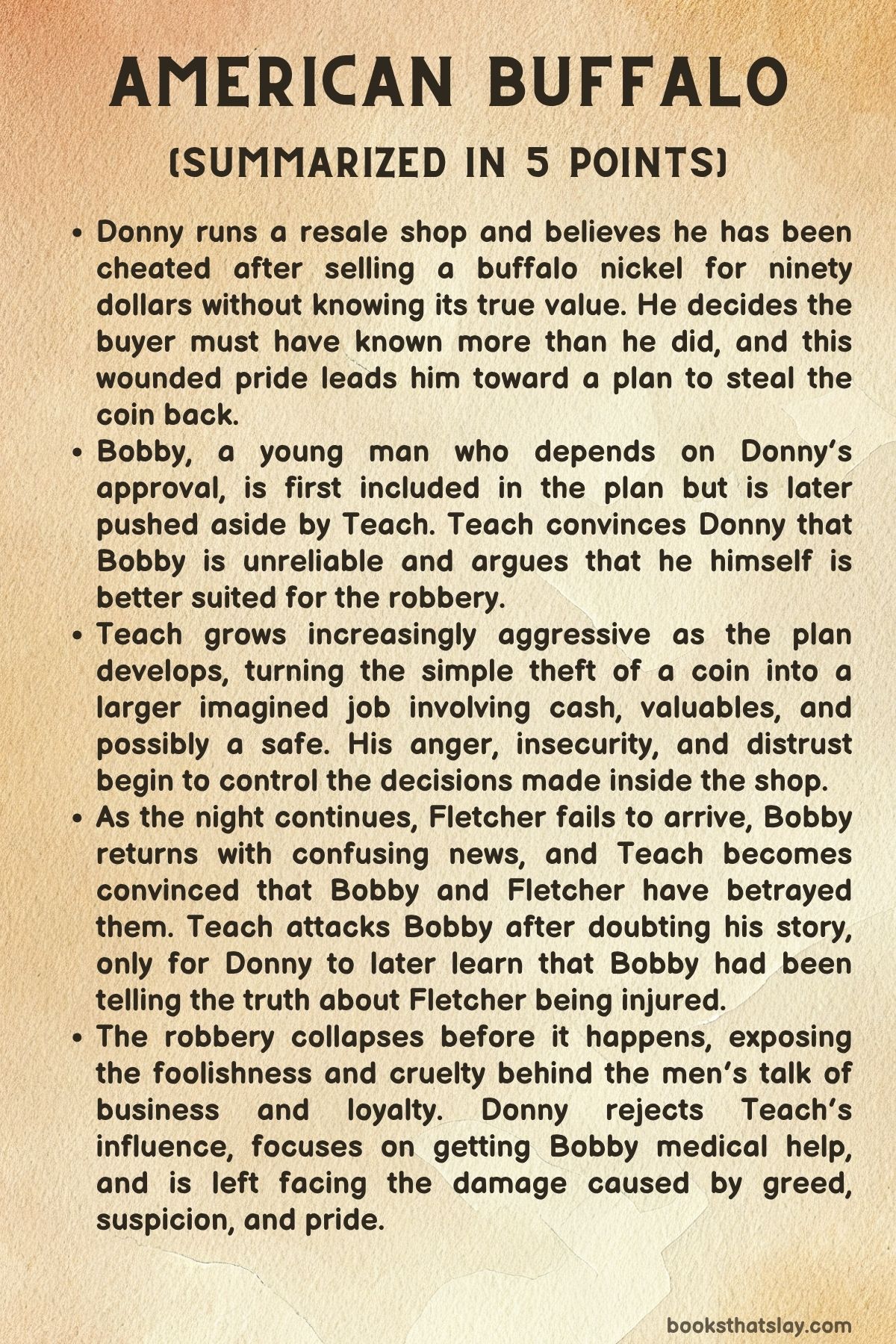
Characters
Donny
Donny is the owner of the resale shop and the character who most wants to believe that he understands business, people, and survival. He speaks with the confidence of a man who has built his identity around street knowledge, yet his actions show that his judgment is often weak.
He lectures Bobby about discipline, value, and action, but he himself fails to understand the true worth of the buffalo nickel before selling it. This gap between what Donny says and what Donny knows is central to his character.
He wants to appear practical and in control, but he is easily influenced by Teach, especially when Teach attacks Bobby’s reliability and questions Fletcher’s honesty. Donny’s idea of business is also morally confused.
He insists that business and friendship are separate, using this idea to justify selfish or dishonest behavior, yet he still wants to see himself as loyal and fair. His relationship with Bobby reveals a softer side.
Though he scolds Bobby and allows Teach to push him aside, Donny also feels responsible for him. By the end of American Buffalo, Donny’s guilt over Bobby’s injury makes him reject the robbery and turn against Teach.
This does not make him fully noble, but it shows that he still has some sense of care beneath his hard talk.
Teach
Teach is volatile, insecure, and deeply resentful. He enters the story angry over a minor slight from Ruthie, and that anger sets the tone for much of his behavior.
He constantly interprets ordinary actions as signs of disrespect, which suggests a man who feels powerless and tries to cover it with aggression. Teach talks about loyalty and friendship, but his loyalty is conditional and self-serving.
He quickly undermines Bobby, then Fletcher, because he wants the robbery to belong to him. His language is filled with confidence, but that confidence often hides panic.
He claims he can handle the theft, crack a safe, and manage danger, yet his planning is careless and his phone call to the target’s home shows how unprepared he really is. The gun that falls from his pocket exposes the violence under his boasting.
Teach is not simply a criminal figure; he is a man desperate to feel important. He needs Donny to choose him over Bobby and Fletcher.
When Bobby returns with news about Fletcher, Teach’s suspicion turns into brutality, and he attacks Bobby without proof. His final statements about there being no law, no right or wrong, and no friendship reveal his collapse into bitterness.
In American Buffalo, Teach represents the danger of wounded pride when it is joined with greed and fear.
Bobby
Bobby is young, vulnerable, and eager to be accepted by Donny. He is often treated as incompetent, and in many ways he is unreliable.
He forgets instructions, fails to follow the target properly, and lies about seeing the man leave his house. Yet his mistakes come less from malice than from anxiety and a desire to prove himself.
Bobby wants Donny’s approval, and this need drives him to make poor choices. His purchase of the second buffalo nickel shows this clearly.
He spends fifty dollars on a coin not because he has outsmarted anyone, but because he wants to make up for disappointing Donny. This makes him the most emotionally exposed character in the play.
While Donny and Teach hide behind talk of business, Bobby is more openly dependent. He asks for money, seeks reassurance, and apologizes when things go wrong.
His weakness makes him an easy target for Teach, who uses him to prove his own superiority. Bobby’s injury is one of the most important moments in the story because it reveals how destructive the older men’s suspicion and greed have become.
He is not innocent in a simple sense, since he lies and participates in the plan, but he is far less corrupt than the men around him. His final apology to Donny is painful because it comes after he has been harmed by the very world he wants to belong to.
Fletcher
Fletcher never appears directly, but he has a strong presence through what other characters say about him. Donny admires him as a model of street intelligence and uses him as an example while teaching Bobby about business.
To Donny, Fletcher is capable, sharp, and useful, the sort of man who can survive through wit. Teach, however, views Fletcher as a threat.
Because Donny wants Fletcher involved in the robbery, Teach begins attacking his character, accusing him of dishonesty and betrayal. Fletcher becomes a symbol of competition between the men.
His absence allows others to project their own fears and needs onto him. Donny wants him to represent competence; Teach wants him to represent betrayal.
The news that Fletcher has been beaten and hospitalized shifts the direction of the story. At first, Teach refuses to believe it and turns his suspicion toward Bobby.
When the report proves true, Fletcher’s unseen suffering exposes the danger of Teach’s paranoia. Fletcher’s role is important because he shows how reputation works in this world.
A man can be praised as brilliant one moment and condemned as crooked the next, depending on who is speaking and what they want.
Ruthie
Ruthie is also an offstage character, but she helps reveal Teach’s personality and the social world around the shop. Teach’s anger toward her begins with a small incident involving breakfast, yet he treats it as a serious insult.
His reaction says more about him than it does about Ruthie. She seems to be part of the same circle of poker players and neighborhood figures, and her presence suggests a community built on casual contact, gambling, favors, grudges, and gossip.
Ruthie also serves as a contrast to Teach’s claims about friendship. He insists that he is generous and loyal, but his anger toward her is petty and exaggerated.
Later, Ruthie becomes important because she confirms the truth about Fletcher’s condition. Her call helps prove that Bobby was not lying about Fletcher being hurt.
In that moment, Ruthie becomes a source of truth from outside the shop’s distorted atmosphere. Though she does not appear physically, she affects the action by provoking Teach’s resentment and later correcting the false suspicions that have led to violence.
Grace
Grace has a smaller role in the story and is mentioned in connection with the news about Fletcher. Like Ruthie, she belongs to the wider circle surrounding Donny, Teach, Bobby, and Fletcher.
Her importance comes from the way her name supports the idea that news travels through this social world quickly. When Bobby says that Ruthie and Grace know about Fletcher’s injury, he is pointing to a network outside the shop that already understands what has happened.
Grace does not shape the plot as strongly as Donny, Teach, or Bobby, but her mention helps widen the setting beyond the resale shop. The men inside the shop act as though their plans and suspicions are the center of everything, yet figures like Grace remind the reader that they are part of a larger neighborhood community.
Her presence also adds pressure to Bobby’s story because it suggests that the truth can be checked. In a play filled with lies, guesses, and accusations, even a minor offstage figure can help mark the difference between rumor and fact.
The Customer
The customer who buys the buffalo nickel is the unseen figure whose purchase triggers the central conflict. He enters Donny’s shop, buys a coin for ninety dollars, and leaves Donny feeling that he may have been cheated.
What matters is not whether the customer truly cheated Donny, but how Donny and Teach interpret the sale. The customer becomes their target because they assume he knows more than they do.
His knowledge, or their belief in his knowledge, makes them feel foolish and robbed, even though the transaction was voluntary. He represents the fear of being outsmarted in business.
Donny cannot accept that he may have sold something without knowing its worth, so he turns his embarrassment into a plan for theft. The customer is never developed as a full person because the men do not see him as one.
They reduce him to a mark, a house, a possible safe, and a chance for profit. His unseen presence shows how greed often begins with wounded pride rather than real need.
Themes
Business, Value, and Self-Deception
The characters speak about business as if it is a moral system, but their understanding of it is confused and self-serving. Donny teaches Bobby that business requires action, knowledge, and nerve, yet his own behavior proves that he does not fully possess these qualities.
He sells the buffalo nickel without knowing its value, then decides the buyer must have cheated him because the buyer may have known more. This reaction turns Donny’s ignorance into resentment.
Instead of accepting that he made a poor deal, he convinces himself that stealing the coin back is a reasonable correction. Teach strengthens this self-deception by presenting the theft as a larger opportunity.
The men use business language to make greed sound practical and justified. They talk about value, profit, and fairness, but they do not do the basic work of understanding what the coin is worth.
This theme shows how easily people can dress up foolish choices in serious language. In American Buffalo, business is not shown as clean ambition or smart exchange; it becomes a cover for insecurity, envy, and the refusal to admit failure.
Friendship and Betrayal
Friendship in the play is unstable because the characters use the word often while failing to act with real trust. Donny claims that friendship and business should be separate, but this separation becomes a way to excuse disloyal behavior.
He cares for Bobby, yet he allows Teach to insult and remove him from the robbery. Teach speaks angrily about how friends should treat one another, especially when discussing Ruthie, but he quickly betrays others whenever it benefits him.
He undermines Bobby by calling him unreliable, then attacks Fletcher’s reputation when Fletcher becomes an obstacle to his own importance. Even Bobby lies to Donny because he wants to repair his standing and remain useful.
The play presents friendship as something the characters desire but do not know how to protect. Their world is full of suspicion, small debts, favors, insults, and tests of loyalty.
No one feels secure, so every relationship becomes vulnerable to manipulation. The attack on Bobby marks the lowest point of this broken trust.
Teach harms him because he assumes betrayal before looking for truth. By the end, Donny’s concern for Bobby suggests that friendship has not disappeared completely, but it has been badly damaged by greed and pride.
Masculinity, Pride, and Power
The men in the story constantly try to prove their strength, intelligence, and usefulness. Donny performs the role of the experienced businessman, Teach performs the role of the fearless operator, and Bobby tries to become the kind of man Donny will respect.
Their language is full of lessons, challenges, insults, and claims about what a real man should know or do. Yet their need to appear powerful often exposes weakness.
Teach is the clearest example. He reacts with rage to small humiliations because his pride is fragile.
His anger at Ruthie, his contempt for Bobby, and his hostility toward Fletcher all come from a fear of being dismissed or replaced. Donny’s pride is quieter but still important.
He cannot accept that he may have misjudged the nickel’s value, so he reframes the sale as an injustice done to him. Bobby’s pride is mixed with need; he lies and buys the second coin because he wants to prove that he is capable.
The play criticizes a version of masculinity built on dominance and suspicion. These men believe power comes from control, toughness, and cleverness, but their actions lead to confusion and violence.
Their pride does not protect them; it makes them reckless.
Language, Confusion, and Moral Evasion
The characters talk constantly, but their speech often hides more than it reveals. They use repeated phrases, unfinished thoughts, and forceful claims to create the feeling of certainty, even when they do not know what they are doing.
Donny’s lessons to Bobby sound authoritative, but they are vague. Teach’s speeches sound confident, but they are driven by anger and fear.
The more the men talk about business, loyalty, and justice, the less clear those ideas become. Language becomes a tool for pressure.
Teach uses it to weaken Donny’s trust in Bobby and Fletcher. Donny uses it to teach Bobby, but also to avoid admitting his own mistakes.
Bobby uses lies and partial truths because he does not know how to face Donny honestly. This pattern creates a moral fog in which theft can be called business, suspicion can be called caution, and violence can be treated as a response to imagined betrayal.
The play shows how people can talk themselves into wrongdoing by changing the names of things. The robbery is never simply planned; it is justified, renamed, enlarged, and defended through speech.
In the end, words fail to protect anyone from the real harm caused by fear and mistrust.