American Colonies Summary and Analysis
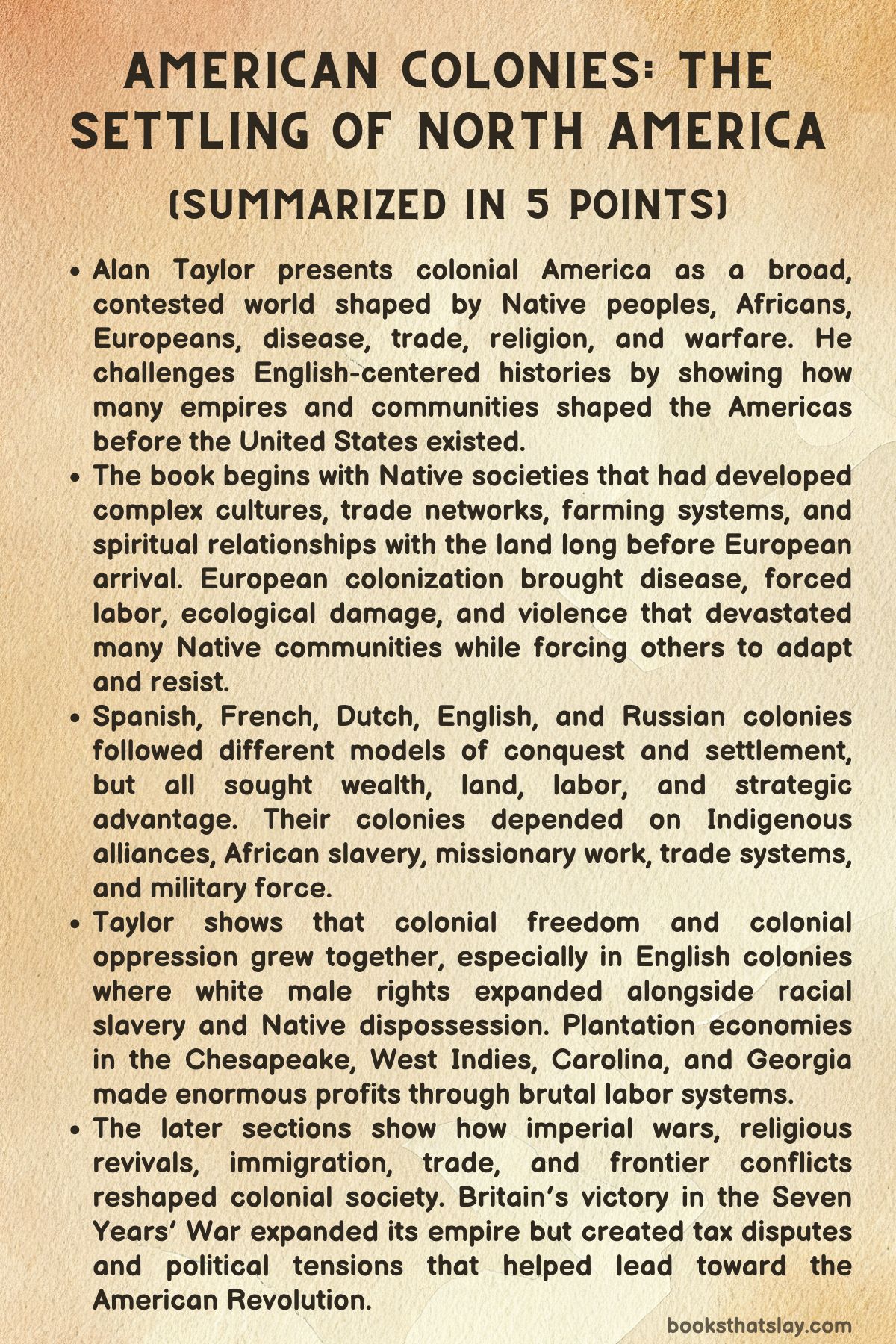
American Colonies: The Settling of North America by Alan Taylor is a wide-ranging history of colonial North America that challenges the usual English-centered story of early America. Rather than presenting the colonies as a simple prelude to the United States, Taylor shows a crowded, contested world shaped by Native peoples, Africans, Europeans, disease, trade, religion, warfare, slavery, and environmental change.
The book moves across Spanish, French, Dutch, English, Russian, and Indigenous spheres, arguing that colonial America was not one story but many overlapping struggles for land, labor, power, and survival. Its central focus is how conquest and cultural contact created the foundations of modern America.
Summary
American Colonies presents colonial North America as a vast and varied history that begins long before Europeans arrived. Alan Taylor opens by correcting older accounts that focused mainly on English settlers and white male achievement.
He argues that such accounts hide the experiences of Native peoples, enslaved Africans, poor settlers, women, and rival European empires. The book’s central claim is that America’s colonial past was shaped by contact among many peoples, and that this contact produced both cultural mixture and brutal systems of inequality.
The story begins with Native societies before 1492. Taylor describes the first peoples of North America as descendants of migrants from Asia who adapted to many different environments over thousands of years.
Some became mobile hunters, while others built settled farming communities, irrigation systems, trade routes, and large chiefdoms such as Cahokia. Native peoples developed varied cultures, but many shared a view of nature as spiritually alive and requiring balance.
This differed sharply from the European Christian belief that humans had a divine right to dominate nature. That difference in worldview later shaped conflicts over land, labor, and resources.
European expansion began with the search for trade routes and wealth. Spain and Portugal, energized by religious warfare and Atlantic exploration, developed new models of conquest in Africa and the Canary Islands before applying them in the Americas.
Christopher Columbus’s voyages connected the Old and New Worlds, but the exchange was unequal. Europeans gained new crops and wealth, while Native peoples suffered from disease, forced labor, violence, and ecological disruption.
Old World pathogens such as smallpox devastated communities that had no immunity, giving Europeans a powerful and unintended advantage.
Spain built the first major European empire in the Americas. Hernán Cortés conquered the Aztec capital, helped by disease, military technology, alliances, and internal divisions among Native groups.
Spanish conquest was driven by greed, religion, and loyalty to the Crown. Systems such as the encomienda allowed Spaniards to extract tribute and labor from Indigenous peoples.
Missionaries tried to impose Catholicism, but Native people often blended Christian practices with older beliefs. Spanish men also formed families with Native and African women, producing complex mixed societies organized through racial hierarchies.
Spanish efforts to expand northward were less successful. Expeditions led by Hernando de Soto and Francisco Vásquez de Coronado searched for riches in the southeast and southwest but found no equivalent to Mexico’s silver and gold.
These expeditions still caused enormous damage through violence, theft, and disease. Native societies in the southeast collapsed or reorganized, forming new identities from surviving groups.
Spain maintained scattered frontier colonies in Florida, New Mexico, Texas, and California largely for defense, missions, and imperial rivalry rather than profit.
Farther north, French and Dutch colonies developed through the fur trade. In Canada and the Great Lakes, Europeans depended on Native hunters and traders, which created more balanced relationships than in plantation zones.
French traders often married Native women and entered kinship networks. Yet the fur trade still damaged Native life.
Demand for beaver pelts depleted animal populations, increased dependence on European goods, and intensified wars among Native groups. The Iroquois, Hurons, French, and Dutch became locked in cycles of trade, alliance, warfare, mourning rituals, and adoption.
English colonization followed a different path. In Virginia, the English first struggled to survive.
Roanoke failed, and Jamestown nearly collapsed because settlers expected quick wealth rather than hard agricultural work. The Powhatan confederacy initially treated the English as another dependent group, but misunderstanding and violence turned relations hostile.
Tobacco eventually saved Virginia economically, while the headright system encouraged private landownership. English expansion then pushed Native peoples off their lands through war, broken agreements, and hunger.
The Chesapeake colonies developed a society based on tobacco, land, and labor exploitation. At first, much of the workforce consisted of indentured servants from England.
Some survived their contracts and gained land, but falling tobacco prices and the rise of wealthy planters made opportunity harder to find. Bacon’s Rebellion exposed the anger of poor white men and servants toward elites and Native peoples.
In response, the planter class increasingly relied on enslaved Africans and promoted white racial unity to reduce class conflict. Taylor presents this as a key turning point: liberty for white men expanded alongside racial slavery.
New England was shaped by Puritan religion, family migration, and small farms. Puritans came to create a godly society that would reform English Protestantism.
Unlike the Chesapeake, New England attracted families, produced healthier settlements, and encouraged literacy so that people could read the Bible. Its towns were more equal among white men, but not tolerant in a modern sense.
Dissenters were punished or expelled, and fears of witchcraft showed the anxiety of Puritan life. Relations with Native peoples worsened as English settlers judged Native land use as lazy and ungodly.
Wars against the Pequot and later Metacom’s uprising destroyed many Native communities in southern New England.
The West Indies and Carolina reveal the most violent side of English colonial capitalism. Sugar made Barbados and Jamaica enormously profitable, but sugar production required harsh labor in deadly conditions.
Planters shifted from white indentured servants to enslaved Africans and created severe slave codes that influenced mainland colonies. Carolina imported this model, combining plantation slavery with an Indian slave trade.
Colonists encouraged Native groups to capture enemies and sell them into slavery, spreading violence deep into the interior. Rice and indigo later made South Carolina rich, but that wealth rested on enslaved labor and fear of rebellion.
The Middle Colonies offered a different model. Dutch New Netherland was religiously and ethnically diverse before England seized it and renamed it New York.
New Jersey and Pennsylvania also became plural societies, especially under William Penn’s Quaker vision of religious tolerance and peaceful dealings with Native peoples. Pennsylvania prospered through wheat farming and immigration, but even there land hunger eventually broke earlier promises to the Lenni Lenape.
Taylor shows that pluralism and expansion could coexist with dispossession.
The book then follows imperial politics and war. The Glorious Revolution weakened royal centralization in the colonies and restored many local assemblies.
Britain’s wars with France and Spain strengthened the empire while increasing debt. The Atlantic economy expanded, and colonists became eager consumers of British goods.
Immigration from Scotland, Ireland, and Germany reshaped the colonies, while forced African migration expanded slavery. The Great Awakening transformed colonial religion by stressing emotional conversion, individual experience, and challenges to established authority, though most revivalists still failed to oppose slavery.
French America remained smaller and more dependent on royal support than British America. Canada’s habitants often lived better than peasants in France, but the colony had little autonomy and few exports beyond furs.
In the Great Lakes, French power relied on diplomacy and gift-giving with Native allies. Louisiana struggled economically but remained strategically important because it helped contain British expansion.
Across the Great Plains, horses and guns transformed Native life, empowering groups such as the Comanche while increasing warfare, raiding, and social inequality.
The Seven Years’ War reshaped the continent. Britain defeated France, gained Canada, and took control of much of eastern North America.
Yet victory created new problems. Native allies of France resisted British rule in Pontiac’s Rebellion, forcing Britain to restore some diplomatic practices.
At the same time, the cost of war led Britain to tax the colonies more directly. Colonists objected because they believed free men could only be taxed by their own representatives.
Taylor suggests that the same empire that helped colonial settlers expand also created the crisis that led toward revolution.
The final sections widen the map to the Pacific. Russian fur traders exploited the Aleut people in Alaska, while Spain colonized California to block rivals and protect Mexico.
Franciscan missions forced Native Californians into labor and religious instruction, often treating them as children who could be controlled for their supposed improvement. British and French explorers also entered the Pacific with scientific ambitions, but exploration still opened the way to imperial competition.
Overall, American Colonies argues that colonial America was not simply English, democratic, or destined to become the United States. It was a violent, diverse, changing world shaped by empire, trade, labor systems, Native resistance, African slavery, religious conflict, and ecological transformation.
Taylor’s history shows that American freedom and American inequality grew together, making the colonial past both foundational and deeply troubling.
Key People
Alan Taylor
Alan Taylor is not a character inside the historical action, but his role as the author strongly shapes the way the people and groups are presented. In American Colonies, Taylor acts as a corrective voice against a narrow English-centered version of colonial history.
He does not treat the colonies as a simple origin story for the United States. Instead, he brings forward the people who are often left at the margins: Native communities, enslaved Africans, poor European laborers, women, religious dissenters, and non-English empires.
His perspective is analytical rather than sentimental. He repeatedly shows how freedom, property, expansion, and profit often depended on violence, dispossession, and forced labor.
Taylor’s presence is especially important because he refuses to make colonial history morally simple. Victors are shown as ambitious and adaptable, but also exploitative; victims are shown not as passive figures, but as people who resisted, adapted, negotiated, and survived under severe pressure.
Native Peoples
Native peoples are central to the book’s account of colonial America. They are not presented as a single unified group but as many distinct societies with different languages, economies, religions, and political systems.
Before European arrival, they had already built complex worlds: mobile hunting bands, farming villages, trade networks, irrigation systems, chiefdoms, and spiritual traditions rooted in balance with the natural world. Taylor shows that Native peoples were skilled environmental managers, not inhabitants of an untouched wilderness.
Their use of controlled fire, mixed planting, seasonal movement, hunting practices, and trade reflected practical knowledge built over generations. After European contact, Native communities faced disease, warfare, land loss, trade dependency, enslavement, and missionary pressure.
Yet they were never merely helpless. They formed alliances, played European powers against one another, adopted guns and horses, absorbed captives, created new confederacies, and rebuilt identities after collapse.
Their tragedy lies not in weakness but in facing an invasion that combined microbes, hunger for land, military force, and commercial pressure.
European Colonizers
European colonizers function as both historical agents and representatives of competing imperial systems. Spanish, French, Dutch, English, and Russian colonizers all sought wealth and power, but they pursued those goals in different ways.
The Spanish relied heavily on conquest, Catholic missions, tribute, and racial hierarchy. The French often depended on trade alliances with Native peoples, especially in the fur economy, which required diplomacy as much as force.
The Dutch emphasized commerce and tolerance, creating a diverse but relatively thinly populated colony. The English combined private property, elected assemblies, settler migration, plantation agriculture, and aggressive expansion.
Russian traders in Alaska showed another form of colonial exploitation through the fur trade and coercion of the Aleut. Across these differences, Taylor presents a shared pattern: Europeans entered the Americas claiming religious, commercial, or civilizing purposes, but their success usually rested on taking land, controlling labor, and reshaping local societies.
Their character as a collective force is marked by ambition, adaptability, and a persistent ability to justify violence as progress.
Christopher Columbus
Christopher Columbus appears as a figure whose mistaken geography changed world history. Taylor presents him not as a heroic discoverer but as a militant Catholic and ambitious navigator seeking royal support, wealth, and a western route to Asia.
His significance comes less from personal greatness than from the consequences of his voyages. Columbus helped connect the Atlantic worlds, but that connection produced catastrophe for Indigenous peoples.
His settlement of Hispaniola followed patterns already tested in Atlantic islands: occupation, forced labor, plantation production, and religious justification. His treatment of the Taino foreshadows later colonial systems across the Americas.
Columbus’s character is defined by confidence, miscalculation, religious certainty, and commercial hunger. He believed he was serving God and monarchy, but his actions helped open a world of conquest, enslavement, disease, and extraction.
Taylor uses him to show how colonization began not as an accident of contact alone, but as an extension of European ambitions already formed before the Americas entered their plans.
Hernán Cortés
Hernán Cortés represents the conquistador as a daring, violent, and opportunistic figure. His conquest of Tenochtitlán depended on military technology, alliances with enemies of the Aztecs, disease, and ruthless calculation.
Taylor does not reduce his success to European superiority; instead, he shows that Cortés benefited from local divisions and from smallpox, which weakened Indigenous resistance. Cortés embodies the mixture of greed and religious certainty that marked Spanish conquest.
He sought gold, status, and power, yet he also understood his actions through the language of monarchy and Christianity. His character reveals how conquest could be framed as both personal advancement and sacred duty.
Cortés also exposes the limits of imperial control. Men like him were useful to the Spanish Crown because they expanded territory, but they were also dangerous because their violence and hunger for reward could destabilize the empire the Crown wanted to govern and tax.
Spanish Missionaries
Spanish missionaries are presented as agents of religion, discipline, and cultural transformation. They believed they were saving Indigenous souls by converting them to Catholicism, but their work often required coercion, surveillance, and destruction of Native religious practices.
In Mexico, New Mexico, Florida, and California, missionaries tried to replace Indigenous worldviews with Christian doctrine, European gender roles, settled agriculture, and obedience to colonial authority. Their character is complicated because many of them sincerely believed in their mission.
They were not always motivated by profit in the same way as soldiers or planters. Yet sincerity did not make their actions harmless.
They often treated Native peoples as children needing control, and they used forced labor, punishment, and confinement to achieve religious ends. Taylor’s portrayal shows that colonial violence was not only military or commercial.
It could also appear in the form of education, conversion, and claims of moral improvement.
Powhatan
Powhatan stands as one of the most important Native political figures in the English colonial story. He ruled over a network of Algonquian-speaking groups and initially saw the English in Virginia as a small, vulnerable people who might be absorbed into his own system of tribute and dependency.
This makes him a powerful counterpoint to English assumptions. The settlers did not arrive in an empty land, and they were not immediately dominant.
Powhatan’s authority rested on kinship, tribute, diplomacy, and strategic control over food. His relationship with the English reveals the cultural misunderstandings that defined early Virginia.
The English wanted land and supplies but resisted subordination; Powhatan expected newcomers to fit into existing regional politics. As English hunger and aggression increased, cooperation gave way to violence.
Powhatan’s importance lies in showing that Native leaders initially negotiated from positions of real strength, even though the long-term effects of disease, population growth, and English land hunger eventually overwhelmed that balance.
Pocahontas
Pocahontas appears less as a romantic figure and more as a person caught inside a larger political struggle between Powhatan’s people and the English settlers. Her capture became a tool of colonial pressure, helping force an uneasy peace in Virginia.
Taylor’s treatment moves away from myth and places her within the violent realities of diplomacy, kinship, coercion, and survival. Pocahontas’s significance is not that she symbolizes harmony between peoples, but that her story shows how English colonists used Native bodies, families, and political ties to secure their position.
She also represents the way colonial history often turns complex Native women into simple cultural symbols. In the larger account, her role highlights the gendered dimension of colonization: women could become bridges between societies, but they could also be used as hostages, converts, wives, and signs of colonial success.
Opechancanough
Opechancanough is presented as a leader who understood the long-term danger of English expansion more clearly than many others. As Powhatan’s brother and successor, he launched major attacks against the Virginia settlers in an effort to stop their growth.
His actions show that Native resistance was not random violence but a strategic response to dispossession. From the English perspective, his attacks justified harsher campaigns against Native peoples.
From the Native perspective, they were attempts to defend land, autonomy, and survival. Opechancanough’s character is marked by patience, political awareness, and determination.
He saw that English settlements were not temporary trading posts but expanding colonies that would consume Native territory. His eventual defeat and death symbolize the collapse of Native power in the Chesapeake, but Taylor’s account makes clear that this collapse came through war, disease, and English expansion, not through any natural or inevitable process.
John Smith
John Smith represents the hard, militarized survival instincts of early English colonization. In Jamestown, he tried to impose discipline on settlers who were often unwilling or unable to farm, build, and sustain themselves.
His leadership reflected the colony’s desperate condition: the English depended on Native food while also demanding it through threat and force. Smith’s character is practical, aggressive, and self-promoting.
He understood that survival required labor and order, but he also participated in a colonial mindset that treated Native resources as available for English needs. His role highlights the weakness of early Virginia.
The colony did not begin as a confident success but as a fragile settlement surrounded by people who knew the land better and controlled the food supply. Smith’s importance lies in showing that English colonization was not inevitable; it survived through discipline, violence, adaptation, and eventually tobacco.
Nathaniel Bacon
Nathaniel Bacon is one of Taylor’s clearest examples of ambition disguised as popular rebellion. He appealed to poor white settlers and former servants who were angry about taxes, limited land, and frontier conflict with Native peoples.
Bacon presented himself as a defender of common colonists, but his rebellion was also a bid for personal power. His willingness to kill Native people against the governor’s orders made him popular among settlers who wanted land and security.
Bacon’s character reveals how class anger could be redirected into racial and frontier violence. His rebellion frightened Virginia’s elite because it united servants, freedmen, and poor settlers against established authority.
After the rebellion, elites worked to prevent similar uprisings by strengthening racial divisions and expanding African slavery. Bacon therefore matters less as a revolutionary hero than as a catalyst for a harsher racial order.
His actions helped expose the unstable foundations of Chesapeake society.
William Berkeley
William Berkeley represents the older colonial elite in Virginia. As governor, he protected wealthy planter interests and maintained trade relations with certain Native groups, even when frontier settlers demanded war.
His resistance to Bacon was not based on broad humanitarian concern but on political and economic calculation. Berkeley feared disorder and wanted to preserve elite control.
His character shows the tension between colonial aristocracy and poorer white settlers. To common planters, he appeared corrupt, distant, and unwilling to protect them.
To the elite, he represented stability and hierarchy. His conflict with Bacon revealed that English colonial society was not united simply because settlers shared race or religion.
Class divisions were severe, and poor white resentment could threaten the ruling class. Berkeley’s defeat in the crisis helped push planters toward a new political strategy: granting more status to white men while deepening the subordination of Africans and Native peoples.
Puritans
The Puritans are portrayed as disciplined, literate, hardworking, and intensely religious settlers who wanted to build a reformed Christian society in New England. They valued family migration, education, labor, and moral order.
Their settlements were healthier and more stable than those in the Chesapeake, and their farms created a relatively broad property-owning society among white men. Yet Taylor also shows their severity.
They did not believe in modern religious freedom, and they punished dissenters who threatened communal unity. Their belief that hard labor proved moral worth shaped their judgment of Native peoples, whom they wrongly saw as lazy because Native land use did not match English farming habits.
Puritan character is therefore double-sided: they helped create habits of literacy, local government, and relative equality among settlers, but they also enforced conformity and justified Native dispossession through religious ideas about labor and wilderness.
Metacom
Metacom, known to the English as King Philip, emerges as a leader responding to the steady erosion of Native land and autonomy in New England. His uprising was not simply a sudden outbreak of violence; it came after years of pressure from English settlement, missionary control, legal interference, and cultural contempt.
Metacom’s character is shaped by resistance under narrowing possibilities. He attempted to unite Native groups against English expansion, but Native political divisions and English alliances with rival groups weakened his cause.
His war brought destruction to both Native and English communities, but its consequences were especially devastating for Native peoples. Taylor uses Metacom’s story to show the tragedy of failed pan-Native resistance in a region where English demographic growth and land hunger had become overwhelming.
Metacom stands as a symbol of Native refusal to accept colonial domination, even when the odds had turned sharply against survival.
William Penn
William Penn represents the more tolerant and commercially successful side of English colonization, though his vision also had limits. As a Quaker, he founded Pennsylvania on principles of religious openness, fair dealing, and peace with Native peoples.
His colony attracted diverse European migrants and became prosperous through wheat farming and pluralism. Penn’s character is marked by idealism, pragmatism, and political skill.
He understood that tolerance could create stability and growth. Yet the later history of Pennsylvania shows that even a colony founded on peace could not escape the pressures of land hunger, immigration, and expansion.
As settlers pushed westward, earlier commitments to fair Native relations broke down. Penn’s importance lies in the contrast he provides: colonialism could be less brutal in method, but it still tended toward dispossession when population growth and property interests overpowered moral restraint.
Enslaved Africans
Enslaved Africans are among the most important collective figures in American Colonies. They were forcibly carried into colonial systems that depended on their labor, especially in the West Indies, Chesapeake, Carolina, and Georgia.
Taylor presents them not only as victims of slavery but as people who preserved culture, resisted domination, formed communities, and shaped colonial society. Their experiences varied by region.
West Indian sugar plantations were especially deadly, while rice plantations in South Carolina and Georgia imposed brutal task labor. In the Chesapeake, enslaved communities gradually developed stronger family and religious networks.
In northern colonies, slavery was less dominant but still real. Enslaved Africans resisted through rebellion, escape, work slowdowns, cultural survival, and religious adaptation.
Their character as a collective presence exposes the central contradiction of colonial liberty: many white colonists claimed freedom as a sacred right while building their prosperity on bondage.
George Whitefield
George Whitefield represents the emotional power of evangelical religion in the eighteenth-century colonies. As a traveling preacher, he used dramatic sermons to reach large audiences and helped spread the revival movement known as the Great Awakening.
His character is energetic, theatrical, and controversial. He appealed especially to people who felt excluded from established churches or dissatisfied with dry, formal preaching.
Whitefield’s influence helped weaken traditional religious authority by encouraging ordinary people to value personal conversion and emotional experience. Yet his impact was limited by the contradictions of his time.
Revivalism could challenge hierarchy in churches, but it did not consistently challenge slavery or racial inequality. Whitefield’s importance lies in showing how religious movements prepared colonists to question inherited authority, even when those movements failed to apply their principles equally to all people.
Jonathan Edwards
Jonathan Edwards represents the intellectual and theological side of evangelical revival. Unlike Whitefield’s public theatricality, Edwards is associated with careful religious interpretation and the idea that intense emotional conversion could reveal divine grace.
He helped give credibility to revivals by presenting them as evidence of God’s active presence in colonial life. His character combines stern Calvinist theology with a deep interest in religious psychology.
Edwards believed that people needed to experience their helplessness before they could understand salvation. His role in the book shows how religious change was not only social but also intellectual.
He helped frame revival as a serious spiritual event rather than mere disorder. At the same time, the movement he supported opened doors to forms of religious expression that traditional ministers found threatening, including lay preaching and greater participation by women and young people.
George Washington
George Washington appears before his revolutionary fame as a young and inexperienced officer whose actions helped trigger a major imperial war. His ambush of a French patrol contributed to the escalation that became the Seven Years’ War.
Taylor’s portrayal cuts against the later image of Washington as a composed national father. Here he is ambitious, uncertain, and part of a larger imperial contest he does not fully control.
His survival after British failures helped build his reputation, but the episode also shows how local frontier actions could have global consequences. Washington’s early role reveals the connection between land hunger, military ambition, and imperial rivalry.
He stands as a reminder that figures later celebrated in national history first acted within the messy world of empire, speculation, Native alliances, and European competition.
Jeffrey Amherst
Jeffrey Amherst represents the arrogance of British victory after the defeat of France. Once Britain gained control of former French territories, Amherst dismissed the diplomatic customs that had maintained relations with Native peoples, especially gift-giving.
He saw such practices as unnecessary expenses rather than essential political rituals. His character is rigid, dismissive, and dangerously confident.
By cutting off gifts and treating Native allies as conquered dependents, he helped provoke widespread resistance. Amherst’s failure shows that military victory did not mean effective rule.
The British could defeat France, but they could not simply command Native peoples without respecting existing diplomatic systems. His replacement’s decision to restore gift-giving proves the practical weakness of Amherst’s approach.
He is important because he reveals how imperial power often misunderstood the societies it claimed to govern.
James Oglethorpe
James Oglethorpe represents reformist colonial ambition with clear limits. He helped found Georgia as a colony meant to discipline England’s poor and serve as a defensive buffer against Spanish Florida.
His opposition to slavery in Georgia was not primarily based on sympathy for enslaved Africans, but on military and social reasoning. He believed slavery would weaken white labor, reduce the number of armed settlers, and create instability.
Oglethorpe’s character is paternalistic, disciplined, and idealistic within the boundaries of his time. He wanted Georgia to be different from Carolina, but settlers soon demanded the same plantation privileges available elsewhere.
His failure shows the strength of the plantation model in the southern colonies. Even reform plans could collapse when colonists equated freedom with the right to control land and enslaved labor.
Junipero Serra
Junipero Serra represents the missionary face of Spanish California. He believed deeply in Catholic conversion and saw Native Californians as people who could be remade through religious instruction, discipline, and labor.
His character is zealous, sincere, and controlling. Taylor’s account does not portray the mission system as simple kindness.
Native people were often confined, punished, denied wages, and forcibly returned if they fled. Serra and other missionaries thought they were guiding people toward salvation, but their work disrupted Native autonomy, culture, family life, and land use.
His role shows how colonial domination could be carried out by people who believed themselves morally righteous. Serra’s importance lies in the uncomfortable gap between intention and consequence: a mission could speak the language of salvation while functioning as a system of coercion.
Themes
Colonial America as a Multiethnic and Contested World
American Colonies rejects the idea that early America was mainly an English story moving smoothly toward the United States. The colonial world was crowded with Spanish soldiers, French traders, Dutch merchants, English settlers, Russian fur hunters, Native confederacies, African captives, missionaries, pirates, farmers, servants, and imperial officials.
Each group entered the continent with different goals, and none controlled events completely. Native peoples shaped trade, diplomacy, warfare, and settlement patterns.
Africans transformed plantation economies and religious culture despite enslavement. European empires competed with one another, and their rivalries gave Native groups room to negotiate, resist, and survive.
This theme changes the meaning of colonial history. The colonies were not a single developing nation in waiting; they were a set of unstable borderlands where power shifted constantly.
Taylor’s approach also challenges national pride by showing that American diversity came from conquest, forced migration, cultural exchange, adaptation, and survival. The modern United States began not from unity but from conflict among many peoples who were drawn into the same imperial world under unequal conditions.
Freedom and Slavery Growing Together
Colonial liberty did not expand apart from slavery; in many places, it expanded beside it. Taylor repeatedly shows that white settlers’ demands for rights, land, representation, and lower taxes often depended on the subordination of others.
In Virginia, wealthy planters responded to class unrest by strengthening racial slavery and encouraging poor white men to identify with racial privilege rather than with exploited laborers of all backgrounds. In Barbados, Jamaica, Carolina, and Georgia, plantation wealth required enslaved African labor, harsh laws, and constant fear of rebellion.
Even political ideas that later became central to American independence were shaped inside societies that accepted bondage. Colonists complained that taxation without representation made them like slaves, while many of them owned enslaved people or profited from slavery.
This contradiction is one of the book’s most important arguments. Freedom in colonial America was not universal.
It was a protected status, often defined by race, gender, property, and religion. The rights of some people became more secure because other people were denied rights almost completely.
Land, Labor, and the Pursuit of Profit
The hunger for land and labor drives much of the colonial story. Europeans came seeking wealth, but wealth in the Americas usually required control over territory and workers.
Spanish conquerors extracted tribute and labor through conquest. English settlers built tobacco, sugar, rice, and indigo economies by using indentured servants, enslaved Africans, and dispossessed Native lands.
French traders relied on Native hunters for furs, while Russians forced Aleut labor into the sea otter trade. Even colonies built on ideals, such as Pennsylvania or Georgia, faced pressure from settlers who wanted more land, more labor, and more autonomy.
Taylor shows that colonial economies were rarely gentle. Crops exhausted soil, plantations consumed workers, trade dependency changed Native hunting patterns, and livestock damaged Indigenous food systems.
Profit also reshaped social values. Planters called themselves genteel while relying on brutal labor systems.
Colonists praised independence while demanding access to other people’s land. This theme exposes colonial expansion as an economic project as much as a religious or political one.
The pursuit of prosperity repeatedly turned moral claims into excuses for exploitation.
Cultural Adaptation, Resistance, and Survival
The colonial world forced every group to adapt, but adaptation did not mean surrender. Native peoples adopted European guns, metal tools, horses, trade goods, and diplomatic tactics while trying to preserve autonomy.
Some formed new confederacies after disease and war destroyed older communities. Others used alliance systems to balance rival empires against one another.
Enslaved Africans preserved music, worship styles, family ties, agricultural knowledge, and forms of resistance under severe conditions. European colonists also adapted.
The French learned that diplomacy and gift-giving were necessary in the Great Lakes. The English developed new labor systems and political assemblies.
The Spanish adjusted frontier policy when missions and military force failed against powerful Native groups such as the Comanche. Taylor’s account shows that colonial history was not only a story of domination from above.
It was also a story of people responding to crisis with negotiation, rebellion, cultural blending, migration, and reinvention. Survival often required compromise, but compromise could carry pain.
New identities emerged from loss, captivity, conversion, forced labor, and displacement, making colonial America a place of both destruction and creation.