Angela Davis: An Autobiography Summary and Analysis
Angela Davis: An Autobiography is the autobiography of activist, scholar, and revolutionary Angela Y. Davis. The book presents her life as inseparable from the larger struggle against racism, political repression, capitalism, sexism, and the prison system.
Davis writes about growing up in segregated Birmingham, becoming politically conscious through study and activism, joining communist and Black liberation movements, and facing prosecution after the Marin County Courthouse revolt. The book is both a personal account and a political statement, showing how Davis’s experiences shaped her commitment to collective freedom and prison abolition.
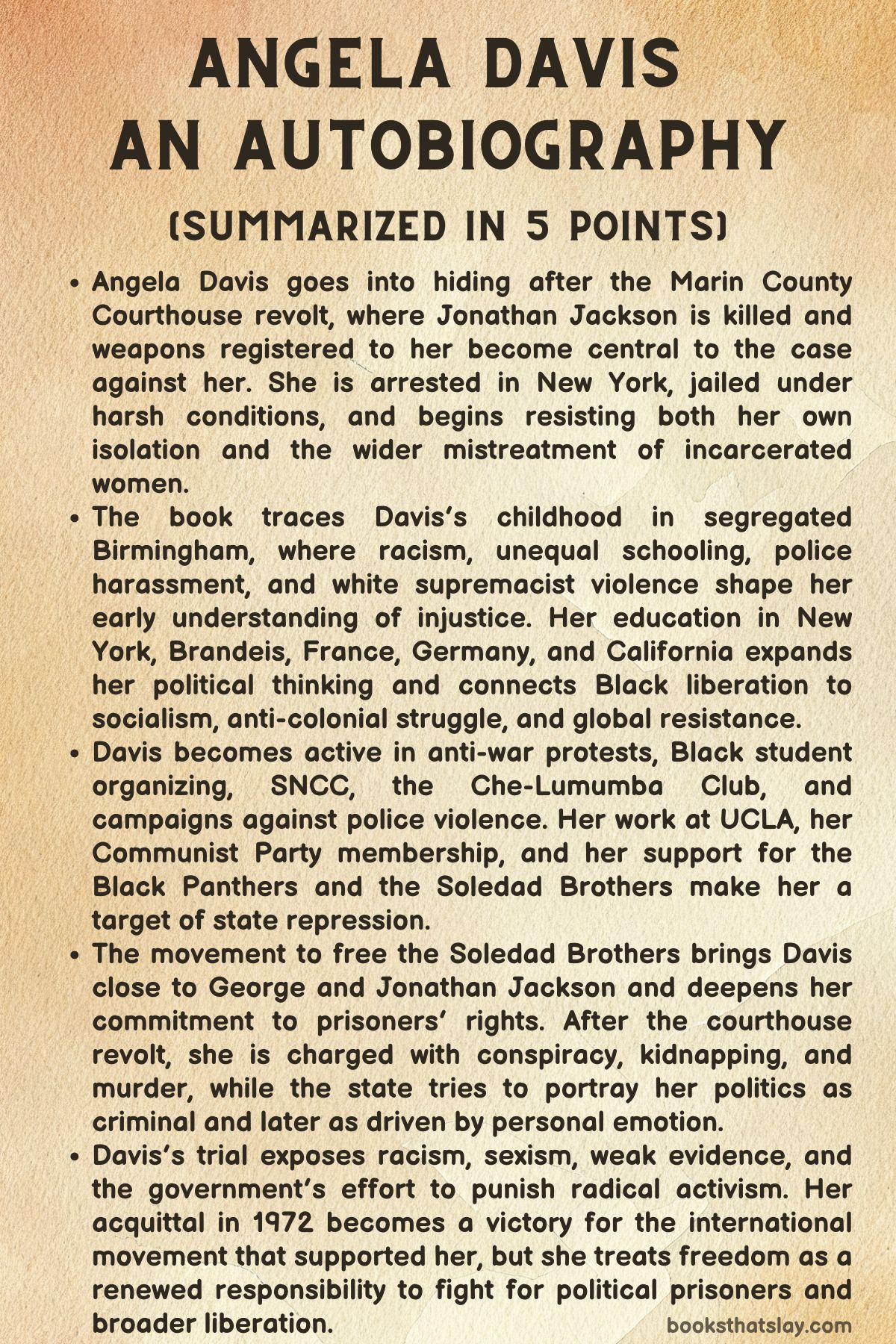
Summary
Angela Davis begins with Davis in hiding in Los Angeles in August 1970 after the Marin County Courthouse revolt. Jonathan Jackson, the younger brother of imprisoned activist George Jackson, has been killed during the incident, and Davis is shaken by grief.
A gun registered in her name was used in the revolt, and the authorities accuse her of involvement. Already targeted because of her Communist Party membership, her support for Black liberation, and her firing from UCLA under pressure from Governor Ronald Reagan and the Board of Regents, Davis becomes one of the FBI’s most wanted people.
With help from friends and allies, Davis moves from safe house to safe house. She travels to Miami and then to New York, trying to remain hidden while also worrying about her family in Alabama.
Her time underground ends when the FBI arrests her at a Howard Johnson Motor Lodge in New York. She is taken to the New York Women’s House of Detention, a jail she had often passed as a teenager without fully understanding the lives of the women inside.
In jail, Davis is first placed in a ward for prisoners with mental health conditions. Officials claim this is for her protection, but Davis understands that they want to isolate her from the general population because she is a political prisoner.
Outside the jail, people gather to demand her release, and their voices give her strength. Inside, she begins to see more clearly how racism, poverty, and state violence shape the lives of incarcerated women.
Almost all the women being brought into the jail are Black or Puerto Rican, and many cannot afford bail.
Davis’s lawyers fight for her rights, and she resists the jail’s attempts to silence her. When she speaks with other women about communism and injustice, she is moved into solitary confinement.
She and her legal team file a lawsuit challenging the treatment of political prisoners, and Davis goes on a hunger strike. Her struggle leads to improved conditions, but she remains focused on the fact that many other prisoners face the same or worse treatment without public attention.
In the jail, women form bonds of care and survival, and Davis helps develop a bail fund so that released women can support those still inside.
The narrative then turns to Davis’s childhood in Birmingham, Alabama. She grows up in a middle-class Black family in a segregated city marked by white supremacist violence.
Her neighborhood experiences repeated attacks as Black families move into areas claimed by white residents. From an early age, Davis sees the contrast between Black and white schools, the effects of poverty among her classmates, and the constant danger of racist policing.
She also learns Black history in segregated schools, which gives her a strong sense of pride, though she later rejects the idea that individual hard work alone can overcome systemic oppression.
As a teenager, Davis becomes increasingly restless in Birmingham. The civil rights movement is growing, and she takes part in small acts of resistance, including sitting at the front of a bus in solidarity with the Montgomery Bus Boycott.
She later joins a program that allows her to attend an integrated high school in New York. At Elizabeth Irwin High School, she encounters leftist teachers, reads socialist and communist texts, and begins to connect Black liberation with broader struggles against exploitation.
Reading The Communist Manifesto helps her imagine freedom not only for Black people but for all oppressed groups.
Davis attends Brandeis University, where she feels isolated as one of the few Black women on campus. Her political awareness deepens through activism, study, and travel.
A visit to Helsinki for the World Festival for Youth and Students broadens her sense of international solidarity. In Paris, she witnesses racism against Algerians and recognizes parallels with the violence she knows from Birmingham.
While studying in France, she learns of the bombing of the 16th Street Baptist Church in Birmingham, where four Black girls are killed. Because she knows the victims, the news devastates her, and she is frustrated that many around her cannot understand the depth of the crime or the society that made it possible.
Back at Brandeis, Davis studies with philosopher Herbert Marcuse, who becomes an important mentor. She later goes to Frankfurt for graduate study, where she encounters racism in housing and observes the unresolved legacy of fascism in West Germany.
She participates in anti-war demonstrations and grows more drawn to the Black Liberation Movement unfolding in the United States. Wanting to be part of the struggle at home, she transfers to the University of California, San Diego, where Marcuse continues to guide her graduate work.
In California, Davis becomes deeply involved in activism. She helps build a Black Student Union and works with the Student Nonviolent Coordinating Committee in Los Angeles.
The organization campaigns against racist police violence, but it is weakened by internal sexism and anti-communism. Davis and other women do much of the practical work while some men accuse them of taking too much leadership.
When anti-communist pressure leads to the removal of a supportive member, Davis sees this as a serious betrayal of the movement’s principles.
After SNCC declines, Davis joins the Che-Lumumba Club, a Black branch of the Communist Party in Los Angeles. She also helps push UC San Diego to create a college that will serve Black, Chicano, and working-class students.
During a trip to Cuba, she admires the revolution’s efforts to expand education, fight racism, and organize labor for collective benefit. On returning to the United States, she begins teaching philosophy at UCLA, but her Communist Party membership makes her a target.
The university fires her, the courts rule the firing unconstitutional, and the regents continue trying to remove her.
At the same time, Davis becomes increasingly involved in campaigns against police violence and in support of political prisoners. She witnesses the police attack on the Black Panther headquarters in Los Angeles and helps organize protests.
She also testifies in the case of Hekima, a young Black man whose defense addresses the social effects of racism and poverty. Through this work, she becomes convinced that prisons are central to the struggle for liberation.
Davis then joins the movement to free the Soledad Brothers: George Jackson, John Clutchette, and Fleeta Drumgo. They are accused of killing a prison guard, but Davis argues that they are targeted because they are politically conscious and have helped other prisoners understand oppression.
She becomes close to George Jackson’s family, especially Jonathan Jackson, and begins corresponding with George. The campaign gains national attention and wins a change of venue for the trial.
The Marin County Courthouse revolt changes Davis’s life. Jonathan Jackson enters the courtroom where prisoner James McClain is on trial, and the incident ends with Jonathan, the judge, and others dead after authorities fire on the scene.
Davis is accused because weapons registered to her are involved. She is arrested, jailed, and extradited to California, where she faces charges that could lead to the death penalty.
In California, Davis insists that her defense must treat her as a political prisoner, not simply as an individual defendant. She is held in harsh conditions and often isolated, but public pressure and legal action bring some improvements.
She continues studying, writing, and working with supporters. The death of George Jackson in San Quentin prison wounds her deeply, but it also strengthens her resolve to keep fighting for prisoners.
When California abolishes the death penalty, Davis becomes eligible for bail. She is released in 1972 and prepares for trial while continuing to speak about political prisoners.
During the trial, the prosecution first tries to portray her as a dangerous radical, then shifts to a sexist argument that she acted because of romantic feelings for George Jackson. Davis rejects this claim and helps expose the weakness of the state’s case.
Witnesses fail to prove conspiracy, and one key identification is shown to be unreliable and racist.
On June 4, 1972, the jury acquits Davis of conspiracy, kidnapping, and murder. Outside the courthouse, supporters celebrate her freedom.
Davis thanks them but makes clear that the struggle is not over. Her release is not presented as a private victory.
It is part of a wider movement against racism, political repression, and imprisonment. The book closes with Davis free, but still committed to the liberation of those behind bars and to the broader fight for justice.
Key Figures
Angela Davis
Angela Davis is the central figure of Angela Davis, and the book presents her as a thinker, activist, prisoner, teacher, daughter, friend, and revolutionary whose personal life cannot be separated from political struggle. She is not written as a distant public icon but as a person under pressure: frightened while hiding from the FBI, grief-stricken after Jonathan Jackson’s death, angry at state violence, and determined to use even imprisonment as a site of resistance.
Her character develops through a constant movement between private emotion and public responsibility. When she is jailed, she refuses to see her own case as separate from the lives of the other women around her.
Her response to isolation, surveillance, and the threat of execution is not only fear or self-defense but a deeper commitment to political prisoners and the prison population as a whole. Davis’s intellectual formation is also central to her character.
From Birmingham to New York, Brandeis, France, Germany, Cuba, and California, she keeps expanding her understanding of racism, capitalism, colonialism, sexism, and incarceration. She is shaped by grief, study, discipline, and solidarity, and by the end of the book, her acquittal is less a personal ending than a renewed promise to continue fighting for collective liberation.
Jonathan Jackson
Jonathan Jackson is one of the most emotionally significant figures in the book because his death becomes a turning point in Davis’s life. He is young, politically committed, and closely connected to the struggle to free the Soledad Brothers through his brother George Jackson.
Davis sees him not simply as a teenager caught in a violent event but as someone formed by the same prison system and racist state violence that the movement is fighting against. His action at the Marin County Courthouse is presented through Davis’s grief and anger, and his death leaves her devastated.
Jonathan’s importance lies partly in how he represents the radicalization of young Black people who could no longer accept the slow pace of reform or the brutality of the justice system. His death also leads directly to the charges against Davis, since weapons registered to her are used in the incident.
Yet the book does not reduce him to a legal fact. He remains a figure of pain, love, courage, and political consequence, and Davis’s mourning for him becomes part of her larger resolve to fight for those behind prison walls.
George Jackson
George Jackson is one of the most powerful presences in Angela Davis, even though much of his role comes through letters, memory, political work, and the campaign to free the Soledad Brothers. He is portrayed as a prisoner whose political consciousness makes him dangerous to the authorities.
Davis sees him as someone who understands prison not as an isolated institution but as a concentrated expression of racism, capitalism, and state power. His relationship with Davis is intellectual, emotional, and political.
Their correspondence draws them close, but the prosecution later tries to reduce that connection to romance in order to deny the political meaning of Davis’s actions. George’s death in San Quentin is one of the book’s most painful moments.
Davis rejects the official account of his killing and experiences his death as another example of the state destroying Black resistance. Yet George is not presented only as a victim.
He is a symbol of political awakening inside prison, a person whose writings and organizing help others understand their conditions, and a force that continues to push Davis forward even after his death.
Helen
Helen plays an important role during Davis’s period underground. She is the friend who helps Davis at a moment of immediate danger, when Davis is trying to disguise herself and escape arrest after the Marin County Courthouse revolt.
Helen’s home becomes one of the first spaces of protection in the book, and her presence shows the importance of trusted networks in political struggle. She is not developed as fully as Davis or George Jackson, but her role is meaningful because she represents practical solidarity.
At a time when helping Davis could bring legal danger, surveillance, or punishment, Helen chooses loyalty and action. Her character shows that political movements depend not only on public leaders and famous speeches but also on people willing to provide shelter, secrecy, transportation, and emotional steadiness.
Through Helen, the book shows friendship as a form of resistance.
David Poindexter
David Poindexter is another key figure in Davis’s escape after she goes into hiding. He accompanies and assists her as she moves from place to place, including Miami and New York.
His role is marked by trust, risk, and quiet commitment. Like Helen, he shows how Davis’s survival depends on a wider community of people willing to act under pressure.
Poindexter’s character also helps reveal the loneliness and tension of Davis’s time underground. She is not moving freely; she is being hunted by the FBI, separated from her family, and forced to rely on careful decisions made by others as well as herself.
Poindexter’s support gives Davis a measure of safety during a period when any mistake could lead to arrest. His importance lies less in dramatic speeches or ideological explanation and more in the practical courage of helping someone the state has marked as an enemy.
Margaret Burnham
Margaret Burnham is one of Davis’s most trusted lawyers and an emotionally grounding presence during her imprisonment and trial. Because she is a longtime friend of Davis’s family, she brings both legal skill and personal comfort.
Her character stands at the meeting point of law, friendship, and political commitment. Burnham does not treat Davis’s case as a narrow criminal proceeding; she understands the larger political stakes and works to protect Davis from the discrimination and isolation imposed by jail authorities.
Her role becomes especially important when Davis is confined in harsh conditions and when the defense must respond to the state’s attempt to present her as either a criminal radical or a woman driven by passion. Burnham’s steady presence shows the importance of legal defense within liberation movements.
She is not separate from the struggle; she is one of the people making it possible for Davis to resist the state inside the courtroom and outside it.
John Abt
John Abt is part of Davis’s legal defense and appears as one of the lawyers who helps her after her arrest. His role represents the legal front of the political battle surrounding Davis’s case.
Though he is not explored with the same emotional closeness as Margaret Burnham, he is important because Davis’s survival depends on attorneys who understand both the charges and the political forces behind them. Abt’s presence also reflects the connection between leftist politics and legal defense in the period.
Davis is not facing a neutral system; she is facing a government that has already targeted communists, Black radicals, and political prisoners. Abt’s character, therefore, belongs to the network of defenders who challenge the state’s power through legal means while recognizing that the courtroom itself is part of the struggle.
Ronald Reagan
Ronald Reagan appears as a major representative of state power and anti-communist repression. As governor of California, he is linked to the campaign against Davis’s position at UCLA.
His role in the book is not personal in the ordinary sense; he functions as a public figure whose actions reveal how government authority, racism, and anti-communism support one another. Davis’s firing from UCLA is not presented as a simple employment dispute.
It becomes a sign of how institutions punish radical thought, especially when that thought comes from a Black woman who openly identifies with communism and Black liberation. Reagan’s character represents the political climate Davis is fighting against: a climate in which radical teachers, activists, and prisoners are treated as threats to be removed rather than as people raising necessary truths.
The UCLA Board of Regents
The UCLA Board of Regents acts as an institutional antagonist in Davis’s life. The board’s effort to remove her from teaching shows how universities can become instruments of political control.
Davis’s department and many supporters defend her, and the courts rule that her firing is unconstitutional, yet the regents continue looking for ways to push her out. Their character in the book is collective rather than individual, but their role is important.
They represent respectable authority hiding repression behind rules, procedures, and institutional language. Through them, Davis shows that racism and anti-communism are not only enforced by police, jails, and courts.
They are also enforced by universities, boards, and administrators who claim neutrality while silencing radical voices.
Herbert Marcuse
Herbert Marcuse is one of Davis’s most important intellectual mentors. He does not simply assign her books or advise her from a distance; he invites her into serious philosophical discussion and helps guide her toward graduate study.
His role in the book shows how education can become politically transformative when it is connected to freedom rather than status. Marcuse helps Davis deepen her engagement with Marxist thought and philosophy, but he does so in a way that respects her seriousness as a thinker.
His influence is especially important because Davis’s activism is never separated from study. She reads, questions, travels, teaches, and organizes, and Marcuse helps strengthen that intellectual foundation.
He represents a model of mentorship rooted in respect and political seriousness.
James Jackson
James Jackson appears at different points in Davis’s life and represents the long history of communist struggle in the United States. During Davis’s childhood, he is forced into hiding because of McCarthy-era persecution, and this leaves a strong impression on her.
As a child, she understands the situation in simple moral terms: a Black man is being hunted by white authorities because of his beliefs. Later, she meets him again in an international political context, and he becomes part of the world of communist organizing that shapes her adult consciousness.
James Jackson’s character helps connect Davis’s personal development to an older generation of Black radicals. He shows that state repression did not begin with Davis’s case; it is part of a longer pattern of targeting communists, Black activists, and people who challenge American power.
Fania Davis
Fania Davis, Angela Davis’s sister, shows how political repression reaches beyond the public activist and into the family. Her experience with police violence in San Diego makes the danger surrounding Davis’s life feel even more immediate.
When police storm Fania and Sam’s residence, shoot Sam, and arrest Fania after she tries to protect him, the book shows how the state intimidates and punishes people connected to radical movements. Fania’s character also reveals the emotional cost borne by Davis’s family.
She is not only a sister in the private sense but someone caught in the same atmosphere of surveillance and violence. Through Fania, the book makes clear that political persecution spreads outward, affecting relatives, partners, and communities.
Sam
Sam, Fania’s husband, is significant because his shooting by police exposes the physical danger faced by Davis’s family and supporters. His character is not developed at length, but what happens to him is crucial.
The police attack on his home shows how easily state violence can enter domestic space and how quickly victims can be turned into suspects. Sam’s experience supports Davis’s argument that repression is systematic rather than accidental.
He becomes part of the evidence, within the story, that the police and political authorities use force to intimidate those connected to Black radical politics. His role also deepens Davis’s anger at the state, because the violence against him is not abstract; it strikes close to her family.
Davis’s Mother
Davis’s mother is a major influence on Davis’s early life and emotional world. She appears as protective, politically aware, and deeply affected by her daughter’s imprisonment.
During Davis’s youth, her mother’s connections and values help expose Davis to a wider world beyond Birmingham. She is cautious about Davis leaving for school in the North, but her concern comes from love and an understanding of danger.
Later, Davis’s imprisonment becomes especially hard on her mother, showing the cost of political struggle on families. Her character represents the strength and burden of Black motherhood under racism: raising children to survive, think, and resist while knowing the world is prepared to punish them for doing so.
Davis’s Father
Davis’s father appears most strongly through Davis’s memories of childhood and family life. He provides for the household, and Davis’s early awareness of class inequality is tied to moments such as taking coins from his money to help classmates buy lunch.
He also appears in the incident in Tennessee, when a police officer uses racist authority to extract money from him under threat of arrest. This moment shows Davis the everyday humiliations and dangers Black families face even when doing nothing wrong.
Her father’s character reflects dignity under pressure, but also the painful reality that Black men could be exploited by officers who understood exactly how much power they held.
The Burnham Family
The Burnham family is important in Davis’s early development because her time with them in New York helps her compare Northern and Southern racism. At first, New York appears to offer a kind of racial harmony that contrasts with Birmingham.
Yet Davis soon sees that racism also exists in the North, especially through housing discrimination against an interracial couple. The Burnhams’ role in the book is partly personal and partly educational.
Through them, Davis experiences a wider social world, but she also begins to understand that racism is national rather than only Southern. Margaret Burnham later becomes one of Davis’s lawyers, so the family’s connection to Davis extends from childhood experience to adult political defense.
The Women in the New York Women’s House of Detention
The women in the New York jail are among the most important collective characters in Angela Davis. They reshape Davis’s understanding of prison life and help her see incarceration as a system built on racism, poverty, gendered control, and neglect.
Many are Black or Puerto Rican, and many are trapped because they cannot afford bail. Some are placed in psychiatric areas where medication dulls their ability to communicate.
Others form kinship systems to survive the loneliness and dehumanization of jail. Davis does not treat them as background figures.
She learns from them, talks politics with them, exercises with them, and works toward a bail fund that can help them leave. Their solidarity with Davis also matters: they call out to her, support her, and join in protest.
Through them, jail becomes not only a place of punishment but also a place where political awareness can grow.
The Women in the Marin and Santa Clara Jails
The women Davis meets in California’s jails continue the book’s attention to incarcerated women as full human beings rather than anonymous prisoners. Their lives reveal the sexism and racism of jail administration.
Laundry work, for example, is treated as women’s natural duty, while racial discrimination shapes who is allowed or forced to perform it. Even when Davis is isolated, gestures such as a woman calling good night from far away create a sense of connection.
These women show that community can exist under conditions designed to prevent it. They also deepen Davis’s commitment to prison work after her own release.
Their conditions convince her that the energy used to improve her situation should also be directed toward everyone imprisoned.
Ruchell Magee
Ruchell Magee is Davis’s co-defendant and one of the prisoners connected to the Marin County Courthouse revolt. His role is important because he represents the legal and political complexity of the case.
The state attempts to connect him to Davis partly through an unopened letter found in her apartment, leading to plans for a joint trial. Magee, however, has his own legal strategy and political understanding.
He believes a federal trial would better serve him, while Davis wants to be tried in state court, so they decide against being tried together. Magee’s character reminds readers that political defendants are not symbols alone; they have different histories, aims, and legal needs.
His presence also keeps attention on the prison system that produced the revolt and the threat of execution hanging over those accused.
John Clutchette
John Clutchette, one of the Soledad Brothers, represents the prisoners Davis believes are being punished for political consciousness rather than proven guilt. He is accused, along with George Jackson and Fleeta Drumgo, of killing a prison guard, but Davis emphasizes that the evidence points more clearly to their activism than to their responsibility for the crime.
Clutchette’s character is part of the book’s larger argument about political imprisonment. He shows how prison authorities and courts treat organized Black prisoners as threats.
His survival after the abolition of the death penalty becomes part of Davis’s relief, because his life is no longer under immediate threat from state execution. He represents both vulnerability and resistance inside the prison system.
Fleeta Drumgo
Fleeta Drumgo, another of the Soledad Brothers, plays a similar role in the book’s portrayal of prison struggle. Like Clutchette and George Jackson, he is presented as a prisoner whose political activity makes him a target.
The case against the Soledad Brothers becomes one of the central campaigns in Davis’s activism, and Drumgo’s place in that campaign matters because it shows that the issue is not only George Jackson’s fate. The state’s accusations threaten multiple Black prisoners whose real offense, in Davis’s view, is encouraging others to think about liberation.
Drumgo’s character expands the book’s focus from individual suffering to organized prison resistance.
James McClain
James McClain is the prisoner on trial at the Marin County Courthouse when Jonathan Jackson enters the courtroom. His role is brief but crucial because his trial becomes the setting for the event that changes Davis’s life.
McClain’s presence connects the courthouse revolt directly to the wider prison struggle. He is not simply a courtroom figure; he represents the men already caught in the prison and court systems that Davis and others are trying to challenge.
His involvement in the incident also shows how courtrooms, like prisons, become sites where the conflict between state power and Black resistance erupts.
William Christmas
William Christmas is one of the men who joins Jonathan Jackson, James McClain, and Ruchell Magee during the Marin County Courthouse revolt. His role is not explored in great individual depth, but he is part of the group whose actions lead to the deadly confrontation outside the courthouse.
As with the others, his character must be understood through the book’s focus on imprisonment, desperation, and political anger. He belongs to the world of incarcerated people whose lives are shaped by violence from both prison authorities and the larger justice system.
His death during the incident adds to the sense that the revolt ends not in liberation but in further loss.
Hekima
Hekima is a young Black man whose murder conviction has been overturned before he is tried again. Davis is called as a witness in his case, and her testimony addresses the relationship between racism, poverty, and individual behavior.
Hekima is important because he helps Davis see how Black prisoners are developing a political understanding of their circumstances. His case moves beyond the question of whether one person committed one act and asks how social systems produce the conditions under which people are judged and punished.
Although he is convicted again, he does not surrender his struggle for freedom. His character strengthens Davis’s belief that prison activism must address the social roots of criminalization.
Otelia Young
Otelia Young, Davis’s former neighbor, is called by the prosecution during the trial in an attempt to connect Davis to Jonathan Jackson’s plans. Instead of strengthening the state’s case, her testimony fails to show that Davis was part of a conspiracy.
Her role is important because it reveals the weakness of the prosecution’s strategy. The state tries to use Black witnesses to support its case against Davis, but Young’s testimony does not deliver what prosecutors need.
As a character, she is less politically defined than many others, but her appearance in court helps expose the gap between accusation and proof.
Alden Fleming
Alden Fleming is a white service station owner who claims to have seen Davis and Jonathan Jackson near the Marin County Courthouse before the revolt. His testimony becomes important because the defense exposes his inability to reliably identify Black people.
Fleming’s character represents everyday racism inside legal testimony. He is not a government official, but his unreliable claim could still have helped convict Davis if left unchallenged.
The defense’s questioning shows how racial assumptions can enter the courtroom disguised as eyewitness evidence. Fleming therefore becomes an example of how racism can shape not only laws and policing but also perception itself.
The Prosecutor
The prosecutor functions as one of the main antagonistic forces in the trial. His strategy changes as the movement successfully presents Davis as a political prisoner.
Unable to rely only on the image of her as a dangerous radical, he shifts to a sexist argument that her actions were motivated by love for George Jackson. This approach tries to reduce Davis’s politics to emotion and her revolutionary commitment to romance.
The prosecutor’s character is important because he embodies the state’s attempt to control the meaning of Davis’s life. He wants the jury to see her not as a thinker or activist but as a woman ruled by passion.
Davis’s response as co-counsel challenges both the legal accusation and the sexism behind it.
The Jurors
The jurors become significant near the end of the book because their decision determines Davis’s immediate future. The jury pool itself reflects racial exclusion, especially when the only Black woman is removed.
Yet the final jury does not accept the prosecution’s case. Some women jurors respond to Davis’s argument against the sexist “crime of passion” theory, and after the acquittal, jurors congratulate her.
Their role shows that the courtroom is unpredictable. It is shaped by racism and state power, but it can also become a space where weak evidence, biased testimony, and political manipulation are challenged.
The jurors’ verdict gives Davis her freedom, though the book makes clear that freedom for one person does not end the broader struggle.
The FBI
The FBI operates as a collective character representing surveillance, pursuit, and political repression. Agents track Davis, question her after international travel, arrest her in New York, and help shape the public image of her as a dangerous fugitive.
The FBI’s role is not limited to law enforcement. In the book, it stands for the federal government’s effort to monitor and suppress radical movements, especially those connected to communism, Black liberation, and anti-war activism.
Davis’s fear while underground comes largely from the FBI’s reach, but her later reflections show that the Bureau’s power also depends on public fear and misinformation. The false hijacking story during jury deliberations deepens the sense that federal authorities are willing to associate her with violence even without evidence.
The Police
The police appear throughout the book as agents of racial control and state violence. In Birmingham, they are part of the racist order Davis grows up under.
In Los Angeles, San Diego, and elsewhere, they raid offices, attack protesters, shoot Black people, and intimidate families. They harass Davis and her friends, raid SNCC’s office, attack the Black Panther headquarters, and participate in the wider repression of radical movements.
The police are not presented as isolated bad actors. They are shown as part of a system that protects white supremacy and punishes Black resistance.
Their repeated presence across different cities and stages of Davis’s life helps prove one of the book’s central arguments: racism is not regional or accidental but built into American institutions.
SNCC Members
The members of the Los Angeles SNCC branch represent both the energy and the tensions of movement work. The organization gives Davis a place to fight racist police violence and work with others committed to Black liberation.
At the same time, internal sexism weakens the group. Davis, Bobbie, and Rene do much of the daily labor, while some male members criticize women’s leadership as harmful to Black men.
The organization also suffers from anti-communist pressure, which leads to division and the removal of Franklin Alexander. Through SNCC, the book shows that liberation movements are not automatically free of the oppressive ideas they oppose.
They must also confront sexism, political fear, and internal power struggles.
Bobbie and Rene
Bobbie and Rene work with Davis in SNCC and are important because they reveal the gendered labor inside activist organizations. Along with Davis, they keep the office and organization functioning, yet their leadership is questioned by men who accuse them of taking too much control.
Their characters show how women often carry the practical burden of movement work while being denied full respect for that labor. Bobbie and Rene are not minor simply because they are not public icons.
They represent the many women whose organizing, administrative work, planning, and persistence sustain political movements. Their experiences also sharpen Davis’s understanding of sexism within Black liberation spaces.
Franklin Alexander
Franklin Alexander is one of the few men in SNCC who supports Davis and the other women organizers. His removal from the organization because he is a Communist marks a serious turning point.
To Davis, this decision signals the beginning of SNCC’s decline in that context because it accepts anti-communist logic instead of defending political principle. Franklin’s character matters because he represents solidarity across ideological and gendered tensions.
His support for the women in the organization and his communist politics make him both valuable to Davis and vulnerable to expulsion. Through him, the book shows how anti-communism can weaken movements from within.
Malcolm X
Malcolm X appears during Davis’s time at Brandeis, where his speech challenges the white liberal audience. His role is brief but important because he exposes the limits of liberal sympathy.
Davis notices that many white students become defensive instead of taking responsibility for racism. Malcolm’s character in the book is a force of confrontation.
He does not allow the audience to feel innocent simply because they oppose Southern segregation in theory. His presence helps Davis see the difference between passive agreement and active struggle.
He sharpens her understanding of how racism survives even among people who consider themselves progressive.
James Baldwin
James Baldwin appears at Brandeis during the Cuban Missile Crisis, when he speaks at a campus rally. His presence helps Davis reconnect with activism during a period when she feels isolated.
Baldwin represents the power of Black intellectual and artistic voices in political life. His role in the book is not as central as Marcuse’s or George Jackson’s, but he contributes to the environment in which Davis’s political consciousness continues to grow.
He is part of the larger world of Black thought that surrounds and influences her, reminding her that writing, speech, and public witness can all become forms of resistance.
The Cuban Delegation and Cuban Revolutionaries
The Cuban delegation at the youth festival and the revolutionaries Davis later meets in Cuba help expand her sense of international liberation. They show her a society attempting to reorganize education, labor, race relations, and public life after revolution.
Davis admires the way Cuba opens the university to people beyond the elite and treats racism as a social problem that must be confronted by law and collective practice. These figures are important not as single named characters but as a political community that offers Davis an example of revolutionary possibility.
Through them, she sees that liberation is not only protest against injustice but also the building of new institutions and values.
Davis’s Fellow Students and White Liberals
The students Davis encounters at Brandeis, in France, and in other educational settings often reveal the limits of liberal understanding. Some are sympathetic in general terms but unable to grasp the depth of racist violence.
After the Birmingham church bombing, Davis feels that those around her cannot understand why the whole society is responsible. At Brandeis, white liberal students become defensive when Malcolm X criticizes them.
These characters are important because they show how racism can survive in polite, educated spaces. They also clarify Davis’s political growth.
She learns that sympathy without action, and tolerance without structural change, are not enough.
Themes
Racism as a National System
Racism in Angela Davis is shown as a national structure rather than a Southern exception. Birmingham gives Davis her earliest education in segregation, white violence, unequal schools, racist policing, and the constant threat faced by Black families.
Yet the book repeatedly rejects the idea that racism belongs only to Alabama or the South. In New York, Davis learns that housing discrimination affects interracial couples.
In Paris, she witnesses violence and hatred directed at Algerians and recognizes the same logic of domination she has seen in the United States. In West Germany, she encounters racial barriers while looking for housing.
In California, racism appears through police raids, university repression, courtroom bias, prison conditions, and media distortion. This theme is powerful because it shows racism as adaptable.
It can appear as a bomb in Birmingham, a police bribe in Tennessee, a university firing in Los Angeles, a jail policy in New York, or a witness’s inability to distinguish between Black people in court. The book argues that racism is maintained not only by open hatred but also by institutions that claim to be fair.
Davis’s life becomes evidence that racism must be fought across schools, prisons, courts, workplaces, and political movements.
Prison, Punishment, and Political Imprisonment
Prison is not treated as a hidden background institution but as one of the central locations of American injustice. Davis’s own imprisonment gives her direct contact with women whose lives have been shaped by poverty, racism, lack of bail, poor medical care, isolation, and neglect.
She sees that jail does not correct harm or heal people; it often worsens their conditions and cuts them off from resources and dignity. The book also presents political imprisonment through Davis’s case, the Soledad Brothers, Ruchell Magee, Hekima, and others who are punished not only for alleged acts but for political consciousness.
The authorities fear Davis speaking with other prisoners about communism because ideas can create solidarity. This fear exposes the political function of prison: it controls bodies, but it also tries to control thought.
Davis’s time in jail deepens her commitment to prison abolition and prisoners’ rights because she understands that her visibility gives her advantages many others do not have. The theme insists that the prison system cannot be separated from racism, capitalism, gender, and state power.
Davis’s freedom matters, but the book refuses to let her release stand as enough while others remain confined.
Collective Struggle Over Individual Heroism
The book presents Davis as an extraordinary figure, but it consistently resists turning her into a lone hero. Her survival depends on friends who hide her, lawyers who defend her, prisoners who support her, family members who endure pressure, activists who organize outside jail, and international supporters who demand her freedom.
Even when the public chants for Davis’s release, she redirects attention to the other women inside and to political prisoners more broadly. This theme matters because it changes the meaning of victory.
Davis’s acquittal is not framed as the triumph of one person over false charges alone. It is the result of organized pressure, legal work, public protest, political education, and shared risk.
The bail fund inside the women’s jail is a clear example of this principle: one woman’s release becomes connected to responsibility for others still confined. Davis’s political growth also comes through collective spaces such as schools, study groups, SNCC, the Che-Lumumba Club, anti-war protests, and prison defense campaigns.
The book argues that liberation is not created by isolated brilliance. It is built through relationships, discipline, disagreement, sacrifice, and the willingness to see one person’s struggle as part of a much larger fight.
Gender, Sexism, and the Control of Women
Sexism appears in both state institutions and activist spaces, making it one of the book’s most important tensions. In jail, women prisoners are treated through degrading assumptions about femininity, domestic labor, sexuality, and obedience.
The laundry system in the California jail is especially revealing because women are expected to perform domestic work as if it were natural to them, while men’s laundry is handled differently. Racial discrimination makes this sexism even harsher for Black women prisoners.
In political organizations, Davis also confronts sexism when women do much of the essential work but are accused of weakening Black men by taking leadership roles. This shows that movements fighting racism can still reproduce patriarchal ideas unless they challenge them directly.
The prosecution’s argument during Davis’s trial adds another layer: the state tries to explain her politics through romantic attachment to George Jackson, reducing her revolutionary commitments to female emotion. Davis’s rejection of this claim is a defense of both her innocence and her intellectual agency.
The theme shows that women in the book are controlled through prisons, courts, domestic expectations, political suspicion, and emotional stereotypes, yet they continue to organize, defend one another, and lead.