American Predator Summary and Analysis
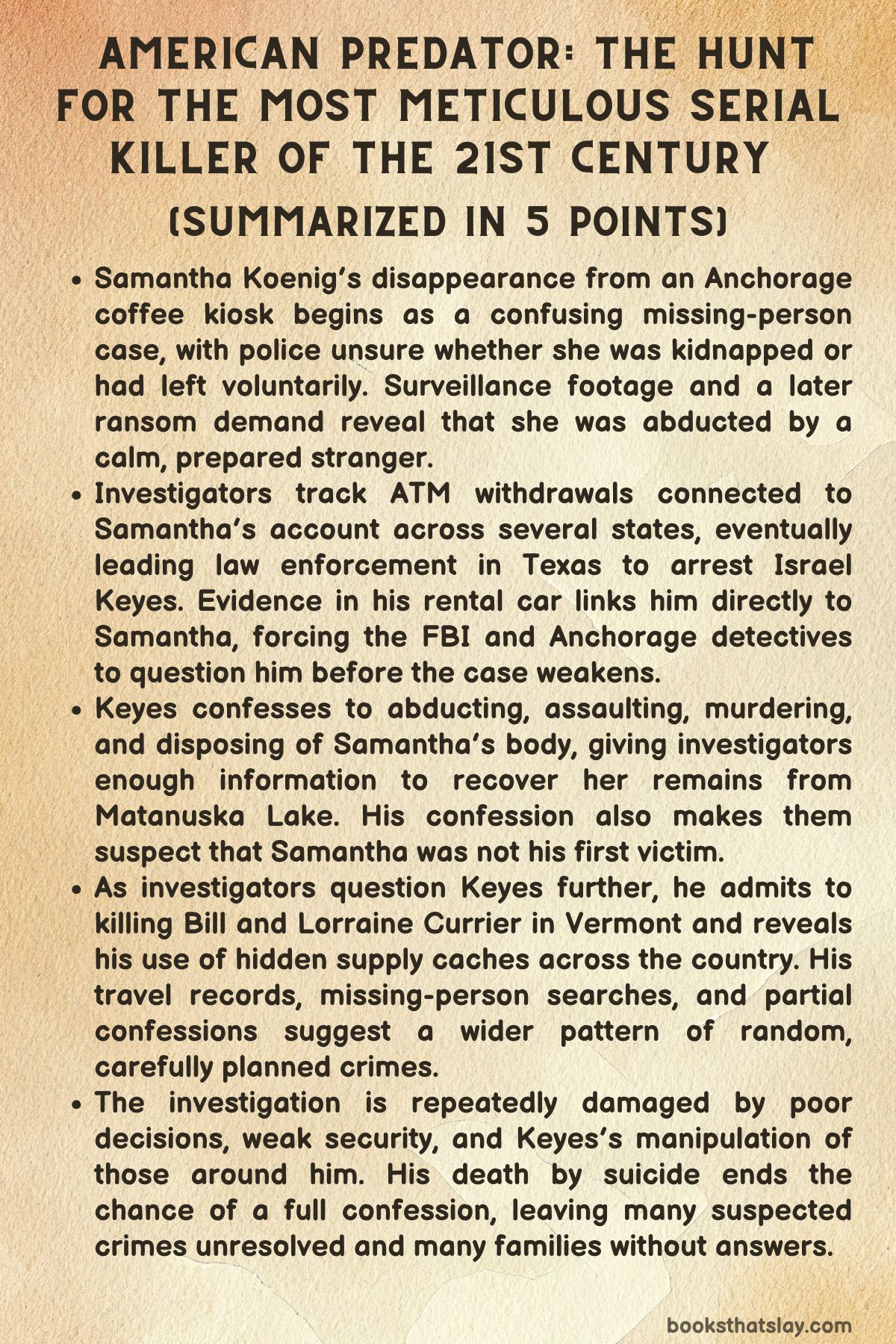
American Predator: The Hunt for the Most Meticulous Serial Killer of the 21st Century by Maureen Callahan is a true-crime account about Israel Keyes, one of the most unsettling serial killers investigated by the FBI. The book begins with the 2012 disappearance of 18-year-old Samantha Koenig in Anchorage, Alaska, then follows the investigation that exposed Keyes’s wider history of abduction, rape, murder, and hidden “kill kits” across the United States.
Callahan writes the case as both a criminal investigation and a warning about how random violence can evade familiar patterns. It is also a study of institutional failure, ego, and the difficult work of uncovering the truth after a killer chooses silence.
Summary
American Predator opens with the disappearance of Samantha Koenig, an 18-year-old barista working late at a coffee kiosk in Anchorage, Alaska. At first, her case confuses investigators.
There is no clear sign of a struggle, she does not press the panic button, and some officers wonder if she may have left voluntarily or staged the event. Her father, James Koenig, refuses to accept that idea.
He pushes the police, the media, and the public to treat Samantha’s disappearance as a kidnapping, handing out flyers and keeping her name visible across the city.
The investigation changes when surveillance footage shows the truth. A man calmly approaches Samantha at the kiosk, threatens her with a gun, forces her to empty the register, binds her, and takes her away.
Even then, police are unsure what they are looking at. The abductor seems so controlled that some assume Samantha must know him.
Suspicion falls on people close to her, including her boyfriend, Duane, and even her father, especially after a ransom demand appears.
The ransom note arrives with Polaroids of Samantha and instructions to deposit money into her account. This turns the case into a federal kidnapping investigation.
FBI Special Agent Steve Payne joins local detectives Monique Doll and Jeff Bell. Their plan is to use the ATM card connected to the ransom demand to track the person responsible.
When withdrawals begin in Anchorage and later in the American Southwest, investigators realize the kidnapper is traveling.
Law enforcement in Texas eventually stops a man driving a white Ford Focus. His name is Israel Keyes, and he is from Alaska.
Inside the car, officers find evidence linking him to Samantha’s case, including her driver’s license, her ATM card, clothing seen in surveillance footage, a gun, and other suspicious items. Keyes appears calm and controlled, but the evidence is enough to arrest him.
At first, Keyes gives a weak explanation, claiming he found the card and phone in a bag and thought they were payment for construction work. Investigators know the story is absurd, but they also know their case is still fragile.
Unless Keyes talks, they may only be able to charge him with financial crimes. The interrogation becomes the center of the book, as Payne, Doll, Bell, and prosecutor Kevin Feldis try to get Keyes to confess.
Keyes eventually admits that he abducted Samantha from the kiosk. He says he had not known her before and chose the place because it was open late and looked vulnerable.
He describes taking her to his truck, controlling her with threats, returning to the kiosk for her phone, and later going to her home to steal her ATM card and license. This confirms Duane’s earlier story about seeing a stranger in Samantha’s vehicle.
Keyes then reveals the full horror of what happened. He took Samantha to a shed at his home, where he had prepared a space to hold a victim.
His girlfriend and daughter were nearby in the house, unaware of what was happening. He raped and murdered Samantha before leaving on a planned trip with his daughter.
Later, after returning, he staged the ransom photos by making Samantha’s body appear alive, wrote the ransom note, and disposed of her remains in Matanuska Lake. Investigators recover her body only because Keyes gives them the location.
Once Samantha’s case is confirmed, the investigators realize Keyes is not an ordinary offender. His confidence, planning, and emotional distance suggest he has killed before.
They begin searching his background, travel history, computers, and financial records. What they find is disturbing: Keyes traveled widely, left little digital trace, and had buried murder supplies in hidden caches around the country.
These caches contained guns, ammunition, zip ties, duct tape, and other tools. His method allowed him to arrive in one place, retrieve supplies, attack strangers, and leave without obvious connection to the crime.
Keyes admits to murdering Bill and Lorraine Currier in Vermont. He explains that he flew across the country, retrieved one of his hidden caches, selected the Curriers’ house, broke in, abducted them, and took them to an abandoned farmhouse.
He killed Bill after Bill resisted, then raped and murdered Lorraine. He left their bodies in the building, expecting demolition or decay to hide the evidence.
Investigators are horrified not only by the crime but by how carefully Keyes had arranged his movements to avoid detection.
The book then follows the FBI’s attempt to connect Keyes to other missing-person cases. The task is almost impossible.
Keyes has no consistent victim type, no fixed location, and no clear pattern beyond opportunity, control, and sexual sadism. He may have targeted couples, women, hikers, sex workers, and people in remote places.
He may also have committed bank robberies, arsons, and assaults that were never connected to him.
Callahan gives attention to Keyes’s childhood and background. He grew up in an isolated, extremist, survivalist environment, moving through rural areas with a large family that avoided government systems, schools, and modern medicine.
He was exposed to guns, racist ideology, and anti-government beliefs. As a boy, he showed cruelty toward animals and became skilled at moving through wilderness unseen.
He later joined the Army, where others saw his strength, discipline, and practical abilities, but some also noticed violence, cruelty, and disturbing behavior.
Keyes’s adult life appears normal on the surface. He runs a construction business, has a girlfriend, raises a daughter, and earns praise from clients.
Many people describe him as polite, reliable, and capable. This ordinary public image makes him more frightening.
He is not hiding in plain sight because he seems strange; he is hiding because he seems useful, calm, and forgettable.
A major thread in American Predator is the failure of institutions. The investigation is repeatedly damaged by ego, poor judgment, and weak security.
Prosecutor Kevin Feldis insists on leading interrogations despite lacking the skill and position to do so safely. He reveals information to Keyes that gives the killer more power and makes him less willing to talk.
Local systems also underestimate Keyes. In court, he nearly escapes after using materials such as pencil pieces and cellophane to defeat restraints.
In prison, warnings about his suicide risk are ignored.
As the investigation continues, Keyes offers hints about other crimes but withholds enough to keep control. He wants the death penalty, partly because he claims he wants to spare his daughter prolonged media attention.
He also enjoys the power of knowing what investigators do not. He gives fragments about Washington, New York, Texas, and other places, while the FBI tries to match his travels to disappearances and unsolved murders.
Before investigators can get the full truth, Keyes dies by suicide in his cell in December 2012. He leaves behind a disturbing scene, a blood-soaked note, and cryptic clues, including skull drawings and the word “Belize.” His death ends the chance of full confession.
Some investigators believe he killed 11 people; others suspect the number is much higher.
The book closes with uncertainty. Keyes’s crimes remain partly unsolved because his system was built around randomness, distance, and preparation.
He chose strangers, traveled across states, buried supplies in advance, and erased evidence carefully. Callahan presents him as a new kind of serial killer: one whose danger came not from a visible pattern, but from the lack of one.
American Predator is therefore not only the story of Samantha Koenig’s murder and the search for justice, but also the story of how easily a disciplined predator can exploit gaps in law enforcement, geography, and public expectation.
Key People
Israel Keyes
Israel Keyes is the central criminal figure in American Predator, and he is presented as a man whose outward normalcy makes his violence more disturbing. He is a contractor, a father, a boyfriend, and a man who can appear polite, practical, and ordinary to clients and acquaintances.
This public image hides a private life built around control, secrecy, sexual violence, and murder. Keyes is not shown as impulsive in the usual sense; he prepares, travels, buries supplies, studies criminal behavior, and chooses victims with little personal connection.
His lack of a fixed victim type makes him difficult to detect and even harder to understand. He treats murder as a private system, almost like a craft, and his intelligence is directed toward avoiding patterns that police are trained to recognize.
His cruelty is matched by his need for power. Even after capture, he tries to control investigators through selective confession, silence, demands, and manipulation.
His death by suicide becomes his final act of control, leaving investigators with fragments instead of answers.
Samantha Koenig
Samantha Koenig is the victim whose abduction exposes Keyes’s crimes to investigators. She is young, social, loved by her father and boyfriend, and working an ordinary late shift when she is taken.
Her role in the narrative is not limited to being a victim; her disappearance becomes the force that pushes law enforcement into uncovering a far larger threat. Samantha’s behavior during the abduction shows fear, but also a desperate instinct for survival.
She obeys Keyes when he threatens her, tries to escape when she has a chance, and later attempts to reason with him. Her death is described as a devastating personal loss and as the case that finally breaks through Keyes’s carefully built secrecy.
Through Samantha, the book also shows how quickly suspicion can fall on those closest to a missing person, especially when investigators do not yet understand the kind of criminal they are facing.
James Koenig
James Koenig, Samantha’s father, is defined by grief, urgency, and fierce devotion. From the beginning, he refuses to accept the idea that Samantha left voluntarily.
While investigators hesitate, James pushes the public and the police to recognize that his daughter has been kidnapped. His methods are emotional and public: he distributes flyers, speaks to reporters, organizes community attention, and keeps Samantha’s name visible.
At the same time, he becomes a suspect because of his past, his marijuana operation, his handling of the reward fund, and his reluctance to cooperate fully with police at certain moments. This makes him a complicated figure.
He is not portrayed as flawless, but his love for Samantha is unmistakable. His insistence that she would never vanish without contacting him proves correct.
Later, his desire to know the full truth about her death shows a painful form of parental duty: he believes that bearing the horror is part of honoring her.
Duane
Duane, Samantha’s boyfriend, is first presented as another person close to her whose behavior draws suspicion. His relationship with Samantha includes conflict, and his story about seeing a stranger near her vehicle sounds strange to investigators at first.
Because early investigators do not yet understand Keyes’s movements, Duane’s account seems unreliable, and this places him under a cloud of doubt. Later, Keyes’s confession confirms that Duane really did see him near Samantha’s truck, which changes how Duane’s role is understood.
He is not central in the later investigation, but his experience shows how the people closest to a victim can become trapped between grief, suspicion, and public judgment. He also helps move the case forward by receiving the message from Samantha’s phone that leads to the ransom note and photographs.
Monique Doll
Detective Monique Doll is one of the key investigators in Samantha’s case. She begins the case during her first day in Anchorage’s homicide division, which places her immediately under enormous pressure.
Doll is sharp, experienced, and skeptical. At first, she considers possibilities involving Samantha’s father and boyfriend, showing her commitment to following evidence rather than emotion.
Her most important role emerges during Keyes’s interrogation. Keyes responds to her differently than he does to others, especially Kevin Feldis.
Doll understands how to use humility, patience, and controlled attention to make him talk. She does not challenge him with ego; instead, she lets him feel observed and important while guiding him toward confession.
Her skill contrasts strongly with Feldis’s clumsy approach. Doll becomes one of the few people able to draw information from Keyes without immediately triggering his need to dominate the room.
Steve Payne
FBI Special Agent Steve Payne is one of the strongest investigative minds in the narrative. He is cautious, strategic, and deeply aware of what is at stake.
From early in the case, he questions the idea that Samantha left on her own, recognizing details that do not fit that theory. As the case develops, Payne becomes the figure most focused on understanding Keyes as a criminal system rather than just solving one murder.
He sees the importance of keeping Keyes talking, controlling what information is revealed, and building enough evidence to prevent him from walking free. Payne’s frustration often comes from institutional interference, especially when Feldis weakens the interrogation strategy.
He also carries the emotional burden of speaking with Samantha’s father and later trying to uncover unknown victims. Payne is portrayed as intelligent and committed, but also limited by bureaucracy, ego, and failures outside his control.
Jeff Bell
Jeff Bell is a practical, disciplined investigator whose background as a US Marshal and SWAT member shapes his thinking. He is described as logical and clinical, but he is also capable of recognizing danger in ways others miss.
Like other investigators, he is initially uncertain about Samantha’s disappearance, but once Keyes is identified, Bell becomes one of the people most alert to his intelligence and physical risk. Bell understands that Keyes is not merely a prisoner who has been caught; he is a highly capable predator who may still try to escape, manipulate, or harm others.
His warnings about prison and courtroom security prove justified when Keyes nearly escapes. Bell’s role is especially important because he sees both the psychological and practical threat Keyes represents.
He is not only trying to solve crimes; he is trying to prevent further damage from a man who remains dangerous even in custody.
Kevin Feldis
Kevin Feldis, the federal prosecutor, is one of the most controversial figures in the investigation. He wants control over the case and seems to view it partly as a career-making opportunity.
His legal authority gives him influence, but his behavior in interrogation damages the careful strategy that Payne and others are trying to maintain. Feldis lacks the skill needed to question a suspect like Keyes, and his need to appear powerful often has the opposite effect.
He reveals information that should have been withheld, shows uncertainty, and allows Keyes to sense weakness and conflict among the people questioning him. His presence shows how ego can harm justice.
Feldis is not portrayed as evil, but as dangerously self-important. In a case where patience, restraint, and teamwork are essential, his desire to lead becomes one of the investigation’s biggest obstacles.
Kimberly Anderson
Kimberly Anderson is Keyes’s girlfriend, and her character shows how successfully Keyes separated his public life from his criminal life. She lives with him in Anchorage and sees him as a partner and father figure, not as a murderer.
When police question her, she strongly denies that he could have kidnapped anyone. Her disbelief is important because it shows how convincing Keyes’s ordinary life appeared to those closest to him.
She provides a partial alibi without understanding that Keyes had built his crimes around travel, timing, and concealment. Investigators eventually conclude that she was not involved.
Kimberly’s role is tragic in a quieter way: she represents the intimate blindness that can exist when a person’s daily behavior is carefully managed. Keyes’s ability to live beside her while hiding Samantha nearby reveals the depth of his compartmentalization.
Heidi Keyes
Heidi Keyes, Israel Keyes’s mother, gives insight into the unusual and extreme environment in which he was raised. She is religious, isolated, and connected to fringe Christian communities.
Her family life involves distrust of government, rejection of conventional systems, and movement through remote places. Heidi’s reaction to her son’s arrest is striking because she seems emotionally distant from the horror of Samantha’s disappearance.
When approached for help, she frames the matter through religious belief rather than urgency or moral responsibility. Her memories of Keyes’s strange behavior after Samantha’s murder provide important clues, but her failure to question him at the time reflects the family’s unusual norms.
Heidi is not presented as the cause of Keyes’s crimes, but her character helps explain the isolation, extremism, and lack of outside accountability that shaped his early years.
Tammie
Tammie is Keyes’s former partner and the mother of his daughter. Her relationship with him reveals another side of his personality: controlling, disciplined, judgmental, and emotionally dark.
At first, she connects with him through shared experiences of deprivation and hardship. He takes on domestic responsibilities and later becomes deeply devoted to their daughter, especially after Tammie’s medical trauma and addiction.
Yet Tammie also begins to see that Keyes’s helpfulness is tied to control. He dominates conversations, belittles people, drinks heavily, and speaks of having a “black heart.” Her role is important because she knew him before his Anchorage life and saw signs of darkness without knowing their full meaning.
Through Tammie, the narrative shows how disturbing traits can appear in domestic life but still fall short of revealing the full truth.
Keyes’s Daughter
Keyes’s daughter is mostly kept at a distance from the narrative, which reflects the investigators’ and Keyes’s stated concern about protecting her from publicity. Her presence, however, is deeply significant.
Keyes seems genuinely devoted to her, and this devotion sits beside his extreme violence in a way that is difficult to reconcile. He plans crimes around family trips, wakes her for travel after murdering Samantha, and later claims that he wants a quick death partly to spare her from ongoing public exposure.
This does not redeem him; instead, it makes his compartmentalization more disturbing. His daughter represents the ordinary life he wanted to preserve while committing acts that destroyed other families.
She is also a reminder that the consequences of his crimes extend beyond victims and investigators to the people who must live with his name.
Bill and Lorraine Currier
Bill and Lorraine Currier are a married couple whose murders reveal the wider scale of Keyes’s crimes. They are not connected to Keyes personally, which is exactly what makes their case so frightening.
Their home is chosen because it fits his needs, not because they have wronged him or drawn his attention in any meaningful personal way. Bill’s resistance disrupts Keyes’s plan, showing that Keyes’s control can be shaken when victims fight back.
Lorraine’s suffering then becomes part of Keyes’s attempt to regain that control. The Curriers’ case is also important because it proves that Samantha was not an isolated victim.
Their murders expose Keyes’s use of travel, hidden supplies, abandoned buildings, and careful disposal methods. They become central to the FBI’s effort to understand his past crimes, even though physical evidence is difficult to recover.
James Tidwell
James Tidwell is one of the possible victims connected to Keyes through travel patterns, timing, and suspicious details. His disappearance in Texas occurs during a gap in Keyes’s account of his movements.
Tidwell is described as reliable and steady, which makes his sudden disappearance especially alarming. His abandoned truck, missing presence, and the possible connection between his appearance and a bank robbery create a strong but incomplete line of suspicion.
Tidwell’s role in the narrative shows the difficulty investigators face after Keyes’s death. There are clues, patterns, and unsettling overlaps, but not always enough proof to give families certainty.
He represents the unresolved human cost of Keyes’s secrecy.
Debra Feldman
Debra Feldman is identified by investigators as Keyes’s New York victim. Her background as a drug addict and sex worker matters because the narrative stresses how offenders like Keyes may target people they believe law enforcement will not prioritize.
Her case exposes a harsh social reality: some victims are easier for predators to erase because society has already treated them as less visible. Debra’s role is not developed as fully as Samantha’s or the Curriers’, but her presence is important because it expands the moral scope of the investigation.
Justice cannot depend on a victim’s social status, stability, or public sympathy. Her disappearance becomes part of the effort to reconstruct Keyes’s hidden movements and restore identity to those he tried to reduce to secrets.
Mary Cooper and Susanna Stodden
Mary Cooper and Susanna Stodden are discussed as possible victims in connection with the Pinnacle Lake murders. Their deaths are frightening because of their randomness, the public setting, and the lack of clear motive.
Investigators see similarities between the crime and Keyes’s known habits: comfort in wilderness, use of a .22, targeting pairs, and the possibility of degrading body placement. Their case shows how difficult it is to prove responsibility when a killer avoids patterns and leaves little trace.
Whether or not Keyes killed them, their inclusion reflects the wider fear created by his methods. They stand for the many unresolved cases that investigators must revisit once they realize Keyes may have moved through the country killing strangers.
Julie Harris and Cassie Emerson
Julie Harris and Cassie Emerson are young girls whose disappearances near Keyes’s childhood environment raise disturbing questions. The book does not present their cases as confirmed Keyes crimes, but the timing, location, and later halt in similar disappearances make investigators consider the possibility.
Their cases are important because they suggest that Keyes’s predatory behavior may have begun earlier than he admitted. They also create tension around his claim that he did not target children.
Keyes often presents himself in ways that make him seem governed by certain limits, but the investigators cannot trust his self-description. Julie and Cassie represent the uncertainty surrounding the beginning of his violence and the possibility that his known crimes are only part of the truth.
Jane Doe
Jane Doe, the surviving victim connected to the Boca Raton pattern, is one of the most important examples of resistance and survival in the wider investigation. Her account includes elements that resemble Keyes’s known behavior: the use of a gun, zip ties, ATM withdrawals, a vehicle-based abduction, false instructions about describing the attacker, and blacked-out goggles.
She survives partly because she stays calm, talks to her attacker, and refuses to behave in the way he expects. Her testimony is initially doubted because the crime sounds too strange, which reveals another failure in how institutions respond to victims.
Jane Doe’s role shows that survivors may carry knowledge that seems unbelievable until later crimes prove its value. Her experience also suggests that Keyes may have let some victims live when they disrupted his expectations.
Randi Gorenberg
Randi Gorenberg is one of the Boca Raton victims whose murder leads police to take Jane Doe’s earlier report more seriously. Her death appears random, with valuables left behind and no obvious personal motive.
This randomness is exactly what makes her case relevant to Keyes’s possible pattern. She represents victims whose cases are difficult to solve because investigators often search first for personal enemies, financial motives, or domestic explanations.
When none appear, the crime becomes harder to classify. Randi’s case helps show how a predator who chooses strangers can move through ordinary public spaces, especially parking lots and shopping areas, and create terror without leaving a clear personal link.
Nancy and Joey Bochicchio
Nancy and Joey Bochicchio are a mother and daughter killed in a case that shares disturbing similarities with the earlier Boca Raton attacks. Their deaths expand the suspected pattern and show the killer’s willingness to attack even when a child is present.
The use of restraints and blacked-out goggles links the case to a method of control that resembles Keyes’s known thinking. Their role in the analysis is painful because they show how quickly an ordinary errand can become a fatal encounter when a predator is operating without a personal motive.
Like other possible victims, their story remains marked by uncertainty, but their case deepens the sense that Keyes’s reach may have extended far beyond the crimes he confessed.
Steve Rayburn
Texas Ranger Steve Rayburn plays a crucial role in the capture of Keyes. He receives information from the FBI about the suspect’s movements and helps coordinate the search in Texas.
His challenge is practical and difficult: law enforcement is looking for a white Ford Focus, an extremely common rental car. The eventual stop of Keyes depends on careful attention, coordination, and a willingness to act on a narrow window of opportunity.
Rayburn’s role shows how a major case can turn on local officers taking a federal warning seriously. Without the Texas stop, Keyes might have continued traveling, destroying evidence, and possibly killing again.
Payne’s Investigative Team
The broader FBI and law enforcement team functions almost like a collective character. The team copies hard drives, searches travel records, studies missing-person cases, follows financial trails, checks buried caches, and tries to verify Keyes’s partial confessions.
Their work is exhausting because Keyes’s method defeats normal investigative shortcuts. They cannot simply look for a victim type, a home territory, or a clear timeline.
Their role shows the limits of even determined police work when a killer has built his crimes around randomness. The team also represents moral persistence.
Even when Keyes dies and many answers become unreachable, their work continues through records, comparisons, and attempts to give unidentified victims some measure of justice.
Themes
Randomness as a Form of Terror
Keyes’s crimes are terrifying because they often lack the patterns that investigators and the public expect. Many serial killers are associated with a type of victim, a familiar location, or a recognizable ritual.
Keyes tries to avoid all of that. He travels across states, hides supplies in advance, removes himself from the places where he commits crimes, and chooses victims who have little or no connection to him.
This randomness makes his violence feel larger than one case. Anyone in the wrong place at the wrong time could become a target.
In American Predator, randomness is not the absence of planning; it is part of the planning. Keyes understands that police often begin by looking for personal motives, local suspects, and repeated patterns.
By refusing those patterns, he creates delay and confusion. The theme also changes how safety is understood.
Ordinary places such as coffee kiosks, homes, parking lots, hiking trails, and rural roads become vulnerable spaces. The fear comes from knowing that Keyes’s victims did not necessarily do anything to attract him.
They simply crossed the path of someone who had prepared to disappear after the crime.
Control, Power, and Manipulation
Control shapes nearly every part of Keyes’s behavior. Before his arrest, he controls victims through weapons, restraints, threats, isolation, and fear.
He also controls the setting of his crimes by preparing sheds, abandoned buildings, vehicles, hidden caches, and escape routes. After his arrest, that same need for control moves into the interrogation room.
Keyes decides what to reveal, what to hide, when to cooperate, and when to punish investigators with silence. His confessions are never simple acts of honesty.
They are transactions, performances, and attempts to keep power. He wants to control the media, his family’s exposure, the timeline of his death, and the investigators’ access to truth.
Even his suicide functions as a final refusal to let others finish the story on their terms. This theme is important because it shows that Keyes’s violence is not only physical.
It is psychological and procedural. He wants victims, investigators, families, and institutions to feel his dominance.
Every partial answer he gives creates more questions. Every withheld detail extends his power beyond the prison cell.
Institutional Failure and Human Ego
The investigation is shaped not only by Keyes’s intelligence but by the weaknesses of the systems trying to contain him. Law enforcement initially misreads Samantha’s disappearance, considering theories that delay a full public response.
Later, once Keyes is in custody, the case is damaged by professional ego, poor coordination, and weak security. Kevin Feldis becomes the clearest example of how ambition can interfere with justice.
His insistence on leading interrogations, despite not being suited to the task, gives Keyes openings to regain confidence and withhold information. Prison and courtroom failures are just as serious.
Keyes nearly escapes after being underestimated, and later dies by suicide despite warning signs and security concerns. These failures do not erase the work of skilled investigators such as Payne, Doll, and Bell, but they reveal how fragile a major investigation can be when institutions fail to listen to expertise.
The theme is not simply that mistakes happen. It is that ego, complacency, and bureaucracy can protect a dangerous person’s secrets even after he has been captured.
The Hidden Life Behind Ordinary Appearances
Keyes’s public life is one of the most disturbing parts of the narrative because it looks so normal. He has a business, customers, a girlfriend, a daughter, family ties, and daily routines.
People describe him as reliable, polite, capable, and good with his child. This ordinary surface allows him to move through communities without attracting lasting suspicion.
The contrast between his public identity and private violence raises difficult questions about how well people can truly know those around them. Kimberly does not believe he could be guilty.
Clients admire him. Family members explain away strange behavior.
Even investigators initially find little in official records because Keyes has no obvious criminal history. This theme shows how evil does not always announce itself through visible disorder.
In Keyes’s case, his competence helps him hide. His construction skills, wilderness knowledge, military training, and calm demeanor all become tools.
The ordinary life is not separate from the criminal life; it helps support it. That is what makes his character so unsettling: he does not live outside society, but inside it, using its assumptions as cover.