American Pastoral Summary, Characters and Themes
American Pastoral is Philip Roth’s novel about Seymour “the Swede” Levov, a Newark-born Jewish athlete whose life appears to embody the American dream: success, beauty, order, prosperity, and acceptance. Seen through the imagination of narrator Nathan Zuckerman, the Swede becomes a symbol of postwar optimism and assimilation.
Yet the novel steadily exposes the pain beneath that polished surface. His daughter Merry’s violent political act during the Vietnam era destroys the family’s peace and forces the Swede to confront guilt, social unrest, betrayal, and the limits of parental love. The book is a tragedy about how private life can be broken by history.
Summary
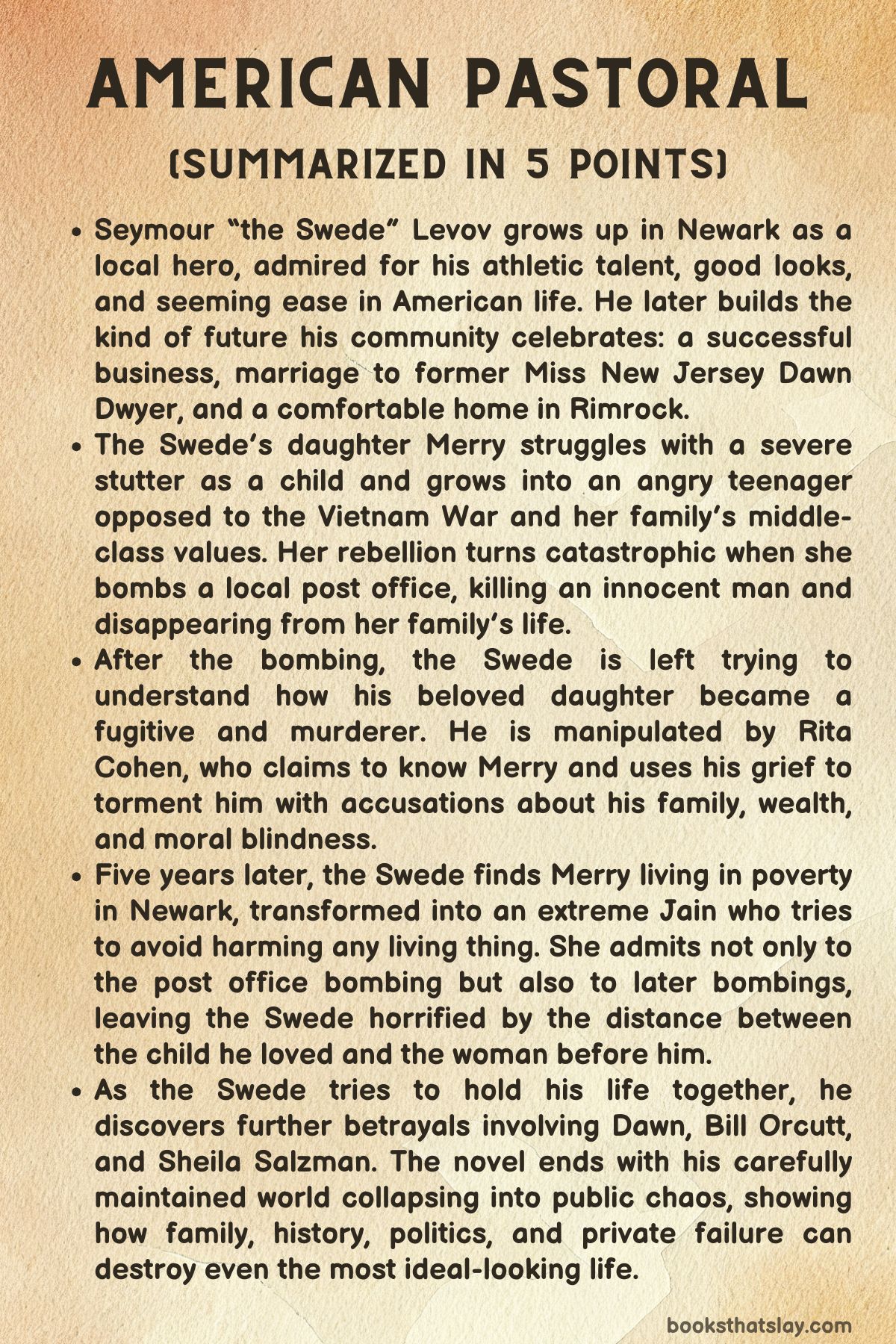
American Pastoral begins with Nathan Zuckerman remembering Seymour Levov, known throughout Newark as “the Swede.” In Zuckerman’s youth, the Swede is almost mythical: tall, handsome, gifted at sports, admired by Jewish boys who see in him a model of confidence and American success. He seems to have escaped every burden attached to immigrant struggle and ethnic limitation.
His family has risen through hard work in the glove business, moving from the labor of the tannery to ownership, money, and social standing.
The Swede’s life appears to confirm every postwar promise. He serves in the Marines, though the war ends before he sees combat.
He goes to college, becomes a baseball star, turns away from professional athletics, and joins the family business. He marries Dawn Dwyer, a former Miss New Jersey, whose Catholic background and beauty seem to mark the Swede’s full entrance into mainstream American life.
To Zuckerman, the Swede has achieved what everyone around him once wanted: respectability, prosperity, a beautiful wife, a strong business, and a home beyond the old Newark neighborhood.
Years later, Zuckerman meets the Swede again and finds him strangely plain in conversation. The Swede talks about family, business, illness, and the decline of Newark, giving little sign of inner conflict.
Zuckerman initially thinks there may be nothing beneath the surface. Soon afterward, however, at a school reunion, he speaks with the Swede’s younger brother Jerry and learns the truth: the Swede has died of cancer, and his life was shattered long before by his daughter Merry, who bombed a post office during the Vietnam War.
An innocent man was killed. This single act destroyed the Swede’s faith in his family, his country, and the order he had believed governed his life.
Zuckerman then imagines the Swede’s story from the inside, beginning with Merry’s childhood. As a young girl, Merry suffers from a severe stutter.
The Swede loves her deeply and tries to help without making her feel defective, but Dawn is more openly frustrated and embarrassed. At one point, the Swede accidentally mocks Merry’s speech and then kisses her in a way that later haunts him.
In his search for the origin of disaster, he wonders whether this confusing moment caused some damage he never understood. Merry’s stutter persists despite therapy, and as she grows older, her anger hardens.
By adolescence, she is overweight, furious, and consumed by hatred of the Vietnam War, President Johnson, capitalism, and her parents’ comfortable life.
The Swede tries to respond with patience. He believes that parents must keep talking, keep listening, and stay firm without crushing their child.
Merry begins spending time with activists in New York, which frightens him. Hoping to keep her closer to home, he suggests that she organize protests in Rimrock, their quiet New Jersey town.
Instead, Merry bombs the local post office and disappears.
After the bombing, the Swede is left in shock. He cannot reconcile the child he loved with the fugitive who has killed a man.
Dawn collapses emotionally and eventually suffers suicidal depression. The Swede keeps functioning, but his life becomes a performance of endurance.
He still runs the glove factory, still tries to appear decent and steady, yet privately he is consumed by Merry’s absence.
A young woman named Rita Cohen visits him, pretending to be a student researching the leather industry. The Swede gives her a factory tour, remembering the pleasure he once took in explaining work, craft, and honest production.
Rita then reveals that she knows Merry and demands Merry’s Audrey Hepburn scrapbook. The Swede obeys, hoping any contact might lead him to his daughter.
Rita later demands more items and then money, while taunting him with accusations: that he exploits workers, that Dawn hated Merry, that Merry could never live up to the image of the beauty queen and the sports hero. The Swede meets Rita at a hotel with money, but she tries to humiliate and sexually manipulate him.
He flees, and when he finally turns to the FBI, Rita has vanished.
Years pass. The Swede watches reports of radical bombings across America and fears Merry may be involved, though part of him insists she must be innocent.
He searches his memories for an explanation. He remembers Merry as a child, deeply disturbed by televised images of Buddhist monks burning themselves in protest.
He recalls finding radical literature in her room. He debates imaginary political arguments in his mind, defending his business and his treatment of workers against the charge that he is merely a capitalist oppressor.
He keeps the Newark factory open partly as proof, perhaps to Merry, that he has not abandoned the city or the people who depend on him.
Five years after Merry disappears, Rita sends a letter saying Merry is in Newark under the name Mary Stoltz, working at an animal hospital. Dawn, meanwhile, has been trying to rebuild herself.
She regrets her beauty-pageant past, undergoes plastic surgery in Geneva, gives up cattle raising, and decides she wants a new house because the old one holds too much pain. The Swede agrees, even though the house once represented his ideal life.
He continues to give way to other people’s needs, as if self-denial can preserve what remains.
The Swede goes to Newark and finds Merry. She is transformed.
She now follows Jainism, covering her face, refusing to bathe, eating little, and trying to avoid harming even the smallest forms of life. She lives in a filthy, freezing room in a decaying building.
Her stutter is gone, but she is physically ruined and spiritually fixed in a severe form of self-punishment. She admits that she bombed the post office alone.
She also tells him she later planted more bombs, killing more people. During her years underground, she lived with radicals, stayed in communes, was raped in Chicago, and eventually abandoned political revolution for extreme religious nonviolence.
The Swede is horrified. He cannot accept that his privileged daughter became a murderer without coercion, guilt, or madness.
He begs her to come home, but she refuses. In anger and desperation, he tears away her veil and tries to force the truth from her.
The smell of her body makes him vomit. His fantasy of rescuing her collapses.
That night, he calls Jerry, who tells him to bring Merry home by force. Jerry attacks the Swede’s lifelong gentleness, calling it weakness and accusing him of hiding behind a perfect image.
The Swede breaks down, but he cannot accept Jerry’s brutal solution.
The novel then turns to the Swede’s wider household and social world. His parents visit, unaware of the full truth about Merry.
His father Lou is blunt, proud, opinionated, and bitter about the decline of Newark and the glove industry. The Swede also hosts friends and neighbors, including Bill Orcutt, the architect designing Dawn’s new house, and Orcutt’s wife Jessie.
Orcutt represents an older American lineage that the Swede both admires and feels excluded from. Though the Swede has wealth and success, he still senses the barrier between his immigrant Jewish background and Orcutt’s inherited Protestant confidence.
During the dinner gathering, the Swede discovers that Dawn and Orcutt appear to be having an affair. This revelation joins the other betrayals already weighing on him.
He also knows that Sheila Salzman, Merry’s former speech therapist, hid Merry after the bombing and never told him. Sheila and the Swede had once been lovers during the months after Merry vanished.
Now he sees Sheila’s silence as unforgivable, especially because Merry later killed more people. His rage spreads toward everyone: Dawn, Orcutt, Sheila, Rita, Jerry, Merry, and himself.
As the dinner continues, the guests discuss politics, morality, Newark, pornography, religion, and social decline, while the Swede silently unravels. He remembers how Lou once challenged Dawn before the marriage over Catholicism, Jewish identity, and the religious future of their children.
Dawn had stood her ground then, and the Swede recalls the strength that first drew him to her. Yet in the present she seems able to perform cheerfulness while hiding her affair and her wish to escape their old life.
Rita calls again, still taunting him. This time, the Swede begins to doubt that she ever truly had power over Merry.
But the damage she caused remains. Sheila checks on him, and he confronts her for sheltering Merry.
Sheila argues that she could not betray Merry’s trust and implies that perhaps Merry had reason to fear him. The Swede tells her Merry killed more people and that Sheila might have prevented it.
His anger drives her away.
By the end, the Swede imagines catastrophe everywhere. He fears Jerry has called the FBI and that Merry will be arrested because of him.
He imagines violence against Orcutt. He imagines Merry returning and destroying what remains of the family.
Then, in the dining room, Jessie Orcutt drunkenly stabs Lou in the face with a fork, nearly blinding him. The scene turns the Levovs’ polished social world into chaos.
Zuckerman closes by asking whether such suffering can be deserved, leaving the Swede’s story as a vision of a man who wanted a peaceful American life and instead found that no amount of goodness, patience, or success could protect him from history, violence, and human disorder.
Characters
Seymour “the Swede” Levov
Seymour Levov, known as the Swede, stands at the center of American Pastoral as a man who seems to have been designed by his community’s hopes. In youth, he is admired for his athletic skill, physical beauty, discipline, and modesty.
To the Jewish boys of Newark, he represents escape from social limitation: he is proof that one can be Jewish, successful, admired, and fully accepted into American life. Yet his tragedy lies in the gap between appearance and reality.
The Swede believes in decency, patience, hard work, family duty, and self-control, but these values leave him unprepared for Merry’s violence. He keeps trying to understand catastrophe through ordinary parental guilt, asking whether some mistake of his caused everything.
His goodness becomes a burden because he cannot act cruelly, even when cruelty might seem practical. He wants to rescue Merry, protect Dawn, honor his parents, preserve his business, and maintain dignity, but every part of his life resists his control.
By the end, he is no longer the shining hero of Newark but a broken man forced to face disorder, betrayal, and the possibility that virtue does not guarantee safety.
Nathan Zuckerman
Nathan Zuckerman is the narrator and imaginative force behind the Swede’s story. He begins with childhood admiration, remembering the Swede as an almost unreal figure of grace and success.
As an adult, when he meets the aging Swede, he initially mistakes his plainness for emptiness. This error becomes central to Zuckerman’s role: he learns that people cannot be understood by surfaces, reputations, or even intimate memory.
After hearing from Jerry about Merry’s crime and the Swede’s suffering, Zuckerman reconstructs the family tragedy through research, memory, speculation, and sympathy. He is not simply reporting events; he is trying to imagine the hidden life of a man he once idolized.
His perspective gives the novel its moral uncertainty. Zuckerman knows that any account of another person may be incomplete or wrong, yet he also understands that imagination is the only way to approach lives that remain partly inaccessible.
Through him, the Swede becomes not just a fallen hero but a figure through whom questions of family, history, guilt, and American identity are examined.
Merry Levov
Merry Levov is the most disruptive figure in the story, not because she appears often, but because her actions reorder every life around her. As a child, she is intelligent, sensitive, and afflicted by a severe stutter that shapes her relationship with her parents and with herself.
Her speech difficulty becomes more than a physical or psychological condition; it becomes a sign of frustration, humiliation, and inner resistance. As she grows older, that resistance turns political.
She rejects her parents’ comfort, their social aspirations, their patriotism, and their belief in ordinary American success. Her bombing of the post office is both a political act and a family rupture.
To the Swede, Merry remains his child, yet she is also a murderer, a fugitive, and later an ascetic who embraces extreme nonviolence after having committed violence. Her transformation into a Jain is deeply disturbing because it suggests not peace but punishment.
Merry moves from rage against the world to rage against the self. She is never easily explained; she is a daughter, rebel, criminal, victim, and penitent, and the novel refuses to reduce her to one cause or one meaning.
Dawn Dwyer Levov
Dawn Dwyer Levov is often seen through the Swede’s longing for an ideal domestic life, but she is far more complicated than the role he assigns her. As a former Miss New Jersey, she embodies beauty, social achievement, and the Swede’s dream of entering a wider American world beyond Newark.
Yet Dawn’s pageant past becomes a source of resentment and regret. She feels trapped by the image others have of her, especially the idea that she is merely decorative.
Merry’s crime destroys Dawn’s emotional stability, leading to depression, suicidal despair, and later an effort to remake herself physically and socially. Her plastic surgery and desire for a new house are not shallow acts alone; they are attempts to escape a life contaminated by grief.
At the same time, her affair with Bill Orcutt shows how far she has moved from the marriage the Swede is trying to preserve. Dawn is both wounded and evasive.
She suffers terribly, but she also participates in the denial and performance that define the family’s collapse.
Jerry Levov
Jerry Levov, the Swede’s younger brother, acts as a harsh counterforce to the Swede’s restraint. Where the Swede is patient, composed, and self-sacrificing, Jerry is direct, angry, and often cruel in his clarity.
He loves his brother, but his love expresses itself through judgment. Jerry believes the Swede’s lifelong nobility has made him passive and false, a man too committed to being good to confront reality with force.
His reaction to Merry is unforgiving; he sees her as the destroyer of his brother’s life and cannot accept the Swede’s continued attachment to her. Jerry’s accusations cut deeply because they expose a possible weakness in the Swede’s ideal self-image.
He suggests that Merry may be rebelling not only against society but against the Swede’s polished emotional distance. Jerry is not presented as morally superior, but he voices truths others avoid.
His brutality reveals the cost of honesty when it lacks mercy.
Lou Levov
Lou Levov, the Swede’s father, represents immigrant ambition, discipline, and old-world toughness transformed into American business success. He builds the family glove company through labor, knowledge, and fierce standards.
Lou believes in work, loyalty, family pride, and direct speech. He is deeply attached to Newark and bitter over its decline, seeing social change as a collapse of order, craftsmanship, and common decency.
His expectations shape the Swede’s sense of duty, but Lou’s forceful personality also creates pressure around identity, religion, and family control. His pre-marriage questioning of Dawn shows his fear that Jewish identity will be weakened or insulted within his son’s marriage.
Yet Lou is not merely narrow or prejudiced; he is a father trying to protect a family history built through struggle. His inability to understand Merry’s radicalism reflects a generational divide.
To him, the life his family achieved should inspire gratitude, not rebellion. His injury at the dinner table becomes a physical sign of the family’s wider collapse.
Rita Cohen
Rita Cohen is one of the most unsettling characters because her power lies in manipulation. She enters the Swede’s life under false pretenses and quickly becomes a tormentor who exploits his grief.
By claiming contact with Merry, she gains emotional control over him. She attacks his class position, his business, his marriage, and his image of himself as a good father.
Her accusations are politically charged, but her methods are personal and sadistic. She understands that the Swede’s love for Merry makes him vulnerable, and she uses that vulnerability to humiliate him.
Whether she truly represents Merry’s world or merely feeds on the Swede’s need for answers remains uncertain. This uncertainty makes her more disturbing.
Rita functions as a voice of accusation from the radical outside, but she also exposes how easily guilt can be weaponized against a person who is already searching for his own fault.
Sheila Salzman
Sheila Salzman, Merry’s former speech therapist, occupies a morally complicated position in the story. Professionally, she is connected to Merry’s childhood vulnerability; later, she becomes connected to both Merry’s flight and the Swede’s loneliness.
By hiding Merry after the bombing and not telling the Swede, Sheila makes a choice that she defends as loyalty to Merry’s trust. From the Swede’s perspective, however, this silence is unforgivable because Merry later commits more violence.
Sheila’s earlier affair with the Swede adds another layer of betrayal and need. She is practical, controlled, and less vivid to the Swede than Dawn, yet she becomes part of the secret life that contradicts his public image of family order.
Her character raises difficult questions about confidentiality, responsibility, and intervention. Was she protecting a damaged young woman, or enabling a fugitive?
The story does not give her an easy moral position.
Bill Orcutt
Bill Orcutt represents a kind of American belonging that the Swede admires but cannot fully possess. With his old family lineage, architectural authority, and confident social position, Orcutt belongs to a Protestant world rooted in inheritance rather than immigrant striving.
The Swede’s fascination with him reflects his desire to claim a complete place in America, not merely through money or achievement but through cultural ease. Yet Orcutt is also corrupting.
His affair with Dawn turns him from a symbol of belonging into another figure of betrayal. The new house he designs becomes associated not with renewal but with deception and displacement.
Orcutt’s presence reveals how the Swede’s dream of assimilation depends on approval from people whose world may never truly include him.
Jessie Orcutt
Jessie Orcutt appears as a woman damaged by disappointment, alcohol, and nostalgia. Her drunken grief during the dinner scene exposes the unhappiness beneath the polished manners of the Swede’s social circle.
She is not central to the plot in the way Merry or Dawn is, but she helps reveal that disorder is not limited to the Levov family. The people around them are also unstable, lonely, resentful, or broken.
Her stabbing of Lou with a fork turns private misery into sudden public violence. The act is shocking because it takes place in a setting meant to display civility and control.
Jessie’s breakdown shows that the social world the Swede tries to enter is no safer, cleaner, or more rational than the world he fears.
Marcia Umanoff
Marcia Umanoff is sharp, skeptical, and often abrasive. She challenges the social performances around her and seems to take satisfaction in exposing weakness.
Her contempt for Dawn’s pageant identity and her pleasure at the Levovs’ collapse make her an uncomfortable presence. She is not simply cruel, however; she also represents a refusal to participate in polite illusions.
In a world where many characters hide pain behind manners, Marcia sees through surfaces and speaks from a place of intellectual aggression. Her role at the dinner table intensifies the sense that the Swede is surrounded by people who either misunderstand him, judge him, or quietly enjoy the failure of his perfect life.
Vicky
Vicky, one of the Swede’s loyal factory employees, represents the human reality behind his defense of the glove business. When the Swede imagines political accusations against him, he thinks of workers like Vicky as evidence that he is not the exploitative capitalist Merry and others condemn.
Her loyalty during the Newark riots matters to him because it affirms his belief in mutual obligation between employer and worker. Through Vicky, the factory is shown not only as a business but as a place of craft, continuity, and interracial dependence.
Yet her presence also reveals the limits of the Swede’s understanding. He sees himself as fair and responsible, but Merry’s radical critique suggests that individual kindness may not answer larger social anger.
Bucky Robinson
Bucky Robinson is one of the few Jewish figures in the Swede’s Gentile Rimrock environment, and his role highlights the Swede’s distance from communal Jewish identity. Bucky tries to connect him to the local Jewish community, but the Swede resists.
He has not moved to Rimrock to recreate Newark or maintain ethnic boundaries; he wants a broader, mythic America symbolized by open land, neighborly games, and figures like Johnny Appleseed. Bucky’s presence reminds readers that the Swede’s assimilation is not simply success but also refusal.
He moves away from the communal world that formed him, hoping to become part of something larger and less marked by ancestry. That desire is both understandable and fragile.
Themes
The Fragility of the American Dream
In American Pastoral, the American dream is not presented as a simple lie, but as a powerful promise that can still fail the people who believe in it most sincerely. The Swede’s life seems to contain every sign of national success: athletic fame, a thriving family business, a beautiful wife, a country home, and social respect.
His father’s rise from immigrant labor to business ownership gives that dream a generational foundation. The Swede does not inherit ease alone; he inherits a mission to complete the family’s movement into security and acceptance.
Yet Merry’s bombing destroys the idea that prosperity can protect a family from history. The Swede has followed the rules as he understands them, but the world does not reward him with peace.
His tragedy is not that he is hypocritical or corrupt; it is that he is decent in ways that prove insufficient. The novel shows the American dream as emotionally seductive because it offers order, purpose, and belonging.
At the same time, it is fragile because it depends on denial: denial of political rage, social fracture, family resentment, and the unpredictable violence that can enter even the most carefully built life.
The Limits of Parental Responsibility
The Swede’s response to Merry’s crime is shaped by a desperate need to locate his own failure. He examines her childhood, her stutter, his accidental mockery, his troubling kiss, his patience, his leniency, and his attempts to guide her political anger into safer forms.
This search for a cause is deeply human because parental love often assumes that the child’s suffering must be traceable to something the parent did or failed to do. Yet the story resists that comforting logic.
Merry is shaped by family, but also by politics, temperament, humiliation, ideology, and chance. The Swede wants guilt because guilt at least suggests connection and meaning.
If he caused Merry’s fall, then her actions belong to a story he can understand. If he did not, then he must face a worse possibility: that children can become strangers despite love, care, and sacrifice.
The theme is painful because it does not absolve parents completely, nor does it make them fully responsible. Instead, it shows parenthood as an intimate relationship haunted by unknowability.
The Swede can love Merry, search for her, beg her to return, and still fail to reach the person she has become.
Assimilation, Identity, and Belonging
The Swede’s life is driven by a desire to belong to America without qualification. His athletic success, marriage to Dawn, move to Rimrock, and admiration for figures like Johnny Appleseed all show his longing for an identity beyond immigrant Jewish Newark.
He does not reject his family, but he wants to move past the boundaries that defined earlier generations. This makes his success both inspiring and uneasy.
Lou Levov’s suspicion of Dawn’s Catholicism and Bucky Robinson’s attempt to draw the Swede back toward Jewish community reveal the tension between inheritance and reinvention. The Swede imagines assimilation as freedom from old divisions, but the world around him keeps reminding him that identity is not so easily shed.
Bill Orcutt’s old American lineage makes the Swede feel that money and achievement may still not grant full belonging. Merry’s rebellion adds another blow by rejecting not only her father’s values but the entire social order he worked to enter.
The novel treats assimilation as a dream of peace, but also as a source of vulnerability. In trying to become unmarked, universal, and fully accepted, the Swede loses touch with forms of identity that might have helped him understand conflict, exclusion, and anger.
Violence, Disorder, and the Collapse of Control
The story repeatedly shows how quickly controlled surfaces can give way to violence. Merry’s bombing is the clearest example, but it is not the only one.
Newark’s riots, radical bombings across the country, Rita’s psychological assaults, Dawn’s affair, Sheila’s secrecy, Jessie’s drunken attack on Lou, and the Swede’s own fantasies of killing Orcutt all belong to a world where order is unstable. The Swede believes in restraint.
He trusts work, manners, patience, and rational conversation. Yet these tools cannot contain the forces surrounding him.
Political violence enters his family through Merry, but private violence also appears in marriage, friendship, memory, and desire. The dinner scene is especially important because it places social politeness beside emotional chaos.
Guests discuss culture and morality while the Swede silently absorbs betrayal, fear, and rage. When Jessie injures Lou, the violence hidden beneath civility becomes visible.
The theme is not only that America is violent, but that violence exists under the polished arrangements people use to deny it. The Swede’s collapse comes from recognizing that no home, class position, moral code, or public identity can fully protect against disorder.