American Creation Summary and Analysis
American Creation: Triumphs and Tragedies at the Founding of the Republic by Joseph J. Ellis is a work of American history about the founding era, but it is not a simple celebration of the founders. Ellis presents the creation of the United States as a mix of achievement, chance, argument, compromise, and moral failure.
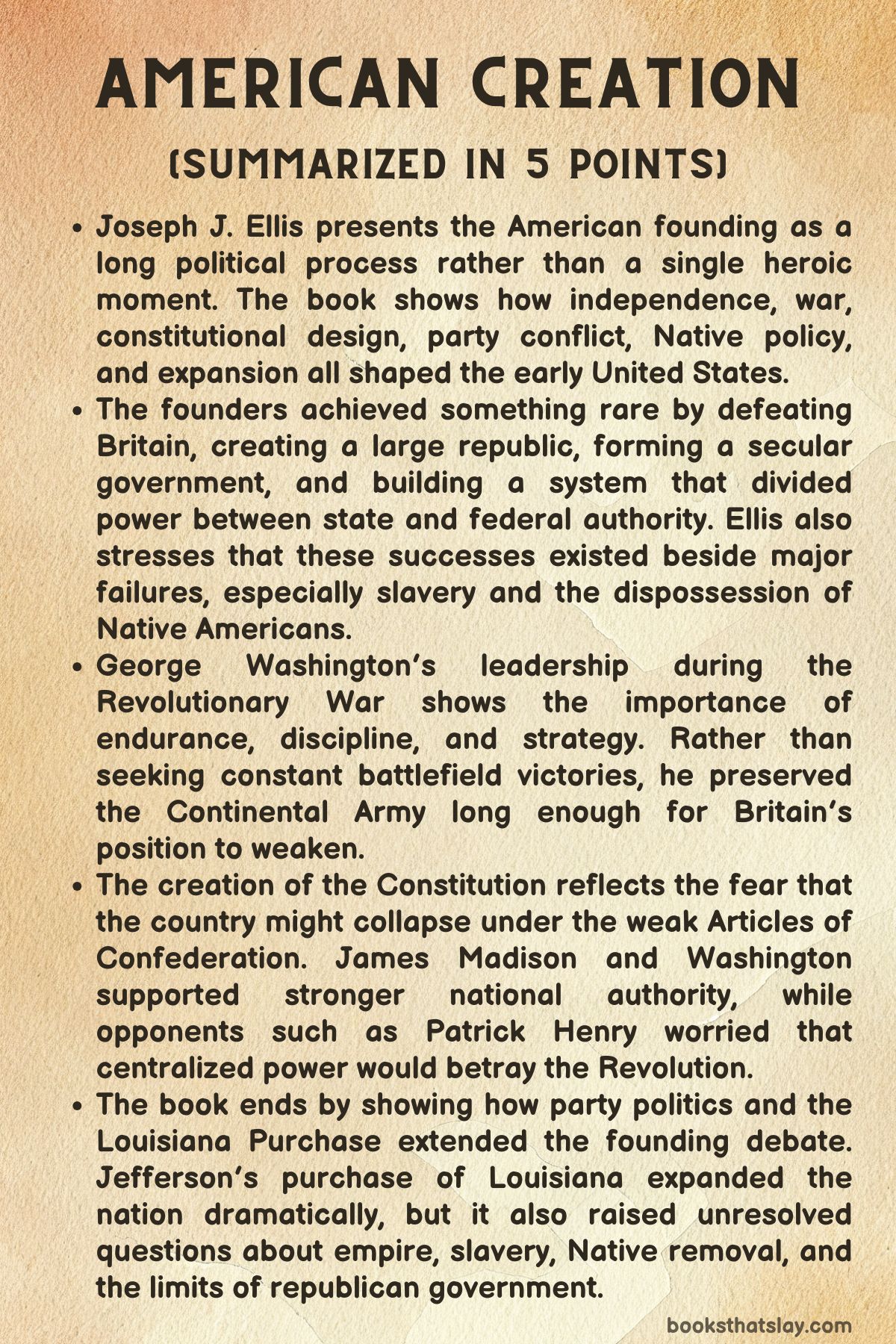
The book looks at how the revolutionary generation won independence, built a national government, created a party system, expanded the country, and failed to solve the injustices of slavery and Native American dispossession. In Ellis’s view, the founding was not a single moment but a long political process that stretched from 1775 to 1803.
Summary
American Creation begins with Joseph J. Ellis explaining why he turned again to the American founding. The disputed presidential election of 2000 raised questions about the Electoral College and about whether modern political leaders seemed smaller than figures such as George Washington, John Adams, and Thomas Jefferson.
Ellis uses these questions as a way to look back at the founding generation, not as flawless heroes, but as gifted and limited political actors working under extraordinary pressure.
The book presents the founding of the United States as one of the most important political achievements of the modern world. In the late eighteenth century, the colonies defeated Britain, then the strongest military power in the world, and became the first modern colony to win independence.
They created a republic over a vast territory, formed a secular national government, divided sovereignty between state and federal authority, and eventually accepted political parties as part of public life. Ellis stresses that these achievements were rare because revolutionaries often destroy old systems without being able to create stable new ones.
The American founders managed both rebellion and government-building.
At the same time, Ellis is careful not to treat the founders as saints. Their greatest failures were slavery and the treatment of Native Americans.
These failures were not side issues; they shaped the future of the nation. Ellis’s central argument is that the American founding was both brilliant and deeply flawed.
It produced durable political structures while leaving behind conflicts that later generations would have to face.
The story begins in the period when the colonies moved from resistance to independence. After Britain defeated France in North America, it tried to exert stronger control over its colonies.
The colonists resisted, but the move toward independence was gradual rather than sudden. John Adams emerges as a major figure in this process.
He believed that the break with Britain had already become unavoidable, yet he understood that many colonists were not ready to abandon loyalty to the crown. His strategy was to move slowly enough to bring moderates along.
The early fighting helped change public opinion. The battles around Boston showed that Britain was determined to crush resistance, but they also proved that British forces could be challenged.
George Washington took command of the colonial militias and discovered that they were difficult to manage. The soldiers were independent, poorly supplied, and unused to strict discipline.
Washington concluded that the Americans needed to become more like the professional army they were fighting.
Necessity forced the revolutionaries into choices that later seemed more democratic than they may have intended. Black soldiers fought beside white soldiers in some units, and men of lower social rank could rise because talent mattered more than birth.
Yet the founders were unwilling to carry revolutionary equality into slavery or women’s rights. Thomas Paine’s writing gave independence a powerful public voice, while Adams focused on the harder question of how a new government should function.
By the time the Declaration of Independence was adopted, the colonies had already moved a long way toward separation.
The war itself tested whether the revolution could survive. During the winter at Valley Forge, Washington’s army suffered from hunger, poor supplies, and low morale.
Farmers often preferred selling goods to the British because British money was worth more than American certificates. The army’s supply system broke down, and Washington had to appoint stronger administrators to restore order.
The long war strained patriotism, and Washington came to see that ideals alone could not sustain an army. Soldiers needed pay, discipline, organization, and long-term support.
Washington’s strategy also changed. Instead of seeking one decisive battle against Britain, he learned to preserve the army and avoid destruction.
The arrival of French support helped the American cause, but the larger contest became a test of endurance. Washington understood that if the army survived and the public did not lose faith, the British might eventually decide the war was not worth the cost.
After independence, the new country faced another crisis: the government created under the Articles of Confederation was too weak. Washington feared that the states were drifting into disorder because each acted mainly for itself.
James Madison shared this concern. From his experience in state and national politics, Madison believed the country needed a stronger central government.
He worked hard to persuade Washington to attend the constitutional convention because Washington’s presence gave the effort legitimacy.
Madison entered the convention hoping for a much stronger national system than the one that finally emerged. His preferred plan included a powerful federal structure and representation based heavily on population.
But the convention required compromise. The final Constitution divided power between the national government and the states, and it created a Congress in which one house represented population while the other gave equal representation to states.
Madison did not get everything he wanted, but he later turned the compromise into a defense of the Constitution. When opponents claimed the new system destroyed state sovereignty, Madison argued that sovereignty had been divided in a new and creative way.
Ellis then turns to one of the founding era’s clearest moral failures: Native American policy. After independence, the United States claimed authority over lands east of the Mississippi, even though Native nations lived there.
Federal leaders had two basic options: military removal or gradual settler expansion. Both assumed that the United States had a right to the land.
Henry Knox, with Washington’s support, tried to design a more humane policy. He hoped Native tribes could remain in protected enclaves while settlers moved around them, and he imagined that tribes would gradually adopt agriculture.
This policy was tested with the Creek people. Their leader, Alexander McGillivray, understood both American ambition and Spanish influence in the region.
He distrusted American promises and tried to protect Creek interests through diplomacy. The federal government arranged a major summit and signed a treaty with the Creeks, but the agreement soon failed.
Settlers in Georgia kept moving onto Creek lands, and the federal government lacked the power or will to stop them. In the end, population pressure defeated diplomacy.
Washington was angered by the settlers’ lawlessness, but anger did not save Native land.
The book also explains how political parties emerged from conflict among the founders. Jefferson and Madison came to believe that Alexander Hamilton’s financial policies, especially the national bank, were moving the country toward rule by northern financiers and possibly monarchy.
Madison’s position was striking because he had once argued strongly for national power. Now he and Jefferson framed Hamilton as a threat to the Revolution’s meaning.
Hamilton fought back, and the public debate became personal and bitter. Newspapers became weapons.
Jefferson, while serving in government, quietly supported opposition writing against Hamilton. Hamilton accused Jefferson of ambition and betrayal.
These conflicts deepened when war broke out between Britain and France. Washington declared American neutrality, but Republicans favored France while Hamilton’s supporters leaned toward Britain.
The Whiskey Rebellion and Jay’s Treaty with Britain further widened the split. By the time John Adams defeated Jefferson in the presidential election, the old hope that the nation could rise above party conflict was fading.
Jefferson chose party opposition over cooperation with Adams.
The final major episode is the Louisiana Purchase. Jefferson believed the West was America’s future.
At first, he expected Spain’s weakening empire to give way gradually. But when Spain transferred Louisiana to France, the situation became alarming because Napoleon’s France was far more powerful.
Jefferson remained patient. He expected French plans in the Caribbean to fail, and they did.
After the French army was devastated in Santo Domingo, Napoleon decided to sell Louisiana to the United States.
The purchase nearly doubled the size of the country and gave the United States an enormous new future. Yet it also created serious contradictions.
Jefferson, a defender of limited government, used broad executive power to complete the deal. The new territory also raised questions about empire, Native removal, and slavery.
Ellis argues that this was a lost chance to address slavery’s future, but Jefferson avoided the issue. He feared that emancipation would lead to racial conflict and possibly destroy the Union.
American Creation ends by presenting the founding as an ongoing process rather than a finished achievement. Ellis argues that the central question was not democracy against aristocracy, since the founders were not modern democrats.
The deeper issue was whether the former colonies could become a nation. Geography and time helped them.
The country’s size gave Washington room to avoid defeat, gave Madison a basis for defending an extended republic, and gave Jefferson confidence that Louisiana could become part of America’s future. The founding generation’s greatest creative act, Ellis suggests, was building a political system flexible enough to keep arguing, adapting, and surviving.
Key People
Joseph J. Ellis
Joseph J. Ellis functions as the guiding historical voice behind American Creation, shaping the founding era as a story of achievement, accident, compromise, and failure. He does not present the founders as distant icons or as villains beyond recovery.
Instead, he treats them as ambitious, intelligent, flawed people who worked within pressure-filled circumstances. His perspective is especially important because he balances admiration with criticism.
He recognizes the founders’ success in creating a lasting republic, but he also insists that slavery and Native American dispossession must be seen as central failures rather than side issues. Ellis’s role is not that of a neutral recorder of dates; he is an interpreter who wants readers to understand the founding as a living political process.
George Washington
George Washington appears as the most stabilizing figure in the founding generation. His importance comes less from brilliant theory than from judgment, patience, and public trust.
As commander of the Continental Army, he learns that revolutionary enthusiasm alone cannot win a long war. He sees the need for discipline, supplies, structure, and endurance.
His leadership at Valley Forge shows his ability to survive hardship without surrendering to panic. Later, his support for a stronger federal government gives the constitutional movement authority it might otherwise have lacked.
Washington also emerges as a tragic figure in Native American policy: he wants treaties respected, yet he cannot control settler expansion. His greatness lies in restraint, but the limits of that restraint reveal the weakness of the early republic.
John Adams
John Adams is presented as one of the clearest political minds of the revolutionary period. He understands earlier than many others that reconciliation with Britain is no longer realistic, yet he also knows that independence cannot be rushed if it is to gain broad support.
His strength lies in patience, timing, and institutional thinking. Unlike Thomas Paine, Adams does not assume that freedom will automatically produce good government.
He worries about structure, representation, and the dangers of unchecked power. His work on constitutional ideas shows his belief that independence must be followed by order.
Adams is also somewhat overshadowed by Jefferson’s more famous Declaration, and Ellis gives him renewed importance by showing how much of the actual movement toward independence depended on Adams’s political labor.
Thomas Jefferson
Thomas Jefferson is one of the most complex figures in the narrative. He gives the Revolution some of its most memorable language, especially through the ideals associated with equality and natural rights, but his political actions often reveal contradiction.
He distrusts centralized authority when Hamilton uses it, yet he exercises broad executive power when purchasing Louisiana. He speaks in the language of liberty while avoiding meaningful action against slavery.
Jefferson also becomes a party leader who chooses opposition to John Adams rather than cooperation, even though they share a revolutionary past. His vision of the West gives the United States room for expansion, but it also supports policies that worsen Native displacement and leave slavery unresolved.
James Madison
James Madison is portrayed as a brilliant but shifting political thinker. During the debate over the Constitution, he sees the dangers of excessive state power and argues for a stronger national government.
His role in persuading Washington to attend the convention shows both his strategic intelligence and his understanding of political symbolism. Yet Madison’s later opposition to Hamilton creates a striking reversal.
The same man who once feared weak national authority comes to suspect that federal power is becoming a tool of financial and regional domination. This change makes Madison one of the most revealing figures in the book because his career shows how quickly revolutionary ideals could be reinterpreted when political circumstances changed.
Alexander Hamilton
Alexander Hamilton represents energy, financial imagination, and the force of national power. His national bank and financial policies are designed to give the United States economic credibility and administrative strength.
To his supporters, Hamilton is building the practical machinery that a real nation requires. To Jefferson and Madison, he seems to be moving the country toward rule by financiers and perhaps toward monarchy.
Hamilton’s personality intensifies the conflict because he answers attacks directly and aggressively. He is not simply a financial planner; he is a political combatant who understands that public argument can define national identity.
His importance lies in forcing the new republic to face whether independence could survive without strong institutions.
Thomas Paine
Thomas Paine serves as the Revolution’s most effective popular voice. His writing turns independence into a plain, urgent cause that ordinary readers can understand.
He believes monarchy itself is the problem and that removing it will allow a better political world to emerge. In this sense, Paine is more optimistic than Adams.
He trusts the liberating force of revolution more than the careful design of government. His role highlights a major tension in the founding: the difference between inspiring people to break from empire and building institutions capable of governing after the break.
Paine’s influence is powerful because he gives emotional and moral clarity to independence, even if he underestimates the difficulty of political construction.
Nathanael Greene
Nathanael Greene appears as a practical and capable military administrator. His appointment to repair the army’s supply problems shows Washington’s need for trustworthy talent during crisis.
Greene’s importance comes from the fact that war is not only fought on battlefields. Soldiers need food, clothing, transport, organization, and money.
Greene understands that a long war requires systems, not just courage. His view that money is essential to war cuts against romantic ideas of pure patriot sacrifice.
Through Greene, Ellis shows that the American Revolution depended on administrative competence as much as heroic language. Greene also reflects the merit-based nature of the Continental Army, where ability could elevate men beyond inherited status.
Baron von Steuben
Baron von Steuben represents the professionalization of the American army. His training of Washington’s troops gives the Continental Army skills it badly needs, including discipline, formation, and order.
He matters because the early American forces are not naturally suited to military hierarchy; many soldiers resist authority and behave more like independent local fighters than members of a national army. Von Steuben helps transform them into a more reliable fighting force.
His presence also shows that American victory was not purely homegrown. Foreign expertise, French alliance, and European military knowledge all contributed to survival.
He is a reminder that independence required learning from the very kind of disciplined military culture Americans often claimed to resist.
General Howe
General Howe represents British military strength but also British strategic failure. He wins battles, yet those victories do not destroy the American cause.
His occupation of Philadelphia shows the British ability to seize important places, but it also reveals the limits of conventional warfare against a rebellion spread across a large territory. Howe’s decisions allow Washington to preserve the Continental Army, which becomes more important than holding any single city.
Through Howe, the book shows that Britain could win engagements and still fail politically. His role helps explain why Washington’s defensive strategy worked: the British needed to break American resistance, while the Americans mainly needed to survive.
General Henry Clinton
General Henry Clinton marks a shift in British strategy. His orders to consolidate in New York and avoid major land battles confirm that Britain’s approach is changing from active conquest to containment.
Clinton’s role is important because it indirectly validates Washington’s long-term strategy. If the British are no longer able or willing to chase full military victory across the colonies, then the American task becomes endurance.
Clinton is less central as a personality than as a sign of Britain’s declining confidence. His position shows how the war’s scale, cost, and geography worked against imperial control.
King George III
King George III appears as the symbol of imperial authority and royal rejection. His refusal to accept colonial resistance as legitimate helps push the colonies toward independence.
By declaring the colonies outside his protection and cutting off trade, he makes compromise harder and gives radicals stronger evidence that the relationship with Britain has broken beyond repair. His importance is not based on personal complexity in the narrative but on political consequence.
He becomes the figure against whom colonial loyalty collapses. The moderates who once hoped to remain loyal to the crown are forced to reconsider when the king himself treats the colonies as enemies.
Henry Knox
Henry Knox is central to the early republic’s Native American policy. As secretary of war, he wants the United States to treat Native nations with a level of dignity and legality.
He regards tribes as foreign nations and tries to create a policy that does not simply reproduce imperial conquest under an American name. Knox’s plan imagines protected Native enclaves and gradual adaptation to agriculture.
Yet his vision is defeated by settler expansion, weak enforcement, and the assumption that American claims to land are superior. Knox is a figure of limited reform: he sees the moral problem more clearly than many others, but his solution remains tied to American expansion and cannot withstand demographic pressure.
Alexander McGillivray
Alexander McGillivray is one of the most important non-American political figures in the narrative. As a Creek leader, he is educated, strategic, and deeply aware of American unreliability.
He negotiates with the United States while also using Spanish power as a counterweight. His caution is justified because he has seen promises made to Native peoples fail under settler pressure.
McGillivray’s acceptance of treaty negotiations is not naïve trust; it is a tactical response to danger from Georgia settlers and land companies. His later turn back toward Spain shows that he understands the treaty cannot protect Creek land if the United States will not enforce it.
He exposes the gap between American ideals and American behavior.
Patrick Henry
Patrick Henry represents the anti-federalist defense of local sovereignty. He claims the true spirit of the Revolution belongs to those who resist centralized power.
His opposition to the Constitution is rooted in the belief that Americans fought Britain to protect local liberty, not to create a distant national authority. Henry’s argument is powerful because many ordinary Americans still think of themselves mainly through state and local identities.
He forces Madison to defend the Constitution not as a betrayal of independence but as a new arrangement of divided power. Henry’s role is important because he reminds readers that the Constitution was not inevitable.
It was contested, uncertain, and frightening to many people who had recently fought an empire.
Philip Freneau
Philip Freneau plays a key role in the rise of partisan politics through his newspaper. His publication becomes a vehicle for Republican attacks on Hamilton and his allies, with Jefferson quietly supporting the effort.
Freneau’s importance lies in showing how quickly the new republic developed a political press. Public opinion had to be shaped, and newspapers became the battlefield for accusations, ideology, and reputation.
His role also reveals Jefferson’s indirect style of political combat. Rather than openly leading opposition from within the administration, Jefferson supports a public platform that can criticize Hamilton while giving him some distance from the attacks.
John Jay
John Jay is significant because his treaty with Britain becomes one of the early republic’s most divisive political events. He negotiates under difficult conditions, and Ellis presents the agreement as probably the best available deal, even though many Americans hate it because of lingering hostility toward Britain.
Jay’s role shows the difference between diplomatic necessity and public emotion. The treaty deepens the divide between emerging political parties and tests Washington’s authority.
Jay is not portrayed as a popular hero here; he is a statesman whose practical compromise becomes politically explosive. His work demonstrates that independence did not end America’s dependence on careful negotiation with powerful European nations.
James Monroe
James Monroe appears as Jefferson’s special envoy during the Louisiana crisis. His role is to support Robert Livingston in France and help secure a diplomatic solution at a moment when war seems possible.
Monroe’s importance is partly ironic: by the time he arrives, events have already shifted toward the sale of Louisiana. Even so, his appointment shows Jefferson’s desire to avoid reckless military action and pursue negotiation.
Monroe represents the diplomatic patience behind one of the largest territorial acquisitions in American history. His presence also reflects Jefferson’s reliance on trusted political allies when the nation’s future expansion is at stake.
Robert Livingston
Robert Livingston is the American diplomat who first tries to confirm French intentions in North America and then helps secure the Louisiana Purchase. He faces evasive French officials and unclear information, but he remains active in seeking an opening.
When Napoleon unexpectedly decides to sell, Livingston acts decisively. His agreement to the purchase price helps transform the United States overnight.
Livingston’s role shows how major historical outcomes can depend on readiness during unexpected opportunity. He does not control the larger causes, such as France’s failure in Santo Domingo or Napoleon’s strategic priorities, but he recognizes the moment when it arrives.
Napoleon Bonaparte
Napoleon Bonaparte appears as a distant but decisive force in American expansion. His acquisition of Louisiana from Spain alarms Jefferson because France is far more powerful than Spain.
Napoleon’s plan to rebuild French power in the Americas depends on success in Santo Domingo, but that effort fails because of resistance and disease. Once his Caribbean plan collapses and war with Britain approaches, Louisiana becomes less useful to him.
His decision to sell is strategic, not generous. Napoleon’s role shows how American growth was shaped by European conflict as much as American planning.
The United States gains an empire partly because France’s imperial project fails elsewhere.
Toussaint L’Ouverture
Toussaint L’Ouverture is crucial to the background of the Louisiana Purchase. As the leader of resistance in Santo Domingo, he stands at the center of the French failure that changes North American history.
The French deceive and capture him, but the larger resistance continues after people learn that France intends to restore slavery. The defeat of French forces prevents Napoleon from establishing the military base he wanted in New Orleans and the Mississippi region.
Toussaint’s role shows that enslaved and formerly enslaved people in the Caribbean helped shape the future of the United States. American expansion is therefore linked to Black resistance beyond the borders of the United States.
Charles Leclerc
Charles Leclerc, Napoleon’s brother-in-law, leads the French expedition to Santo Domingo. His mission is meant to restore French control and prepare the way for a stronger French presence in North America.
At first, his forces gain ground through deception, including the capture of Toussaint L’Ouverture. But the campaign collapses when resistance intensifies and disease devastates the French army.
Leclerc’s death from yellow fever symbolizes the failure of Napoleon’s American ambitions. His role is important because his defeat indirectly opens the door to the Louisiana Purchase.
Through Leclerc, Ellis shows how events far from Washington or Paris could redirect the fate of the United States.
George W. Bush and Al Gore
George W. Bush and Al Gore appear mainly as the modern starting point for Ellis’s historical question in American Creation. The disputed election of 2000, in which the Electoral College determined the winner despite the popular vote, prompts renewed attention to the founders’ political design.
Bush and Gore are not characters in the founding story, but they help frame why the founding still matters. Their election raises questions about institutions, leadership, and whether modern Americans understand the compromises built into their political system.
Their role is brief but useful because it connects eighteenth-century decisions to present-day political consequences.
Themes
The Founding as a Long Political Process
The founding is presented not as a single heroic moment but as a process that unfolds over decades. Independence, military survival, constitutional design, party conflict, Native policy, and territorial expansion all belong to the same larger story.
This approach challenges the habit of treating the Declaration of Independence or the Constitution as isolated events. The move toward independence requires persuasion, timing, and public readiness.
The war requires endurance rather than one clean victory. The Constitution emerges from fear that the first national government is failing.
Political parties develop despite the founders’ hope that public virtue might prevent faction. The Louisiana Purchase extends the founding question by asking what kind of nation the United States will become once it controls a vast new territory.
In American Creation, Ellis suggests that the founding generation’s real achievement was not perfection but the creation of a political structure that could keep changing. The country begins through argument, and that argument becomes part of its survival.
The Revolution does not end when Britain is defeated; it continues as Americans decide how much power the national government should have, who belongs within the republic, and how far its ideals should reach.
Achievement and Moral Failure Existing Together
The founding generation creates a durable republic while also leaving behind deep injustices. Ellis refuses to separate these two realities.
The same leaders who help form a new system of liberty fail to end slavery and fail to protect Native peoples from dispossession. This makes the founding neither pure triumph nor simple hypocrisy.
Its greatness and its failures exist side by side. The founders are capable of unusual political creativity: they divide sovereignty, build a secular republic, accept argument as a feature of government, and turn rebellion into institutions.
Yet their imagination narrows when confronted with racial slavery and Native land rights. Jefferson’s refusal to seriously consider gradual emancipation after the Louisiana Purchase is especially revealing because the new territory creates a major opportunity to shape slavery’s future.
Washington and Knox’s Native policy also shows the limits of good intentions when enforcement is weak and expansion is treated as inevitable. The theme matters because it prevents a comforting version of history.
Ellis asks readers to see the founding as both admirable and morally compromised. The United States inherits not only the founders’ structures but also their evasions.
The Conflict Between National Power and Local Sovereignty
The struggle between federal authority and state power drives much of the political conflict in the narrative. Many Americans believe the Revolution was fought to protect local self-rule from distant authority.
For them, a strong national government seems dangerously similar to the British power they had resisted. Washington and Madison, however, come to believe that the country cannot survive if the states act only for themselves.
The failure of the Articles of Confederation makes this problem urgent. Madison’s support for a stronger central government grows from practical experience, not abstract theory.
Yet the Constitution that emerges is not a total victory for nationalism. It divides power between the states and the nation, creating a system that is intentionally mixed.
Patrick Henry’s opposition shows why ratification is so uncertain: he speaks for those who fear that liberty will be lost through consolidation. Later, Madison’s shift against Hamilton reveals that even supporters of national power can become suspicious when that power appears tied to finance, region, or elite control.
The theme shows that American politics begins with a permanent tension. The country needs national authority to survive, but fear of centralized power remains one of its defining instincts.
Politics, Parties, and the Legitimacy of Disagreement
The emergence of political parties reveals a major change in how Americans understand disagreement. At first, many founders hope that virtuous leaders can rise above faction.
They associate parties with selfishness, corruption, and instability. Yet policy disputes quickly become too serious to remain private differences among gentlemen.
Hamilton’s financial system, Jefferson and Madison’s suspicion of centralized power, Washington’s neutrality policy, the Whiskey Rebellion, and Jay’s Treaty all push leaders into organized opposition. Newspapers become weapons, and personal relationships suffer under ideological pressure.
Jefferson and Adams, once allies in the revolutionary cause, become political opponents because party loyalty starts to outweigh personal friendship. This development is messy and often bitter, but Ellis treats it as one of the founding generation’s lasting achievements.
The acceptance of political parties means that dissent does not have to be treated as treason. A republic can survive organized disagreement if institutions allow conflict to be expressed without destroying the system itself.
The theme is especially important because it connects the founding era to modern politics. American democracy depends not on the absence of conflict but on rules and habits that allow conflict to continue without breaking the country.