Cursed King Summary, Characters and Themes
Cursed King by Julie Saman is a contemporary royal romance set in the tiny Mediterranean kingdom of Messalina, where tragedy has left a young king convinced his family is doomed. After a horrific loss shatters his household, King Sebastian retreats into isolation, determined to protect his children at any cost.
Into that guarded world steps Bellamy Wright, an American teacher already carrying her own grief as she cares for a father with dementia. What begins as a coerced job arrangement turns into a steady reshaping of a frightened family—and a dangerous collision with politics, obsession, and a man who refuses to let the past loosen its grip.
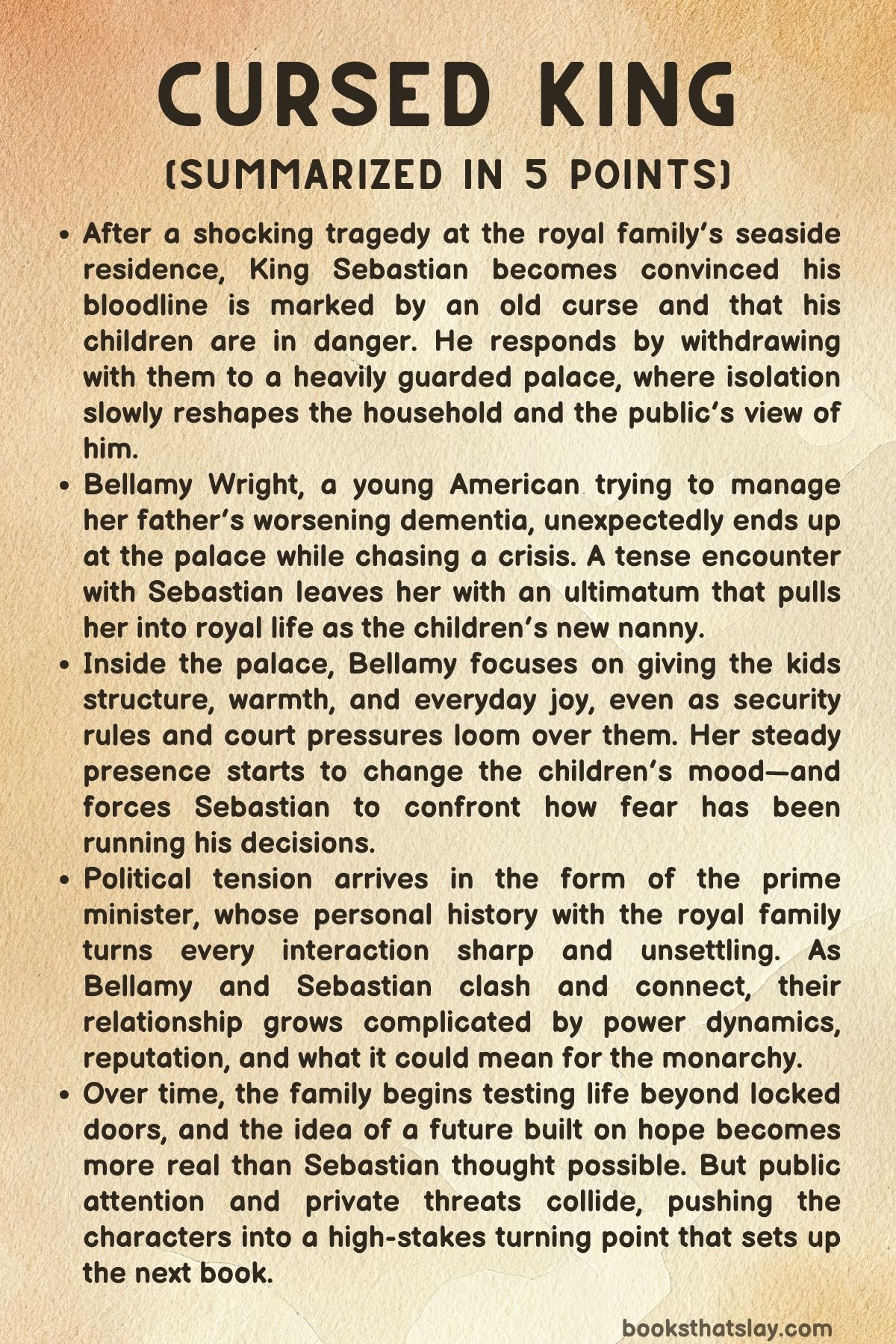
Summary
King Sebastian of Messalina watches his life split in two on an otherwise peaceful day at the royal summer residence. His daughters, Phaedra and Sabrina, are playing in the garden while baby Prince Zayer fusses with his nanny.
The family is waiting for Queen Nora to arrive by helicopter after visiting her sick mother in France. Sebastian notices something wrong with the aircraft as it nears the cliffside palace.
Seconds later it crashes and erupts into flames. He shields his daughters as they witness the explosion that kills their mother.
The aftermath doesn’t bring Sebastian the kind of grief he expects. Instead, it sharpens an old fear he once brushed aside: that the royal line is cursed.
He remembers earlier losses—his father killed during political violence, a sister taken, another sister hidden away because of illness—and connects them to a long-standing legend about Messalina’s origins. The story claims the country was founded for the Roman empress Messalina and that Emperor Claudius condemned her bloodline after her betrayal and execution.
Even though Nora wasn’t born into Messalinian royalty, Sebastian treats her death as proof that marrying into the family doesn’t protect anyone.
Terrified that his children will be next, Sebastian withdraws from public life. He moves the children to a secluded northern palace near the Alps and locks down their world.
Security becomes the kingdom’s quiet obsession: guard rotations, restricted movement, carefully controlled routines. Three years pass with Sebastian rarely leaving and the children rarely seeing anything beyond the palace walls.
The public reads his isolation as mourning, but inside the household it’s closer to a siege mentality.
Keeping a stable nanny proves nearly impossible. One after another quits, is dismissed, or simply disappears from the job.
When Sebastian’s household staff—his practical housekeeper Emily, his loyal security chief Javier, and his aunt and assistant Althea—tell him they need yet another replacement, he’s furious. The latest nanny ran off before dawn after Sebastian caught her sneaking toward his bedroom, and he’s tired of opportunists who see the palace as a ladder.
With Prime Minister Samil Batorini arriving soon for a weeklong political visit, Sebastian can’t ignore the staffing problem. He demands someone different—someone focused on the children, not the crown.
In Tourin, a nearby city, Bellamy Wright is trying to hold her life together. She’s twenty-one, American, and living in Messalina while juggling money worries and visits to her father, whose dementia is worsening.
One phone call from him rattles her: he speaks as if her late mother is still alive and insists he has invented something he needs to take to MIT. Soon afterward, his case manager calls with alarming news—her father has vanished from his care facility.
Bellamy tracks him through an app and learns he’s at the royal palace.
Panicked that her father will be arrested, Bellamy races to the palace in her landlord’s borrowed car. Guards confirm her father broke in and tried to take something, fighting when stopped.
A sympathetic guard—familiar with dementia through his own family—lets her in quietly. Inside the grand halls, Bellamy is overwhelmed by the wealth and formality, and her nerves make her clumsy: she knocks over a marble bust on a pedestal, breaking it and snapping off its nose.
Before she can recover, Phaedra and Sabrina appear and scold her for swearing. Bellamy explains about her father and admits the accident.
The girls identify the bust as their great-grandfather and, to Bellamy’s surprise, keep talking instead of calling for guards. Their curiosity turns personal; Bellamy admits her mother died years earlier.
When Sabrina confesses she barely remembers her own mother, Bellamy gently suggests a way to hold onto her memory by imagining her face. The moment lands.
The girls decide Bellamy is safe and drag her through the palace to report the broken statue to Emily, forcing Bellamy to carry the heavy marble head along the way.
Emily quickly pieces together the truth: Bellamy is an English teacher who left university to help care for her father. Emily brings her to Sebastian’s study to wait, and Bellamy—trying to calm down—wanders among the books, noticing mythology and history that echo the kingdom’s obsession with curses.
Sebastian storms in and explodes at the sight of a stranger in his private space. Emily explains everything: the break-in, the toaster oven her father carried like a treasure, the metal disk he tried to steal, and the ruined sculpture by a famous artist.
Phaedra and Sabrina plead with their father to let Bellamy stay. They say she’s kind, and they want her as their nanny.
Sebastian interrogates Bellamy sharply, offering no gentleness and no sympathy for her financial reality. Bellamy snaps back, demanding her father and the chance to leave.
Javier confirms Bellamy’s background checks out, but Sebastian’s solution is ruthless: Bellamy can “pay” for the damages by working for him. If she refuses, he threatens to press charges against her father and blame Bellamy for the vandalism.
Cornered, Bellamy agrees to a contract—one year, employment at the palace’s discretion, strict security rules, and clear boundaries, including staying out of Sebastian’s private suite.
Bellamy returns her father to the facility, packs what little she owns, and comes back to the palace shaken by how quickly her life has been rearranged. On her first morning, Phaedra, Sabrina, and Zayer burst into her room before dawn like a joyful invasion.
Zayer is instantly affectionate, and the girls are thrilled to claim her. Bellamy tries to establish structure—breakfast, lessons, supervised play—and learns how isolated the children truly are.
Phaedra’s “school” is effectively a single-child program with a tutor in a separate building, and she hates the loneliness.
Sebastian appears in the hallway, unexpectedly hands-on for a man who usually keeps his distance. He criticizes Bellamy’s sleepwear as inappropriate, warns her that the prime minister is arriving, and orders her to keep the children away from political meetings.
Bellamy’s habit of speaking to him like a normal person—using “Sebastian” instead of a title—throws him off, and their exchanges become a mix of irritation and something warmer that neither wants to name.
The palace’s size becomes its own hazard. During hide-and-seek, Bellamy can’t find Sabrina and Zayer, and panic rises fast because a parliamentary meeting is happening nearby and she can’t shout without causing a scene.
She finally hears Zayer crying and discovers him scraped and bleeding behind a wall hanging while Sabrina tries to hush him. At that exact moment Prime Minister Samil Batorini appears, amused, and then Sebastian arrives furious.
Sebastian comforts his son and punishes Sabrina by taking away dessert, while Bellamy accepts blame in French to defuse the moment.
Samil immediately focuses on Bellamy. He flirts openly, makes invitations that sound like commands, and treats her like a prize he can claim.
Bellamy refuses, insisting her responsibility is the children, but Samil persists—kissing her hand, pressing for dinner, and needling Sebastian the entire time. Sebastian pulls Bellamy away, then privately corners Samil and warns him to stop mentioning the “curse” and to stay away from the nanny and the children.
The hostility between the men is old and personal: Samil was once in love with Nora and blames Sebastian for her death.
Bellamy, skeptical of superstition, decides the best way to fight fear is to give the children ordinary happiness. She starts a Friday-night ritual—cookies, popcorn, and a movie—and to her surprise Sebastian drifts in and stays.
The children light up when he joins them. In the kitchen, the flirtation between Sebastian and Bellamy spikes into something dangerously intimate, then pulls back again as both try to keep control.
As weeks pass, Bellamy bonds deeply with the children. She helps Phaedra face fears, builds routines that soothe them, and gives them attention that isn’t shaped by dread.
Sebastian, meanwhile, keeps his distance from Bellamy, then admits—through tense conversations and late-night honesty—that his attraction is the reason. When Zayer has a nightmare and Bellamy injures her toe rushing to him, Sebastian appears, tends the wound with surprising care, and tells her she’s doing an excellent job.
They attempt a “truce”: professional behavior, no flirting. It doesn’t last.
A fierce argument erupts over the children’s confinement. Sebastian insists the palace must remain a fortress because he believes danger is real and inherited.
Bellamy argues that keeping the children locked away is its own form of harm. The fight turns raw, and Sebastian lashes out by reminding her she is “only the nanny.” Bellamy refuses to accept that role as a reason to stay silent.
In the heat of it, Sebastian kisses her to stop the argument, and the kiss becomes a sexual encounter. When Bellamy admits she’s a virgin, Sebastian pulls back, shaken by what he’s risking—her trust, his authority, the household’s fragile balance.
Bellamy refuses to be dismissed and insists on being heard and respected. They stop short of intercourse that night, but the line between them is gone.
Bellamy proposes a compromise that forces Sebastian to confront his fear: a carefully secured outing for the children beyond palace grounds. Reluctantly, he agrees.
The next day they go to private royal land by a lake near the Alps, with Javier coordinating security. The children explode with joy, especially at the bouncy house.
Sebastian is tense, then suddenly pulls Bellamy into a desperate kiss, admitting he feels out of control and blaming her for making him face his terror. Bellamy points him back to his children—laughing, running, alive—and the sight softens him.
He tells her to come to his suite that night.
Their return brings another shift: Prince Rowan, Sebastian’s brother, arrives. Rowan is charming, playful with the children, and instantly curious about Bellamy.
He teases Sebastian, clearly delighted that someone finally changed the palace’s atmosphere. Rowan occupies the children so Sebastian and Bellamy can be alone, and that night Sebastian and Bellamy sleep together fully for the first time, with Sebastian careful at first and then undone by how much he wants her.
Afterward, Sebastian admits a possessiveness that scares him: he doesn’t want to let her go.
Rowan calls him out the next morning. This isn’t just sex, Rowan says—it’s love, and love might be the only force strong enough to end whatever has haunted their family.
Rowan proves his point by taking the children out again on a guarded hike, and nothing terrible happens. Althea supports the shift, suggesting it’s time for the children to live instead of hide.
Sebastian stops resisting the change. He seeks Bellamy out on her day off, joins her in the shower, and tells her he loves her—saying it plainly and then repeating it in French, calling it forever.
Bellamy breaks down, admitting she feels the same. They agree to keep their relationship private for now, even as the family begins spending time outside the palace more often.
A month later they’re staying at a secure alpine chalet, and the children are thriving. On Bellamy’s birthday, Sebastian gives her a heart-shaped diamond heirloom reset into a pendant, framing it as his heart in her hands.
But Bellamy’s personal life is unraveling. After a visit to her father, she sits outside in the cold, devastated because his memory is collapsing and he no longer recognizes her.
She tries to hide the depth of her pain, but Sebastian finds her, drives her home in silence, and then offers practical solutions—medical opinions, moving her father to the palace, anything. He gives her a car so she never has to struggle to reach her father.
Bellamy finally lets herself fall apart, and Sebastian holds her as she cries, naming the loss she’s living through.
Sebastian decides he’s done hiding. He wants to tell the children and eventually the world.
He proposes a bold public step: a Christmas ball at the palace, symbolizing openness and a new beginning. Bellamy worries about judgment—she’s young, she was hired staff, and the court will be cruel—but Sebastian insists he will choose her publicly.
He raises the idea of marriage bluntly, leaving Bellamy overwhelmed. Before she can fully process it, Sebastian tells the children the truth in the palace library: he and Bellamy are together, and he hopes she will be their queen.
The girls accept it with startling ease, treating it like proof that love can defeat the curse they’ve been taught to fear.
The danger arrives through Samil. He corners Bellamy in the palace, grabs her, and spews obsession and resentment.
He calls her Sebastian’s “toy,” claims Sebastian owes him for Nora, and reveals details about Nora’s final day that were never public—suggesting Samil was far closer to the crash than anyone knew. Bellamy escapes shaken, torn between fear and the worry that Sebastian will respond violently.
Sebastian confronts Samil with the cold authority of a king. When Samil insinuates Bellamy is being harmed, Sebastian makes it clear the mark on her neck is consensual and publicly labels Bellamy his girlfriend.
The Christmas ball proceeds under heavy security. Bellamy arrives with the children, and Sebastian gives a speech about reopening the palace and choosing love over fear.
Then he makes Bellamy step into the spotlight, acknowledges she is their nanny, calls her the light in his family’s life, and proposes in front of the crowd. Bellamy says yes.
Sebastian announces her as the future queen, and the room erupts.
Moments later, Samil storms out. Bellamy finally tells Sebastian what Samil said earlier, including the helicopter detail.
Sebastian realizes only someone involved would know that. Javier digs through archives and finds evidence of tampering, along with footage showing Nora arguing with Samil at her parents’ estate on the day she died.
Before they can act, Bellamy vanishes. A missing attendant and dead phone signal point to an abduction.
One working camera finally shows Samil dragging her toward the third-floor library. In the library, Bellamy is held at knifepoint.
Samil rants about hatred and entitlement, cuts her throat shallowly to terrify her, and plans to throw her from a window to stage an “accident.” Bellamy fights back when she can, reaching for a panic button, but Samil smashes her phone and overpowers her.
Sebastian bursts into the library and tackles Samil to stop the attack. Rowan rushes Bellamy toward medical help while Javier secures the children.
Sebastian and Samil fight brutally. Samil stabs Sebastian, and Sebastian—bleeding and furious—forces Samil toward the shattered window.
In the chaos, Samil ends up outside the broken opening and falls to the rocks below.
Sebastian collapses from blood loss as Bellamy returns, injured and bandaged, begging him to stay awake. Javier confirms the children are safe.
Sebastian loses consciousness as help arrives, and the story ends on that cliffhanger, with the larger consequences and recovery left for the next book.
Characters
King Sebastian of Messalina
Sebastian is defined by a collision of duty, fear, and loneliness. The helicopter crash that kills Nora doesn’t just traumatize him; it becomes the event he uses to explain everything through the lens of a generational “curse,” and that belief hardens into a governing philosophy: control the environment, control the risk.
As a father, his love is real but expressed as confinement—three years of isolation in a northern palace, constant security, and emotional distance that leaves his children safe but starved of normal life. As a king, he is politically cornered and personally reactive, especially around Samil, whose presence triggers old jealousy and unresolved guilt about Nora.
His defining contradiction is that he insists he is rational and protective while repeatedly acting from panic, obsession, and possessiveness; Bellamy becomes the catalyst who exposes that contradiction. With her, Sebastian shifts from coercive power (pressuring her into the nanny role by threatening legal consequences for her father) to vulnerable attachment, then to a man trying to rebuild a life outside fear.
Even his tenderness often arrives wrapped in dominance—correcting her clothes, policing access to his suite, demanding formality—yet the moments where he bandages her toe, joins movie night, and finally admits love show the person he has been suppressing. By the end, Sebastian’s arc is a struggle between curse-driven fatalism and love-driven agency, and the proposal at the Christmas ball is his attempt to choose a future publicly, not just privately, even though that choice immediately provokes violence.
Bellamy Wright
Bellamy is written as resilient practicality under emotional strain, and her moral center is shaped by caretaking long before the palace ever appears. At twenty-one, she has already endured losing her mother and is actively losing her father to dementia, and that slow grief makes her unusually patient with children and unusually intolerant of cruelty disguised as “necessity.” She enters the royal household through coercion—her father’s break-in gives Sebastian leverage—and that uneasy foundation matters because it frames Bellamy’s early defiance: she refuses to be reduced to a servant or a pawn, even when she must comply.
Her strength shows less in grand gestures than in the daily work of restoring normalcy: routines, school encouragement, comforting the girls about their mother, and creating small traditions like cookie-and-movie night that quietly undo the palace’s gloom. Bellamy also functions as the story’s skeptic, pushing back against the curse narrative not by debating mythology but by insisting the children need sunlight, friends, and freedom regardless of what Sebastian fears.
In romance terms, she is not a social climber; her anxiety about public judgment, age difference, and “nanny” optics reads as a protective instinct—she understands how easily the world can weaponize perceptions. Her virginity reveal intensifies her need for control and consent on her terms, and it forces Sebastian to confront the ethical and emotional consequences of his desire.
The kidnapping sequence confirms another core trait: when cornered, Bellamy fights, thinks in survival steps, and tries to trigger help; she is not merely rescued, even though Sebastian ultimately arrives. Bellamy’s character, overall, is the emotional bridge of Cursed King—she connects grief to hope, fear to courage, and a locked-down family to the possibility of life beyond the walls.
Queen Nora
Nora’s on-page presence is brief, but her shadow structures the entire conflict. She is simultaneously an individual tragedy—a mother killed in front of her children—and a symbol used by others: Sebastian uses her death as “proof” of the curse and as justification for isolation, while Samil uses her as the centerpiece of his grievance and entitlement.
The portrait description—Sebastian unsmiling beside Nora—suggests a marriage that was respectable and functional more than passionate, which adds complexity to Sebastian’s later love for Bellamy; he is not simply “moving on,” he is discovering a kind of intimacy he never had. Nora’s importance also lies in what is withheld and later revealed: the detail that she “wasn’t supposed to be on the helicopter” becomes the key crack in the official story, turning her from tragic victim of fate into the potential victim of a plot.
In that way, Nora operates as the story’s missing truth, the hinge between superstition (curse) and a real-world threat (sabotage and obsession).
Phaedra
Phaedra is the child most clearly shaped by anxiety and responsibility, likely because she is old enough to remember the crash as a defining horror and old enough to interpret her father’s fear as reality. Her “school” situation—isolated, single-student tutoring—mirrors Sebastian’s fortress mindset and shows how protection becomes a social and emotional deprivation.
Phaedra craves structure and meaning, so she is vulnerable to the curse narrative; fear becomes a story that explains why her life is so small. Bellamy’s influence on her is therefore significant not just as comfort but as re-parenting: encouraging education, daring her to jump from the diving board, and giving her the emotional permission to be brave.
When Phaedra says she loves Bellamy, it reads as a child attaching to a stable caregiver who brings both warmth and boundaries, something she hasn’t had consistently since Nora’s death. Her enthusiastic acceptance of Bellamy and Sebastian together also shows a child’s hunger for family wholeness—she wants the household to make sense again, and she interprets love as a protective magic that can “break” the curse, which is both innocent and poignantly revealing.
Sabrina
Sabrina is more openly mischievous and socially bold, using play and provocation to test the adults around her. Her decision to hide near the parliament meeting—silencing Zayer, staying unusually quiet—signals not just childish prank energy but a child pushing against confinement by inserting herself into the adult world that has been kept distant.
She is also the child who articulates the ache of loss with blunt clarity when she admits she can’t remember her mother; that line anchors her mischief in grief rather than mere troublemaking. Sabrina bonds to Bellamy quickly because Bellamy treats her as a whole person—correcting language, insisting on schedules, but also validating feelings and creating fun.
Even her punishment (dessert withheld) becomes a moment that shows what she needs: consistent limits paired with continued affection, not fear-based control. Sabrina’s role is to bring motion to the household—she’s the spark that reveals how badly the children need normal chaos and how sterile Sebastian’s safety project has become.
Prince Zayer
Zayer represents innocence under threat and is the character most directly used to show the stakes of both protection and freedom. As a toddler, he can’t intellectualize the curse, politics, or grief, but his nightmares, crying, and scraped knee reveal how the atmosphere of fear seeps down even when adults think they’re shielding him.
His immediate attachment to Bellamy underscores her caregiving competence—he responds to calm presence and routine—and his vulnerability repeatedly forces Sebastian into tenderness, like when Sebastian comforts him in front of Samil or when Zayer’s nightmare draws Sebastian into the intimate scene where he bandages Bellamy’s toe. Zayer is also a plot accelerant: losing sight of him triggers panic, and in the kidnapping crisis, the first priorities are always “secure the children.” In emotional terms, Zayer is the purest argument against Sebastian’s fortress: he needs a world that teaches joy and resilience, not only caution.
Althea
Althea is the household’s stabilizing strategist—the adult who can see both the emotional and political realities without collapsing into either. As Sebastian’s aunt and assistant, she navigates the line between family loyalty and responsible governance, pushing for practical needs like hiring a nanny and preparing for the prime minister’s visit while also trying to protect the children’s wellbeing.
She functions as a quiet conscience for the romance too: noticing the mark on Bellamy’s neck, warning her about optics, and offering support without shaming her. Althea’s power is relational rather than authoritarian; she can’t “command” Sebastian out of fear, but she can keep the household functioning and nudge change in survivable steps.
When she supports outings and later manages crises during the ball, she embodies the theme that safety isn’t only walls and guards—it’s also competent, caring adults making hard choices clearly.
Javier
Javier is the professional spine of the royal security world: competent, observant, and loyal, but not blindly so. He verifies Bellamy’s background quickly, manages logistics for the outing to royal land, and later becomes essential in the investigation when the helicopter detail suggests inside knowledge and sabotage.
Javier’s value spikes during the ball crisis because he can translate panic into actionable steps—reviewing surveillance, identifying tampering, locating the one working camera, and coordinating protection for the children. He also provides a contrast to Sebastian’s fear: Javier treats threats as solvable problems rather than supernatural destiny, which subtly undercuts the curse narrative.
In the climactic library sequence, even when Sebastian becomes the one who physically intervenes, Javier’s role is what makes the response organized rather than chaotic.
Emily
Emily, the housekeeper, is the household’s gatekeeper of order and decency. She sees Bellamy first not as a romantic complication but as a person with a credible, sad story and a skill set that the palace desperately needs.
Emily manages the collision between royal authority and human mess—broken busts, detained intruders, children pleading—and she has enough influence to put Bellamy in front of Sebastian rather than letting her be discarded. Her role is especially important early because she helps establish Bellamy’s legitimacy in a place where outsiders are suspected.
Emily’s quiet firmness also highlights how dysfunctional things have become: the fact that eight nannies have cycled through, and that one tried to enter Sebastian’s bedroom, shows a household where power dynamics have invited exploitation, and Emily is one of the few people consistently trying to keep it ethical.
Prime Minister Samil Batorini
Samil is the story’s most overt antagonist, built from entitlement, obsession, and political leverage. He weaponizes status to demand access to Bellamy, treats refusal as impossible, and frames her not as a person but as a prize in his rivalry with Sebastian.
His obsession with Nora is not grief but ownership; he speaks as if Sebastian “stole” Nora and therefore owes him, which reveals a worldview where women are currency in male conflict. Politically, Samil needles Sebastian with legislation and public insinuations, and personally, he aims to destabilize him—sending photos, provoking jealousy, invoking the curse.
What makes Samil truly dangerous is the mix of obsession and competence: he knows camera blind spots, an unguarded entrance, and he seems to possess nonpublic details about Nora’s final day, implying involvement that turns him from merely harassing to potentially murderous. His kidnapping of Bellamy is the logical endpoint of his psychology: if he can’t control the narrative through politics or humiliation, he will control it through violence.
Even his death—falling from the broken window during the struggle—fits his pattern, because his need to dominate finally puts him literally over the edge.
Prince Rowan
Rowan functions as a corrective force and a mirror for Sebastian. He arrives with the ease and warmth that Sebastian has lost, instantly connecting with the children and making the household feel lighter simply by treating life as something still worth living.
Rowan’s teasing about Bellamy is not just comic relief; it’s an intervention that normalizes Sebastian’s feelings and challenges the idea that love is a threat. He also models the alternative to Sebastian’s fear by taking the children out on a guarded hike, proving that managed risk can exist without catastrophe.
His blunt conversation—calling out that Sebastian is falling in love and suggesting love could “break” what haunts them—frames the central thematic battle: not whether the curse is real, but whether Sebastian will live as if it is inevitable. Rowan’s role in the climax is equally practical; he helps in emergencies and supports the family structure, showing that Sebastian does not have to carry everything alone.
Maurice
Maurice, the case manager, is a small but important realism anchor: he is the voice of the outside world where systems exist—care facilities, tracking apps, protocols—and where Bellamy’s crisis begins. His call sets the plot in motion by confirming the elopement from the facility and forces Bellamy into the palace’s orbit.
Though he doesn’t dominate later events, his presence reinforces Bellamy’s role as a caregiver navigating institutional limits, not just a romantic heroine swept into royalty.
Vincenzo Alrimi
Alrimi appears through the broken sculpture attributed to him, which matters less as a person than as a symbol of value and consequence in the royal world. The bust incident exposes Bellamy’s vulnerability in a space built on priceless objects and inherited prestige, and Sebastian’s reaction uses that value to assert dominance.
The reference to the artist underscores how easily the palace converts accidents into debts, and how quickly a human mistake becomes leverage in the hands of a king who is used to being obeyed.
Themes
Fear as a System of Control
Security in Cursed King is not treated as a neutral necessity; it becomes a governing philosophy that shapes how Sebastian parents, rules, and even breathes. After Nora’s death in front of the children, fear stops being an emotion that rises and falls and becomes a structure he builds his life around.
The palace is turned into a sealed environment where schedules, guards, rules, and distance replace spontaneity and warmth. Sebastian’s belief in a curse gives that structure a justification that feels bigger than personal trauma, which matters because it lets him frame control as responsibility rather than avoidance.
The children’s world narrows until “safety” becomes indistinguishable from captivity, and their development begins to show the cost: loneliness for Phaedra, risky games from Sabrina that test boundaries, and night terrors for Zayer that reveal how little the fortress actually protects them from fear.
Bellamy’s arrival challenges that system not through ideology but through daily care. She focuses on normal childhood rituals—movie nights, cookies, play, encouragement—because she can see that the children are paying for their father’s coping mechanism.
Her conflict with Sebastian is not simply a disagreement about parenting style; it is a clash between two ways of handling trauma. Sebastian tries to prevent loss by limiting exposure, while Bellamy tries to build resilience by expanding life.
The picnic becomes a turning point because it forces Sebastian to confront evidence: the children can be outside, can laugh, can experience joy without disaster instantly striking. Even then, the fear doesn’t disappear; it changes shape.
Sebastian’s panic and anger on the drive show that control has become addictive, and losing it feels like danger in itself. The story also complicates the theme by showing that fear is not irrational when threats are real.
Samil’s stalking and later kidnapping proves that danger exists outside Sebastian’s mind, which makes the question sharper: how do you protect a family without letting protection become the very force that harms them? The theme lands in that uncomfortable middle ground where safety is necessary, but fear-based safety corrodes trust, freedom, and emotional growth.
Power, Consent, and the Ethics of Dependence
Bellamy’s employment begins under coercion, and Cursed King does not let that origin fade into the background. Sebastian leverages the state, his authority, and the threat of legal consequences to force a vulnerable young woman into a contract she does not want, at a moment when her father’s dementia has her emotionally cornered.
That initial imbalance hangs over everything that follows because it sets the terms of their proximity: she is needed, she is watched, and she has limited exit options. Even when she becomes competent and valued, the foundation remains ethically unstable.
The narrative repeatedly returns to the question of whether affection can be “clean” when one person controls the other’s housing, pay, and legal exposure. Bellamy’s anxiety about being perceived as a seducer is not only social; it’s also about credibility.
If she ever claims agency, will anyone believe it, or will power erase her voice?
Sebastian’s behavior shows how power distorts self-perception as well. He uses status as armor—calling her “only the nanny,” enforcing titles, issuing orders—especially when he feels attraction or tenderness that threatens his control.
That defensive posture reveals that he recognizes the imbalance even if he does not correct it at first. Their sexual relationship escalates during conflict, and the intensity is written as both mutual desire and emotional volatility, which raises the stakes around consent.
Bellamy asserts boundaries and makes choices, including insisting she will not be discarded, and Sebastian pauses when he learns she is a virgin, signaling that conscience exists. Yet conscience is not the same as fairness.
The story emphasizes how easily intimacy can become entangled with obligation when a person’s stability depends on the other’s approval.
What complicates the theme further is that Bellamy does gain real influence, and Sebastian’s dependence flips the dynamic in emotional terms. He becomes protective, possessive, and increasingly afraid of losing her, which can look like devotion but also resembles another form of control.
The engagement and public proposal add a new layer: turning a private relationship into a political fact. In that moment, power can legitimize love, but it can also trap Bellamy inside a role where saying “no” carries enormous public consequences.
The theme is less about labeling the relationship as right or wrong and more about exposing how dependence reshapes desire, how authority can masquerade as care, and how difficult it is to separate love from leverage once the two have been fused.
Grief, Replacement, and the Threat of Loving Again
Loss in Cursed King is not presented as a single event that characters “move on” from; it is a condition that rearranges identity. Sebastian’s reaction to Nora’s death is telling because he admits he respected her but was not in love with her, and yet the aftermath still dominates his life.
That contradiction highlights that grief is not only about romance; it is also about guilt, failure, public scrutiny, and the terror of repeating tragedy. Nora becomes a symbol around which political rivals, the public, and Sebastian himself build narratives.
Samil weaponizes Nora’s memory as a claim of ownership and as a tool to accuse Sebastian of theft and violence. Sebastian, meanwhile, treats Nora’s death as proof of danger and as evidence that intimacy invites catastrophe.
In that sense, grief functions like a rule: love equals risk.
Bellamy enters that landscape carrying her own grief, which is quieter but ongoing. Her mother’s death is a past wound, and her father’s dementia is a living loss that resets every day.
Dementia forces Bellamy to mourn someone who is still alive, which mirrors Sebastian’s experience of living among reminders of Nora—portraits, public expectations, and the children’s missing memories. Sabrina’s inability to remember her mother makes grief generational; the children are grieving something they cannot fully name.
Bellamy’s suggestion that they picture their mother in their minds is small, but it shows how grief can be managed through imagination and ritual when facts are painful.
The romance is charged partly because it threatens the “no more love” rule. Sebastian’s attraction is described as destabilizing because it exposes how much he has been functioning without emotional risk.
His guilt after intimacy is not only moral; it is superstitious and defensive, as if loving Bellamy might summon consequences. Bellamy’s fear is different: she worries that she is temporary, that she will be discarded, that she will be judged, and that attachment will cost her the children she loves.
Their relationship becomes a battleground between the desire to be held and the instinct to protect oneself from loss. The proposal and plan to go public force the issue: grief cannot remain private once the relationship becomes a national story.
The theme suggests that healing does not mean forgetting Nora or erasing the past; it means refusing to let the past dictate the future. Even so, the kidnapping and violence near the end underline a brutal reality: loving again does not guarantee safety.
It simply makes life worth choosing despite risk.
Family, Caregiving, and the Pain of Cognitive Decline
Bellamy’s life before the palace is shaped by caretaking that offers little reward and no clear endpoint. Her father’s dementia is not used as background tragedy; it drives her decisions, her finances, her exhaustion, and her vulnerability to coercion.
His phone call that blends past and present shows how dementia erases shared reality, and Bellamy’s panic is rooted in the knowledge that she cannot argue him back into lucidity. When he elopes and breaks into the palace, his actions create chaos, but the story frames them through the lens of illness rather than criminal intent.
Bellamy’s desperation to protect him from arrest reveals how caregivers often function as buffers between an impaired loved one and a world that punishes confusion.
The theme deepens when Bellamy later sits outside in the cold after visiting him and realizes he no longer recognizes her as his daughter. That moment is not only sadness; it is an identity crisis.
If your parent cannot confirm who you are, a foundational relationship collapses. Bellamy’s attempt to hide her breakdown from Sebastian also reflects a common caregiver habit: minimizing pain to avoid becoming a burden.
Yet the palace environment, with its resources and power, offers a sharp contrast to the constrained world of public care facilities. Sebastian’s practical offer—second opinions, moving her father, giving her the car—shows how wealth can make suffering more manageable without making it disappear.
The gesture is caring, but it also highlights inequality: Bellamy’s access to help depends on her proximity to the king and his willingness to intervene.
Caregiving is mirrored in Bellamy’s role with the children. She is drawn to them because her life has trained her to manage need, fear, and dependency.
The children’s trauma requires patience similar to dementia care: repeated reassurance, predictable routines, and emotional steadiness. Sebastian, in turn, is confronted with caregiving as something he avoided by outsourcing to nannies, schedules, and staff.
Bellamy forces him into a more direct, embodied kind of care—bandaging, comforting nightmares, showing up for movie night, going on outings. The theme suggests that caregiving can be both a trap and a path to connection.
It drains Bellamy, but it also gives her a purpose and a family-like bond. At the same time, the story refuses to romanticize it.
Exhaustion, isolation, and grief remain constant, and the pain of watching a loved one disappear mentally is portrayed as a slow erosion that love cannot fix—only accompany.
Public Image, Political Power, and Private Vulnerability
The palace is not just a home; it is a stage where every private choice can become a national issue. Sebastian’s isolation is interpreted by his people as grief and instability, and that public perception becomes a political vulnerability exploited by Samil.
The prime minister’s pressure to sign unpopular legislation shows how personal weakness can be turned into leverage. Sebastian’s hostility toward Samil is personal, but it is also political: he cannot afford to appear compromised, and yet his personal life is precisely what Samil targets.
The narrative builds tension by repeatedly placing intimate moments next to public obligations—parliament meetings, security protocols, formal rules—so that desire and duty collide in the same corridors.
Bellamy’s position intensifies this theme because she is simultaneously invisible and scandalous. As “the nanny,” she is socially subordinate, yet her closeness to the king makes her a threat to powerful people.
Samil’s harassment reveals how political figures feel entitled to private access, especially to women seen as lower status. His insistence that she cannot refuse lunch or dinner because of his office turns political authority into personal coercion.
His language about Bellamy being a “toy” also shows how public narratives can strip her of agency: if she is reduced to an object, her relationship becomes evidence of Sebastian’s weakness rather than her own choice. Althea’s warning to cover the bruise on Bellamy’s neck captures the brutal mechanics of public perception: a small mark can become a story that destroys reputations regardless of consent.
The Christmas ball is the clearest expression of politics as theater. Sebastian chooses a ceremonial event to reveal a personal truth, turning romance into a public strategy to reopen the palace and signal stability.
His speech credits love and frames Bellamy as “light,” which is emotionally sincere, but it also functions as state messaging. The proposal is not only a romantic gesture; it is a political declaration that reorders the hierarchy and challenges entrenched expectations.
Bellamy’s “yes” is therefore both personal and national, and the crowd’s reaction matters as much as her feelings. The kidnapping immediately after the proposal underscores the risks of visibility: the moment a private bond becomes public, it becomes targetable.
The theme argues that in royal life, vulnerability is never purely private. Love can be a source of strength, but it can also be exploited as a weakness, and the effort to control narrative can never fully control reality—especially when enemies understand the palace’s routines, blind spots, and symbols.
Fate, Belief, and the Human Need for Explanations
The “curse” in Cursed King operates less as a confirmed supernatural fact and more as a psychological framework that shapes choices. Sebastian’s belief gives him a way to organize chaos: kidnapped siblings, a murdered father, a hidden ill sister, and Nora’s death are too random and cruel to hold without a story that explains why.
A curse provides that story. It turns tragedy into pattern, and pattern into expectation.
Once Sebastian accepts that expectation, his behavior becomes a self-protective loop: he anticipates disaster, restricts life, and interprets any threat as confirmation. Even Samil’s taunts about the curse are effective because they trigger Sebastian’s deepest fear—that he is not merely unlucky but doomed, and that his children are inheriting doom.
Bellamy’s skepticism is not just cultural; it is a survival strategy. If she accepts the curse story, she becomes a caretaker in a haunted house where danger is inevitable and meaning is predetermined.
Instead, she treats the children’s fear as something that can be softened through experience, joy, and routine. Her approach suggests that belief systems can heal or harm depending on how they influence behavior.
The children’s idea that “kisses” can break the curse is especially revealing. They take a frightening concept and translate it into something hopeful and comprehensible.
That childlike logic is not foolish; it is an emotional tool. It gives them a way to imagine that love has power against fear.
The plot later complicates the curse framework by introducing evidence that at least some tragedies may be engineered rather than mystical. The detail that Nora was not supposed to be on the helicopter, the footage of her arguing with Samil, and Samil’s knowledge of camera blind spots all suggest human causation.
This shift matters because it challenges the comfort of fatalism. If disasters are caused by people, then protection requires investigation, accountability, and confronting corruption—not isolation and superstition.
Yet the theme does not simply replace “curse” with “conspiracy.” It shows why belief persists even when facts emerge: belief fills emotional gaps that facts cannot. Knowing that someone might have caused Nora’s death does not erase the terror that more harm can come.
It may even intensify it.
In the end, fate versus agency becomes the emotional question beneath the romance. Sebastian’s movement outward—picnics, travel, reopening the palace, choosing a future with Bellamy—signals a decision to live as if agency matters.
Love is framed as the force that makes that decision possible, not because love magically prevents danger, but because it makes courage sustainable. The curse, whether real or metaphorical, loses power when the family refuses to let fear dictate every choice, even while acknowledging that threats can still be real and immediate.