Crowntide Summary, Characters and Themes
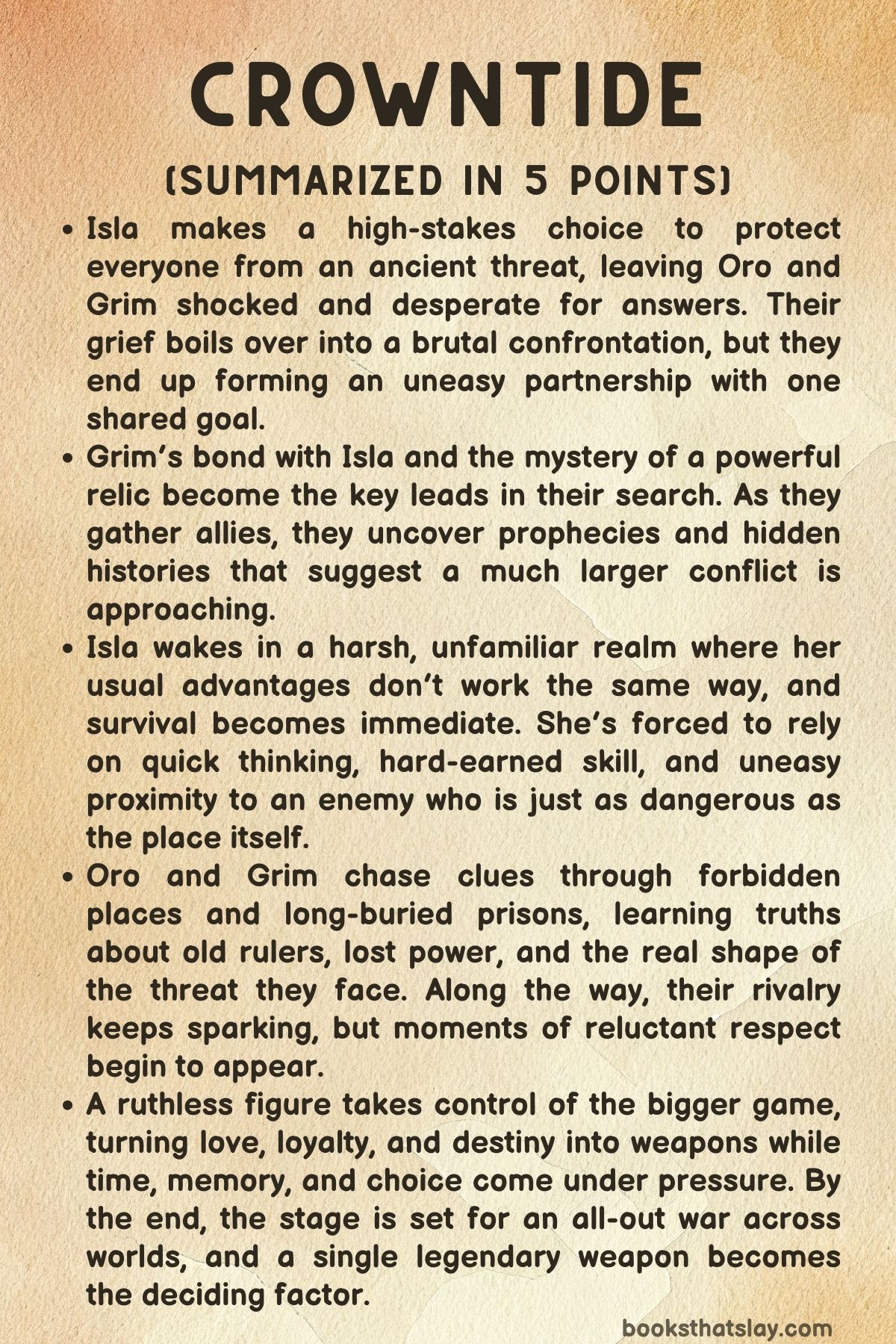
Crowntide by Alex Aster is a high-stakes fantasy about love, loyalty, and survival when two worlds begin to collide. After Isla vanishes through a secret portal to drag an immortal enemy away, the people who love her most are left with fear, anger, and one shared goal: bring her back.
What follows is a race across cursed lands and broken realms, where power has a price and memory can be used like a weapon. As ancient rulers return and old prophecies tighten their grip, Isla and her allies face choices that could save everything—or end it.
Summary
In the aftermath of the maze’s destruction, Oro Rey and Grim Malvere stand at the scorched center where Isla disappeared. Grim, ruler of Nightshade, is shaken as he clutches a burned feather fragment—proof she was there—while Isla’s bonded panther, Lynx, rages at the sealed spot.
Oro understands what Isla has done: she pulled Lark Crown, an immortal ancestor who cannot be destroyed in their world, through a hidden portal into the founders’ original realm. Isla meant to end the threat elsewhere, even if it cost her.
Shock turns into fury. Grim attacks Oro, and the two kings fight barehanded because the maze blocks their powers.
The brawl ends with both bloodied and broken, until Grim holds a blade at Oro’s throat and asks one question: does Oro love Isla? Oro answers yes.
Grim, strangely steadied by the truth, decides they will retrieve Isla together. He hates Oro, but loves Isla more.
Back at Grim’s winter castle, Grim gathers Oro and their allies—Enya, Zed, Calder, and the general Astria. The portal Isla used is closed, and the only other major gateway is the Lightlark portal, which Grim could force open at catastrophic cost.
Grim admits he can feel Isla through their soul-bond, but he cannot follow it across realms. Oro pushes for solutions.
Grim reveals a dangerous secret: a legendary object called Infinite, stronger than Lightlark’s heart, has destroyed or cursed those who sought it. Grim claimed it long ago, and Isla now wears it on a chain.
Grim recalls how he obtained Infinite. After asking Isla to be his wife, he traveled to the shielded island Atlas and entered a darkness that stole his senses and tested his mind.
The island confronted him with the lives he took, the soldiers he slaughtered, and the guilt he buried. It forced him into the memory of killing his sister Laila as a child when his shadows spiraled out of control.
It also showed Isla’s worst moments, including villages burned by her power, taunting him for loving her anyway. Grim refused to deny any part of her and insisted his love did not have limits.
The darkness demanded his deepest desire, tore something from his mind, and only then allowed him to take the black diamond.
Meanwhile, Isla and Lark arrive in the other realm with a crushing impact. Isla seals the portal shut using everything she has left and collapses in an ash desert beneath a strange, swirling sky.
Healing is slow, and her powers are nearly blocked; even Infinite does not help. Scavengers in gray capture them, strip Isla of her weapons and armor, and drag her behind a cart stacked with ruined bodies—remains from failed crossings.
Isla tries to escape and free Lark, but the ash itself pulls her back. Along the road, she glimpses brief flashes of the world’s former beauty—forests and rivers—before it dissolves into ash again.
A sand-creature attacks the scavengers, draining two of them into husks before fleeing.
On Lightlark, Oro refuses to accept Isla is gone. He seeks Cleo, who admits she aided Isla because Isla promised a chance to revive Cleo’s lost son.
Cleo shares a prophecy about someone “born of life and death,” marked by halves, whose choice will decide doom or prosperity, and warns that a war between worlds—Crowntide—is coming. She also reveals Oro’s father searched for a “lost king.” Using a hidden compass-map, Grim portals Oro and Cleo to a small rock in the ocean.
Cleo parts the sea to reveal a vast drop, and Grim and Oro leap into an underwater land where their powers vanish.
They find an ancient prison: chained beings trapped in a cycle of drowning, dying, reviving, and drowning again. Fighting with only blades, Grim and Oro push through feral prisoners and argue about Isla, love, and the damage they’ve done.
Oro insists he will save Isla even if she never chooses him; to him, love means wanting her alive. Their alliance remains tense but functional.
In the other realm, a storm arrives and changes everything. Rain restores Isla’s power—and Lark’s.
Lark breaks free, heals, and attacks immediately, opening a storm portal above and sending a massive torrent toward Isla. Isla battles her while chaos erupts: portals open overhead, dropping twisted creatures, and knights arrive in beams of light wearing void-like helmets and carrying shadow-forged weapons.
Their presence drains Isla’s essence, pins her down, and shatters her armor. Seeing a smaller portal that leads elsewhere within the same realm, Isla grabs Lark, shields them with fused armor pieces, and escapes into a forest under the same unnatural sky.
The forest is alive with ancient force and forces remembrance. Isla is dragged through scenes of her childhood training—brutal drills, punishment, isolation, and the destruction of the few keepsakes she had of her mother.
She also remembers finding a strange stick that could open a keyhole into another world.
Back in the underwater prison, Grim and Oro face a chained scaled beast: a massive scorpion with a whip-like tongue and lethal stinger. It nearly kills Grim, but Oro intervenes, severing the tongue and blocking the strike—snapping Grim’s ancient sword into fragments.
They escape over a rocky rise and finally reach the lost king, chained with ten shackles, eyes blank until Grim threatens him. The king speaks as if he expected them, warns the future is split, and confirms Cronan is alive.
The king explains that Isla is a Worldkey: with all six abilities and the Infinite diamond that once cast Cronan out, she could allow Cronan to return and rule everything once he has his sword and crown. This realm was once a prison-bridge where relics were hidden; Cronan tried to claim Infinite but failed because it required a soul and love, so it cursed him and made this world poisonous to him.
The king produces golden Threads of Time from within his own body and says they are the only thing that can help set things right—so long as Cronan never gets them. When Grim and Oro take the threads, the king vanishes, leaving only chains.
Cleo’s strength falters above as she holds the ocean apart, so Grim and Oro fight their way out, using chains as weapons, and Grim chooses to save Oro during the collapse.
They seek a way to reach the cursed world and recruit Azul, who agrees despite her grief. In that fogbound place, Grim and Oro face echoes of the dead—brief, painful reunions that underline what is at stake.
They return to Lightlark with a plan and a terrible clock ticking.
In the other realm, Cronan arrives in the Forgotten Forest, crushing its defenses into ash. Isla sees how closely he resembles Grim and understands the danger: Cronan is Grim’s ancestor and the ruler of this ruined world.
Soon after, Grim finds a strange woman in an otherworldly castle—Isla, unrecognized because Cronan has erased Grim’s memories of her. Cronan claims she is a threat because she loves the Sunling king.
He orders Grim to kill her. Grim attacks, but Isla unleashes power, escapes into the storm, and Grim hunts her through shadows.
Back on Lightlark, Oro’s grief cracks into uncontrolled power, and the island reacts violently due to his nexus curse—collapsing cliffs, raising waves, and forming a fire cyclone. Enya’s near-death snaps him back.
As they defend the tide pool portal, beasts pour through, and a massive sky creature nearly kills them before Oro tears it open to rescue Enya from inside.
Isla hides in an oasis village and meets Jessel and two children who share scarce “sacred water.” Isla leaves to protect them, then reaches through her bond with Oro. She warns him Grim is hunting her and that Cronan wiped Grim’s memory.
Oro urges her to reach the portal they are holding, and when she asks for Grim’s weakness, Oro answers: her.
Grim catches Isla, and their chase tears across shifting terrain through storm portals. A lightning-triggered vision shows Grim holding Isla dead on a battlefield, and it shakes him enough to stop short of killing her.
He brings her back to Cronan alive. Cronan reveals Isla’s absorption: she carries the power of everyone she has killed, and he wants to control her.
He also wants the Threads of Time and intends to use a Pool of Possibilities to change outcomes. Grim, believing he must earn trust to protect his people, gives Cronan the Threads.
Cronan forces Isla into an impossible choice: serve him, or he destroys her world and everyone in it. He also engineers a cruel “salvation” where Isla and Grim must duel—winner saves their realm—turning love into a weapon.
Isla tries to rebuild new memories with the memoryless Grim, even sharing a final night with him, but she escapes before the spectacle. Oro, guided by a silver-haired woman near a silver pool, learns of a hidden weapon called Heartblade—something that can kill anyone and anything.
Isla returns to the Forgotten Forest to force Grim through living memories of their history, hoping to restore what was taken. For a moment, the word “infinite” seems to reach him—but Cronan arrives and forces Isla to lead him to the Pool of Possibilities.
There, Cronan uses the pool and his stolen tools to search for paths to greater power, then breaks Isla’s neck. Isla heals: she secretly killed Lark to absorb her ancient power and become nearly impossible to kill, intending to revive Lark later.
Isla fights back with overwhelming force, frees trapped souls, and pushes into Cronan’s mind, discovering Heartblade is the one weapon that can truly end him. She takes his crown, shaking the world.
Isla asks Grim to join her and reach for Heartblade, but Grim steps into the pool and sees futures where going with her means his death. Believing he must choose the one path that keeps Nightshade alive, he betrays her, sends Cronan’s crown away, and uses his power against Isla—making Isla and the pool vanish.
Isla reappears at Lightlark’s tide pool as it expands into a midnight crater, releasing people long lost—including Cleo’s son. Oro catches Isla as she collapses.
Isla tells him Grim chose Cronan, yet insists their bond proves Grim’s love was real. Before Oro can explain what he has seen in the futures, the sky splits open and dozens of portals appear—Cronan’s worlds arriving to conquer.
Isla realizes the war can only end with Heartblade, and that fate has fractured into many outcomes. Someone will wield the blade, and someone will die by it—leaving one final question: whose heart it will pierce.
Characters
Isla Crown
Isla is the emotional and moral fulcrum of Crowntide. She is defined by a paradox the story refuses to simplify: she is both catastrophe and cure, a woman whose power can incinerate villages by accident and also resurrect the drowned dead from a cosmic prison.
Her defining trait is will—when she realizes Lark cannot be ended in their world, she chooses exile into a founders’ realm rather than let everyone else pay the cost, and that instinct to shoulder the impossible keeps repeating even when it destroys her body, her safety, and her chances at peace. Isla’s identity is also bound to memory: the Forgotten Forest weaponizes her past to break and shape her, Cronan attempts to pry open her mind like a locked room, and she responds by turning remembrance into strategy—trying to “build new memories” with Grim when the old ones are stolen, and later dragging him through living scenes of their life to force recognition back into him.
Her growth is not about becoming softer or stronger—she already contains both—but about accepting what she is without letting Cronan define it: she refuses to become his weapon even when he offers survival, and she takes terrifying agency by killing Lark to absorb an ancient flair, choosing imperviousness to death not as domination but as a last lever against an immortal tyrant. By the end, Isla is less a chosen one than a pressure point in reality itself: “Worldkey,” bearer of Infinite, carrier of six abilities, and the person whose love and choices split futures into branching possibilities, making her both the war’s spark and its only credible end.
Grim Malvere
Grim begins as Nightshade’s demon ruler, but his core is grief braided with devotion, and Crowntide uses him to explore what love costs when it collides with centuries of violence. He is a man built to be feared who is undone most completely by absence: Isla’s disappearance turns him feral, and the first thing that comes out of him is brutality—his fight with Oro is not politics, it is mourning with fists.
Yet Grim’s brutality is paired with an almost startling emotional clarity; when he asks Oro if he loves Isla, the answer doesn’t enrage him, it relieves him, because Grim’s obsession is not possession so much as retrieval—he wants her alive more than he wants to win. His past is a wound that never closes: the vision of killing his sister Laila, his history as a merciless killer, and the guilt of soldiers he slaughtered form the psychological architecture of his self-loathing, and the island Atlas forces him to confront the ugliest parts of himself by insisting his love is hypocrisy.
Grim’s response is the most honest thing about him—he does not deny Isla’s monstrous edges or his own; he insists love includes the whole, and that insistence is what lets him claim Infinite in the first place. When Cronan erases his memories of Isla, Grim becomes the story’s most painful illustration of how identity can be severed from experience: his body still reacts to her aura, his bond still tugs, but his mind becomes weaponizable.
Even so, he is not reduced to a puppet; he strategizes within a three-week deadline, he hesitates when a lightning-triggered vision shows him holding Isla dead, and he keeps choosing and re-choosing what loyalty means. His most devastating choice—betraying Isla at the pool after seeing futures where joining her means his death—reveals his fundamental fracture: Grim is capable of self-sacrifice, but he is also terrified of being erased, and Cronan exploits that fear by turning survival into treason.
Grim ultimately embodies the book’s cruel question: if love is real but memory is stolen, does love still obligate you—and what happens when your future fear outweighs your past devotion?
Oro Rey
Oro is the Sunling king, but his most defining quality in Crowntide is not light—it is restraint, and the story repeatedly shows how hard-won that restraint is. He loves Isla with a steadiness that refuses to become entitlement; even when Grim presses him, Oro’s answer is immediate and clean, and later he crystallizes his philosophy with painful maturity: true love means wanting her alive regardless of who she chooses.
That ethos is what makes him an unusual rival—he is not trying to “win” Isla so much as to keep her from being lost to death, tyranny, or fate. Yet Oro is also dangerous in a way he fears, because his emotions are coupled to land through the nexus curse; when his grief spikes, the island breaks, cliffs collapse, and a tidal wave becomes an externalized panic attack.
His near-catastrophic fire cyclone is not villainy, it is the cost of leadership when your body is a lever attached to the world’s foundation, and Enya’s presence yanks him back to humanity precisely because she makes the consequences personal again. Oro’s arc is also about being useful without control: he saves Grim from the chained scorpion at the price of Grim’s blade shattering, he leads defenses against an endless breach of beasts, and he becomes Isla’s lifeline through their bond when she is alone in an ash world and needs one actionable truth—Grim’s weakness is her.
By the end, Oro is both anchor and fault line: he holds the line against invading horrors, catches Isla when she collapses, and carries foreknowledge of branching futures that seems to tear him from the inside, positioning him as the character most likely to be asked to choose between love, survival, and the world—without the comfort of certainty.
Lark Crown
Lark is an immortal ancestor and a living embodiment of inevitability, functioning less like a conventional villain and more like a curse wearing a face. What makes her terrifying is not simply power, but persistence—she cannot be ended in their world, which forces Isla into the desperate logic of exile and inter-realm warfare.
Lark’s personality reads as predatory contempt: she mocks weakness, capitalizes on moments when storms restore abilities, and when freed, she doesn’t negotiate—she attacks immediately with overwhelming force, calling down a catastrophic torrent. Yet the narrative also uses Lark as a mirror to Isla, showing how ancient power curdles when it is only survival and dominion; Lark is what Isla could become if love and empathy were burned out of her.
Her significance grows when Isla bargains with her—Lark becomes a reluctant instrument because she wants her feather artifact back, proving that even near-mythic beings can be tethered by desire and ego. Isla’s eventual decision to kill Lark to absorb her flair is one of the book’s darkest moral turns: it reframes Lark from antagonist to resource, and it underlines a central theme that power in this universe is transmissible, stolen, and paid for in blood.
Even after death, Lark remains a lingering ethical weight, because Isla intends to revive her later—meaning Lark becomes a debt Isla carries, not a problem neatly removed.
Cronan
Cronan is the architect of the larger nightmare, a conqueror whose cruelty is systematic rather than impulsive. He operates like a strategist who thinks in timelines, probabilities, and leverage, which makes him feel less like a monster and more like an empire given consciousness.
His obsession with Infinite and the Threads of Time reveals his governing impulse: he does not merely want to win, he wants to make losing impossible by rewriting the conditions of reality. Cronan’s manipulation is intimate—he doesn’t only invade worlds, he invades minds, building labyrinthine defenses like a maze and prying into Isla’s mental walls, while also exploiting the link that invasion creates to expose his own weakness.
He weaponizes spectacle as governance, turning Isla’s death into a public performance and forcing a duel designed to destroy both hope and love: either Isla dies, or Grim kills her and dies with her, or Grim refuses and dooms his people. Even his “knights” are an extension of his narcissism, revealed as weaker versions of himself, which makes his army not merely loyal but literally self-derived—an empire of echoes.
Cronan’s most chilling quality is his ability to turn love into a liability: he erases Grim’s memories to turn devotion into obedience, dangles Nightshade’s survival as a chain, and tries to reduce Isla to a breeding plan and an ultimate weapon through her absorption flair. Yet he is not invulnerable; he fears a specific weakness, and Heartblade is positioned as the one true check on his immortality, making Cronan the kind of villain who cannot be reasoned with, only ended—if anyone can bear the moral and emotional cost of doing it.
Cleo
Cleo functions as the story’s hinge between prophecy and consequence, a figure whose grief becomes bargaining power. Her collaboration with Isla is not framed as simple betrayal or alliance; it is maternal desperation weaponized by a world that keeps offering miracles at a price.
The promise of resurrecting her lost son makes her choices comprehensible even when they are dangerous, and her revelation of an additional prophecy widens the conflict into generational inevitability—Crowntide is not a single crisis but an approaching collision of worlds. Cleo’s power is also depicted as physically costly; holding the sea split open while Grim and Oro descend into the ancient prison is an act of sustained sacrifice, and the image of her exhaustion turning the staircase uneven and fragile underscores that her magic is not abstract—it is muscle, stamina, and pain.
When the drowned and chained beings begin returning and her son appears alive, her arc becomes an illustration of what the book repeatedly argues: hope is real, but it arrives wearing the bruises of everything it demanded to exist.
Enya
Enya’s role is that of a relational stabilizer—a character who keeps larger-than-life powers tethered to human stakes. Her most crucial moment is not a battle victory but an interruption: she enters the eye of Oro’s raging storm and her fear snaps him back before he becomes a natural disaster that kills everyone he is trying to save.
That dynamic positions her as someone whose presence carries emotional authority, even over kings, because she represents the immediate, living cost of losing control. Her injury—losing her wings and being swallowed by an enormous creature—reinforces the vulnerability of even powerful allies and prevents the conflict from becoming a cleanly heroic power fantasy.
Enya’s survival, pulled from inside the monster, becomes a quiet counterpoint to the book’s darker resurrection mechanics: sometimes being saved is not mythic destiny, it’s someone choosing you hard enough to tear through horror.
Zed
Zed operates as a frontline constant, a companion whose value is proven through endurance rather than revelation. In the escalating defense against beasts pouring through the tide pool, Zed is part of the core group that keeps standing when the situation becomes absurdly unwinnable, and that persistence matters because it establishes that the world is not saved by one protagonist’s power alone.
Zed’s presence helps frame Oro’s leadership as communal rather than solitary; every time the narrative returns to the island’s defenses, Zed’s continued fighting reinforces that survival is a collective act that eats at everyone, not just at the kings.
Calder
Calder, like Zed, is a survivalist pillar whose characterization is expressed through action under pressure. He is repeatedly positioned among the defenders when the tide pool breach turns into a prolonged siege, and his steadiness helps communicate the scale of the threat: it is not a single monster to slay but a sustained collapse of boundaries between worlds.
Calder’s importance is structural—he makes the defense feel like a real war effort rather than a backdrop for royal drama, and by being there through the worst surges, he anchors the narrative in the reality that ordinary courage is still required even when gods and ancestors are moving pieces on a cosmic board.
Astria
Astria is presented as Grim’s general, a figure of disciplined loyalty who embodies Nightshade’s martial backbone. Her inclusion in the council-like gatherings signals that Grim’s realm is not held together by his will alone, and her presence implicitly contrasts with Grim’s emotional volatility: where he swings between grief and violence, a general like Astria represents the machinery of order that must keep functioning.
Even without extended interiority, she matters because she demonstrates that Grim is not merely a solitary monster-king; he is the head of an organized power, and the stakes of his decisions ripple through people trained to follow him into disaster.
Lynx
Lynx, Isla’s bonded panther, carries the story’s rawest grief response. When Isla vanishes, Lynx roars and claws at the charred ground as if rage could reopen a closed world, and that animal intensity expresses what the human characters often can’t say cleanly: loss is not poetic, it is feral.
Lynx’s hesitance during the kings’ fight—prowling, growling, not fully intervening—also highlights the complicated bond dynamics around Isla: Lynx is loyal to her, but the conflict is between the two men who love her, and the animal’s uncertainty mirrors the story’s larger moral uncertainty about ownership, partnership, and what “protection” means when it becomes violent.
Aurora
Aurora appears like an intervention from the mythic layer, a silver-haired presence who can stop time, disperse attackers, and offer sanctuary through a silver pool. She functions as both mercy and warning: she gives Isla restoration and a breath of safety while insisting something worse is coming, and later she shields Isla at the pool long enough for a plan to unfold.
Aurora’s significance lies in what she represents—an older, possibly forgotten order that still resists Cronan’s flattening darkness—and her selective appearances suggest that help in this universe is never free or constant; it arrives in narrow windows, requiring the characters to act decisively before it disappears.
Azul
Azul is the embodiment of grief turned into resolve, someone whose loss—her husband’s death in the curses—could have made her inert, but instead becomes a reason to keep participating. When Grim and Oro need a living connection to reach the cursed world, Azul agrees despite exhaustion, which shows a different form of courage than battlefield valor: the willingness to reopen trauma because it might save others from inheriting it.
Her return from the foggy realm is solemn, and that emotional tone matters because it reminds the reader that the dead are not merely lore; they remain psychologically present, shaping choices and alliances in the living world.
Jessel
Jessel introduces a crucial texture of ordinary life inside the ruined otherworld of Crowntide. She is compassionate without being naïve—she shares water, food, and shelter while the world outside is ash and scarcity, and her home with Prelis and Agor becomes a brief pocket of tenderness that throws Isla’s isolation into sharper relief.
Jessel also embodies the cost of Cronan’s long rule: communities that survive by clinging to “sacred water,” by hiding underground, by accepting that opposition often means disappearance. Isla leaving quietly to avoid endangering Jessel and the children underscores Jessel’s narrative purpose—she makes Isla’s war personal by giving it innocent faces who would be crushed if the protagonists treat collateral damage as abstract.
Prelis and Agor
Prelis and Agor are the story’s reminder of what the war is actually about—not crowns, not prophecy, but whether children get to grow up in something other than ash. Their presence in Jessel’s underground home creates a moral contrast with Cronan’s galaxy-room ambitions and his talk of breeding heirs and conquering planets.
They also serve as a mirror to Isla’s own stolen childhood memories of brutal training and punishment; seeing children sheltered, fed, and cared for clarifies what was denied to her and what she refuses to let be denied to others if she can help it.
Egan and Violet
Egan and Violet appear as dead figures who pull Oro toward duty and sacrifice, and their significance is less about their individual histories than the way they reveal the cursed world’s emotional predation. Their presence in that realm shows how grief can be manipulated through brief reunions, tempting the living to linger, to choose longing over responsibility.
For Oro, these encounters sharpen the theme that leadership is often choosing to walk away from the dead in order to protect the living, even when the dead are the ones you most want to keep.
Laila
Laila exists primarily as a psychological scar, the sister Grim killed as a child when his shadows went out of control. The vision of her accusing him of betrayal and shoving him from the cliff is not just trauma replay—it is a manifestation of Grim’s deepest fear that love makes him disloyal and unworthy.
Laila’s role is to personify the guilt Grim cannot outrun; she is the “proof” his own mind uses to argue that he does not deserve family, tenderness, or redemption. That guilt is precisely what makes him vulnerable to Cronan later, because a man who believes he is fundamentally corrupt can be convinced that monstrous choices are all he is fit to make.
The Lost King
The lost king functions like a narrative oracle with agency, a chained figure who speaks in inevitabilities and probability rather than simple guidance. His warnings about split futures and his emphasis on keeping the Threads of Time from Cronan position him as someone who sees time like terrain—mapped, forked, and weaponized.
His abrupt vanishing after delivering the threads suggests he is less a rescued prisoner than a designed encounter, which adds to the story’s sense that the world contains mechanisms and guardians older than the current conflict. He matters most because he reframes Isla not just as powerful but as infrastructural—Worldkey, amplifier, and the hinge that could let Cronan return—and by doing so, he turns the personal love triangle into a cosmic vulnerability.
Themes
Love as Choice, Sacrifice, and Responsibility
Love in Crowntide is presented as an active, often brutal choice rather than a comforting refuge. The narrative repeatedly frames love as something that demands action even when that action causes pain, loss, or moral conflict.
Isla’s decision to drag Lark into another realm rather than destroy her outright is rooted in a refusal to let her world be annihilated, even if it means erasing herself from everyone she loves. This is not framed as noble in a simple sense; it is isolating, terrifying, and leaves devastation behind.
Grim’s response to Isla’s disappearance reinforces this portrayal. His grief manifests as violence, denial, and obsession, yet beneath it lies a persistent commitment to finding her, regardless of cost.
His willingness to work with Oro, a rival and romantic threat, shows love overriding pride and hatred. Oro’s position complicates this further.
He loves Isla without expectation of possession, repeatedly asserting that her survival matters more than who stands beside her. That idea of love as responsibility rather than reward stands in direct opposition to Cronan’s version of love, which is possessive, strategic, and rooted in control.
Cronan treats love as leverage, something to exploit for power, whether through breeding heirs or manipulating bonds. The contrast becomes sharper when Grim loses his memories.
Even stripped of shared history, he is still pulled toward Isla, suggesting love is not just emotional recall but something embedded deeper, almost structural. Yet the story refuses to let love be enough on its own.
Love does not prevent Grim from choosing Cronan when faced with survival and prophecy. Love does not save Isla from suffering or force happy alignment.
Instead, love is shown as something that coexists with betrayal, fear, and impossible choices. It gives characters reasons to endure, to fight, and sometimes to fail.
In this world, love is not a guarantee of salvation; it is a force that magnifies consequence.
Power, Control, and the Cost of Immortality
Power in Crowntide is never neutral. Every form of strength, whether elemental, political, or cosmic, extracts a price from those who wield it.
Immortality, in particular, is depicted as corrosive rather than aspirational. Cronan’s long existence has stripped him of empathy, leaving behind a fixation on dominance, legacy, and inevitability.
His need to control outcomes through the Threads of Time and the Pool of Possibilities reflects a fear of uncertainty rather than confidence in strength. Grim’s relationship with power is shaped by guilt.
His shadows, once tools of conquest, are inseparable from the atrocities he committed, including the death of his sister. The trial he faces on Atlas forces him to confront not just what he has done, but what power turned him into.
Isla’s abilities represent another dimension of this theme. Her absorption of the powers of those she kills turns survival into a moral burden.
Each victory adds weight rather than relief, making her strength inseparable from loss. The Infinite diamond embodies the illusion of ultimate power.
It promises fulfillment while quietly taking something essential in return, blurring the line between gift and curse. Even Oro, often positioned as morally steadier, loses control when grief overwhelms him, and the land itself reacts violently to his emotional imbalance.
Power responds to inner states as much as intention, suggesting that authority without emotional restraint is inherently dangerous. The repeated suppression of powers in certain realms reinforces the idea that strength is context-dependent and fragile.
When power is stripped away, characters are reduced to raw physical struggle, exposing who they are without their advantages. Immortality and vast power do not grant clarity or peace; they prolong conflict and magnify mistakes.
The story argues that unchecked power leads not to order, but to repetition of harm on a larger scale.
Memory, Identity, and the Fear of Being Forgotten
Memory functions as the foundation of identity, and the threat of losing it is portrayed as a form of annihilation more terrifying than death. Grim’s erased memories of Isla do not simply remove affection; they destabilize his sense of self.
He becomes vulnerable to Cronan’s influence precisely because his past has been stripped away, leaving gaps that can be filled with lies and manipulation. Isla’s attempt to rebuild their connection through shared memories highlights how identity is constructed through lived experience rather than titles, bonds, or fate.
The Forgotten Forest externalizes this theme by forcing characters to confront suppressed histories. It does not allow selective remembrance; pain, joy, and shame surface without permission.
Isla’s childhood memories of training, punishment, and loss reveal how her resilience was forged through erasure of comfort and safety. Cronan’s manipulation of memory is deliberate and strategic.
By showing Grim visions of Isla killing those he loves, he reframes her identity as threat rather than partner. Memory becomes a weapon used to dictate future choices.
At the same time, Isla’s ability to invade Cronan’s mind reveals that even the most fortified identities have weaknesses shaped by fear and regret. The story also explores collective memory through ruined worlds and ash deserts that once held life.
These landscapes remember what was lost, even when inhabitants try to move on. The resurfacing of trapped souls and resurrected victims suggests that the past cannot be permanently buried.
Memory demands acknowledgment. Characters who attempt to escape it, like Cronan, become trapped in cycles of repetition.
Those who face it, like Isla, carry its weight forward. Identity in this world is not fixed by birth or prophecy but continuously reshaped by what is remembered, what is erased, and what is chosen to be faced.
Fate, Choice, and the Violence of Prophecy
Prophecy is not a guiding light but a source of coercion. Visions of the future are presented as fragmented, conditional, and deeply harmful when treated as absolute truth.
The oracle’s predictions about Crowntide and the figure born of life and death create pressure that shapes decisions long before outcomes arrive. Characters act not because they want to, but because they fear what will happen if they do not.
Cronan embodies the most extreme response to prophecy. He attempts to dominate fate itself by rewriting timelines, believing that control over possibility equals control over reality.
This obsession strips agency from everyone around him, turning lives into variables. Grim’s choice at the Pool of Possibilities illustrates the cruelty of prophetic knowledge.
Seeing futures where his survival depends on siding with Cronan traps him in a decision where every option carries moral devastation. Isla’s resistance to prophecy is quieter but persistent.
She repeatedly disrupts expected outcomes, whether by surviving death, absorbing Lark’s power, or refusing to kill Grim when demanded. The narrative suggests that prophecy becomes violent when treated as instruction rather than warning.
Fate exists, but it is unstable, branching, and responsive to human action. The repeated emphasis on fractured futures underscores that no single path is guaranteed.
Even when characters believe they are acting to save the world, they may be narrowing its possibilities instead. The final question surrounding Heartblade reinforces this uncertainty.
The story does not promise that destiny will resolve cleanly or justly. It insists that choice remains, even when outcomes are unbearable.
Fate may frame the battlefield, but it does not remove responsibility for what is done upon it.