About Grace Summary, Characters and Themes
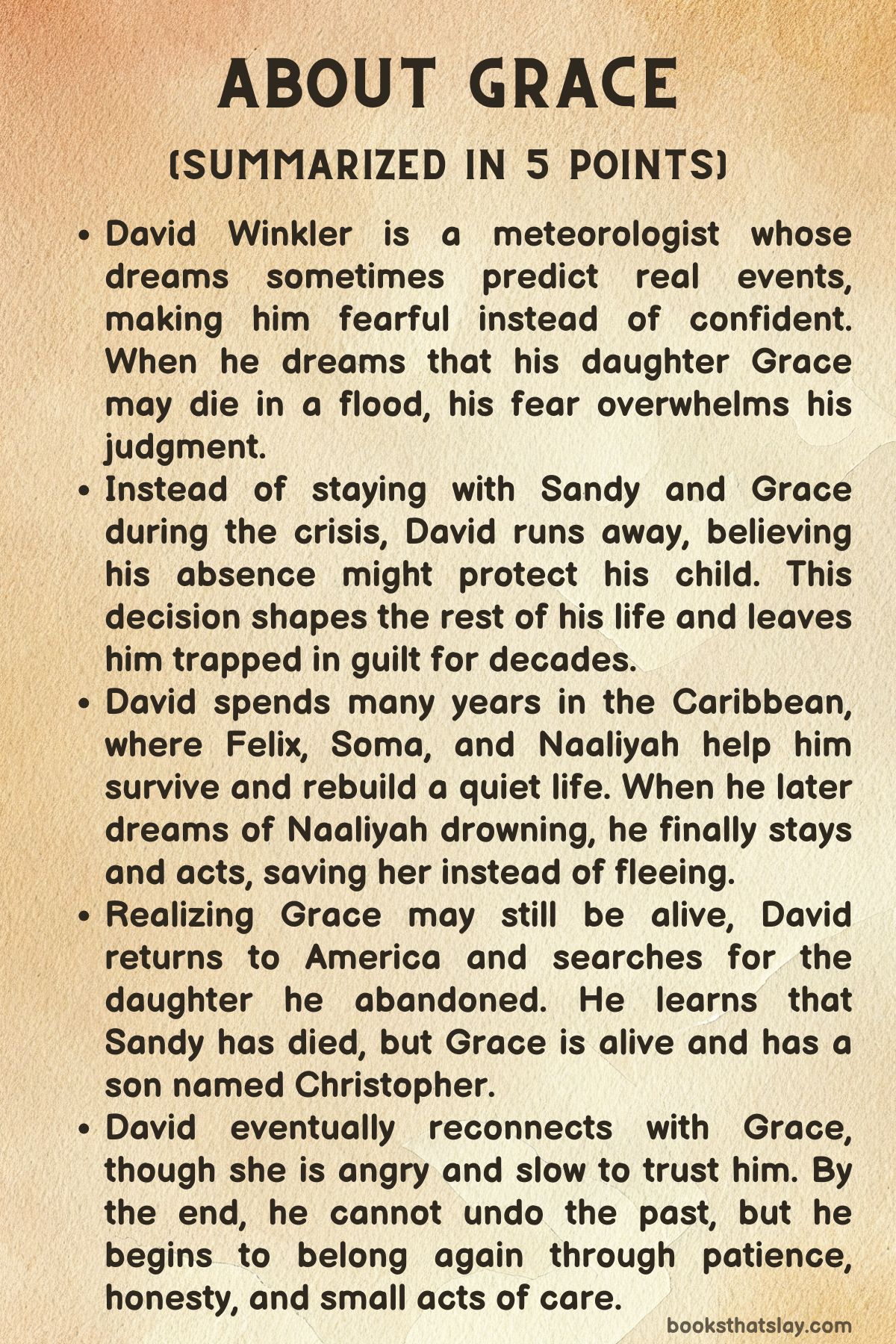
About Grace by Anthony Doerr is a literary novel about memory, fear, guilt, and the long consequences of one terrible decision. At its center is David Winkler, a man whose dreams sometimes predict real events before they happen.
That gift, which should make him feel prepared, instead leaves him frightened and uncertain, especially when his young daughter seems to be in danger. The novel follows him across decades and across continents, from Alaska and Ohio to the Caribbean and back again, as he struggles with love, loss, and the question of whether a person can ever return from the life he abandoned.
Summary
David Winkler is a meteorologist whose life is shaped by an unsettling ability: now and then, he dreams events before they happen. Sometimes the dreams are minor and only become meaningful in hindsight, but at other times they arrive with a force that convinces him they are warnings.
As a child in Cleveland, he first learns the weight of this gift when he dreams of a man being struck by a bus. The event happens exactly as he foresaw it, leaving both him and his mother shaken.
His mother believes him, but the experience teaches David that knowledge does not necessarily give him the power to change what is coming.
Years later, David is living in Anchorage, Alaska, working for the National Weather Service. He meets a woman named Sandy after recognizing her from a dream in a grocery store.
Their connection grows slowly, then turns into an affair. Sandy is married to Herman Sheeler, a bank manager, but she feels trapped by the narrowness of her life and drawn to the possibilities David seems to represent.
Their meetings become the center of David’s emotional world. When Sandy becomes pregnant, the situation shifts from fantasy to consequence.
David offers escape, and eventually she leaves Herman and runs away with David to Cleveland.
In Ohio they build a new life together. David becomes a television meteorologist, and Sandy creates art in a basement studio.
They marry and settle into a house near the Chagrin River. Their daughter, Grace, is born, and David feels a depth of love that changes him completely.
For a while he feels protected inside family life. Then the dreams return.
This time they are centered on Grace and on water. In the most frightening one, floodwater fills the neighborhood, Grace is missing in the house, and when he finally finds her and carries her outside, she is limp and unresponsive in his arms.
David becomes obsessed with the dream. Because of his training, he knows that weather conditions make flooding plausible.
He tries to persuade Sandy that they should leave the house, go on vacation, or at least take the danger seriously. But Sandy sees only that he is acting strangely, sleepwalking, and putting their infant daughter at risk.
His fear makes him seem unstable instead of protective. The more urgently he speaks, the less believable he becomes.
Tension grows between them as heavy rain begins and local flooding worsens.
At the crisis point, Sandy takes Grace and leaves him behind at a hotel after another episode of sleepwalking. David returns home, sees the flooded area, and becomes convinced that if he enters the house he will fulfill the dream and cause Grace’s death himself.
Instead of facing the moment, he runs. First he drives away in panic, then keeps going, moving from place to place until he reaches New York and boards a freighter bound for the Caribbean.
His flight is not brave or rational. It is an act of terror by a man who thinks absence might save the child he loves.
He ends up on St. Vincent with no money, little food, and no plan. He calls home repeatedly but learns almost nothing.
When he finally reaches Sandy, she is furious and tells him never to contact her again. He collapses into desperation and poverty until a Chilean couple, Felix and Soma Orellana, take him in.
They live with their daughter Naaliyah and three boys they have sheltered after political violence forced them to flee Chile. Their generosity gives David the first stable ground he has had since he fled Ohio.
David begins working for Nanton, a businessman building an inn over the lagoon. The labor is harsh but useful because it quiets his mind.
He writes letter after letter to Sandy and Grace, apologizing, pleading, and asking for news. He hopes for forgiveness or at least confirmation that Grace is alive.
Eventually a package arrives containing all of his letters returned to him. Sandy’s message is brutal: he is to stay away and consider himself dead.
Crushed by that rejection, David nearly drowns himself at sea, but he survives, as if denied even the release of death.
He remains on the islands for twenty-five years. During that time he becomes almost ghostlike, working maintenance at the inn, living simply, and watching the natural world with the same patient attention he once gave to weather.
Naaliyah grows up and becomes a marine scientist. David forms a deep bond with her, one based on shared observation and quiet companionship.
Yet his old fear returns when he dreams of Naaliyah drowning during fieldwork. This time, instead of running, he acts.
He warns her, watches over her, and even sabotages her boat to keep her from going out. When the dreamed event finally happens, he is there.
He reaches her in the water and saves her life.
That rescue changes him. For the first time, David has evidence that a dream does not only trap him; perhaps it can also prepare him to intervene.
Soon after, someone suggests that if he could help Naaliyah survive, perhaps Grace survived too. David realizes that Sandy never actually told him Grace had died.
That possibility, which should have occurred to him years earlier, opens a door inside him. He decides to return to America and find out the truth.
Back in Ohio after twenty-five years, David learns that Sandy died of ovarian cancer two years earlier. He also learns that locating Grace will not be easy.
He sets out across the United States visiting women who share her name, following thin leads with stubborn hope. The journey becomes both sad and strange, filled with false starts and brief encounters with people who show him kindness.
None of them is his daughter. Worn down physically and emotionally, he eventually makes his way north toward Alaska, where Naaliyah is now doing research.
At a remote camp in the Yukon, he recovers his strength while living near Naaliyah again. Snow, silence, and scientific work return him to an older version of himself, the boy who once loved snow crystals and the man who once studied water.
Encouraged by Naaliyah, he finally writes to Herman Sheeler and asks what became of Grace. Herman replies with the answer David has spent decades fearing and hoping for: Grace is alive.
She is an adult, divorced, and the mother of a young son.
David travels to Anchorage, where Grace lives. Even then he cannot simply walk up and announce himself.
He leaves pies at her door and retreats. He visits Sandy’s grave.
He gradually reconnects with Herman, who has become an unexpected bridge between past and present. Herman, despite everything, treats David with a rough and surprising decency.
Through him David begins to spend time with Grace’s son, Christopher, before Grace is ready to accept him.
When Grace finally confronts him, her anger is fierce and justified. She grew up believing that her father was unstable and that he abandoned her and Sandy.
David cannot erase that fact. He can only admit it.
Over time, through Herman, Christopher, and a family emergency, Grace allows him closer. During a crisis involving Christopher going missing and Herman suffering a heart attack, David acts instead of fleeing.
In the aftermath, Grace tells him what happened on the day of the flood: Sandy had gone back to the house to save her sculpture, and Grace survived. At last David understands the truth he spent most of his life avoiding.
By the end of the novel, loss remains real. Sandy is gone, Felix dies, and the years David abandoned can never be restored.
But he is no longer living as a fugitive from his own fear. He builds a modest life near Grace and Christopher, shares in family rituals, and begins, however imperfectly, to belong again.
The novel closes not with certainty, but with a hard-won peace, as David faces the world he once fled and accepts that love, guilt, memory, and hope can exist together.
Characters
David Winkler
David Winkler is the emotional and moral center of About Grace, and he is one of those rare characters whose greatest gift is also the source of his ruin. His prophetic dreams set him apart from other people long before he understands what they mean, and that difference shapes his inner life.
He grows up with a strong sensitivity to the natural world, especially snow, water, and weather, and this habit of close observation makes him both a skilled scientist and a deeply anxious man. He is intelligent, gentle, and attentive, but he is also passive in crucial moments.
He studies life carefully, yet when action is demanded of him, he often freezes or retreats. This tension defines him.
He is not selfish in any simple sense, because much of what he does comes from fear for the people he loves. At the same time, his fear becomes destructive because he trusts his own dread more than the messy reality of human relationships.
David’s greatest weakness is that he treats foreknowledge as a burden he must carry alone. Instead of allowing uncertainty to remain uncertainty, he turns his visions into fixed truths.
That habit leads him to believe he can prevent disaster only by removing himself, which becomes the central tragedy of his life. His abandonment of Sandy and Grace is not presented as a cold decision but as a failure of courage and faith.
He cannot bear the possibility that he himself might become the instrument of his daughter’s death, so he flees. What makes him such a powerful character is that he spends the rest of his life living inside the consequences of that moment.
He becomes a man haunted not only by what he saw, but by what he failed to do. His years in exile are not simply punishment.
They reveal his capacity for endurance, tenderness, and reflection. He can work hard, observe deeply, and care faithfully for others, but he struggles to forgive himself enough to reenter life.
Over time, David’s character develops through repetition and revision. His bond with Naaliyah gives him another chance to respond differently to fear.
When he dreams of her death, he again becomes obsessed, but this time he stays present. He acts, waits, and finally helps save her.
That moment matters because it proves that his visions do not only imprison him. They can also become part of responsibility rather than escape.
By the end, David is still fragile, still marked by guilt, and still inclined toward withdrawal, but he is no longer entirely ruled by fear. His late reunion with Grace and Christopher does not erase his failures, yet it shows that he has learned the hardest lesson of his life: love requires staying, even when certainty is impossible.
Sandy
Sandy is one of the most complex figures in the novel because she is both the object of David’s longing and a fully realized person with her own hunger for change. When David first meets her, she is already living inside a life that feels too small for her.
Her marriage to Herman is stable on the surface, but she experiences it as confining and dull. She is restless, imaginative, and dissatisfied with the limits placed around her.
Her attraction to David is not based only on romance. He represents risk, possibility, and escape from repetition.
She wants more from life than routine respectability, and that desire makes her vulnerable to the intensity of their relationship.
Sandy has artistic ambition, and that matters because it reflects something essential in her character. She does not merely want a different husband or a different house.
She wants transformation. Her sculpture, her unfinished projects, and her desire to become something larger than the role she has been assigned all suggest a woman trying to make form out of dissatisfaction.
She is practical enough to survive, but she also resists living as someone whose life is already decided. This is why she leaves with David, even though the choice is reckless.
She chooses uncertainty over stagnation.
At the same time, Sandy is not idealized. She can be withholding, evasive, and hard to read.
She does not fully explain her intentions, either to Herman or to David, and that secrecy creates instability around her. Once Grace is born, her priorities sharpen.
She becomes more protective, more grounded in immediate reality, and less tolerant of David’s dream-driven fears. Where David grows more abstract and panicked, Sandy becomes more concrete.
She sees his sleepwalking, his instability, and his inability to separate nightmare from present danger, and she responds as a mother. Her refusal to believe in his visions is not simply narrow-mindedness.
It is a defense of ordinary life against a fear that threatens to consume the household.
After David disappears, Sandy becomes a figure defined by endurance and anger. Her returned letters show how absolute her hurt is.
She refuses him not only because he left, but because his departure forced her into a life of solitary survival. Later revelations make clear that she carried enormous weight alone while still preserving some complicated emotional loyalty to him.
That contradiction is central to her character. She can condemn David and still remain attached to him in memory.
She can be furious and wounded and still unable to redraw her emotional history completely. Sandy embodies the cost of someone else’s failure.
She is not simply the abandoned wife. She is the person who had to turn grief into a functioning life.
Grace
Grace exists first in David’s imagination as beloved child, threatened child, lost child, and possible ghost. For much of the novel she is less a speaking presence than a force that shapes the lives of others.
That absence is meaningful. She becomes the central missing piece around which David’s guilt hardens.
Yet when she finally emerges as an adult, she is not a symbol. She is a person whose life has been deeply marked by abandonment.
Her character is built on the tension between what David imagines and who she actually is.
As a child, Grace represents innocence and possibility. David’s love for her is immediate and overwhelming, and his fear for her safety becomes stronger than his trust in himself.
Because of that, Grace becomes the measure of David’s failure. He tells himself he ran to save her, but in reality he leaves her to be raised without him.
By the time he finds her as an adult, she has inherited not his memories but the damage caused by his absence. She has grown up with a story about him that casts him as unstable and unreliable, and from her perspective that judgment is reasonable.
Her anger is one of the most justified emotions in the book.
Adult Grace is strong, self-protective, and unsentimental. She does not melt into reunion simply because David has suffered.
She demands that he face what he did. That refusal is important because it prevents the story from turning reconciliation into easy forgiveness.
Grace is a mother herself, and that fact sharpens her understanding of what it means for a parent to leave. Her protective instincts toward Christopher likely deepen her outrage at David’s disappearance.
She knows from the inside what care requires, and that makes his absence feel even less excusable.
Yet Grace is not defined only by resentment. Over time, she shows a capacity for listening and for measured openness.
She allows David back into the margins of family life, first indirectly and then more clearly. Her willingness to let him remain near Christopher suggests that she recognizes something sincere in him despite everything.
She does not erase the past, but she begins to make room for a more complicated truth. In that way, Grace represents both judgment and renewal.
She is the life David lost and the relationship he does not deserve but is slowly permitted to enter.
Herman Sheeler
Herman begins as the injured husband in a love triangle, but he becomes far more than that. At first he appears almost ordinary to the point of invisibility, which is part of why Sandy feels trapped with him.
He is conventional, dependable, and tied to routine. From David’s perspective, Herman seems like the man Sandy must escape in order to live fully.
But the novel gradually revises that impression. Herman is not glamorous, but he possesses a steadiness that gains moral weight over time.
One of the most remarkable things about Herman is his endurance of humiliation without being reduced by it. He is deceived by his wife and by David, and later he becomes the man who remains when David vanishes.
He helps sustain the world David abandoned. That alone gives him a dignity that grows stronger as the story progresses.
He does not become saintly; he carries pain, awkwardness, and some bitterness. But he also develops into one of the most generous figures in the book.
When David returns decades later, Herman could reject him completely. Instead, he feeds him, speaks with him, and eventually allows him access to Christopher.
This generosity does not mean he has forgotten what happened. It means he has learned how to live beyond it.
Herman’s kindness is especially striking because it is practical rather than sentimental. He offers meals, bus rides, information, and later a path toward renewed family contact.
His decency is never theatrical. It appears in ordinary acts.
That fits his character perfectly. He is a man of structures, routines, and repeated gestures, and in the end those qualities matter more than the dramatic intensity that once made David seem more appealing.
Herman becomes an unexpected model of moral adulthood. He has been wronged, yet he does not build his life around revenge.
He also serves an important thematic role by embodying the life that continues after betrayal. While David turns absence into identity, Herman keeps living.
He ages, has health problems, works, loves Sandy in his own way, and becomes involved in Grace and Christopher’s lives. Through him, the novel suggests that constancy may look plain from a distance but carries its own depth and grace.
His eventual relationship with David is uneasy, strange, and deeply human. He becomes one of the clearest signs that repair, while incomplete, is still possible.
Naaliyah
Naaliyah is one of the most vital presences in About Grace because she brings movement, intelligence, and renewal into David’s long exile. As a child she first appears curious, teasing, and observant, someone who watches David with interest rather than fear.
She shares his attention to the natural world, though her fascination lies with insects and marine life rather than weather and snow. This shared habit of looking closely creates a quiet bond between them.
Over the years she becomes his closest connection to growth and change.
Naaliyah’s importance lies partly in contrast. Where David tends to become trapped in memory and possibility, she moves forward.
She studies, leaves home, returns, and builds a scientific life for herself. She carries some of her parents’ history of displacement, but she is not content to remain inside inherited sacrifice.
Her restlessness has purpose. She wants work, knowledge, and a larger future.
In that sense she belongs to a younger generation that respects the past without surrendering to it. She is not drawn to suffering for its own sake.
She wants a life.
Her relationship with David is layered. At times she is student, companion, surrogate daughter, and eventually caretaker.
But the bond is never reduced to one simple role. She sees his loneliness and his goodness, but she also sees his self-defeating habits with unusual clarity.
She is one of the few people willing to challenge him directly. When he tries to stop her from going on the water, she resists him because she values her work and her independence.
Later, in Alaska, she becomes the person who pushes him toward truth. She insists he keep searching, keep writing, keep living.
She refuses to let him turn regret into an excuse for surrender.
Naaliyah also represents David’s chance to alter his pattern. By saving her when the dream of her drowning comes true, he discovers that foreknowledge need not lead to flight.
She becomes the living proof that destiny is not always fixed in the way he feared. That change affects the rest of his life.
Beyond her symbolic importance, however, she remains a convincing and memorable person: smart, ambitious, impatient, loyal, and capable of tenderness without softness. She is one of the main forces that pull David back toward the world.
Felix Antonio Orellana
Felix is a figure of warmth, improvisation, and generosity. He enters David’s life at the moment when David has reached physical and emotional collapse, and his kindness is immediate rather than cautious.
He does not demand explanation before offering food, transport, shelter, and work. That instinctive hospitality defines him.
Felix is not naive; he knows exile, danger, and uncertainty firsthand. Yet instead of becoming hardened by those experiences, he turns toward abundance whenever he can.
He cooks, feeds people, tells stories, and creates community.
His background as a refugee from political violence adds depth to his character. He has lost a country and a former life, but he refuses to let displacement erase his sense of purpose.
He rebuilds through labor and care. The kitchen becomes one of his main forms of identity, and his cooking is not merely practical.
It is a way of preserving dignity and pleasure in unstable conditions. He makes meals into acts of order and affection.
That makes him a quiet counterpoint to David, who often responds to loss by withdrawing. Felix responds by gathering people in.
As a father, Felix is loving but not controlling. He worries about Naaliyah, but he also recognizes that children move beyond their parents’ plans.
His household, filled with adopted responsibilities and layered histories, reflects his capacity to expand the idea of family. He and Soma do not live only for themselves.
They make room for others. David survives because Felix first decides there is room for him too.
Felix’s later decline and death carry great emotional weight because he represents one of the clearest examples of goodness in the novel. He is not idealized into perfection.
He drinks too much later in life, and sorrow changes him. But even in diminished form he remains associated with welcome, nourishment, and practical love.
His presence reminds the reader that survival is not only about endurance. It is also about the ability to feed, shelter, and make place for another person.
Soma
Soma is one of the quiet moral anchors of the book. She is less outwardly exuberant than Felix, but her steadiness gives shape to the household David enters in the Caribbean.
She works, manages, observes, and makes difficult generosity look natural. When David arrives, disoriented and nearly broken, Soma does not romanticize his suffering.
She simply helps. Her care is practical, disciplined, and full of intelligence.
She notices more than she says, which makes her one of the wisest characters in the novel.
Her history of exile parallels Felix’s, yet her response is distinct. Where Felix expresses resilience through sociability and food, Soma expresses it through order, labor, and emotional clarity.
She knows that survival depends not only on kindness but also on boundaries. This becomes especially important in her dealings with David.
She welcomes him, supports him, and later sits vigil with him when he fears for Naaliyah, but she also understands that love cannot mean total surrender to another person’s obsessions. She is capable of compassion without losing judgment.
Soma’s relationship with Naaliyah reveals another side of her character. She is both mother and witness, aware that children are shaped by their parents’ histories but not fully contained by them.
When Naaliyah begins moving away from the family, Soma feels that change sharply. Her sadness is understated, which makes it more affecting.
She understands that love often means allowing separation. That understanding gives her interactions with David additional depth, because she recognizes in him someone who failed at that balance and has suffered for it.
By the later sections of the novel, Soma becomes one of the few people still connecting David to his years abroad. Her letters, gifts, and continued concern show a long memory of care.
She does not dramatize loyalty, but she practices it across decades. Through Soma, the novel presents a form of strength that is not loud, heroic, or self-advertising.
It is the strength of someone who keeps tending to life even after history has taken much away.
Christopher
Christopher enters the story late, but he quickly becomes essential because he turns David’s abstract longing for family into a living, daily responsibility. As Grace’s son, he is both continuation and second chance.
He is curious, energetic, and open to wonder, especially in relation to insects, small experiments, and the natural world. His presence draws out David’s gentleness in immediate ways.
With Christopher, David is not only remembering what fatherhood might have been. He is participating in care in the present.
Christopher is important because children in this novel often reveal truths adults avoid. He moves toward fascination rather than shame, and that openness allows David to form a bond that is simple in the best sense.
They look at crystals, insects, and chrysalides together, and these moments matter because they are free of grand declarations. They are built from attention.
Christopher accepts David before fully understanding the emotional history around him, and that acceptance gives David a place to practice steadiness.
At the same time, Christopher is not merely a device for redemption. His temporary disappearance creates one of the final crises of the novel and forces the adults into action.
Through him, David once again faces the possibility of loss, but this time he responds with urgency rather than retreat. Christopher’s safety becomes part of the process through which Grace begins to trust David differently.
In that sense, Christopher is both beloved child and bridge between generations.
He also reflects the book’s broader concern with inheritance. Christopher inherits not only family history but also patterns of curiosity.
His interest in the small living world around him connects him to both David and Naaliyah. He suggests the possibility that wonder can continue even after damage.
His presence gives the ending warmth and future orientation. He is not burdened by the past in the same way as the adults, which allows him to embody hope without sentimentality.
David’s Mother
David’s mother plays a foundational role in the formation of his character. She is the first person to take his unusual perceptions seriously, and her response to his childhood dreams shapes the way he understands both nature and mystery.
She introduces him to snowflakes, frost, and the beauty of close observation, and in doing so she gives him a language for wonder. Through her, David learns that the world is full of patterns worth studying.
She is therefore central not only emotionally but intellectually. Much of David’s later work with weather and water can be traced back to the habits of attention she encouraged.
She is also associated with a kind of emotional openness that David later longs for and rarely finds again. When the bus accident confirms the reality of one of his dreams, she does not dismiss him outright.
Even if she cannot fully explain what is happening, she gives him sympathy rather than contempt. That matters because it contrasts sharply with the disbelief he later experiences from Sandy.
His memories of his mother often carry an atmosphere of quiet acceptance, of someone able to stand before darkness and still look upward.
Her influence extends symbolically as well. She is linked to winter, starlight, and the natural cycles that fascinate David throughout his life.
She helps establish the novel’s connection between scientific curiosity and emotional memory. She is not just a nurturing parent; she is one of the sources of his way of seeing.
Even after her death, she remains present as an internal guide, especially whenever David feels the need for comfort or for a model of patient attention.
The Butcher
The butcher appears later in the story, but his role is larger than his page time might suggest. He functions as one of the plain-spoken truth tellers who can say to David what no one else has framed so directly.
Unlike those who are either entangled in David’s past or emotionally invested in protecting him, the butcher brings outside clarity. His conversations with David help shift the narrative from endless remorse toward possibility.
When he suggests that David may have changed fate before and that Grace could still be alive, he does more than offer hope. He interrupts a long habit of fatalistic thinking.
What makes the butcher effective is his groundedness. He belongs to the ordinary world of work, conversation, and practical judgment.
He is not impressed by David’s suffering as a special condition. Instead, he responds with a common-sense moral imagination that cuts through David’s self-absorption.
This does not make him cold. In fact, his kindness is real.
But it is the kindness of someone who believes that a person must keep moving toward what can still be done.
He serves an important structural function by helping David imagine a future again. Up to that point, David has treated his life largely as aftermath.
The butcher helps transform it into unfinished business. That shift is crucial, and it comes from a character who is memorable precisely because he is so direct, modest, and human.
Nanton
Nanton is not one of the most emotionally intimate characters, yet he matters because he represents the systems of labor, structure, and material survival that make David’s island life possible. As the builder and owner of the inn, he offers David work when David has almost nothing.
His motives are not sentimental. He wants reliability, physical effort, and usefulness.
In that sense he treats David first as a worker rather than a wounded soul. This is significant because labor becomes one of the ways David remains alive.
Nanton’s plans for the inn, especially its unusual construction over the lagoon, suggest ambition and vision. He wants to turn natural beauty into enterprise, and that mixture of imagination and practicality mirrors other forms of making found throughout the novel.
Unlike the artists and dreamers in the story, however, Nanton channels vision into business. He is a builder of structures rather than relationships.
Still, his role should not be underestimated. He gives David a place in a social order, however limited, and later continues to employ him as the years pass.
The dignity and indignity of David’s work under Nanton track David’s own long exile. Through Nanton, the novel acknowledges that survival often depends on employers, systems, and routines that are not emotionally rich but are materially necessary.
He is a secondary character, but he anchors an entire phase of David’s life.
Themes
Fate, Knowledge, and Human Choice
David Winkler’s prophetic dreams introduce a complicated question about whether knowing the future helps or harms a person. His ability to foresee events seems at first like a gift, but over time it becomes a burden that distorts how he understands responsibility.
The dreams often reveal moments that later happen exactly as he saw them, and that accuracy causes him to treat his visions as unavoidable truths rather than possibilities. Instead of seeing the future as something flexible, he begins to interpret it as a rigid sequence that he cannot alter.
This belief shapes many of his choices, especially when he dreams about his daughter being in danger during a flood. Because he trusts the dream more than his own judgment, he becomes convinced that his presence will cause the tragedy he fears.
That conviction leads him to abandon his family in the hope that distance will protect them.
The story carefully questions this way of thinking. David’s interpretation of fate creates suffering rather than preventing it.
His fear turns into paralysis, and his attempt to escape destiny becomes the action that damages his life the most. The narrative suggests that knowledge alone does not determine the future.
Instead, the way a person responds to that knowledge matters more. This idea becomes clearer decades later when David dreams of Naaliyah drowning during her research work.
The vision feels just as real as his earlier dreams, yet this time he responds differently. Instead of fleeing from the possibility, he stays near her, watches carefully, and prepares himself to intervene if necessary.
When the accident occurs, he is able to help save her life.
That moment transforms how fate is understood in the story. The dream did not trap him in a predetermined outcome.
It prepared him to act responsibly within an uncertain situation. The theme therefore moves away from fatalism and toward a more complex view of choice.
Knowing something might happen does not remove human agency. It creates a responsibility to remain present and attentive.
Through David’s long struggle with his visions, About Grace explores how people often mistake fear for destiny and how courage sometimes lies not in escaping danger but in staying where love demands.
Guilt, Redemption, and the Long Weight of a Single Decision
David’s life becomes defined by a single moment of failure: the decision to run away instead of facing the uncertainty surrounding the flood and his daughter’s safety. What makes this choice powerful as a theme is that it does not remain confined to the moment itself.
It spreads across decades of his life, shaping how he understands himself and how he relates to others. Once he leaves Ohio, he begins to view himself as someone who no longer deserves ordinary happiness.
His exile in the Caribbean becomes more than a geographical distance. It becomes a psychological punishment that he believes he must endure because of what he did.
The years he spends on the island show how guilt can transform a person’s identity. David lives quietly, works hard, and avoids forming new attachments that might create additional responsibilities.
His routines are simple and almost monastic. Although he continues to observe nature and occasionally form friendships, he does not attempt to rebuild the kind of family life he abandoned.
Instead, he carries the belief that his mistake permanently disqualifies him from belonging anywhere. The weight of guilt becomes so strong that even the possibility of forgiveness feels impossible to him.
The theme of redemption slowly emerges when David begins to reconsider the past. Saving Naaliyah from drowning becomes an important turning point because it proves that he is capable of acting bravely instead of retreating.
That experience does not erase his earlier failure, but it challenges the idea that a person must remain trapped by it forever. When he finally returns to the United States and searches for Grace, his journey is not simply about finding his daughter.
It is about testing whether a broken relationship can still contain room for repair.
Grace’s reaction when she meets him again shows that redemption is never immediate or guaranteed. She does not forgive him easily, and the damage of his absence remains real.
Yet the slow rebuilding of trust through Christopher and Herman demonstrates that redemption can occur through consistent action rather than dramatic declarations. David does not regain the past he lost, but he gains the opportunity to participate in the present.
Through this long arc of guilt and cautious reconciliation, About Grace portrays redemption as something fragile, gradual, and earned through patience.
Exile, Home, and the Search for Belonging
The idea of home changes meaning repeatedly throughout the narrative. For David, home initially refers to the life he builds with Sandy and Grace in Ohio.
That place seems stable and safe until his fears about the flood disrupt it. When he leaves, he enters a state of exile that lasts for twenty-five years.
The island where he eventually settles offers shelter and routine, yet it never becomes a true home in the emotional sense. Instead, it exists as a place where he can survive while avoiding the unresolved questions that drove him away from his family.
This condition of exile connects David with other characters who have also experienced displacement. Felix and Soma, for example, arrive in the Caribbean after fleeing political violence in Chile.
Their version of exile is very different from David’s. They did not abandon their home voluntarily; they were forced to leave.
Yet they respond by creating a new sense of belonging through community, work, and generosity. Their house becomes a place where strangers are welcomed and meals are shared.
In contrast, David initially treats exile as isolation. He keeps his emotional distance from the world around him, living as if he is only temporarily occupying space rather than truly inhabiting it.
Over time, the contrast between these responses reveals that belonging is not determined solely by geography. It depends on participation in human relationships.
Felix and Soma demonstrate that a sense of home can be rebuilt through care and commitment to others. David gradually learns this lesson through his bond with Naaliyah and through the routines of his work at the inn.
Even so, the deeper sense of belonging he once had remains incomplete until he confronts the family he left behind.
When he finally returns to the United States, the places he remembers no longer match the world he encounters. Neighborhoods have changed, buildings have disappeared, and the people he knew have grown older or died.
The journey across different states in search of Grace highlights how fragile the idea of home can be when time passes. Ultimately, belonging emerges not from the recovery of old spaces but from the willingness to reenter relationships that carry both pain and love.
By the end of the story, David’s home is not defined by a particular house or city. It is defined by the fragile but real connections he rebuilds with Grace, Christopher, and the people who remained part of his life.
Nature, Observation, and the Quiet Meaning of the Natural World
Throughout the narrative, the natural world functions as more than a background setting. Water, snow, insects, clouds, and animals appear repeatedly, shaping how characters think about time, change, and survival.
David’s fascination with snowflakes begins in childhood when his mother introduces him to the beauty of their patterns. That early experience influences his career in meteorology and his lifelong habit of observing the environment carefully.
The precision of natural patterns appeals to him because it suggests order within complexity. Weather systems, crystals, and cycles of water offer a kind of clarity that human relationships rarely provide.
This attention to nature continues during his years on the Caribbean island. The sea, the lagoon beneath the inn, and the insects studied by Naaliyah all represent systems that function according to rhythms larger than human anxieties.
For David, watching these patterns becomes a form of quiet reflection. When he studies clouds or marine life, he temporarily escapes the guilt and uncertainty that dominate his personal history.
The natural world offers moments of stillness where observation replaces fear.
Naaliyah’s scientific work extends this theme by showing how curiosity about nature can lead to discovery and growth. Her research into marine organisms and insects reflects a forward-looking engagement with the environment.
While David often studies nature to understand the past and to search for patterns that confirm his dreams, Naaliyah approaches it as a field of knowledge that can expand through careful investigation. This difference highlights the contrast between memory and possibility.
In the final sections, when David returns to studying snow crystals in Alaska, the imagery of snow carries symbolic weight. Snowflakes form briefly and melt quickly, reminding him that beauty and meaning often exist only for a moment before disappearing.
His attempts to photograph them despite failing eyesight and shaking hands reveal both persistence and acceptance. He cannot perfectly capture what he sees, yet he continues trying.
Through these scenes, About Grace suggests that observing the natural world can teach humility. Nature does not provide simple answers about fate or suffering, but it offers patterns of renewal, transformation, and patience that mirror the slow process of human healing.