My Husband’s Wife Summary, Characters and Themes
My Husband’s Wife by Alice Feeney is a psychological thriller set in a Cornish coastal village where identity, marriage, and memory become weapons. Eden Fox thinks she’s starting over in Hope Falls with her husband, Harrison, and a new chapter for her art.
One evening, she returns home to find a woman living her life—wearing her dress, her rings, and using her name—while Harrison insists Eden is a stranger. With the village taking the impostor’s side and the police unconvinced, Eden is forced into a desperate search for proof, answers, and survival.
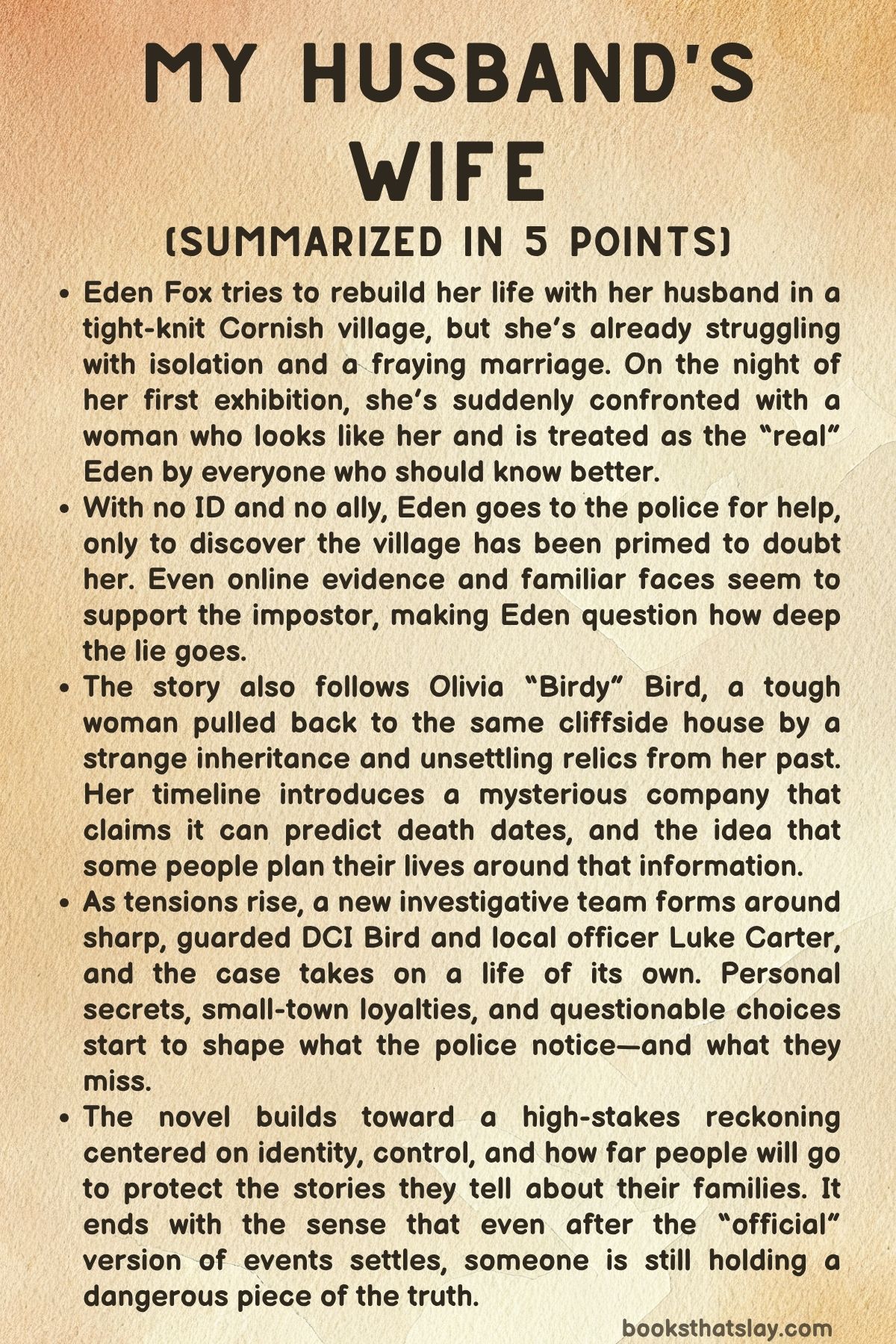
Summary
Eden Fox, an artist seeking a fresh start in the Cornish coastal village of Hope Falls, returns from a dusk run along the cliffs to her cliffside home, Spyglass.
She is preparing for her first local exhibition, but her key no longer fits the lock. A woman who looks strikingly like her—wearing Eden’s black velvet dress and wedding rings—answers the door and calmly claims to be Eden Fox. Harrison, Eden’s husband, appears and supports the stranger, insisting he has never seen Eden before and telling her to leave. The village quickly sides with the impostor, who has already embedded herself in local life.
Locked out with no phone, ID, or money, Eden’s attempts to prove her identity fail. Police Sergeant Luke Carter and the community recognize the impostor through social media, gallery events, and recent interactions. Eden’s exhibition proceeds with the fake Eden giving a toast as the artist, calling Harrison “my Harri.”
Desperate, Eden breaks into Spyglass, only to find all traces of her life erased—photos replaced, belongings gone. She flees after a confrontation, visits her daughter Gabriella at The Manor (a residential facility where the girl has lived mute and traumatized since a childhood accident), and hears Gabriella whisper that the woman at Spyglass is not her mother.
A mysterious burner phone leads Eden to a cliffside meeting spot at sunrise with a message echoing Harrison’s intimate phrase. There, she is pushed to her death.
Interwoven is a second timeline beginning six months earlier. Olivia “Birdy” Bird, a reclusive London detective facing terminal cancer, unexpectedly inherits Spyglass from a grandmother she barely knew—locally legendary as “the woman who died twice.”
In the house, memories surface, along with clues to her family’s past and a letter from Thanatos, Harrison’s company, which claims to predict exact death dates through invasive data collection. Birdy visits the clinic, receives her own “end date,” and relocates to Hope Falls, taking a temporary senior detective role.
As the investigation into Eden’s disappearance and the body on Blackwater Bay unfolds, layers of deception unravel. The impostor is revealed as Mary, Gabriella’s caregiver at The Manor. Birdy is Harrison’s ex-wife and Gabriella’s biological mother.
Ten years earlier, Eden—then the family nanny—had an affair with Harrison. When young Gabriella witnessed it, Eden pushed her down the stairs, staged a bicycle “accident” on the road, and timed a call so Birdy (distracted while driving to a missing-child case) would hit her and take the blame. Overwhelmed by guilt, Birdy left the family; Harrison later married Eden.
Birdy learns the truth from Gabriella (with Mary’s help in communication) and conspires with Harrison and Mary for revenge: gaslight and erase the real Eden by installing Mary in her place, leveraging Harrison’s resources, the village’s unfamiliarity with Eden, and staged digital footprints.
The plan aims to drive Eden to despair and stage her death as suicide at the cliffs. Harrison uses hidden tunnels in Spyglass to move undetected. Birdy, racing her predicted death date, confronts the moral weight of her actions.
Sergeant Carter, torn between duty, attraction to “Eden” (Mary), and growing doubts, becomes entangled. His wife Jane lurks in the background. On the night of the village’s Day of the Dead festival, Birdy overdoses as her “death day” arrives, but Carter revives her.
In the aftermath, truths surface: Harrison and Mary flee together (with plans for Gabriella), Birdy’s cancer remits, and she finds tentative peace with her daughter at Spyglass.
The final twist reframes everything: Jane, motivated by jealousy after seeing Carter with the impostor (Mary), followed and pushed the real Eden off the cliff, mistaking her for the woman threatening her marriage due to their resemblance.
She confesses she knows Carter’s secrets (including his night with Birdy) and warns she is still watching, ready to act again if needed. The novel closes on the unsettling idea that in Hope Falls, identities can be stolen or discarded, revenge cycles onward, and the past remains buried only until the next convenient lie.
Characters
Eden Fox
In My Husband’s Wife, Eden is introduced as a talented but emotionally frayed artist who uses running as a coping mechanism for isolation, anxiety, and the quiet erosion of her marriage. Her character is built around a deep need to be seen and believed, which makes the identity theft not just a plot shock but a psychological assault: the nightmare is that her closest relationships and even the broader community can be persuaded to agree she does not exist.
Eden’s vulnerability is practical as well as emotional—she is repeatedly stripped of proof, resources, and safety—yet she is not passive; she pivots quickly from pleading to survival mode, breaking into Spyglass, stealing a vehicle, and taking desperate risks when institutions fail her. The story also asks the reader to hold two realities about Eden at once: she is a frightened woman being gaslit on a village-wide scale, and she is later revealed as someone whose past contains ugliness, selfishness, and harm, meaning her terror is real even if her innocence is not absolute.
That tension is what makes her compelling—Eden is both victim and catalyst, a woman who wants tenderness and belonging but who has also, at crucial points, used manipulation and cruelty to protect what she wanted.
Harrison Woolf
Harrison functions as the controlled center of chaos: outwardly the polished husband with money, competence, and credibility, inwardly a man ruled by fear and the desire to control outcomes that feel uncontrollable, especially death. He weaponizes calmness and social proof, choosing language and posture that positions Eden as unstable while making himself appear reasonable, and his greatest power comes from understanding how easily systems can be steered by confidence, documentation, and repetition.
Harrison’s founding of Thanatos reveals his core obsession: he wants certainty, wants to turn grief and dread into a solvable equation, and that mindset bleeds into his personal life where people become variables to manage rather than souls to protect. His parenting is sincere in its attachment to Gabriella, but it is also possessive and self-justifying—he frames extreme actions as protection, which lets him excuse moral collapse as necessity.
Across the novel he reads as a man who believes love is proven through ruthless prevention of pain, even when his methods create the very suffering he claims to avoid.
Olivia “Birdy” Bird
Birdy is a character shaped by two different kinds of death: the literal closeness of terminal illness and the psychological death of a life derailed by guilt. Her tough exterior is less hardness for its own sake than a defensive posture—she learned that softness makes you easy to break, and she has been broken before by mistakes she cannot undo.
Birdy’s presence also destabilizes the story’s moral ground: she becomes both investigator and architect, a person who can read others because she has spent years reading herself with merciless scrutiny. The inherited house, the folklore of the “woman who died twice,” and the Thanatos letter feed Birdy’s growing conviction that fate is not just coming for her, it is scheduled, and that belief pushes her toward taking control of the ending.
When her truth is revealed, Birdy becomes the emotional engine of revenge—her grief as a mother and her guilt as the driver who hit Gabriella merge into a single need to balance the universe—but the novel never allows that motive to be purely heroic; Birdy’s love curdles into planning, her pain becomes strategy, and she crosses lines while still believing she is reclaiming justice.
Gabriella Woolf
Gabriella is the story’s quiet epicenter: even when she is physically absent, every major decision bends around her injury, her silence, and what adults project onto her. Her selective mutism and child-locked sense of self make her both vulnerable and strangely powerful, because her whispered words carry the weight of prophecy in a world where everyone else is lying.
The uncanny paintings of Spyglass transform her from a passive victim into a witness whose mind has been recording what her life refuses to say aloud, suggesting that trauma can trap language while sharpening perception. Gabriella’s role is also tragic in how she is used—each adult frames their actions as being “for Gabriella,” turning her into a moral shield—but she retains agency in the moments that matter, especially when she identifies the false mother and later appears in ways that suggest she has learned to navigate fear through performance and mimicry.
By the end, Gabriella embodies the story’s most unsettling idea: identity can be worn like clothing, and a child raised in manipulation may learn that the safest self is the one that can change.
Luke Carter
Luke begins as the earnest local policeman who still believes procedures lead to truth, and the case becomes a rapid education in how unreliable “truth” is when community consensus, personal desire, and power align. He is drawn with an almost painful decency—he wants to help, wants to be respected, wants to do right—and that makes his missteps more human than foolish, especially when he confuses his emotional reactions for investigative clarity.
Luke’s attraction to Eden, his guilt about what he did and did not do for her, and his subsequent intimacy with Birdy reveal a man who seeks comfort in closeness while also trying to prove his worth through action, which is a volatile combination in a mystery built on deception. His choices show how easily a “good man” can become compromised without ever deciding to be bad: curiosity becomes intrusion, loyalty becomes secrecy, and ambition becomes rationalization.
Luke’s arc is less about corruption than about vulnerability—he is repeatedly placed in situations where the right thing is unclear, and his hunger to matter makes him easy to steer.
Sergeant Carter
Carter represents institutional confidence: he is the officer who trusts what appears verified, who relies on ID, online footprints, and local recognition, and who interprets a distressed woman without documents as a likely threat rather than a likely victim. He is not written as cruel so much as complacent, and that distinction is important because his failures are the kind that happen every day—believing the calm person, distrusting the panicked one, letting “everyone knows her” override the possibility of coordinated deceit.
At the same time, his own story with Birdy exposes that he is not merely a functionary; he is someone capable of desire, moral bargaining, and personal desperation, which complicates the early image of him as simply wrong-headed. When he is tempted with rewards and pressured into silence, My Husband’s Wife uses him to show how systems can be compromised not only by villains but by ordinary people who want relief—money, stability, restored family pride—and who tell themselves that what they are ignoring is none of their business.
Diana Harris
Diana is a social hinge character: she connects the private domestic horror at Spyglass to the public world of the village, art, and reputation. As the gallery owner, she represents legitimacy—if Diana presents someone as Eden Fox, the community accepts it—and that makes her either dangerously naïve or quietly opportunistic depending on how you read her.
Her flirtation around Harrison and her presence at key moments position her as someone who enjoys proximity to drama while insisting she is only adjacent to it, which fits the novel’s wider theme of spectatorship and complicity. Diana’s choices highlight how performance can become truth in a small town: once she has introduced the impostor as Eden and watched people applaud, reversing that narrative would threaten her credibility and her business, so the lie becomes convenient to maintain.
Whether she suspects more than she admits, she functions as a reminder that people often choose the version of reality that is easiest to host and sell.
Maddy
Maddy is the village’s emotional weather: she supplies warmth, teasing familiarity, and the sense that Hope Falls is a real community with long memory and tight social bonds. Through her, Luke becomes more than a uniform—he becomes “Lulu,” a boy with a childhood shaped by loss when the brewery took the pub, and that background helps explain why Luke craves belonging and why restoring status matters so much to the Carter family.
Maddy also acts as a social truth-teller who sees dynamics others miss; her comment about Luke’s wife punctures Birdy’s assumptions and introduces the recurring idea that people are never quite who they seem in public. She is not a mastermind, but she is a pressure point—small revelations from her have big consequences because she is trusted, and trust is the currency that the novel keeps showing can be stolen, traded, and weaponized.
Ingrid
Ingrid, the worker at The Manor, functions as the institutional face of care: calm, procedural, and trained to interpret unusual behavior as part of a patient’s condition. Her presence shows how easily a facility can become a sealed world where the staff’s explanations override outsiders’ alarms, which mirrors Eden’s broader experience of being dismissed when she cannot produce proof.
Ingrid’s details about Gabriella—her triggers, her removed mirrors, her dependency on routines—also underline how trauma reshapes a life into a managed environment, and how that environment can be exploited by those who understand it. Ingrid may not knowingly participate in deception, but she inadvertently enables it by treating appearances as stable facts: uniforms, badges, and the right tone of voice become enough to move through locked doors.
Mary
Mary is the most quietly dangerous kind of character in the story: the helper whose role grants access, trust, and intimate information, allowing her to shape outcomes without looking like a threat. As a caregiver closely involved with Gabriella’s communication, she sits at the intersection of vulnerability and influence, which makes her position ethically loaded even before the revenge plot comes into focus.
Mary’s participation in the plan suggests a person who justifies extraordinary cruelty as care, convincing herself that what she is doing protects a child and repairs a mother’s broken life. She also embodies the theme that identity is not only stolen through wigs and rings but through roles—nurse, nanny, confidant—because those roles carry automatic authority.
By aligning with Harrison and Birdy and later moving with Harrison, Mary reads as someone who can detach emotion from action when she believes the outcome is righteous, making her loyalty feel chillingly professional.
Jane Carter
Jane arrives late but reframes the moral landscape with a brutal simplicity: she is not driven by grief like Birdy or fear like Harrison but by the cold logic of protecting her family at any cost. Her narration reveals that behind the official story and even behind the revenge story, there is another layer of private violence—someone watching, choosing, and acting without needing anyone else’s permission.
Jane’s willingness to kill, paired with her suspicion of secrets between Carter and Birdy, positions her as the embodiment of the novel’s final warning: you can survive one conspiracy and still be trapped in another, because domestic life itself can conceal predators. She also reinforces the story’s recurring inversion of credibility—wives are expected to be background, supportive, harmless—and she uses that invisibility as cover, proving that the most dangerous person in a mystery is often the one no one bothered to suspect.
Themes
Identity as a weapon and a prison
Eden’s life unravels not because she lacks the truth, but because truth becomes irrelevant once a community accepts a different story. When the stranger answers the door wearing Eden’s dress and rings, it is not only a personal violation; it is a demonstration that identity can be seized through performance, repetition, and social confirmation.
The impostor has rehearsed Eden’s mannerisms, appears in Eden’s spaces, and is already embedded in local routines. The village’s recognition becomes a kind of evidence stronger than Eden’s own memory, and the police treat familiarity as proof.
What makes this frightening is that Eden cannot “argue” her way back into herself. Without documents, without phone access, without photos, she is reduced to an unverified claim, while the impostor carries the visible tokens of marriage, home, and professional credibility.
The online trail—carefully staged posts, timed appearances, and images that suggest an established life—shows how modern identity can be manufactured as a dossier, and how quickly a person can be made socially nonexistent when that dossier is removed or replaced.
The story also shows identity as a trap for those who engineer the deception. The impostor’s success depends on staying inside a narrow script: the agreeable wife, the talented artist, the confident local presence.
That script has to remain consistent under pressure, which means the impostor is constantly policing her own behavior. In parallel, Birdy has lived with the afterimage of a single catastrophic moment—her belief that she injured Gabriella—and that belief becomes the defining label she cannot escape, even after moving away.
The plot’s later revelations turn “Eden Fox” into a contested title rather than a stable personhood: a name that can be worn, assigned, withdrawn, and used to justify violence. The result is a world where being recognized matters more than being real, and where the self is treated as something that can be repossessed by whoever controls the narrative, the props, and the audience.
Marriage as a system of control, not comfort
From the opening tension in Eden and Harrison’s relationship, marriage is presented less as companionship and more as an institution that can be leveraged. Eden expects the basic rights of a spouse—entry to her own home, being known by her partner, a shared public identity—yet those rights vanish the moment Harrison refuses to acknowledge her.
That refusal is not simply emotional abandonment; it functions like an administrative erasure. He uses the marriage framework as a shield: the police instinctively protect the “wife inside” and treat the “intruder outside” as the threat, because the domestic picture is already socially legible.
Marriage here is not intimacy; it is paperwork without paperwork, a socially enforced status that others will defend even when the person claiming it may be lying.
The manipulation within the relationship extends beyond Eden. Harrison’s secrecy about seeing Gabriella, his long absences, and his ability to coordinate a replacement presence reveal an imbalance of power that Eden has underestimated.
The home, Spyglass, becomes a controlled environment where access can be granted or denied like permission rather than shared belonging. Later, the story broadens this into a triangle of past and present relationships: Birdy’s history with Harrison, the question of Gabriella’s parentage, and the role of “Mary” show a pattern where partnership is bound up with planning, concealment, and mutual complicity.
Even when affection appears—pet names, shared phrases, private references—it is repeatedly repurposed as a tool to steer someone’s actions. “I love you to the moon and back” is not merely sentimental; it becomes a trigger that directs Eden to a specific location at a specific time, demonstrating how marital language can be used to guide behavior with the force of trust behind it.
At its darkest, marriage becomes a pretext for punishment. Eden is not only cast out; she is made to look unstable, criminal, and dangerous.
That framing is effective precisely because spouses are assumed to know each other. The moment Harrison says “I don’t know her,” the social world treats Eden as the problem.
The story’s emotional cruelty comes from watching the institution’s public power—its ability to decide who belongs in a house, who is believed, who is protected—operate independently of private truth. Marriage becomes an engine that can legitimize a lie, isolate a target, and give violence a respectable cover.
Surveillance, data, and the manufactured “evidence” of reality
The conflict escalates because surveillance replaces trust as the main way reality is established. Eden’s immediate crisis is made worse by the absence of her phone and ID, but the deeper problem is that other people have plenty of “proof” already—just not the kind that reflects her lived experience.
The staged Instagram account is a perfect example of how evidence can be built in advance: images of the house renovations, posts that suggest routine, photos that place “Eden” in the village before the night of the exhibition. This digital footprint doesn’t simply support the impostor’s claim; it actively undermines Eden by making her look like the copy.
In a small community, online presence becomes an extension of reputation, and once that reputation is aligned with the impostor, Eden’s attempts to explain sound like desperation rather than testimony.
This theme deepens through My Husband’s Wife’s concept of Thanatos, which turns prediction into a business model and fear into a product. The clinic’s intake process—fingerprints, samples, invasive questionnaires, device surrender—suggests a system that treats the body and personal history as harvestable resources.
The promise is certainty: a date that supposedly arrives with scientific authority. But the real mechanism is power.
Once someone believes a date is fixed, they begin reorganizing their choices around it, and that can be exploited. Birdy’s reaction shows how prediction narrows the future into a single looming deadline, making even ordinary days feel like preparation for an appointed end.
Harrison’s admission that the algorithm isn’t always accurate, and that it failed to anticipate his own crisis, exposes the core danger: a fallible system gains influence because people treat its output as fate.
Surveillance also appears in the more intimate forms: the tracker hidden in a phone, the management of images inside Spyglass, the removal of photographs, the replacement of domestic artifacts. These acts show that “evidence” is not neutral; it is curated.
When Eden searches the house and finds all traces of herself gone, she discovers that identity can be edited like a room. Even Gabriella’s art becomes a kind of involuntary surveillance: she paints Spyglass with impossible accuracy, implying knowledge that should not be accessible, as if the house itself is recording and transmitting.
Across these layers, the story argues that modern certainty is often built from controlled inputs—what is posted, what is hidden, what is tracked—and that whoever controls the record can control what others accept as real.
Revenge as moral certainty that justifies cruelty
The story’s emotional fuel is the way vengeance disguises itself as justice. Birdy’s guilt over Gabriella’s injury makes her vulnerable to any explanation that gives the pain a clear cause and a clear target.
Once she believes Eden engineered the accident and harmed Gabriella, revenge becomes a path that feels righteous rather than monstrous. The plan to replace Eden publicly, erase her belongings, and push her toward a fatal fall is not impulsive anger; it is organized punishment designed to mirror Eden’s helplessness.
Eden is denied entry to her home, denied recognition, denied credibility, and finally denied safety—each step structured to make her experience feel inevitable, as if she is simply meeting the consequences she “earned.” That sense of inevitability is what revenge offers: the comfort of a storyline where suffering has meaning and can be paid back in equal measure.
Yet the story repeatedly exposes the ugliness of that comfort. The revenge is not clean.
It depends on manipulating police procedures, exploiting community assumptions, and enlisting bystanders who think they are supporting normal order. It also harms indiscriminately: Eden’s terror is real whether or not she deserves it, and the machinery built to punish her is the same machinery that could crush anyone who becomes inconvenient.
The presence of Gabriella complicates the morality further. Her trauma and her childlike mental state make her both victim and witness, and her whispered lines and paintings function like fragments of truth that others use to confirm what they already want to believe.
Revenge becomes contagious: once one person accepts it as justified, others join in—Harrison with logistics, “Mary” with access, Birdy with determination—until harm is shared responsibility rather than individual choice.
The final twist with Jane pushes the theme into an even harsher light: vengeance does not end when the “right” person is punished; it spreads into new fears and new justifications. Jane’s willingness to kill “to protect her family” shows how easily moral certainty can be claimed by anyone who feels threatened.
By the end, revenge is not portrayed as closure; it is portrayed as a mindset that keeps finding reasons. It turns love into leverage, safety into suspicion, and accountability into an excuse for domination.
The most chilling implication is that once people decide someone is guilty, they start treating cruelty as proof they were right all along, because the victim’s suffering becomes the very spectacle that satisfies the need for payback.