Murder Your Darlings Summary, Characters and Themes
Murder Your Darlings by Jenna Blum is a suspense novel about ambition, fame, and the hidden costs of storytelling. It follows Sam Vetiver, a bestselling author who’s burned out and terrified she’s about to lose her career, and William Corwyn, a celebrity novelist whose charm and literary reputation seem almost too polished to be real.
A third voice—an obsessive watcher calling herself “the Rabbit”—hovers at the edge of every encounter, tracking William with unnerving devotion. As Sam is pulled closer to William’s world, the book turns into a sharp, high-stakes mystery about who gets credit, who gets erased, and what some people will do to stay on top.
Summary
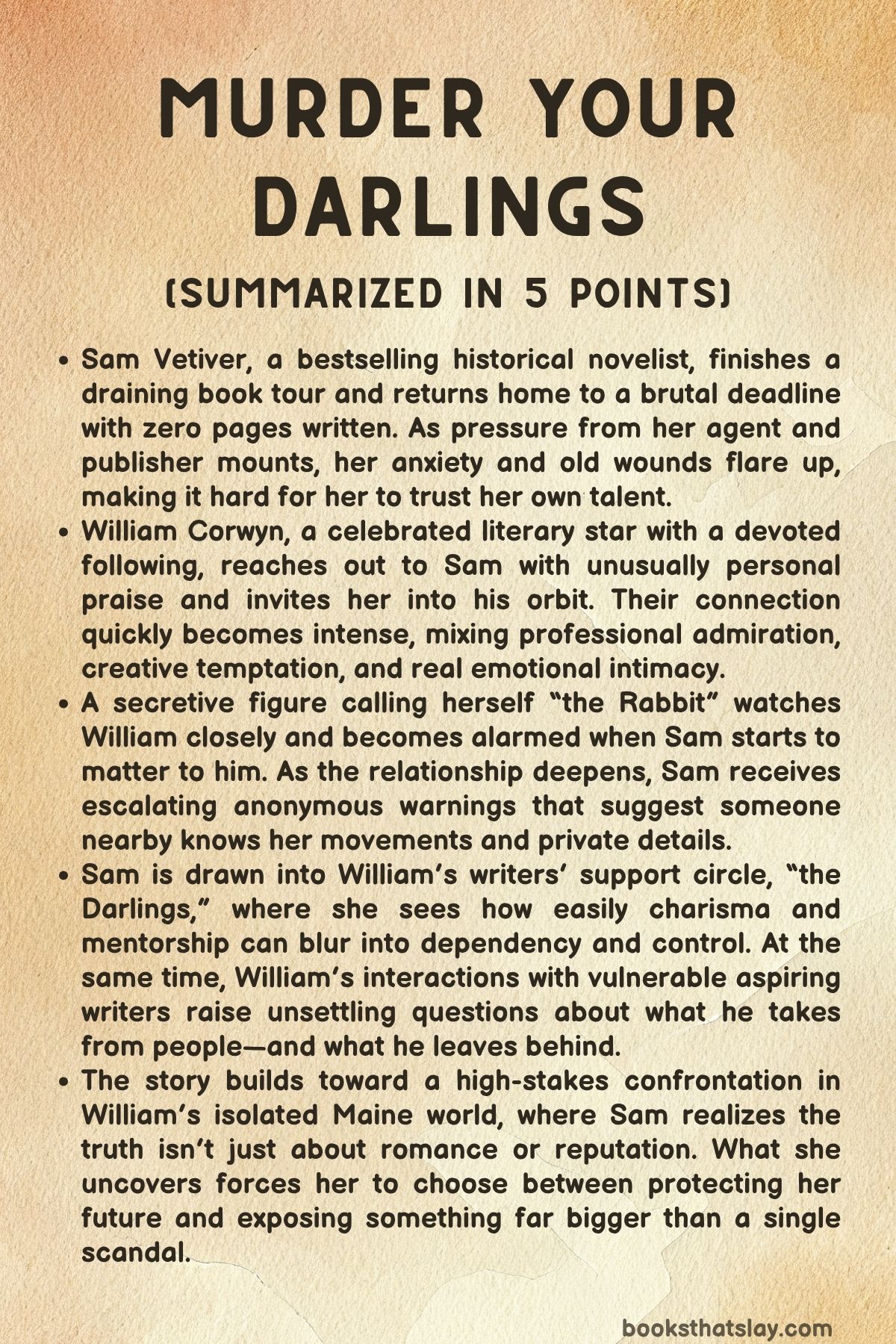
A woman who calls herself “the Rabbit” watches famous novelist William Corwyn at his isolated A-frame house on a remote Maine island. Fans leave gifts at a locked gate; William throws them away.
The Rabbit has learned to get inside by slipping through a forgotten basement window and hiding in a root cellar. She knows his routines, the layout of his bedroom, even the gun he keeps nearby.
From outside, she listens to him with a visiting woman and fixates on how he performs intimacy like a practiced script. The Rabbit leaves shaken and angry, deciding that whatever she did to deal with earlier women in his life wasn’t enough.
This time, she’ll have to change tactics.
In Boston, Sam Vetiver—an enormously successful historical novelist—finishes a grueling book tour. Publicly she’s witty and polished; privately she’s falling apart.
The crowd at her final stop is smaller than promised, and she’s haunted by a disturbing memory tied to a hotel room and blood on a carpet. Back at her hotel, she tries to distract herself with social media and dating apps, but everything feels hollow.
She leans on her best friend, Drishti, who supports her through codependency recovery, and she calls her ex-husband Hank, now sober in a halfway house. Hank still knows how to steady her: he reminds her to be practical, to respect the deadlines, and to keep moving.
The affection between them hasn’t vanished, but their history makes everything complicated.
Once home, Sam sits at her desk and tries to begin the next novel she’s contractually obligated to deliver in five months. The words won’t come.
Her notes feel thin, her research gaps look fatal, and the book she’s supposed to write—about a Gold Rush ancestor—feels like a copy of her earlier work. She spirals harder when she finally reads an email from her agent, Mireille: Sam’s latest sales are underperforming, the market is tightening, and publishers are getting ruthless.
Mireille needs pages soon to prove Sam is on track, or Sam could lose her deal. Sam panics, drinks, and tries to force the work, but the pressure makes her mind seize up.
Then an email arrives from William Corwyn. He praises Sam’s writing in extravagant detail and quotes her lines back to her, saying her work affects him the way a painful, humbling experience once did.
He mentions they share a publisher and invites her to dinner or to attend one of his New England events. The message is flattering, startling, and also suspicious—William doesn’t casually send notes like this to peers.
Sam tells herself she’s going out of curiosity, but she’s also hungry for anything that might restart her stalled creative life.
During a nor’easter, she attends William’s packed reading at an indie bookstore. His promotional machine is everywhere, including a life-size cutout.
He reads with ease, charms the room, and fields questions like a performer who’s mastered his set. In a story that earns him a standing ovation, he talks about losing his fiancée to suicide in graduate school and how his grief led to forming “the Darlings,” a free support group for writers across New England.
Afterward, the store owner introduces Sam. William recognizes her instantly, hugs her, and publicly pulls her into his orbit by having her sign alongside him.
The Rabbit is in the crowd too, disguised, watching William’s attention lock onto Sam. She panics.
Sam is not a random fan or a short-term fling; she’s talented, credible, and exactly the kind of woman William might want seriously. The Rabbit decides Sam is a threat she can’t ignore.
After the event, William asks Sam to dinner. They end up at a late-night French café, soaked by sudden rain, talking with the easy intimacy of people who speak the same language.
William’s admiration seems genuine, but he also tests boundaries with sharp jokes and blunt flirtation. Sam admits she’s blocked and scared she’s running out of time.
William plays a game with her—fast questions about writing habits—and tells her the world needs another book from her. The attention hits Sam like oxygen.
When he touches her gently and calls her by her real first name, Simone, it feels like someone has finally seen through her public persona. Their chemistry turns physical.
They kiss hard, and William leaves quickly afterward, promising more soon. Sam is left flushed, excited, and determined to figure out who William really is.
They begin emailing constantly—flirty, suggestive, intimate messages that fold tour loneliness into fantasy. Then Sam receives a threat through her website: “STAY THE F*CK AWAY FROM WILLIAM CORWYN.” She tries to brush it off as an unstable fan, but the warning lands in the center of her growing attachment.
Sam drives to a Portsmouth hotel to attend a Darlings meeting. She watches writers confess fear, envy, rejection, and shame.
A writer she recognizes, Tabitha, admits that earlier success hasn’t protected her from the industry’s current coldness. After the meeting, William introduces Sam to people, including a devoted admirer named Melody.
Suddenly, the Rabbit is spotted—short, round, disguised in a pink wig and camo cap. William recognizes her and explodes, chasing her through the hotel and threatening police.
He tells Sam the Rabbit is a longtime stalker who follows him everywhere.
William takes Sam to Fort Constitution by the ocean, promising her safety. Their attraction turns into a risky sexual encounter on the fort’s narrow walkway.
Hidden among rocks below, the Rabbit listens, confirms Sam’s identity, and watches enough to know the relationship has become physical. Sickened and furious, she decides to escalate.
Sam goes to her support group and tries to sound grounded about “an amazing man,” but her excitement makes her careless. Drishti warns her not to let fear sabotage happiness, but also urges caution.
Soon Sam receives a photo of herself and Drishti taken moments earlier—sent from a blocked number with another warning. Now it’s not just a threat; it’s surveillance.
The Rabbit has moved from emails to real-world intimidation.
William comes to Sam’s apartment and their relationship intensifies. In the aftermath, he pushes on the one area Sam won’t discuss: her unfinished book.
He suggests she abandon the Gold Rush project and chase a different idea. When William finds another threat note left at Sam’s door, he admits there might be a second source—an unstable “complication” from the Darlings he recently ended.
He proposes they stop seeing each other for Sam’s safety, but Sam refuses. William shifts from caution to possession, promising protection and inviting her to his secluded Maine home, imagining a shared life of writing and love.
Then the narrative widens to Cyndi Pietorowski, a new writer from Salem who attends the Darlings and feels reborn by William’s attention. She’s writing a historical novel about her ancestor Margaret Scott, executed during the Salem Witch Trials.
Cyndi’s life is saturated with spirituality and obsession: she’s quit her job, lives among tarot items and candles, and keeps nineteen cats. William messages her, praising her project and arranging to meet at the “Blue Trees” installation in Salem.
His encouragement feels like salvation to Cyndi. To William, it reads as opportunity.
William accidentally crosses wires: a confirmation meant for Cyndi ends up in a conversation with Simone. Simone spirals, sending emotional messages and a crying video, accusing him of abandoning her for other women.
William ignores her and meets Cyndi anyway. At the Salem Witch Trials Memorial, Cyndi speaks about Margaret Scott as if she’s present, claiming Margaret appeared to her and demanded her story be written.
William gives writing advice and then makes the moment intimate, kissing Cyndi’s wrist and suggesting they meet again. For a flash, he thinks he sees Simone nearby, but isn’t sure.
William visits Cyndi’s purple Victorian condo and finds chaos: cats, clutter, occult objects, and a portrait of Margaret Scott. While Cyndi is distracted, William notices psychiatric medications—lorazepam, lithium, an antipsychotic—and hides the evidence back in the mess.
He has sex with her and begins thinking about access: her notes, her outline, her work. Soon after, he travels to New York to meet editor Jayne Wetzel at their publisher, Hercules, pitching a new historical fiction concept and pushing for control.
He also visits Simone’s editor, claiming Simone’s new thriller idea “appropriates” a painful story from his life and hinting at legal consequences—pressure designed to interfere with her career.
On Halloween Eve, Cyndi and William book a suite at the Hawthorne Hotel in Salem because Cyndi believes it’s a portal to the spirit world. Salem is crowded and feverish with tourists.
William arrives to find the suite filled with Cyndi’s objects—and then Simone appears, having obtained a key by posing as Cyndi’s sister. Simone storms through the room searching for Cyndi.
A scream comes from the bathroom: Cyndi is dead in a bathtub full of blood. A note says she is joining Margaret Scott, asks that her will be found at home, and begs that her cats be rehomed.
Police question William and Simone. William frames his involvement as mentorship, admits he suspected instability, and points investigators toward his stalker with a distinctive overbite.
Simone describes their relationship and admits she watched William meet Cyndi, visited Cyndi’s house, and later met Cyndi to plan a confrontation. She arrived late to the Hawthorne and found Cyndi dead.
Outside, the Rabbit watches the aftermath and admits guilt, then fixes her focus on Simone: wherever Simone goes next, the Rabbit will follow.
Time jumps to the Maine island. The Rabbit is revealed as Emily, hiding in William’s basement while William and Sam—now engaged—arrive.
Emily listens through vents as they eat breakfast and talk about the MFA program where Sam and William met. Emily’s memories show her own past at that program: William, then a charismatic professor, singled her out, seduced her, and made her believe she mattered—until she overheard him mocking her to male students as a “mercy” hookup.
The humiliation destroyed her: she quit, left writing, and watched her life collapse.
A blizzard traps William and Sam on the island. William warns her not to go outside, citing the death of his sister Pen in a storm.
While he’s out briefly for supplies, Sam sneaks into his basement study to search for proof he steals women’s work. The room is sterile: awards, a laptop, a photo she assumes shows young William with Pen.
She can’t unlock the laptop. William returns early, appearing with an axe, and catches her.
Furious, he ends the engagement and tells her she’ll leave when the storm clears.
Sam retreats, terrified and freezing. Then she receives a text from an unknown number: William’s laptop is open—come down now.
Emily has unlocked it using a passcode tied to a death date. She explains she has known for years that one of William’s bestselling books came from another woman’s story, and that every time she tried to expose him, another woman ended up dead.
Now she’s giving Sam the chance she never had.
Sam enters the study and finds a nightmare made orderly: William’s current draft is built directly from Cyndi’s handwritten outline and documents. In a BOOKS folder, she finds proof that each of William’s novels originated from a woman’s manuscript, stored alongside her obituary or death record.
Pen’s own manuscript is there too, with a note from William promising to publish it under his name and “improve” it. Sam uses her phone as a hotspot and starts emailing evidence out as battery life collapses.
William begins coming downstairs.
Sam escapes into the blizzard, fighting whiteout conditions. Emily attacks William with a mallet but is overpowered.
Sam hides in the outdoor hot tub under its cover, but William finds her. She accuses him of killing women for their stories.
William insists he “helped” them by giving their ideas his talent and his name. He attacks and strangles her.
In a final desperate move, Sam drives her fountain pen into his neck and runs. William chases her into the snow and assaults her again.
Emily reaches them and smashes William with a heavy glass award. William twitches back to life; Sam strikes again until he goes still.
Snow falls across his bloodied face. Sam pulls his hood over him, and Emily admits she stayed close to keep Sam alive.
In the epilogue, Sam and Emily appear on a major TV book show after Sam writes a bestselling, novelized account of what happened. The audience celebrates Emily as “the Rabbit,” and William’s public image collapses as the stolen work and the dead women behind his books finally come into view.
Characters
Sam Vetiver (Simone “Sam” Vetiver)
Sam is a successful historical novelist whose public competence masks a private collapse: she is contractually obligated to produce a new book but is emotionally unable to enter the work, and that paralysis quickly becomes existential because her identity, finances, and sense of worth are tied to being productive and admired. Her loneliness is not simply romantic; it’s structural—touring puts her in front of crowds yet leaves her alone in hotel rooms, which makes praise feel like oxygen and silence feel like punishment, so William’s attention hits her at the exact weak point.
As Simone, she’s more vulnerable than “Sam,” and her decision to reveal her real name to William signals how badly she wants intimacy that is not performative; she wants to be seen without having to perform. At the same time, Sam is not naïve—she notices the machinery of author branding, understands the industry’s cruelty, and carries a buried memory of blood on a hotel carpet that suggests she already knows what it costs to keep going when something terrible happens.
Her arc in Murder Your Darlings is a painful education in the difference between artistic rescue and predation: she begins by hoping William will be a catalyst for her blocked work, then becomes determined to uncover who he really is, and finally turns survivor and witness, using the tools of a writer—attention, evidence, narrative—to expose the pattern and end it.
William Corwyn
William is charisma weaponized: he performs empathy with the polish of a seasoned reader on tour, offering audiences a moving origin story, offering writers a “support group,” offering women a sense of specialness—yet each offer is structured to consolidate control and access. His sexuality is presented as a kind of authored experience, with the “narrative” monologue during sex revealing how he treats intimacy as a script in which he directs outcomes; it is less connection than domination disguised as craft.
He cultivates a public persona of grief and mentorship—the dead fiancée, the Darlings, the discovery story about an editor—that functions as moral camouflage, making skepticism feel cruel and belief feel virtuous. Underneath, he is a plagiarist and killer who believes in his own myth of entitlement: he frames theft as “helping,” claiming women’s ideas need his talent and name to become real, which exposes a worldview where women are raw material and he is the author-god who grants legitimacy.
His island home, with its isolation, gate, and hidden entry points, mirrors him—a controlled environment designed to admit only what serves him—until the same secrecy becomes the place where evidence accumulates and his narrative collapses.
Emily (the “Rabbit”)
Emily is the novel’s most unsettling mirror: she is introduced as a voyeuristic stalker, almost monstrous in her fixation, yet the later revelation reframes her as a survivor whose life was derailed by William’s cruelty and whose obsession is braided from humiliation, grief, guilt, and the desperate need to make meaning out of what happened. At Harrington, she experiences a classic pattern of predatory mentorship: he selects her, flatters and touches, redirects her voice toward what he wants, and then publicly degrades her to reassert power, leaving her with a wound that destroys her writing self and, by extension, her future.
The stalking becomes a warped form of justice-seeking because institutions fail—she tries to alert police, she tracks patterns, she watches women die—and each failure intensifies her compulsion to witness, to intervene, to not be powerless again. Her disguises and secret entries aren’t just thriller mechanics; they symbolize how she has been forced into invisibility, living in the margins of other people’s lives because her own was shattered.
By unlocking the laptop and guiding Sam to evidence, Emily transforms from watcher to actor; the “Rabbit” identity, once a sign of obsession, becomes a survival role she adopted to keep moving through fear. The epilogue’s public embrace of her as “the Rabbit” is bittersweet: she is finally believed, but she is also branded by the very persona she created in trauma, suggesting the cost of being recognized only after performing your pain in a way the world can consume.
Hank (Sam’s ex-husband)
Hank is a portrait of recovery that is neither romanticized nor demonized; he exists in the in-between, sober in a halfway house, still emotionally connected to Sam, and still shaped by the wreckage of addiction. His conversations with Sam show the kind of intimacy that comes from surviving something together—he knows her patterns, speaks in logic and consequence, and can name the contract pressure without flinching, which makes him feel grounding compared to William’s intoxicating flattery.
At the same time, he represents a previous chapter of Sam’s life where love and instability were entangled, so even his steadiness carries echoes of codependency and the fear of relapse—his presence reminds her what it is to caretake and to be caretaken. Hank’s role is crucial because he demonstrates the difference between someone who wants Sam to be safe and functional versus someone who wants Sam to be usable; his affection is real, but it doesn’t demand she become smaller or surrender authorship of her life.
Drishti
Drishti functions as Sam’s moral ballast and reality-check, not by controlling Sam but by insisting Sam stay connected to her own agency. As a best friend and codependency sponsor, she occupies a uniquely intimate position: she can be tender and blunt in the same breath, reminding Sam to enjoy herself while also naming risk and urging safety measures.
She represents community as an antidote to the isolating glamour of literary celebrity; where William creates “community” that centers him, Drishti is part of a community that centers accountability and self-awareness. Her presence also highlights Sam’s vulnerability to love-bombing and performance-based validation—Drishti can see when Sam is spiraling, when trauma is driving the steering wheel, and when Sam is about to confuse intensity for intimacy.
Even when Drishti isn’t physically present, her texts act like a second conscience, a tether to the life Sam has outside the orbit of famous men and public applause.
Mireille (Sam’s agent)
Mireille embodies the cold pulse of the publishing ecosystem: she is not cruel for cruelty’s sake, but she delivers pressure in numbers and deadlines because that is how the machine speaks. Her email about disappointing sales and tightening contracts turns Sam’s creative block into a survival threat, making writing feel less like art and more like an emergency procedure.
Mireille’s role clarifies why William’s message is so effective—his extravagant praise arrives right after an institutional message of doubt, so he becomes, in Sam’s mind, both a romantic possibility and a professional lifeline. Mireille is also a reminder that “success” is not safety; even bestselling authors can be one bad season away from losing leverage, which makes Sam susceptible to anyone who promises certainty, momentum, or rescue.
Tim (the bookstore boss)
Tim is a small but telling figure because he represents the everyday world the Rabbit can still access and manipulate. Through him, we see Emily’s capacity to perform normalcy—holding a job, taking direction—while privately running an intense surveillance operation.
The fact that Emily can function under a boss while living this double life underscores how obsession can hide in plain sight, and how institutions, even something as benign as a bookstore, can become unwitting infrastructure for harm when someone is determined enough. Tim also serves as a contrast to William’s fame: Tim has ordinary authority, while William’s authority is cultural, erotic, and narrative, which makes it far harder for others to challenge.
Tabitha
Tabitha is a cautionary reflection of Sam’s fear: a writer who has tasted success and is now facing rejection in a tightening industry, she puts voice to the panic that achievement can evaporate. Her presence in the Darlings meeting reveals how William’s ecosystem feeds on people at their most fragile—writers with bruised confidence who are primed to mistake his attention for salvation.
Tabitha also helps normalize Sam’s anxiety, making Sam feel less alone in her dread, which ironically lowers her defenses to the group’s dynamics. In a story obsessed with the theft of women’s work, Tabitha’s struggle underscores the systemic reality that women can be discarded by the market even when they are talented, which is part of the background condition William exploits.
Melody
Melody appears as an admirer introduced in the glow of William’s social sphere, and her function is to show how easily access to William becomes a kind of social currency. She represents the fan-to-follower pipeline: the way readers, aspiring writers, and community members can be drawn into intimacy-adjacent proximity with a famous author and feel chosen simply by being noticed.
Even if Melody herself isn’t depicted as malicious, her presence highlights the crowd around William that can blur boundaries, normalize his flirtations, and make his private behavior harder to interpret as predatory because it happens in a haze of admiration.
Cyndi Pietorowski
Cyndi is written as painfully ripe for exploitation: new to writing, hungry for validation, and spiritually convinced her story is a calling, she is both earnest and unstable in a way that makes William’s attention feel like destiny. Her identity—Salem native, descendant of Margaret Scott, former attorney, practicing Wiccan—gives her a ready-made mythic frame, and William immediately uses that frame as a hook, performing fascination and mentorship while quietly scanning for access to her manuscript.
The discovery of psychiatric medications complicates the stereotype the world might reach for; the novel doesn’t make her illness the cause of her vulnerability so much as part of the landscape William navigates without empathy, cataloging it as risk management rather than human pain. Cyndi’s relationship with writing is devotional—Margaret “appears,” commands her, and she quits her job—so when William entwines himself with her project, he is not just flirting; he is stepping into her belief system and redirecting it toward himself.
Her death, framed as joining Margaret, becomes one more instance of women’s stories being taken even as their bodies are discarded, and the tragedy is sharpened by how clearly she wanted to matter as a writer, not as a cautionary tale.
Jayne Wetzel
Jayne is the industry gatekeeper William knows how to charm and pressure, and her scenes show his professional predation running parallel to his sexual predation. She initially tries to set boundaries—urging rest, preferring email—yet he demands in-person access and raises security concerns, signaling paranoia and control while also asserting dominance over the process.
Jayne’s enthusiasm for his new concept demonstrates how thoroughly William has captured institutional trust; his brand and track record make him credible even when he behaves erratically. She is not portrayed as villainous, but as someone operating in a system that rewards confidence and productivity, which allows a manipulator to keep moving forward as long as the work sells.
Patricia Miller (Simone’s editor)
Patricia is positioned at the intersection of art, commerce, and liability, which makes her particularly vulnerable to William’s manipulation. When William claims Simone’s new project “appropriates” his personal tragedy and hints at legal trouble, he is using the industry’s fear of controversy as a weapon to isolate and destabilize Sam.
Patricia’s value to the plot is that she represents how control can be exerted without physical violence: a single insinuation to an editor can jeopardize a career, intensify a writer’s panic, and make the victim feel watched and constrained. Her role also emphasizes the asymmetry of power between an established celebrity author and a struggling author under contract pressure, showing how William can attack Sam from multiple angles—romantic, psychological, and professional—at once.
Becky Bowman
Becky is an absence that functions like a ghost in the story: she exists through Emily’s discovery that William’s breakout phenomenon originated in Becky’s romance plot and through the grim proof that Becky is dead. As the person William was engaged to and the source of a major stolen work, Becky stands at the origin point of his pattern, suggesting that his “tragic fiancée” narrative is not just grief but part of the machinery that keeps him protected.
Becky also symbolizes the core horror of the premise in Murder Your Darlings: women’s creativity is treated as extractable value, and their disappearance becomes a footnote while the man’s career becomes legend. That Emily remembers Becky’s idea with such clarity underscores how stories can be intimate gifts shared between women—trust, companionship, creative exchange—and how violating that trust is a form of murder even before the literal one.
Pen (William’s sister)
Pen is both personal alibi and buried evidence; William uses her death in a storm as a story to justify control, wrapping coercion in concern. Yet Pen’s presence in the laptop files—her manuscript, and William’s note promising to publish it under his name—reveals that even family is not sacred to him; she is another source, another work to “dress up,” another life reduced to material.
The photo of young William with a girl becomes chilling in retrospect because it shows how easily sentiment can be staged while betrayal is stored in secret. Pen’s function is to deepen William’s monstrosity by showing the pattern isn’t only about fans or mentees; it’s about entitlement so total it can consume a sister.
Zahra Alaam
Zahra appears briefly, but the way William reacts to her name is revealing: he pretends not to remember and then dismisses her achievements, which exposes his reflexive need to minimize women who might rival his authority. She represents the women who did not become his victims—those whose talent, reputation, or distance might protect them—yet even then, he attempts to erase them socially by belittling them.
In a narrative about stolen authorship, Zahra’s function is to show that William’s contempt isn’t only for women he can exploit; it is a structural disdain for women’s excellence when it does not serve his self-image.
Svetlana
Svetlana’s presence in the codependency group grounds the story in a wider community of women negotiating harm, addiction, and survival. Her account of an alcoholic husband parallels Sam’s history with Hank and implicitly warns how easily love can become a system of self-erasure.
By including her, the novel expands beyond the celebrity-stalker plot into a broader portrait of how women are trained to accommodate chaos, to doubt themselves, and to keep going—patterns that William weaponizes when he tells Sam she’s safe with him and encourages her to surrender control. Svetlana is less a plot driver than a thematic anchor, reminding us that Sam’s vulnerability is not an individual flaw but part of learned relational dynamics the group is trying to unlearn.
Themes
Obsession, Surveillance, and the Loss of Boundaries
Murder Your Darlings opens with a sense of trespass that never really stops: Emily, calling herself “the Rabbit,” treats William Corwyn’s life like a place she can enter, rearrange, and possess. She studies his habits, watches him through windows, hides in his closet, learns where he keeps a gun, and follows his tour schedule with the dedication of someone building a private world that runs parallel to his public one.
That behavior is not framed as a single impulsive act; it is routine, practiced, and escalating, which matters because it shows how obsession turns into structure. The causeway, the gate, the fan gifts, and the hidden basement window become a map of how fixation works: barriers exist, but the obsessed mind specializes in finding the one overlooked opening that restores the fantasy of access.
When Emily threatens Sam anonymously, obtains her number through impersonation, and sends real-time photos to prove proximity, the focus shifts from watching to controlling. The power of surveillance is not only that it gathers information; it forces the target to second-guess everyday safety.
Sam’s relationship with William becomes contaminated by the possibility of unseen eyes, and the threat is effective even before any physical harm occurs because it reshapes her choices. The theme becomes even sharper later, when the plot reveals that William has his own long-term pattern of invading people’s inner lives—reading vulnerabilities, finding private material, taking what is not his.
Obsession in the book is not limited to a stalker outside the house; it also lives inside institutions, romances, and careers. The result is a world where privacy is always fragile, and the line between admiration and entitlement keeps getting crossed until it stops being a line at all.
Power, Charisma, and Predation in Creative Spaces
William’s appeal is not accidental. He performs warmth and insight in public, speaks fluently about grief, community, and craft, and positions himself as both star and caretaker through “the Darlings.” That role gives him access to aspiring writers who arrive with need, insecurity, and hope—exactly the conditions that make mentorship powerful and dangerous.
He knows how to mirror what people want to hear: Sam receives extravagant praise at the moment she is terrified about her career; Cyndi receives special attention that makes her feel chosen; the audience receives a story about loss that earns a standing ovation and builds his moral authority. The book keeps returning to how charisma can function like a credential, letting someone bypass scrutiny because the surrounding crowd already believes they are good.
William also uses sexual intimacy as a tool of influence. His habit of narrating during sex is not just a quirk; it signals control over the emotional script, the pacing, and the partner’s experience.
With Sam, physical closeness quickly merges with professional pressure—he critiques her writing block, suggests a new concept, implies he can rescue her book. That blend can feel supportive, but it also creates dependency, especially when he later withdraws attention and leaves her pleading.
The story’s most explicit account of predation appears in Emily’s memory from the MFA setting: a professor uses status, flirtation, and humiliation to break someone’s self-image, then walks away untouched while she loses her program, her job, and her willingness to write. The larger pattern becomes clear by the end: William’s domination is not only emotional or sexual, it is economic and cultural.
He leverages institutions—publishing, workshops, tours, support groups—to harvest women’s labor and turn it into his brand. The theme argues that predation in creative worlds often looks like opportunity at first, because it is delivered through praise, attention, and proximity to success.
Authorship, Ownership, and the Theft of Women’s Stories
Sam’s panic about her deadline and her inability to start the contracted novel sets up a painful question: what does it mean to produce art on demand when your name is also your livelihood? That anxiety deepens when William enters as a celebrated peer who seems to validate her talent, because his approval feels like both personal recognition and professional rescue.
The theme of authorship then widens from “Can I write?” to “Who gets to be credited, believed, and protected?” William’s career is built on the public assumption that the voice on the page belongs to him, that his success is evidence of genius, and that his published name accurately marks the creator. The revelation that his novels originate in women’s manuscripts and outlines—kept alongside death records—turns authorship into something grimly transactional.
The book treats stolen writing as more than plagiarism: it becomes a form of erasure, where women’s creative identities are taken along with their work, and their deaths become part of the mechanism that keeps the theft safe. William’s language about “helping” the women by giving their ideas his talent and name exposes a worldview in which women’s imagination is raw material and male status is the finishing process that makes it “real.” That logic resembles a familiar cultural bias: women can be muses, students, mentees, fans, or unstable geniuses, but the authoritative author is the man who packages the story for the market.
Even the publishing ecosystem appears vulnerable to influence when William pressures Sam’s editor by framing her emerging project as legal risk. The story suggests that ownership in art is never purely artistic; it is enforced through contracts, reputations, gatekeepers, and fear.
Sam’s eventual act of sending evidence and later writing a true account flips the script: she reclaims narrative control, names what was hidden, and forces public recognition of the women whose work was stolen. In that sense, authorship becomes both a personal struggle and a justice project, where telling the truth is not only creative expression but also a way to restore identity to the erased.
Trauma, Shame, and the Fight to Reclaim a Self
Nearly every major character carries a private wound that shapes what they accept and what they ignore. Sam’s writing block is not simply lack of discipline; it sits beside flashes of a bloody memory, a reliance on support meetings, and a fragile sense that her career could collapse at any moment.
Her loneliness on tour, her disgust at dating apps, and her pull toward Hank despite the history all suggest someone trying to manage fear by seeking familiar emotional patterns, even when they are risky. That makes her especially susceptible to William’s attention, because it arrives as certainty and direction when she feels scattered.
Emily’s trauma is defined by humiliation and betrayal in a setting that was supposed to nurture her talent. The aftermath is telling: she quits the program, stops writing, and lives for years inside the consequences of one man’s casual cruelty.
Shame here behaves like a theft of future time—she loses not only that moment but the version of herself who believed she could become an author. Cyndi’s story brings another facet: intense identification with an ancestor’s suffering, spiritual certainty, and mental health instability that makes her both earnest and vulnerable.
In each case, trauma narrows options, and the narrative shows how predators take advantage of that narrowing. Yet the theme is not only about damage; it is about what recovery looks like when it is messy and imperfect.
Sam keeps going to group. She keeps reaching out to Drishti.
She tries to build a life where she can choose groundedness over spirals, even when she fails. Emily’s transformation is complicated: her stalking behavior is harmful, but it also comes from years of trying to force accountability in a world that ignored her warning signs.
The climax turns reclaiming the self into physical resistance—Sam using a fountain pen, the tool of her trade, as the instrument that keeps her alive. That detail matters because it links survival to voice: the same identity William tried to exploit is the identity that helps defeat him.
By the epilogue, public storytelling becomes part of healing. Being seen, believed, and able to name what happened does not erase trauma, but it changes who controls the meaning of it.