About a Boy Summary, Characters and Themes
About a Boy by Nick Hornby is a contemporary British novel that explores loneliness, responsibility, and unexpected friendship. The story centers on two very different characters: Will Freeman, a carefree thirty-six-year-old who avoids work and commitment, and Marcus Brewer, a thoughtful twelve-year-old struggling with bullying and his mother’s depression.
Their lives cross by accident, but the connection that develops between them gradually changes both of them. Through humor and honest observations about modern life, the novel shows how people who seem mismatched can help each other grow. At its heart, the book examines what family means and how relationships can shape who we become.
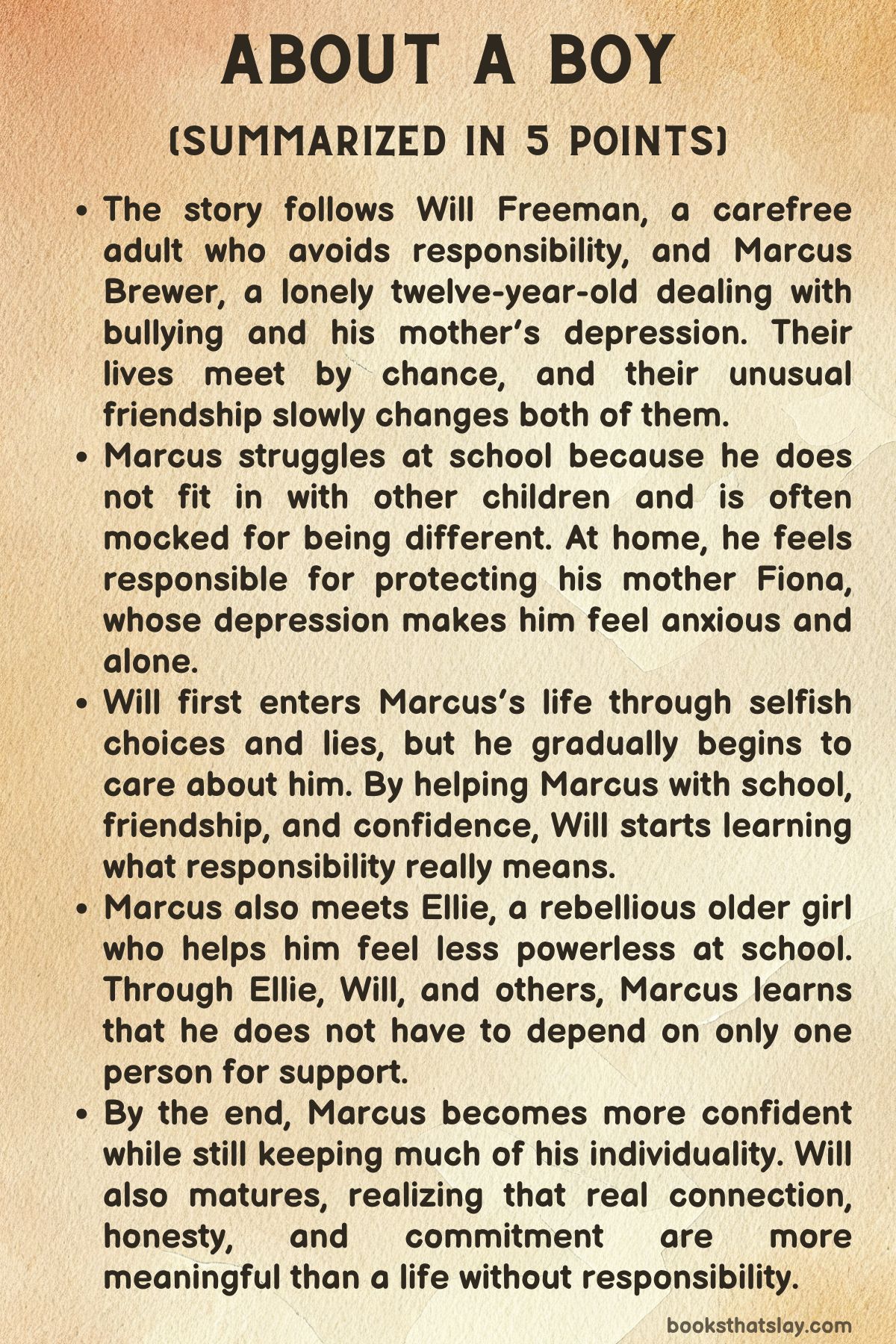
Summary
The story begins in London with Marcus Brewer, a twelve-year-old boy living with his mother Fiona. Marcus’s parents separated years earlier, and he now moves between homes and lifestyles that rarely feel stable.
Fiona is sensitive, thoughtful, and strongly idealistic about life, but she also struggles with deep sadness. Marcus worries constantly about her.
Even though he is still a child, he believes it is his job to keep her happy and prevent her from falling deeper into depression.
At school Marcus has a miserable experience. His classmates see him as strange because he does not follow the same trends as they do.
Fiona has raised him with unusual tastes, encouraging him to listen to older music and read books instead of engaging with modern pop culture. Because of this, Marcus dresses and behaves differently from the other children.
The result is that he becomes a target for bullies. Small habits, such as singing when he is nervous, make things worse and provide more reasons for the other kids to mock him.
Marcus tries to survive by ignoring them, but the situation leaves him isolated and unhappy.
At the same time the narrative introduces Will Freeman, a man in his mid-thirties who lives a completely different life. Will has no job and very few responsibilities.
He survives comfortably on the royalties from a popular Christmas song written by his father many years earlier. Because of this income he spends his days watching television, listening to music, and enjoying a relaxed lifestyle.
Will prides himself on being independent and unattached. He avoids commitments and prefers casual relationships with women rather than serious emotional involvement.
One day Will discovers that pretending to be a single father helps him meet attractive single mothers. He joins a support group for single parents and invents a fictional child in order to fit in.
At the group he meets Suzie, a friendly woman with a young daughter. Through Suzie he later encounters Marcus at a picnic in the park.
Their first meeting is awkward. Marcus finds Will shallow and uninterested in serious matters, while Will views Marcus as an odd and socially uncomfortable kid.
During the picnic Marcus accidentally causes a scene involving a dead duck in the park. Soon after, Will and Suzie accompany Marcus back to his house.
When they arrive they find Fiona unconscious after attempting to take her own life with pills. The event shocks Marcus deeply.
He had already worried about his mother’s sadness, but seeing the reality of it terrifies him. Fiona survives and returns home, but Marcus becomes convinced that he must find a way to protect her in the future.
Marcus decides that the best solution is to expand their small household by bringing another adult into their lives. He begins to think that Will might be a good candidate, even though he does not fully trust him.
Marcus arranges situations where Will and Fiona spend time together, hoping they will form a relationship. Will quickly realizes that Marcus is trying to set them up, but he is not interested in Fiona.
Her personality and lifestyle are far from the glamorous partners he usually prefers.
Despite this, Marcus continues visiting Will’s apartment after school. At first Will finds the boy annoying and inconvenient.
However, he slowly realizes that Marcus is dealing with serious problems. The boy admits that he is being bullied and feels lonely at school.
Will tries to help in small ways, such as giving advice about clothes and buying him fashionable shoes to help him fit in with other students. Unfortunately the plan fails when the bullies steal the shoes, leaving Marcus embarrassed again.
Eventually Fiona discovers that Marcus has been spending time with Will and becomes angry. She is upset that Will lied about having a child and worries about his influence on Marcus.
During a confrontation Will explains the truth about the bullying Marcus faces at school. Fiona had not fully understood how serious the situation was.
Although she forbids Marcus from seeing Will for a while, the connection between them has already begun to form.
Over time Will realizes that Marcus’s presence has begun to affect his life. For the first time he feels responsible for someone else.
Although he often claims he wants to avoid involvement, he continues helping Marcus navigate the complicated world of school and friendships. He teaches Marcus about popular music, trends, and the kinds of things other kids talk about.
These lessons slowly help Marcus adapt and become less of an outsider.
At school Marcus meets Ellie, a rebellious older girl who enjoys challenging authority. Ellie initially mocks Marcus for not recognizing a famous musician on her sweatshirt, but she gradually becomes friendly with him.
Her confidence and strength impress Marcus, especially when she stands up to the bullies who have been tormenting him. With Ellie’s support Marcus begins to feel slightly more accepted among the other students.
Meanwhile Will meets a woman named Rachel at a party. Rachel is intelligent and interesting, and Will genuinely wants to impress her.
Unfortunately he once again lies about Marcus, allowing Rachel to believe that Marcus is his son. The situation becomes complicated when Rachel suggests that Marcus should meet her own son, Ali.
Marcus reluctantly participates in the deception, although he does not fully understand why Will feels the need to lie.
As their relationship grows closer, Will eventually admits the truth to Rachel. He explains that Marcus is not his child but a boy he befriended after a series of unusual circumstances.
Rachel is initially surprised, but she also recognizes that the connection between Will and Marcus is genuine. The friendship has clearly changed Will.
He is no longer completely detached from other people’s lives.
While these changes occur, Marcus continues to struggle with his mother’s emotional health. Fiona’s depression does not disappear, and Marcus remains afraid that she might try to harm herself again.
He asks Will for help, hoping that Will can somehow fix the situation. At first Will hesitates because he feels unprepared to deal with such serious problems.
Eventually he begins to understand that Marcus truly depends on him.
A dramatic turning point occurs when Marcus and Ellie travel together and become involved in an incident at a shop displaying images of a famous musician who has recently died. Ellie angrily breaks a window in protest, believing the shop is exploiting the tragedy for profit.
The police arrest both teenagers. Their parents and guardians must come to the station to resolve the situation.
At the police station several characters gather, including Fiona, Will, Ellie’s mother, and Marcus’s father. The experience forces everyone to confront their responsibilities.
Fiona openly expresses her guilt and fears about being a bad parent. Marcus, frustrated by the adults in his life, also shares his feelings about how difficult it has been to cope with everything around him.
Afterward Marcus spends time with his father in Cambridge. During their conversation his father admits that he has not always been present enough in Marcus’s life.
Marcus reflects on how many different people now surround him: his parents, Will, Suzie, Ellie, and others. Instead of depending entirely on one person, he believes it is better to have several people who can offer support when needed.
By the end of the story both Marcus and Will have changed. Marcus becomes more confident and socially aware.
Although he still has his unique personality, he learns how to fit in better with other students and protect himself from bullying. At the same time Will has begun to abandon the detached lifestyle he once valued.
Through his relationship with Marcus he discovers the importance of responsibility and emotional connection.
Will also grows closer to Rachel, recognizing that love requires vulnerability and commitment. He accepts that caring for others means risking disappointment and pain.
For someone who once avoided attachment at all costs, this realization represents a major transformation.
The novel closes with the sense that both characters have gained something valuable from their unlikely friendship. Marcus has developed strength and resilience, while Will has learned empathy and maturity.
Their lives remain imperfect, but each has found a stronger sense of belonging and purpose than before.
Characters
Will Freeman
Will Freeman begins as a man who has organized his whole life around comfort, distance, and freedom from responsibility. Financially secure because of the royalties from his father’s Christmas song, he has the luxury of drifting through his days without work, routine, or commitment.
He sees this as sophistication rather than emptiness. His identity is built on style, taste, and emotional detachment.
He likes being available for pleasure but unavailable for obligation, and he treats other people’s lives as something to observe rather than enter. At first, this makes him funny and superficially charming, but it also reveals his shallowness.
He has trained himself to avoid seriousness so thoroughly that he mistakes avoidance for self-knowledge.
What makes Will such a strong character is that his change is gradual and reluctant. He does not suddenly become generous or wise.
Instead, Marcus forces him into forms of contact he never intended to accept. At first Will helps in fragments, often for selfish or accidental reasons, but even those small actions begin to alter him.
His advice to Marcus about clothing, music, and fitting in may seem trivial, yet it comes from the first real effort he has made to improve another person’s life. Beneath his cynicism, there is intelligence and sensitivity, but both have been left idle for years.
Marcus activates those unused parts of him. That is why his growth feels believable: he is not transformed into a different person, but he becomes a fuller version of himself.
Will also represents a particular kind of modern isolation. He has money, leisure, and independence, but very little meaning.
His life is structured around surfaces, and Rachel correctly senses that he seems blank because nothing deeply matters to him. His relationship with Marcus begins to fill that blank space.
Through Marcus, Will learns that being needed can be frightening, inconvenient, and yet deeply humanizing. His eventual emotional openness, especially in love, matters because it comes at the cost of the identity he once prized.
By the end, he is more vulnerable, less cool, and far more alive. In About a Boy, Will’s arc shows that maturity is not simply about age but about accepting that real life depends on connection, duty, and risk.
Marcus Brewer
Marcus is one of the most affecting characters because he is both unusually innocent and unusually burdened. He is only twelve, but he thinks like someone much older because his home life has forced him into emotional vigilance.
He worries constantly about his mother’s depression and comes to believe that her survival may depend on him. This sense of responsibility shapes everything he does.
He is observant, serious, and often painfully literal. He does not understand the social codes that other children seem to absorb naturally, and that makes him stand out at school.
His awkwardness is not stupidity or weakness; it comes from being raised in an environment guided by values that make sense morally but leave him unprepared for the cruelty of adolescent group behavior.
Marcus is especially well drawn because he is neither idealized nor reduced to victimhood. He is odd, sometimes exasperating, and often funny without trying to be.
His perspective exposes how arbitrary many social rules are. He asks basic questions about coolness, music, clothes, and friendship, and those questions reveal how much everyday life depends on performance.
At school he is bullied not because he is bad or foolish, but because he does not know how to protect himself within that performance. His singing, his clothes, his cultural references, and even his earnestness become marks against him.
Yet his difference also gives him moral clarity. He sees pretension, cowardice, and hypocrisy with unusual sharpness, even when he cannot fully name them.
His central struggle is learning how to be a child without abandoning himself. Early on, Marcus behaves as if he must solve adult problems, especially Fiona’s depression.
He tries to build a larger support network because he knows one person cannot carry another forever, yet he still thinks in terms of rescue. His friendship with Will helps rebalance him.
Will teaches him practical lessons about surviving among peers, but more importantly, Marcus begins to experience moments where he does not have to be the caretaker. That shift matters.
By the end, Marcus has gained some social confidence and a protective outer layer, but this comes with a loss too. Part of his open, unfiltered self begins to fade.
His development is therefore bittersweet. He becomes stronger, but that strength is partly the result of compromise.
He learns how to live in the world as it is, not as it should be.
Fiona Brewer
Fiona is one of the most complex adults in the novel because she is both admirable and deeply flawed. She is intelligent, ethical, compassionate, and committed to living according to her beliefs.
She rejects consumerism, superficial judgment, and fashionable conformity. In many ways she has tried to build a sincere life, one based on values rather than appearances.
Yet the same idealism that gives her dignity also limits her ability to see what Marcus is experiencing. She assumes that if she teaches him the right principles, the world should meet him fairly.
She underestimates the violence of school hierarchies and the loneliness of being visibly different. Her failure is not a lack of love but a lack of practical understanding.
Her depression is handled with unusual honesty. She is not presented as a melodramatic figure or simply a neglectful mother.
Instead, she is someone living under a weight that distorts perception, drains energy, and damages her ability to function. Her suicide attempt is a turning point not only because it shocks Marcus, but because it exposes the terrifying gap between inner suffering and outward domestic routine.
Fiona’s pain does not make her noble, and the novel does not pretend that love automatically overcomes it. She can be self-absorbed, absent, and emotionally dangerous to her son even while genuinely caring for him.
That contradiction makes her human.
One of the most important aspects of Fiona’s character is her guilt. She senses the harm her illness causes Marcus, and this awareness becomes part of the burden she carries.
Her confession that she did not always want motherhood and that she sometimes feels frightening resentment toward her son is especially powerful because it breaks the usual idealized image of mothers. She is not cold, but she is honest about how overwhelming motherhood can be when combined with mental illness.
Fiona’s role in About a Boy broadens the emotional scope of the story by showing that good intentions and love are not always enough to protect a child. At the same time, she is never reduced to her illness.
She remains a thoughtful, difficult, wounded person trying to keep going.
Ellie McCrae
Ellie is introduced as rebellious, sharp-tongued, and intimidating, but she gradually becomes far more than a symbol of teenage defiance. She represents a different way of being damaged.
Unlike Marcus, whose suffering is direct and concrete, Ellie seems drawn to drama, anger, and self-created chaos. She is fascinated by transgression, by music that expresses pain, and by identities built around rejection of the ordinary.
At first Marcus is dazzled by her because she has exactly what he lacks: confidence, style, aggression, and social fearlessness. She can defend herself and others.
She can turn ridicule back on the people who try to use it.
Yet Ellie is not simply stronger than Marcus. She is unstable in her own way, and the story gradually shows the difference between lived pain and imagined intensity.
Her reaction to Kurt Cobain’s death, and the destructive behavior that follows, reveals how much she invests herself in borrowed tragedy. She is emotional, impulsive, and politically performative, but not always grounded in consequences.
That is why Marcus eventually understands that she is not right for him. He sees that she seeks trouble because she has room to romanticize it, while he has already had enough real trouble at home.
Even so, Ellie matters enormously in Marcus’s growth. She helps him gain status at school, gives him entry into a new social world, and protects him from physical humiliation.
She also provides one of the novel’s clearest lessons about adolescence: admiration does not always lead to compatibility. Marcus is attracted to her courage and difference, but he eventually recognizes that what he needs is not more instability.
Ellie remains memorable because she is both ridiculous and sincere, strong and fragile. She is a teenager trying on identities with real emotional force, and the novel allows her both her excesses and her humanity.
Rachel
Rachel plays a crucial role because she exposes the limits of Will’s old persona more clearly than anyone else. She is attractive to him not just because she is interesting, but because she possesses the kind of depth he knows he lacks.
She is creative, emotionally present, and attentive to what lies under the surface. When she first encounters him, she senses his charm but also his emptiness.
That perception matters because most of Will’s earlier relationships allow him to remain lightly engaged and fundamentally unchanged. Rachel does not.
She expects a person, not a performance.
Her importance is not only romantic. She acts as a moral and psychological mirror.
Through her, Will begins to see that his blankness is not sophistication but underdevelopment. She recognizes that his bond with Marcus is real even when it begins inside a lie, and that recognition helps bring Will closer to honesty.
Rachel’s response to him is nuanced. She is not gullible, and she is not impressed merely by style.
She can appreciate his humor and kindness while also seeing his evasions. This balance makes her feel credible rather than idealized.
Rachel also stabilizes the narrative at a point when Will starts to confront emotional realities he would once have run from. She is buoyant, practical, and emotionally literate.
She does not rescue him in a sentimental way, but she offers him a model of adult attachment that is neither suffocating nor shallow. Her presence helps shift the story from comic deception toward emotional accountability.
She matters because she gives Will something worth risking himself for.
Suzie
Suzie functions as one of the bridges between the main characters, but she is more than a plot device. She is warm, socially capable, and grounded in a way that contrasts with both Fiona’s intensity and Will’s selfishness.
As a single mother, she belongs to a world Will initially enters only to exploit, yet her decency exposes the ugliness of his deception. She trusts easily enough to bring him into contact with vulnerable people, but she is not naive in the long term.
When she later confronts him about his lies, her anger feels earned because she has been one of the people most taken in by his performance.
Suzie is also important because she embodies ordinary competence. She is not written as dramatic or psychologically extreme, yet she keeps showing up when things matter.
She takes responsibility, cares for others, and acts decisively during Fiona’s crisis. In a novel filled with emotionally entangled adults, Suzie stands out for her steadiness.
Her role highlights what dependable adulthood looks like without making a show of it.
Through Suzie, the story also comments on gendered vulnerability. She, like the other women at the single parents’ group, carries the aftermath of male failure.
Will first sees this as an opportunity, but the narrative gradually forces both him and the reader to recognize the pattern of damage beneath the comic setup. Suzie therefore helps shift the tone from satire toward a more serious understanding of abandonment, trust, and care.
Clive Brewer
Clive, Marcus’s father, is not cruel or malicious, but he is deeply disappointing. He represents the kind of parent whose failures come through absence, weakness, and unreliability rather than open harm.
Marcus’s relationship with him is shaped by that disappointment. Clive remains present enough to exist in Marcus’s life, but not solidly enough to provide real structure or reassurance.
He has moved on into another life, and Marcus has had to absorb that fact without much comfort.
What makes Clive interesting is that he eventually shows some awareness of his limitations. He is not proud of the father he has been, and he understands that Marcus has needed more than he has provided.
This self-knowledge does not erase the damage, but it prevents him from becoming a flat symbol of bad fatherhood. His conversation with Marcus near the end is important because it gives both of them a moment of honesty.
Clive admits the truth, and Marcus answers with a maturity that suggests he has already stopped expecting too much from him.
Clive’s role helps develop one of the novel’s central ideas: that no single adult can always provide everything a child needs. Marcus does need fathering, but not necessarily from his biological father alone.
Clive’s inadequacy becomes part of the reason Marcus learns to imagine support as something more collective. His weakness helps shape Marcus’s realism.
Ali
Ali, Rachel’s son, offers a useful contrast to Marcus. He is the same age, but he is far more typical in social behavior, emotional expression, and adolescent possessiveness.
His initial hostility toward Marcus comes from fear that Will’s presence will disrupt his world. This response is childish, territorial, and completely believable.
Unlike Marcus, Ali has not been pushed into premature seriousness by a parent’s instability. He can afford to react as a normal boy protecting his place.
Although Ali does not dominate the narrative, he helps clarify Marcus’s unusualness. In scenes between them, Marcus’s emotional burden becomes more visible because Ali carries less of it.
At the same time, Ali is not presented as superior or more mature. He is simply a child in a different environment.
His brief aggression, followed by apology, also shows how conflict can be temporary and manageable when it is not rooted in chronic fear or humiliation.
Ali contributes to Will’s development as well. Being around both boys shows Will different forms of boyhood and different kinds of need.
Marcus’s dependence is intense and complicated, while Ali’s is more ordinary and direct. This contrast pushes Will closer to the recognition that adults do, in fact, shape children constantly, whether they mean to or not.
Angie
Angie appears early, but her effect on Will is larger than her page time might suggest. She is the woman who helps him discover the emotional advantages of presenting himself as a caring man rather than an openly selfish one.
In that sense, she is tied to one of his worst habits: turning intimacy into strategy. He notices how grateful she is for basic decency after being treated badly by her former partner, and instead of responding with humility, he sees an opening.
That reaction says a great deal about the person he is at the start.
Yet Angie’s significance is not only in what she reveals about Will’s opportunism. She also helps establish the emotional environment of the adult world in the novel, where many women are living with abandonment, disappointment, and the aftereffects of unreliable men.
Will first treats this pattern as useful social knowledge, but it later becomes part of the moral education he cannot avoid. Angie therefore belongs to the story’s larger pattern of showing what male irresponsibility looks like from the other side.
Lee Hartley
Lee Hartley is not deeply layered, but he is important as the main face of school cruelty. He represents the social machinery that identifies vulnerability and punishes it.
His bullying is not especially original or psychologically complex, and that is partly the point. He does not need a tragic backstory for the damage to be real.
He exists within a school culture where ridicule, theft, and intimidation are normal tools for establishing hierarchy.
Through Lee, the story shows how children learn to attack difference. Marcus’s clothes, voice, mannerisms, and confusion all become opportunities for humiliation.
Lee’s behavior strips away any sentimental idea that children are naturally kind or that schools automatically correct unfairness. Adults often fail to stop him effectively, which makes him more frightening than he would be as an isolated bad kid.
He matters less as an individual than as a force pressing Marcus toward change.
Megan
Megan, Suzie’s daughter, is a minor character, but she adds texture to the world of children surrounding the adults. Her presence often heightens tension or awkwardness, especially in moments when adults are trying to manage crises while children react in direct, uncontrolled ways.
She helps remind the reader that the emotional failures of adults always spill outward onto younger people. Even when she is not central, she contributes to the sense that childhood in this story is not protected or distant from adult confusion.
Will’s Father
Will’s father never occupies much direct space, yet he casts a long shadow over Will’s identity. The royalties from his Christmas song have given Will material freedom, but they have also enabled emotional stagnation.
Will has inherited comfort without purpose. Later, when Will reflects on his father’s depressive and alcoholic tendencies, the inheritance becomes psychological as well as financial.
This connection matters because it complicates the contrast between Will and Fiona. Their lives may look different on the surface, but both are shaped by forms of withdrawal from reality.
As a background figure, Will’s father helps explain why Will grew up with money but without strong inner direction. The song itself is a symbol of accidental inheritance: something cheerful and commercially successful that supports a life lacking substance.
That irony suits the novel’s broader interest in the gap between appearance and feeling.
Katrina
Katrina, Ellie’s mother, helps ground Ellie’s storyline by showing the parental side of teenage rebellion. She is not as heavily developed as Fiona or Suzie, but her presence reminds the reader that difficult teenagers do not emerge from nowhere.
She has to manage Ellie’s volatility and public misbehavior while still functioning as a parent. In scenes around the police station, she becomes part of the adult group forced to respond to the consequences of adolescent action.
Her inclusion broadens the novel’s portrait of imperfect parenting and reinforces that family strain takes many forms.
Ms. Maguire and Mrs. Morrison
These school figures are not central as personalities, but they are important symbolically. Ms. Maguire, in failing to protect Marcus during a moment of humiliation, reveals how adults sometimes align themselves with group cruelty out of insecurity.
Mrs. Morrison, with her bland and ineffective advice, represents institutional response at its weakest. Neither woman is monstrous, but both show how children can be failed by systems that prefer order and appearances over understanding.
Their inadequacy adds to Marcus’s sense that he must navigate life largely on his own.
Ruth
Ruth appears briefly, but her scene with Ellie is meaningful. As the owner of the record shop whose window Ellie breaks, she forces Ellie to face an actual person instead of an abstract target.
Ruth shares Ellie’s admiration for Kurt Cobain, yet she expresses it through ordinary adult life rather than destructive gesture. This encounter punctures Ellie’s self-dramatizing protest and brings her back into reality.
Ruth matters because she shows that sincerity does not require theatrical rebellion.
Lindsey
Lindsey, Clive’s partner, remains mostly in the background, yet her presence helps define the changed structure of Marcus’s family life. She is part of the new arrangement Marcus must accept, one more example of how adult relationships reshape a child’s world without asking permission.
She is neither villainized nor especially intimate, which feels appropriate. Her significance lies in showing the ordinary way new adults enter a child’s emotional landscape and alter the sense of home.
Zoe and the Wider Social Circle
The secondary friends around Ellie and Marcus, including Zoe and others at school, contribute to the novel’s interest in group identity. They form the shifting audience before whom characters perform versions of themselves.
For Marcus, these circles are crucial because acceptance is never only personal; it is social and coded. These characters are not individually drawn in great depth, but collectively they show how adolescent belonging works.
They help mark Marcus’s movement from outsider status toward partial inclusion, while also showing the cost of that transition.
Themes
Isolation and the Need for Human Connection
A powerful idea running through About a Boy is the experience of isolation and the gradual discovery that people cannot live entirely alone. Several characters begin the story believing that independence protects them from disappointment, yet the narrative repeatedly shows that emotional distance produces emptiness rather than strength.
Will Freeman embodies this condition most clearly. His lifestyle is organized around avoiding responsibility and attachment.
Because he does not need to work and has structured his life around comfort and leisure, he treats human relationships as optional entertainment rather than necessary bonds. At first he believes that emotional independence is a sign of maturity and control.
However, his life gradually reveals itself to be hollow because it lacks meaningful connection.
Marcus’s life reveals a different form of isolation. His loneliness is not self-chosen but forced upon him by circumstances.
At school he is excluded because he does not understand social expectations, and at home he feels emotionally alone because his mother’s depression prevents her from providing stability. Marcus experiences a kind of emotional exile, where he is physically surrounded by people but still feels responsible for managing problems that a child should never have to handle.
His isolation is intensified by the fact that adults around him often misunderstand his situation.
The relationship between Will and Marcus begins almost accidentally, yet it becomes a solution to their different forms of loneliness. Each character offers something the other lacks.
Marcus provides Will with purpose and responsibility, while Will provides Marcus with practical guidance and emotional relief. Their friendship shows that connection does not have to fit traditional definitions of family.
It can arise between unlikely individuals who recognize each other’s needs.
Other characters reinforce this theme as well. Fiona’s depression partly emerges from emotional disconnection and disappointment in relationships.
Rachel represents a healthier form of connection because she expects honesty and emotional presence rather than superficial charm. By bringing these characters together, the story shows how isolation is rarely solved through dramatic gestures but through ordinary acts of companionship, patience, and attention.
The theme suggests that people are not meant to live entirely as individuals. Personal identity grows stronger, not weaker, when it is supported by relationships that create responsibility and mutual care.
Growing Up and Emotional Maturity
The narrative explores the complicated process of growing up by presenting two characters who develop in opposite directions. Marcus is a child forced to take on adult responsibilities too early, while Will is an adult who has avoided the responsibilities normally associated with maturity.
Their friendship gradually balances these extremes, allowing both characters to move toward healthier emotional development.
Marcus begins the story carrying burdens that most children are not prepared to handle. His mother’s depression creates an atmosphere where he feels responsible for maintaining emotional stability at home.
Because of this pressure he becomes watchful, serious, and overly cautious about upsetting her. Instead of focusing on school friendships or personal interests, he spends much of his energy monitoring Fiona’s well-being.
This dynamic gives Marcus an unusual sense of awareness, but it also prevents him from experiencing childhood normally. He worries about issues far beyond his control, and he often feels as if he must act like the adult in the household.
Will, by contrast, has delayed emotional maturity for many years. His financial security allows him to live without commitments, and he measures success through personal comfort rather than responsibility.
His worldview treats adulthood as something restrictive that should be avoided. He believes that maintaining independence and avoiding attachment will protect him from disappointment or obligation.
This attitude allows him to remain carefree but also prevents him from developing emotional depth.
Their interaction gradually changes both of them. Will begins to recognize that maturity does not only involve freedom but also involvement in other people’s lives.
Helping Marcus face bullying, guiding him through social challenges, and worrying about his well-being introduce Will to forms of responsibility he had previously rejected. These experiences push him toward a more serious understanding of adulthood.
At the same time, Marcus learns that he does not need to carry every emotional burden alone. Through Will and other people in his life, he discovers that problems can be shared and that adults must sometimes handle their own struggles.
This realization allows him to relax slightly into his age group and develop friendships at school. By showing both characters moving toward a middle ground, About a Boy suggests that growing up is not simply about age.
Emotional maturity develops through relationships that challenge individuals to rethink their habits and responsibilities.
The Complexity of Family and Nontraditional Support Systems
Family in the story is not presented as a stable or traditional structure. Instead, it appears as something flexible and sometimes improvised.
Many characters live in households shaped by separation, divorce, or emotional distance. Marcus’s parents are divorced, and his father has created a new life elsewhere.
Fiona raises Marcus alone while struggling with depression, and the absence of a stable support system leaves both of them vulnerable. The novel shows how traditional family roles often fail to provide the emotional stability people expect from them.
Marcus responds to this instability with an unusual strategy. Instead of hoping that his parents will repair their relationship or suddenly become perfect caregivers, he begins searching for additional people who can contribute to his support system.
His decision to involve Will in his life comes from the belief that more adults might help protect his mother and improve their household situation. Although his plan is naive in some ways, it reflects a realistic understanding that survival sometimes depends on expanding one’s network rather than relying on a single person.
Will’s presence in Marcus’s life eventually becomes part of an unconventional family arrangement. He is not Marcus’s father, yet he gradually takes on certain mentoring and protective roles.
Their relationship shows that family connections can develop through care and shared experience rather than biological ties. Other characters also contribute to this evolving network.
Suzie provides emotional support during Fiona’s crisis, and Rachel eventually becomes part of Will’s growing sense of responsibility.
The idea of extended support becomes especially important because several adults in the story struggle with their own limitations. Fiona’s depression affects her ability to care for Marcus consistently.
Clive, Marcus’s father, acknowledges that he has not been as involved as he should have been. Instead of presenting these failures as permanent disasters, the narrative suggests that additional relationships can help fill the gaps left by imperfect parents.
Through these interactions, the story emphasizes that healthy emotional environments rarely depend on a single perfect figure. Stability often emerges from a combination of friendships, mentors, relatives, and partners who share responsibility in different ways.
About a Boy presents family not as a rigid institution but as a living structure that can expand and adapt when people choose to support one another.
Identity, Social Pressure, and the Desire to Fit In
Social identity plays a central role in the struggles faced by several characters, particularly Marcus. His difficulties at school highlight how strongly adolescent communities depend on conformity.
Clothing, music preferences, behavior, and speech patterns all become signals that determine whether someone belongs to the group. Because Marcus has been raised with different values and cultural references, he unintentionally violates many of these unwritten rules.
His classmates interpret these differences as weakness, which leads to bullying and exclusion.
Marcus’s situation reveals how identity can become shaped by social pressure rather than personal choice. He initially believes that individuality should not matter because people should judge others based on character rather than appearance.
This belief reflects Fiona’s ideals about authenticity and independence. However, school culture operates according to different principles.
Students quickly identify anyone who does not follow common trends, and those differences become opportunities for ridicule.
Will introduces Marcus to the practical reality of navigating these expectations. He teaches him about contemporary music, fashion, and conversational cues that other children recognize immediately.
These lessons are not presented as moral compromises but as survival strategies. By understanding the signals that define social belonging, Marcus gains some protection against the cruelty of his peers.
He begins to develop confidence and humor, which allow him to engage with classmates rather than remaining isolated.
At the same time, the story recognizes that adapting to social expectations can involve personal loss. As Marcus learns how to blend in, parts of his original personality begin to fade.
The qualities that once made him unusual also made him distinctive and thoughtful. This tension raises an important question about identity: how much should someone change in order to belong?
Other characters experience similar pressures. Will’s early identity is built around appearing cool and detached, and he worries that emotional involvement might damage that image.
Ellie constructs a rebellious identity shaped by music culture and dramatic gestures. Each character shows how identity can become tied to performance within a social environment.
By exploring these struggles, the narrative shows that identity is rarely stable. People constantly adjust themselves according to the expectations of others, even when they believe they are acting independently.
The challenge lies in finding a balance between social belonging and personal authenticity.