Everyone in the Group Chat Dies Summary, Characters and Themes
Everyone in the Group Chat Dies by LM Chilton is a modern mystery-thriller that uses the everyday language of WhatsApp pings, viral videos, and online fandom to tell a story about guilt, attention, and how easily “truth” can be edited. Kirby Cornell is running from a disastrous past when a message appears in a dormant group chat—from someone who is supposed to be dead.
What starts as a sick joke turns into a chain of escalating threats and real bodies. Set in a fading English town with an old serial-killer legend, the book follows Kirby as she’s pushed to face what happened, and who is willing to kill to control the story.
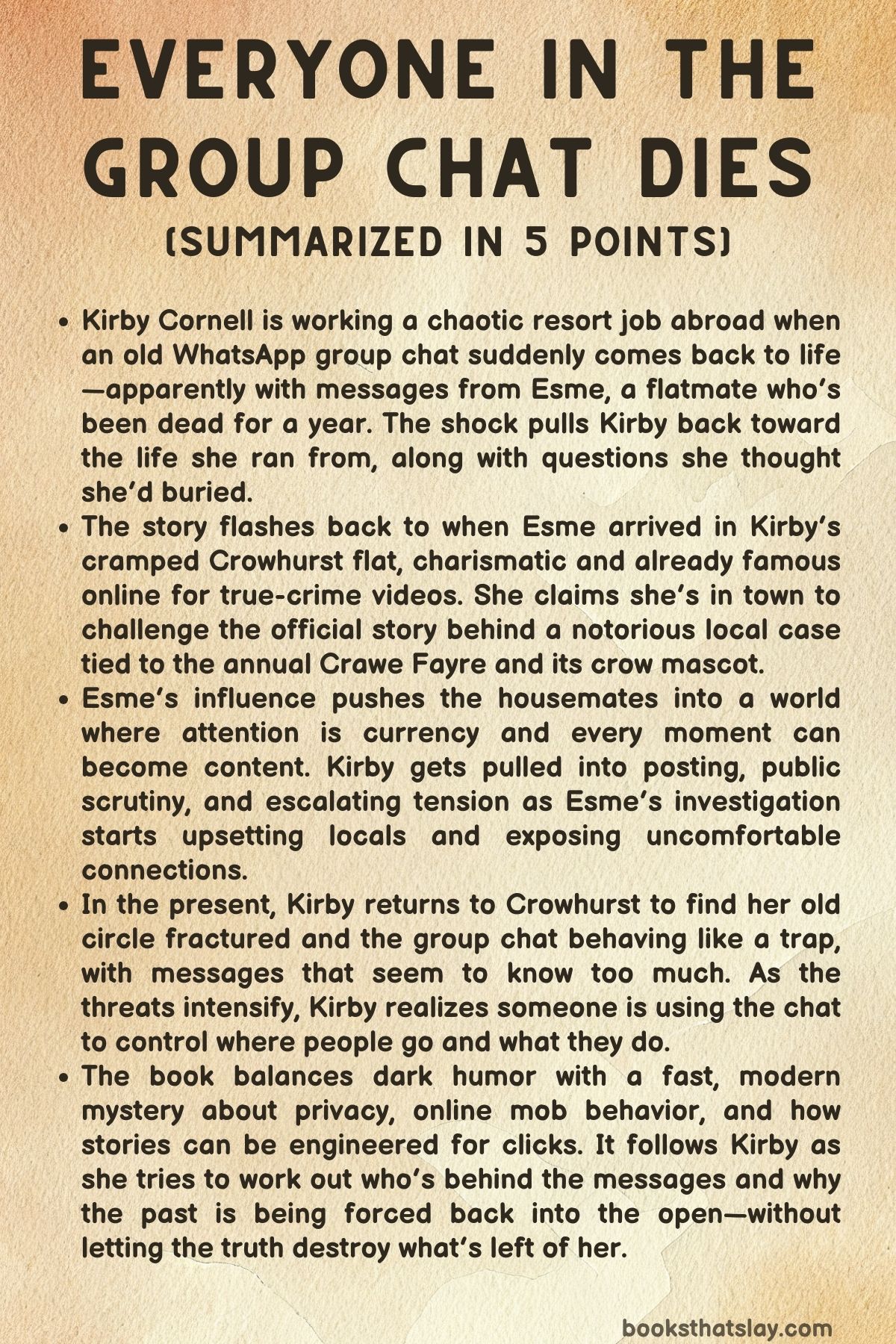
Summary
Kirby Cornell is nearly thirty-one and stuck in a dead-end job in Magaluf, cleaning a hotel pool for a singles travel company. She’s exhausted, irritated by the forced cheer of the work, and quietly glad she’s far away from the people who knew her before.
Early one morning, her phone buzzes with a WhatsApp notification from an old group chat called the Deadbeats—shared with her former flatmates from “Flat Four” in Crowhurst. The message is from Esme.
Kirby freezes, because Esme died a year ago.
Kirby tries to dismiss it as a prank, but the chat keeps stirring back to life in unsettling ways. Then Max Robertson, the former flatmate who originally had the box room, suddenly leaves the chat.
Kirby searches his name and finds a news report saying Max died two days earlier in a fatal train accident. The timing is impossible: his account left the group chat minutes ago.
Kirby’s dread turns to certainty that something is very wrong. A new message arrives that sounds like a threat, and Kirby decides she can’t stay hidden anymore.
She quits her job, books the first flight back to England, and replays the messages over and over, trying to work out who is behind them and what they want from her.
On the flight home, Kirby’s mind keeps snapping back to the year before, when she lived in Crowhurst with Dylan, a trainee chef at the local pub; Dave Watkins, Dylan’s best friend and constant chaos agent; and Seema, a dental nurse obsessed with true crime. Their flat was cramped and shabby, their evenings full of petty arguments and comfort routines.
Into that ordinary mess walked Esme, a young woman with a key and a confident smile, announcing she’d be renting the box room for the summer. The flatmates panic because the room wasn’t supposed to be sublet, and their landlord—Frank Garrett, known behind his back as “Creepy Frank”—liked to show up uninvited.
Still, Esme seems harmless at first, if slightly intense. Then she says, calmly, that she has come to Crowhurst to catch a serial killer.
Esme isn’t just some random lodger. She’s famous online, a true-crime creator with a huge following on a video app called ShowMe, where she plays detective for her fans.
She claims she solves cold cases and finds evidence the police miss. Dylan is openly disgusted by her methods, calling it exploitative.
Esme fires back that the police can’t be trusted and that she can do what they can’t. Crowhurst has a dark story for her to work with: in 1996, during the town’s harvest celebrations, five teenagers were murdered.
A man named Peter Doyle was blamed. The legend says he wore the Crawe Fayre’s crow costume—Jack Daw—used a ceremonial trowel as the weapon, and later died after fleeing.
The town has never fully let it go.
As the flatmates drink together and Esme films bits of the town, Kirby is pulled toward Esme’s confidence and the promise of being seen. One night, Esme persuades Kirby to join ShowMe and helps her make a small, silly video about local roadworks.
Esme pushes Kirby to make it dramatic and “real.” Drunk and off-balance, Kirby ends up stumbling into the taped-off roadworks hole. Esme treats it like a useful stunt—proof the site is dangerous and a perfect clip for attention.
Kirby wakes the next morning hungover to find the video has exploded online. She’s furious and embarrassed, but Esme has already posted it and tagged her.
When Kirby tries to confront Esme, the box room is empty, the mattress deflated, and Esme is gone.
In the group chat, Esme leaves a message that reads: “Crowhurst Killer is a lie.” Kirby realizes it likely means something else—“Crowhurst Killer is alive.” She tries to pitch the idea to her editor at the struggling Crowhurst Gazette, Trevor, hoping it could be the story that saves the paper. Trevor shuts it down, warning her not to publish rumours about a case that scarred the town.
Meanwhile, Esme’s online presence becomes more disturbing. One night, the flatmates see that Esme is live-streaming.
She walks through dark streets whispering that she’s about to confront someone connected to what happened at Staker Point, the cliff linked to the old case. Then the stream jolts, a scream cuts through the audio, and the broadcast ends.
Esme’s phone goes dead.
The flatmates try to get help, but without details about Esme’s real identity, the police are dismissive. They contact Max, assuming he arranged Esme’s stay, only for him to insist he never rented out his room.
That revelation turns the flat’s confusion into fear: Esme arrived with a key and a story, but nobody knows how she got access.
Kirby, frantic and feeling responsible, does the one thing Esme taught her to do: she uses the internet. She posts a ShowMe video telling Esme’s followers that Esme has vanished while investigating, and that Esme believed Peter Doyle might still be alive.
The response is immediate. Crowds of online sleuths—“Watsons”—flood the town’s story with speculation, rumours, and pressure.
Kirby’s attempt to help becomes a spotlight that won’t switch off.
In the present, Kirby returns to Crowhurst and finds the town hollowed out: closed shops, familiar places boarded up, and former friends scattered. She tracks down Seema, hoping to regroup, but before they can meet properly, Seema leaves the group chat.
Kirby goes to the dentist surgery where Seema used to work, using a spare key Seema mentioned. Inside, the building is quiet and wrong.
Kirby finds Seema dead in the dental chair, her throat smashed, blood pooled beneath her, and a single black feather left nearby. Terrified, Kirby makes an anonymous emergency call and flees.
Almost immediately, the group chat pings again, making it clear the person behind “Esme” is watching and controlling the timing.
Kirby realizes the pattern: Esme is dead, Max is dead, Seema is dead. That leaves Kirby, Dave, and Dylan as the last people in the Deadbeats chat.
At the Crawe Fayre grounds, Kirby notices something bloody inside a claw machine stuffed with toys. In desperation she gets coins, plays, and wins the “prize”—a real severed hand.
She recognizes it as Dave’s. Moments later, “Dave The Legend” leaves the chat.
The messages lure Kirby into a hay-bale maze, where she hears a phone ringing and sees Jack Daw’s crow costume. A figure approaches holding a trowel.
Kirby runs, scrambles over the hay, escapes, and then sees Superintendent Morris appear with unsettling speed. When he orders her not to move, Kirby panics and bolts.
On the anniversary of Esme’s death, Kirby drives toward Staker Point in a daze of fear and guilt. She is stopped by a young woman who looks eerily like Esme, but speaks with a local accent.
The girl is Frank’s niece, part of a new wave of online copycats trying to “solve” Esme’s case for content. She recognizes Kirby and begins filming her, accusing her and baiting her for a reaction.
Kirby, trapped and furious, plays along just enough to get an advantage—then steals the girl’s keys and leaves.
The missing truth finally catches Kirby in full. A year earlier, Esme wasn’t simply taken.
Esme and Dave staged her disappearance. Dave had been in contact with Esme through ShowMe and secretly helped her hide nearby, feeding the drama that grew her audience.
Dylan lied to the police about being the last person to see Esme, trying to protect the others and keep suspicion away from Dave. When Kirby confronted them at Staker Point, Esme turned the situation into leverage.
She had discovered Dylan’s darkest secret: his mother, Betty, had been connected to Peter Doyle, and Dylan was Peter’s child. Esme threatened to expose it to her followers, framing Dylan’s family as part of the town’s violence.
A struggle broke out near the edge. Dylan lunged for Esme’s phone.
Esme shoved him. He shoved back, and Esme fell.
She tried to grab the phone as she went over, but she hit the rocks below and died. Panicked, the group agreed to a cover story: Esme slipped while filming, and Kirby “found” her alone.
Kirby called emergency services, then filmed herself announcing she’d found Esme’s body—an act that would haunt her.
Back in the present, Kirby uses the stolen keys to break into Stewart Heights and search Frank’s basement. She finds signs that someone has been preparing props and tools: fresh blood, disturbing items linked to the old case, and evidence connected to the Jack Daw costume and the trowel.
Someone enters wearing the crow head, and Kirby barely escapes after a violent struggle.
Kirby’s last lead takes her to the Gazette’s printing site. There she finds Jack Daw standing motionless—then discovers Dylan inside the costume, alive but gagged.
Before she can free him, Trevor attacks. Kirby realizes Trevor has Esme’s phone and has been the one impersonating her in the group chat, using the messages to pull the Deadbeats back into reach.
Trevor confesses that he’s been shaping Crowhurst’s horrors for years. He framed Peter Doyle long ago to create a story that would make the town notorious and keep the paper relevant, and he killed again to control the narrative when the past threatened to break loose.
He even recruited Esme online and paid her to stage the disappearance so he could run a new wave of headlines—until Esme died for real and everything became messier.
Trevor tries to force Kirby into a final setup that blames Dylan as a new “Crowhurst Killer,” then plans to kill Kirby and present himself as the survivor. Kirby stalls long enough to fight back.
In the chaos, Dylan tackles Trevor despite his injuries. Trevor reaches for the trowel, but Kirby kicks him into the machinery.
Trevor dies, and Kirby restarts the presses, turning his planned story into a scene he can’t spin.
Dylan, fading fast, insists the truth has to be told. Kirby records Dylan’s confession: Trevor’s role, and what really happened at Staker Point.
Dylan dies after admitting that in the struggle, he pushed Esme and she fell. Kirby sends the confession to Morris.
Afterward, Crowhurst becomes infamous nationwide. Kirby faces the consequences: media attention, funerals, and the wreckage of the lives around her.
She moves away, deletes her ShowMe account, and tries to rebuild a quieter life outside the town’s hunger for spectacle. On a train out of Crowhurst, she’s added to yet another huge group chat.
This time, she turns off notifications and keeps going.
Characters
Kirby Cornell (Clare “Kirby” Cornell)
Kirby is the emotional center of Everyone in the Group Chat Dies, and her defining contradiction is that she desperately wants a clean, quiet life while repeatedly being pulled toward spectacle. At the start she is physically exhausted, cynical, and hiding in Magaluf because distance feels like the only way to outlive shame; her “fresh start” is less reinvention than self-erasure.
Her guilt is not abstract: she carries the memory of Esme’s death, the lies told afterward, and the way she helped turn a corpse into content, so every new message in the Deadbeats chat lands like a moral invoice coming due. Yet Kirby is not simply passive or victimized—she makes choices that ignite consequences, from leveraging Esme’s followers to forcing attention onto the case, to later orchestrating chaos around town to survive.
What makes her compelling is how her survival instinct and her conscience wrestle: she wants truth, but she also wants absolution, and the story repeatedly tests whether she can tell the truth without also chasing the attention that once ruined her.
Esme Goodwin
Esme is charisma weaponized—an internet-famous sleuth who understands that online attention isn’t earned by accuracy but by narrative heat. She frames herself as righteous because she “does what police can’t,” but the details of her behavior show a deeper appetite for control: she scripts reality, coaches Kirby into “B-roll” and drama, and engineers a viral moment by turning Kirby’s fall into content without consent.
Esme’s morality is slippery, not because she lacks intelligence, but because she values impact over harm; she treats other people as props in her story, including victims’ families and, eventually, her own disappearance. Her death is tragic, but it is also the natural collision of her method with the real world—when you escalate everything for an audience, you eventually escalate into something you can’t edit away.
Even after dying, Esme remains the book’s most powerful presence because her phone, her persona, and her fandom become tools others can wear like a mask, proving that in the attention economy a “person” can outlive their body and keep doing damage.
Dylan
Dylan begins as the most grounded flatmate—hardworking, practical, and instinctively skeptical of Esme’s true-crime performance—yet he is also the story’s most fragile pressure point because his identity is tied to a secret he never chose. His parentage connects him to Crowhurst’s defining trauma, and that inherited stigma becomes the lever Esme uses to control him: the threat is not only personal ruin, but his mother being punished by public obsession.
Dylan’s arc is the transformation from someone who wants life to stay small (shift work, flat drama, quiet affection for Kirby) into someone trapped inside a narrative bigger than him, literally costumed and staged as Jack Daw. In the end, he becomes both victim and contributor to tragedy—his shove kills Esme, his later confession attempts to restore truth—and his death reads like the book’s harshest verdict on scapegoating: Crowhurst and the Gazette need a monster, and Dylan is “useful” as one.
Dave “The Legend” Watkins
Dave performs confidence the way some people breathe, using humor, bravado, and that “Legend” persona to keep everything light—until you realize the persona is also how he avoids accountability. He seems like harmless chaos at first, the mate who buys disgusting shots and plays up the Jack Daw costume as a joke, but his closeness to the town’s folklore and his willingness to collaborate with Esme’s stunts reveal a more dangerous trait: he enjoys the game when it feels consequence-free.
Dave’s involvement in staging Esme’s disappearance shows how easily he slips from prankster to accomplice, especially when it offers him attention, excitement, or proximity to someone famous. His fate is one of the most brutal turns because it punishes that casual complicity; the story treats him as an example of how “just messing around” becomes lethal when you’re playing with someone else’s fear and a town’s open wound.
Seema
Seema is the clearest symbol of how true-crime culture becomes a lifestyle rather than an interest: she consumes cases for fun, talks in the language of suspicion, and treats mystery like comfort food. That obsession gives her sharp instincts—she recognizes patterns, she understands how stories get manipulated—but it also makes her vulnerable, because she is primed to believe everything is a clue and that proximity to violence is exciting rather than corrosive.
Her death is especially chilling because it happens in a sterile place meant for care, turning a familiar setting into a display, complete with the feather as a theatrical signature. Seema’s role in the broader narrative is to show that fascination does not equal preparedness; being fluent in the genre of crime doesn’t protect you when you become a character inside it.
Max Robertson
Max is mostly absent in person, but crucial in function: he is the missing hinge that allows Esme to enter the flat, and later his “leaving the chat” becomes the first undeniable proof that the group chat is being used as a murder mechanism. Because he is gone from the flat, he becomes an easy scapegoat and a convenient mystery, the kind of off-screen figure people project motives onto without evidence.
His death—sudden, public, and then eerily mirrored by the timing of his chat activity—turns technology into a ghost story: the book uses Max to make the reader feel how modern identity can outlive the body for a few minutes, long enough to terrify, manipulate, and summon people back into danger.
Frank Garrett (“Creepy Frank”)
Frank functions as the town’s obvious suspect, built from all the ingredients that make someone look guilty in a story: intrusive landlord behavior, proximity to the flat, an uncomfortable presence, and suspicious connections to the past. He is also a commentary on how communities assign villainy—once a person is labeled “creepy,” every detail becomes evidence.
At the same time, Frank isn’t merely misread; his secrecy and control (including his anger around the Jack Daw costume and the weirdness of his basement) make him complicit in the atmosphere that lets real evil hide. His relationship with his niece places him at the intersection of old, offline Crowhurst and the new wave of online sleuthing, and his role shows how easy it is for true-crime narratives to mistake “unpleasant” for “killer,” clearing space for the real perpetrator to operate.
Superintendent Morris
Morris embodies institutional friction: he is cautious, procedural, and often dismissive, which in this story reads as both frustrating and realistic. He repeatedly treats Kirby as suspicious, not purely because he is incompetent, but because Kirby’s behavior—running, lying, staging videos—makes her look exactly like someone with something to hide.
Morris also illustrates the theme of “official truth” versus “viral truth”: he cannot move at the speed of ShowMe, and he won’t validate claims without proof, which leaves space for manipulators to fill the gap with spectacle. By the end, his role becomes the channel through which confession and evidence might finally become reality, but the damage done by delay, doubt, and narrative chaos is already irreversible.
Trevor
Trevor is the story’s clearest portrait of ambition curdling into atrocity, and his danger lies in how ordinary he initially appears: a stressed editor trying to keep a dying paper afloat, scolding Kirby for unprofessionalism, insisting on restraint. That surface practicality hides a ruthless belief that the town—and the Gazette—need notoriety more than they need peace.
He doesn’t merely exploit tragedy; he manufactures it, shaping reality into a headline, first by framing Peter Doyle and later by orchestrating fresh horror to resurrect relevance. Trevor’s use of Esme’s phone and the Deadbeats chat is particularly revealing: he understands that modern control isn’t only about physical force, it’s about narrative ownership—who speaks, who is believed, and which “version” goes public.
In the end, Trevor is the book’s thesis made human: when attention is currency, some people will spill blood to keep the account full.
Betty Barnes
Betty seems peripheral at first—warm, local, a familiar face in the town’s daily routine—but she becomes emotionally central once her connection to Peter Doyle is revealed. Her protectiveness and unease whenever the past is mentioned suggest a life spent managing other people’s hunger for scandal, and her role highlights how the true cost of infamous crimes is often paid by those who didn’t commit them.
Through Betty, Everyone in the Group Chat Dies explores inherited punishment: even if the killer is dead, the community keeps sentencing the family in public opinion. She also anchors Dylan’s tragedy, because the threat to expose his parentage is ultimately a threat to turn Betty into a symbol—proof that in Crowhurst, a person can be reduced to a footnote in the town’s favorite story.
Charlotte Goodwin
Charlotte represents the grief that true-crime content routinely steps over: the parent who loses a child and then must watch strangers monetize that loss. Her condemnation of Kirby, voiced in an interview, sharpens one of the book’s hardest questions—whether “raising awareness” is sometimes just a prettier phrase for exploitation.
Charlotte’s presence is brief but heavy; she forces the narrative to acknowledge that behind every clickable mystery is a family living with an absence that doesn’t resolve when the audience gets bored. She also becomes an unwitting link in the chain of manipulation when Esme’s phone is taken, underlining how mourners are often targeted precisely because they are vulnerable.
Peter Doyle
Peter Doyle is less a living character than a mythic object that everyone fights over, because his alleged crimes provide Crowhurst with a story it cannot stop telling. The uncertainty around his fate, identity, and scapegoating turns him into a narrative tool: for Esme, proof the official version is wrong; for Trevor, a convenient villain to frame; for the town, a ready-made explanation that keeps deeper questions buried.
Even after DNA identification confirms the body, Doyle remains powerful as an idea, because what matters is not only what he did, but what people can make others believe he did. In that way, he is the shadow villain of Everyone in the Group Chat Dies—a reminder that once a community builds its identity around a monster, it will keep rebuilding the monster even when the body is in the ground.
Themes
Digital voyeurism and the pressure to perform
The world of Everyone in the Group Chat Dies treats attention as a kind of currency, and the story keeps showing how quickly ordinary life becomes a stage once a phone camera is pointed at it. Kirby’s first real collision with that reality happens when Esme posts the roadworks footage of Kirby falling, turning an unpleasant, private moment into a public spectacle that spreads faster than Kirby can react.
The humiliation is not only that she looks foolish; it is that she loses ownership of her own image. From there, the narrative keeps stressing that online audiences do not simply “watch” events, they shape them.
Esme’s followers are trained to expect escalation, and their appetite creates incentives for creators to raise the stakes, even when the stakes are human safety and grief. Kirby’s later decision to post about Esme’s disappearance shows how slippery the slope is: she begins from panic and genuine concern, but she is also stepping into a system where tragedy becomes content.
The pressure of the platform pushes people toward certainty, simplicity, and drama—exactly the opposite of what real investigations need. That tension becomes frightening in the “ShowMeSherlocks” copycat culture, where people cosplay detective work for likes, and where Kirby is treated less like a traumatised witness and more like a character whose reactions can be harvested.
The theme is not “phones are bad” so much as “systems that reward spectacle will eventually demand blood,” and the book repeatedly illustrates how the pursuit of engagement trains people to treat real danger as a plot twist rather than an emergency.
Paranoia, surveillance, and the collapse of private life
The group chat functions like a locked room that is supposed to be safe, familiar, and intimate, and the horror comes from watching it become hostile territory. When messages arrive from Esme after her death, the shock is not only supernatural in feeling; it is invasive.
A space meant for banter and shared memory is taken over by someone who understands the group’s history and uses it like a weapon. The “left the chat” notifications are especially unsettling because they twist a mundane social-media mechanic into a death bell, forcing Kirby to interpret tiny digital signals as proof that something real and violent is happening.
As the threats escalate, the book keeps tightening the sense that Kirby cannot separate the online from the physical. Someone is always watching: at the dentist surgery, at the fayre, in Stewart Heights, and even inside institutional spaces that should provide safety.
That sense of constant observation reshapes Kirby’s choices—she flees before she can explain, she lies to get help, she improvises diversions—because she assumes any stable procedure will be used against her. Importantly, the surveillance theme also extends to the town itself.
Crowhurst has its own collective gaze: people remember, judge, and cling to stories. The plot makes it clear that “being seen” can be a punishment, and that public narratives can trap someone more effectively than locked doors.
Kirby’s dread is not just fear of a killer; it is fear of being framed, clipped into a storyline, and watched into helplessness.
Guilt, complicity, and the long afterlife of a single decision
Kirby’s exhaustion and cynicism in Magaluf are not random character traits; they read like symptoms of someone trying to outrun a moral injury. The book builds its emotional weight by showing that the worst consequences do not come only from what the killer does, but from what the survivors agree to hide.
The secret of what happened at Staker Point makes guilt communal: a shared decision becomes a shared trap, and the group’s relationships rot under the pressure of what they cannot say. Kirby’s guilt is particularly complex because it is layered.
She feels responsible for platforming the case, for mobilizing followers, for turning a disappearance into a public drama, and later for filming Esme’s body as part of the cover story. Even when Kirby tries to act ethically, the story makes her confront how limited “good intentions” are once harm has already been set in motion.
Dave and Dylan’s choices show other angles of complicity: Dave’s willingness to participate in a fake disappearance, Dylan’s lie about being last to see Esme, and the way each lie is justified as protection. The theme becomes sharper when the deaths begin in the present timeline, because the killings are aimed at people who already carry guilt, using that guilt as leverage.
The story is insistent about a brutal idea: if you hide the truth to avoid immediate punishment, you may create the conditions for a larger disaster later. Kirby’s arc is shaped by the slow transition from avoidance to accountability, and the ending’s emphasis on confession and evidence highlights that survival is not only physical—it is also about refusing to live inside a lie forever.
Small-town mythology and the hunger for a defining story
Crowhurst is presented as a place that cannot stop narrating itself. The Crawe Fayre, the Jack Daw costume, and the legacy of the 1996 murders create a local mythology that people either exploit or resent, but no one fully escapes.
The town’s identity is tied to the old killings, and the book portrays that tie as both shameful and economically tempting. Some residents want the past left alone; others keep it alive through folklore and rituals; and a few see it as a resource that can be mined.
This theme becomes darker when the narrative reveals how the desire for notoriety can become a motive in itself. The idea that a town might benefit from being infamous is grotesque, but the book treats it as believable because communities under decline can become desperate for attention, investment, and relevance.
In that context, murder becomes a perverse form of marketing, and the media becomes a machine that can be fed with fear. The Jack Daw figure is important because it shows how a mascot can shift into a threat: something designed for communal celebration can be repurposed into a symbol of predation.
The costume also allows violence to feel like a “return” of legend, which makes people easier to manipulate. The theme is ultimately about how stories can hollow out reality.
Once Crowhurst is known as a “killer town,” everything that happens is interpreted through that lens, and people become props inside a narrative that feels bigger than them. Kirby’s attempt to leave, and later to leave again, suggests that the only way to reclaim a life is to exit the town’s story economy entirely.
Institutional failure and the temptation to replace authority with crowds
The story repeatedly shows official systems as slow, limited, or unwilling to engage unless forced by visibility. Early on, the police cannot act decisively because Esme is missing without enough formal details, and later Kirby learns that being loud online can create movement that official channels resist.
That dynamic helps explain why Esme’s worldview has appeal: if institutions appear indifferent, crowds look like power. But the book also highlights the dangers of replacing authority with a digital mob.
Esme’s claim that she can do what police “legally can’t” is framed as a selling point to followers, yet it also signals the ethical erosion that comes from seeing rules as obstacles rather than safeguards. Kirby’s use of the audience to amplify Esme’s disappearance is effective in generating pressure, but it also creates collateral damage, feeding speculation and paranoia and drawing unstable people into the orbit of the case.
The “Watsons” culture shows how quickly crowds produce certainty without evidence, and how easily they turn on individuals who are emotionally available on camera. Even the Gazette’s precarious state adds to the institutional theme: local journalism is depicted as both necessary and vulnerable, with economic strain pushing editors toward sensational angles or away from hard truths depending on what protects the paper.
The book suggests a grim feedback loop: weakened institutions invite vigilantism; vigilantism creates chaos; chaos makes institutions retreat further or become more punitive. Kirby is caught inside that loop, punished for speaking, punished for silence, and forced to navigate a world where neither the police nor the crowd can be trusted to care about truth more than story.
Identity, reinvention, and the fear of being known
Kirby’s attempt to start over in Crowhurst, hiding her link to a famous father and the fallout from an earlier viral controversy, connects personal identity to public consumption. The book treats “being known” as unstable: fame can arrive from a family association, a workplace incident, or a humiliating clip posted without consent.
Kirby’s impulse is to become unremarkable, to live in a shabby flat with familiar routines, because ordinariness feels like safety. Esme disrupts that by treating Kirby as raw material for content, coaching her into a persona and proving how quickly authenticity can be manufactured.
The theme deepens when Kirby becomes “Clare” in the later sections, underlining how identity can fracture under pressure and how names can feel like costumes people are forced to wear. There is also a darker strand: the revelation about Dylan’s parentage shows how identity can be weaponised, not just socially but existentially.
Dylan is terrified not because the fact changes who he is, but because the town’s story about “blood” and legacy could swallow his life and his mother’s. The book keeps returning to the idea that people are more than the narratives attached to them, yet those narratives still have power to ruin them.
Kirby’s final choices—moving away, deleting her ShowMe account, refusing to immediately monetize the ordeal—read as an attempt to reclaim selfhood from a culture that converts experience into branding. The theme resolves not with a triumphant reinvention, but with a quieter assertion: the right to exist without being processed, packaged, and consumed.