Fallen Gods Summary, Characters and Themes
Fallen Gods by Rachel Van Dyken is a dark academia romantasy built around Norse myth, family betrayal, buried power, and a romance formed between enemies who were trained to destroy each other. The book follows Rey Stjerne, Odin’s daughter, as she is sent to Endir University to awaken Aric Erikson, a Frost Giant heir, and recover Thor’s missing hammer, Mjölnir.
What begins as a mission of manipulation becomes a dangerous bond between two people trapped by ancient wars and ruthless guardians. The story combines campus rituals, hidden runes, divine memory, and emotional conflict into a high-stakes fantasy romance.
Summary
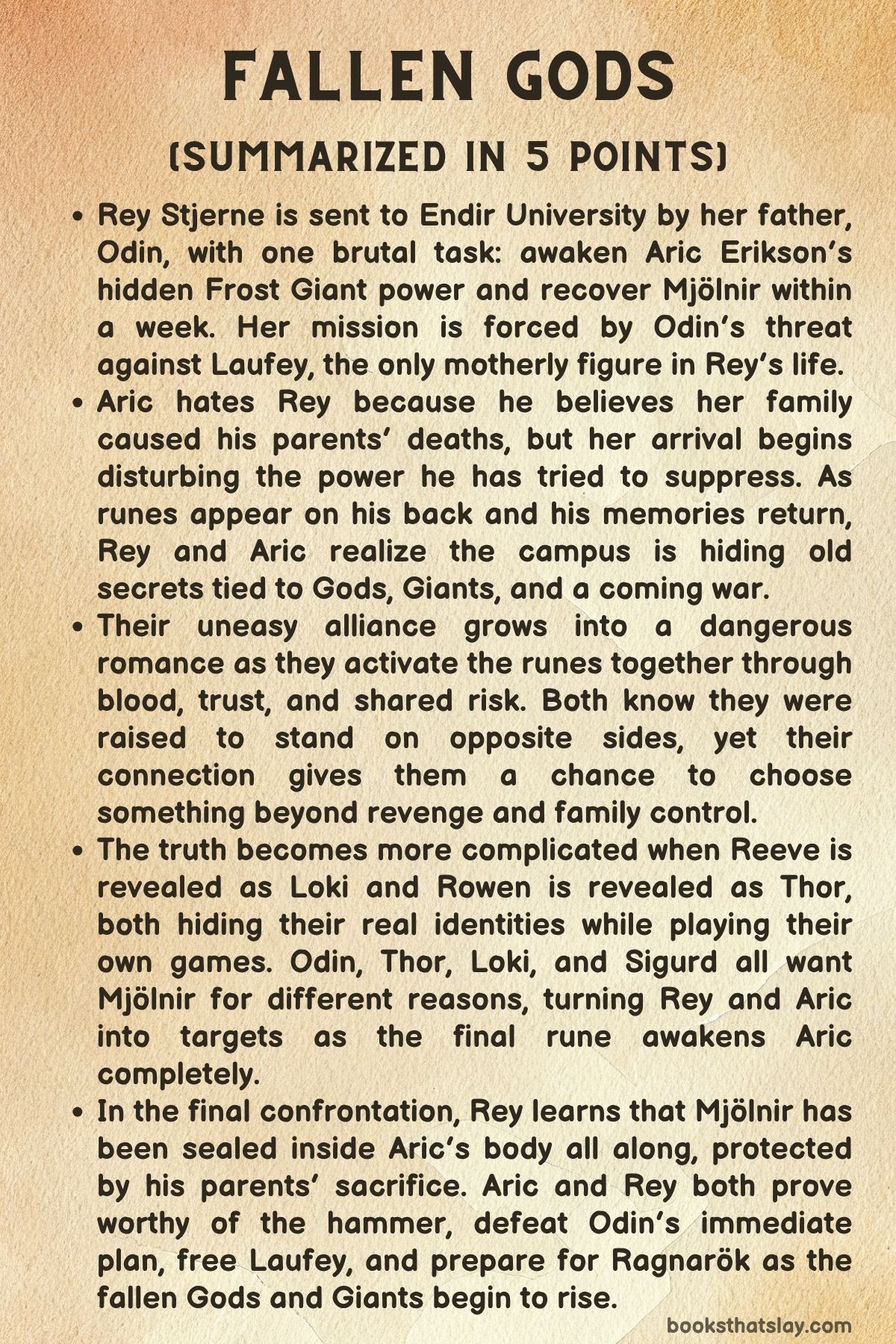
Rey Stjerne arrives at Endir University on her eighteenth birthday with a mission that feels more like a death sentence than an assignment. Her father, Odin, sends her to the campus to find Thor’s hammer, Mjölnir, within one week.
The threat behind the task is clear: if Rey fails, her stepmother, Laufey, will suffer or die. Laufey, a Frost Giant who has shown Rey the closest thing to maternal love, begs her not to go, but Odin does not care about fear, love, or hesitation.
He wants the hammer back, and he believes the Erikson family is the key to finding it.
Endir University looks like a place built out of old myth and old violence. Its dark stone buildings, runes, strange traditions, and forbidden locations make Rey feel that the campus itself is watching her.
She quickly learns that Aric Erikson, the cold and furious heir of the Erikson family, lives right next door to her. Aric once had a brief, arranged connection to Rey, but that ended badly, and soon after, his parents died.
He blames Odin and Rey’s family for their deaths, so when Rey arrives, his hatred is immediate. His younger brother, Reeve, is more playful on the surface, but his smiles carry warning signs of their own.
Rey’s first task is to understand Aric. Odin believes Aric’s parents hid Mjölnir and that Aric’s memories must be awakened before the hammer can be found.
Rey has a power called the Aethercall, which makes people adore her and allows her to influence emotions, but Aric and the Eriksons are not easily controlled. Rey begins watching Aric, searching his room, studying Laufey’s secret rune note, and tracking the runes carved across campus.
The five runes in Laufey’s message become the map Rey must follow: Raido, Dagaz, Hagalaz, Othala, and Thurisaz.
Aric is also changing. Rey’s presence disturbs something inside him that he has spent years trying to suppress with medication and discipline.
Frost forms when he loses control. His eyes flash white.
He has violent dreams and visions of blood, battle, monsters, and Mjölnir. His grandfather Sigurd tells him that control is everything, but Sigurd’s concern feels less protective than strategic.
As Aric’s powers wake, runes begin burning themselves into his back. Each rune seems tied to a place, a choice, and a deeper part of his buried Giant identity.
The first major shift happens in the Hall of Ormir, where Rey is struck during a strange supernatural incident involving a mirror and a black pool. Aric catches her, and frost spreads where he touches her skin.
A rune appears on his back, marking the beginning of his visible awakening. Later, during a trip to the Ice Caves for a class assignment, Rey and Aric are trapped in a collapse.
Aric has a vision of ancient war and Mjölnir, while Rey discovers another rune. Their connection becomes harder to deny, even as both of them know they are enemies by blood, family, and command.
Rey begins to see that Aric is not simply a weapon or an obstacle. He is a young man crushed beneath inheritance, grief, fear, and control.
Aric, in turn, starts to understand that Rey is not Odin’s willing puppet. She is trapped by his cruelty, especially through his threats against Laufey.
Their alliance forms after Rey reveals that she needs a Giant to find Mjölnir. Aric admits what he is, and together they activate more runes through shared blood.
The process is painful, intimate, and dangerous. With each rune, Aric becomes more powerful, and with each shared secret, their truce becomes less like a strategy and more like a choice.
Their bond deepens in private moments. Rey sleepwalks into Aric’s room, and her presence calms the storm in his blood.
Aric leaves his door open for her at night, while during the day they pretend not to care. They argue, tease, kiss, and eventually become lovers, even though both believe their families will force them apart.
Rey’s feelings frighten her because love has never been safe in her life. Aric’s feelings frighten him because he believes he may become a monster.
Yet together they find brief peace, and that peace becomes one of the strongest forces in the story.
Around them, the larger truth begins to break open. Rowen, Rey’s trusted protector, is not merely a bodyguard.
His scars, rage, nightmares, and strange connection to Odin’s blood suggest that he is hiding something immense. Reeve also has a secret.
He is not just Aric’s charming younger brother; he is Loki, the God of Mischief, hidden in plain sight. His role is unclear at first because he threatens Rey, manipulates events, and claims loyalty to different sides at different moments.
Sigurd, meanwhile, reveals himself as far more dangerous than a powerful grandfather. He wants Aric fully awakened and intends to use him in the coming war.
The final movement of the story begins with the Wild Hunt, a campus ritual that becomes the opening move in a supernatural conflict. Odin arrives with Laufey, proving he is willing to use her as leverage in front of everyone.
Sigurd also turns the ritual into a larger awakening, releasing forces that have been asleep inside students and hidden beings. Rey and Aric slip away to activate the last rune, Thurisaz, using the cobblestone Rey tripped over when she first arrived.
When the final rune awakens, Aric fully transforms into his Frost Giant power. The revelation that follows changes everything: Mjölnir is not hidden somewhere on campus in a normal sense.
It has been sealed inside Aric’s body, protected within his spine.
Before Rey and Aric can act freely, they are captured. Odin, Rowen, Loki, and guards gather in the Hall of Ormir, where Rey is chained and Aric is wounded.
Odin demands the hammer’s location, while Laufey is brought in as a hostage. Loki seems to side with Odin, but his actions remain slippery.
Rey is forced toward the black pool and sent underwater to retrieve what they believe is Mjölnir. Guided by a serpent rune and Aric’s light, she finds a hidden object beneath the water, but it is not the hammer.
It is the Nightfrost ring, the legendary diamond ring tied to Thor’s love and betrayal of a Giant woman.
The discovery exposes Rowen’s truth. He is Thor, Odin’s son, hidden under glamour and scars.
He puts on the ring and transforms, revealing the depth of his bitterness and hunger for recognition. Odin calls him son, and Thor tries to take Mjölnir from Aric’s body, but the hammer rejects him.
Odin then admits Rey’s real purpose: her blood is meant to help retrieve the weapon. Rey understands that she has been used from the beginning, not as a daughter, but as a tool.
Aric refuses to surrender. He speaks to Mjölnir as its protector and claims worthiness not through bloodline, but through sacrifice and love.
The hammer erupts from his back, breaking his chains and restoring his power. In the battle that follows, Aric wields Mjölnir against Odin’s forces.
Rey also proves worthy and calls the hammer to her hand. She uses it to strike Odin, forcing him and Thor to flee.
Laufey is freed, and Rey survives, but victory is not simple. Sigurd appears and warns that the fallen Gods and Giants are waking.
Loki admits that Ragnarök is beginning and that he helped Rey in his own manipulative way.
In the aftermath, Rey and Aric choose each other while accepting that their world is not safe. Aric takes Rey to a cabin filled with wildflowers for their first real date.
They discuss Mjölnir, power, and the future. Rey decides they should open the Bifrost and restore power to all the fallen, even though that means Odin may rise again.
Aric agrees, trusting her choice. Their quiet moment is filled with tenderness, but it is not an ending free from danger.
It is a pause before a larger war, with Rey and Aric no longer pawns, but active players in the fate of Gods, Giants, and the realms.
Characters
Rey Stjerne
Rey Stjerne is the emotional and moral center of the book, a heroine shaped by fear, duty, and the constant need to survive her father’s cruelty. As Odin’s daughter, she has been trained to view herself as a weapon, not as a person with desires of her own.
Her Aethercall gives her power over emotion and attraction, but it also isolates her because she can never fully trust whether people respond to her or to the glamour surrounding her. Rey’s mission at Endir forces her to manipulate Aric, yet her conscience keeps pushing back against the role Odin has written for her.
Her love for Laufey reveals the softer part of her nature: she is capable of fierce loyalty, gratitude, and sacrifice. Her journey is not only about finding Mjölnir but about claiming the right to choose what kind of power she will serve.
By the end, Rey proves that worthiness is not defined by Odin’s bloodline or command. She becomes worthy because she chooses protection over domination, love over obedience, and courage over fear.
Aric Erikson
Aric Erikson is a Frost Giant heir trapped between grief, rage, and a power he does not fully understand. At the start of the story, he sees Rey as a symbol of everything that ruined his life.
He believes her family is responsible for his parents’ deaths, and his hatred becomes a shield against the attraction he still feels. Aric’s internal conflict grows as his dormant Giant nature begins to awaken.
Frost, lightning, visions, and runes reveal that his body holds a legacy far older and more violent than he imagined. What makes Aric compelling is that his fear of becoming a monster is matched by his instinct to protect.
He is dangerous, but he is not empty of tenderness. Rey calms him not because she controls him, but because she reaches the part of him that still wants to choose love instead of revenge.
His worthiness to wield Mjölnir comes from his willingness to die for Rey and protect the hammer from those who would abuse it.
Odin
Odin is the chief antagonist, a ruler whose fear of weakness has turned into tyranny. He presents himself as a father and king, but his actions show that he values people only as tools.
Rey is useful because of her blood. Laufey is useful as leverage.
Rowen is useful as a hidden son and weapon. Odin’s desire for Mjölnir is not rooted in justice or restoration, but in domination.
Cut off from Asgard and losing power, he becomes increasingly unstable, violent, and desperate. His cruelty is personal as much as political; he knows exactly which emotional pressure points to use against Rey.
Odin’s vision of restoring divine supremacy exposes the old war at the heart of the story. He does not want balance between Gods and Giants.
He wants the return of a hierarchy where his side rules and everyone else submits. His defeat matters because it proves that inherited authority can be challenged when those he has controlled finally refuse to obey.
Laufey
Laufey is one of the quietest yet most important figures in the story because her love shapes Rey’s moral compass. As Rey’s stepmother and a Frost Giant, she exists in a dangerous position inside Odin’s household.
She is not powerful in the same outwardly violent way as Odin or Sigurd, but her endurance, patience, and healing ability make her strength deeply meaningful. Laufey gives Rey warnings through runes, stories, and hidden messages, guiding her without openly rebelling in ways that would get them both killed.
Her bedtime story about the small wolf pup teaches Rey that survival can require patience while stronger predators destroy one another. Laufey’s suffering also raises the emotional stakes of Rey’s mission.
Rey is not seeking Mjölnir for glory; she is trying to save the woman who gave her care in a loveless world. Laufey represents protective love, hidden resistance, and the wisdom of those who survive under oppression without surrendering their inner loyalty.
Rowen / Thor
Rowen begins as Rey’s trusted protector, almost a family figure, but his true identity as Thor reshapes the reader’s understanding of his behavior. Before the reveal, he seems scarred by past failure, loyal to Rey, and damaged by something he refuses to explain.
His moments of tenderness make his later betrayal more painful. The truth is that Rowen’s loyalty is split by resentment, divine pride, and the need to be recognized by Odin.
As Thor, he carries the weight of old myths, lost power, and his broken connection to Mjölnir. His bitterness becomes especially clear when he tries to claim the Nightfrost ring and then force the hammer out of Aric’s body.
Rowen’s tragedy lies in the gap between what he once represented and what he has become. He is not a noble thunder god returning to save the world.
He is a wounded son, angry that his sacrifice was ignored, willing to harm Rey and Aric in pursuit of what he believes should still belong to him.
Reeve Erikson / Loki
Reeve appears at first as Aric’s charming, irritating younger brother, but the mask hides Loki, the God of Mischief. His early humor, gossip, and casual sharpness make him seem like a campus trickster rather than a divine manipulator.
Once his identity is revealed, many of his actions take on a darker meaning. Loki knows far more than he says, and he is constantly positioning himself between competing sides.
He threatens Rey, protects secrets, wounds Aric emotionally, and still leaves clues that help the final outcome. This makes him one of the most morally slippery figures in the book.
He is neither fully trustworthy nor simply evil. His love for Aric as a brother figure appears real, but it is twisted by secrecy and long-term schemes.
Loki’s role is to disturb any simple idea of loyalty. He shows that help can come through manipulation, betrayal can hide protection, and truth can arrive too late to avoid damage.
Sigurd Erikson
Sigurd Erikson is a controlling patriarch whose polished public image hides ancient rage and ambition. As Endir’s founder and Aric’s grandfather, he presents himself as a guardian of legacy, but his real interest is power.
He monitors Aric, manipulates his education, controls campus wards, and seems to understand much more about the awakening than he reveals. His treatment of Aric mirrors Odin’s treatment of Rey: both young people are heirs, weapons, and symbols in wars started before they were born.
Sigurd wants Aric to awaken, but not so Aric can be free. He wants him positioned for the Giant side of the coming conflict.
His identity as an ancient Giant gives him authority, but also makes him rigid and vengeful. Sigurd’s most frightening quality is his ability to sound reasonable while making ruthless plans.
He is not chaotic like Loki or openly cruel like Odin; he is strategic, patient, and willing to sacrifice emotional bonds for the future he wants.
Ziva Morales
Ziva Morales brings warmth, humor, and emotional clarity into a story dominated by secrecy and inherited violence. She is one of the few people unaffected by Rey’s Aethercall, which makes her friendship with Rey feel unusually honest.
Her immunity gives Rey a rare experience: someone choosing her without magical pressure. Ziva’s bold personality and quick wit keep her from being pushed aside by the powerful people around her, but she also carries pain connected to Aric and Reeve.
Her history as Aric’s childhood best friend suggests that Sigurd’s control damaged more than one relationship. Ziva often sees emotional danger clearly, especially when she warns Rey not to confuse obsession with intimacy.
That insight matters because Rey and Aric’s connection is full of power, attraction, and risk. Ziva functions as a grounding force.
She reminds Rey of ordinary friendship, direct speech, and the possibility of loyalty not tied to bloodlines, prophecies, or family commands.
Eira Helian
Eira Helian appears as part of the campus social world and as a cover for Rowen’s presence at Endir. Her father’s connection to Odin Enterprises gives Rey a believable explanation for Rowen acting as her bodyguard, but Eira’s role is not only logistical.
She represents the way ordinary students and semi-connected figures can be drawn into systems of power without fully understanding their danger. Around Rey, Aric, Reeve, and Sigurd, Eira seems less aware of the supernatural stakes, yet her presence helps maintain the false normalcy of campus life.
She also exposes how Odin’s influence reaches beyond his home and family into business, education, and social networks. Eira’s interactions with Rowen carry unease because he is often near her while hiding his true identity and purpose.
As a supporting character, she helps show that Endir is not isolated from Odin’s world. It is one more space where status, secrecy, and protection can be used as masks.
Mjölnir
Mjölnir functions almost like a character because it has memory, loyalty, grief, and standards of worthiness. It is not simply a weapon waiting to be taken.
The hammer resists ownership by those who see it as a tool of conquest. Odin wants it to restore domination.
Thor wants it because he believes it should return to him. Sigurd wants control of what it represents.
Yet Mjölnir has been hidden inside Aric, protected by his parents’ sacrifice, and it responds to a deeper idea of worth than bloodline alone. Its bond with Aric is protective and intimate, almost like a secret life sealed into his body.
When Rey calls it successfully, the story broadens the meaning of worthiness. The hammer recognizes her not because she obeys Odin, but because she chooses sacrifice and protection.
Mjölnir’s shifting between Aric and Rey suggests that power in the novel is meant to serve balance, not possession.
Aric’s Parents
Aric’s parents are dead before the central events of the story, but their choices shape almost everything that happens to Aric. Their deaths are the wound behind his anger, the mystery behind his powers, and the reason he mistrusts Rey.
The revelation that they sealed their abilities and Mjölnir into him turns them from distant victims into active protectors. They made Aric a living vault, not out of cruelty, but because they believed he could guard what others would abuse.
Their sacrifice also complicates Sigurd’s control over Aric. Sigurd uses their memory to pressure him, but their true legacy is not obedience to Sigurd’s hatred.
It is protection, endurance, and trust in Aric’s worth. Through them, the book explores how the dead continue to influence the living, both through trauma and through hidden gifts.
Aric’s final awakening is partly an act of remembering what they died to preserve.
Dr. Tyrson
Dr. Tyrson plays a smaller but useful role in the campus structure of the story. As the professor of Advanced Ancient History, he helps place Rey and Aric in direct partnership, which accelerates the tension between them.
His class assignment sends them to the Ice Caves, where one of the major rune discoveries and supernatural incidents occurs. Whether he fully understands the forces moving around him or is merely part of a schedule manipulated by Odin and Sigurd, his role serves the larger machinery of Endir.
He represents the academic face of the university: lessons, assignments, research, and historical landmarks. Yet in this world, history is never neutral.
A class project can become a supernatural trigger, and a campus landmark can expose buried myth. Dr. Tyrson’s presence reinforces Endir’s dual identity as both a university and a container for ancient memory.
Professor Higgins
Professor Higgins appears during one of the most volatile moments between Rey and Aric, when they are caught in Sigurd’s office. Her arrival threatens to expose their search, but her mention of Aric’s dead parents triggers his anger and power.
This makes her role important despite her limited presence. She becomes a catalyst, pushing Aric toward a loss of control and forcing Rey to act quickly.
Rey’s decision to kiss Aric is not merely romantic in that moment; it is strategic, protective, and urgent. Professor Higgins therefore helps reveal the instability of Aric’s awakening and the danger of careless words around old grief.
Her scene also shows how the ordinary authority figures at Endir are outmatched by the supernatural forces beneath campus life. A professor enforcing rules has no real control when divine blood, Giant rage, and ancient runes begin to surface.
Minor Students and Campus Figures (Gaby Smith, Jameson Jacobs, Jillian Merritt, Hector Salas, Zane, Becks, and others)
The minor students and campus figures, including Gaby Smith, Jameson Jacobs, Jillian Merritt, Hector Salas, Zane, Becks, and others, help create the illusion of a normal university experience around Rey and Aric. Their ordinary goals, jokes, flirting, and social behavior contrast sharply with the supernatural war building beneath the surface.
Rey’s jealousy of their planned futures is important because it shows what she has been denied. They can imagine careers, friendships, hobbies, and simple ambitions, while she has been raised as a chess piece in Odin’s violent game.
Some of these figures also show how easily ordinary campus life can become part of ritual and awakening. During events like orientation games and the Wild Hunt, students participate as though they are joining traditions, not realizing that old powers are stirring around them.
These minor characters make Endir feel populated, but they also highlight the danger of a world where myth hides inside social routine.
Themes
Power, Control, and the Right to Choose
Power in Fallen Gods is never neutral. Odin wants power as ownership: ownership of weapons, children, lovers, realms, and history itself.
Sigurd wants power through legacy and strategy, using Aric as a vessel for Giant revenge. Thor wants power as restoration of status, believing Mjölnir and Nightfrost should return to him because of who he once was.
Against these older forms of power, Rey and Aric develop a different understanding. Their power becomes meaningful only when tied to choice.
Rey has been treated as Odin’s bloodline tool, but she becomes strongest when she refuses to act only as his daughter. Aric has been treated as a Giant weapon, but he becomes worthy when he protects rather than merely destroys.
The hammer’s behavior supports this idea. It does not answer permanently to the loudest claim or oldest title.
It responds to sacrifice, loyalty, and moral intention. The theme argues that inherited power without conscience becomes abuse, while chosen responsibility can turn dangerous strength into protection.
Inheritance, Bloodline, and Buried Identity
Bloodline drives much of the conflict, but the story questions whether blood should define destiny. Rey is Odin’s daughter, and that fact places her under suspicion, pressure, and danger.
Aric is a Frost Giant heir, and that identity has been hidden, medicated, feared, and controlled. Rowen is Thor, carrying divine history beneath scars and glamour.
Reeve is Loki, living inside the role of a brother while hiding an older, more dangerous self. Each character is shaped by lineage, yet none of them is only what their blood says they are.
Rey’s greatest decisions often oppose Odin’s desires. Aric’s worthiness is not based on being born powerful, but on how he chooses to use what was sealed inside him.
The runes on Aric’s back work as marks of inheritance, but they are also stages of self-knowledge. The story treats identity as something buried by trauma, memory loss, family lies, and political need.
Becoming whole requires uncovering the past without becoming imprisoned by it.
Love as Defiance
The romance between Rey and Aric matters because it grows in direct opposition to the roles assigned to them. Their families expect hatred, manipulation, revenge, and betrayal.
Odin sends Rey to use Aric. Sigurd wants Aric to use Rey.
Both sides imagine love only as weakness or leverage. Yet Rey and Aric’s bond becomes a form of rebellion.
At first, their attraction is tangled with suspicion and danger, but it gradually becomes a place where both can rest from the identities forced on them. Rey calms Aric’s storm, while Aric sees the person beneath Rey’s training and glamour.
Their intimacy does not erase the war around them, but it gives them a reason to resist becoming copies of Odin, Sigurd, or Thor. Love in the story is not soft escape from conflict.
It is a choice made while surrounded by threats. When Aric says he is worthy because he would die for Rey, the statement reframes strength as devotion rather than conquest.
Their relationship challenges the old feud by proving that inherited enemies can still choose each other.
Memory, Myth, and the Cost of Hidden Truth
The story is built on erased memories, disguised identities, hidden weapons, and myths that turn out to be incomplete or distorted. Odin has altered what families remember.
Aric does not fully understand what happened to his parents or what lives inside his body. Rey grows up hearing versions of stories that carry emotional truth but not always the full political history.
The Nightfrost legend, the destruction of Jötunheim, Thor’s betrayal, Loki’s schemes, and Mjölnir’s hiding place all show how myth can be used to protect, manipulate, or excuse violence. Hidden truth has a cost.
Aric’s ignorance leaves him vulnerable to Sigurd. Rey’s lack of knowledge makes her a tool for Odin.
Loki’s secrecy damages his bond with Aric even when some of his actions help. The book suggests that memory is power because whoever controls the past can direct the future.
Once Rey and Aric begin uncovering the truth, they also gain the ability to make choices outside the stories written for them.