Her Time Traveling Duke Summary, Characters and Themes
Her Time Traveling Duke by Bryn Donovan is a time-travel romance that links a guarded Regency-era nobleman with a modern Chicago woman who practices witchcraft. Henry Horatio Leighton-Lyons, Duke of Beresford, has spent a decade trying to outthink grief after losing his wife, Charlotte.
Rose Novak, meanwhile, is competent and caring on the outside but lonely in the quiet parts of her life. One impulsive spell on a full-moon night, plus a mysterious astrolabe tied to Henry’s past, brings him two centuries forward. What follows is culture shock, comic misunderstandings, dangerous curiosity from powerful people, and a love that forces both of them to decide what “home” really means.
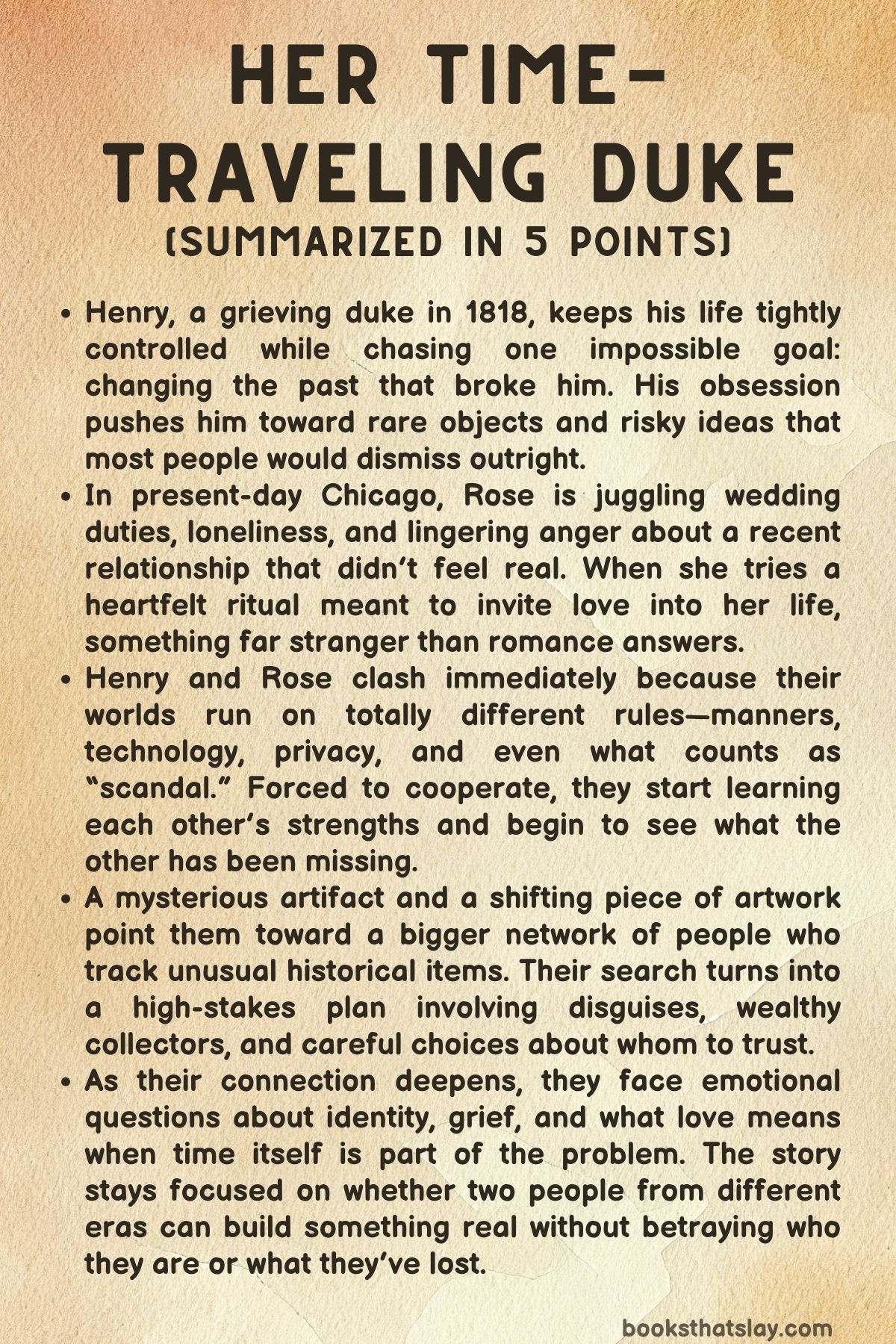
Summary
Henry Horatio Leighton-Lyons, the fifth Duke of Beresford, begins May 1, 1818, the way he begins many days: with discipline. He spars in a converted barn with Quentin Dunton, an American boxer he employs for private lessons, pushing his body as if sweat and bruises can keep his mind from wandering.
But the date won’t allow that. It marks ten years since the death of his wife, Charlotte, and the memory sits close to his skin.
Henry has built a life around rigid habits, isolation, and relentless study, fixating on theories of time and motion because the only problem he truly wants to solve is the one that took Charlotte away.
At his estate, Everly Park, he moves through rooms that once held lively dinners and music, now quiet under dust covers and restraint. He prefers the library, where reminders of Charlotte are everywhere—in the books she liked, the way she used to speak, the plans she once made for the household and the people who depended on it.
Society keeps sending invitations as the London season winds down, and Henry is expected to rejoin the world and remarry. He despises the pressure and the hollow politeness that comes with it.
He is also thinking about legacy: he has no children, older sisters, and a title that will pass to a male cousin. His fortune, however, can be shaped.
He intends to use much of it to support science, especially through an organization he is founding, the World Astronomical Society, which he hopes will fund scholars and discovery across borders. Even so, he is irritated by the practical demands of that dream—like sitting for a portrait meant to hang at the society’s headquarters.
That same night, more than two hundred years later, Rose Novak is busy holding together a wedding in modern Chicago. She is maid of honor for her best friend Emily, and she manages the chaos with a practiced calm: snacks for a cranky child, timing checks, emergency supplies, steady reassurance.
The wedding has its own unusual history. Emily is marrying Griffin, a man with an impossible past—he was once a knight in the early fifteenth century and, until recently, a stone statue at the art museum where the ceremony is held.
Rose has seen strange things before, but she still tries to keep her life grounded and manageable.
She also tries to avoid Aaron Coleman, an FBI art crimes agent who once went undercover at the museum and pretended to date her as part of an investigation tied to Griffin. Aaron wants to apologize for the deception and the messy feelings it left behind, but Rose shuts him down.
She is tired of being treated like a prop in someone else’s story.
During the evening, Rose and a few others pause in front of a newly acquired painting: a portrait of Henry Leighton-Lyons, Duke of Beresford, dated 1818. Rose feels an odd jolt of familiarity when she looks at him, though she can’t explain why.
The portrait shows him at a desk with an ornate brass instrument nearby, and something about the scene makes her linger. But the night is busy, and she eventually goes home to take care of Emily’s dog, Andy War-Howl, who is staying with her.
Alone in her apartment after the festivities, Rose feels the quiet crash in that space after a big event. She distracts herself with the small practices that comfort her.
Earlier she drew tarot cards—Eight of Wands, Six of Cups, and The Lovers—and the combination sits in her mind like a suggestion. It is May 1, Beltane, under a full moon.
Feeling lonely and more than a little fed up with her romantic history, Rose decides to do a love spell meant to bring an “old-fashioned gentleman” into her life. She sets her altar with care: her rare blue moonstone necklace, a rose petal from Emily’s floral crown, a pink candle, an image of Venus, and a statue of Hecate.
She speaks an incantation that arrives in her mind fully formed, surprising even her. As midnight lands, she focuses on the face of the duke from the portrait.
Back in 1818, Henry is in his library with the portrait painter, Walter Wilke. The painted background is detailed and nearly complete, but Henry himself remains only a rough outline waiting for the final sitting.
Wilke is particular, refusing to let Henry alter the arrangement of objects in the room. One of those objects is an antique astrolabe—significant to Henry because it was a gift from Charlotte shortly before she died.
Henry touches it while thinking intensely of her, and the world abruptly breaks apart. His senses lurch, his vision blanks, and when he opens his eyes again he is standing in a small yellow room that makes no sense at all.
A dog barks at him like he is an intruder.
Rose appears holding a glass of wine, sees a strange man in historical clothes in her apartment, screams, and throws the wine directly at him. Henry, soaked and furious, demands answers.
Rose, staring at his face, realizes this isn’t a costume or a prank. It is the man from the painting.
Henry panics and bolts outside, convinced he has been kidnapped for ransom or drugged into madness. Rose chases him barefoot, trying to keep Andy from causing a disaster while Henry gapes at cars, streetlights, and the unnatural speed of everything around him.
She manages to get him back upstairs and begins explaining, bluntly and without patience for his demand to be treated as a duke. Henry insists he must be dreaming or ill, blaming fumes from paint and his own exhaustion.
Rose, however, can’t ignore the evidence. Her spell, the portrait, and the timing all point to something real.
She calls Jason Yun, a museum curator who belongs to a secret circle that studies enchanted artifacts. On the rooftop, with the city glowing around them and the sky washed blank by light pollution, Henry struggles to accept the absence of stars and the presence of a future that feels like a cruel joke.
Rose insists she is a witch, and Henry argues there must be a rational mechanism. When Jason appears on Rose’s phone screen during the call, Henry is stunned by the sight of a moving face in a small device.
Rose explains what she did, embarrassed and defensive: she wanted love, not a literal man pulled out of history.
As they trade details, a contradiction emerges. If Henry never finished his portrait sitting, why does the painting exist in Rose’s time?
Jason suggests that reality may force consistency, or that magic reshapes details to correct the timeline. Discussion turns to the astrolabe.
Henry reveals it was Charlotte’s gift, and Rose reacts with unexpected emotion at Charlotte’s name. Henry describes Charlotte’s illness and his guilt at trusting a doctor who dismissed her symptoms.
Jason notes that modern medicine could likely diagnose and treat such conditions, but that doesn’t help Henry’s past.
Rose lists the spell’s components and what she invoked, including Hecate, goddess of crossroads. Jason asks what Henry was thinking when he touched the astrolabe.
Henry admits it was Charlotte. Rose then mentions her moonstone necklace.
Henry recognizes the stone: it matches the missing setting in the astrolabe. Jason confirms the astrolabe is rumored to enable time travel and that it has been missing its moonstone for decades.
He also reveals another crucial detail: the astrolabe is no longer in England. It is in Chicago.
The next day Henry sees proof of what Rose has told him when she searches for Everly Park online and shows him photos. His home is now a public site under the care of the National Trust, his private life reduced to tours and captions.
Rose is appalled by the scale of wealth represented by an estate like his; Henry argues it supported a large household and was meant to shelter generations. Their argument is cut off when Andy nearly falls from the roof, drawn by noise from the street.
Henry reacts without thinking, hauling the dog to safety. Rose collapses in tears from the shock, and Henry—despite his stiffness—steadies her, locks Andy away, and quietly takes care of the moment.
Rose helps Henry adapt to daily life: modern clothes, plumbing, toothpaste, teabags, trains, and street traffic. He is alarmed by the casualness of her neighborhood and the variety of people, but he also begins noticing Rose’s competence and generosity.
When he tastes pineapple and learns it is common food now, he is both delighted and stunned. Rose teases him often, but the teasing softens into affection.
Jason meets with Rose, Henry, and Rose’s brother Ryan and brings bad news: Henry’s portrait at the museum has changed. Where Henry’s painted face should be, there is now only an unfinished gray shape, and it is being treated like vandalism.
Jason has already had to speak with police and Aaron Coleman. Jason also shares research that points to the astrolabe being used in the early 1700s for a jump forward in time, with no successful uses after the moonstone was removed.
The current owner is Victor Reuter, a wealthy donor with access and influence. Reuter is hosting a charity gala soon, and Jason proposes that Rose and Henry attend under false names, locate the astrolabe, and attempt to reverse Henry’s displacement.
Ryan wants no part of anything illegal, but he offers useful information about the layout of Reuter’s mansion, including a hidden compartment behind a hinged panel. Jason supplies tools: anti-recognition glasses, a jammer to disrupt cameras, fake IDs, and cash for expenses.
He gives Henry and Rose aliases and helps them plan a plausible cover. Henry, who once lived among rigid rules of class and reputation, finds himself learning a new kind of performance in a world that watches through cameras and social media rather than footmen and gossip columns.
As the days pass, Henry spends time in a library, amazed by the access to books and the freedom of borrowing them. Rose shows him her work at the museum, where she writes and promotes art online.
He is shocked by the scale of the audience and by the cruelty of anonymous comments. When Rose admits strangers sometimes mock her, Henry becomes furious on her behalf, wanting to confront them as if honor can be defended the way it was in his world.
Rose explains that this kind of cruelty hides behind distance, and that her work is partly an attempt to offer something better to people who are drowning in ugliness.
They attend a public projection show along the river, an enormous display of light and motion based on a famous painting. Henry is astonished by the spectacle and by the joy of the crowd.
The city begins to feel less like a nightmare and more like a place where wonder is built into daily life. At the same time, he cannot forget the problem of returning home, and the tension between those two truths pushes him toward Rose.
When Emily and Griffin visit Rose’s apartment, Henry struggles with jealousy, especially when Griffin hugs Rose with easy familiarity. Henry’s manners and pride slip into rudeness, and he insults Griffin.
Griffin responds with a blunt warning. After they leave, Rose confronts Henry.
Their argument moves quickly from pride to fear to desire. Henry admits he wants Rose, even though he has insisted they cannot build a real future.
Rose refuses to let the moment be controlled by what might happen later. They kiss, and the attraction becomes physical.
Henry is inexperienced beyond his marriage, anxious about pleasing her, but Rose guides him with humor and honesty. Their relationship becomes both comforting and complicated, full of warmth but shadowed by the knowledge that he may vanish back into history.
As the gala approaches, Jason supplies disguises and a detailed plan. Rose prepares spell materials as well, bringing a heliotrope flower and a bloodstone based on an old claim about invisibility, though Henry dismisses it.
Under the surface, Rose carries guilt that her spell disrupted Henry’s life. Henry carries a different guilt: the feeling that he is betraying the memory of Charlotte by wanting Rose so deeply.
That guilt erupts when Henry, half-asleep, calls Rose “Charlotte.” Rose is devastated. Henry insists he believes Rose is Charlotte returned, pointing to coincidences—shared phrases, familiar handwriting, the moonstone, and Rose’s instinctive recognition of objects tied to his past.
Rose refuses the idea, furious that he may only be loving a replacement. She orders him out and calls Jason to arrange a hotel for him.
Henry regrets his words immediately, but the damage is done.
Separated, both of them spiral in their own ways. Henry realizes he has been trying to solve his grief by forcing an explanation onto Rose.
Rose worries her love spell has turned into a trap and that she has lost the best thing that has happened to her in years. Emily comforts her, reminding her that even magical mistakes can be repaired with honesty and effort.
Rose performs a spell asking Hecate for guidance and focuses on the practical mission of returning Henry home.
At the museum conservation lab, Rose studies the altered portrait and notices details Jason missed: images of Hecate and Venus in the background, a moon globe that suggests the full moon is key, and an eight of clubs that echoes her Eight of Wands tarot card. She calls Henry and arranges a meeting at his hotel, awkwardly disguising the topic over the phone.
When they gather—Rose, Henry, Ryan, Emily, and Jason—they connect the clues. The astrolabe, the invoked goddesses, the moon timing, and the tarot symbolism all suggest they must recreate the conditions that brought Henry forward.
Jason offers an enormous payment for the astrolabe if they return with it, revealing how valuable it is to him and his group. Ryan lashes out, accusing Rose of always sacrificing herself.
Henry also insists Rose should not risk her life for him. Rose refuses to back down.
She caused the problem, and she will fix it. Emily hides the astrolabe inside a wall clock for travel, and they decide to go to England during the next full moon.
On the way to the airport, trouble finds them. A large man confronts Rose and Henry, demanding they come with him because of their connection to Jason.
Henry uses his boxing training to knock the man down, and Rose helps finish the escape with Henry’s heavy suitcase. They flee, warn the others, and push forward with the plan.
In England, Henry changes back into his 1818 clothes and they travel to Everly Park, now closed to the public. At the gate, in mist and rain, Henry admits he loves Rose and that the life he left behind feels like a cage compared to what he has found with her.
Rose admits she loves him too and asks him to stay in Chicago permanently. Henry agrees, full of hope—until Rose sees starflowers like those from her Six of Cups card and is hit by a wave of memory so sharp it steals her breath.
Henry used to pick those flowers for her. She remembers gardens, anniversaries, the Venus statue, the shape of her own life inside that old house.
Rose realizes she is Charlotte.
With that realization, the confusion snaps into a different pattern. Rose wants to go back briefly to 1818 so the memories can settle fully, and Henry also wants to leave a notarized explanation for his disappearance, rather than letting his household suffer uncertainty.
In a sheltered folly on the grounds, they set candles, hold the astrolabe together, and succeed in traveling back.
In 1818, they move quickly. Henry brings Quentin Dunton into the house, trusts him with the truth, and faces the staff and his solicitor.
He writes and notarizes a letter explaining that he has fallen in love with an American woman and is leaving England. He amends his estate plans, distributing money to Brady and his daughter, to Dunton, to Wilke, to Kirchhoff, and to other staff, ensuring they are protected.
He also directs that the completed portrait be delivered to the World Astronomical Society. Rose helps Wilke by giving him a modern photo of the finished painting so he can recreate it accurately, restoring the timeline’s missing piece.
In private, Rose and Henry share time that feels both new and familiar, now threaded with the truth that they have loved each other before. Henry asks whether Charlotte once knew the astrolabe could allow time travel.
Rose admits she had heard rumors but believed Henry would be the one to understand it. Together they choose the future, returning to Chicago.
Back in Rose’s world, the crisis resolves. The portrait reappears restored, and the FBI drops its case.
The immediate threat fades. Rose and Henry marry on the terrace of the Adler Planetarium at sunset, with Emily and Ryan beside them.
Henry commits to building a life in the present, planning to study physics and ground his curiosity in modern knowledge. Jason continues circling the edges with his secret group and his hunger for magical artifacts, but Rose sets a firm boundary: she will not chase time travel again unless it is truly necessary.
Rose and Henry, finally aligned on what they want, hold on to the simplest truth their strange journey taught them—some love doesn’t end; it just waits until the right moment to be found again.
Characters
Henry Horatio Leighton-Lyons, Fifth Duke of Beresford
Henry is introduced as a man who has turned discipline into armor, using regimented exercise, meticulous dress, and obsessive study to keep grief from swallowing him whole. The death of Charlotte ten years earlier isn’t just a sorrow he carries; it becomes the central force shaping his identity, pushing him toward theories of time and motion as if intellect could rewrite fate.
His aristocratic pride is real—he expects deference, clings to titles, and initially measures the modern world through the lens of propriety and hierarchy—but beneath that rigidity is a conscience that hasn’t gone numb, shown in the way he quietly plans financial support for Brady’s daughter because it mattered to Charlotte. Once thrown into Rose’s time, Henry’s defining trait becomes his need for explanations and control, and the story repeatedly tests that impulse by forcing him to accept mystery, social change, and vulnerability.
His emotional arc sharpens when jealousy and fear of loss trigger his worst impulses—snapping at Griffin, dismissing Rose’s choices, and later trying to force meaning onto coincidences by insisting she must be Charlotte reborn—yet he’s also capable of genuine growth, apologizing, adapting, and ultimately choosing love over the prison of his old life. By the end, his transformation isn’t that he stops being Henry the duke; it’s that he learns to let devotion be lived in the present rather than endlessly “fixed” through the past, turning his brilliance away from obsession and toward building a future.
Rose Novak
Rose is practical on the surface—someone who manages wedding chaos with emergency crackers and handles life with steady competence—but she also carries a private loneliness that she tries to soften with ritual, humor, and a stubborn refusal to let bitterness define her. Her belief in magic isn’t presented as naïve escapism; it’s an expression of agency, a way of insisting the universe can still hold wonder even when people disappoint her, as with Aaron’s deception.
Rose’s emotional strength shows in how quickly she moves from shock to responsibility once Henry appears: she doesn’t romanticize the situation, she problem-solves, sets boundaries, and refuses to treat him like a fantasy object even though he literally arrives out of one. She embodies a modern moral center that constantly challenges Henry’s assumptions—about reputation, class, gender roles, and what people “should” do—and she refuses to shrink herself to fit his worldview.
At the same time, Rose is not invulnerable; the story lets her be hurt, especially when Henry’s grief and longing make him treat her like a replacement rather than a whole person, and that moment becomes a crucial assertion of self-respect when she sends him away. Her arc culminates in a layered revelation: she is both her present self and, in a deeper spiritual continuity, Charlotte, but the key point is that Rose does not become valuable because she “was” someone else—she remains the driving force because she chooses accountability, love, and courage, including the risky decision to travel back in time to repair what she set in motion.
Charlotte Leighton-Lyons
Charlotte is physically absent for most of the narrative, yet she functions like a gravitational field that shapes everything: Henry’s grief, his fixation on time travel, and even Rose’s eventual unraveling of memory. She is remembered as intelligent and warm—someone whose ideas about charity still influence Henry’s decisions and whose presence lingers in the spaces of Everly Park and in objects like the astrolabe.
The story also paints her as quietly powerful in retrospect, because the astrolabe is tied to her, and the later revelation suggests she lived with knowledge or intuition that Henry didn’t fully grasp. Importantly, Charlotte is not simply an idealized lost wife; she becomes a bridge between eras and identities, forcing the narrative to explore whether love is singular to one lifetime or persistent across time.
When Rose recovers Charlotte’s memories, Charlotte’s role shifts from symbol to continuity: she represents the part of love that survives death, not as a sentimental abstraction but as lived experience returning in fragments—gardens, statues, phrases, and small habits. Charlotte’s tragedy—dismissed illness, limited medical understanding, and Henry’s guilt—also underlines the story’s tension between what cannot be changed and what can be healed, because even if her death cannot be undone cleanly, her love can still be reclaimed through Rose’s present-day life.
Jason Yun
Jason functions as the story’s pivot between skepticism and enchantment, embodying a pragmatic curiosity that makes him essential once time travel becomes real. He’s the connective tissue to the wider world of enchanted artifacts and secretive research, and his calm competence helps stabilize situations that could easily spiral into panic or melodrama.
Jason’s personality balances humor with sharp focus: he’s amused by the absurdity of a duke on a phone screen, but he immediately starts asking the right questions, building a working theory from details like the missing moonstone, the astrolabe’s rumored history, and the altered portrait. His moral ambiguity is subtle but present—he offers money, supplies clandestine tools, and strategizes misinformation to distract Victor Reuter—yet he also respects Rose’s autonomy more than most people around her, repeatedly centering consent and choice even when the mission matters.
Jason’s role highlights a theme of modern power: unlike Henry’s inherited authority, Jason’s influence comes from knowledge networks, resources, and controlled narratives. By the end, he remains a door to further adventures, but the story keeps him from overwhelming the romance by positioning him as facilitator rather than savior, someone who can open paths without owning the protagonists’ decisions.
Emily
Emily is Rose’s emotional anchor and a representation of chosen family, shown first through Rose’s devotion as maid of honor and later through Emily’s steady presence when Rose is hurt and confused. She embodies a modern, grounded confidence—keeping her last name without fuss, managing marriage without surrendering identity—and that casual certainty quietly challenges Henry’s assumptions about how women “should” exist.
Emily’s warmth also provides contrast: she welcomes Henry with openness and curiosity, and when conflict erupts, she tries to de-escalate rather than dominate the moment. Her narrative purpose deepens when she supports Rose during the breakup and helps practically with the astrolabe concealment; she’s not only a friend who comforts, but someone who participates in the solution.
Emily’s strength is understated because it’s consistent—she doesn’t need dramatic speeches to matter—yet her loyalty helps keep Rose from being isolated by the extraordinary events unfolding around her.
Griffin
Griffin is both a friend and a foil, and his unusual origin—once a knight, once a statue, now living in modern Chicago—makes him one of the clearest mirrors for Henry’s displacement. Because Griffin has already crossed time and identity boundaries, he implicitly demonstrates that adaptation is possible, and that makes Henry’s resistance look more like choice than inevitability.
Griffin’s protectiveness toward Rose is genuine, but it also sparks Henry’s jealousy because Griffin occupies a familiar intimacy with her that Henry cannot control or contextualize. When tensions flare, Griffin is direct to the point of aggression, willing to threaten Henry to defend his circle, which positions him as a boundary-enforcer in the friend group.
Yet he isn’t portrayed as a villain; he is a man who understands what it costs to be uprooted and is unwilling to let Rose be collateral damage in someone else’s emotional turmoil. In that sense, Griffin pressures Henry toward maturity: if Henry wants a place in Rose’s life, he must respect the people who already hold it.
Aaron Coleman
Aaron is the story’s emblem of modern betrayal dressed as professionalism: an FBI art crimes agent whose undercover role required deception and emotional manipulation, leaving Rose with a wound that looks like romance but feels like being used. Even when he tries to apologize, his presence represents mistrust and the uneasy reality that authority doesn’t guarantee integrity.
Aaron’s narrative function is partly catalytic—his history with Rose helps trigger the loneliness that leads to the love spell, and later his involvement in the portrait “vandalism” case adds pressure and stakes. He also serves as contrast to Henry: where Henry is bluntly honest to a fault and bound by rigid codes, Aaron is skilled at performance and ambiguity, able to pretend intimacy for a job.
By the end, Aaron’s suspicion about Henry’s arrival underscores the story’s theme that extraordinary love stories still exist inside systems—law enforcement, media attention, institutional scrutiny—that demand explanations and threaten privacy.
Ryan Novak
Ryan is Rose’s protective brother and a voice of caution, representing the grounded skepticism that keeps the story from floating away into pure fantasy. He cares deeply for Rose, and his reluctance to participate in anything illegal shows both common sense and moral boundaries, even when he still contributes useful information like the hidden compartment detail.
Ryan also embodies a quieter emotional truth: he sees patterns in Rose’s self-sacrifice and calls it out, especially when money and danger are on the table, refusing to let “fixing things” become an excuse for Rose to erase herself. His curiosity is real—books on multiverses and time dilation, interest in the logic of what’s happening—but it’s always filtered through concern for consequences.
When he eventually accepts involvement with Jason’s group only under legal conditions, it completes his characterization as someone willing to engage with wonder as long as it doesn’t demand that he abandon his ethics.
Quentin Dunton
Quentin appears initially as Henry’s boxing instructor, but his role is more than athletic training: he represents Henry’s attempt to impose structure on pain through physical discipline and routine. As an American in Henry’s world, Quentin also quietly signals the coming cultural collision, foreshadowing Henry’s eventual attachment to an American woman and a different way of living.
When Quentin reappears in 1818 after the time-travel return, he becomes part of Henry’s act of closure and generosity, included in the revised distribution of Henry’s wealth and gratitude. Quentin’s presence reinforces a key aspect of Henry’s character: beneath aristocratic stiffness, Henry respects competence and loyalty, and he values people who contribute to his life beyond social rank.
Brady
Brady is the butler who embodies the continuity of Everly Park as a living system, not just a grand house. His relationship with Henry shows a softer side of the duke’s responsibility: Henry asks after Brady’s family, remembers Molly’s name, and plans an allowance that reflects Charlotte’s influence and Henry’s desire to do something tangible with his privilege.
Brady’s presence also highlights the loneliness of the estate—staff remain, rituals continue, but the warmth of a household has faded—making Henry’s grief feel embedded in the architecture and routines. Later, when Henry amends his estate to provide generously for Brady and others, Brady becomes a marker of Henry’s growth from isolated mourning to active care, turning duty into a personal expression of gratitude.
Walter Wilke
Wilke, the portrait painter, represents the strange intersection of art, permanence, and the supernatural mechanics of the plot. His insistence on controlling the scene—refusing Henry’s adjustments and painting the setting in detail while Henry remains unfinished—mirrors how Henry’s life is meticulously arranged around absence, with the “subject” of his future still uncertain.
The portrait itself becomes a living indicator of temporal disruption, changing when Henry vanishes and later offering symbolic clues that guide the characters toward the conditions needed for reversal. When Rose provides Wilke with a modern color photo so he can reproduce the completed portrait accurately, Wilke’s role shifts from passive artisan to active participant in restoring consistency, making him a conduit through which the future reaches back to shape the past.
He underscores one of the novel’s central ideas: art can be both record and instrument, capturing reality while also helping to create it.
Victor Reuter
Victor Reuter operates largely at a distance, but he embodies modern wealth and influence in a way that parallels Henry’s aristocratic power while feeling colder and more transactional. As the owner of the astrolabe and a museum donor, he sits at the intersection of money, prestige, and control over cultural objects, which makes him a natural antagonist to a group trying to return a person to his rightful time.
The planned gala at his mansion highlights how privilege persists across centuries, just in new forms: titles become donor status, estates become modern mansions, and social access becomes tickets and networks. Even without extensive direct interaction, Reuter’s function is clear—he is an obstacle wrapped in legitimacy, the kind of person who can possess extraordinary artifacts through ordinary financial means, forcing Rose and Henry into deception and risk to reclaim what matters.
Kirchhoff
Kirchhoff, Henry’s solicitor, represents the formal machinery of inheritance, legality, and legacy, which matters deeply because Henry’s life is defined by what he can and cannot pass on. His presence in the early chapters grounds Henry’s anxieties: no children, sisters, a title that must move to a male cousin, and a fortune Henry wants to redirect toward scientific good through the World Astronomical Society.
When Henry returns to 1818 and drafts notarized explanations and revised gifts, Kirchhoff becomes crucial to transforming Henry’s emotional choice into a legally coherent exit from his old world. He symbolizes the truth that love alone isn’t enough to untangle a life; institutions, paperwork, and social consequences must be faced, and Henry’s willingness to do that work is part of his redemption.
Daniela
Daniela appears as part of Rose’s social circle at the wedding, and while her role is smaller, she contributes to the sense that Rose has a real community and a full life that predates Henry. Her inclusion in moments like noticing the portrait helps ground the story in ordinary friendships and shared curiosity, emphasizing that the extraordinary enters an already-populated world rather than replacing it.
Daniela’s function is to reinforce Rose’s identity as someone embedded in relationships, not a solitary heroine waiting for romance to give her meaning.
Andy War-Howl
Andy War-Howl, Emily’s dog staying with Rose, is more than comic relief; he becomes a stress-test for Henry and Rose’s bond early on. The rooftop incident where Andy nearly falls forces Henry into immediate, instinctive action, revealing courage and protectiveness that cut through his confusion and pride.
For Rose, Andy represents the emotional weight of caretaking—she takes responsibility for others even when overwhelmed—and her breakdown after the scare shows how thin her composure sometimes is beneath daily competence. Andy also helps humanize Henry in the modern setting, because saving the dog is one of the first times Rose sees Henry’s character expressed through action rather than entitlement or argument.
Themes
Grief, Guilt, and the Need to Rewrite Loss
Henry’s daily discipline—boxing practice, precision clothing, rigid schedules, and relentless reading about time and motion—functions less as self-improvement and more as a controlled environment where he can keep sorrow from spilling over. Ten years after Charlotte’s death, he is still living in a house filled with absence, walking past rooms that once held warmth and conversation, choosing the library because it is the closest thing to being with her without having to admit he is alone.
His fixation on reversing time is not framed as a harmless intellectual hobby; it is a moral argument he is having with himself. If knowledge and effort can conquer a death that felt preventable, then he can escape the conclusion that he failed her.
That is why the details of her illness matter so much to him, including the memory of a doctor who dismissed symptoms and the belief that he should have pressed harder. The story repeatedly shows grief expressing itself as responsibility, where love turns into an obligation to correct an outcome.
When modern characters point out that medicine could have helped, it doesn’t simply soothe him; it intensifies his sense that the universe is unfair and that he personally made the wrong call in the only time it mattered. The pain does not vanish when he arrives in the future, because being surrounded by modern solutions only underlines what he could not do for Charlotte.
His emotional arc begins shifting only when he starts treating time travel less as a tool to erase the past and more as a reality that forces him to accept that some events cannot be “earned back” through discipline. Even then, the impulse to fix remains, but it changes form: instead of trying to defeat death directly, he channels his devotion into tangible care for others, such as honoring Charlotte’s charitable idea for Brady’s daughter and ensuring the household staff are supported.
That movement from obsessive reversal to reparative action shows grief becoming something he can carry without letting it hollow out every future relationship.
Agency, Autonomy, and the Cost of “Doing the Right Thing”
Rose’s choices continually challenge the idea that morality is mainly about self-sacrifice. She is competent, socially connected, and deeply loyal, but she also has a history of being expected to manage everyone else’s needs—wedding logistics, emotional caretaking, problem-solving at work, smoothing over conflict, and even handling the consequences of other people’s deceptions.
When Henry arrives, she does not treat him like a fragile artifact or a fantasy; she asserts boundaries immediately, refuses automatic deference, and insists on telling her friends rather than keeping secrets to protect someone else’s comfort. That insistence on transparency is a form of self-respect, because secrecy would place the entire burden on her.
The same theme sharpens later when money and risk enter the situation. Jason’s reward offer and the plan to infiltrate a gala test whether Rose’s sense of responsibility will be exploited.
Ryan’s anger frames a long-standing pattern: Rose tends to absorb danger and inconvenience because she believes that making things right is her job, even when the consequences are personal. The narrative does not present her as reckless; it presents her as someone who equates love with fixing and who has to learn that repair does not require self-erasure.
Henry’s presence complicates this because he is both a person with real needs and a living reminder that her spell had consequences. Rose’s autonomy is threatened not only by outside pressure but by Henry’s emotional projections, particularly when he tries to define her identity through the idea that she is Charlotte.
Her refusal is more than denial; it is a demand to be seen as herself rather than as a role created by his grief. Even when she later accepts the truth of her connection to Charlotte, it matters that she arrives there through her own experience and memory rather than surrendering to Henry’s insistence.
The story positions agency as the ability to choose truth on your own timeline, to set boundaries even when someone’s pain is understandable, and to help without treating your own life as collateral.
Love as Choice Under Impermanence
The romance is shaped by a countdown that neither character can ignore: Henry believes he must return to his own time, and Rose fears that keeping him would be selfish or impossible. That constraint removes the illusion that love automatically secures the future.
Their intimacy begins with intense attraction and emotional need, but it quickly becomes a conversation about consequences. Henry hesitates because he doesn’t want to make Rose a scandal in his moral framework and doesn’t want to take what he cannot keep.
Rose pushes back because she refuses to treat desire as shameful or to deny herself connection out of fear. Their relationship becomes a study of how people behave when they do not have certainty.
Instead of presenting romance as a reward after problems are solved, the story makes romance part of the problem-solving process: affection motivates cooperation, but it also complicates judgment through jealousy and pride. Henry’s jealousy toward Griffin and Aaron shows insecurity produced by displacement; he lacks the social context where he used to feel competent, so he overcompensates with possessiveness.
Rose’s resentment after the “Charlotte” mistake exposes a different fear: that love will be conditional on her being a comforting mirror rather than a fully seen partner. What makes the theme compelling is that love is treated as a series of decisions rather than a single confession.
Rose chooses to continue helping Henry even after being hurt; Henry chooses to apologize and accept limits; both choose honesty about what they want even when that truth is inconvenient. When they finally decide to build a life together in Chicago, the decision is not framed as fate removing obstacles; it is framed as an adult commitment made after seeing each other under stress, conflict, embarrassment, and vulnerability.
Love here is not proven by grand statements but by the willingness to take responsibility for impact, to repair after harm, and to accept that time—whether historical or emotional—cannot be controlled, only faced.
Power, Privilege, and the Moral Education of Displacement
Henry’s arrival in modern Chicago forces a confrontation with privilege that he has never had to articulate. In his world, wealth and title are structural facts, explained by inheritance, duty, and the expectation of leadership.
In Rose’s world, that same wealth reads as excess, exclusion, and historical imbalance. Their argument about Everly Park being public property and Rose’s reaction to what the estate represents is not a superficial culture shock moment; it’s a moral clash between a worldview that normalizes hierarchy and one that demands justification.
Henry defends the estate as a home built for family and staff, implicitly arguing that the system provided livelihoods. Rose sees the symbolic weight of who gets to live in such spaces and who is expected to serve.
Neither is portrayed as purely right or wrong; the tension exists to show how moral understanding depends on context and how displacement can accelerate learning. Henry’s exposure to modern life does not simply amaze him with plumbing and airplanes; it forces him to see how social norms can change without society collapsing.
Women keep their names, people speak casually across class lines, strangers comment cruelly online, and art is shared globally rather than guarded by gatekeepers. Rose’s work at the museum also complicates simple ideas about ownership and access: she helps bring cultural objects to a wide audience, but the story also includes wealthy donors, private ownership of powerful artifacts, and the sense that money can shape what gets protected or investigated.
The gala plan, the anti-recognition glasses, and the negotiations around the astrolabe highlight a modern form of power: surveillance, media narratives, and influence through donations rather than titles. Henry’s growth is visible when his sense of duty becomes more humane and less performative.
His instinct to support staff and honor promises becomes a bridge between worlds, suggesting that privilege can be redirected toward fairness when it is paired with accountability rather than entitlement. Displacement becomes his education: the loss of automatic status forces him to earn respect through conduct, empathy, and restraint.
Magic, Science, and the Human Need for Explanations
Rose and Henry represent two different strategies for making sense of chaos. Rose uses ritual, symbolism, and intuition—not as a joke, but as a meaningful way to focus intention and create personal guidance.
Henry uses measurement, theory, and disciplined study, trying to turn the universe into something that can be understood and therefore controlled. Their conflict over whether she is “a witch” and his insistence on scientific causes is not only about belief; it’s about emotional safety.
Henry clings to rational explanation because it preserves the idea that the world follows rules, which is crucial for someone haunted by a death he could not prevent. Rose clings to magic because it validates her agency in a world where she often has to absorb other people’s chaos and still keep moving.
The story refuses to declare one approach superior. Instead, it shows that both are languages for meaning-making, and that real change happens when the characters allow both languages to coexist.
The astrolabe itself becomes a symbol of that coexistence: a scientific instrument that carries magical capacity, tied to astronomy and also to goddesses, tarot, and moonstone. The altered portrait functions as an ethical puzzle and a breadcrumb trail at once, implying that the universe enforces consistency while also responding to symbols and intention.
Jason’s role reinforces the theme by treating enchantment with a researcher’s mindset, collecting sources, comparing evidence, and making plans that blend technology with lore. The story suggests that the impulse to explain is universal, whether the tool is a formula or an incantation.
What matters is the humility to accept that explanation does not equal control. Henry learns that understanding time travel will not automatically grant him the power to undo grief; Rose learns that intention can have consequences that require accountability beyond the ritual.
Their eventual cooperation implies a more balanced worldview: respect evidence, respect mystery, and take responsibility for what you set in motion even when you cannot fully explain it.