Loving The Tormentor Summary, Characters and Themes
Loving The Tormentor by Lola King is a dark romance thriller set across two worlds: the rough North Shore of Silver Falls and the polished cruelty of Silver Falls University. Nyx Mayer, a working-class violinist with big plans and bigger fears, earns a rare scholarship into an elite music program—only to become a public symbol in a rich family’s power games.
When she collides with Achilles Duval, a famous prodigy carrying his own secrets, attraction turns into dependence, control, and danger. As Nyx fights to keep her future, she’s pulled into violence, blackmail, and a hidden society that treats people like tools.
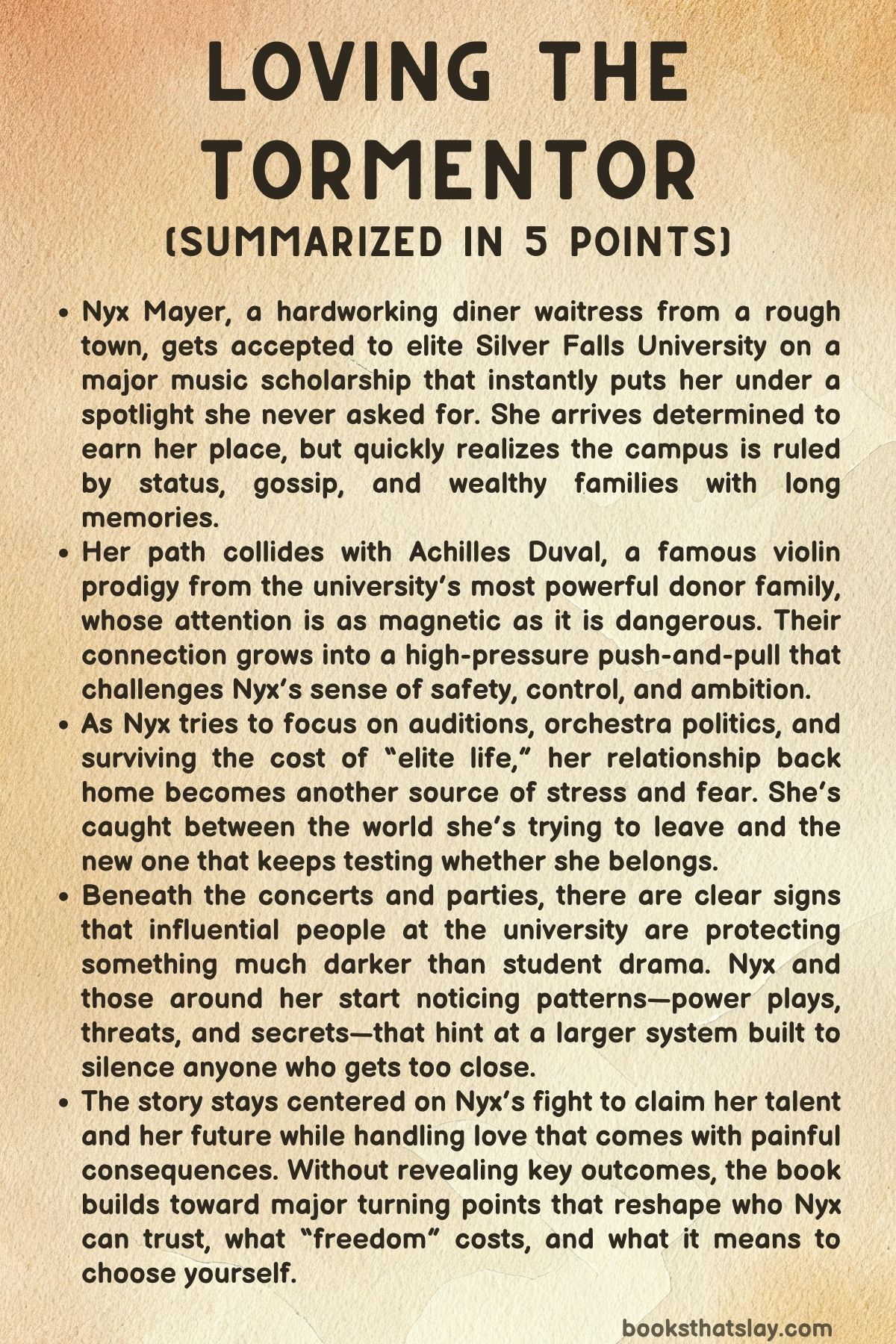
Summary
Nyx Mayer sits in a cramped interrogation room while a detective presses her about a narrow window of time—4 a.m. to 6 a.m.—the morning Achilles Duval was found dead at his family’s lake house.
The detective talks as if her guilt is obvious, calling her obsessed and implying that obsession ends in murder. Nyx insists she loved Achilles, but inside she knows love wasn’t the whole truth.
What she had with him hurt, changed her, and left her with a reputation that makes her an easy target now. Even before she hears anything official, she feels like she’s being set up to take the fall for the last disaster Achilles left behind.
Five months earlier, Nyx is still surviving shift to shift at an underground diner on the North Shore called The Basement. The job keeps the lights on, but it also traps her in a town ruled by old grudges, fragile truces, and people who think violence is normal.
Nyx’s one clean exit is music. She’s applied to Silver Falls University, a prestigious school she cannot afford, hoping talent will be enough.
Her best friend and coworker, Lena, tells her an envelope has arrived from SFU admissions. Nyx can’t make herself open it.
Hope feels dangerous when your life has taught you that good news always comes with strings. Her boyfriend, Chase, is one of those strings.
He’s connected to the North Shore’s criminal past and carries himself like someone who can decide what happens to others. He frames his presence as protection, but his protection has a price: control, jealousy, and the constant reminder that he’s the reason her father’s debts haven’t destroyed them yet.
During a hectic shift, Nyx learns that Achilles Duval is sitting alone in the diner. He’s famous—an admired violin prodigy with the kind of wealth Nyx only sees on screens.
She’s followed his career for years, so serving him coffee makes her shake. Achilles treats the place like a waiting room, refilling black coffee again and again, checking the door like someone will walk in and change his life.
When the owner complains about unpaid refills, Nyx tries to enforce the rules. Achilles responds by slipping five hundred dollars into her apron and calmly buying more time.
Eventually, Achilles leaves, and for a moment Nyx almost follows him—until Chase walks in, casual and territorial. Chase notices the unopened SFU envelope and pushes her to open it.
Then he flips, turning cold and possessive, hinting she shouldn’t even try because she “belongs here.” His friends join in, mocking her dreams and grabbing the envelope like it’s a joke they can pass around. Nyx storms out back, furious and humiliated.
Outside, she accidentally witnesses Achilles arguing in French with his mother by two luxury cars. A young blonde girl, Sophie, appears briefly, excited to see Achilles, and is immediately pushed away into the car.
Achilles begs to see her, his anger spilling out when the car drives off without him. Nyx tries to disappear, but Achilles notices her.
His calm is sharp enough to feel like a threat. He accuses her of eavesdropping, then sees the SFU envelope.
Before she can stop him, he takes it and opens it, using the moment to toy with her panic. Nyx snatches the letter and finally reads it through tears: she’s accepted, and she’s won the Virtuoso Scholarship.
Achilles leaves with a faint smile and a promise that sounds like a warning—he’ll see her in September.
When Nyx arrives at SFU near the end of August, the reality is ugly in a quieter way than the North Shore. Security treats her car like a problem.
Staff label her “the scholarship student” and hand her a list of costs her scholarship won’t cover. She’s told her two-toned hair violates the school’s code and must be changed.
She also learns she must attend an inauguration event for a new music building funded by the Duval family. The name hits hard: the same family as Achilles.
At home, Nyx does the math and realizes talent doesn’t pay for everything. Chase offers money, but makes it transactional, turning generosity into leverage.
He escalates the fight by reminding her that leaving him means losing the only barrier between her family and debt collectors. Nyx is furious, but fear keeps her tied to him.
At the SFU inauguration, Achilles appears with his father, a powerful man obsessed with image and influence. Achilles watches Nyx get paraded as a symbol—poor background, scholarship miracle, proof of the Duval family’s “generosity.” His friends, including Peach and Ella, approach Nyx more warmly.
Achilles doesn’t. He assumes Nyx is another piece on his father’s board and decides she won’t get kindness from him.
Nyx attends a party hosted by Peach and Ella, already anxious about standing out. Chase drives her and spends the ride tearing her down, criticizing her outfit and implying the North Shore’s old conflict is heating up again.
Lena witnesses part of it and gently tells Nyx she deserves better. Nyx ends up accepting a ride from Kayla King, a blunt, dangerous-sounding figure who warns her that rich boys can be reckless because they believe consequences don’t apply to them.
Kayla offers Nyx a small knife “just in case,” and tells her to call Kayla, not the police, if anything happens.
At the party, Nyx feels watched and judged. Students mock her clothes and treat her like entertainment.
She learns about “Hermes,” a gossip account that targets people for sport, and discovers it’s already posting about her—claiming she doesn’t belong. Achilles appears with Wren, and immediately provokes Nyx with smug comments about his own talent and status.
Peach tries to protect Nyx by reminding everyone Nyx has a boyfriend, but Achilles seems amused by the idea of boundaries.
Overwhelmed, Nyx goes upstairs searching for a bathroom and accidentally walks into a bedroom with an attached bathroom. When she comes out, she stumbles into Achilles with another girl, Evelyn, who is upset and leaves quickly.
Nyx is disturbed by what she sees in the room, and Achilles confronts her, blaming her for intruding. He keeps her there, offers her champagne, and shifts the conversation to music.
Nyx talks about how she learned violin under difficult circumstances and about losing her teacher. The moment turns dangerous when Achilles learns she hates having anything around her neck.
He uses a tie to intimidate her, pushing her into a sexual situation she does not want. When it’s over, he discards her emotionally and warns her to stay out of his life.
Afterward, Achilles isolates himself and begins composing obsessively, claiming Nyx sparked something in him he hasn’t felt in years. His world has its own threat: the Silent Circle, a secret group tied to elite families, with his father at the center.
Achilles’s father wants him initiated, and the Circle’s rules involve women being assigned roles meant to serve men’s power. Achilles convinces himself Nyx will be manageable because he has already frightened her into silence.
At orchestra placement auditions, Nyx arrives shaken after another issue with Chase. Achilles corners her and demands her phone number, implying he can shape her future at SFU.
During auditions, Nyx panics when she realizes she forgot rosin, but another violinist, Josh, helps her. Nyx’s playing draws attention because she uses an unusual left-handed setup.
She places well, and Josh becomes the new soloist after the previous one breaks her wrist. When Chase picks Nyx up, he aggressively accuses her of flirting and grabs her in front of others.
Nyx notices Achilles watching. Soon after, she receives a text from an unknown number asking whether her boyfriend scares her.
Achilles calls Nyx back to the stage after rehearsal and tells her her real problem isn’t technique—it’s fear, reputation, and the way she measures herself through other people’s opinions. He claims he’ll “fix” her anxiety in a way she will hate.
He forces her into humiliation and pain using a conductor’s baton while threatening her place in the orchestra if she resists. He makes her repeat affirmations about her talent and worth, twisting cruelty into a warped lesson.
When she finally declares she deserves the violin and her place, he stops and turns the moment into intimacy. Nyx leaves aching and confused, but notices something terrifying: she plays better afterward, as if part of her has learned to respond to control.
Not long after, Nyx discovers her car vandalized outside her diner shift. Bennett, connected to the violence around Chase, confronts her and says it’s a warning.
He demands she deliver Achilles to them for revenge and threatens that Nyx will be next if she refuses. Achilles arrives, intervenes with chilling calm, and escalates the situation.
Bennett points a gun at him. Achilles steps into the muzzle and dares him to shoot, making it clear Bennett’s life will be ruined either way sees.
Bennett backs down—only for Achilles to pull his own gun and shoot Bennett in the arm.
Instead of taking him for help, Achilles drives to an abandoned warehouse and tortures Bennett. Nyx is forced to see the aftermath up close.
Achilles films Bennett confessing he hurt Nyx, labeling her “Achilles Duval’s girl,” then sends the proof to Bennett’s contacts to spread fear. He kills Bennett.
Immediately after, Achilles forces sexual contact while making Nyx face the body, using terror as a leash. Then he takes her to his gated lake house and tells her to stay there.
In exchange, she will rehearse daily, help him finish his concerto, and become his inspiration.
Time blurs into a strange captivity that looks like luxury from the outside. Achilles teaches Nyx about the Silent Circle—its leader, its initiated men, the roles women are pushed into, and the way wealth makes crimes disappear.
Hermes begins posting threats and leaks, warning that the Circle is being exposed. Nyx is mocked on campus and confronted by Evelyn and others.
When Evelyn insults Nyx using her hearing loss, Nyx punches her. Achilles drags Nyx away, furious—not because Evelyn hurt her, but because Nyx risked her hands and career.
In the heat of it, Nyx calls herself his girlfriend. Achilles latches onto the words like a claim he intends to keep.
Nyx later attends a Duval gathering and runs into her estranged mother, Catherine, who has aligned herself with wealth and status. Nyx embarrasses Catherine in public by correcting her about art, and Catherine retaliates by mocking Nyx as an “educated poor person.” Eugene Duval corners Nyx and patronizes her, implying her future is only to become a compliant wife inside their world.
Then women in revealing dresses enter wearing seashell pendants—the Aphrodites, used sexually by the Circle. Nyx panics, sensing how close she is to being trapped in the role they want for her.
Catherine reveals the deepest betrayal: Nyx’s scholarship and recruitment were orchestrated by Catherine and her husband to use Nyx as bait—pressure meant to force Achilles into joining the Circle. Nyx slaps her mother and is thrown out by security, shattered by the knowledge that her “escape” was planned as a trap.
Back at the lake house, Achilles insists he hasn’t been with anyone else and promises exclusivity, speaking with a calm that Nyx mistakes for safety. The next morning, Achilles is gone.
Nyx runs toward the garage and finds Wren at the doorway. Inside, Achilles is hanging.
Nyx screams and fights to reach him, collapsing when they cut him down. Her world turns into noise, shock, and the certainty that the most controlling person in her life has taken the final control from her.
Nyx is interrogated again about the hours around Achilles’s death. A different detective rules it a suicide and releases her.
She’s given a torn note from Achilles: “I’m a dreamer, mon trésor. You should try it sometimes.” Outside, friends gather around her.
News breaks that elite figures are being arrested in connection to the Circle, including major political and legal names. Wren explains Achilles left a protected hard drive—the Hermes files—and Wren turned it over to police.
The Circle collapses under raids, arrests, and internal fallout.
At Achilles’s funeral, Nyx places his favorite violin on his coffin. Later, she finds an engagement ring hidden in his case, plus another note with the same phrase and the same carefully chosen wording.
She grieves for months while friends rotate staying with her. Hermes is publicly credited with exposing the Circle.
Nyx learns she and Sophie are the only beneficiaries in Achilles’s will. She inherits half his fortune, the lake house, and his compositions.
She forces herself back to classes, pushes through rumors, and eventually becomes orchestra soloist. Nearly two years later, at graduation, she writes letters to Achilles in a notebook titled “I’m a dreamer.
You should try it sometimes.”
At graduation, Achilles’s mother arrives with Sophie. Sophie winks, and when Nyx turns, Achilles is standing there—alive.
Nyx nearly collapses. Achilles steadies her and says he’s proud.
A toddler runs up calling Nyx “Mama,” revealing Nyx has a daughter, Lyra, who is Achilles’s child.
Back at the lake house, Achilles explains the truth. He attempted suicide expecting to die, knowing his death would trigger the release of evidence.
He survived and woke in an ambulance. Detective Turner forced a deal: Achilles had to remain “dead” while the operation dismantled the Circle, to protect Nyx and their friends.
He lived in France near Sophie, allowed only minimal contact through the two notes. Once the final conviction landed, Achilles returned immediately.
He proposes for real. Nyx accepts, but demands he get treatment for depression.
He agrees, already in therapy and on medication.
As they rebuild, Sophie moves in and Achilles’s mother helps. Catherine begins stalking Nyx again.
Catherine calls Achilles, claiming she can see Nyx driving, then threatens to cause a crash. Over the phone, there’s the sound of impact.
Achilles races to the highway and finds Catherine dead and Nyx trapped upside down in a smoking car. He smashes the window with his fist to pull Nyx free, ruining his hand.
Doctors confirm Nyx will live, but Achilles realizes his hand is too damaged to play professionally. He asks Nyx to promise she will be the soloist for his concerto.
She promises.
Six months later, Nyx performs Achilles’s concerto, “Mon Trésor,” as soloist, with Achilles conducting despite chronic pain and a deformed hand. After the standing ovation, their daughters join them onstage.
Friends gather afterward at the lake house, celebrating new beginnings and pregnancies, joking about Hermes, and honoring what it cost to survive. Nyx and Achilles choose a future built on truth, treatment, and family—determined to live outside the shadow of the Circle.
Characters
Nyx Mayer
Nyx Mayer is the emotional center of Loving The Tormentor, defined by a fierce will to escape poverty and violence and an equally fierce tendency to endure what she shouldn’t. Her dream—earning a place in an elite music world—isn’t just ambition, it’s a survival strategy, a way to rewrite her identity beyond the North Shore’s debts, threats, and inherited fear.
Nyx’s inner life is marked by contradiction: she can be sharply intelligent and perceptive, yet she also delays opening the admissions envelope because hope feels dangerous, as if wanting something too much will invite punishment. Her relationships expose this pattern most painfully; with Chase, she confuses protection with captivity, and with Achilles, she confuses intensity with inevitability, even while recognizing the relationship is venomous.
Over the course of the story, Nyx develops a harder clarity—she learns to name what is happening to her, to defend herself physically and socially, and to claim her talent without apologizing for where she came from—yet that growth is complicated by the way her confidence is repeatedly engineered through fear, control, and spectacle. By the end, Nyx becomes someone who can carry grief, rage, love, and ambition at once: she completes her education, becomes a soloist, raises children, and insists on healing as a condition of love, refusing to let survival be the same thing as surrender.
Achilles Duval
Achilles Duval is built as both an object of fascination and a source of terror in Loving The Tormentor, a prodigy whose brilliance is inseparable from cruelty until the story forces the reader to see how much of that cruelty is a chosen weapon and how much is a learned language of power. He performs detachment like armor, treating people as instruments in his private war against his father and the Silent Circle, and he approaches Nyx first as a curiosity and then as a fixation—someone whose fear, talent, and hunger to prove herself become the raw material for his control and his art.
Achilles’s violence isn’t accidental or merely reactive; it is deliberate, aestheticized, and often framed as “teaching,” which is part of what makes him frightening—he can translate domination into philosophy and call it improvement. At the same time, he is not emotionally empty; his obsession with composing, his protective instincts, and his eventual willingness to burn down the Circle at the cost of himself suggest a man who experiences feeling as something unbearable unless it is shaped into pain, sex, music, or sacrifice.
His apparent suicide becomes the story’s sharpest pivot: the same intensity that once trapped Nyx is redirected into self-erasure to destroy the system that made him, and his later return reframes him as someone capable of accountability only when survival is paired with treatment and restraint. Even then, Achilles remains a paradox—tender and dangerous, protective and possessive—made finally human not by being forgiven, but by accepting limits, therapy, and the loss of his hand as a consequence he cannot buy his way out of.
Chase
Chase represents the familiar cage Nyx is trying to outgrow, a man who offers safety with one hand while tightening the leash with the other. His connection to the old gang world and to Nyx’s father’s debts gives him power that masquerades as responsibility, allowing him to frame coercion as protection and control as love.
He polices Nyx’s appearance, her choices, and even her future, reacting to her scholarship and college life not with pride but with possessiveness, because her independence threatens the structure that benefits him. What makes Chase particularly insidious is how transactional he becomes when Nyx needs support—money and help are offered with sexual or emotional strings attached—so that her survival always costs her dignity.
He also embodies the culture Nyx comes from where fear is normal and retaliation is routine, and his jealousy at SFU shows that he cannot tolerate Nyx being seen, admired, or simply existing outside his domain. Even after his death, Chase’s shadow persists through Bennett and the threats that follow, emphasizing that the world he represents is not just one man but a network of people who believe they are owed access to Nyx’s body and future.
Lena
Lena functions as Nyx’s moral mirror and emotional anchor, the friend who says aloud what Nyx is too frightened or conditioned to admit. She is practical, protective, and blunt in a way that cuts through Nyx’s romanticizing of suffering, especially when she points out that Nyx’s relationship with Chase began under debt-collection pressure rather than genuine choice.
Lena’s strength is not glamour or power but steadiness; she works alongside Nyx, watches for danger, and repeatedly tries to return Nyx to her own instincts, to the version of herself who wanted music before she wanted to survive a boyfriend. Her role becomes even more important because Nyx moves into an environment where cruelty is wrapped in wealth and politeness; Lena represents a kind of honesty Nyx can trust.
Even when Lena is physically outside the elite campus world, her presence lingers as the voice of home that isn’t romanticized—the home that can love you and still tell you to leave.
Colin
Colin is a smaller but meaningful figure, representing the ordinary kindness of working-class community and the impulse to protect without ownership. He is the first to push Nyx toward action when Achilles appears at the diner, urging her to follow him, not because Colin wants something from her but because he recognizes opportunity when he sees it.
Colin’s youth and excitement contrast with the exhausted, wary atmosphere Nyx lives in; he reminds her that awe and possibility still exist, even in a place defined by grudges and scarcity. In the broader story, Colin’s presence helps highlight how rare uncomplicated support becomes once Nyx enters SFU, where attention is often predatory and social warmth is often strategic.
Sophie
Sophie is both Achilles’s vulnerability and his tether to a future that isn’t defined by the Circle. Early on, her brief appearance is emotionally explosive because it reveals Achilles begging, pleading, and being denied—proof that even a wealthy prodigy can be powerless in the face of family control.
Sophie later becomes central to the meaning of Achilles’s “death” and survival, because his decision to live in France near her turns his rebellion into something more than self-destruction; it becomes a choice toward caretaking and responsibility. Sophie also complicates the Duval family narrative by embodying innocence amid corruption, and her presence at the end—arriving with Achilles’s mother, winking at Nyx—signals that the new family structure is not built on secrecy alone but on alliance.
She is the living evidence that Achilles can love in a way that is not only consuming, and that Nyx’s life after the Circle includes a child who belongs to the future rather than the past.
Peach
Peach acts as Nyx’s first real shield inside the elite social world of SFU, using boldness and social confidence to block cruelty before Nyx has the tools to do it herself. Her connection to volunteering at a women’s shelter suggests a conscience that doesn’t fit neatly inside the wealthy ecosystem she inhabits, and that moral mismatch is what makes her friendship feel real rather than performative.
Peach confronts people directly, including Achilles, when she thinks they are crossing lines, and she is often the one who translates the unspoken rules of campus hierarchy to Nyx. At the same time, Peach is not naïve; she understands how vicious gossip can be and how quickly outsiders become targets, so her protectiveness is strategic as well as heartfelt.
Her call to Achilles about Hermes and the Circle also places her near the story’s resistance network—she is someone who may enjoy parties and status but will not accept silence when the system starts to eat people.
Ella
Ella provides a softer social bridge for Nyx, reinforcing that not everyone in the elite orbit is cruel or empty. Where Peach’s protection is aggressive and confrontational, Ella’s support is more about inclusion—bringing Nyx into circles, normalizing her presence, and helping her understand the culture that is trying to shame her.
Ella’s role matters because Nyx needs multiple kinds of safety: someone to fight for her and someone to simply stand beside her when she feels like she doesn’t belong. Ella’s place in the friend group also helps underline that resistance to the Circle and to Hermes isn’t only a dramatic crusade; it’s also built through everyday solidarity, people choosing not to participate in humiliation as entertainment.
Wren
Wren is the character who most clearly embodies conscience mixed with calculation, operating as the stabilizing force in Achilles’s orbit and later as the person who helps turn destruction into justice. He is consistently positioned as the one urging civility, moderation, and realism, which makes him a counterweight to Achilles’s extremes and a necessary ally for Nyx when her life becomes entangled with the Duval machine.
Wren’s most defining act is his role in delivering the “Hermes Files” to the authorities, converting private evidence into public consequence and ensuring the Circle collapses through arrests rather than only through personal revenge. In that sense, Wren represents a different kind of power than Achilles—power that works through systems, timing, and restraint.
His presence at Achilles’s death scene, physically holding Nyx back, is tragic because it shows that even protection can feel like violence when it blocks grief, yet it also demonstrates his priority: keeping Nyx alive and functional when the moment could destroy her. Wren’s loyalty is not romantic, but it is profound—he chooses the outcome that ends the Circle even when it costs him emotionally.
Alex
Alex offers Nyx a model of identity that refuses to be boxed into a single origin story. Through Alex and their relationship with Xi, Nyx encounters a space where someone can have connections to the North Shore past without being reduced to it, which directly challenges Nyx’s fear that she will always be judged as “gang-adjacent” or “poor scholarship girl.” Alex’s steadiness is part of the friend network that carries Nyx through grief, scandal, and recovery, showing that chosen family can be practical—rides, places to stay, people rotating shifts of care—rather than only emotional reassurance.
The later announcement of Alex and Xi’s pregnancy reinforces the theme that survival is not the end goal; building a future is, and Alex symbolizes that forward motion happening alongside Nyx’s own.
Xi
Xi is important because they collapse the false divide between “elite campus life” and “North Shore life,” revealing how people carry layered histories into new worlds. Nyx’s initial panic around Xi shows how deeply she has learned to fear exposure and misinterpretation, but Xi’s calm response and refusal to judge create one of the story’s early moments where Nyx is allowed to breathe.
Xi’s relationship with Alex adds to the sense of community that forms around Nyx, and their presence also suggests that the elite world’s cruelty is not the only kind of danger—there are histories and reputations that follow people, yet those histories don’t have to define them. In the closing scenes, Xi’s future-focused joy stands in contrast to the Circle’s obsession with legacy through control, offering a healthier idea of what legacy can be.
Chris
Chris plays the role of information conduit and strategic pressure inside, bringing news about the Silent Circle, the timing of initiations, and the shifting risk landscape around Achilles. His function is less about emotional intimacy and more about mechanics—he is part of the web that knows how the elite machine operates and how quickly it can pivot to protect itself.
Because Chris is close enough to Achilles to discuss the Circle directly, he represents the way corruption becomes casual among insiders, discussed like scheduling rather than moral catastrophe. At the same time, his inclusion in Nyx’s support circle after Achilles’s death suggests that people like Chris can choose sides, and that proximity to wrongdoing does not inevitably mean loyalty to it.
Evelyn
Evelyn embodies social cruelty weaponized through envy and status anxiety, functioning as both a personal antagonist and a symbol of the campus culture that punishes outsiders. Her involvement with Achilles at the party, followed by her later appearance with injury and jealousy, places her in the orbit of sexual politics and rumor where harm is blurred, denied, and then repurposed as social ammunition.
Evelyn’s decision to mock Nyx’s hearing loss is particularly revealing because it targets vulnerability rather than behavior; she doesn’t just dislike Nyx, she wants Nyx to feel defective and ashamed. Nyx punching her is one of the story’s rawest collisions between old-world survival reflexes and new-world consequences, and Evelyn’s presence helps show how easily the elite environment provokes violence without ever appearing violent itself.
She is less a complex villain than a portrait of what happens when entitlement meets insecurity: cruelty becomes entertainment, and humiliation becomes currency.
Cassie
Cassie functions as an amplifier of social pressure the kind of person who treats gossip as power and interrogation as sport. Alongside Evelyn, she presses Nyx for information not because she cares about truth, but because access to secrets is status, and Nyx’s connection to Achilles makes her feel like a vault to be cracked.
Cassie represents the quieter violence of elite circles: no guns, no bruises, just a steady attempt to control narrative and isolate targets through insinuation. Her role underscores that Nyx doesn’t only fight physical threats; she also fights the erasure of her credibility, the constant implication that she is either a fraud or a slut, never simply a musician.
Miss Rivera
Miss Rivera represents institutional authority, the gatekeeper who can validate Nyx’s talent while also feeding the rumor machine through opaque decisions. By moving Nyx to first chair, she confirms Nyx’s ability in a way Nyx desperately needs, but because the environment is hostile, the same decision becomes evidence used against Nyx, framed as favoritism tied to Achilles.
Miss Rivera’s importance lies in how she illustrates that institutions can be both merit-based and politically contaminated: a student can earn something and still be accused of stealing it. She also reflects the pressure-cooker nature of elite music culture, where bodies and minds are expected to perform flawlessly, and where students like Nyx must prove not just skill but also the “right” kind of background and composure.
Detective Turner
Detective Turner is the story’s pivot from private nightmare to public consequence, appearing as someone who sees the larger picture and chooses to act on it. By ruling Achilles’s death a suicide initially and later forcing the deal that keeps Achilles “dead,” Turner becomes an uncomfortable moral figure: he protects Nyx and enables the dismantling of the Circle, but he also participates in deception that prolongs Nyx’s grief and reshapes her reality without her consent.
Turner represents the idea that justice in a world this corrupt is not clean; it is negotiated, strategic, and sometimes emotionally brutal. His delivery of the torn note in an evidence bag also turns intimacy into procedure, emphasizing how love and loss become case material the moment power structures collapse into investigation.
Eugene Duval
Eugene Duval is the embodiment of polished evil, a man who turns philanthropy into leverage and family into infrastructure for exploitation. He uses Nyx’s scholarship as a public-relations spectacle and a private trap, positioning her as bait to force Achilles into the Circle while presenting himself as a benefactor to the world.
Eugene’s worldview is chillingly transactional: women are categorized and assigned roles like Heras and Aphrodites, not as identities they choose but as functions that serve male legacy. His patronizing dismissal of Nyx’s future—reducing her to a decorative outcome—exposes how the Circle sustains itself through social scripts as much as through overt violence.
Eugene’s eventual arrest is not just plot resolution; it is the narrative’s statement that power built on secrecy is vulnerable when proof escapes the family vault.
Catherine (Nyx’s Mother)
Catherine is one of the most psychologically damaging figures because she attacks Nyx through abandonment, humiliation, and calculated betrayal rather than physical force. She reinvents herself inside wealth and then uses that wealth to rewrite Nyx as something lesser—an embarrassment, a scholarship prop, an “educated poor person” who should know her place.
Catherine’s cruelty is intimate; she knows exactly which wounds to press because she created some of them by leaving. Her revelation that she orchestrated Nyx’s scholarship as bait is the story’s purest betrayal, because it weaponizes Nyx’s talent and hope, turning achievement into manipulation.
Even when Nyx stands up to her publicly, Catherine feeds on the reaction, treating pain like proof of control. Her final act—stalking and causing the crash—cements her as a character who would rather destroy her daughter than allow her to belong to herself, making her death less a tragic loss and more the severing of a poisonous tether.
Kayla King
Kayla King represents pragmatic, streetwise protection, someone who understands danger not as theory but as daily logistics. She doesn’t romanticize Nyx’s relationship with Chase or her entry into the wealthy campus world; she calls out the risks plainly and offers solutions that are morally gray but designed to keep Nyx alive.
Her advice to call her instead of the police reveals a world where official systems are unreliable, and survival often depends on informal networks. Kayla’s presence also emphasizes that Nyx is not alone in coming from violence; there are other women who have learned how to navigate it, and Kayla is a version of strength that doesn’t require approval from elites.
She functions as a reminder that while Nyx is entering a new environment, the old environment still has claws—and sometimes the only thing that matters is having someone who will pick up the phone.
Bennett
Bennett is the story’s warning flare, representing how quickly violence escalates when pride and revenge replace reason. His attack on Nyx is not only about punishing her but about using her as a tool to reach Achilles, which mirrors the Circle’s logic in a different social class: women become conduits for male conflict.
Bennett’s threats force Nyx back into the bodily fear she thought she had outgrown, showing how trauma is not erased by time or education. His confrontation with Achilles also exposes the asymmetry of power; Bennett believes a gun gives him control, but Achilles’s wealth, reputation, and recklessness dismantle that advantage instantly.
Bennett’s death is not framed as justice so much as a horrifying demonstration of what happens when Achilles decides rules don’t apply—Bennett becomes a message, not a person, and Nyx is forced to witness the cost of being claimed as “Achilles Duval’s girl.”
Lyra
Lyra symbolizes continuation and reclaimed future, the living proof that Nyx’s story does not end in loss or in the Circle’s control. Her existence reframes the years of grief and survival as years that also contained creation, love, and endurance that produced something new.
Lyra calling Nyx “Mama” anchors Nyx’s identity in something beyond victimhood or prodigy status; she is not only a musician and not only someone’s obsession—she is a parent shaping a home. Lyra’s presence also softens Achilles’s return into something less mythic and more grounded: he returns not just to Nyx, but to responsibility, to a child whose safety demands real stability and healing.
David Falcon
David Falcon appears as an emblem of how far the Circle’s reach extends, connecting elite secrecy to national ambition. His arrest matters less for his personal characterization and more for what he represents: that the Circle is not a campus rumor or a family scandal but a structure braided into public power.
By including a presidential contender among those taken down, the story emphasizes that Nyx and Achilles were never battling a private enemy; they were caught in a network that uses prestige to disguise predation. Falcon’s function is to widen the stakes, making the Circle’s collapse feel like societal rupture rather than a single-family downfall.
Vanessa Godwin
Vanessa Godwin, as the attorney general implicated in the Circle’s arrests, reinforces the theme that institutions meant to protect can also be the machinery of harm. Her involvement suggests legal immunity, influence, and the ability to bury consequences—exactly the conditions that allow people like Eugene to operate without fear.
Like Falcon, she is less a fleshed-out individual and more a symbol of systemic rot, proving that the Circle’s crimes were enabled not only by money but by the capture of law itself. Her arrest serves as narrative confirmation that the evidence Achilles left behind was strong enough to pierce the highest shields.
Hermes
Hermes operates as both weapon and catalyst, a gossip identity that can destroy reputations while also—ironically—becoming the public face credited with taking down the Silent Circle. As a social-media force, Hermes represents surveillance turned into entertainment, a system where belonging is policed through posts, photos, and insinuations that travel faster than truth.
For Nyx, Hermes is the invisible hand that makes every room feel hostile, reinforcing that elitism can be violent without ever raising its voice. Yet Hermes’s eventual association with the Circle’s collapse complicates the morality of exposure: the same mechanism that humiliates newcomers also becomes a channel through which secrets spill.
Hermes ultimately symbolizes the story’s core tension between narrative and power—who gets to tell the story of who belongs, who is dangerous, who is innocent—and how that control can ruin lives even when it occasionally serves justice.
Themes
Power, Control, and the Cost of Protection
From the moment Nyx is treated like a suspect in the interrogation room, power is presented as something that is claimed, not earned. The detective speaks as if guilt is already decided, and that tone matches nearly every institution Nyx later faces: the diner’s unwritten rules, the campus bureaucracy that labels her “the scholarship student,” and the elite culture that decides who belongs.
In Loving The Tormentor, Nyx lives in spaces where other people set the terms, and the people with leverage keep reminding her they have it. Chase uses money and debt as a leash, presenting himself as the shield against danger while quietly becoming a major source of it.
His “help” is transactional, linked to ownership and sexual obligation, so even the idea of safety becomes contaminated. Achilles then arrives as a different kind of protector, more effective and far more terrifying.
He can neutralize threats that would destroy Nyx, but he does it by escalating violence and making her witness it. His protection isn’t offered as a gift; it is presented as proof that her body and choices are now inside his jurisdiction.
The story keeps forcing a hard question: when someone prevents harm by creating a new system of fear, what has actually been saved? Nyx experiences moments where Achilles’s dominance seems to quiet her anxiety and sharpen her performance, which complicates her ability to name what is happening to her.
The book shows how coercion can disguise itself as rescue, especially to someone whose life has taught her that survival often requires accepting ugly bargains. Even when Achilles does genuinely care, he still builds a private world where he decides what consequences exist, who gets punished, and what Nyx is allowed to feel.
The emotional trap is that his power sometimes produces real relief, and relief can be mistaken for love when fear has been constant.
Trauma, Conditioning, and the Confusing Language of Desire
Nyx’s fear responses are not abstract; they are physical and immediate, shaped by earlier violation and by years of living where danger can show up without warning. The narrative repeatedly shows how trauma teaches the body to anticipate pain and humiliation before they happen, and how that anticipation can become the lens through which every relationship is interpreted.
Nyx does not simply “remember” trauma; she carries it into rooms, rehearsals, bedrooms, and conversations, scanning for cues, calculating risk, bracing for the next strike. Achilles weaponizes this knowledge with brutal precision, using her admitted triggers to force compliance and then reframing that compliance as growth.
That framing is part of the book’s most unsettling territory: the way controlled pain and controlled fear can temporarily make chaos feel manageable. Nyx notices she plays better after being hurt, and that observation is dangerous because it creates a false logic where harm gets credited as medicine.
The story also addresses shame around involuntary arousal during assault, making it clear that the body’s responses do not equal consent and do not make a victim complicit. When Nyx confesses she orgasmed during rape and was shamed for it, the book highlights how humiliation can be used to seal trauma in place, turning a bodily reaction into a lifelong accusation.
Achilles’s reassurance matters to her, but it also sits beside his own violations, which shows how comfort and harm can come from the same mouth and the same hands. The theme is not simply that Nyx is traumatized; it is that trauma scrambles the internal vocabulary for safety, affection, and control.
If the only models Nyx has known are protection that comes with threats and love that comes with punishment, her nervous system learns to interpret intensity as intimacy. The book forces the reader to confront how easy it is for someone in Nyx’s position to confuse being chosen with being owned, or to read obsession as devotion when devotion has never been gentle.
The result is a relationship dynamic where desire is present, but it is constantly being shaped by fear, guilt, and conditioning, making it hard to tell which impulses are truly hers and which were trained into her.
Class, Belonging, and Social Violence in “Respectable” Spaces
Nyx enters Silver Falls University believing talent will be her passport, but the book quickly shows that talent only grants access to the building, not acceptance inside it. She is treated as a symbol before she is treated as a person: the scholarship recipient paraded for publicity, the “poor background” used as a story the wealthy can congratulate themselves for sponsoring.
The humiliation she experiences at the diner is loud and obvious, but the humiliation she experiences among elites is polished, bureaucratic, and camera-ready. The staff member who lists expenses not covered by the scholarship effectively tells Nyx that acceptance comes with a price tag she still cannot afford.
Even her hair becomes a battleground, because the institution can demand conformity as proof of gratitude. The gossip ecosystem, especially the Hermes account, turns social life into surveillance, making Nyx’s image a public object to be rated and attacked.
What is striking in Loving The Tormentor is how cruelty adapts to its environment. In the North Shore, threats are direct: a vandalized car, a bruising grip, a gun pulled in a parking lot.
At SFU, threats appear as laughter at her clothes, whispers about how she earned her seat, and posts designed to isolate her without leaving fingerprints. This social violence is still violence because it targets belonging, reputation, and future prospects.
The book also shows how class power protects the abusers: wealthy boys act untouchable because consequences rarely reach them, and families like the Duvals can control narratives through money, law, and influence. Nyx’s excellence on the violin becomes one of the few spaces where she can speak without asking permission, yet even that space is politicized through placement decisions, rumors, and Achilles’s proximity.
Her identity is continuously negotiated by others: as a scholarship project, as bait, as “Achilles Duval’s girl,” as a threat to the hierarchy, as an emblem of scandal. The story argues that “respectability” is not the opposite of brutality; it can be a cleaner method of enforcing the same hierarchy.
Nyx’s struggle for belonging is therefore not only personal insecurity but a rational response to a system designed to remind her that she is a guest who can be expelled at any time.
Music as Identity, Discipline, and a Battlefield for Worth
Music is not a hobby for Nyx; it is the route out of poverty, the proof she is more than what the North Shore expects, and the one place where she can build something pure out of an impure life. The violin becomes the measure by which she evaluates her own legitimacy, and that makes it vulnerable to manipulation.
When Nyx plays well, she feels real, and when she plays badly, her entire future feels negotiable. The book repeatedly ties performance to survival: auditions are not just about chairs, they are about whether she gets to stay, whether she gets to dream, whether she gets to keep a self.
Achilles understands this and uses it. He frames her anxiety as the obstacle to greatness and positions himself as the cure, which allows him to justify invasive control as “training.” The punishment onstage is written as a twisted lesson in confidence and anticipation, where fear is used to force a declaration of worth.
Nyx’s improved playing after humiliation becomes the most seductive evidence that his methods “work,” even though the improvement is more likely the result of adrenaline, hyperfocus, and the desperate need to survive his scrutiny. The violin Achilles gives her carries a double meaning: it is an extraordinary resource she could never access alone, and it is also a brand, a reminder that her ascent is tied to him.
The concerto that Achilles composes, inspired by Nyx, further blurs the line between honoring someone and exploiting them. Nyx becomes the muse, but the muse is also the captive audience.
Still, music remains the story’s most consistent language of truth. Nyx’s left-handed technique, her hearing loss, her resilience after injury, and her eventual rise to soloist position show that her artistry is not a gift from Achilles or from SFU; it is something she has built under pressure for years.
In the later arc, when Achilles loses the ability to play professionally and Nyx promises to be the soloist for his concerto, music shifts from being a weapon used against her to being a shared commitment to life. The performance of “Mon Trésor” becomes a statement that the past will not be the only composer of their future.
Even then, the theme does not become sentimental; it remains grounded in cost. Art is shown as something that can rescue, but it does not rescue for free.
It demands discipline, exposure, and vulnerability, and those demands can be exploited by predators. Nyx’s journey is partly about reclaiming music as hers again, not as a stage where other people decide what she deserves.
Institutions of Secrecy, Corruption, and Manufactured Fate
The Silent Circle operates as a formalized version of what Nyx has faced informally all her life: powerful people making private rules and punishing anyone who challenges them. What changes at SFU is the scale and sophistication.
The Circle has titles, rituals, and gendered roles that reduce women to functions—wives to display power and sexual commodities to provide it. That structure gives language to what the elite already believe: that influence is inherited, consent is negotiable, and consequences are for outsiders.
The book emphasizes how such systems maintain themselves not only through violence but through paperwork, networking, and strategic philanthropy. Scholarships and buildings are not just generosity; they are tools used to control narratives and recruit leverage.
Nyx’s recruitment is revealed as orchestrated bait, which reframes her entire “opportunity” as something purchased for a purpose she never agreed to. This is where the theme of manufactured fate becomes central.
Nyx thinks she is fighting to earn her place, but someone else has already placed her on the board as a piece in a larger plan. Achilles also appears trapped by the same machinery, pressured to initiate and forced to play a role that will protect his father’s influence.
The Hermes account operates as both weapon and counter-weapon: public exposure becomes one of the only ways to fight a private empire. Yet even that is risky, because public attention can destroy reputations without necessarily protecting victims.
The “Hermes Files” and the mass arrests show the system collapsing, but the narrative makes clear that collapse requires extraordinary evidence, insider access, and police cooperation—advantages most victims never get. This theme also connects to the opening interrogation: institutions decide truth based on what is convenient, and a poor young woman attached to a dead rich man is an easy story.
The book highlights how secrecy thrives when the public prefers simple narratives and when the law is entangled with status. Even after the Circle is dismantled, the story suggests that power does not vanish; it shifts forms, hides, and waits.
Catherine’s later stalking and threats underline that private malice can survive public justice. The fight against corruption is shown as possible, but it is not portrayed as neat.
It requires betrayal, sacrifice, and in this story, even a staged death and years of forced silence, which raises uncomfortable questions about what justice demands from the people it claims to protect.