The Art of Burning Heather Summary, Characters and Themes
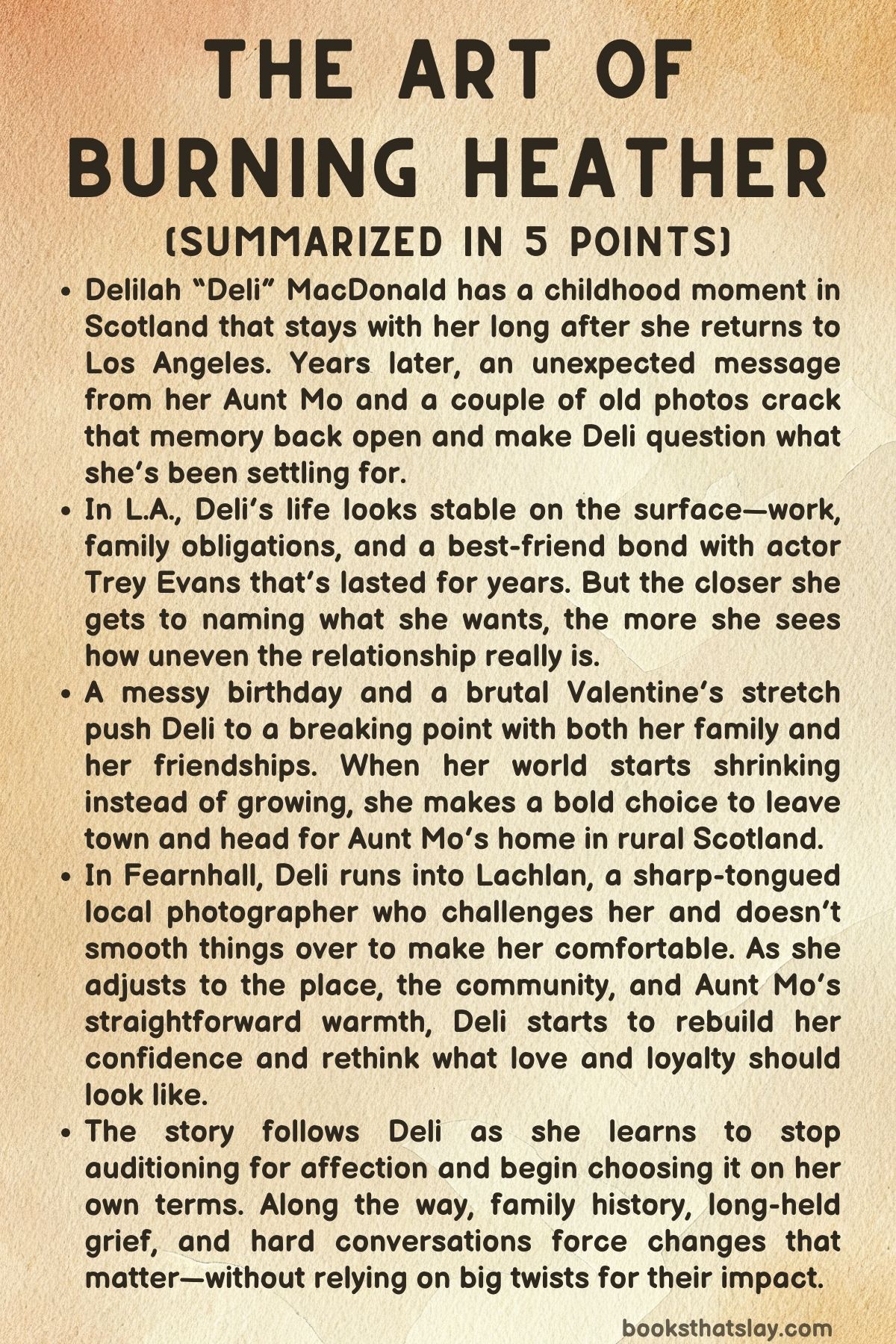
The Art of Burning Heather by Devrie Brynn Donalson is a contemporary romance about a woman who finally stops waiting to be chosen and starts choosing herself. Delilah “Deli” MacDonald has spent years in Los Angeles trying to prove she’s worthy—of love, of art, of space in her own life—while being boxed in by a sharp-tongued mother, a fading best friendship, and a best-friend crush who keeps her close only when it suits him.
When her estranged Aunt Mo reaches out from Scotland, Deli takes a risk and leaves everything familiar behind. What she finds there is messy family history, unexpected belonging, and a kind of love that asks for honesty instead of performance.
Summary
Delilah MacDonald’s first brush with Scotland happens when she is nine, visiting with her mother and grandmother to see her Aunt Maureen, known as Aunt Mo. On the last night of the trip, Delilah runs through the wild countryside with her eyes closed, pushed by a childish urge to feel fearless.
She nearly slips over a sea cliff, catches herself in time, and blurts a swear word that feels thrilling and forbidden. A local boy appears—Lachlan—with striking golden eyes and a camera.
He notices her scraped knees and bleeding hands, and despite her prickly defensiveness, he helps her clean up with water and his jacket. Their talk is awkward and curious in the way kids can be: Delilah jokes about sheep and asks questions, while Lachlan wonders about California and movie stars.
Delilah says she wants to be an artist; Lachlan says he wants to take photos so he can remember everything.
As they walk, they reach a hill and look out over a meadow of purple-pink heather under a gray sea sky. Delilah is taken by how strong the flowers seem, thriving in harsh weather.
Lachlan, with a blunt sincerity that catches her off guard, tells her she is beautiful. When Delilah realizes she is running out of time before her family notices she’s gone, she and Lachlan sprint back toward Aunt Mo’s cottage with the bright red door.
Before she leaves, Lachlan asks to take her picture so he won’t forget her. Delilah stands among the stones and heather, throws her arms wide, and shouts into the wind, looking more like herself than she ever does in posed photos.
Lachlan snaps the picture and disappears as Delilah’s mother calls for her, then scolds her for being dirty and difficult.
Years later, Delilah—now twenty-nine and going by “Deli”—is stuck in a life that feels smaller than she is. She works in a flower shop in Los Angeles, good at making arrangements but treated by her mother, Lorraine, as if the job is proof of laziness and wasted potential.
Deli’s best friend, Chloe, is drifting away, and the person Deli keeps circling around is Trey Evans, her longtime best friend and a working actor she has been quietly in love with for years. Six months earlier, Trey kissed her suddenly and then acted as if it never happened.
Deli did the same, convinced that if she waited long enough, he would finally say what the kiss meant.
On Deli’s birthday, the family dinner turns into a familiar mess. Lorraine criticizes Deli’s work and dismisses flowers as not real art.
Deli’s grandmother Rosemary drinks and pokes at Lorraine, and the tension rises until Lorraine knocks wine into Deli’s lap and ruins her dress, then adds a cutting remark. Chloe cancels at the last minute.
Trey alternates between playful closeness and abrupt distance, and the night leaves Deli feeling embarrassed, unseen, and exhausted by the role she’s expected to play in her own family.
Around this time, Deli receives an email from Aunt Mo—the first contact in nearly twenty years—wishing her well and attaching photos. One is of nine-year-old Deli by the red door in Scotland, windblown and laughing.
Another shows Aunt Mo in a pub beside a tall man with auburn hair and amber eyes. The image tugs at Deli in a way she can’t name, like a memory trying to surface.
Lorraine’s reaction is immediate and harsh: she treats the message as contamination, throws away the mail, and insists Maureen is not family. When Deli tries to read the letter anyway, Lorraine rips it up.
Deli salvages the photos from the trash, taped together like evidence that some part of her life existed outside Lorraine’s control.
Still clinging to hope about Trey, Deli goes to his apartment after Valentine’s Day, believing he has invited her for a confession of his own. Trey cooks her favorite meal, buys her favorite blue flowers, and acts intimate enough that Deli can almost believe she is finally safe to want what she wants.
But the night pivots sharply. Trey becomes defensive when Deli touches the wine, mocks the romantic show Lorraine gifted her, and fixates on the photo of Aunt Mo with the auburn-haired man.
Then, when Deli demands the truth about why he asked her over, Trey reveals it: he has fallen in love—with someone else, a woman named Scarlett. The dinner wasn’t for Deli.
It was rehearsal. He wanted Deli to reassure him that his plan with Scarlett would work, because Deli is the person he uses to steady himself.
Deli finally sees the pattern in full. Trey wants her available, loyal, and on-call, but not chosen.
When she tries to leave, he panics—not because he loves her, but because he can’t imagine losing the comfort of her devotion. In the hallway, Deli says the words she has been swallowing for years: she is in love with him.
Before anything can happen, the buzzer sounds—Scarlett has arrived. Deli meets Scarlett in the elevator: poised, glamorous, and nervous in her crimson dress.
Deli, bleeding inside but refusing to make Scarlett her enemy, tells her she looks beautiful. Scarlett returns the kindness.
Deli goes home and breaks down alone, then twists the knife further by checking Chloe’s social media and finding that Chloe lied about being sick and is instead on a romantic trip with a new boyfriend.
The next day at work, Deli’s anger finally finds a target. She discovers a customer has sent romantic roses to a mistress while sending a cheap arrangement and syrupy devotion to his wife.
Furious, Deli changes the wife’s bouquet into a message of betrayal and warning and writes a single word on the card: “Believe me.” When the man storms into the shop and threatens Deli’s coworker, Deli escalates the confrontation and gets fired. Her boss, Paola, makes it clear the firing is not only punishment—it is a shove out of a life where Deli keeps accepting scraps and calling it love.
With Trey exposed and Chloe gone, Deli chooses the one door that has cracked open: Aunt Mo. She emails her impulsively, asking to come to Scotland without a real plan.
Aunt Mo—now living in Fearnhall—receives the message as if she’s been waiting for it. She shares it with Lachlan, now grown, who has been close to her for years.
Lachlan worries Deli will hurt Aunt Mo or stir up old pain, and he decides he will keep Deli at a distance. But Deli arrives anyway, stepping off the train with grief, courage, and far too much luggage.
Lachlan meets her with a sign and an attitude, and they bicker from the first minute.
At Aunt Mo’s cottage, the welcome is immediate and startling in its ease. Mo hugs Deli, sets her up in a room, shows her the view, introduces her to the animals, and makes it plain that Deli belongs there if she wants to.
Mo’s home is warm, messy, full of personality, and nothing like the conditional affection Deli grew up with. Mo also has a way of pushing Deli into life: she drags her into an icy sea for “wild swimming,” laughs through discomfort, and then squeezes Deli’s hand with simple certainty—she’s glad Deli is there.
For the first time in a long time, Deli feels something that isn’t performance.
As Deli adjusts, she meets more of Mo’s community, including Hannah, a woman carrying her own quiet tragedy. Lachlan takes Deli walking through the hills, explaining that Hannah once had a fiancé and a daughter, and both vanished the night before the wedding.
Hannah never stopped searching. During the walk, the heather fields return like a memory made real.
Lachlan talks about local plants and folklore, including bluebells tied to truth-telling and the superstition that turning a bluebell inside out means winning the person you love. Deli asks for one, half-joking and half-serious, but Lachlan refuses, saying the person she loves doesn’t deserve it.
Later, Deli finds an inside-out bluebell hidden in his jacket pocket, suggesting he’s been carrying his own kind of hope.
Aunt Mo, sensing Deli’s need to reclaim herself, helps her plot a small act of revenge and freedom: a photo shoot designed to make Trey jealous. Lachlan agrees to be the camera man and, reluctantly, the leading man.
Out in the Highlands, their staged plan keeps slipping into something real. Lachlan carries Deli across a stream when she slips, kneels to help her with her boot, and watches her closely in a way that doesn’t feel like judgment.
When Deli freezes in front of the camera, she admits her mother trained her to believe she is disappointing to look at. Lachlan answers by offering truth instead of reassurance.
He tells her she is not the problem.
In return, Lachlan opens a door into his own past: a cruel father, a home where violence and blame were normal, and a childhood where he learned to absorb damage quietly. Aunt Mo helped him later by teaching him how to build, fix, and survive.
The honesty between Deli and Lachlan changes the air between them. During the shoot, Deli suddenly recognizes him.
He is the boy from the cliff. Lachlan admits he recognized her immediately and never forgot the fearless kid who roared into the wind.
They almost kiss, but rain drives them back.
Afterward, Deli sees the photos and is stunned by what they show: not a girl trying to be acceptable, but a woman who looks alive. She posts one, then sees a new image of Trey with Scarlett and finally does what she has been afraid to do—she sends Trey a message ending it, saying she needs to get over him.
The moment is shaky and raw, but it is hers. Lachlan pours whisky, toasts her courage, and they kiss.
The kiss is interrupted by an intruder at the pub: William, Lachlan’s brother, who disappeared long ago and has a talent for reopening wounds. Deli overhears the family tension and realizes William’s absence has been a long-standing ache for their mother.
When William discovers Deli, she recognizes him too: he is Billy S. Burns, a famous actor from the show Deli has been binge-watching, the same show her mother mocked. The coincidence is dizzying and threatens to turn Deli into tabloid material.
As pressure mounts—family conflict, public attention, and Deli’s own fear of ruining Aunt Mo’s life—Deli starts preparing to leave Scotland. She feels guilty, as if her presence causes damage wherever she goes.
Aunt Mo interrupts the spiral by pulling Deli into the sea again, then revealing she plans to leave too, to face the family history she has avoided. Mo tells Deli the problems existed long before Deli arrived, and she offers Deli something radical: the cottage, the pets, the business, the community.
She tells Deli to accept love that is freely given, and to stop chasing love that requires her to shrink.
Deli’s breaking point arrives on the coast when she collapses in grief, and a dog named Angus leads her toward a farm. She sees smoke rising and runs, terrified someone is hurt, only to find Cairn calmly conducting a controlled burn on the heather.
He explains the purpose: old growth becomes thick and hard, choking out what could come next. Burning the heather makes space for new life to grow.
The lesson lands in Deli’s body like truth. She realizes she has been living like old heather—holding onto what has hardened, afraid of what will happen if she lets it go.
Meanwhile, Trey shows up in Scotland, tracking Deli down to Lachlan’s pub. He talks about Deli as if she is property he can reclaim.
Lachlan sees who Trey is up close and refuses to play along. When Deli returns to the cottage, she discovers another betrayal: her mother, Lorraine, has been stirring the chaos, even sending photos to gossip outlets to control the story and punish Deli.
Lorraine then escalates further by inviting Trey to the cottage, staging a confrontation under the banner of “helping.”
Trey tries to regain control the only way he knows how—by performing devotion. He arrives with a token gift and drops to one knee with a ring, proposing marriage.
He claims he realized he loved Deli only after seeing her with someone else. Deli finally answers with clarity: no.
Trey lashes out, insults her, and tries to reduce her choices to fear. Deli refuses friendship, refuses the old role, and shuts the door on him.
She also draws a line with her mother, telling Lorraine she loves her, but she deserves better than a love that cuts.
Trey returns to the pub furious and humiliating. The community responds in a way Deli has rarely experienced: protection without conditions.
In the confrontation, Hannah punches Trey, and the pub celebrates the boundary like it is a holiday. Lachlan, realizing he might lose Deli to fear and misunderstanding, runs into the rain to find her.
On the cliffside, he checks her injured ankle and tells her plainly that he is in love with her. Deli answers with her own decision: she isn’t leaving, and they have time.
Back at the cottage, she apologizes for doubting him and uses her knowledge of flowers to create a wordless love letter—an arrangement that says what she can’t fully say yet: she is falling in love too.
Deli stays in Fearnhall. Months pass, and she and Lachlan build a life: running the cottage and event work, caring for animals, and becoming part of a community that doesn’t demand she earn her place through pain.
Deli still grieves the loss of Chloe and keeps limited contact with her mother, but she stops organizing her life around Lorraine’s approval. Scotland becomes home not because it is perfect, but because it allows her to be whole.
Eventually, Lorraine calls with news: Rosemary has taken a turn. Deli flies back to California.
In Rosemary’s final days, the family gathers—Deli, Lorraine, and Aunt Mo—sharing a brief pocket of laughter over a card game, and Rosemary dies peacefully afterward. At the funeral, Aunt Mo struggles to stay composed until Lachlan and friends arrive to support her.
Then a surprise arrives too: Beth, Aunt Mo’s lost love from decades earlier, who comes after seeing the obituary. Mo breaks down in relief as they reunite, proof that some stories don’t end just because time passed.
Deli gives Rosemary’s eulogy with honesty, naming her grandmother’s fierceness and flaws, and repeating Rosemary’s last insistence: choose your life while you still have time. In the epilogue, Deli is back in Scotland on her thirtieth birthday, waking to rain and small, steady gestures of love from Lachlan.
She finds a fallen photo of herself at nine—wild, fearless, arms open to the wind—and pins it back up. She feels love for the child who didn’t know what she would survive.
Quietly, she wishes herself happy birthday, no longer waiting for permission to exist.
Characters
Delilah “Deli” MacDonald
Delilah is the emotional center of The Art of Burning Heather—a woman whose life has been shaped by being told (directly and indirectly) that she is “too much” in the wrong ways and “not enough” in the ways that supposedly matter. As a child in Scotland, she is wild-hearted, impulsive, and brave, drawn to open space and danger with the kind of instinct that feels like freedom rather than recklessness.
That early moment by the cliff and the heather establishes her core tension: she craves aliveness, yet she grows up inside relationships that train her to shrink. As an adult in Los Angeles, Deli’s work with flowers reflects who she truly is—someone fluent in feeling, symbolism, care, and beauty—yet she is constantly undermined by family judgments that reduce art to productivity and affection to performance.
Her long attachment to Trey exposes her deepest pattern: she confuses loyalty with love and proximity with being chosen, staying available because availability has become her version of worth. Scotland becomes more than an escape; it becomes a corrective experience where she is seen without being managed, desired without being used, and welcomed without having to audition.
By the end, Deli’s growth is not about becoming harder or less sensitive—it is about becoming more truthful, choosing what nourishes her, and making room for new life the way the land does after fire.
Lachlan
Lachlan functions as both a romantic counterpart and a mirror that reflects Deli back to herself with accuracy rather than criticism. When they first meet, he is direct, practical, and unexpectedly gentle—someone who offers help without bargaining for it, which is startling to a girl already learning to be cautious with intimacy.
As an adult, his steadiness is built from fracture: he carries a history of violence in the home and the kind of childhood where a parent’s cruelty makes a child feel responsible for everything that breaks. His photography is not just a hobby; it is his philosophy—an attempt to preserve truth, to witness what matters, and to hold onto moments that might otherwise be rewritten by shame or time.
What makes Lachlan compelling is that he is protective without being possessive; even when he is jealous or wary, he tries to safeguard Deli’s agency rather than control her choices. His relationship with Aunt Mo shows his capacity for loyal, chosen-family attachment, and his bond with Hannah reveals a tenderness that is practiced, not performative.
When he tells Deli she is wrong to believe her mother’s narrative about her being unphotogenic or disappointing, he is not offering empty reassurance; he is naming a lie that has structured her self-image. His arc is about bravery of a quieter kind: risking openness, admitting love, and choosing to build something stable after a life that taught him stability could be stolen.
Maureen “Aunt Mo”
Aunt Mo is the story’s catalyst and its emotional safety net, embodying the idea that family can be chosen, repaired, and reinvented. She is warm, mischievous, and resilient, someone who meets pain with humor and meets fear with action, even when she hesitates at first.
Her long silence and the careful way she approaches reconnecting with Deli suggest a woman who has learned that love can be risky—especially when old family wounds can reopen with one message or one visit. In Scotland, Mo becomes a model of intimacy without competition: she is comfortable in her body, comfortable offering care, and comfortable letting people be complicated without punishing them for it.
Her “wild swimming,” her bathrobe gifts, and her playful rituals are not quirky decoration; they are deliberate invitations to live differently—less guarded, more present. Mo also represents accountability without martyrdom: she refuses the idea that Deli “caused” the family’s problems and insists the truth that those fractures existed long before Deli arrived.
By asking Deli to take over the cottage and business, Mo gives her something more profound than shelter—she gives her trust, belonging, and a future that does not depend on anyone’s approval. Mo’s later reunion with Beth underscores her own theme: it is never too late to choose love, and old losses do not have to remain permanent endings.
Trey Evans
Trey is written as the seductive trap of familiarity—charismatic, talented, affectionate in flashes, and deeply self-centered in structure. He thrives on Deli’s steadiness, using her as an emotional home base while reserving romantic commitment for other women, which allows him to feel supported without being vulnerable.
His behavior illustrates a specific kind of emotional exploitation that can hide behind friendship: he gives just enough intimacy to keep Deli hopeful, then withdraws into silence or denial when accountability appears. The kiss that is never discussed becomes symbolic of his pattern—he tests what he can take, then pretends nothing happened so he can keep the benefits without the consequences.
Even his elaborate dinner is less about love than about reassurance; he needs Deli to stabilize him, validate him, and confirm his choices will succeed. When Deli finally confesses her feelings, his answer is not love or clarity—it is need, which exposes the core of his attachment: Deli matters to him as a resource, not as a partner.
His trip to Scotland and sudden proposal are not a romantic awakening so much as a fear response triggered by losing control and seeing Deli desired elsewhere. Trey’s role in the story is crucial because he represents the version of love that burns without warming—an attachment that consumes time, confidence, and possibility until the person trapped inside it decides to step away.
Chloe
Chloe begins as Deli’s best-friend voice on the other end of the phone—someone who can puncture denial with a blunt sentence—yet she gradually becomes a secondary heartbreak that mirrors Trey’s betrayal in a different key. Her absence is not only logistical; it is emotional abandonment at the exact moment Deli most needs steadiness.
The social media reveal, where Chloe is clearly thriving elsewhere while claiming she is too sick to show up, lands as a particular kind of modern cruelty: not a dramatic confrontation, but a quiet choice to prioritize a new life while leaving an old friend to grieve alone. Chloe’s function in the narrative is less about villainy and more about the reality that friendships can be outgrown, replaced, or neglected without closure.
For Deli, Chloe’s disappearance sharpens the story’s larger lesson: love that is real does not require you to beg for basic presence. Chloe becomes part of what Deli must mourn to become free—proof that sometimes the hardest goodbyes are the ones that happen without a formal ending.
Lorraine MacDonald
Lorraine is one of the story’s most complex sources of pressure—an emotionally controlling mother whose love is real but whose methods are damaging. She frames Deli’s life through harsh “realism,” equating worth with status, romance with strategy, and art with indulgence unless it looks impressive to outsiders.
Her repeated needling about Deli’s job and appearance is not just meanness; it is a worldview where fear drives everything—fear of being judged, fear of being left behind, fear that softness will ruin survival. Lorraine’s hostility toward Aunt Mo and Scotland suggests buried history and unresolved resentment, and her willingness to destroy Mo’s letter and photos shows how threatened she feels by any narrative that might liberate Deli from her influence.
Even when Lorraine tries to help—pushing Deli to move on from Trey—it comes wrapped in control rather than care, as if Deli’s choices must be managed for her own good. Her most revealing moment is the betrayal of sending photos to a gossip outlet and then welcoming Trey into the cottage, which shows how easily she prioritizes her preferred storyline over Deli’s wellbeing.
Yet the story does not flatten Lorraine into a monster; it acknowledges that she may love her daughter while still being unwilling or unable to change. Lorraine represents the painful truth that love and harm can coexist, and that adult children sometimes must choose boundaries even when they still love the parent who wounded them.
Rosemary McDonnell
Rosemary is sharp-edged, theatrical, and emotionally volatile, using humor and cruelty interchangeably as weapons and armor. She drinks heavily, needles her daughter, and makes outrageous comments that oscillate between comedy and brutality, which makes her both difficult and captivating.
Underneath the chaos is an older woman haunted by time and by choices she cannot undo, especially those tied to Scotland and a man who left her behind in more ways than one. Rosemary’s obsession with passports, calendars, and deadlines suggests she is motivated by urgency: she believes the window for repair is closing, and she cannot bear another failure.
Her relationship to Deli is paradoxical—she insults her, then offers money; she gives harsh advice, then delivers the most honest emotional truths. Rosemary’s final guidance to Deli, urging her to live deliberately while she still has time, reframes her entire character as someone who understands regret intimately and does not want Deli to inherit it.
Her death lands not as a neat redemption but as a complicated ending for a complicated woman—someone fierce and unforgettable, whose love was imperfect but whose final message was clarity.
Hannah
Hannah is a quiet embodiment of endurance, shaped by a loss so enormous it has reorganized her entire life. Her history—an engagement, a daughter, and a disappearance on the eve of what should have been a beginning—casts her as someone permanently living in the aftermath of a mystery.
What makes Hannah powerful is her refusal to surrender to finality; she keeps searching, keeps hoping, keeps moving through days that must feel like repetitions of grief. She is not warm in the conventional sense, and her guardedness initially reads as dislike, but it is more accurately a protective boundary built from years of disappointment.
Her bond with Lachlan reveals her softer layers: she accepts comfort from him, allows small gestures like a flower tucked behind her ear, and quietly observes what he feels for Deli with a kind of perceptive tenderness. Hannah’s punch that floors Trey is not just comedic justice; it is the moment where her restraint breaks in defense of someone else’s dignity, signaling that beneath her quietness is fire.
Hannah’s role in the story reinforces a theme of faithfulness—not the romantic kind, but the human kind: staying devoted to truth, to searching, and to the people who earn their place beside you.
Paola
Paola acts as a boundary and a turning point for Deli, serving as the first authority figure in Deli’s adult life who refuses to enable her stagnation. She reads Deli’s emotional unraveling with accuracy and responds not with softness but with a decisive push that forces movement.
Firing Deli is harsh on the surface, yet it functions like an intervention—an insistence that Deli cannot keep living the same loop, apologizing for everyone else’s behavior while swallowing her own pain. Paola also represents a different kind of mentorship: she does not offer comforting fantasies, but she does offer a hard truth that becomes liberating—sometimes losing a job, a routine, or a familiar role is the only way to stop being trapped in it.
Her presence is brief compared to family and romance arcs, but her impact is structural: she helps create the rupture that makes Scotland possible.
Sarah
Sarah is a small but important voice of clarity who helps Deli name what has been happening with Trey without romanticizing it. When she suggests that Trey may need to lose Deli to understand her value, she is not promising reconciliation; she is validating the idea that Deli’s constant availability has distorted Trey’s perception of consequence.
Sarah also shows what solidarity looks like in contrast to Chloe’s absence—simple, direct, and present. She doesn’t demand that Deli justify her feelings, and she doesn’t minimize what happened.
In a story full of people trying to script Deli’s life, Sarah offers something rarer: perspective without control.
Scarlett
Scarlett appears mostly through Deli’s perspective at first—as the feared “other woman” who seems to have what Deli has been waiting for—yet her brief direct interaction with Deli complicates that simplistic framing. In the elevator, Scarlett comes across as nervous but sincere, offering warmth rather than smugness, which suggests she is not the architect of Deli’s pain so much as another person walking into Trey’s orbit with incomplete information.
Scarlett functions as a narrative device that exposes Trey’s character: he can “choose” someone else, not because Deli is unworthy, but because Trey is making choices based on ego and convenience. Scarlett’s presence forces Deli to confront reality instead of hope, and that confrontation becomes the doorway to Deli’s freedom.
William Scott
William is disruption made human—charismatic, intrusive, and loaded with unresolved history that he drags into Lachlan’s life without permission. His arrival at the pub is not only about familial tension; it threatens the fragile new space Deli and Lachlan are creating, reminding everyone that old wounds do not stay buried just because life is getting better.
As Lachlan’s brother, William embodies betrayal and abandonment, someone who repeatedly breaks their mother’s heart and then reappears as if damage is reversible. The twist that he is also a famous actor collapses Deli’s escapist world into her real one, forcing her to see how fame, fantasy, and reality collide—especially given Trey’s profession and the way image has controlled Deli’s life.
William’s main purpose is to test bonds: he pressures Lachlan’s restraint, exposes family pain, and intensifies the stakes around loyalty and home.
Beans
Beans, the cat, may be nonverbal, but the role is unmistakable: a symbol of belonging, comfort, and the small daily reasons to stay alive when emotions become too big. Beans also acts as a comic counterweight to the story’s heavier turns, but the humor carries meaning—this animal chooses Deli, curls into her space, and even tries to follow her, reinforcing that Deli is already building attachment and responsibility in Scotland.
Beans represents home as something felt, not declared, and helps anchor Deli’s new life in ordinary care rather than dramatic romance alone.
Angus
Angus appears as a guiding presence at Deli’s lowest moment, functioning almost like the landscape itself reaching out a hand. The dog leading Deli toward the farm and the smoke connects her personal collapse to the book’s central metaphor: burning as renewal rather than destruction.
Angus is not characterized through dialogue, but through action—showing up, nudging her toward help, and redirecting her away from isolation. In a story where Deli has often had to beg humans to notice her, Angus notices without hesitation, reinforcing the theme that love can be simple, immediate, and freely offered.
Cairn
Cairn enters as the clearest embodiment of the book’s philosophy about pain, endings, and rebirth. His controlled burn of the heather reframes fire from catastrophe into stewardship, explaining that sometimes what looks like destruction is actually the only way to make space for new growth.
He speaks to Deli at exactly the moment she believes she has ruined everything, offering a perspective that does not deny grief but changes its meaning. Cairn is not there to solve her problems; he is there to give her a metaphor sturdy enough to carry her through them.
His calmness, his connection to land, and his willingness to tell the truth without drama make him a hinge character—someone who helps Deli understand that she is allowed to start over, and that starting over is not failure.
Callum
Callum is an offstage character whose absence still shapes the emotional weather of the family. As the man tied to Rosemary’s refusal to return to Scotland and her sense of being abandoned, he represents the original fracture that echoed down through Lorraine and into Deli.
His choice to stay behind and die is not presented as a neutral fact inside the family psyche—it is experienced as betrayal, as an ending without repair, and as proof that people leave and do not come back. Callum’s legacy in the story is the inheritance of fear: fear of being left, fear of wasting time, fear that love is something you lose unless you control it first.
Even unseen, he helps explain why Rosemary and Lorraine cling so tightly to their narratives—and why Deli’s decision to choose her own life is such a radical break from the family pattern.
Beth
Beth arrives late, but she lands like an answered prayer for Aunt Mo, embodying the story’s insistence that time does not automatically close every door. Her appearance after Rosemary’s death suggests that endings can also be openings, and that love can return in forms you stopped expecting.
Beth’s importance is not in how much page-time she gets, but in what her presence confirms for Mo: that choosing courage earlier mattered, and that holding space for love was not foolish. Beth functions as Mo’s mirror to Deli’s arc—proof that the heart can survive long separations and still recognize home when it appears.
Themes
Freedom, Choice, and the Cost of Staying Small
From the opening memory of a child running with her eyes closed toward the edge of a cliff to the adult decision to leave Los Angeles behind, The Art of Burning Heather keeps returning to the same pressure point: freedom is not a personality trait, it is a series of decisions made in the face of fear and conditioning. Delilah’s earliest moment in Scotland is not just a near-accident; it establishes how exhilaration and danger sit side by side when someone moves without permission.
As an adult, she has learned to shrink her desires so conflict doesn’t erupt—especially around her mother. The story shows how that habit turns into a life strategy: picking the safer sentence, swallowing the sharper truth, waiting for someone else to choose her.
Her work with flowers is treated as “less than” by her family, and the dismissal trains her to doubt the legitimacy of her own inner life. The result is a version of captivity that doesn’t need locked doors: she stays because she’s been taught that wanting more makes her unreasonable, dramatic, or ungrateful.
Scotland becomes the setting where she tests a different way of living, not because it magically fixes her, but because it gives her room to hear herself think. The pivotal shift happens when she stops negotiating for scraps of attention—first with Trey, then with her mother—and accepts that love and approval are not the same thing.
Freedom here is portrayed as active and sometimes brutal: quitting roles that provide identity, cutting off loops that feel familiar, allowing herself to be disliked, and choosing a life that may disappoint the people who trained her to perform. The book treats choice as something that arrives after grief, not before it—because you often have to mourn the life you thought you were supposed to live in order to fully step into the life you actually want.
Emotional Labor, Dependency, and the “Best Friend” Trap
The relationship between Delilah and Trey is written as a lesson in how emotional labor can masquerade as intimacy. Delilah has been positioned as the stabilizer: the person who answers, the person who reassures, the person who absorbs confusion and returns calm.
Trey’s dependence is not subtle; he admits he invited her over to soothe his anxiety about making a new relationship official, down to validating the details of the meal. That confession reframes years of their dynamic into something harshly clear: her presence functions as his safety net, not his commitment.
The book also shows how this kind of role gets cemented—through small moments of reward that keep hope alive. The earlier kiss that is never discussed becomes the perfect mechanism of control without overt cruelty: just enough to keep her waiting, never enough to require accountability.
When Delilah finally says out loud that she is in love with him, the crucial question she asks—whether he notices her—exposes the emotional reality beneath their history. Trey’s answer (“I need you”) is the story’s most damning summary of a bond built on extraction.
What makes this theme land is that Delilah is not presented as naïve; she is presented as trained. She has learned to measure her worth by usefulness, to treat being needed as proof she matters, and to interpret her own longing as inconvenient.
Even Chloe’s betrayal echoes the same pattern from another angle: Delilah gives, shows up, tries, waits; the other person chooses themselves while keeping Delilah on a string of partial truths. The narrative is blunt about what breaks the trap: not winning the person, but withdrawing the service.
Delilah’s decision to disappear is a boundary so large it forces reality into the open. In this world, people who rely on you will often call it love, but the book insists on a sharper distinction—love involves risk and reciprocity, not just access.
Delilah’s growth comes from recognizing that being someone’s constant does not automatically make you chosen, and that a “best friend” label can hide a deeply unequal arrangement.
Mothers, Daughters, and Inherited Wounds
Family conflict in The Art of Burning Heather is not treated as background noise; it is the engine that shapes Delilah’s self-concept. Lorraine’s criticism of Delilah’s work and appearance is not random meanness—it functions as a worldview that says value must be proven through conventional success, polish, and control.
Lorraine’s rejection of Aunt Mo, including the destruction of the letter and photos, shows how family narratives are policed: certain relationships are declared “not family” not because they lack love, but because they threaten the version of the past that someone needs to survive. Rosemary adds another layer: her sharpness, her drinking, her provocations, and her sudden moments of generosity reveal a woman who has learned to fight for oxygen in a family where tenderness is unsafe.
The story suggests that the women in this line have been taught to survive by controlling the terms of love—through criticism, tests, withholding, or dominance—because they do not trust love to remain if they stop managing it. Scotland becomes the site where the cycle is named rather than obeyed.
Aunt Mo offers Delilah something unfamiliar: affection without a transaction, warmth without humiliation, closeness without leverage. Even the physical details matter—Mo’s comfort with her body and with cold-water swimming becomes a quiet rejection of shame as a family inheritance.
Lorraine’s panic about Delilah going to Scotland exposes how threat works in families: independence is interpreted as betrayal, and autonomy is reframed as manipulation by an outsider. The book also refuses to simplify the mothers into villains.
Lorraine’s fear reads as real; Rosemary’s urgency about time reads as earned. But it still holds them responsible for the damage they cause.
Delilah’s most adult act is not forgiving them or cutting them off completely; it is choosing a boundary that doesn’t require their approval. When she tells her mother she loves her but deserves better, the line captures the theme’s core tension: love can exist alongside refusal.
The final arc, including Rosemary’s death and the brief unity of the women at the end, doesn’t erase harm; it shows the possibility of tenderness arriving late and imperfectly. Inheritance here is not destiny.
The story argues that you can come from a lineage of sharp-edged love and still decide to build a gentler home.
Self-Worth, Art, and Being Seen Clearly
Delilah’s relationship with art is not a hobby subplot; it is her central struggle for legitimacy. She calls herself an artist as a child, but as an adult she is arranging flowers under a cloud of contempt, especially from her mother, who dismisses the work as laziness and not “real” art.
That dismissal does lasting harm because it teaches Delilah to distrust her own taste, her own talent, and even her own face. Her discomfort with photographs is not vanity—it is learned shame.
She freezes in front of the camera because she expects images to confirm her inadequacy, the same way family dinners confirm it through sarcasm and put-downs. The narrative uses Lachlan’s photography to reverse that expectation.
He does not coax her with false praise or insist she pose correctly; he creates conditions where she can appear as herself. The first photograph, taken when she is wild and roaring into the wind, captures a version of Delilah that does not apologize for taking up space.
The adult photo shoot repeats that logic: the goal begins as jealousy bait, but it turns into evidence. When Delilah sees the images and feels stunned by how true she looks, the moment is about perception and permission.
She has been trained to see herself through the eyes of people who benefit from her insecurity—people who can keep her close, compliant, and easy to manage. Clear seeing becomes an act of repair.
Flowers operate similarly. Delilah’s “dictionary” of flowers allows her to speak without begging for the right words; it is artistry as communication, beauty as truth, meaning as something she can author.
Even her “rogue” bouquet to Big Papa’s wife shows art as moral language: she uses her skill to puncture a lie and protect someone from being kept in the dark. The cost of being seen is also acknowledged—once her image circulates, Lorraine weaponizes it by contacting a gossip magazine, turning Delilah’s emerging confidence into public exposure.
But the book insists that visibility is still worth it when it comes from self-respect rather than performance. Delilah’s journey is not about becoming photogenic; it is about reclaiming the right to exist without constant correction.
Art becomes the place where she stops asking whether she is allowed to be herself and starts acting as if she already is.
Renewal Through Destruction and the Courage to Make Space
The controlled burn on Cairn’s land is the book’s clearest statement about renewal: new growth requires space, and space sometimes requires loss. The fire is not framed as chaos; it is deliberate, purposeful, and grounded in an understanding that old heather can harden and choke out what comes next.
That idea lands on Delilah at the moment she is most raw—when she believes she has ruined everything and feels numb with guilt. The theme works because Delilah’s life has become its own overgrowth.
Her attachment to Trey has stopped being love and started being habit. Her friendship with Chloe has become a source of humiliation and confusion rather than support.
Her job, while meaningful, has become a place where she is stuck managing pain rather than creating a future. The book treats her breakup with those versions of herself as a burn: she does not simply “move on,” she has to destroy the structures that kept her safe but miserable.
That includes letting the fantasy of Trey die, letting the old family script lose its power, letting the role of reliable rescuer collapse. The story also shows that renewal is not clean.
Delilah’s grief is physical—sobbing in the elevator, collapsing by the roadside, spiraling on television late at night—because clearing space feels like losing oxygen before you find it again. Scotland does not erase pain; it gives her a landscape that mirrors change as a normal, survivable process.
Even Aunt Mo’s decision to leave and face unfinished family mess reinforces the theme: avoiding the past is another kind of overgrowth. Making space sometimes means confronting what you refused to name.
By the end, renewal is portrayed as ongoing rather than final. Delilah still misses Chloe, still has limits with her mother, still carries memories that sting.
But she has built a life where love is offered freely, where community holds her, where work has purpose, and where she can look at her younger self with tenderness rather than embarrassment. The book argues that destruction is not the enemy of growth; refusal to change is.
Clearing space is an act of hope, not because it guarantees what comes next, but because it makes what comes next possible.