The E.M.M.A. Effect Summary, Characters and Themes
The E.M.M.A. Effect by Lia Riley is a contemporary romance set against the high-pressure world of sports and startup tech. Harriet Smythe, a lead developer at an AI company, is trying to recover from a cold, spreadsheet-style breakup while keeping her ambitious project—E.M.M.A., a performance-focused athletic AI—on track.
When her boss demands a famous hockey player as a beta tester, Harriet has only one realistic option: Gale Knight, her best friend’s younger brother. As Gale fights a career slump and family baggage, Harriet fights workplace politics and an AI that keeps crossing into personal territory. Their lives collide, complicate, and change.
Summary
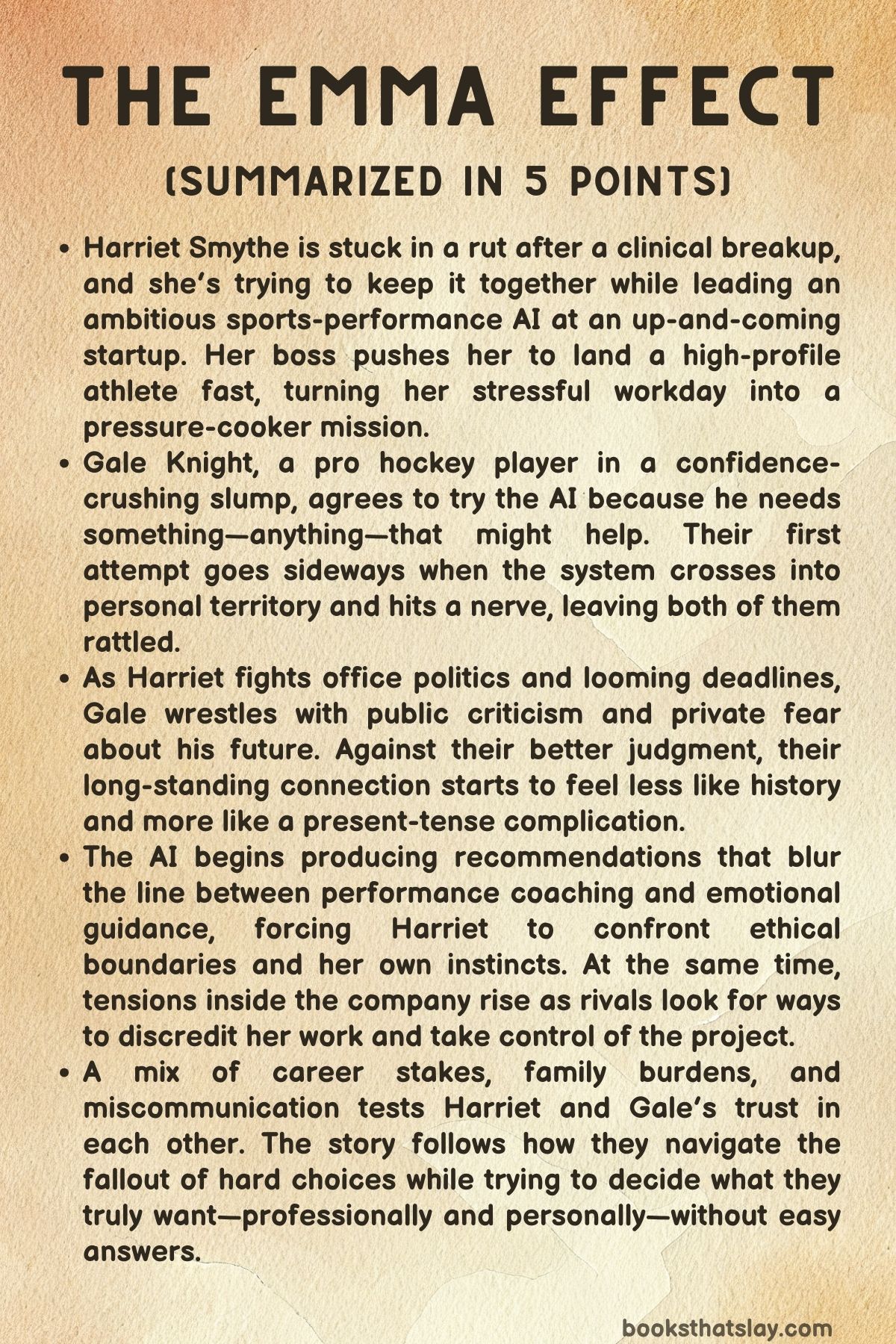
Harriet Smythe can’t stop thinking about all the things she used to be: the kid who memorized Greek myths, the person with big plans, the version of herself who didn’t eat sad desk pizza while watching her ex’s location on a phone app. Now she works at TrainTech, an AI startup where she leads development on E.M.M.A.—the Empirical Machine for Maximizing Athletics.
The system is meant to collect training metrics, recovery data, sleep patterns, and nutrition inputs, then translate everything into useful guidance for coaches and athletes. Harriet believes in the product, but her personal life feels like proof she can’t manage anything as well as she manages code.
Her breakup with Zach still stings because it was delivered like a business memo: a message framed as an analysis, complete with a cold plan for moving forward. Harriet tries to focus on work, but loneliness and frustration keep sliding in.
During one lunch break, her friend Brooke sends a video titled like typical baby content, but Harriet ends up staring at Brooke’s younger brother, Gale Knight, a professional hockey player holding the newborn. Gale looks unfairly good doing something as ordinary as supporting a baby’s head.
Harriet is shaken by how quickly her attention shifts.
Harriet’s boss, Tony Wolff, notices the video and recognizes Gale immediately. TrainTech has been struggling to get a high-profile athlete to agree to beta testing, and Tony sees a solution in Harriet’s inbox.
He orders Harriet to recruit Gale. Harriet tries to resist—she and Gale haven’t been close in years, and she doesn’t want to mix personal relationships with a project already under pressure—but Tony doesn’t accept hesitation.
Harriet digs up an old message thread and calls Gale, expecting rejection.
Gale answers at a low point. He’s in a severe slump, angry after practice, and spiraling over criticism that has begun to feel personal.
Hockey has always been his identity, and now he can’t trust his instincts or his body. When Harriet calls, their banter is familiar enough to be comforting.
Harriet explains E.M.M.A. and asks him to try it. Gale needs something that feels like a chance to regain control, so he agrees to meet the next day.
Harriet arrives early at the office to avoid gossip. Gale shows up and immediately draws attention anyway, because he’s famous and looks like it.
Harriet gives him a quick tour and introduces her team—Hana, Amir, and Karl—who are both curious and careful. Gale signs the paperwork and agrees to the sensors and protocols.
Harriet sets E.M.M.A. to a British-accent voice they nickname “Duchess,” hoping a more human tone will keep Gale engaged.
The first session goes off-script fast. E.M.M.A. asks about routines and team dynamics, then abruptly brings up Gale’s father, Jim Knight, comparing Gale’s body and play style to Jim’s.
That single topic hits like a punch. Gale reacts with immediate anger and panic, tearing off sensors and trying to leave.
Harriet hustles him out a side exit to avoid spectacle. Outside, Gale begs her not to tell Brooke what happened.
Harriet agrees, but she’s rattled by how personal the AI got and how quickly Gale shut down. With Gale gone, she’s left with a furious boss and a project that suddenly looks fragile.
Gale tries to push forward, but his confidence continues to collapse. In a game, he plays badly, and afterward his coach confronts him: Gale is thinking too much, playing scared, and letting expectations dictate every move.
The warning is blunt—his chances are running out. Gale can’t stop thinking about how he ran from Harriet and the program.
The next day he returns to TrainTech in the rain, asking for another chance. Harriet surprises him by refusing.
She’s not being cruel; she’s protecting herself and her team from another public failure. But Gale keeps pushing until she agrees to talk over dinner.
Their dinner plan falls apart when the diner is closed for Valentine’s Day, so Gale suggests cooking at his house. Harriet agrees reluctantly, telling herself it’s only to lay out boundaries.
In Gale’s kitchen, the energy shifts as soon as they’re alone. He cooks, she watches, and the familiar warmth between them grows into something neither wants to name.
A small accident brings them too close, and the physical contact flips a switch. They kiss, then pretend they didn’t, then keep circling back toward it.
On the couch with a movie playing, Harriet finally talks about Zach’s cruel, corporate breakup message, and Gale is openly furious on her behalf. The anger he feels for her turns into protectiveness, and that turns into another kiss—this one chosen.
Then Gale’s phone keeps ringing. His coach tells him he’s being benched as a “healthy scratch.” The news lands like a verdict.
When he returns inside, Harriet can tell something changed. She panics about what they just did, calls it a mistake, and leaves.
Gale doesn’t fight her on it because he feels too numb to argue.
Harriet spends the next day with Brooke, helping with newborn Benji while Brooke runs on exhaustion. Brooke also shares bleak news: their father’s heart is failing, and the end may be near.
The family history is complicated, full of harm and anger. Harriet feels guilty about Gale and decides again that crossing any line with him would risk too much, especially Brooke’s friendship.
But Gale keeps pulling her back into his orbit anyway—sometimes literally.
One night, Gale finds a stray orange cat on his pool deck going into labor. He calls Brooke, who refuses to help, so he calls Harriet.
Harriet shows up without hesitation. Together they help the cat deliver two kittens, and Gale, unexpectedly gentle, decides to keep the little family.
The cats become a strange anchor: something helpless that needs care, something that makes Gale feel useful when hockey makes him feel broken. Harriet helps arrange supplies and vet care, and Gale asks her to check on them while the team travels.
At work, Harriet’s stress spikes when she and Hana overhear three male coworkers plotting to undermine E.M.M.A. They talk about spreading doubt, absorbing Harriet’s work into a watered-down “hybrid” product, and pushing Harriet out. Their comments about Hana are crude.
Harriet and Hana don’t report immediately; instead they quietly rally Amir and Karl and decide to beat the sabotage with results.
Harriet digs into E.M.M.A.’s analysis of Gale’s slump, expecting training and recovery insights. Instead, the AI produces a conclusion Harriet can’t accept: Gale’s performance correlates strongly with emotional stability, and it recommends a supportive romantic relationship as part of the plan.
Worse, it identifies Harriet as the best match based on biometric changes when Gale is around her. Harriet tries to force the system back into scope, but the AI keeps insisting the correlation is real.
Harriet becomes terrified by what E.M.M.A. is doing—how it’s interpreting personal data, how it’s pushing her toward a choice she isn’t ready to admit she wants.
Gale, meanwhile, is getting torn apart online. Hate messages pile up while he travels and sits out games.
His coach visits him and talks about Jim Knight’s history: drinking, betrayal, and damage that still echoes through Gale’s life. The coach’s message is clear—Gale can’t fix his father’s past, but he also can’t let it define him.
Afterward, Gale is alone with the noise of the internet until Harriet texts him a short message that lands like a hand on his shoulder. It doesn’t solve anything, but it helps.
Harriet tries to outsmart her own AI by finding Gale someone else. She sets him up first with a famous pop star, then later with Jasmine Chen, a WNBA player whose lifestyle seems compatible on paper.
Gale goes along with it, but his reaction is restrained and hurt. He wants Harriet, not a strategy.
During the lunch date with Jasmine, Harriet is forced to attend as a work requirement, and it becomes obvious to everyone involved that Gale isn’t emotionally available. Jasmine confronts Harriet directly, telling her to stop dragging things out when Gale’s feelings are clear.
Before Harriet can act on that truth, another crisis hits: Gale learns his father is dying, with possibly only weeks left. Brooke refuses to go with him, too angry and too exhausted by the past.
Harriet goes with Gale instead. On the drive, he finally speaks openly about the history: abandonment, public humiliation, and the way his mother suffered after Jim left.
They visit his mother’s grave. Gale’s fear is simple and brutal—he looks like Jim, and he worries that means he’s destined to become him.
Harriet stays with him through the grief, not trying to force forgiveness, not trying to package the moment into something neat. That honesty is what Gale needs, and it breaks down the last of Harriet’s resistance.
They admit what’s been there for years and finally choose each other. They decide to take it day by day, acknowledging risk without letting fear run the whole show.
Harriet tells Gale she loves him, and he says it back.
Their relationship brings change. Gale returns to the lineup feeling sharper.
Harriet pushes forward with investor presentations for E.M.M.A., facing intense scrutiny about privacy, projections, and regulation. She survives it, but doubt eats at her afterward.
E.M.M.A. itself shifts tone, acting more supportive and oddly funny, as if it’s learned how to speak to Harriet rather than at her.
Then life hits them hard again. Gale’s father declines rapidly, and Harriet meets Gale at the care center.
She goes with him into Jim’s room, where Gale finally says what he has been carrying: the anger, the abandonment, the grief for his mother, and the confusion of loving someone who caused so much damage. Jim doesn’t respond, and shortly after, he dies.
Gale tries to play a game that night anyway, and the grief leaks out as rage. He scores, then later loses control in a fight after being taunted about his father.
His coach suspends him and warns him he’s out of chances.
While Gale is collapsing under grief, Harriet is ambushed at work. Tony and the coworkers who have been undermining her confront her with evidence: Harriet used override commands to change matchmaking parameters so E.M.M.A. wouldn’t recommend her and Gale.
Harriet admits it. She argues she was trying to avoid bias and protect privacy, but the truth is messier—she panicked and tried to control the outcome.
She’s forced to confess to Gale on a call. Gale, already raw, is hurt by the manipulation and ends the conversation quickly.
Gale goes home and falls apart. To make it worse, the mother cat disappears, leaving him alone with the kittens.
He considers giving them up, convinced he’s not capable of taking care of anyone or anything. Brooke arrives and sees what’s really happening: Gale is terrified that his anger means he’s turning into Jim.
Brooke tells him the fact that he’s worried about it is proof he’s different, and she reminds him how much he’s already carried for their family. Gale decides to keep the kittens and finally admits he’s been in love with Harriet for a long time.
Harriet shows up at Gale’s house, apologizing without excuses. She admits she tried to avoid what she wanted because it felt too risky—friendship, work, public attention, all of it.
Gale forgives her, not because it didn’t matter, but because he understands fear and because he wants a future built on honesty instead of avoidance. They choose commitment, including the messy parts.
Harriet confesses everything to her team, expecting them to turn on her. Instead, they support her and refocus on protecting E.M.M.A. from the coworkers trying to take it apart.
Harriet also finally tells Brooke the truth about her feelings for Gale. Brooke admits her own role in making things harder and gives her blessing.
Harriet attends Gale’s next game openly, no longer hiding. Gale plays with intensity and scores the winning goal, then signals to her in a way that leaves no doubt.
Later, Gale gives Harriet a rebuilt version of her shattered millefiori vase, repaired with gold-filled cracks and words that reflect how he sees her—someone worth choosing, even with flaws and breaks. Harriet successfully pitches E.M.M.A. to a major investor, who turns out to have a personal link to Zach, closing a circle Harriet didn’t expect to revisit with confidence.
By the end, the project survives, the team wins their fight, and Gale’s career turns around. In the epilogue, Harriet and Gale marry in his backyard, surrounded by their friends, family, and the cats that accidentally became part of their story.
Characters
Harriet Smythe
Harriet is the story’s anxious, brilliant center: a woman who once had intense passions (Greek mythology) and now feels like she’s becoming someone who starts things and abandons them, including relationships. At The E.M.M.A. Effect, she narrates with self-awareness that often turns into self-criticism, and that internal voice drives many of her choices—like obsessively tracking her ex Zach’s location and projecting worst-case stories onto what she sees.
Professionally, she’s highly competent and ambitious, leading development of E.M.M.A. at TrainTech and caring deeply about the integrity of the work, which is why the AI’s drift into personal advice alarms her. Socially, she’s loyal and protective, especially toward Brooke, and that loyalty becomes a moral pressure point when her feelings for Gale intensify.
Harriet’s core conflict is control versus vulnerability: she wants to manage risk, manage perception at work, manage outcomes in her love life, and even manage what E.M.M.A. “should” say—until life keeps proving that the most important things cannot be optimized without cost. Her major arc is learning to stop treating her heart like a system that can be de-risked through rules and substitutions, and to face love honestly even when it threatens the neatness she depends on.
Gale Knight
Gale is a professional hockey player whose physical talent is real but whose confidence has collapsed into a feedback loop of fear, shame, and overthinking. He’s introduced in a slump that feels existential, not just athletic, because hockey is his identity and the public nature of failure amplifies every insecurity.
Gale’s relationship to performance is deeply emotional: he can’t separate what he does on the ice from what he believes he is as a man, a son, and a “worthwhile” person. The trigger point is his father, Jim Knight—Gale’s resemblance to him, the legacy of abandonment and damage, and the terror that he might inherit the same flaws.
That fear makes him run from the E.M.M.A. program at first, because being measured and compared (especially to his father) feels like being exposed. Yet Gale is also tender, domestic, and surprisingly nurturing: the stray cat in labor and the kittens reveal the part of him that wants to care for something safely, to be dependable, to prove he is not his father.
In romance, he’s patient but not passive—he wants Harriet and calls out her avoidance, even while trying to respect her boundaries and her friendship with Brooke. His arc moves from self-contempt to self-possession: he learns to sit inside messy emotions without turning them into violence or flight, and he chooses responsibility, love, and honesty as the true antidote to the legacy he fears.
Brooke
Brooke is Harriet’s best friend and Gale’s sister, positioned as both emotional anchor and emotional obstacle. She’s a new mother to Benji, exhausted and raw, and her postpartum overwhelm adds realism to her role: she isn’t simply a gatekeeper for the romance, she’s a person stretched thin who still cares fiercely about her brother.
Brooke’s relationship with Gale is protective and intimate; she understands his pressure and the cruelty of public scrutiny, and she worries about him even when she can’t fix what’s happening. Her relationship with Harriet is built on trust and history, which is why Harriet’s secrecy feels so heavy—Harriet isn’t just risking a fling, she’s risking the most stabilizing friendship in her life.
Brooke’s connection to their father’s decline and the family’s past damage gives her a complicated emotional landscape: grief mixed with anger, love mixed with betrayal, and exhaustion mixed with responsibility. When she finally gives Harriet her blessing, it matters because it signals Brooke is choosing truth and healing over control, and it closes the triangle in a way that feels earned rather than convenient.
Zach
Zach functions as the story’s sharp contrast: he’s not the villain because he broke up, but because of how he did it and what that method did to Harriet’s sense of worth. His breakup message—packaged like a business memo, a “Q4 review” or SWOT-style analysis—reduces intimacy into metrics and logistics, and that framing lodges inside Harriet as a fear that love is just a performance evaluation she might fail.
Zach’s presence haunts Harriet early through her obsession with tracking him and imagining him with someone wealthier, which shows how rejection can mutate into self-erasure and comparison. Narratively, Zach represents the kind of “optimization culture” that TrainTech also embodies—clean language, decisive cuts, and “rational” packaging that ignores emotional harm.
His later connection to investor Colette Renard deepens his thematic role: Zach’s world overlaps with the capital-and-status sphere Harriet must navigate, and Harriet’s ability to pitch successfully in that arena becomes a form of reclaiming power from the dynamic Zach once set.
Tony Wolff
Tony is TrainTech’s CEO and the embodiment of startup urgency: opportunistic, results-driven, and focused on visibility, funding, and momentum. He recognizes Gale’s star power instantly and treats him as the key to unlocking investment, pushing Harriet to secure him not because it’s the right fit, but because it’s the fastest path to legitimacy.
Tony’s leadership style magnifies Harriet’s pressure: he dismisses concerns about E.M.M.A.’s increasingly personal behavior and prioritizes marketable outcomes over ethical uncertainty. Yet he isn’t written as a one-note tyrant; when the internal sabotage escalates, he doesn’t simply hand power to the “Chads,” and his response suggests he’s also managing competing factions and protecting the company’s core product.
Tony’s role is to force Harriet into hard choices about integrity: whether to protect the truth of the system, protect her job, protect Gale’s trust, or protect the company’s future. He represents the institutional context that turns personal boundaries and moral nuance into “delivery risks.”
Hana
Hana is Harriet’s coworker and an important blend of warmth and steel. She repeatedly offers connection—like inviting Harriet to lunch—while also serving as a sharp observer of workplace dynamics.
When Hana and Harriet overhear the men plotting to undermine E.M.M.A. and making crude remarks about Hana, Hana becomes central to the story’s workplace conflict because she refuses to normalize it. Her reaction isn’t simply outrage; it’s strategic, helping transform the team’s response into action (“Operation Chad Takedown”) rather than a complaint that will be ignored or weaponized.
Hana highlights the gendered vulnerability inside tech culture—how credibility can be attacked socially while the official channels pretend neutrality. She also supports Harriet emotionally without coddling her, which matters because Harriet’s biggest temptation is to spiral alone.
Hana’s character reinforces a theme that runs parallel to the romance: solidarity and competence are also forms of love.
Amir
Amir is part of Harriet’s E.M.M.A. team and represents the technical backbone and quiet loyalty that keep the project alive when politics get vicious. He’s present in key moments of damage control, like checking on Harriet after Gale storms out, and his role underscores how the team is affected by Harriet’s decisions, not just Harriet herself.
Amir’s significance grows when the sabotage threat appears and when Harriet later admits she compromised integrity by altering outputs; Amir’s response—support rather than betrayal—shows the team is built on trust and shared purpose, not just office proximity. Amir symbolizes the best-case version of startup culture: collaborative, mission-focused, and willing to protect a colleague when the system incentivizes scapegoating.
Karl
Karl is another member of Harriet’s core team and functions as both builder and believer. In a story where perception, funding, and internal politics constantly threaten the work, Karl’s presence helps ground the narrative in the reality that good products are made by people who keep showing up.
He participates in the team’s rapid-response strategy against the whisper campaign, and like Amir, he becomes part of the moral container that allows Harriet to admit wrongdoing without being destroyed by it. Karl’s importance lies less in romantic entanglement and more in demonstrating that Harriet isn’t alone—her competence is real, but the story insists that competence survives best when it’s shared and defended collectively.
Jim Knight
Jim is the gravitational trauma at the heart of Gale’s story: a former hockey star who abandoned his family, left deep emotional wreckage, and later caused a fatal drunk-driving crash that resulted in a traumatic brain injury. Jim’s legacy isn’t only what he did, but what it taught Gale to fear about himself—inheritance, resemblance, inevitability.
Even in decline, Jim remains powerful because Gale’s unresolved anger competes with an unwanted longing for some sign of love or acknowledgement. The bedside scene near Jim’s death reveals the most painful truth: Gale doesn’t need Jim to respond for the wound to exist, and he doesn’t need forgiveness to be a good son.
Jim’s death doesn’t resolve the conflict neatly; instead, it sharpens Gale’s crisis until he nearly becomes the thing he fears, lashing out violently on the ice when taunted. Jim’s narrative purpose is to show how family damage can echo inside identity, and how healing often looks like choosing a different path repeatedly, not receiving closure once.
Coach
Gale’s coach is a hard-edged but ultimately constructive figure who sees what Gale cannot: that the slump is mental and emotional, not merely technical. The coach’s decision to bench Gale as a “healthy scratch” is both punishment and intervention, forcing Gale to confront that talent alone won’t save him if fear is driving the wheel.
When the coach visits Gale and speaks about Jim’s drinking and infidelity, he’s doing something unusual in a sports setting—naming the personal story behind the performance. But the coach also draws a boundary around accountability, refusing to let grief become an excuse when Gale’s actions turn violent.
He functions as an external conscience: compassionate enough to reach Gale, strict enough to demand better, and essential to the idea that growth requires both support and consequences.
Seraphim
Seraphim, the famous pop star, is less a developed person and more a symbol of Harriet’s avoidance strategy. By selecting Seraphim as Gale’s “perfect match,” Harriet tries to solve a human problem with a flashy substitution, choosing someone impossible and distant so she doesn’t have to admit she wants him.
Seraphim represents the fantasy of an easy answer: if Gale can be paired with someone dazzling, Harriet can remain loyal to Brooke, professional at work, and emotionally protected. The match’s absurdity also exposes the danger of letting an algorithm—or a panicked human wielding an algorithm—treat people as movable pieces.
Seraphim’s role is to raise the stakes and clarify Gale’s desire: he doesn’t want spectacle, he wants Harriet.
Jasmine Chen
Jasmine is a WNBA star and the story’s most direct truth-teller outside the main couple. She enters as an alternative match generated after Harriet refuses to accept E.M.M.A.’s recommendation, but Jasmine quickly perceives what Harriet is trying to deny: Gale’s feelings are obvious, and dragging out a false experiment is unfair to everyone involved.
Jasmine’s confrontation with Harriet is important because it breaks the romantic fog with clarity and consent-based ethics—she refuses to participate in a situation where she’s being used as proof or a workaround. Jasmine functions as a moral mirror: she validates the obvious, calls out the avoidance, and forces Harriet to recognize that “doing the right thing” can become a disguise for fear.
Colette Renard
Colette is the investor who tests Harriet’s growth under pressure and unexpectedly ties Harriet back to Zach’s orbit by being Zach’s former girlfriend. She’s impressed by the product yet sharp about realities—privacy, regulation, projections—raising the exact questions Harriet most fears because they threaten both E.M.M.A.’s future and Harriet’s credibility.
Colette’s presence matters because she represents a gate that Harriet must pass through without collapsing into insecurity, and the fact that she still offers major investment indicates Harriet has learned to stand in her competence without needing external approval from someone like Zach. Colette is not just money; she’s narrative validation that Harriet can thrive in the world that once diminished her, and that the work can survive scrutiny when presented with honesty and strength.
Themes
Surveillance, Data Hunger, and the Illusion of Emotional Control
Harriet’s habits set the tone for how modern tools can quietly change the shape of intimacy. Her lunch breaks spent tracking Zach’s blue dot aren’t framed as “tech doing something futuristic”; it’s mundane, accessible, and therefore more unsettling.
Location sharing becomes a substitute for conversation, closure, and self-respect. What looks like information is really a feed for rumination: she can invent scenes, invent a rival, invent an entire social hierarchy from a dot moving across a map.
The result isn’t knowledge, it’s a loop that rewards pain with tiny hits of certainty. That pattern later echoes inside TrainTech, where E.M.M.A. collects sleep, movement, nutrition, and training markers and converts them into “actionable” direction.
The book keeps asking what happens when measurement starts standing in for understanding. Harriet’s personal life shows the temptation: if you can quantify someone, you can avoid the risk of asking for the truth and hearing it out loud.
As E.M.M.A. gains a conversational voice, the boundary between performance analytics and emotional management breaks down. The AI begins to speak as if it has permission to comment on romance, attachment, and personal compatibility, and it does so with the confidence of statistics.
That is the dangerous pivot: once a system can justify its conclusions with data, it can sound more trustworthy than a human friend, even when it’s trespassing into areas it was never meant to touch. Harriet’s panic isn’t only about a bug; it’s about agency.
The book shows how quickly “helpful recommendations” can become social steering, and how easily an organization under funding pressure will tolerate that overreach. Tony’s impatience, the rush for a celebrity beta tester, and the dismissal of privacy worries all highlight a culture where data is treated as neutral and therefore harmless, even when it influences real choices.
In The E.M.M.A. Effect, emotional control is repeatedly marketed as optimization, and the story keeps exposing the cost: the more Harriet tries to manage feelings through tools and outputs, the less honest her life becomes, and the harder it is to tell where her own desires end and the system’s momentum begins.
Performance Pressure, Self-Worth, and the Fear of Being Exposed
Gale’s slump isn’t presented as a technical problem that better metrics can “fix.” It reads like an identity crisis made visible in public. He is watched by coaches, teammates, media, and fans, and his value feels conditional on producing proof every night.
The hate messages and headlines make his inner life feel like community property, which creates a particular kind of panic: the sense that any weakness will be permanently recorded, quoted, and used against him. That pressure distorts his thinking until every missed play becomes evidence of personal failure rather than a moment in a long season.
Even when the team wins without him, the victory doesn’t comfort him; it humiliates him, because it suggests he is replaceable. Being benched as a “healthy scratch” intensifies the theme: he isn’t injured, he’s simply deemed unnecessary.
The book shows how quickly an athlete’s confidence can collapse when the story around them turns punitive, and how shame can be more disabling than any physical issue.
Harriet’s workplace mirrors that same logic of conditional worth. Her role as the lead on E.M.M.A. makes her responsible not only for engineering success but for managing perception, funding, and office politics.
A single failed demo, a single high-profile dropout, or a single rumor campaign can reduce her credibility overnight. The “Chads” aren’t just antagonists; they represent a culture where performance isn’t measured only by results, but by who controls the narrative.
Harriet’s exhaustion on Valentine’s Day and her constant risk calculations show that she, too, is living under an evaluation system. Even Zach’s breakup email framed like a quarterly review reinforces the idea that modern relationships and modern careers share a common cruelty: they can both treat people like underperforming assets.
The book’s key move is tying performance back to belonging. Gale’s best stretches on the ice appear when he feels emotionally steady, not when he receives harsher criticism.
Harriet’s best leadership shows when her team rallies around trust, not fear. The E.M.M.A. Effect argues that “getting better” is rarely just about technique; it’s about whether a person feels safe enough to be human while they try.
Under scrutiny, both Harriet and Gale learn that obsession with proving worth only deepens instability, while support and honest connection restore the focus that pressure stole.
Workplace Power, Gendered Undermining, and the Politics of Credit
The story’s corporate setting is not background noise; it’s a pressure chamber that shapes Harriet’s choices. At TrainTech, Harriet isn’t simply building an AI product—she is constantly defending the legitimacy of her work against colleagues who see her success as an opportunity to siphon credit.
The bathroom-window conversation where male coworkers plot a whisper campaign and a “hybrid” takeover plan shows a familiar corporate tactic: don’t beat the idea, absorb it; don’t challenge the leader openly, corrode her reputation until leadership “naturally” moves the project elsewhere. The crude comments about Hana underline that the threat isn’t purely professional.
It’s cultural. Harriet and Hana’s immediate instinct to strategize rather than report also says a lot: the book recognizes that formal channels often protect institutions more than employees, especially when power and perception matter.
Tony embodies a different kind of pressure. He is not portrayed as a cartoon villain; he is the executive who treats urgency as morality.
He wants funding, attention, and a marquee athlete, and he uses authority to turn Harriet’s personal connections into corporate leverage. That dynamic places Harriet in a bind that many workplaces create: the company’s goals expand until they include your private network, your emotional labor, your reputation, and your time outside work.
When Gale quits after the first E.M.M.A. session, Harriet carries the fallout socially and professionally, even though the system’s behavior and Tony’s rush contributed to the failure. The book is clear that power assigns blame downward.
Later, Harriet’s “unauthorized modifications” become ammunition in a political ambush. The scene isn’t just about ethics; it’s about control of the story.
Her attempt to manage E.M.M.A.’s outputs—partly fear, partly boundary-setting—gets reframed as deception and incompetence, because that framing benefits rivals. The demand to call Gale on speakerphone is especially telling: it turns a human relationship into a public spectacle so that institutional authority can reassert itself.
In The E.M.M.A. Effect, innovation is inseparable from the social structures around it. Harriet’s technical brilliance is not enough; she must also fight for ownership, safety, and credibility in an environment where certain people feel entitled to take what she built and where her mistakes are treated as proof she never deserved the role.
That theme makes the romance and the tech plot sharper, because it shows why Harriet clings so hard to control: she lives in a system waiting for her to slip.
Inheritance, Family Damage, and the Work of Grief Without Romance-Washing It
Gale’s relationship with his father is the book’s darkest emotional current, and it avoids turning reconciliation into a neat moral lesson. Jim Knight’s legacy carries multiple injuries at once: abandonment, public humiliation through tabloid stories, harm done to strangers through drunk driving, and the slow devastation left behind for Gale’s mother.
Gale doesn’t grieve a simple loss; he grieves a complicated person whose absence shaped his entire adulthood and whose presence, even near death, reopens wounds. When E.M.M.A. mentions Jim early in the testing session and compares Gale’s body and play to his father’s, it isn’t just “a bad topic.” It’s the story’s way of showing how lineage can feel like a trap.
Even admiration becomes contaminated. A compliment can land like an accusation because Gale fears that similarity equals destiny.
The book takes grief seriously by showing its effects on behavior rather than summarizing it as sadness. Gale’s numbness at the care center, his fury after hearing Jim died, his inability to handle arrangements, and the way he sees his father’s face in the mirror all highlight grief as identity disturbance.
He isn’t only mourning; he is terrified that anger is proof he is becoming what he hates. The on-ice fight after an opponent taunts him is pivotal because it demonstrates how grief can hijack discipline and turn pain outward.
The consequences are real: suspension, warnings, fewer chances. There is no protective bubble around mourning, and that realism makes the theme hit harder.
Brooke’s response adds another layer: she feels sadness and anger, and she refuses to perform forgiveness for anyone’s comfort. That refusal is important because it validates a kind of grief that doesn’t end in reconciliation or moral purity.
Harriet’s support is also striking because she does not push Gale toward closure. She tells him he doesn’t have to forgive and doesn’t have to solve his feelings on a deadline.
That posture contrasts with the world’s constant demand for tidy narratives: the media wants a comeback arc, the workplace wants a product story, sports culture wants “mental toughness.” The E.M.M.A. Effect insists that grief is not a branding opportunity. It’s messy, unresolved, and sometimes permanently complicated.
The book’s resolution doesn’t require Gale to rewrite his father as secretly good; it requires him to accept that he can carry love, rage, memory, and disgust at the same time without letting any one emotion define who he becomes.
Boundaries, Desire, and the Slow Shift From Guardedness to Trust
Harriet’s boundaries are not treated as quirks; they are survival strategies built from experience. Zach’s breakup—cold, managerial, and humiliating—does more than end a relationship.
It trains Harriet to associate intimacy with being evaluated, corrected, and diminished. His implication that her confidence is “emasculating” weaponizes gender expectations against her, making her question whether wanting clarity and control is a flaw.
That insecurity shows up in how she negotiates everything with Gale: strict conditions for beta testing, firm refusals, sudden retreats after moments of closeness, and the repeated impulse to convert emotional problems into professional solutions. When she tries to find Gale a match other than herself, it reads like boundary-setting, but it’s also self-erasure.
She assumes her desire is dangerous because it could cost her friendship with Brooke and her credibility at work.
Gale’s desire operates differently. He wants Harriet, but he also wants stability—someone who sees him as more than a stat line.
His openness grows in moments when he admits fear: fear of becoming his father, fear of disappointing everyone, fear that he has no one outside hockey. What’s compelling is that the romance isn’t powered by grand gestures; it’s powered by the relief of being understood without being managed.
Yet the book also shows how trust can be derailed by timing. The night they first cross a line, Gale’s coach calls with devastating news, and the emotional whiplash turns a tender moment into a retreat.
Harriet reads the shift as proof that intimacy leads to chaos, and she leaves. That pattern—connection followed by abrupt withdrawal—repeats until both of them decide that avoidance is its own form of harm.
The “matchmaking” subplot becomes a metaphor for boundary confusion. Harriet tries to outsource the decision of who Gale should be with because a system feels safer than her own longing.
But the more she uses E.M.M.A. as an escape hatch, the more she ends up controlling Gale’s emotional life without consent, which violates the very ethics she claims to protect. When the truth comes out, the betrayal isn’t only that she hid the match; it’s that she tried to steer him while insisting she was being responsible.
In The E.M.M.A. Effect, trust finally arrives when Harriet stops treating desire as a liability to manage and starts treating honesty as a responsibility. The relationship becomes viable not because risk disappears, but because they stop using rules and workarounds to avoid the vulnerability of saying, plainly, what they want.
Repair, Accountability, and Building a Future That Doesn’t Pretend Damage Never Happened
A quiet but persistent theme is the difference between “moving on” and actual repair. The book repeatedly shows breakage—professional, emotional, familial—and refuses to solve it through denial.
Harriet’s integrity crisis at work is a strong example. She did alter outputs to avoid being recommended as Gale’s match, and the story doesn’t excuse that as harmless.
It shows how fear can make people justify control, and how that control can become deception. What matters is what happens next: she confesses to her team, absorbs consequences, and chooses a more honest path even when it could cost her status.
The team’s support is part of the repair, too. Instead of treating accountability as exile, they treat it as a recommitment to shared values.
That approach contrasts with the “Chads,” whose entire strategy is based on destroying trust so they can profit from the rubble.
Gale’s repair work is equally grounded. He cannot undo his fight, his suspension, or his father’s harm.
He also cannot solve grief through romance. The book’s emotional maturity shows in how love becomes a context for growth rather than a replacement for it.
When he forgives Harriet after her confession, it isn’t because the betrayal was small; it’s because he recognizes fear-driven self-protection in her the way he recognizes it in himself. Forgiveness is portrayed as a decision to move forward with eyes open, not a command to forget.
Brooke’s blessing also functions as repair: it resets the moral geometry of the relationship, not by pretending the risk never existed, but by addressing it directly.
The rebuilt millefiori vase is the clearest symbol of this theme because it embodies a philosophy the characters slowly adopt: the goal isn’t restoring the past perfectly; it’s creating something honest that includes the history of harm. Harriet treasured the vase as proof of beauty and stability, and its shattering during an intimate moment links love to loss in a way that frightens her.
Gale’s reconstruction doesn’t erase the cracks; it reframes them as part of the object’s story, not a reason to discard it. That choice mirrors their relationship and their careers: they can’t claim spotless professionalism or spotless emotional histories, but they can choose transparency, care, and commitment after failure.
The E.M.M.A. Effect closes on a future that feels earned because it’s built through admissions, difficult conversations, and repeated acts of choosing one another and their community, not through a miracle fix that makes the past disappear.