Watch Us Fall Summary, Characters and Themes
Watch Us Fall by Christina Kovac is a modern psychological suspense novel set in Washington, D.C., where friendship, reputation, and private trauma collide under public scrutiny. Lucy Ambrose narrates the story from inside the fallout of a scandal that still hangs over her friend group.
Lucy, Addie James, Estella Warbler, and Penelope Zamora once felt untouchable—young women building a life together in a Georgetown row house, calling themselves the “sweeties.” That sense of safety cracks when Addie dates Josh Egan, a famous TV anchor with a political legacy, and then he vanishes during a historic snowstorm. As police, reporters, and online sleuths close in, Lucy’s version of events begins to splinter.
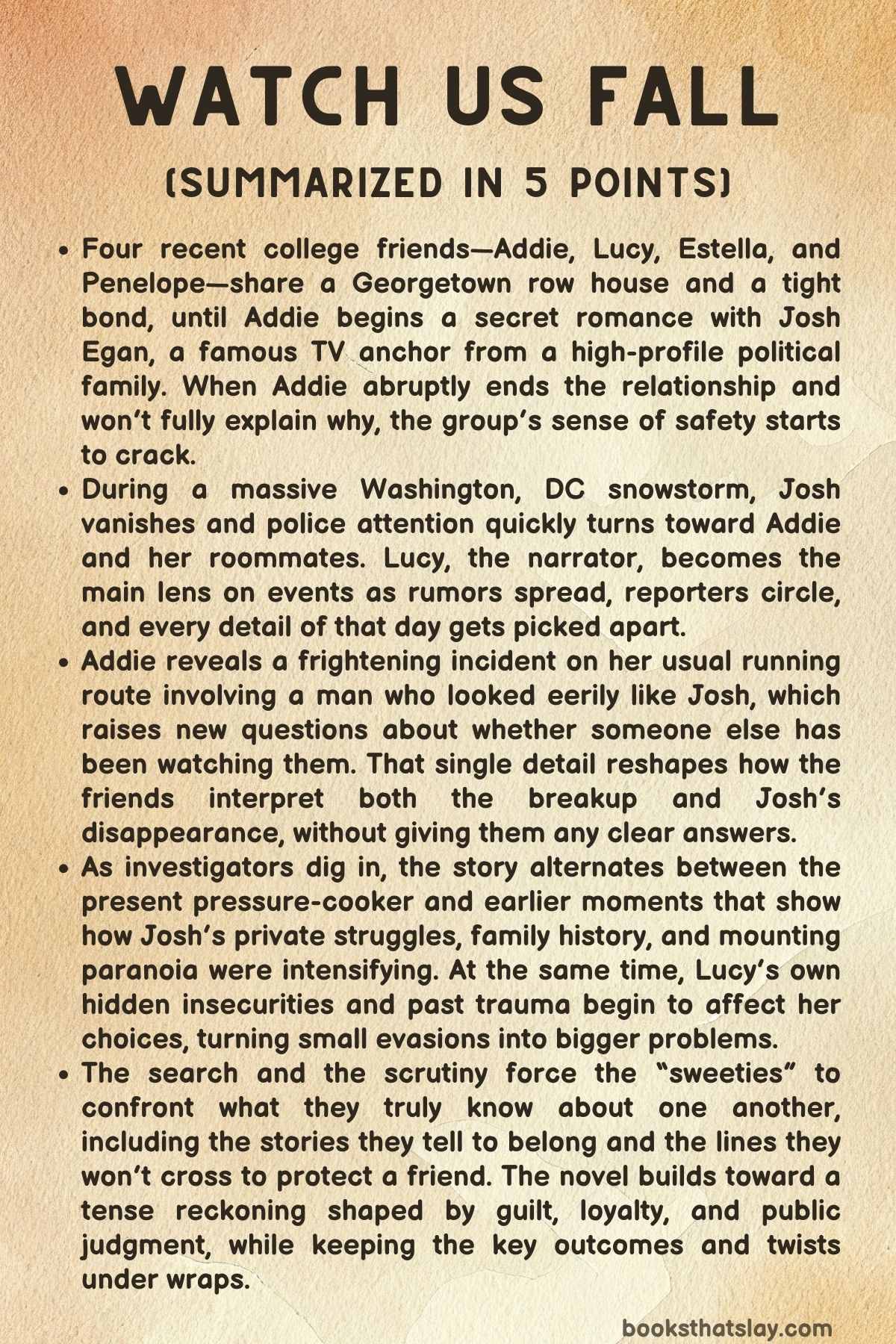
Summary
Lucy Ambrose begins by admitting that people still talk about what happened to Addie James and Josh Egan, and that she was close enough to catch fragments of the truth. Lucy and Addie were best friends, bound tightly to their other two housemates, Estella Warbler and Penelope Zamora.
The four women—who call themselves the sweeties—live together after college in a Victorian Georgetown row house, building an intense, shared life of routines, private jokes, and long-standing loyalty.
Over one summer, Addie starts disappearing for days at a time and returning radiant, refusing to explain where she has been. The others eventually learn the secret: Addie has been seeing Josh Egan, a well-known TV news anchor from a famous political family.
Addie didn’t tell them because she feared gossip and wasn’t sure the relationship mattered. Then, without warning, she ends it.
When Lucy presses for a reason, Addie says only that Josh frightened her in a way she never wants to experience again.
On January 20, the day a major snowstorm hits Washington, Josh disappears. That morning, Lucy wakes thrilled by the weather, but quickly notices odd details in the house.
Addie’s running shoes are gone early, and when Addie returns at 10:19 she locks the door with the deadbolt—something none of them usually do. Lucy sees a bruise blooming on Addie’s cheek.
Addie rushes upstairs, and Lucy follows her to the bathroom, where Addie is running water into the tub. Her track jacket is soaked in pinkish water, stained with blood.
Addie insists the blood is not hers, then breaks down sobbing, which is out of character for her. Lucy helps her rinse and wash the jacket properly, and pushes for an explanation.
Addie describes her morning run along the C&O Canal towpath, usually a familiar and safe place. Near the boathouse, she noticed a man sitting on a hill who seemed familiar.
As the sky darkened and the storm built, she turned back. Near a hidden cut-through to a private riverside spot the sweeties have used for years, the man sprang from the brush and grabbed her wrist.
Addie believed he was trying to drag her away. She fought back and struck him hard, making his nose bleed heavily.
She refuses to call the police, desperate to forget the entire encounter, but Lucy is alarmed, worried the attacker might have followed her and learned where they live. Lucy asks what he looked like.
Addie, shaking, says the man resembled Josh so strongly that for a moment she thought it was him.
That detail sticks to Lucy’s mind, especially because Addie once brought Josh to the sweeties’ hidden cove. Lucy remembers their freshman year and how Addie led them there and saved Lucy from drowning, cementing the bond between them.
The day continues under worsening snow. Lucy goes to her job at Andrew Lee Strategies, a political messaging firm, where she works as an opposition researcher while spiraling internally about Addie, Josh, and the attack.
She searches Josh online and finds unusually little public record for someone so visible, but she does find a private group photo captioned “Egan’s Artwork” that shows a hole punched into a newsroom wall. It suggests a temper that matches Addie’s vague fear.
That night, despite the storm, Estella throws a party at the row house. The sweeties get tipsy, climb onto the snow-covered roof, and dance and howl into the night, trying to feel invincible again.
The mood ruptures when Henry, Estella’s hookup, announces a detective is downstairs asking about Josh. Detective Rayne Kelley explains that Josh failed to show up for his afternoon news anchor shift, cannot be reached, and his network requested a welfare check.
Josh’s car is still in his garage, and the concierge suggested he might be with Addie. Addie says they broke up a week ago.
Kelley questions Addie in private while the party collapses into awkward chaos. A guest posts a photo of Addie being questioned, feeding rumors.
A fight breaks out, and Henry smashes the guest’s phone with a shovel. Kelley leaves disgusted by the spectacle.
Near midnight, Addie insists on going to Josh’s Foggy Bottom penthouse to check on him. Lucy goes with her.
Estella drives through heavy snow while Penelope comes along. Inside Josh’s condo, everything is dark and empty.
Lucy notices an official portrait of Josh’s father, Senator Elliott Egan, hidden in a closet. In another room, Lucy finds the floor littered with ripped campaign materials, an empty whiskey bottle, and torn memorabilia from the senator’s career.
Addie explains that Josh had been unraveling. She spoke to Marcus, a producer friend, who said Josh had been acting strangely for days—threatening calls, late arrivals, missed meetings, erratic behavior.
Pressed for why she ended things, Addie describes a fight where Josh demanded she move in immediately. When she hesitated, he accused her of choosing her friends over him and began insisting on bizarre claims about them.
He insisted that if Addie loved him, she would believe him. He punched a wall, chased her toward the elevator, and ranted about lies.
Addie reveals the person he targeted most wasn’t Estella or Penelope. It was Lucy.
Josh told Addie that Lucy’s mother was dead.
Lucy is furious and insists her mother is not dead. But the accusation hits a nerve because Lucy has lied before—about her background, about her family’s wealth, about details that made her seem more impressive and secure than she felt.
She admits that before college she embellished her life while texting her future roommates, and the lie grew until it felt impossible to correct.
The next morning, an elderly neighbor tells Lucy she saw Josh outside the row house the night before, staring up at Addie’s windows. Lucy rushes inside, thinking it proves Josh is alive and the mystery will resolve.
Instead, tensions inside the house sharpen. Estella and Penelope notice Lucy’s frantic energy and suspect she has taken medication from Estella’s cabinet.
Lucy tries to open up, beginning to explain why she fears closets, and drifts into childhood memories of her father leaving and returning, of police involvement, and of a terrifying moment when her father hid inside a closet and was discovered during a confrontation.
As the city shuts down and rumors spread, Lucy goes to see her boyfriend, Connor, who co-owns a coffee shop near the canal. Connor is caring but alarmed that Lucy has kept Josh’s disappearance from him.
Soon Nikki Banks, a former friend of Estella’s who now works for a columnist, arrives and hints the story is already circulating online: Addie’s missing boyfriend, the police questioning, the party photo, and whispers of intimidation. Lucy tries to downplay it, but the world is already forming its own version of events.
The narration briefly shifts to Josh’s perspective months earlier, showing his obsession with Addie and the odd mix of loneliness and entitlement that shapes him. He notices her running schedule, seeks her out, and starts dating her.
When he meets the roommates, Lucy tells a dramatic story about a Georgia barrier island and her family’s supposed property. Josh quietly clocks inconsistencies and becomes fixated on what Lucy is hiding.
In the present, police go public: a Washington Post alert announces Josh Egan is missing. Surveillance footage shows Josh walking toward Rock Creek Park.
Addie meets Detective Kelley and reports the towpath attack, including the resemblance to Josh. A composite sketch is produced that looks like a younger, darker-haired version of him.
More of Josh’s recent past comes into view. Anonymous calls have been leaving him tips that also contain intimate details about his childhood—details that trigger memories he didn’t know he had.
The caller mentions a woman from his father’s campaign, Claire Ryan, and suggests his father’s public image hid serious cruelty. Josh’s stress escalates, and he dismantles his tip line, desperate to control the intrusion.
Eventually, he drives to confront Claire Ryan, only to meet the caller: a tall young man who resembles him. Josh realizes the caller is his half brother, Leo Ryan.
Back in the present, new garage footage shows Josh arriving at his condo the Friday night before he vanished with an unidentified tall man in flannel and a cap. Addie is certain it’s the same man who attacked her.
She calls Detective Kelley. Meanwhile, an internet sleuth named Rachel Babbitt appears at the row house with a following and a tablet full of candid photos of Josh around the city, pushing Lucy and Addie to study them for clues.
They reject her help, but her presence makes it clear the case is no longer private.
As volunteer searches intensify, Josh’s friend Marcus arrives looking shaken and says searchers found someone in the woods near the river, close to the boathouse. The narrative then returns to Josh’s last day through his therapy session.
Josh admits he tried to warn Addie about Lucy, believing Lucy was lying about her identity. His therapist challenges his belief that love should mean accepting his version of reality.
Josh realizes his rage during the breakup felt like becoming his father.
That Friday evening, Josh meets Leo and brings him to the condo to look through their father’s belongings. Leo is hungry for proof, for objects, for power.
He takes items, drinks Josh’s whiskey, and speaks with a rough, cynical bluntness. Josh is unsettled by Leo’s temper and worldview, but still feels pulled toward him by shared blood and shared damage.
When the body is found, Lucy follows Addie into the snowy park. Addie climbs a tree to watch activity near the boathouse, desperate to see without being seen.
Lucy scouts closer, slips past tape, and overhears investigators debating whether Josh suffered hypothermia and whether a bruise above his ear came from a fall or a blow. Lucy sees Josh’s body curled against a tree, snow on his clothes, his watch visible.
She cries out and is grabbed by police. Detective Kelley warns her not to lie and not to repeat what she overheard.
Lucy finds Addie again and tells her about the bruise and the investigators’ uncertainty. Addie becomes intensely focused on details and orders Lucy to go home and tell the others she is fine.
Lucy returns to the house in shock and then to Connor, who comforts her. That night Lucy searches for Addie again and waits near the canal, watching lights and hearing generators from where police continue working.
Addie finally returns before dawn, cold and shaken, admitting she hid nearby while police worked. She tells Lucy she had sensed for days that Josh was gone, even while denying it aloud.
She believes the towpath attacker is responsible.
Soon, new pressure arrives. A reporter has surveillance footage of a frightening elevator confrontation between Josh and Addie, suggesting abuse and raising public suspicion that Addie may have defended herself.
Estella admits she lied to investigators about her whereabouts during the snowstorm, weakening Addie’s alibi. Lucy becomes determined to expose Leo Ryan as the attacker and killer.
Lucy contacts Leo through Instagram, and he invites her over, asking her to bring Addie. Lucy goes alone.
Leo insists he only wanted to talk to Addie and claims he did not attack her. He reveals he is Josh’s half brother and admits he spoke with Detective Kelley as next of kin.
Then he drops a terrifying detail: the footprint at the scene didn’t match his large boot, and police are looking for a smaller shoe—possibly Addie’s. Leo suggests only one person could have lured Josh into the woods, implying Addie, and Lucy leaves in panic.
Unable to reach Addie because her phone is broken, Lucy drives to Addie’s parents’ house at night. Addie appears briefly at an upstairs window but refuses to come out.
Lucy then goes to the towpath clearing and sees that police took a plaster cast of a boot print. She recognizes the tread as Moncler—boots Addie once gave Lucy.
She places her own boot into the print and realizes it matches.
The story finally breaks open. In Josh’s last hours, a caller claims Lucy killed her parents.
Then Lucy remembers the snowstorm day in full: Josh called her repeatedly and demanded a meeting at the boathouse. Lucy went, believing he had hurt Addie.
In the woods, they argued. Josh accused her of murdering her parents based on the caller’s story.
When Josh stepped toward her with his hand out, Lucy panicked, climbed up, and kicked him. The kick struck his chest.
He fell and hit his head. Lucy heard him groan and assumed he was fine, then ran away.
Josh, dazed and bleeding, tried to follow but collapsed in the snow and died as the storm buried him.
Lucy returns to the house in shock and tries to get rid of the boots and her mother’s letters. Penelope and Estella catch her.
The letters reveal Lucy’s mother is missing, not dead, and that Lucy has been living inside a web of half-truths shaped by fear and unfinished history. Lucy starts to flee, but Penelope pushes her to stay and get help, recognizing Lucy’s unraveling as more than simple guilt.
Lucy realizes Addie has Josh’s phone and would see call records proving Josh contacted Lucy that day. Lucy texts Josh’s number and Addie replies.
They meet near the courthouse. Lucy confesses everything: the meeting, the argument, the kick, and her flight.
Addie admits she already suspected from the phone and is torn between grief for Josh and love for Lucy. She says police are asking about the boots and she has hired a lawyer to buy time.
Lucy urges Addie to leave before police arrive and to go tell Connor. Then Lucy calls Detective Kelley and offers the truth.
When Kelley arrives, Lucy hands over Josh’s phone and identifies herself as the person they have been looking for.
In the aftermath, Lucy describes being confined in an institution or controlled setting, haunted by memory and by the moment everything tipped. She clings to a final mental image of the four friends together on the rooftop during the storm—dancing, shouting into the night, still believing their world could never split apart.
Characters
Lucy Ambrose
Lucy is the story’s self-appointed witness and eventual confessor, someone who builds her identity out of observation, narrative control, and strategic omissions until the pressure of Josh’s disappearance collapses the distance between “watching” and doing. In Watch Us Fall she reads people sharply—especially Addie, whose composure Lucy both admires and relies on—but Lucy’s insight is compromised by her need to manage how others see her.
The small lie about her father owning beach resorts is not just a social fib; it becomes a structural crack that Josh pries at, and it foreshadows how Lucy treats truth as something adjustable when belonging is at stake. Her childhood trauma around her father’s return and the closet is the book’s emotional engine for her panic responses: when Josh corners her with accusations about her past, Lucy reacts with the instincts of a threatened child rather than an adult who can pause, verify, and de-escalate.
The tragedy is that Lucy’s protective loyalty turns violent in the exact way she fears—an impulsive kick, a flight response, a denial that “it counts” because she didn’t intend it—until the evidence, the boots, and Josh’s phone force her to choose between self-preservation and responsibility. By the end, Lucy’s surrender is not framed as heroic redemption so much as the first honest act she can no longer avoid, and her final dream of the rooftop is a portrait of grief for the version of friendship that existed before she tried to control the story.
Addie James
Addie is the gravitational center of the group—competent, disciplined, and emotionally contained—whose steadiness gives the others a home base and, ironically, makes it easier for them to miss when she is in real danger. Her running life is not just a hobby but an identity that signals control and forward motion, which is why the towpath assault and the pink-tinged jacket land as a violation of her core self.
Addie’s relationship with Josh begins as something private and self-owned, a rare pocket where she doesn’t have to perform for her friends’ expectations, but it becomes another arena where other people’s stories and power press in: Josh’s celebrity, his family legacy, the network’s machinery, and the anonymous caller’s destabilizing revelations. When she breaks up with him, it’s not because she stops loving him but because she recognizes coercion—the demand that love equals belief, the insistence that she choose him over her support system, the way he rewrites reality and tries to enlist her as a witness against Lucy.
After Josh dies, Addie’s control becomes a survival strategy; she turns into someone who watches investigators, hires a lawyer, withholds feelings, and tries to stay upright long enough to make decisions. Yet her devotion to Lucy doesn’t disappear—she reads the call history, suspects the truth, and still shows up to hear the confession—making her one of the book’s most complex moral figures: a person balancing love, betrayal, and the dead weight of public scrutiny.
Addie’s final movement—running from the meeting, running toward the next impossible conversation with Connor—feels consistent with who she is: someone who keeps moving because stopping would mean collapsing.
Estella Warbler
Estella is charisma and volatility braided together, the roommate most likely to convert stress into spectacle, whether that’s throwing a “Danger Punch” party in a blizzard or dragging the sweeties onto the roof to howl at the storm. She performs confidence, but Watch Us Fall repeatedly reveals that she uses performance as a shield against shame, uncertainty, and the fear of being irrelevant within her own friend group.
Her loyalty is real—she shows up, she drives, she escalates to protect her people—but it expresses itself in impulsive, messy ways that create collateral damage, like the party that invites gossip and the chain of events that leads to police attention and online scrutiny. Estella’s most consequential trait is her willingness to lie when cornered, not out of cruelty but out of panic; admitting she misrepresented Addie’s alibi exposes how fragile their shared story is and how a single “small” falsehood can become a weapon in someone else’s hands.
At the same time, Estella is perceptive in the way social animals are perceptive: she spots shifts in energy, senses when Lucy is spiraling, and later becomes the person who physically moves to warn Addie about the elevator footage. Estella embodies the book’s theme that friendship can be fierce and sincere while still being unreliable—because love doesn’t automatically make you careful.
Penelope Zamora
Penelope is the group’s quiet ballast—practical, ethically oriented, and trained by her hospital work to notice what others dismiss as mood or drama. She is the character most consistently trying to move from adrenaline to care, from rumor to reality, which makes her feel almost like the moral nervous system of the sweeties.
She listens when Lucy begins to open the door to her childhood trauma and refuses the easy minimization that Lucy reaches for, insisting that pain matters even when the worst outcome didn’t fully happen. After Josh’s body is found and Lucy’s behavior grows erratic, Penelope reframes the situation through a mental-health lens rather than a scandal lens; she doesn’t deny accountability, but she recognizes dissociation, repetition compulsion, and how old fear can hijack present choices.
Her decision to persuade Lucy not to flee is one of the book’s most quietly powerful interventions, because it forces the story away from a clean “monster” narrative and into a messier truth about a damaged person who did something catastrophic. Penelope also functions as the friend who can love someone without romanticizing them: she is capable of tenderness while holding boundaries, which is why she can be both a comfort and an uncomfortable mirror.
If the sweeties are a system, Penelope is the one trying to keep it from becoming a machine that grinds its members into secrets.
Josh Egan
Josh is constructed as both dream and warning: the glamorous public figure whose private life is corroded by inheritance, surveillance, and a creeping sense that his identity is built on lies he did not choose. His charm and sincerity with Addie are not presented as fake—he is moved by her steadiness, hungry for real intimacy, and genuinely terrified of turning into his father—but his love quickly develops a controlling edge when fear takes over.
The anonymous caller and the resurfacing memories turn Josh into a man living inside an unraveling narrative, and he tries to stabilize himself by finding a single “true” axis: if Lucy is lying, then the world makes sense again; if Addie believes him, then love can save him. That is why his demand that love equals belief is so revealing—Josh is not asking for partnership, he is asking for certainty, and he escalates when he cannot get it.
His relationship with truth is also professional: as a journalist he lives on tips, sources, and stories, but here the story turns inward and begins consuming him, pulling him toward paranoia and obsession. The half-brother revelation doesn’t liberate him; it deepens the sense that he is replaceable, replicated, and haunted by the same face in a younger man.
By the time he confronts Lucy, Josh is both victim and provocateur—accusing her of murdering her parents, pushing the sharpest blade into her deepest wound—until the encounter ends in the fatal moment that feels horrifying precisely because it is so small and human: a panic kick, a fall, a storm that doesn’t care. Josh’s death is the book’s pivot from mystery to moral reckoning, turning the question from “who did it” into “how did all of you become capable of this.”
Detective Rayne Kelley
Detective Kelley operates as the hard edge of reality cutting through the sweeties’ insulated world, and her presence forces the housemates to understand that their private loyalties are now evidence. She is skeptical of their dynamics—of parties, secrets, half-truths, and social-media spectacle—and she treats the case with a professional suspicion that can feel harsh but is grounded in pattern recognition: missing partner, inconsistent timelines, public pressure, and friends who protect each other first.
Kelley’s disgust when the party devolves into chaos signals that she sees not just immaturity but obstruction, a group more concerned with narrative management than accountability. Later, when Lucy trespasses at the scene, Kelley’s anger becomes partly procedural and partly psychological; she recognizes that Lucy’s need to insert herself is dangerous, and she uses the threat of jail as leverage to stop Lucy from contaminating the investigation further.
Kelley also functions as a conduit for the book’s institutional power—what the police know, what they withhold, how they pressure witnesses—creating a constant tension between truth and strategy. Even when Kelley’s methods feel intimidating, her role clarifies the stakes: this is no longer a story the sweeties can curate.
Detective Doylan
Detective Doylan is the sharper interrogator energy that amplifies the sense of being cornered, especially for Lucy, whose nervousness reads like guilt long before guilt is established. He presses on timelines, contradictions, and the possibility that the roommates are covering for Addie, and his confrontations at the crime scene escalate Lucy’s fear into crisis.
Doylan’s function is less about personal backstory and more about pressure: he represents how an investigation can become a psychological vise, making already-fractured people more likely to make catastrophic choices. His interactions also expose how easily suspicion spreads when a group is secretive; the sweeties’ closeness, which once made them safe, becomes a reason to doubt them.
Doylan’s presence helps the reader feel the claustrophobia of being watched, judged, and parsed for inconsistencies—the exact sensation that drives Lucy toward both confession and collapse.
Connor
Connor is the nearest thing the book offers to uncomplicated warmth, but his role is not to be naïve; it is to represent a life Lucy might have had if she didn’t keep building herself out of secrets. He meets Lucy with steadiness—coffee shop routines, public affection, a willingness to cover her shift because he loves her—yet he also becomes increasingly alarmed when he realizes she is withholding major information.
Connor’s love is grounded in action rather than story, which contrasts with Lucy’s tendency to narrate herself into safety. The fact that Lucy keeps him partially outside the crisis underscores her compartmentalization: she wants refuge, not accountability, and Connor cannot be both if he knows the truth.
As the situation worsens, Connor becomes the person Addie needs to be told, a moral touchstone that forces Lucy and Addie to acknowledge the real-world blast radius beyond their house. Connor is important because he shows that Lucy is capable of being loved without performance—she just doesn’t fully believe it.
Henry
Henry enters as Estella’s hookup and becomes an agent of escalation, the kind of person whose instinct is to act, dominate, and shut things down physically. Smashing Kevin’s phone with a shovel is protective on the surface—an attempt to stop exploitation—but it also feeds the narrative of intimidation that outsiders quickly attach to the sweeties.
Henry’s energy around the helicopter and “where the action is” reveals a thrill-seeking streak that clashes with Addie’s fear and makes the group’s public footprint messier at the worst moment. He isn’t positioned as the central villain; rather, he is a catalyst, someone whose blunt force approach turns tense situations into combustible ones.
In a story about watching and being watched, Henry is the character who forgets that every action is a signal, and those signals can be used against the people he thinks he is helping.
Marcus
Marcus functions as Josh’s professional tether and as the bridge between Josh’s public life and his unraveling private reality. He is the one who confirms that the newsroom had been worried—threatening calls, behavioral changes, missed meetings—validating that something was wrong beyond romantic drama.
When he arrives devastated with the news that a body has likely been found, Marcus becomes the messenger of irreversible reality, the moment when hope collapses into grief. He also embodies the limits of proximity: he knows Josh intimately in one context, but he cannot prevent Josh’s descent or protect him from the forces pulling at him.
Marcus’s role intensifies the tragedy because it reminds us Josh was surrounded by people and still utterly alone in the part of his life that mattered most.
Leo Ryan
Leo is the book’s most overtly menacing presence because he combines genuine vulnerability with opportunism and coercion. As Josh’s newly revealed half brother, he carries the raw pain of exclusion and poverty alongside a hunger for access—access to Josh’s wealth, to the father’s artifacts, to the power that was denied to him.
Leo’s resemblance to Josh weaponizes identity itself, turning the idea of “seeing” into a trap: a familiar face that is not the same person, a look-alike who can haunt Addie on the towpath and appear in surveillance footage like a ghost. His interaction with Lucy is a study in manipulation; he offers information, feigns innocence, then pivots to intimidation when she tries to leave, and he frames the crime in a way that points the finger toward Addie while also implying he knows how to pull strings through his contact with Kelley.
Leo’s fixation on objects—the portrait, knives, pins, whiskey—feels like an attempt to claim lineage through possessions, as if ownership can rewrite history. Even when he is not the direct cause of Josh’s death, his role is corrosive: he amplifies paranoia, feeds the investigation’s suspicion, and destabilizes every fragile alliance the sweeties have left.
Senator Elliott Egan
Though absent in the present, Senator Elliott Egan dominates the story as an inherited violence that refuses to stay buried. He is remembered as brilliant and legendary in public life, but privately he is associated with cruelty, choking women, and the creation of false narratives to protect power.
Elliott’s shadow explains Josh’s deepest fear—that he will become his father when anger takes over—and it clarifies why Josh treats lies as existential threats rather than social imperfections. The portrait hidden in the closet becomes a visual metaphor for how the family legacy is both enormous and shoved out of sight, an object too heavy to display but too significant to discard.
Elliott also connects the personal to the political: the machinery of campaigns, secrets, coded names like “Odysseus,” and the way institutions can smooth over catastrophe with a public story. Elliott is less a character in scenes and more a force that scripts everyone else’s trauma.
Dr. Mantel
Dr. Mantel serves as the rare voice trying to separate emotion from compulsion, especially for Josh, who confuses love with belief and belief with safety. Through therapy sessions, Dr. Mantel challenges the logic that if someone loves you they must accept your version of reality, and that challenge lands as both clinical and profoundly moral.
The therapist’s role reveals that Josh is not simply an abuser-in-waiting or a victim-in-waiting; he is a person at a crossroads, aware of his temper, afraid of inheritance, and desperate for a different self. Dr. Mantel also highlights the story’s theme of memory—how it returns in fragments, how it can be manipulated, and how confronting it can either heal or destabilize.
Even though therapy does not save Josh, it gives the reader a clearer map of the internal struggle that fuels his worst moments.
Nikki Banks
Nikki functions as the social and media ecosystem personified—someone who turns private crisis into public currency and treats rumors as leverage. Her entrance with Baxter into Connor’s shop is a reminder that the sweeties’ insulation is an illusion; the city is watching, people are talking, and narratives are forming faster than facts.
Nikki’s history with Estella adds an extra sting because she isn’t just a random gossip; she’s someone near enough to know where to poke and far enough to enjoy the fallout. She pressures Lucy by implying that secrecy equals guilt, and she represents the kind of suspicion that thrives in the absence of truth.
Nikki isn’t the cause of tragedy, but she is part of how tragedy spreads—how grief becomes spectacle and how fear becomes content.
Rachel Babbitt
Rachel Babbitt is the internet’s appetite given a face: eager, intrusive, self-important, and convinced that attention equals expertise. Her wall of candid Josh photos is chilling not because it is illegal in a clear-cut way, but because it shows how thoroughly a person can be consumed by public documentation without consent.
Rachel frames herself as helpful, but her “help” is extraction—pulling reactions, harvesting details, trying to turn Addie and Lucy into sources for her audience. She embodies the story’s core irony: everyone is watching Josh, watching Addie, watching the sweeties, and that watching is treated as participation, even morality.
Rachel’s presence raises the stakes for Addie’s need to remain unseen and intensifies Lucy’s sense that the world is closing in, not just through police but through strangers with cameras.
Kevin
Kevin is a minor character whose actions create outsized consequences, illustrating how one opportunistic post can detonate a fragile situation. By photographing Addie being questioned and blasting it online with hashtags, he turns a welfare check and early investigation into public entertainment and accelerates rumor formation.
Kevin’s behavior shows how quickly empathy collapses when proximity to fame is involved; Josh’s celebrity becomes a magnet that attracts people willing to trade basic decency for clicks. His conflict with Henry also marks the moment when the sweeties’ private world becomes unmanageable, because once the image is out, they are no longer people in crisis—they are characters in someone else’s story.
Mrs. Dalton
Mrs. Dalton, the elderly neighbor, plays the role of the ordinary witness whose small observation feels like a lifeline in the early stages of uncertainty. Her claim that Josh was outside staring up at Addie’s windows offers Lucy a burst of hope and a simple narrative—Josh is alive, the mystery can be solved—that Lucy desperately wants to believe.
At the same time, the neighbor’s presence underscores a theme of surveillance that isn’t only digital or institutional; communities watch each other, notice patterns, and talk. Mrs. Dalton’s information doesn’t resolve the case, but it shows how the sweeties’ lives are visible in ways they don’t account for.
Lena
Lena represents formal media’s version of the same hunger that Rachel embodies online, but with more legitimacy and sharper stakes. By possessing surveillance footage of Josh and Addie’s elevator confrontation and pursuing Addie for comment, Lena threatens to convert a private moment of fear into a public narrative about abuse, culpability, and motive.
Her questions force Estella and Lucy to confront how easily Addie can be reframed as suspect in the court of public opinion, especially when the footage looks bad and the victim is famous. Lena’s presence clarifies that truth in Watch Us Fall is not only what happened, but what can be shown, edited, aired, and believed.
Dr. James
Addie’s mother, Dr. James, appears as a gatekeeper figure, someone who responds to danger by controlling access and closing ranks around her daughter. Her cold refusal at the door communicates both protection and suspicion: she is shielding Addie from reporters and chaos, but she is also making it clear that the sweeties no longer automatically qualify as safe.
Dr. James’s role emphasizes that after trauma, the circle of trust narrows, and even lifelong friendships can be treated as threats. She stands for a different kind of power than Josh’s political legacy—professional, maternal, private—and her presence reinforces how the crisis fractures every relationship around Addie.
Sheriff Ed Brown
Sheriff Ed Brown exists in Lucy’s backstory as a figure tied to the original wound: the moment her father returns, the police are called, and authority enters the home. He becomes part of the architecture of Lucy’s memory and the “deal” that later surfaces around her mother’s letters, suggesting that Lucy’s family trauma was never cleanly resolved and may have been managed through silence, discretion, or informal arrangements.
Ed Brown symbolizes how institutions can be both protective and complicit, and how a child can grow into adulthood carrying a story that was never fully spoken aloud. His shadow matters because it explains why Lucy’s instinct under threat is not to seek help, but to hide evidence, run, and control the narrative—habits learned long before Josh ever entered the picture.
Themes
Friendship as refuge and pressure
Life inside the Georgetown row house runs on shared rituals, private jokes, and the reassurance that someone is always nearby. The “sweeties” treat friendship as a chosen family, especially in a city that rewards image and connections.
That closeness gives each of them a place to land—Addie comes home glowing after disappearing, Lucy writes letters on Estella’s stationery like she belongs to something stable, and Penelope and Estella assume the role of watchful guardians when someone seems off. The same closeness also turns into a system of expectations.
People begin to measure loyalty through what is shared and what is withheld, and silence becomes a kind of currency. Addie hides Josh at first because she wants something untouched by gossip, but secrecy in a tight group reads as betrayal.
Lucy’s fear of losing her place in the foursome feeds her habit of shaping stories to fit what she thinks her friends want to hear, even when she hates herself for it. When crisis hits, the group’s protective instinct becomes controlling: they police each other’s behavior, question sobriety, and decide what “help” should look like.
Even love outside the group gets interpreted through that lens. Connor’s steady care is real, but Lucy treats it like a secondary obligation compared to Addie’s unraveling, as if choosing the relationship would mean abandoning the group.
The story keeps returning to how friendship can be both shelter and surveillance, a support network that also magnifies shame. In the end, the memory Lucy clings to is not a romance or a career victory, but the rooftop moment when the four of them felt invincible—because that feeling is the purest version of safety she knows, even though it was already fragile.
Trauma repetition and the body as a memory vault
Lucy’s present-day reactions are constantly shaped by what she cannot fully speak about. Her fear of closets, her jittery urgency, and her tendency to downplay what happened in childhood all show trauma operating like a reflex rather than a narrative.
She insists some things “never fully happened,” yet her body behaves as if they did. That tension becomes important because the plot keeps placing Lucy in situations that echo the original wound: a hidden man in a closet becomes hidden threats in the row house, a childhood terror becomes adult hypervigilance, and the urge to control danger becomes a compulsion to insert herself into the investigation.
Penelope’s concern introduces a clear idea: unresolved trauma can make a person recreate the emotional shape of the past, not because they want pain, but because the nervous system recognizes the pattern and mistakes it for familiarity. Addie’s relationship with running also fits this theme.
Her runs are discipline, escape, identity, and solitude; they make her feel safe until the towpath becomes the site of an attack. Once that happens, the thing that regulated her life becomes contaminated.
Josh’s trauma is different but equally bodily. The anonymous caller’s details unlock memories that hit him like an ambush, and his anxiety shows up through insomnia, rage, and impulsive decisions.
He tries therapy daily, not as a gentle self-improvement project but as emergency stabilization. The book treats trauma as something that lives in sensory fragments—bruises, water turning pink, boot prints in thawing snow, an elevator camera capturing fear.
Lucy’s defining act is also a trauma act: she kicks Josh in a moment of panic when confrontation and accusation collapse into a threat, and her nervous system chooses escape over judgment. The aftermath shows how trauma distorts time and morality; she can’t hold the consequences in her mind until the world forces them into view.
Even the final image she clings to—friends on a roof, music, cold air—reads like an attempt to return to a moment before her body learned that safety can vanish without warning.
Power, fame, and the violence hidden inside prestige
The Egan name carries political legacy, money, and influence, and that influence shapes every response to Josh’s disappearance. His network’s concern, the immediate police attention, the public hunger for updates, and the media’s framing all reflect a hierarchy of whose lives become headline events.
Josh himself benefits from prestige while also being trapped by it. Viewers treat him like a possession, and his career encourages a sense that he is always being watched, evaluated, and interpreted.
The story shows how prestige can cover cruelty. Senator Elliott Egan’s public brilliance sits alongside private harm, and the family’s ability to control narratives teaches Josh that violence can be managed through optics.
That lesson shows up in Josh’s fear of becoming his father and in the way he tries to control Addie’s beliefs, as if shaping her perception can prevent disaster. Media culture in the book is not neutral; it is predatory.
A party photo becomes rumor fuel, an internet sleuth collects candid images like trophies, and a reporter pursues elevator footage as a neat story about abuse and self-defense. Addie’s grief and shock are treated as content, and the threat is not only legal but reputational, as if the wrong narrative could ruin her life even if she is innocent.
The investigation itself carries power dynamics: detectives pressure the roommates, threaten jail, and demand “straight answers,” while also withholding key information and controlling what can be said publicly. Even in private spaces, power seeps in—Josh’s penthouse, his portrait of his father, the ripped campaign documents, and the whiskey all function like artifacts of a system where money and legacy sit beside damage.
The most unsettling point is that public power doesn’t prevent vulnerability; it often rearranges it. Josh can be protected and endangered at the same time, and the people around him become collateral in a fight over image.
The book argues, through events rather than slogans, that prestige is not the opposite of violence. It can be the packaging that lets violence survive.
Control, coercion, and the blurred line between love and possession
The romance between Addie and Josh begins with genuine tenderness and curiosity, but it shifts when Josh starts treating closeness as entitlement. His demand that Addie move in immediately is not presented as a simple desire for commitment; it becomes an ultimatum that narrows her choices.
When she hesitates, he attacks her judgment, isolates her from her friends psychologically, and tries to make her doubt her own perceptions. The manipulation is subtle in its structure even when it becomes loud in its expression.
He reframes normal boundaries as betrayal, and he reframes disagreement as evidence that she does not love him enough. That mindset peaks in his insistence that love and belief are the same thing—if she loves him, she must accept his claims, even when those claims are “obviously untrue” or unsupported.
That is coercion wearing the costume of intimacy. Addie’s response shows another side of control: her refusal to call the police after the towpath attack is a choice to reclaim agency, but it also increases danger because it leaves the threat unaddressed.
Lucy’s behavior sits uncomfortably in this theme too. She believes she is protecting Addie, but she also starts making decisions on Addie’s behalf—following her, inserting herself into private moments, searching Josh’s condo, crossing police tape.
The story keeps asking what protection looks like when fear is driving it, and how quickly it can become possession. Even Leo’s role is built on a distorted hunger for connection: he wants Josh not to leave, wants proximity to the life Josh represents, and speaks about manipulation as if it is normal strategy.
Control appears not only as overt aggression but as the belief that another person’s choices must be managed for the story to feel safe. In that sense, the central tragedy is not just the death but the chain reaction of control attempts—Josh trying to control Addie’s belief, Lucy trying to control the threat, the public trying to control the narrative, and investigators trying to control information.
Each attempt tightens the situation until one panicked moment becomes irreversible.
Guilt, accountability, and the hunger for a clean explanation
After Josh is found, everyone reaches for certainty because uncertainty is unbearable. Rumors push people toward simple villains and simple motives, and even the roommates begin to doubt each other because a clean explanation feels like relief.
Lucy’s guilt is layered: guilt for lying, guilt for not telling Connor, guilt for trespassing, guilt for focusing on being “right” about Leo, and finally guilt for the act that led to Josh’s death. The book shows how guilt can become self-centered without intending to be; Lucy’s desire for credit in identifying Leo is a small but revealing moment, because it shows her reaching for control through achievement even as grief is raw.
Addie’s guilt is different: she wonders whether breaking up and leaving made things worse, whether she abandoned someone who was unraveling, and whether her choices will be interpreted as violence against her. She also carries the private guilt of “knowing” Josh was gone before she admitted it, as if intuition itself is a betrayal.
The investigation pressures guilt into confession, but confession is complicated by trauma and by the fear of being consumed by public judgment. When Lucy eventually tells Addie and then turns herself in, the moment is not framed as moral triumph.
It is closer to surrender—accepting that living inside avoidance will destroy what remains of her life. Accountability in Watch Us Fall is not tidy.
Lucy did not wake up intending to kill, yet her action had lethal consequence, and her flight prolonged harm. The story forces the reader to sit with that complexity: intention matters, but outcome matters too, and fear does not erase responsibility.
At the same time, the book refuses to reduce Josh to a perfect victim. His accusations, his rage, and his coercive framing of love created danger even if he did not deserve death.
The hunger for a single clear explanation—online, in the media, even in the group—is portrayed as a coping mechanism that often creates new harm. The ending, where Lucy is haunted and clings to the rooftop memory, suggests that accountability can coexist with longing and grief, but it does not guarantee peace.