We Solve Murders Summary, Characters and Themes
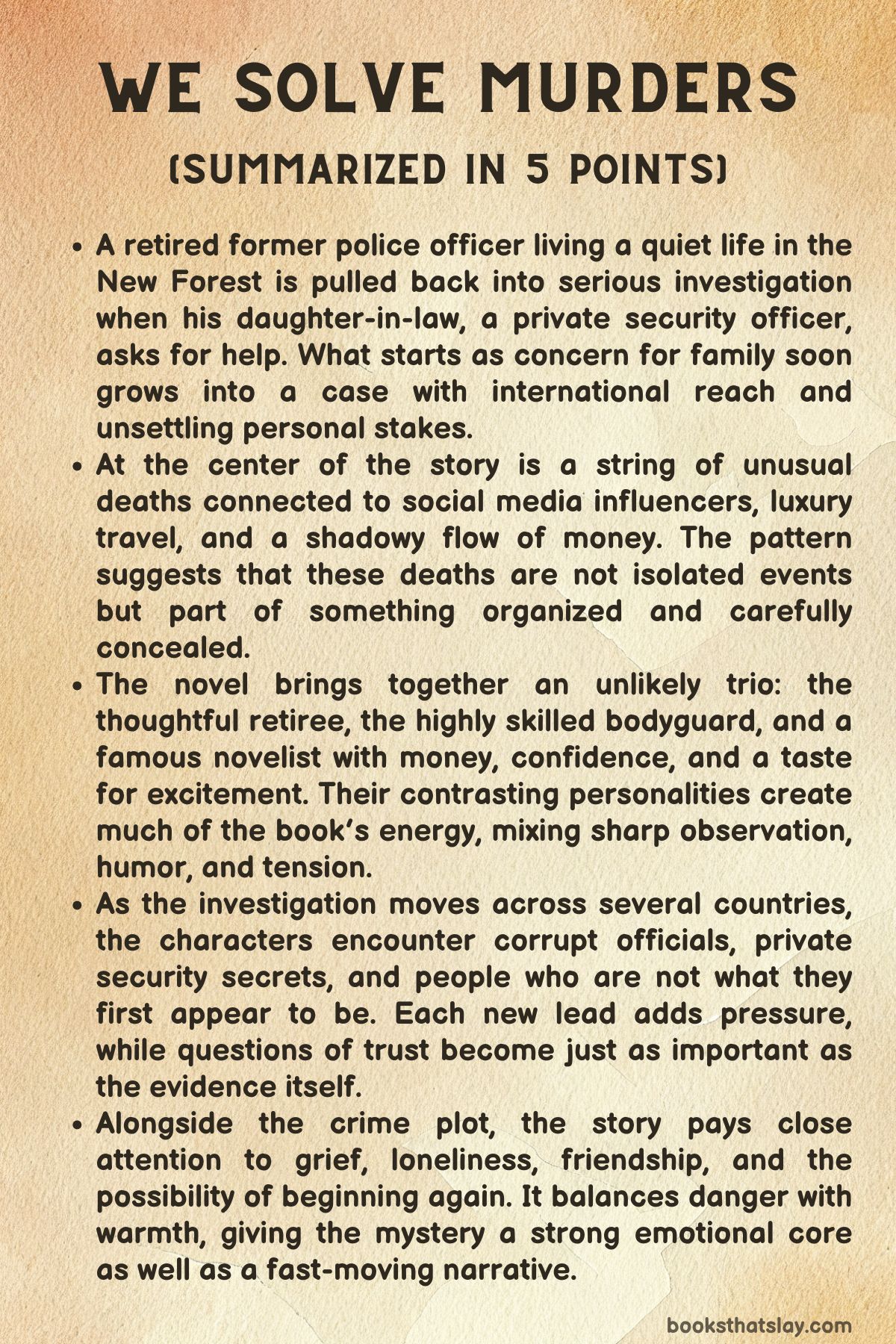
We Solve Murders by Richard Osman is a fast-moving crime novel that mixes danger, humor, and sharp character work. At its center is an unlikely investigative team: Steve Wheeler, a retired police officer who prefers quiet village routines; Amy Wheeler, his highly capable daughter-in-law who works in private security; and Rosie D’Antonio, a rich and famous novelist with a taste for excitement.
What begins as a string of strange influencer murders grows into an international case involving smuggling, hired killings, false leads, and hidden loyalties. The book stands out for its wit, its globe-hopping pace, and the warm, offbeat bond that forms between three very different people.
Summary
The story begins with a mystery surrounding a criminal mastermind known as François Loubet, a man famous for moving illegal money across borders while hiding behind false identities and polished manners. Around the same time, a number of social media influencers are murdered in highly theatrical ways.
Andrew Fairbanks is found dead after what looked like a glamorous promotional trip, and the scene around his body includes a large bag of cash. Other influencers have died just as strangely in different countries.
These killings appear flashy and public, but they are carefully planned, and someone wants a message sent.
Amy Wheeler is working as a bodyguard for Rosie D’Antonio, a successful novelist who is staying on her private island off the coast of South Carolina because of threats from a Russian oligarch offended by one of her books. Amy is smart, disciplined, and used to danger.
Rosie, by contrast, is impulsive, rich, funny, and easily bored by safety. Their uneasy routine changes when Amy realizes that the murdered influencers all had some connection to the security firm Maximum Impact Solutions, the company she works for.
More alarming still, Amy had been near each murder scene. That makes her look suspicious, and it also suggests that someone may be setting her up.
Back in the New Forest, Amy’s father-in-law Steve Wheeler is living a much smaller life. A retired Metropolitan Police officer, he now spends his days solving minor local problems, walking around the village with his Dictaphone, visiting the pub quiz, and quietly missing his late wife, Debbie.
Steve says he does not solve murders anymore, and he means it. But when Amy calls him in fear and asks him to come to the United States, he cannot refuse her.
Though he dislikes travel and values his routines, he boards a private plane and leaves home behind.
Before Steve arrives, Amy and Rosie learn that the danger around them is immediate. Kevin, a former Navy SEAL on the island, turns on Amy after being paid to kill her.
Rosie helps stop him, proving that beneath her glamorous exterior she has courage and quick instincts. Soon after, Amy and Rosie investigate a local sheriff who seems tied to the murder of Andrew Fairbanks.
They discover him dead in his home, then use his computer to uncover evidence that he was paid to carry out the killing and leave planted forensic clues. They also find stolen cash.
Someone shoots at them as they escape, confirming that the conspiracy is still active.
At the same time, trouble spreads inside Maximum Impact Solutions. Jeff Nolan, the company’s head, believes the killings are linked to François Loubet and to a person using the name Joe Blow.
Years earlier, someone from Jeff’s world made a quiet arrangement with Loubet to use minor influencers as money couriers. Fake brands and agency contracts were set up so that people hungry for fame would carry bags across borders without understanding what they were transporting.
When some couriers were caught, the relationship between the two criminal sides worsened. Now murders are being used both as punishment and as warning.
Jeff himself survives an assassination attempt, then disappears, making everyone around him more suspicious.
Steve reaches South Carolina and quickly shows that he has lost none of his investigative skill. He charms, confuses, and outsmarts officials until he gains access to airport footage that reveals a red-haired woman meeting Andrew Fairbanks and carrying the now-important leather holdall.
Steve joins Amy and Rosie, and the three begin to function as a team. Steve brings patience and observation.
Amy brings training and nerve. Rosie brings imagination, money, connections, and an ability to talk her way into almost anything.
Their partnership becomes the heart of the book.
The investigation takes them from South Carolina to St. Lucia, where another murdered influencer had been working. There they trace the pattern again: local help was hired, blood evidence was planted, and the same red-haired woman appears in the background.
Amy also learns that her blood samples from workplace drug testing had been stolen, which explains how someone could frame her for the murders. This discovery narrows the suspects to people inside her own company.
The danger rises because hired killers are now actively pursuing her across countries.
One of those killers is Eddie Flood, who is sent after Amy but proves stranger and less predictable than expected. He follows false trails, misses chances, and gradually becomes less threatening in the usual sense.
Another figure, Rob Kenna, acts as the broker who arranges murders for payment. He works from Dubai and treats killing as business.
The investigation also circles around Henk van Veen, Jeff’s former associate, and Max Highfield, an actor who recruited influencers into the system. Each man seems shady enough to be Joe Blow, and the case turns on working out who first connected Loubet to the courier scheme.
The search next leads to Ireland, where Mark Gooch was killed at a vineyard. Amy is nearly ambushed there, and tensions rise between her and the men around her.
Henk confronts the group and explains why he left Maximum Impact Solutions, believing corruption ran deeper than he could accept. Even with more information, no one can fully tell who is lying, who is guilty, and who is merely vain, greedy, or foolish.
That uncertainty gives the middle of the novel much of its energy. Amy is frightened but keeps going.
Steve admits he is always scared, which becomes one of the story’s most human notes: bravery here is not the absence of fear but the choice to move anyway.
Eventually the action returns briefly to England, where a pub quiz and village friendships become unexpectedly important to the case. Steve’s friends, especially Tony Taylor, help follow the trail through Vivid Viral Media Agency, the odd little business used as a front in the smuggling network.
Felicity Woollaston, the elderly woman whose name sits above the agency, turns out to know little about what has been done through her company, though she later makes morally uncertain choices of her own. The quiet English setting offers relief from the gunfire and chases, but it also becomes the place where hidden identities begin to crack.
The breakthrough comes when Steve realizes Jeff has faked his death in order to stay hidden and communicate safely. Jeff reappears, and arguments flare between him and Henk over who might be Joe Blow.
Meanwhile Amy, now under threat of arrest because of the planted blood evidence, goes underground while Steve and Rosie travel to Dubai. There, the remaining pieces finally start to fit.
Steve first suspects Max Highfield because the name Joe Blow appears in one of his old films, but this line of thought leads nowhere. Max is shallow and self-absorbed, yet not clever enough for the central role in the scheme.
The true revelation comes through Mickey Moody, a seemingly ordinary man in Dubai who plays golf with Rob Kenna and appears harmless. Steve notices tattoos referring to Mickey’s grandmothers, Lou and Bet, and understands that Mickey himself is François Loubet.
Beneath the bland exterior is the criminal mastermind everyone has been chasing. Rob Kenna then dies, shot in a moment that confirms Mickey has begun cleaning up loose ends.
Back in London, Amy and Jeff force a final truth from Susan Knox, the long-serving employee at Maximum Impact Solutions. Susan, not Jeff or Henk, was Joe Blow.
Financial trouble and greed drove her to build the courier arrangement with Loubet. She stole from the company, tried to replace the money through risky schemes, and when those failed, she crossed into larger crimes.
Amy’s shooting of Jeff had been a test to expose which of them Susan would try to protect. Susan chooses herself and reveals her guilt.
With Mickey and Susan exposed, the main conspiracy collapses. Some side threads resolve in comic and surprising ways.
Rosie discovers that the Russian oligarch who threatened her no longer wants her dead because of pressure from a relative who loves her books. Eddie Flood turns out to be less interested in murder than in having Rosie read the novel he has written.
Bonnie Gregor, one of the latest would-be influencer couriers, is saved before carrying out her trip, though the money tied to that job creates one last ethical gray area for those around her.
In the end, the surviving central trio return to Axley and sit on the bench dedicated to Debbie. Amy decides to leave Maximum Impact Solutions and start a new investigative business focused on unsolved murders.
Rosie offers major financial backing, and Steve is pulled, gently but firmly, into joining the venture. Though he resists at first because he loves his old life, he understands that this new partnership gives him purpose, companionship, and a future that Debbie would have wanted him to accept.
The novel closes with the promise of more cases ahead and with the team naming themselves We Solve Murders, a title that turns their strange journey into the start of something new.
Characters
Steve Wheeler
Steve Wheeler is the quiet center of the story, a man who seems to have stepped away from action but has never truly stopped being an investigator. He lives with habit, restraint, and grief.
His days in the New Forest are built around small routines, local errands, his pub quiz team, and recorded messages to his late wife, Debbie. At first glance, he appears to be a man who has deliberately chosen a smaller life after years of police work and personal loss.
Yet that retreat is not surrender. It is a form of self-preservation.
He has seen too much, loved deeply, and paid for both. His reluctance to “solve murders” is less a statement about ability than about emotional cost.
What makes Steve such a strong character is the gap between how he presents himself and who he really is. He talks like a modest village retiree, but he thinks like a first-rate detective.
He notices odd behavior, small inconsistencies, and patterns other people miss. He is patient where others are impulsive, and because he does not need to impress anyone, he becomes especially dangerous to liars.
His intelligence is practical rather than showy. He does not dominate a room through force.
He disarms people with politeness, understatement, and calm observation, then quietly moves closer to the truth.
Emotionally, Steve is defined by love and absence. Debbie remains central to his inner life, and his Dictaphone messages to her reveal the tenderness beneath his dry manner.
He is not a man who performs grief for others, but he carries it everywhere. That gives him depth and also explains much of his caution.
He is protective of routine because routine has helped him survive. The case forces him out of that safe structure and back into danger, but it also returns him to connection.
Through Amy and Rosie, Steve is drawn back into the world, and that journey matters as much as the criminal plot. He does not become a different person by the end.
He becomes more fully himself.
Steve’s relationship with Amy is one of the most revealing parts of his character. He struggles with his son Adam, but with Amy he shares trust, affection, and mutual respect.
She sees his strength clearly, even when he minimizes it. He, in turn, recognizes her competence and never reduces her to a role within the family.
Their bond gives the novel its emotional backbone. Steve also develops a warm, complicated connection with Rosie, who challenges his reserve and unsettles him in ways he does not entirely welcome.
Together, these relationships pull him from solitude toward a new future. By the end, Steve’s acceptance of a new investigative life feels earned because it is not built on ambition.
It is built on loyalty, usefulness, and the possibility that life after loss can still hold purpose.
Amy Wheeler
Amy Wheeler is the engine of the story. She is physically capable, mentally sharp, and emotionally guarded, a professional bodyguard who has built her life around control, preparedness, and survival.
From the start, she operates in a world where danger is routine and trust is limited. She is highly skilled at reading threats, making quick decisions, and keeping vulnerable people alive.
Yet the case places her in an unfamiliar position: instead of merely protecting someone else, she becomes both target and suspect. That shift brings out the complexity in her character.
Amy’s competence is never treated as a gimmick. She is not strong for decorative effect.
Her strength comes from training, instinct, discipline, and a life that has taught her not to depend on rescue. She thinks in terms of exits, weapons, angles, timing, and consequence.
Even when frightened, she keeps moving. One of the most effective things about her characterization is that fear is not removed from her.
She does not behave like someone untouched by danger. She behaves like someone who knows exactly how real danger is and acts anyway.
That makes her impressive without making her emotionally flat.
Beneath Amy’s hard exterior is a person shaped by pain, insecurity, and a very long habit of self-protection. She does not easily speak about her past, but moments in the story suggest a traumatic childhood and a lifetime of managing vulnerability through toughness.
She trusts very few people, and that reserve makes sense. As the case expands, she has to confront the possibility that someone inside her own professional world has betrayed her, used her blood to frame her, and set multiple deaths in motion around her.
That knowledge deepens her isolation. Even when surrounded by allies, she has reason to wonder who is lying.
Amy’s marriage to Adam is handled with realism. There is affection there, but also distance created by work, stress, and different emotional languages.
Her stronger bond with Steve is one of the book’s most interesting family dynamics. Steve gives her steadiness rather than pressure, and she gives him trust without sentimentality.
Rosie brings out a different side of Amy: irritation, amusement, protectiveness, and eventually real friendship. The contrast between Amy’s seriousness and Rosie’s theatrical style helps reveal how flexible Amy actually is.
She may prefer order, but she can adapt to chaos when she chooses.
By the end, Amy’s decision to leave her old firm and build something new is a powerful act of self-definition. She stops being a tool within someone else’s structure and becomes the author of her next life.
That choice fits her perfectly. She is not interested in retirement, safety, or respectability for its own sake.
She wants meaningful work, the freedom to make her own judgments, and a circle of people she can trust. Her arc is not about softening into helpless openness.
It is about learning that independence and connection do not have to cancel each other out.
Rosie D’Antonio
Rosie D’Antonio enters the story as a larger-than-life figure: rich, famous, witty, dramatic, and impossible to ignore. She is a bestselling novelist with a private island, celebrity instincts, and a taste for attention.
It would have been easy to make her a comic stereotype, but instead she becomes one of the most layered characters in the novel. Rosie is funny and flamboyant, but she is also observant, brave, lonely, and far more emotionally perceptive than people assume.
Rosie’s first function in the story is to disrupt seriousness. She talks too much, flirts too freely, and often seems to treat danger like material for a better anecdote.
Yet that surface performance conceals real intelligence. She reads people well, often understands the emotional truth of a room before others do, and knows how stories work.
Because she is a novelist, she is always alive to motive, vanity, weakness, and self-deception. That instinct makes her useful in an investigation, even if she does not think like a trained detective.
She can imagine what kind of person would lie in a given way, or what kind of ego would attach itself to a particular crime.
Rosie is also braver than her glamorous image suggests. She does not simply stand around while others act.
She knocks out Kevin when Amy is threatened, joins dangerous trips across countries, handles weapons when necessary, and repeatedly stays in situations where a more cautious person would leave. Her courage is not identical to Amy’s.
Amy is tactical and controlled; Rosie is emotional and impulsive. But that difference makes Rosie’s courage feel genuine rather than secondhand.
She is frightened by aging, powerlessness, and irrelevance, and she admits as much. That honesty adds dimension to her character.
A great deal of Rosie’s appeal lies in how she balances performance with sincerity. She enjoys attention, but she is not empty.
She can be ridiculous and moving within the same scene. Her flirtation with Steve, for example, begins as part amusement, part desire, part self-expression.
Over time, though, she also recognizes his grief and vulnerability and begins to pull back, not because she loses interest in him as a man, but because she gains respect for what he is carrying. That moment shows growth.
Rosie is capable of restraint, and the novel becomes stronger because she is allowed that maturity.
Her friendships are among the story’s richest elements. With Amy, Rosie forms an unlikely partnership built first on convenience, then on shared danger, and finally on trust.
She is one of the few people who can annoy Amy while still standing beside her. With Steve, she forms a bond shaped by attraction, affection, and mutual admiration.
She is never reduced to comic relief. By the end, her decision to invest in the new detective agency feels exactly right.
She wants adventure, certainly, but she also wants belonging and significance. Rosie’s gift is that she turns energy into loyalty.
She makes life louder, but she also makes it warmer.
Jeff Nolan
Jeff Nolan is one of the story’s most ambiguous figures for much of the plot. As the head of Maximum Impact Solutions, he stands close to the center of the conspiracy, and the narrative uses that position to make him suspicious without ever making him simple.
Jeff is forceful, secretive, and morally compromised in ways that feel plausible for a man running a high-risk security business. He recruits hard people, values aggression, and speaks in the language of control.
He also sees danger before others do and understands that the murders surrounding his company are not random. Because of this, he functions as both investigator and possible culprit.
Jeff’s greatest strength as a character is that he represents professional ruthlessness without becoming entirely inhuman. He has built a culture that rewards extreme traits, and his use of a so-called psychopath test reveals both his cynicism and his fascination with dangerous personalities.
He admires capability, but he also creates an environment in which ethics are easily bent. This makes him partially responsible for the conditions that allowed the conspiracy to grow, even if he is not its ultimate architect.
He lives in a world where intimidation, secrecy, and manipulation are normal management tools.
At the same time, Jeff is not simply a villain. He is genuinely alarmed by the killings, correctly senses the threat posed by Loubet, and tries to act, though often in ways that make him look guiltier.
His disappearance, his fake death, and his hidden communications all reflect a man trying to survive while surrounded by enemies. He is the kind of character whose instincts are sharp but whose methods make trust nearly impossible.
Amy cannot rely on him because even when he may be telling the truth, he behaves like someone trained to conceal.
Jeff’s history with Henk adds another dimension. Their rivalry is personal as well as professional, and their inability to agree even when chasing the same answer says much about Jeff’s temperament.
He wants to dominate, to be right, and to remain the smartest person in the room. Yet the story also undercuts his self-image.
He is not the mastermind he sometimes imagines himself to be. He has blind spots, especially concerning Susan, whose long service makes him assume loyalty where corruption is growing.
That mistake humanizes him. For all his toughness and suspicion, he can still fail to see what is directly in front of him.
In the end, Jeff works best as a man shaped by hard systems, not as the center of evil. He survives because he is adaptable and because he eventually accepts truths that damage his pride.
His role in the resolution matters because it shows that suspicion alone is not the same as understanding. Jeff knows he is in a dirty world, but he still misreads who among his own people crossed the final line.
Susan Knox
Susan Knox is one of the novel’s most effective concealed antagonists because she does not announce herself through flamboyance or obvious menace. She appears, for much of the story, to be an administrative professional at the edge of the action: competent, experienced, trusted, and apparently secondary.
That ordinary position is exactly what gives her power. She knows the company’s systems, files, finances, schedules, and vulnerabilities.
She is the kind of person people stop seeing clearly because they think they already understand her. The novel uses that invisibility well.
Susan’s eventual exposure reveals a character driven not by chaos or sadism but by greed, panic, and the gradual erosion of moral limits. Her criminal path begins with financial theft and rationalization.
She tells herself she can take money, invest it, and replace it later. Once those calculations fail, she reaches for a bigger scheme.
That progression feels psychologically believable. Susan is not presented as someone born into cinematic villainy.
She is someone who makes a series of selfish choices, each one easier after the last, until she is entangled in smuggling, murder, and betrayal.
What makes Susan particularly chilling is her emotional style. She is composed, managerial, and able to speak the language of reason even while enabling violence.
She does not need to shout or posture. Her danger lies in her ability to treat terrible acts as logistical problems.
That trait fits with the revelation of her extreme psychopath score, but the story is careful not to reduce her to a test result. What matters more is how effectively she hides behind usefulness.
Long service becomes camouflage. People assume that time equals loyalty.
In Susan’s case, it only means she has had longer to understand where every lever is.
Her relationship to Jeff is important because it exposes one of the story’s central themes: institutions often trust familiarity more than they trust evidence. Jeff cannot imagine Susan as the betrayer because she has been there for decades.
That assumption gives her room to operate. Her call to Loubet and her attempt to push Amy toward killing Jeff reveal how coldly she manages shifting circumstances.
She is always looking for the version of events that best protects her.
Susan is not the most vivid personality in the cast, but that is part of why she works. She represents the danger of the person who has no need for theatrical evil.
Her motives are small in one sense, merely money, but the damage is enormous. She is a reminder that vast harm can grow out of routine dishonesty once someone decides other lives are acceptable collateral.
François Loubet and Mickey Moody
François Loubet is introduced as a near-mythic criminal figure, a master money smuggler hidden behind false names, polished language, and careful distance. For much of the story, he exists as an idea before he exists as a man.
That is important because it gives him an almost abstract menace. He is the unseen intelligence behind a network of couriers, fake brands, murders, and threats.
He understands vanity, aspiration, and weakness well enough to turn influencer culture into a laundering system. He is not merely moving cash; he is exploiting a whole economy of image and ambition.
What makes the eventual revelation so satisfying is that Mickey Moody seems to be Loubet’s opposite. Mickey appears unremarkable, even gentle, a golfer in Dubai who lacks appetite for criminal glamour.
He speaks like a man content with his modest life and seems, at first, to provide contrast to the louder and greedier men around him. This disguise is not based on dramatic masks or elaborate theatrics.
It is based on underestimation. Mickey survives because no one is impressed by him enough to fear him.
As Loubet, he is methodical, vain in a controlled way, and deeply committed to hierarchy. He treats murder as an extension of business logic.
He wants messages sent, principles enforced, and loose ends removed. Yet there is vanity in that discipline.
He wants to remain unseen while also wanting his power felt. The staged murders, the planted evidence, and the threats all reveal someone who believes he has the right to arrange other people’s fates from a distance.
He is not chaotic. He is managerial, which in some ways makes him worse.
The detail that breaks him open is brilliantly human in scale: the tattoos of his grandmothers’ names, Lou and Bet. That clue matters because it turns a legendary criminal identity into something oddly intimate.
Steve solves him not through dramatic surveillance or impossible deduction, but through noticing a detail attached to family memory. This gives Mickey an unusual texture as a villain.
Even he comes from somewhere tender. Even he once belonged to someone.
That does not excuse anything, but it gives his mask depth.
In the final stretch, Mickey becomes more exposed, more defensive, and more recognizably dangerous. Once Rob Kenna begins to fail and pressure increases, Mickey starts eliminating problems more directly.
His calmness becomes less reassuring and more sinister. He is a strong antagonist because he is credible both as a myth and as a man.
The story’s point is not that evil always looks monstrous. Sometimes it looks mild, patient, and forgettable until the moment it acts.
Rob Kenna
Rob Kenna is the middleman of violence, the man who treats death as a service industry. He is a useful character because he reveals the professional infrastructure behind the crimes.
Unlike Loubet, whose power depends on concealment, Rob is more visible in his appetites. He enjoys luxury, comfort, golf, and the self-image of being a sophisticated operator.
He arranges murders the way another businessman might arrange transport or contracts. This makes him morally rotten, but also socially recognizable.
He belongs to a world where money smooths out conscience.
Rob is not presented as a grand mastermind. His power comes from access, contacts, and willingness.
He knows who can kill, who can be bribed, and how to keep distance between employer and act. In that sense, he is an enabler of other people’s worst impulses.
He is also a useful contrast to the more emotionally complex characters. Rob has little interior conflict.
He is efficient, selfish, and shallow in a cold-blooded way. That makes him believable as a man whose criminality has become habit.
There is, however, an important weakness in him. Rob depends on structures he does not fully control.
He assumes he can manage killers, placate Loubet, and contain failure through replacement. As the plot tightens, that confidence erodes.
Eddie Flood proves unreliable, Amy survives repeated attempts, and Loubet’s patience thins. Rob begins to realize that he too can become expendable.
That dawning fear is crucial because it reveals the true hierarchy. Men like Rob may believe they are power brokers, but they are only useful until they stop delivering.
His death works because it is both sudden and inevitable. Once he ceases to be effective, he becomes exactly the kind of loose end his own profession exists to erase.
The story does not redeem him, nor does it romanticize him. He is a polished facilitator of brutality, and his end shows how little loyalty exists in the world he helped build.
Eddie Flood
Eddie Flood begins as a standard threat: a hired killer sent after Amy. Yet he gradually becomes one of the strangest and most unexpectedly human figures in the novel.
He is dangerous, certainly, but he is also hesitant, distracted, and oddly sincere. His role shifts from active menace to something more complicated, which allows the story to play with genre expectations.
Instead of remaining a pure instrument of violence, Eddie becomes a character with private longings and limitations.
Part of Eddie’s interest lies in his inconsistency. He follows orders, travels where he is sent, and appears in the right places at the right moments, but he repeatedly fails to complete the job.
Some of that is circumstance, some of it is Amy’s skill, and some of it seems to come from Eddie himself. He is not as committed to killing as the system around him expects him to be.
That does not make him innocent, but it makes him unstable in an unusual way. He does not fully belong in the role he has accepted.
The novel then gives him an unexpected secondary identity: the aspiring novelist. This could have been played as a joke, but it is handled with enough seriousness to make Eddie memorable.
His desire to be read, to be taken seriously as a writer, introduces vulnerability into a figure who might otherwise remain flat. When he turns up at Rosie’s door not to kill her but to ask her to read his manuscript, the scene transforms him.
He becomes absurd and touching at once. It also sharpens one of the story’s recurring interests: the stories people tell about themselves, and the stories they wish were true.
Eddie’s connection with Rosie works because she understands vanity and artistic hunger. In another life, he might have become merely difficult rather than criminal.
But he is also a man who entered a violent economy and made himself available for terrible work. The story never lets his literary ambitions wash that away.
Instead, they complicate him. He is both ridiculous and dangerous, needy and capable of harm, pathetic and oddly genuine.
That combination makes him one of the novel’s most distinctive side characters.
Adam Wheeler
Adam Wheeler is a quieter presence than Steve or Amy, but he matters because he helps define both of them. He is Amy’s husband and Steve’s son, yet his emotional relationship with each is very different.
With Amy, he shares affection and understanding shaped by demanding work and long separations. With Steve, he shares awkwardness, distance, and the residue of years in which communication never came easily.
Adam is not written as neglectful or unkind. He is simply less emotionally fluent than the people around him need him to be.
His importance lies in that gap. Steve and Adam do not dislike each other, but they do not know how to move toward ease.
Their scenes in Dubai carry that discomfort well. They try, fail, redirect, and keep going.
This makes Adam believable as a son who has grown into adulthood without fully resolving the quiet tensions of family life. He is not dramatic enough to explode, nor expressive enough to repair things quickly.
That restraint gives him realism.
As Amy’s husband, Adam is supportive but not central to her emotional survival. That is an interesting choice.
The novel does not frame marriage as the single most important bond in her life. Instead, it shows a marriage shaped by mutual respect and practical understanding, but also by the demands of dangerous careers.
Adam helps when he can, such as by attempting to visit Courtney Lewis, yet he remains slightly outside the primary investigative circle. This is not failure on his part.
It is simply the structure of the relationships in the story.
Adam ultimately works as a character who reflects the limits of love without grand declarations. He cares, but caring does not automatically create intimacy.
His presence gives both Steve and Amy someone to measure their other attachments against, and that deepens the family texture of the novel.
Henk van Veen
Henk van Veen is a strong secondary character because he combines sophistication, ego, and genuine suspicion. As Jeff’s former business partner, he stands close enough to the conspiracy to seem plausible as a culprit, yet he also possesses enough moral separation from Jeff to seem credible when accusing him.
Henk is cultivated, intellectually vain, and clearly pleased with his own refinement. He reads philosophy, makes fastidious observations, and carries himself with an air of elegant superiority.
That polish is both comic and strategic.
Underneath the cultivated exterior is a man deeply shaped by professional betrayal. Henk left the old business arrangement because he believed something corrupt was happening around the courier arrests.
That history gives him a legitimate grievance and a motive for distrust. His suspicion of Amy is therefore not completely irrational.
He sees her as someone potentially tied to Jeff’s hidden dealings and moves against her with conviction. This makes him a useful complication rather than a mere obstacle.
He is wrong about key things, but not foolish.
Henk’s pride is one of his defining traits. He likes being the thoughtful one in the room, the man with broader knowledge and better taste.
The novel often pokes fun at this, especially in contrast with louder or simpler men such as Max. Yet Henk is not only comic decoration.
He is dangerous in his own way, and his willingness to act on incomplete certainty makes him volatile. He wants truth, but he also wants to be the person who recognized truth first.
His scenes with Jeff are especially effective because they reveal how similar the two men are beneath their differences. Each believes himself more perceptive than the other.
Each mistakes confidence for proof at times. Together they embody professional masculinity built on competition, mistrust, and the need to control narratives.
Henk never becomes the central villain, but he remains important because he keeps the truth unstable long enough for the real answer to emerge.
Max Highfield
Max Highfield is one of the novel’s most comic creations, a celebrity actor whose vanity is almost total but whose self-image remains touching in its absurdity. He sees himself as a serious artist trapped in a public reputation built on action films, surface glamour, and fan misunderstanding.
He is offended by the wrong kinds of recognition, preoccupied with appearances, and constantly waiting for the world to confirm the greatness he already believes in. In less skilled hands, Max could have become one-note.
Instead, he is funny because his vanity is so specific and so sincerely felt.
Max matters to the plot because he helped recruit influencers into the orbit of Maximum Impact Solutions, making him a plausible suspect in the courier scheme. His odd behavior, death threats, and inflated self-importance make him easy to doubt.
The possibility that he is Joe Blow is strengthened by the discovery of a film role with that name. Yet the eventual dismissal of Max as the mastermind is satisfying precisely because he lacks the necessary depth.
He is self-absorbed, but not strategically secretive. He enjoys his own legend too much to hide inside a quiet criminal identity.
What makes Max enjoyable is that his flaws are social rather than monstrous. He is petty about shoes, eager for admiration, and prone to measuring his career through imaginary injustices.
At the same time, he is not malicious in the central sense that the true criminals are. He occupies a world of performance, branding, and image, which mirrors the influencer economy at the center of the plot, but he remains more fool than architect.
Even his attachment to his dogs and his delight in being shown CCTV footage of them humanize him.
Max is useful because he broadens the novel’s satirical edge. Through him, the story comments on celebrity vanity, cultural shallowness, and the gap between public image and actual substance.
He is ridiculous, but never unbearable. The humor works because he believes in himself so completely.
Felicity Woollaston
Felicity Woollaston initially appears to be a harmless older agent whose company name has been repurposed into something modern and suspicious without her full understanding. She is lonely, somewhat out of date, and bewildered by influencer culture.
Her office, habits, and general outlook belong to an earlier professional era. This makes her sympathetic from the start.
She seems like someone left behind by new systems and only partially aware of what has been done in her name.
That sympathy is real, but the character becomes more interesting because she is not purely innocent in every later choice. Felicity does not seem to have built the criminal network, nor does she understand the full scope of its workings.
Yet once money appears directly before her, she proves capable of compromise. Her advice to Bonnie about using the cash and laundering part of it through her own accounts shows that loneliness and old-fashioned charm do not equal moral purity.
She is tempted, and she rationalizes quickly.
What makes Felicity effective is this mix of decency, weakness, and adaptability. She enjoys attention from Tony, likes being needed, and wants to matter again.
Those desires make her vulnerable but also unexpectedly lively. She is not just a relic.
When someone walks into her office and asks questions, she responds as a person waking up from passivity into participation. That transition gives her more vitality than she first appears to have.
Felicity also adds tonal richness. She belongs to the quieter English comic tradition in the story, where manners, loneliness, and low-level opportunism can coexist.
She is not among the darkest characters, but neither is she spotless. That middle ground makes her feel true.
Tony Taylor
Tony Taylor begins as Steve’s pub friend, a man associated with local routines, mild anxieties, and comic reluctance. He initially seems built for village life rather than field investigation.
He dislikes inconvenience, worries about traffic and roadworks, and does not project adventurous confidence. Yet as the plot expands, Tony becomes a modest but valuable supporting figure.
He is willing, when pressed, to step beyond comfort and help Steve in practical ways.
Tony’s charm lies in his ordinariness. He is not brave in the glamorous sense, but he keeps showing up.
He travels to investigate the agency, spends time with Felicity, reports what he learns, and remains tied to the network of friendship that Steve left behind in the New Forest. In a story full of killers, smugglers, celebrities, and private jets, Tony represents the useful decency of normal people.
He grounds the narrative.
His growing connection with Felicity is also gently handled. He is attracted to her, she responds to the attention, and together they create a quieter subplot about companionship later in life.
That thread adds emotional texture without demanding too much space. Tony never transforms into a secret hero, and that is exactly right.
He matters because he is loyal, observant enough, and part of the social world that makes Steve worth caring about in the first place.
Bonnie Gregor
Bonnie Gregor represents innocence on the edge of exploitation. She is an aspiring influencer who wants attention, status, and a career built on image, but she is not cynical enough to understand the machinery waiting to use her.
Her dream is small and recognizable: she wants online success, wants to believe in her own potential, and is flattered by opportunity. That makes her vulnerable to a system designed to target exactly those desires.
Bonnie is important because she shows how the laundering scheme works from the victim’s point of view. She does not think of herself as entering crime.
She thinks she is accepting a career break. The extra luggage, the paid trip, the oddly vague promotional work all make sense inside a culture that normalizes artificial lifestyles and brand arrangements.
Bonnie’s anxiety at the airport is one of the clearest moral moments in the story because it reveals instinct pushing against fantasy. Something feels wrong before she has full proof.
She also serves as a contrast to the murdered influencers. Bonnie is what another victim looks like just before the trap closes.
That gives urgency to the effort to stop her. Her rescue therefore matters not only in plot terms but also morally.
It proves the protagonists are not only solving what has already happened. They are preventing the system from claiming another life.
By the end, Bonnie remains somewhat open and impressionable, which feels right. She is not transformed into hardened wisdom overnight.
Instead, she emerges as someone who narrowly escaped becoming a disposable part of another person’s scheme.
Kevin
Kevin is a brief but effective character because he introduces the immediate physical threat surrounding Amy on Rosie’s island. As a former Navy SEAL and fellow security professional, he initially belongs to Amy’s world of trained competence.
That shared professional background makes his betrayal sharper. When he reveals he has been paid to kill her, the story confirms that danger is not abstract.
It is already inside the circle.
Kevin functions less as a deeply developed individual than as a narrative pivot. His attack changes the story from suspicious to urgent.
It also allows Rosie to prove she can act under pressure. Kevin’s later death, after being released, reinforces how ruthless the people behind the conspiracy are.
Even hired help is disposable. Though he is not a major psychological portrait, he is structurally important because he collapses Amy’s sense of professional safety almost at once.
Sheriff Justin Scroggie
Sheriff Scroggie is a useful embodiment of local corruption. Publicly respectable and media-friendly, he has the polished appearance that immediately makes Steve distrust him.
That instinct is confirmed when Scroggie is revealed to have accepted payment to kill Andrew Fairbanks and plant evidence. He is the sort of official who turns authority into a paid service, lending institutional legitimacy to criminal plans.
Scroggie’s role is important because he shows that the conspiracy depends not only on distant masterminds but on local collaborators willing to dirty their hands. He is not ideologically committed to anything grand.
He is corrupt because money is offered and because he assumes he can manage the risk. His death then becomes part of the broader pattern of cleanup.
Once he has served his purpose, he too becomes expendable.
Nelson Nunez
Nelson Nunez enters as a feared figure in St. Lucia, a local drug kingpin who appears likely to be another dangerous obstacle. The buildup around him suggests a violent confrontation, and that is indeed what follows.
Yet once Steve, Amy, and Rosie survive the encounter, Nelson becomes less a fixed villain than a reluctant source of information. His willingness to talk after being wounded reflects the practical logic of criminals who value survival over loyalty.
Nelson’s character is not deeply interior, but he contributes to the international texture of the plot. He represents the local criminal nodes that connect to the broader network.
Through him, the protagonists confirm the repeated pattern behind the influencer murders: hired local officers, planted blood, staged scenes. He matters because he turns rumor into confirmation.
Carlos Moss
Carlos Moss, the customs officer in South Carolina, is a relatively small character with outsized charm. His scenes with Steve are memorable because they show Steve’s ability to connect with people through odd details and shared enthusiasms.
Carlos begins stern and official, but the interaction shifts once he and Steve discover common ground in music and airships. That change feels funny and warm without becoming implausible.
Carlos plays an important role in the investigation by enabling access to CCTV and later misleading Eddie about Rosie’s movements. He becomes, briefly, part of the team.
What makes him stand out is his solidity. He is neither corrupt nor foolish.
He is simply human enough to respond to the right person in the right way. In a plot full of mistrust, that reliability is refreshing.
Debbie Wheeler
Debbie Wheeler is absent in physical terms but central in emotional terms. She shapes Steve’s character, choices, and inner life long after her death.
Through his messages to her and his memories of their marriage, Debbie becomes more than a sentimental ghost. She represents love, stability, shared habit, and the life Steve thought he would continue living.
The bench by the pond, the cat they adopted, and the routines they built all carry her presence.
What is striking about Debbie’s role is that she is not used simply to explain Steve’s sadness. She also functions as an ongoing relationship.
Steve still consults her in his own way, still imagines her responses, and still measures future choices against what she would think. That gives the emotional core of the novel unusual warmth.
Debbie is dead, but she is not erased. She remains part of Steve’s decision-making world, and that allows his eventual acceptance of a new chapter to feel like continuity rather than betrayal.
Gary Gough, Lauren Gough, and Mollie Bright
These three characters belong more to the village subplot than to the central international conspiracy, but they are still meaningful. Gary Gough begins as a local criminal presence whose family situation reflects the small-scale moral disorder Steve still notices even in retirement.
Lauren is a bully, Mollie is pressured into theft, and Steve’s intervention shows how closely he reads the social life around him. This subplot quietly establishes Steve’s instincts long before the larger case fully claims him.
What becomes interesting later is the suggestion of change. Lauren apologizes, Mollie and Lauren become friends, and Gary proves unexpectedly helpful in practical ways.
This development supports one of the gentler ideas in the novel: people are not always fixed in the role they first appear to occupy. Even those linked to wrongdoing can shift, soften, or assist.
These village characters also remind the reader that Steve’s world is not made of abstractions. It is a community of flaws, grudges, and small redemptions.
François Loubet’s couriers and the murdered influencers
Andrew Fairbanks, Bella Sanchez, Mark Gooch, and Courtney Lewis are not developed in the same sustained way as the main cast, yet they matter as more than plot devices. Together they represent a certain kind of modern vulnerability: people with public visibility but limited real power, hungry for the appearance of success and therefore easy to manipulate.
They are used as bodies in transit, then discarded once problems arise. Their murders are staged as spectacle, which is fitting in a dark way, because their lives were already being shaped by performance and branding.
Andrew, Bella, and Mark matter because the investigation keeps returning to the indignity of what was done to them. Their deaths are not private tragedies.
They are turned into messages. Courtney’s death in prison extends that pattern by showing that even those already caught in the system can be silenced if they know too much.
These characters deepen the social critique of the novel. The criminal scheme works because it understands aspiration, image, and desperation.
The victims are not fools. They are people who wanted more from life and walked into a machine that knew how to exploit that want.
Vasiliy Karpin
Vasiliy Karpin is a comic surprise because he is introduced as a looming threat to Rosie and then revealed to be far less dangerous than expected. His earlier death threats seem serious, and in another kind of novel he would remain a simple antagonist.
Instead, the story uses him to undercut melodrama. He apologizes, explains that family pressure stopped the plot against Rosie, and turns out to be tied to fandom rather than vengeance by the time he reappears.
This reversal suits the novel’s broader tonal style, where menace and comedy often sit side by side. Vasiliy’s function is not to become a major emotional figure but to remind the reader that not every apparent danger is the real one.
Some threats are exactly what they seem, while others collapse under the absurdity of human motives.
Themes
Performance, Image, and the Business of False Appearances
Public image shapes nearly every major movement in We Solve Murders, not just at the level of celebrity culture but at the level of crime itself. The murders are tied to influencers, people whose livelihoods depend on being seen, admired, and believed.
Their online identities promise glamour, ease, and access, yet those same qualities make them ideal tools for a laundering network. They are chosen not because they are powerful, but because they are visible.
They travel constantly, carry luxury goods without seeming suspicious, and are trained by the economy around them to present artificial versions of their lives as natural truth. The novel understands that in such a world, appearance is no longer decoration.
It becomes currency.
That idea extends far beyond social media. Rosie performs celebrity, yet beneath the wit and extravagance she is thoughtful, lonely, and often sharper than the people around her assume.
Steve performs ordinariness, presenting himself as a retired village man who prefers routine and pub quizzes, while in reality he remains one of the most observant and dangerous minds in the story. Loubet survives by making himself almost invisible, adopting polite language and bland identities that keep others from looking too closely.
Susan hides inside professionalism and long service. Even institutions become performances.
A sheriff presents the face of law while functioning as hired muscle. A security company sells protection while concealing corruption within its own structure.
What gives this theme force is that the story never treats false appearance as a modern problem limited to influencers alone. It suggests that nearly everyone is managing an image, whether for money, safety, power, or emotional survival.
Some do so for harmless reasons, others for catastrophic ones. The murders themselves are staged with visual excess, as though the killers understand that spectacle carries meaning.
A body alone is not enough; it must also tell a story. In that sense, the novel presents crime as another branch of performance culture, one where image controls interpretation until someone patient enough, like Steve, starts separating display from truth.
Loneliness, Grief, and the Need for Human Connection
A deep emotional current in the novel comes from the quiet forms of loneliness carried by its central characters. Steve’s life in the New Forest is peaceful, but it is also marked by absence.
His wife Debbie remains central to his inner world, and his habit of speaking to her through his Dictaphone gives the story an emotional tenderness that sits beneath the jokes and the violence. He has not stopped loving her, and he has not entirely reentered life after losing her.
His routines are comforting, but they are also protective barriers against fresh pain. Solitude has become both shelter and limitation.
Amy carries a different kind of loneliness. Hers is less about bereavement and more about survival.
She has built herself into a person who can cope with danger, but that strength has come with emotional cost. She trusts very few people, speaks little about her past, and is most comfortable when she can rely on her own skill.
The plot places her in a position where even that confidence is shaken. She is being framed, hunted, and potentially betrayed by people from her own professional world.
Her isolation is therefore practical as well as emotional. It is hard to know where safety exists when the systems around you are compromised.
Rosie’s loneliness is masked by wealth, fame, flirtation, and motion. She fills space easily and seems impossible to pity at first, yet her scenes reveal a woman frightened by aging, irrelevance, and the feeling of becoming powerless inside the very life that made her famous.
She can charm a room, but that does not guarantee intimacy. Her emotional openness often arrives wrapped in comedy, which makes it easy for others to underestimate how much she wants to be genuinely known.
The story’s answer to loneliness is not romance in any conventional sense. It is partnership, friendship, and chosen family.
Steve, Amy, and Rosie become a working trio, but more importantly they become a way back into connection for one another. The novel suggests that grief does not vanish, trauma does not simply heal, and loneliness cannot be solved by noise or status.
What can change, however, is whether a person remains locked inside those conditions alone. By the end, the future the characters build matters because it is shared.
They do not defeat isolation by becoming simpler or happier people. They defeat it by finding reasons to stay in each other’s lives.
Greed, Moral Drift, and the Ease of Corruption
The criminal scheme at the center of the novel is built not on grand ideology but on appetite. Money moves the plot at every level, from international laundering to small personal compromises, and the story is especially interested in how corruption rarely begins with monstrous ambition.
It often begins with rationalization. Susan Knox is the clearest example.
Her path into serious crime starts with financial dishonesty she believes she can manage. She takes money, expects to replace it, fails, and then moves toward larger and darker solutions.
That progression matters because it presents corruption as a gradual surrender of limits rather than a single dramatic leap.
The same logic appears throughout the book. The influencer scheme works because ordinary desire can be exploited.
Many of the couriers are not greedy in a cartoonish sense. They want status, visibility, luxury, and a way into a world that seems permanently out of reach.
Those wants are understandable, which is exactly why the system is effective. It identifies insecurity and turns it into logistical opportunity.
On the other side, men like Rob Kenna reduce murder to contract work, proof that once profit becomes the only measure of success, even violence can be reorganized as routine service.
What strengthens this theme is the range of its moral scale. Corruption appears in enormous forms, such as laundering and assassination, but also in smaller, less immediately shocking decisions.
Felicity’s temptation to handle dirty money after spending so much time seeming harmless shows how quickly people can persuade themselves that a compromised action serves a decent purpose. The novel never claims that every flawed person is equally guilty, but it does suggest that greed often enters through doors people prefer not to name as greed.
Convenience, fear, vanity, resentment, and self-justification all become part of the same moral slide.
Against this background, Steve stands out not because he is perfect but because he remains guided by a durable internal code. Amy, too, operates within a violent profession without surrendering her moral center.
Their presence gives the novel contrast. The story is not simply saying that bad people love money.
It is saying that systems built on profit without accountability encourage people to turn conscience into something negotiable. Once that habit begins, nearly any betrayal can be explained away.
Fear, Courage, and the Choice to Keep Going
Fear is treated in the novel as an ordinary and constant part of life rather than a sign of weakness. Amy is highly trained and physically formidable, yet she openly admits at points that she is scared and does not want to die.
Steve, despite his calm intelligence and investigative confidence, says he is always scared. That admission is one of the book’s most revealing moral statements.
Courage here is not loud certainty, cinematic fearlessness, or a lack of vulnerability. It is action taken with full awareness of risk.
This approach gives the story emotional credibility. Amy’s competence would be far less interesting if it came without cost.
Instead, the novel shows that being good at surviving danger does not protect someone from dread. She still has to make choices while carrying that dread.
Steve’s version of courage is equally compelling because it grows out of reluctance. He does not want adventure.
He does not want flights, guns, international conspiracies, or the reopening of old emotional wounds. He wants his cat, his routines, and his quiet village life.
Yet when Amy needs him, he comes. The force of that decision lies precisely in the fact that it is unwanted.
He acts not because he enjoys danger, but because loyalty matters more.
Rosie offers another version of courage. She is not trained like Amy or seasoned like Steve, but she repeatedly remains present in situations where she could retreat into safety and privilege.
Her bravery is impulsive, emotional, and sometimes chaotic, yet it is real. She acts to protect others, not just herself.
Even some of the side characters contribute to the theme in smaller ways, from Tony pushing past his timidity to Bonnie hesitating at the airport because instinct is warning her that something is wrong.
The novel’s treatment of fear also connects with its broader emotional concerns. Grief is frightening.
Aging is frightening. Irrelevance, exposure, betrayal, and intimacy are all frightening.
The book does not isolate courage to moments of physical threat. It also includes the courage required to trust, to rejoin life after loss, to confess uncertainty, and to imagine a new future.
That is why the ending feels earned. The characters do not arrive at peace by becoming invulnerable.
They arrive there by continuing, despite knowing exactly how much can be taken from them.