You Can Scream Summary, Characters and Themes
You Can Scream by Rebecca Zanetti is a fast, modern crime thriller centered on FBI Special Agent in Charge Laurel Snow, a sharp investigator still dealing with personal grief while trying to keep her professional life steady. When Laurel attends her half sister Abigail Caine’s hearing for the killing of their father, violence erupts outside the courthouse—and it doesn’t stop.
A sniper, a missing man, and a trail of strange deaths pull Laurel into a widening case that mixes small-town corruption, a secret research operation, and a weapon built from medical science gone wrong. It’s the 5th book in the Laurel Snow series.
Summary
Twenty-nine days after Pastor Zeke Caine’s death, FBI Special Agent in Charge Laurel Snow attends her half sister Abigail Caine’s pretrial hearing in Washington. Abigail is charged with killing Zeke and claims she acted in self-defense.
Laurel sits with Huck Rivers, a Fish and Wildlife captain she has been growing close to, and watches Abigail present herself as fragile and harmless. The judge refuses to revoke Abigail’s bail, and the hearing ends with tensions still high.
Outside the courthouse, reporters crowd the steps. As Laurel and Huck try to leave, a shot cracks through the noise.
Huck reacts instantly, knocking Laurel down and shielding her. Abigail is hit, and her boyfriend, FBI Agent in Charge Wayne Norrs, rushes to her side.
At the hospital, Laurel learns the injury is minor because Abigail wore a bulletproof vest. Abigail claims Wayne insisted on it due to anonymous threats.
Laurel doubts her sister’s sincerity and suspects the incident may be useful to Abigail’s public image.
At the hospital, a teenager named Viv Vuittron hurries in, worried about Laurel and asking for help. Viv believes her friend Larry Scott’s death in Seattle was wrongly ruled a suicide.
Laurel’s partner, FBI agent Walter Smudgeon, arrives soon after—but he is distracted and shaken. Walter reveals he has just learned his half brother, Tyler Griggs, is missing.
Laurel goes with Walter to Elk Hollow, where Tyler lived. Tyler is known for running a conspiracy podcast and distrusting authority, including the FBI.
At Tyler’s apartment, his girlfriend Sandra Plankton lets them in and insists she hasn’t touched anything. The place has been torn apart.
Computer components are missing, along with Tyler’s hard drive and research notebooks. Laurel finds blood smears and droplets that suggest Tyler was injured during a struggle.
Local police arrive, skeptical at first, but agree to file a missing person report when the blood makes it harder to dismiss.
Huck visits Abigail in the hospital and questions her about who might want her dead. He presses her about past “clinical trials” and rumors of dangerous research, but she denies everything and claims her records were lost when her hard drive crashed.
Huck then asks about threats connected to Zeke’s church. Abigail names members of the congregation who hated her, including Uma Carrington, and mentions Tim Kohnex, a man who called her after Zeke’s death in a way she found disturbing.
Abigail’s attorney, Henry Vexler, interrupts the interview and forces Huck out, warning him not to cross lines.
As Laurel and Huck talk by phone about Tyler’s ransacked apartment, Laurel and Walter realize a black lifted truck has been tailing them. The truck accelerates and rams their vehicle.
Men in balaclavas fire into Laurel’s SUV with an assault-style weapon. Laurel shoots back through the rear window, manages to hit the passenger, and forces the truck to swerve—but the driver keeps slamming them until the SUV flips and lands upside down.
Laurel and Walter survive with injuries, and Huck arrives fast, furious and alarmed. The attack feels planned, not random.
Back at the shared FBI/Fish and Wildlife building, their tech expert Nester reports no immediate leads: the ammunition is common, and nobody with matching injuries has shown up for treatment. Laurel starts connecting names: Larry Scott, a scientist named Dr. Miriam Liu, and Oakridge Solutions—an employer tied to both.
Laurel also learns that Melissa Palmtree, another connected name, is dead and buried near Bellevue. She pushes for an exhumation.
Then the case turns darker. Walter receives word that Tyler’s body has been found on a road near Widow’s River.
Witnesses say the body fell from Frostline Peak. Local detectives treat the death as their jurisdiction and begin questioning Walter’s relationship with Tyler, especially after revealing a trust worth millions could now pass to Walter.
Laurel pushes back, seeing the accusation as too convenient.
Coroner Dr. Ortega shares disturbing findings: Tyler was already dead before the fall. His brain shows widespread microscopic lesions and fast neural damage, the kind of pattern that could come from toxins, infection, or chemical exposure.
Ortega sends samples to specialists and urges them to push for federal involvement.
Not long after, Laurel is approached by Tim Kohnex, who claims he is psychic. He tells Laurel the courthouse bullet may have been meant for her, not Abigail, because they look alike from far away.
He also suggests Huck wants something Laurel can’t give. Laurel dismisses him, but the comments linger because the danger around her keeps escalating.
A separate point of view shows a man named Mark Bitterson fleeing after an encounter with an FBI agent. He crashes his black truck into a tree, stumbles into the woods, and collapses, terrified and half-delirious, believing he sees a dark figure watching him.
Soon, Laurel, Walter, and Huck trace the black truck’s location and find it wrecked. They follow a blood trail into the forest and discover a dead man.
Nearby, they find a fresh mound of earth and realize someone has been buried there recently.
The buried man has a gunshot wound in his arm but died from a stab wound and blood loss. The truck driver is identified as Mark Bitterson.
Laurel and Walter recognize him from Tyler’s recordings as someone meeting with Detective Joshua Robertson, a local officer. Dr. Ortega later confirms Bitterson’s brain shows the same lesion pattern as Tyler’s and Dr. Liu’s.
Ortega also finds unidentified alkaloids in their systems. Laurel begins to suspect a single source is poisoning people and destroying their minds.
Laurel watches a television segment where Abigail tells a dramatic story: she claims Zeke was involved in human trafficking and that he threatened to kill a teenage girl named Joley McNalley. Abigail says she met him at a motel, found the girl dead, and killed Zeke in the aftermath.
Laurel checks the story and finds only thin support—Joley appears to be a runaway with a history of prostitution arrests, not proof of the larger claims Abigail is making. Laurel suspects Abigail is shaping a narrative that will play well publicly, whether or not it matches reality.
Laurel interrogates Detective Robertson and Officer Jillian Jackson. Henry Vexler suddenly appears and represents them, warning Laurel he will fight her hard unless she cooperates in Abigail’s case.
Under pressure, Robertson admits Mark Bitterson blackmailed him over an affair with Jackson and forced him to pass envelopes. Robertson says he met Melissa Palmtree through security work at Oakridge Solutions.
He claims he doesn’t know Dr. Liu, and Jackson denies involvement beyond the affair.
Soon after, Abigail shows up at Laurel’s office and needles her with smug confidence. Laurel tries to pin her down on the trafficking claims and gets a blunt confession: Abigail’s “evidence” was mostly a list of missing teens found online, not real investigative proof.
Before Laurel can push further, gunfire explodes through the office window. Laurel yanks Abigail to the floor as bullets rip through walls and blinds.
Huck and Norrs race into the woods searching for the shooter, but the attacker disappears again.
The violence spreads to Viv. During softball practice, Viv goes into a locker room bathroom and is attacked by John Fitz, an Oakridge Solutions employee she recognizes.
Fitz brutalizes her, drags her through a broken window, and carries her away. The officer assigned to watch Viv discovers the scene and calls Huck.
Laurel launches a full-scale response: lockdown, perimeter, K9 units, drones, roster checks, surveillance pulls, and interviews. Still, they get almost nothing—only a blurred camera image of a hooded man near the field.
Federal agents question Dr. Bertra Yannish from Oakridge Solutions, but with Vexler present as counsel, they cannot hold her without probable cause. Fitz vanishes.
Laurel feels the case tightening around her while the legal system keeps slipping suspects out of her hands.
Tim Kohnex takes matters into his own hands. Claiming the wind guided him, he drives into the mountains with his dog and finds a hidden facility disguised in the forest.
He spots a shed and discovers Viv tied to a chair inside, bruised and injured but alive. As he tries to free her, someone strikes him from behind and he collapses.
Meanwhile, Wayne Norrs and Abigail are attacked on the road. A rusted pickup slams into their vehicle.
A masked shooter fires suppressed shots. Wayne is hit in the chest.
Abigail grabs Wayne’s gun and shoots back, hitting the attacker and forcing him to flee. Wayne survives long enough to reach the hospital, and Abigail tells Laurel he believed he was close to identifying the sniper.
Laurel begins to see the pattern: the sniper’s targets appear to include Abigail and others connected to Oakridge, not Laurel alone. Then Abigail arrives with Vexler and offers a deal—information about a secret lab in exchange for help with her legal situation.
Before Laurel can extract details, Vexler produces a suppressed handgun and reveals himself as the sniper. He forces Laurel and Abigail into the trunk of a battered car and drives them into the mountains.
At the hidden facility, Vexler marches them through lab corridors. Laurel finds Viv alive, along with an injured, dazed Tim.
Vexler’s partners arrive: Dr. Bertra Yannish and John Fitz. Viv identifies Fitz as her kidnapper.
Bertra and Vexler explain they have developed an aerosolized compound derived from yew trees—initially connected to dementia research, now weaponized to cause lethal brain lesions and rapid mental collapse. Their plan is a test deployment at Genesis Valley Community Church during Spring Worship Day, using an enclosed crowd to maximize exposure.
Fitz prepares a smaller canister labeled with Viv’s name for an immediate demonstration.
They lock Laurel, Abigail, Viv, and Tim in a storage closet and intend to spray the canister under the door. Laurel improvises a pressure-based rupture device using cleaning chemicals and metal materials she finds inside.
The blast warps the door enough for them to force it open and escape into the rain.
Laurel orders Abigail to take Viv and Tim, steal Vexler’s car, and get help. Laurel turns back alone, determined to stop the canisters.
She finds Fitz working and knocks him unconscious, but the canister is already moved. Laurel races into another room where Vexler holds the small silver canister.
She attacks him, knocks the canister away, and kills him in a close fight using a fire ax.
Outside in the storm, Laurel confronts Bertra as she raises a larger canister, ready to deploy it. At the critical moment, Huck arrives by helicopter and shoots Bertra before she can release the aerosol.
Laurel grabs the canister and secures it, preventing the attack.
In the aftermath, Abigail goes public again, presenting herself as brave and helpful. Laurel learns the state dropped Abigail’s case after federal pressure, partly to extract what Abigail knows about hidden canisters and the broader operation.
Laurel and Huck return home exhausted, shut off the broadcast, and choose a quieter future together. They plan time with Kate and the girls, and Laurel accepts Huck’s invitation to build a shared life.
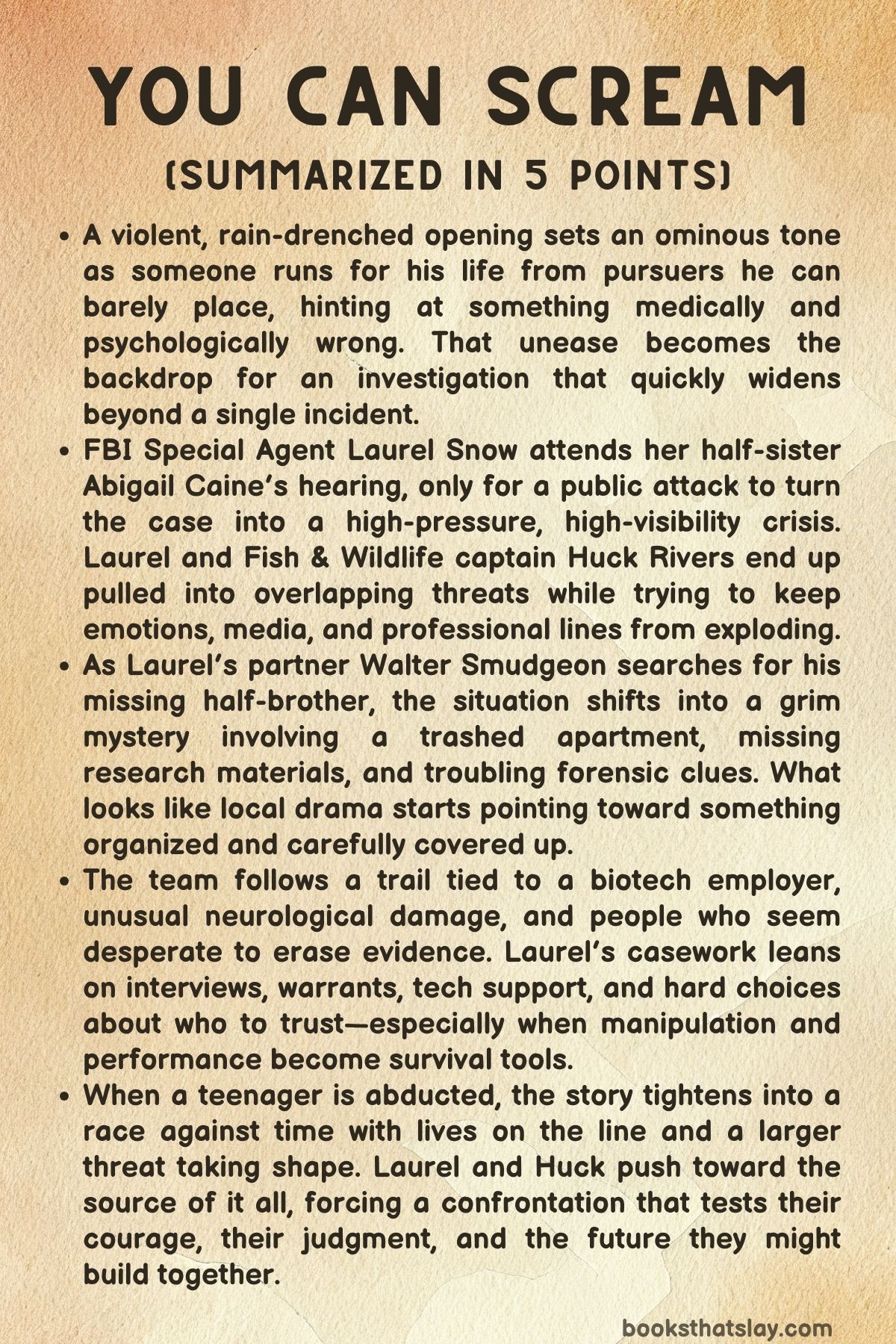
Characters
Laurel Snow
Laurel Snow is the moral and procedural anchor of You Can Scream—a disciplined FBI leader who keeps choosing action over comfort even when the action keeps punishing her. She is defined by controlled intensity: she reads rooms quickly, refuses to be bullied by defense attorneys or media pressure, and turns chaos into an investigation with boards, patterns, warrants, and timelines.
At the same time, her personal life is not a soft subplot but a pressure point, because her half-sister relationship with Abigail forces Laurel to navigate a constant collision between family history and professional duty. Laurel’s strength is that she does not romanticize anyone, including herself; she questions motives, suspects staging, and insists on verifiable facts even when it would be emotionally easier to believe a simpler story.
Her vulnerability is that she carries responsibility like a private religion—she keeps stepping closer to danger, keeps going back inside the burning building, and ultimately decides that stopping the threat matters more than her own safety, which is why she ends up the one running into the facility alone to prevent the weapon from leaving. Her arc is a steady tightening of resolve: she begins in a courtroom trying to endure the optics of the Caine case, and ends in the mountains physically dismantling the conspiracy with her own hands, proving that her defining trait is not simply competence but refusal—refusal to be intimidated, to be manipulated, or to let evil become “somebody else’s problem.”
Huck Rivers
Huck Rivers functions as both protector and equal partner to Laurel, but his characterization avoids the cliché of a simple bodyguard love interest by making him a leader with his own authority, instincts, and moral anger. As a Fish and Wildlife captain, he brings a different kind of competence than the FBI—terrain sense, tracking, rapid response coordination, and a working relationship with the physical world that becomes crucial when the investigation turns into chases, crash sites, and wilderness pursuit.
His protectiveness is immediate and physical—he throws Laurel down on courthouse steps, shows up at the rollover scene, and later arrives by helicopter in the final storm—yet what makes him compelling is that he doesn’t use protection as control. He challenges Abigail bluntly, clashes with Vexler, and pushes hard for accountability, but he also respects Laurel’s agency, even when it terrifies him.
Huck’s emotional core is grief and loyalty: the earlier “recent loss” he and Laurel processed informs his tenderness and his volatility, and the relationship grows because they keep surviving together rather than because the plot pauses for romance. His request that Laurel move in is not presented as a fantasy escape but as a practical declaration of chosen family in a world where blood family can be weaponized.
Abigail Caine
Abigail Caine is the story’s most deliberately ambiguous figure, built to keep the reader oscillating between victim, suspect, and opportunist. She performs vulnerability as strategy—arriving in court dressed to look small, cultivating sympathy, and later leveraging public platforms to reshape the narrative in her favor.
Her intelligence is social and predatory: she knows how to trigger protective instincts, how to bait Laurel, and how to present herself as indispensable when pressure rises. Even when evidence points toward larger conspiracies, Abigail remains unsettling because she consistently treats truth as a tool rather than a value, admitting she used “evidence” scraped from online lists and revealing how easily she manipulates men.
The bulletproof vest episode, the death threats, and the repeated attacks around her create a haze where real danger and manufactured optics blur together, and Abigail thrives in that blur. Yet she is not written as purely invincible; she is also trapped by her own choices, forced into proximity with Laurel, and ultimately dependent on the very people she antagonizes.
By the end of You Can Scream, her most revealing trait is adaptability: she survives by attaching herself to whatever story grants leverage—self-defense, trafficking whistleblower, heroic survivor—so the question she leaves behind is not merely whether she is guilty of one act, but whether she is capable of sincerity at all.
Wayne Norrs
Wayne Norrs is introduced as a high-ranking FBI figure and Abigail’s boyfriend, which immediately places him at an ethical crossroads: protector, investigator, and potential blind spot. His decision-making carries a constant whiff of conflict-of-interest tension because he is both emotionally invested and professionally positioned near the investigations that keep intersecting with Abigail.
He is pragmatic enough to insist on the bulletproof vest and active enough to pursue the sniper lead, suggesting he is not naïve, but his closeness to Abigail makes every action feel double-edged—either commendable vigilance or compromised judgment. When he is attacked and seriously wounded, the narrative uses his injury as proof that the threat is real and escalating, while also stripping him of control at a key moment, forcing others—especially Laurel and Huck—to become the primary engines of response.
Wayne’s role is partly structural: he embodies how institutions become vulnerable when personal attachments are exploited, and his near-removal from the field underscores that the enemy is not just clever but willing to target authority directly.
Henry Vexler
Henry Vexler is the most chilling kind of antagonist in You Can Scream because he weaponizes legitimacy. He enters as a polished defense attorney, speaks the language of rights and procedure, and uses courtroom power dynamics to threaten and posture, especially by implying he can destroy Laurel on the stand.
That early behavior is not mere lawyer theatrics; it is a test of dominance that foreshadows the later reveal that he is willing to commit direct violence while hiding behind the mask of professionalism. His transformation from legal predator to operational sniper is effective because it doesn’t feel like a personality switch—it feels like the same entitlement escalating into action once the stakes demand it.
Vexler represents a particular horror: the enemy inside the system, someone who understands exactly how investigators think and how to obstruct them while running a parallel plan. His end is visceral and personal, not because the story wants gore for its own sake, but because Laurel’s confrontation with him becomes the ultimate rejection of manipulation—she defeats the man who tried to turn law, fear, and captivity into a single instrument of control.
Bertra Yannish
Dr. Bertra Yannish is the scientific architect of the weapon, and her character embodies the moral collapse that occurs when research becomes ideology and profit. She presents herself with the cool distance of expertise, backed by lawyers and procedural shields, and her ability to avoid detention early on shows she understands not only chemistry but systems—how to deny, delay, and keep investigators out.
The lab’s purpose reveals her as someone who has moved beyond “reckless experiment” into intentional harm, taking yew-derived compounds tied to dementia research and turning them into aerosolized tools designed for mass casualty. Bertra is not motivated by passion in a sympathetic sense; she is motivated by capability—the thrill of what can be engineered and sold.
When she prepares to deploy the larger canister in the storm, she becomes the clearest embodiment of the plot’s central fear: invisible, airborne violence that attacks the brain itself. Her death is abrupt, almost clinical, which fits her characterization—her end arrives not as a moral awakening but as a hard stop delivered by force.
John Fitz
John Fitz is the ground-level predator who translates the conspiracy into personal terror, and his role is crucial because it turns abstract bio-weapon stakes into immediate bodily danger. His abduction of Viv is brutal and opportunistic, defined by physical domination and the calculated choice of a private location and quick incapacitation.
Unlike Vexler’s refined menace or Bertra’s intellectual ruthlessness, Fitz is the blunt instrument—useful to the conspiracy precisely because he can act without hesitation or empathy. His later presence at the facility confirms that he is not a lone attacker but a working part of the machine, and the canister labeled with Viv’s name shows how the plot’s evil is also sadistic: it wants not just to kill but to demonstrate control and create fear as a product.
When Laurel knocks him out, it emphasizes the difference between his power and hers—his strength relies on ambush and intimidation, while hers relies on decision and endurance.
Viv Vuittron
Viv Vuittron begins as a concerned teenager with instincts others dismiss, and she evolves into the emotional stakes of the investigation. Her early insistence that Larry Scott’s death was misclassified establishes her as perceptive and stubborn, the kind of civilian who refuses to accept easy official narratives.
When she is abducted, the story does not reduce her to a passive victim; she fights, resists, bites, and tries to scream, and even though she is overpowered, the emphasis on her struggle preserves her agency. Her captivity becomes a symbol of what the villains are willing to do to prove their product, and her survival becomes a quiet rebuke to that logic—she is not merely evidence, she is a person the system must not sacrifice for expediency.
Viv’s presence also forces Laurel to operate with a different urgency than courtroom maneuvering; it is one thing to build a case, and another to save a child before the case exists.
Walter Smudgeon
Walter Smudgeon is Laurel’s partner and a study in suppressed emotion colliding with sudden personal catastrophe. His characterization gains depth when his “withdrawn” behavior is revealed as shock over Tyler’s disappearance, showing how quickly professional composure can fracture when family enters the frame.
Walter carries estrangement like armor—he has reasons for distance from Tyler’s conspiracy world—but the ransacked apartment and blood evidence force him to confront the cost of disengagement. The revelation that Tyler’s trust would pass to Walter if Tyler is dead injects suspicion and discomfort into every interaction with local law enforcement, positioning Walter as someone who must defend his integrity while grieving.
His role in watching Tyler’s recordings is particularly resonant: he is forced to see the brother he dismissed as paranoid as someone who may have been right about being targeted. Walter’s arc is not a clean reconciliation, because death interrupts any chance to repair the relationship, leaving him with a more haunting resolution—he must live with unfinished words and still keep working the case.
Tyler Griggs
Tyler Griggs is largely present through absence—through a ransacked apartment, missing research, fear-laced recordings, and eventually a body—yet he remains vivid because his voice survives in his podcasts. He is framed as a conspiracy podcaster and government skeptic, but the narrative complicates the stereotype by showing that his obsession is not only attention-seeking; he documents specific misconduct, tracks patterns, and anticipates an attack with a seriousness that suggests real threat rather than theatrical paranoia.
His flaws—long-term migraines, erratic intensity, and the sensational tone of some segments—make him easy for authorities to dismiss, which is precisely what makes his fate tragic: he may have been the most motivated person to surface the truth, but his credibility was structurally fragile. The coroner’s discovery that Tyler was dead before the fall and had severe microscopic brain lesions repositions him from “reckless provocateur” to victim of a targeted, scientific violence, implying that his investigative curiosity put him in the path of a weapon designed to erase minds as much as lives.
Sandra Plankton
Sandra Plankton acts as both witness and catalyst, a character whose defensiveness masks real fear and loyalty. Her initial reluctance to cooperate and her protest-arrest history mark her as someone accustomed to being dismissed or targeted by authorities, which explains her posture with police and her suspicion that cops killed Tyler.
What makes her important is that she brings tangible help—handing over the flash drive hidden in Tyler’s belongings—and this choice reframes her from “uncooperative girlfriend” to someone making a risky decision to preserve Tyler’s work. Sandra is driven by grief expressed as anger: she wants blame to land somewhere, and she wants Tyler’s warnings to matter.
Even when her theories are not fully accurate, her contribution is essential because she keeps Tyler’s voice in the story long enough for Laurel and Walter to translate it into actionable investigation.
Nester
Nester is the quiet backbone of the investigative machine, the character who turns hunches into data and keeps the story’s momentum credible. He delivers the practical realities—lack of leads, ballistics results, traffic camera hits, background checks—and those details matter because they prevent the investigation from feeling magical.
Nester’s function is not merely exposition; he is the conduit between field chaos and institutional capability, enabling Laurel to move from suspicion to warrants, from patterns to probable cause. His presence also emphasizes that modern investigations are team sports: Laurel’s instincts are sharp, but without tech work, records, and surveillance pulls, instincts cannot become arrests.
Dr. Ortega
Dr. Ortega plays the role of scientific truth-teller, the coroner whose findings shift the entire case from local corruption and sniper attacks into bio-weapon horror. His autopsy observations—microscopic brain lesions, rapid neural degradation, unidentified alkaloids—are the hinge that connects Tyler, Dr. Liu, and Bitterson into a shared pathology, and his willingness to send samples to specialists shows a commitment to accuracy over convenience.
He is also the character who grounds the story’s science in process: he doesn’t leap to conclusions, he urges further testing, and he encourages federal involvement based on evidence rather than ego. In You Can Scream, Ortega represents the idea that bodies tell the truth even when people lie, and that truth can be terrifying.
Dr. Miriam Liu
Dr. Miriam Liu exists as a key node in the Oakridge Solutions web, a scientist whose condition mirrors Tyler’s and therefore becomes proof that the harm is not random. Even without extensive direct presence, she matters because her connection to Oakridge and the matching lesions imply that the weapon’s development has victims inside its own ecosystem, suggesting exposure, experimentation, or silencing.
Liu’s narrative purpose is to validate that the conspiracy is not just an external threat but something that has already been poisoning lives quietly, making the later mass-attack plan feel like escalation rather than sudden invention.
Larry Scott
Larry Scott is the “misclassified death” that starts pulling the Oakridge thread into focus. Presented as an apparent suicide in Seattle, his significance lies in how his death feels administratively neat—too neat for Viv, who senses the lie.
Larry becomes a symbol of the conspiracy’s ability to disappear people without spectacle: if a death can be filed away as self-harm, the system itself becomes part of the cover, even if unintentionally. His connection to Oakridge marks him as one more person who likely saw something, knew something, or became inconvenient, reinforcing the story’s theme that the most dangerous violence is the kind that can be processed as paperwork.
Melissa Palmtree
Melissa Palmtree is the ghost in the investigation—dead, buried, yet active through the ripple effects of what she handled. Her role as the recipient of envelopes through Robertson, and her link to Oakridge, positions her as an intermediary between corruption and corporate secrecy.
The decision to exhume her indicates that even in death she may hold evidence, and her presence reinforces the idea that conspiracies rely on networks of facilitators, not just masterminds. Melissa represents the middle layer: not the public face like Vexler, not the scientist like Bertra, but the connective tissue that makes illegal systems function.
Detective Joshua Robertson
Detective Robertson embodies the rot of compromised authority, and the story plays him in the uncomfortable space between “dirty cop” and “useful pawn.” He is shown as skeptical and dismissive early, which reads as standard small-town gatekeeping until Tyler’s footage and later interrogation reveal hypocrisy: an affair, package exchanges, moonlighting security at Oakridge, and vulnerability to blackmail. Robertson’s confession—that Bitterson forced him into passing envelopes—paints him as weak rather than mastermind, a man whose private choices made him exploitable.
That weakness is still dangerous, because it created a channel through which a larger conspiracy could move resources and information. Robertson’s character illustrates a key theme of You Can Scream: large horrors often depend on small cowardices.
Officer Jillian Jackson
Officer Jackson is tied to Robertson through the affair and therefore becomes part of the corruption narrative even when she denies deeper involvement. Her characterization sits on ambiguity: she admits the relationship but rejects knowledge of envelopes or Bitterson, leaving open whether she is truthful, ignorant, or protecting herself.
Jackson’s role highlights how easily credibility erodes once personal misconduct is exposed; even if she had nothing to do with the worst crimes, her compromised position allows others—like Sandra and Tyler—to suspect her of everything. In a story about hidden systems, Jackson represents the way ordinary unethical choices become the camouflage that lets extraordinary evil hide nearby.
Mark Bitterson
Mark Bitterson is a vivid example of a conspirator turned disposable, introduced through panic, injury, and hallucination-like terror as he flees. His perception of a shadowy “Reaper” and his physical breakdown suggest a mind and body already under attack, aligning with the later autopsy findings of lesions and alkaloids.
Bitterson’s importance is that he links the local corruption footage to real operatives: Laurel and Walter recognize him from Tyler’s recordings, confirming Tyler’s investigations were touching something real. His death—bleeding, stabbed, abandoned—shows the conspiracy’s hierarchy: even those who act for it are not protected by it.
Bitterson is what happens when fear, greed, and exposure collide—he becomes both clue and cautionary tale.
Tim Kohnex
Tim Kohnex is written as a disruptive wildcard—easy to dismiss, strangely insightful, and ultimately brave in a way that complicates his “psychic” persona. He first appears as an irritant to Laurel’s rational process, claiming visions and delivering unsettling warnings that might be manipulation or coincidence.
Yet he then acts independently, follows intuition into the mountains, and actually finds Viv, proving that whatever he calls it—psychic ability, pattern-sensitivity, luck, or obsession—he can arrive where logic hasn’t yet reached. His courage is underlined by the cost: he is struck down and left injured alongside Viv, becoming another body in the villains’ demonstration of power.
Tim functions as a thematic counterweight to institutional certainty—You Can Scream suggests that truth can surface through odd channels, and that arrogance about who “counts” as credible can be its own kind of blindness.
Kate
Kate’s role is emotionally catalytic: she is the adult whose fear makes the stakes human and immediate when Viv is taken. Her collapse after learning of the abduction is not melodrama but a realistic shock response that reframes the investigation from procedural urgency to parental terror.
Kate anchors the community side of the story—families, schools, routines—what the villains are willing to violate to prove their weapon. The ending’s planned barbecue, with Kate included, emphasizes recovery and chosen-family stability after chaos, making her presence part of the narrative’s insistence that saving one person matters as much as stopping a mass event.
Rachel Raprenzi
Rachel Raprenzi represents the media ecosystem that Abigail exploits and that investigators must endure. Her show is a stage where narratives become weapons: Abigail can allege trafficking, imply heroism, and shape public sentiment faster than any case board can.
Rachel’s function is not to investigate but to amplify, and that amplification is dangerous because it rewards sensational claims while muddying evidentiary truth. In You Can Scream, Rachel is the reminder that modern threats unfold in two arenas at once—the physical world of guns, labs, and canisters, and the public world of optics, sympathy, and influence.
Uma Carrington
Uma Carrington appears as a name offered by Abigail when pressed for suspects, and her characterization is primarily defined by reputation: a turbulent connection to Zeke, strong feelings, and an apparent hostility toward Abigail. Even with limited direct presence, she serves a key function as a possible scapegoat—someone plausible enough to redirect attention toward “church loyalists” and interpersonal drama rather than corporate science and weaponization.
Uma embodies how social conflict can be used as cover, how real emotional mess can obscure a more systematic danger.
Zeke Caine
Zeke Caine is the dead center of the initial legal storm, a pastor whose life and death radiate influence over everyone else’s choices. He is described through allegations and loyalties rather than through living scenes, which makes him a contested symbol: to Abigail, he becomes an abuser and trafficker in her story; to his congregation, he is a figure worthy of devotion; to Laurel, he is both a case fact and a familial wound.
His significance is that his death creates the conditions for Abigail’s public reinvention and for legal leverage games that Vexler tries to exploit. Zeke’s character functions as a narrative pivot—his absence creates a vacuum that different characters attempt to fill with whichever version of him benefits them.
Themes
Identity under pressure and fractured memory
The opening sequence sets the tone for how easily a person’s sense of self can be damaged when the body and mind are manipulated. The man running through the forest isn’t just scared; he is mentally scrambled, reduced to fragments—shadows, monsters, a single command to run, and one oddly intimate word at the end.
That scene becomes a reference point for what happens later to others who encounter the yew-derived compound: a person’s internal world can be invaded, rearranged, and stripped of coherence. The story repeatedly shows how identity can become unstable when perception is unreliable.
Hearing disappears and returns with pain, thoughts don’t connect, and instincts override reasoning. Later, the brain lesions and rapid neural degradation described by the coroner push that same idea into the investigative plot: damage isn’t symbolic, it is physical, measurable, and linked across victims.
For Laurel, identity pressure works differently. She is constantly forced to define who she is in relation to Abigail, to the FBI’s expectations, and to the public narrative being shaped around the case.
Being in the same family as the accused, looking similar enough to be confused at a distance, and being pulled into a legal fight she never asked for makes her identity feel contested. The public sees “sisters,” the court sees “connections,” and defense attorneys see “leverage.” Laurel has to keep asserting boundaries: she refuses to help the defense, refuses to be pulled into Abigail’s performance, and refuses to let public perception decide her role.
The theme becomes less about “finding yourself” and more about defending yourself—holding onto clarity when other people’s agendas, violence, and biochemical harm try to turn humans into tools.
Performance, image, and manufactured truth
Nearly every major conflict is shaped by someone controlling appearances. The courthouse scene is filled with crafted optics: Abigail arrives dressed to project vulnerability, her attorney speaks in polished narratives, and the media swarm outside ready to package the moment into a headline.
The shooting outside the courthouse—especially once it’s revealed she wore a vest—creates a question that never fully goes away: was this danger, or theater designed to generate sympathy and muddy the legal waters? The story builds tension by showing how easily attention can be redirected.
A grazed arm becomes a spectacle, and that spectacle becomes a shield against scrutiny.
This pressure intensifies once Abigail goes on television. Her claims about trafficking and a murdered teen demonstrate how public storytelling can outrun evidence.
She doesn’t need a strong factual foundation; she needs a narrative that moves hearts, triggers outrage, and reframes her as a protector rather than a defendant. Even when Laurel corners her and Abigail admits her “evidence” was weak, the damage is already done because the audience has absorbed the version that feels dramatic and morally urgent.
The theme here is not simply “media manipulation,” but the idea that truth becomes negotiable when performance is rewarded. Henry Vexler embodies the same concept in a darker form: as a lawyer he uses procedure, intimidation, and courtroom posture; as the sniper he uses misdirection, clean exits, and confusion.
The story argues that control over appearances can function like power, and power can be used to delay accountability until the harm is almost irreversible.
Trust, betrayal, and institutional fragility
The investigation moves through overlapping systems—federal agencies, local police, private companies, legal defense teams, and community institutions—and repeatedly exposes how trust breaks down inside each one. Tyler’s podcasts initially look like paranoia, but the details he captured about corruption, packages, and secret contacts prove he was not simply chasing fantasies.
That twist forces a re-evaluation of how institutions label inconvenient people. Someone can be dismissed as unstable or attention-seeking, and that dismissal becomes useful cover for real wrongdoing.
When local officers question whether Tyler staged his own ransacked apartment, their skepticism is portrayed as routine—but it also shows how easy it is for authorities to minimize threats when a victim doesn’t fit a “credible” mold.
Betrayal appears in multiple layers. Detective Robertson’s affair and blackmail create a pipeline of compromised decisions that pull law enforcement into a private company’s orbit.
Oakridge Solutions, operating behind professional credentials, becomes a source of deadly experimentation and secrecy. Even the attorney-client relationship becomes a mechanism for violence once Vexler is revealed as the shooter and architect of the lab plot.
In contrast, the story highlights how trust must be built deliberately rather than assumed. Laurel’s working relationship with Huck functions because it’s tested repeatedly: they exchange information under stress, protect each other physically, and disagree openly without collapsing into suspicion.
Walter’s storyline complicates trust in family; estrangement doesn’t erase responsibility, and guilt mixes with grief when Tyler is found dead and Walter is treated like a suspect. The theme ultimately suggests that institutions can look stable while being easy to corrupt, and that trust—whether professional or personal—has to be earned under pressure, not granted based on titles or roles.
Power, coercion, and the ethics of control
Power in You Can Scream is often exercised through coercion rather than direct authority. Threats of subpoenas, promises of aggressive cross-examination, and “cooperate or suffer” conversations show how the legal system can be used to corner people who are trying to do the right thing.
Laurel is targeted not just by bullets, but by strategy: attorneys attempt to control what she says, when she says it, and how she will appear on the stand. The intimidation is subtle enough to remain “professional,” but the intent is clear—make the investigator hesitate, make her feel exposed, make her fear consequences.
That coercive logic expands into the scientific plot where the ultimate goal is control of bodies and minds. The lab’s weaponized compound is the purest form of domination: it bypasses persuasion, bypasses consent, and turns human biology into a vulnerability that can be exploited at scale.
The victims with lesions are not collateral damage; they are proof that the compound works. The planned church attack makes the ethical stakes explicit because the target isn’t one person but a gathered community in an enclosed space, selected for maximum effect.
Even the choice of a church setting matters: it is a place associated with trust, safety, and belief, which makes the planned use of an airborne brain-attacking agent a violation of social assumptions as well as bodies.
Laurel’s response to this theme is practical rather than philosophical. She doesn’t debate ethics; she acts to stop harm.
But her actions still raise moral weight. She builds a rupture device from common supplies to escape, then returns alone with an ax to prevent a mass attack.
When she kills Vexler, it is not framed as clean heroism; it is close, brutal, and shaped by necessity. The narrative treats moral choices as things made in seconds under threat, where “right” is measured by preventing greater harm, not by maintaining comfort or purity.
Fear as a weapon and survival as a discipline
Fear is constantly present, but it behaves differently across characters. In the forest, fear is raw and involuntary; it narrows thought until only “run” remains.
In the courthouse and office shootings, fear becomes public and contagious, scattering crowds and turning ordinary spaces into danger zones. In the abduction of Viv, fear becomes intimate and targeted: a young person trapped in a small space, controlled by one attacker, with the ability to scream removed through force and isolation.
The title’s implication becomes clearer here—being able to scream is not the same as being heard, and survival often depends on action rather than sound.
The story also shows fear being used intentionally. Sniper attacks and suppressed gunfire aren’t only attempts to kill; they create uncertainty, erode confidence, and pressure investigators into mistakes.
The truck chase is another example: ramming, gunfire, and anonymity turn a road into a trap and force Laurel to fight while injured and exposed. Fear becomes a tool to exhaust defenders and make them doubt whether they can protect anyone.
The villains exploit the idea that if they strike unpredictably, the team will spend its energy reacting instead of pursuing.
Against that, survival is portrayed as a discipline—trained, prepared, and often improvisational. Huck’s rapid mobilization after Viv disappears shows how survival can be procedural: perimeter control, K9 units, drones, canvassing, and coordinated task force work.
Laurel’s approach is survival through clarity: linking lesions across victims, pushing for warrants, refusing distractions, and using every scrap of evidence. When she improvises the escape device in the closet, it’s survival through problem-solving under time pressure, using mundane materials without the luxury of perfect options.
The theme emphasizes that fear never fully disappears; what changes is the ability to keep functioning while afraid, and to convert panic into purposeful movement.
Family bonds, chosen partnership, and emotional repair
Family in You Can Scream is not a comfort; it is a source of complication and unfinished wounds. Laurel and Abigail share blood but not trust, and their connection becomes a liability in court, in public perception, and inside the investigation.
Abigail uses the relationship as a stage prop when it suits her—calling after Laurel in public, appearing in interviews, and positioning herself close to Laurel’s work when she needs attention or leverage. For Laurel, the family bond becomes something she must constantly manage rather than rely on, because Abigail’s self-interest distorts every interaction.
Even when Abigail participates in the final escape and helps get Viv and Tim to safety, the story keeps her motives ambiguous enough that “family loyalty” never feels like the explanation.
Walter and Tyler offer a different family lens: estrangement doesn’t prevent grief, and distance doesn’t remove responsibility. Walter’s shock when Tyler is missing, and later when Tyler is confirmed dead, shows how family ties can remain emotionally binding even when the relationship has been broken for years.
The revelation about the inheritance adds a harsh layer—systems treat family grief as a potential motive, and money can pollute how others read love or regret. Walter’s pain is not only about death but about the knowledge that reconciliation is now impossible.
In contrast, Laurel and Huck represent chosen partnership as a form of repair. Their relationship grows in the spaces between crises: a vacation after loss, protective instincts during the shooting, care after the truck attack, and the intimacy that follows shared danger.
The proposal to move in together isn’t presented as a simple romantic milestone; it reads as a desire for stability in a world that keeps turning familiar places into threats. The final scene’s quiet plan—barbecue, time with Kate and the girls, shutting off the broadcast—suggests emotional repair as an active choice.
They cannot undo what happened, but they can decide what kind of life they build afterward, and who they let into it.