After by Anna Todd Summary, Characters and Themes
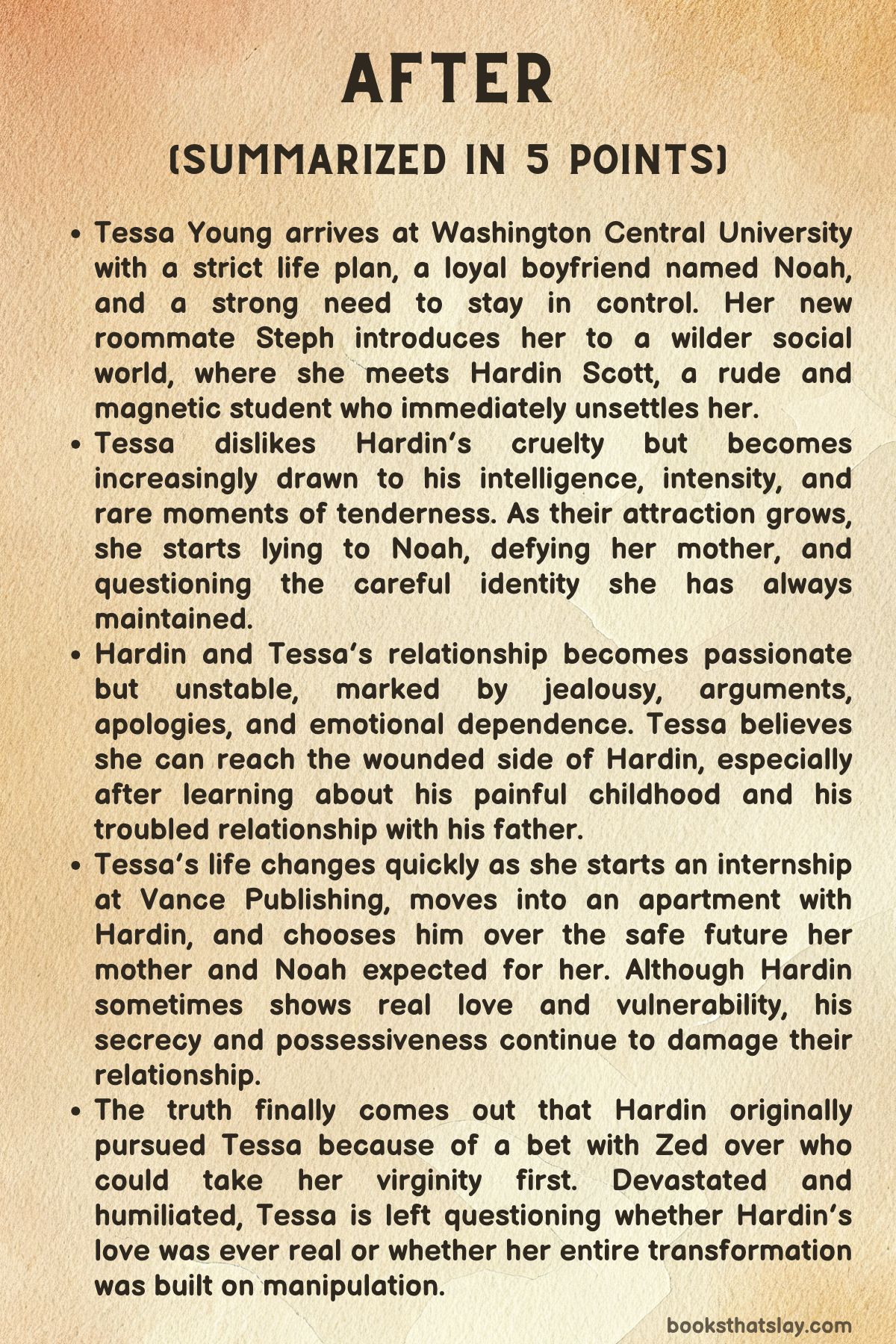
After by Anna Todd is a college romance about Tessa Young, a careful, rule-following freshman whose life changes when she meets Hardin Scott. Tessa arrives at Washington Central University with a plan, a loyal boyfriend, and a strong desire to stay in control.
Hardin is rude, tattooed, secretive, and emotionally volatile, but he draws her into a world of parties, desire, rebellion, and painful self-discovery. The novel follows Tessa as she questions who she is, what she wants, and how much pain she is willing to accept in the name of love.
Summary
Tessa Young begins college at Washington Central University with everything carefully arranged. She has spent years preparing for this moment with her controlling mother, and she arrives on campus with her high school boyfriend, Noah, by her side.
Tessa is organized, modest, ambitious, and determined to do well. She worries about her roommate and whether she will make friends, but she expects college to fit into the life plan she has always followed.
Her expectations shift almost immediately when she meets Steph, her roommate, whose red hair, tattoos, piercings, and partygoing friends make Tessa uncomfortable. Steph is friendly, but her circle feels foreign to Tessa.
Among them is Hardin Scott, a rude British boy with tattoos, piercings, green eyes, and a habit of insulting Tessa whenever they speak. Tessa dislikes him, yet she cannot stop noticing him.
Against her usual instincts, she lets Steph persuade her to attend a party at a fraternity house.
At the party, Tessa feels out of place. She does not drink, she has a boyfriend, and she is shocked by the casual intimacy and rough humor of Steph’s friends.
Hardin is dismissive toward her, and she finds him kissing Molly, a sharp-tongued girl from the group. When Tessa cannot get a ride home, she is forced to stay at the fraternity house.
She discovers that Hardin lives there and that he owns books she loves, including Wuthering Heights. His interest in literature surprises her, but his cruelty keeps her guarded.
Tessa’s classes begin, and she meets Landon, a kind fellow English major. She also finds herself in British Literature with Hardin, where their arguments about classic novels reveal their intelligence and their clashing views on love, pride, and power.
Tessa tries to stay focused on school and Noah, but Hardin keeps pulling her attention. At another party, during a game of Truth or Dare, Tessa is humiliated when the group learns she is a virgin.
She drinks more than she should, and Hardin alternates between mocking her and protecting her. When another drunken boy tries to touch her, she runs to Hardin’s room, and in a moment of fear and confusion, she kisses him.
The kiss changes everything for Tessa. She has never felt anything like it with Noah, and she is shaken by the force of her attraction to Hardin.
He dismisses the kiss as meaningless, leaving her hurt and ashamed. Still, Hardin later comes looking for her and seems worried about her safety.
Tessa’s mother and Noah arrive after learning she has been drinking, and Tessa is forced to defend herself while hiding the full truth of what happened.
Tessa tries to return to her old life, but Hardin keeps disrupting it. She feels guilty about Noah, who has always been kind and dependable, yet she no longer feels the same spark with him.
Hardin continues to appear in her room, provoke her, and then show flashes of tenderness. They kiss again, and Steph warns Tessa that Hardin does not date and is not careful with girls’ feelings.
Tessa learns more about Hardin’s family through Landon. Landon’s mother is engaged to Hardin’s father, Ken, who is also connected to the university.
Hardin hates his father, who was once an alcoholic and absent from Hardin’s childhood. Like Tessa, Hardin was abandoned by a parent around age ten, and this shared wound creates a bond between them.
When Hardin gets drunk and lashes out at his father’s house, Tessa comes to help him. He is cruel one moment and vulnerable the next, telling her she makes him want to be better.
Tessa wants clarity, but Hardin refuses a normal relationship and suggests they keep things physical. Tessa refuses, though her desire for him keeps drawing her back.
As Tessa’s relationship with Hardin deepens, her relationship with Noah falls apart. Hardin forces the truth into the open, and Noah leaves heartbroken, saying he no longer knows who Tessa is.
Tessa feels betrayed by Hardin but cannot fully walk away from him. Their cycle continues: jealousy, arguments, physical passion, apology, and renewed closeness.
Hardin brings out a side of Tessa she never knew existed, while Tessa believes she sees a wounded, better version of Hardin beneath his anger.
Hardin brings Tessa closer to his family, and she becomes important to Ken and Karen because she helps Hardin spend time with them. Tessa is also offered an interview at Vance Publishing, which leads to a paid internship that fits her dream of working in publishing.
Hardin seems both proud and threatened by the ways others help Tessa, especially when his father opens doors for her. He wants to be the one she depends on.
Hardin eventually tells Tessa he loves her, but then cruelly takes it back, leaving her devastated. She tries to move on by going out with Zed, who treats her gently and without pressure.
Even so, Tessa realizes she loves Hardin. When she finally admits it, Hardin confesses that he loves her too.
Their relationship becomes more serious, and Tessa agrees to have sex with him. Hardin is careful in the moment and tells her it is different because he loves her.
Tessa believes she is the only person he has ever truly loved, and this belief helps her accept the speed and intensity of their relationship.
Tessa’s life changes rapidly. She starts her internship, changes her style, argues with her mother, and eventually agrees to move into an apartment with Hardin.
Her mother is furious and accuses Tessa of throwing away her future for someone dangerous. Tessa defends Hardin, convinced that he is changing because of her.
Hardin opens up about his childhood trauma: as a child, he witnessed men attack his mother after a conflict involving his drunken father. This confession helps Tessa understand the source of his nightmares, rage, and emotional walls, and she promises not to leave him.
For a short time, Tessa and Hardin seem to build a shared life. They attend Ken and Karen’s wedding, where Hardin shows signs of healing and even takes steps toward reconciling with his father.
Tessa sees moments of warmth in him and believes their love is helping both of them become new people. Still, secrets remain.
Hardin is evasive about Jace, Molly, Zed, and the past. Tessa senses that his friends know something she does not.
The truth comes out when Molly hints that Tessa has misunderstood everything. Hardin is forced to admit that, after the group learned Tessa was a virgin, he and Zed made a bet over who could take her virginity first.
Hardin kept the bloody sheets from their first time together as proof that he had won. Even Steph knew and never told her.
Tessa looks back on every kiss, every apology, every tender moment, and wonders whether any of it was real. Hardin begs her to believe that he truly fell in love with her, but the damage is unbearable.
Humiliated and shattered, Tessa leaves with Zed and asks him to tell her every detail.
Characters
Tessa Young
Tessa Young is the central character of After, and her development is built around the collapse of the careful identity she has always maintained. At the beginning, she is disciplined, modest, academically driven, and deeply invested in doing what is expected of her.
Her life has been shaped by planning, control, and approval, especially from her mother. Her relationship with Noah also reflects this early version of herself: safe, familiar, predictable, and rooted in the person she used to be.
College places Tessa in an environment where that version of herself is challenged almost immediately. Steph’s friend group, the parties, and especially Hardin expose her to choices and emotions she has never had to confront before.
Tessa’s strongest trait is her desire to be good, but the novel complicates what goodness means for her. She wants to be loyal to Noah, obedient to her mother, successful in school, and morally certain.
Yet her attraction to Hardin forces her into dishonesty, jealousy, secrecy, and rebellion. This does not make her a simple victim of Hardin’s influence; it shows that Tessa has repressed many parts of herself.
Her desire, anger, independence, and need for emotional intensity have been buried beneath politeness and routine. Hardin brings those traits out, but often in painful and damaging ways.
Tessa is also marked by contradiction. She can be intelligent and perceptive, especially in literature and academics, yet she repeatedly ignores warning signs in her personal life.
She recognizes Hardin’s cruelty, instability, and possessiveness, but she also believes in the vulnerable side he shows her. Her compassion becomes both a strength and a weakness.
She wants to understand his pain, and once she learns about his trauma, she becomes even more determined to stay. This makes her emotionally generous, but it also makes her willing to excuse behavior that hurts her.
By the end, Tessa’s greatest wound is not only romantic betrayal but the realization that her transformation may have been manipulated. She has risked her relationship with Noah, defied her mother, changed her habits, moved in with Hardin, and given him her trust.
The revelation of the bet forces her to question whether her new identity was built on love, freedom, or humiliation. Her final decision to hear the full truth from Zed shows a new kind of courage.
She is no longer simply trying to please others or preserve an illusion. She wants knowledge, even if it hurts.
Hardin Scott
Hardin Scott is volatile, intelligent, wounded, and cruelly defensive. He enters Tessa’s life as someone who seems designed to unsettle her.
His appearance, sarcasm, sexual confidence, and refusal to respect social politeness all contrast sharply with Tessa’s careful order. He uses mockery as a shield, often attacking others before they can get close enough to hurt him.
His first interactions with Tessa are harsh and dismissive, but his intelligence and love of literature reveal that there is more beneath his aggressive exterior.
Hardin’s emotional life is shaped by anger, shame, abandonment, and trauma. His hatred for his father comes from years of neglect and from the terrible violence he witnessed as a child.
His nightmares, drinking, fights, and sudden mood changes all point to pain he has never processed in a healthy way. He wants love but fears dependence.
He wants Tessa close but lashes out when she gets too close. He wants to be seen as powerful, but his need for Tessa exposes how fragile he really is.
In his relationship with Tessa, Hardin is both tender and destructive. He comforts her, protects her, shares parts of himself with her, and gradually admits that she matters to him.
At the same time, he controls, humiliates, lies, and manipulates. His possessiveness is especially important to his character.
He becomes furious when Tessa interacts with Noah, Zed, Trevor, or other men, yet he often refuses to define their relationship clearly in front of others. This double standard reveals his fear of vulnerability and his need to maintain power.
Hardin’s love for Tessa may become real, but the origin of their relationship corrupts it. The bet over her virginity exposes the worst parts of him: his arrogance, cruelty, and willingness to treat another person’s trust as a game.
Even if his feelings changed, his failure to confess sooner makes his love morally compromised. He is not simply a misunderstood romantic figure; he is a damaged young man whose pain has made him dangerous to people who care about him.
His tragedy is that he wants to be better, but wanting is not the same as repairing the harm he has caused.
Noah Porter
Noah represents Tessa’s old life: safety, innocence, loyalty, and emotional familiarity. He is younger than Tessa, still in high school, and tied closely to her mother’s vision of who Tessa should be.
Their relationship has lasted for years, but it is built more on comfort and history than passion. Noah has been there for Tessa during painful moments in her childhood, particularly when her father’s alcoholism and absence affected her family.
Because of this, he is not just a boyfriend to her; he is part of her emotional foundation.
Noah’s kindness is genuine, but his connection to Tessa’s mother creates tension. He sometimes tells Tessa’s mother too much about Tessa’s life, which makes Tessa feel watched and managed.
He does not do this out of malice; he seems to believe he is helping or protecting her. Still, his behavior shows why Tessa begins to feel trapped by the world she came from.
Noah loves the version of Tessa he has always known, but college changes her faster than he can understand.
His reaction to Tessa’s betrayal is marked by sadness more than rage. When he learns about Hardin, he is hurt and confused, but he does not become cruel.
This makes him a moral contrast to Hardin. Noah’s pain is quieter, more controlled, and more dignified.
He warns Tessa that Hardin is using her, and although Tessa does not listen, his concern proves accurate in a painful way.
Noah is not written as Tessa’s great romantic match, but he is important because he shows what Tessa is leaving behind. He is stability without intensity, love without danger, and history without transformation.
Tessa’s inability to stay with him does not mean he is unworthy. It means that the person she is becoming can no longer live inside the narrow expectations attached to their relationship.
Steph
Steph begins as Tessa’s surprising roommate and becomes one of the first people who pulls Tessa away from her controlled upbringing. Her appearance and lifestyle initially alarm Tessa’s mother, but Steph herself is warm, friendly, and welcoming.
She invites Tessa into her social world, encourages her to attend parties, and helps her experiment with clothes and makeup. In this sense, Steph functions as a doorway into college independence.
Steph’s role is complicated because she seems supportive while also being connected to the group that harms Tessa. She warns Tessa more than once not to fall for Hardin, and her warnings suggest that she understands his patterns with girls.
She sees his carelessness and tries to protect Tessa from getting too emotionally invested. Yet her knowledge of the bet changes how the reader understands her loyalty.
If she knew about the wager and stayed silent, then her friendship with Tessa becomes deeply compromised.
This contradiction makes Steph one of the more morally uneasy secondary characters. She can be kind in everyday moments, but kindness without honesty becomes inadequate.
She enjoys helping Tessa loosen up and seems to value her as a friend, yet she does not shield Tessa from the most humiliating truth. Her silence allows Tessa to become the object of a game while believing she is making free emotional choices.
Steph also reflects the social environment Tessa enters. The group presents itself as bold, carefree, and rebellious, but beneath that freedom is a culture of secrets, gossip, dares, and emotional recklessness.
Steph is not as openly cruel as Molly or Jace, but her failure to tell the truth makes her part of the harm Tessa suffers.
Zed Evans
Zed is positioned as an alternative to Hardin, but he is not entirely innocent. He is friendly to Tessa from early on and often treats her with more visible respect than Hardin does.
He offers her attention without the same level of open cruelty, and when Tessa tries to distance herself from Hardin, Zed becomes a possible source of comfort. Their date shows him as polite, gentle, and considerate.
He brings her a flower, opens doors, and does not pressure her in the way Tessa expects from the men in Hardin’s circle.
However, Zed’s involvement in the bet makes his kindness suspect. Even if he later behaves more respectfully, he was part of the original act that objectified Tessa and turned her virginity into a competition.
This gives his character a disturbing duality. He can appear safer than Hardin in the present while still sharing responsibility for the betrayal that destroys Tessa’s trust.
Zed also understands Hardin’s world better than Tessa does. He knows the group’s dynamics, the hidden rules, and the danger of certain people like Jace.
His presence often triggers Hardin’s jealousy, which gives him power in the emotional triangle. Tessa sometimes uses Zed to hurt Hardin, especially when she feels rejected or humiliated.
Zed allows this to some degree, but he also seems to genuinely like her.
At the end, Zed becomes the person Tessa turns to for the truth. This is significant because he helped create the harm but may also be the one willing to expose it fully.
His character therefore occupies a morally gray space. He is kinder than Hardin in many moments, but he is not cleanly separate from the cruelty of the group.
Molly
Molly serves as one of Tessa’s clearest rivals and as a symbol of the sexual confidence that initially intimidates her. She is blunt, provocative, and often cruel.
From early on, she mocks Tessa’s innocence and labels her in ways that make her feel small and out of place. Molly’s closeness with Hardin intensifies Tessa’s insecurity because she represents Hardin’s past and the kind of girl Tessa believes she can never be.
Molly’s power comes from her knowledge. She understands the group’s sexual history, Hardin’s behavior, and eventually the secret behind Tessa and Hardin’s relationship.
She uses this knowledge sharply, making comments that unsettle Tessa and suggest that Tessa is the only one who does not understand what is really happening. Molly’s cruelty is often social rather than physical; she humiliates through implication, laughter, and timing.
She also exposes the weakness in Hardin and Tessa’s relationship. Tessa’s jealousy of Molly is not only about attraction.
It is about comparison. Molly has already existed in Hardin’s world, while Tessa is new to it.
Molly knows the rules, and Tessa does not. This makes Tessa feel naive, especially once the truth of the bet is revealed.
Molly is not developed as deeply as Tessa or Hardin, but she is important because she represents the harshness of the social circle Tessa has entered. She does not soften Tessa’s transition into adulthood; she makes it more humiliating.
In After, Molly becomes one of the people who reminds Tessa that desire without respect can become a weapon.
Landon
Landon is one of the few consistently kind and stable figures in Tessa’s college life. Like Tessa, he is academically focused and connected to literature, which gives them an easy foundation for friendship.
He is patient, respectful, and observant. Unlike Hardin’s friends, Landon does not treat Tessa’s innocence as entertainment.
He gives her a place to speak honestly without fear of mockery.
His connection to Hardin through their parents’ relationship makes him important to the family side of the story. Landon knows Hardin’s anger and has been hurt by it, yet he does not respond with equal cruelty.
He often becomes a witness to Tessa and Hardin’s chaos, seeing enough to be concerned but not forcing Tessa into confession. His restraint shows emotional maturity.
Landon also represents a healthier form of masculinity. He is loyal to Dakota, gentle with Tessa, and respectful of boundaries.
While Hardin often turns emotion into control, Landon turns concern into support. He does not try to possess Tessa or make her choices for her.
This makes him a moral anchor in a story full of unstable relationships.
His friendship with Tessa matters because it gives her a connection outside Hardin’s influence. Even when she is consumed by her relationship, Landon remains a reminder that care can be calm, honest, and nonthreatening.
He is not the loudest character, but his steadiness makes the disorder around him easier to see.
Tessa’s Mother
Tessa’s mother is controlling, image-conscious, and deeply invested in the life she has planned for her daughter. She wants Tessa to succeed, but her love is tied to control.
She polices Tessa’s appearance, friendships, romantic choices, and living situation. Her fear of Tessa making mistakes comes across as judgment rather than support, which pushes Tessa further away.
Her reaction to Steph and Hardin reveals her rigid worldview. She immediately judges people by appearance, treating tattoos, piercings, and unconventional behavior as signs of danger.
While some of her concerns about Hardin prove justified, her harshness prevents Tessa from hearing her clearly. Instead of creating trust, she creates rebellion.
Tessa becomes more determined to defend Hardin because her mother attacks him so cruelly.
Tessa’s mother also represents the pressure of respectability. She wants Tessa to remain proper, successful, and attached to Noah, a boy who fits the future she imagines.
When Tessa changes, her mother experiences it as a personal failure and a threat to control. Her decision to threaten Tessa’s college support shows how financial dependence can become emotional power.
The slap marks a breaking point in their relationship. It shows that her need to control Tessa has crossed into violence.
Tessa’s defiance afterward is not just about Hardin; it is about claiming the right to make her own choices, even poor ones. Her mother’s character helps explain why Tessa is so drawn to the freedom Hardin represents, even when that freedom becomes dangerous.
Ken Scott
Ken Scott is central to understanding Hardin’s anger. As Hardin’s father, he carries the weight of past alcoholism, absence, and family damage.
By the time Tessa meets him, Ken appears sober, respectable, and eager to repair his relationship with his son. He is the chancellor and lives a comfortable life, which only increases Hardin’s resentment because Hardin compares that comfort to his mother’s struggles in England.
Ken is not shown simply as a villain in the present. He is polite to Tessa, grateful for her influence on Hardin, and supportive of her career goals through his connection to Vance.
His changed behavior suggests that people can recover and attempt to make amends. However, Hardin’s anger shows that personal reform does not erase the damage caused in the past.
Ken may be different now, but Hardin still carries the memories of who he was.
Ken’s relationship with Karen also creates a new family structure that Hardin resists. To Hardin, his father’s new life looks like replacement and betrayal.
Ken’s happiness feels undeserved to him. Tessa’s presence helps Hardin tolerate Ken for brief periods, but the relationship remains fragile.
Ken’s character raises questions about forgiveness. He wants reconciliation, but the story does not suggest that Hardin owes it to him quickly.
Ken’s remorse may be sincere, yet the consequences of his past choices remain alive in Hardin’s trauma, distrust, and rage.
Karen
Karen is one of the warmest adult figures in the story. As Landon’s mother and Ken’s partner, she offers Tessa a kind of maternal gentleness that Tessa rarely receives from her own mother.
She welcomes Tessa into her home, cooks with her, talks to her, and treats her with trust rather than suspicion. For Tessa, Karen’s house becomes a place of temporary calm amid emotional confusion.
Karen also helps reveal the possibility of family healing. Her relationship with Ken is stable and affectionate, and she wants Hardin to be included rather than rejected.
She does not respond to Hardin with fear or hostility, even when his behavior is difficult. Instead, she remains patient, which makes her a quiet contrast to Tessa’s mother.
Her kindness matters because it influences Tessa’s view of Hardin. Seeing Karen and Ken hope for Hardin’s healing strengthens Tessa’s belief that she can help him change.
Karen’s gratitude toward Tessa reinforces Tessa’s sense that she has a special role in Hardin’s life. This is emotionally meaningful, but it also places pressure on Tessa to stay in a relationship that often hurts her.
Karen is not a dramatic character, but her steadiness gives the novel moments of warmth. She represents domestic peace, acceptance, and the family life Hardin might have had if his childhood had been different.
Jace
Jace represents the more openly threatening side of Hardin’s social world. Unlike friends who are merely reckless or immature, Jace carries a sense of real danger.
Hardin’s discomfort around him suggests that Jace has power within the group and that refusing him is not simple. His presence changes the mood because he seems capable of turning people into entertainment or targets.
Jace’s role is important because he exposes the hidden cruelty beneath the group’s party culture. Games like Truth or Dare and Suck and Blow may appear casual, but around people like Jace they become tools for humiliation, pressure, and control.
Tessa does not fully understand this world, while Hardin knows enough to fear what Jace might do if he sees her as vulnerable.
Hardin’s decision to hide his relationship with Tessa from Jace hurts her, but it also reveals that Hardin’s social circle has rules Tessa does not grasp. Jace is connected to the secrecy that later destroys Tessa’s trust.
His presence makes it clear that Hardin’s past is not just a collection of ex-lovers and bad habits; it is tied to a group culture that treats intimacy as a game.
Jace is not emotionally explored in depth, but he functions as a warning. He shows how easily Tessa’s innocence can be exploited in a world where people value status, secrets, and control more than care.
Kimberly
Kimberly is a secondary but important figure in Tessa’s professional life. At Vance Publishing, she represents the adult world Tessa wants to enter: organized, polished, and career-focused.
Kimberly is friendly enough to make Tessa feel welcome, and her presence helps Tessa imagine a future beyond college drama and romantic confusion.
Her conversations with Tessa offer a different kind of female connection from Steph or Molly. Kimberly is not part of the party group, and she is not involved in the emotional games surrounding Hardin.
This makes her part of the stable world Tessa is trying to build for herself. Through Kimberly, Tessa’s internship becomes not just a job but a glimpse of independence.
Kimberly’s relationship with Mr. Vance also shows Tessa another adult romantic dynamic, one that exists outside the intensity and chaos of her bond with Hardin. Kimberly does not become a central guide, but she belongs to the professional environment where Tessa’s intelligence and ambition can matter on their own terms.
Her role is small, yet meaningful because she helps expand Tessa’s life beyond Hardin. The more Tessa grows at Vance, the clearer it becomes that her future does not have to be defined only by romance.
Mr. Vance
Mr. Vance represents opportunity, ambition, and the professional future Tessa has dreamed about. His publishing house is exactly the kind of place where Tessa wants to work, and his decision to offer her a paid internship validates her intelligence and preparation.
For Tessa, Vance Publishing becomes proof that she can build a life through her own abilities.
At the same time, Mr. Vance’s connection to Ken and Hardin complicates the opportunity. Tessa earns the internship through a successful interview, but the access comes through Hardin’s family network.
This creates tension because Hardin wants to be the person who helps her, and Tessa must navigate the blurred line between independence and assistance.
Mr. Vance also reveals more about Hardin’s hidden life. Tessa learns that Hardin once worked at Vance and now works for another publishing company.
This surprises her because Hardin has kept parts of his academic and professional life hidden. Through Mr. Vance, the reader sees that Hardin is not merely a reckless student; he is capable, intelligent, and professionally connected.
Mr. Vance’s main purpose is to anchor Tessa’s ambition. He opens a door into the world she has always wanted, giving her a path that belongs to her even as her personal life becomes increasingly unstable.
Themes
Identity and Self-Discovery
Tessa’s journey is shaped by the painful gap between who she has been taught to be and who she becomes when she leaves home. At the start, her identity is built around order, achievement, modesty, and obedience.
She knows what to wear, whom to date, how to study, and what future she is supposed to pursue. College unsettles that certainty.
Steph’s social circle, parties, alcohol, sexual desire, and conflict all introduce Tessa to parts of herself she has never had permission to explore. Her attraction to Hardin is not only romantic; it becomes a force that breaks her old self-image apart.
She begins wearing different clothes, challenging her mother, lying to Noah, taking risks, and making choices that would once have seemed impossible. This transformation is not shown as purely freeing or purely destructive.
Tessa gains independence and discovers passion, but she also loses stability, honesty, and self-protection. The central question is whether her new self is truly chosen or shaped by Hardin’s influence.
The revelation of the bet makes this question even more painful. If her awakening was partly manipulated, then Tessa must separate genuine self-discovery from emotional exploitation.
Her growth depends on learning that change is not valuable unless it belongs to her.
Love, Obsession, and Emotional Dependence
The relationship between Tessa and Hardin is built on intense attraction, conflict, need, and emotional dependence. Their love is powerful, but it is rarely peaceful.
They are drawn to each other through arguments, jealousy, secrets, apologies, and physical intimacy. Hardin often treats Tessa as both salvation and possession.
He says she makes him want to be better, but he also tries to control whom she sees, what she does, and how much access others have to her. Tessa, in turn, begins to measure her emotional world through Hardin’s moods.
His tenderness makes her feel chosen, while his cruelty devastates her. This creates a pattern where pain and affection become closely linked.
The more Hardin hurts her, the more meaningful his apologies seem, because each soft moment feels like proof that she alone can reach him. After presents this kind of love as consuming rather than stable.
It shows how easily passion can be mistaken for depth, especially when two people are young, wounded, and desperate to be understood. Tessa’s love for Hardin is real, but the story repeatedly questions whether love is enough when it comes with fear, humiliation, and loss of self.
Control, Rebellion, and Power
Control appears in many forms throughout the story. Tessa’s mother controls through rules, expectations, money, and judgment.
She wants Tessa’s life to follow a respectable path, and she reacts harshly when Tessa steps outside it. Noah’s control is gentler but still present through his closeness with Tessa’s mother and his attachment to the old version of Tessa.
Hardin’s control is more volatile and intimate. He uses jealousy, anger, secrecy, and physical intensity to keep Tessa emotionally close.
Tessa’s rebellion begins as an attempt to escape her mother’s strict standards, but it often leads her into another form of control through Hardin. This makes the theme complex: leaving one restrictive world does not automatically create freedom.
Tessa thinks she is choosing passion and independence, yet she frequently finds herself responding to Hardin’s moods, defending his behavior, and shaping her choices around his reactions. Power also appears in social settings, especially through party games and the bet, where Tessa’s innocence becomes something others discuss, test, and exploit.
Her struggle is not only to rebel, but to recognize when rebellion has made her vulnerable to new kinds of control. Real freedom requires more than defying her mother; it requires ownership of her body, choices, and truth.
Trauma, Damage, and the Hope of Change
Hardin’s behavior is closely tied to trauma, but the story does not let trauma remain simple or clean. His childhood was marked by abandonment, his father’s alcoholism, and the terrible violence he witnessed against his mother.
These experiences explain his nightmares, distrust, rage, drinking, and emotional walls. They also explain why intimacy frightens him.
Loving Tessa means needing someone, and need feels dangerous to him. His pain makes him sympathetic, especially when he finally shares what happened in his childhood.
Tessa’s compassion grows because she sees the injured boy beneath the cruel young man. Yet the story also shows the danger of treating trauma as an excuse for harm.
Hardin’s suffering may explain his behavior, but it does not erase his manipulation, jealousy, violence, or betrayal. Tessa’s belief that she can help him change gives their relationship moments of hope, especially when he reconnects with his father and shows tenderness.
But change is uneven and incomplete. Hardin wants to be better, but he repeatedly returns to secrecy and control.
The bet becomes the clearest proof that love cannot repair damage unless truth and accountability come first. Healing requires more than being loved; it requires honesty, responsibility, and the willingness to stop harming others.