Affluenza Summary and Analysis
Affluenza by John de Graaf, David Wann, and Thomas Naylor is a nonfiction critique of modern consumer culture and its costs. The authors treat overconsumption as a social illness that affects work, families, communities, health, politics, and the environment.
Using history, economics, psychology, environmental science, and real-life examples, the book argues that the pursuit of endless growth and material comfort has not made people happier. Instead, it has produced stress, debt, inequality, ecological damage, and spiritual emptiness. The book also offers practical and political ways to resist consumer pressure and build a simpler, healthier, more humane way of life.
Summary
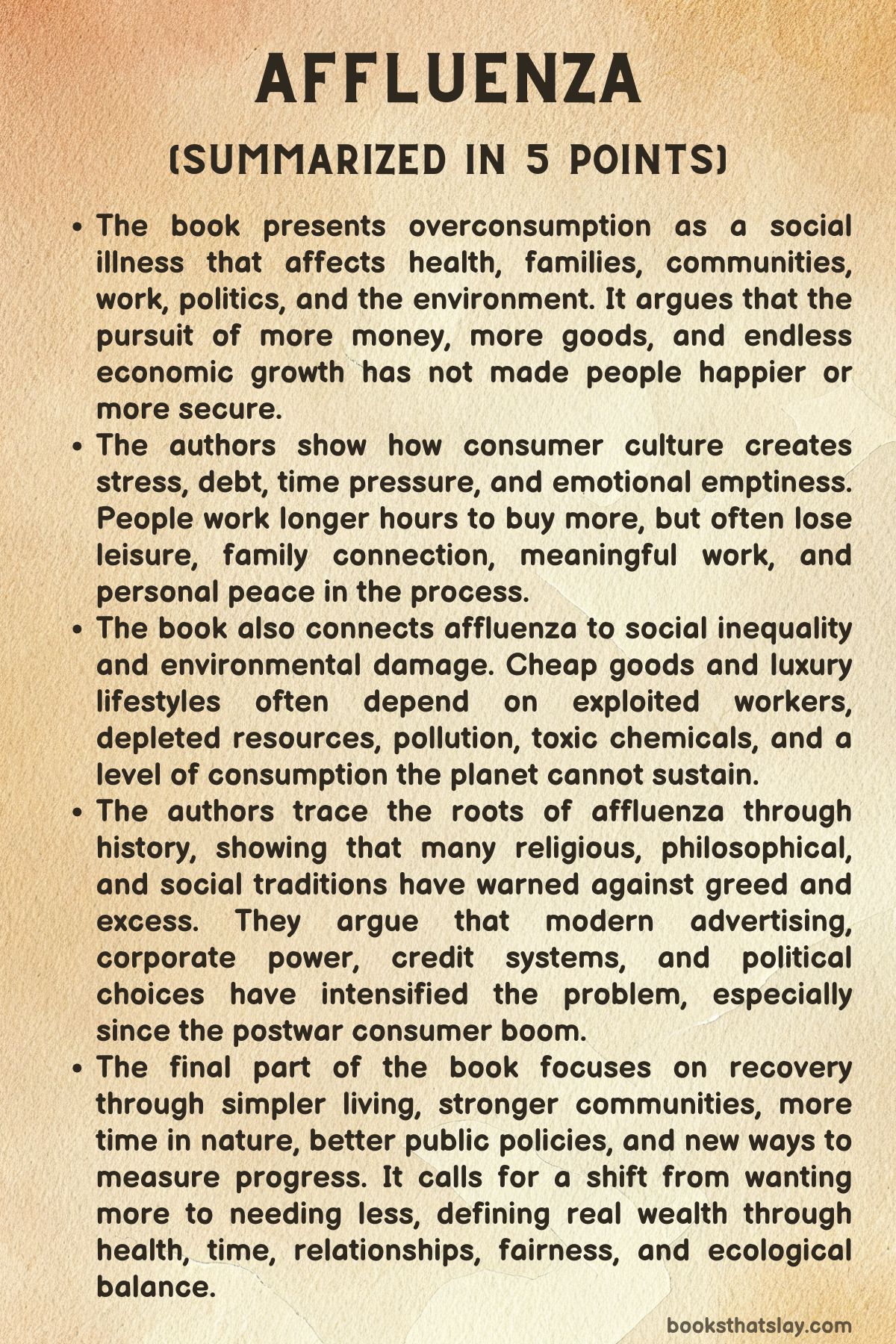
Affluenza presents overconsumption as an epidemic. The authors use the word “affluenza” to describe a condition in which people, corporations, and governments become obsessed with growth, profit, possessions, and the promise that buying more will lead to happiness.
The book began as a public television documentary and later became a broader argument about American consumer culture and its global spread. Its central claim is that the modern economy has trained people to confuse wealth with well-being, while hiding the damage caused by that confusion.
The authors begin by placing modern consumption in the long history of the planet. Human beings have existed for only a tiny fraction of Earth’s history, and industrial consumer society is even more recent.
Yet in that short time, humanity has used extraordinary amounts of energy, land, water, minerals, and other species. The book argues that the post-World War II boom created a new expectation of abundance: larger homes, bigger cars, more appliances, more gadgets, more shopping, and more convenience.
But this rising material comfort has not produced a matching rise in happiness. People own more than earlier generations did, yet often feel more anxious, indebted, and dissatisfied.
One major symptom of affluenza is the domination of life by possessions. Homes have grown, garages have expanded, and storage needs have multiplied because people keep acquiring more than they need.
The authors ask whether people own their things or whether their things own them. Consumer identity has become a social language: clothing, cars, entertainment choices, food, and home design are treated as proof of personality and status.
Advertising and social pressure push people to keep spending, making consumption seem like the normal way to belong, succeed, and express oneself.
This way of life also damages time. People work longer and harder to afford the lifestyles they are told they should want.
The book describes a “time famine,” where work expands while leisure, rest, and family life shrink. Increased productivity has not necessarily given American workers shorter hours or greater freedom.
Instead, many workers feel pressured to skip vacations, stay constantly available, and prove commitment through exhaustion. The authors compare this with parts of Europe, where productivity gains have more often been matched by shorter working hours and longer vacations.
In the United States, the result is stress, poor health, and a sense that life is being traded away for income and goods.
Families and children are also affected. Parents working long hours have less time for one another and for their children.
Family life becomes a matter of scheduling, transporting, managing, and consuming. Television and digital media fill exhausted households with entertainment and advertising.
Children are treated as consumers from an early age, and marketers learn how to influence their desires, sometimes by encouraging them to pressure or resist their parents. The authors connect this consumer pressure with childhood obesity, depression, anxiety, reduced outdoor play, and weakened family bonds.
The illness spreads into communities. Local businesses, public spaces, and neighborly relationships are weakened by large retail chains and corporate development.
When chain stores replace locally rooted shops, money often leaves the community instead of circulating within it. Public gathering places disappear, and private consumption replaces shared civic life.
Gated communities, distrust, and isolation become signs of social withdrawal. The authors argue that real community depends on places where people meet, talk, cooperate, and recognize one another, not just places where they shop.
The book also examines the emotional and spiritual costs of consumer culture. The authors argue that many people work at jobs they do not find meaningful in order to buy things that do not bring lasting satisfaction.
Religious, philosophical, and ethical traditions have long warned against greed and excessive attachment to possessions. Affluenza draws on these traditions to show that the problem is not only economic but moral and psychological.
A society can become materially rich while leaving people lonely, depressed, and unsure of their purpose.
Inequality is another major symptom. The benefits of consumer capitalism are not evenly shared.
Corporate executives and the wealthy gain enormous rewards, while low-wage workers struggle to survive and often produce the cheap goods that richer consumers enjoy. The book points to factory disasters and exploited labor as examples of the hidden human price behind inexpensive toys, clothing, and household products.
The dream of material success spreads across the world, but the suffering required to support that dream is often pushed onto poorer workers and poorer nations.
The environmental damage is severe. The authors argue that humanity’s ecological footprint exceeds what the planet can sustain.
Fossil fuels, industrial agriculture, mining, chemical production, and waste all show the destructive side of growth without limits. Even renewable technologies require minerals and resources that can create new conflicts and environmental pressures.
Everyday consumer goods also release chemicals into homes, waterways, soil, and bodies. Many substances are poorly tested, and their long-term effects on people, animals, and ecosystems remain dangerous.
Affluenza therefore harms not only human society but the living systems that support it.
The second part of Affluenza looks at the causes of the epidemic. The authors note that warnings against greed are ancient.
Religious traditions, Indigenous cultures, Buddhism, classical philosophy, and Christian teachings have all praised moderation and criticized excess. Early American groups such as Puritans and Quakers also rejected luxury and material corruption.
Later thinkers, including Henry David Thoreau, urged simplicity and a life closer to nature. The book argues that affluenza is not inevitable human nature.
Human beings are capable of restraint, cooperation, and contentment when culture supports those values.
The authors also describe a missed historical opportunity. In earlier periods of American labor activism, many workers fought not only for higher wages but for shorter hours and more free time.
The idea was that economic progress should give people richer lives outside work. Some reformers and business leaders supported shorter workweeks without destroying productivity.
Yet after World War II, the United States largely chose a different path: increased production, suburban expansion, highways, credit, advertising, television, and shopping malls. The “good life” became tied to buying goods.
From the 1980s onward, consumer culture intensified. Deregulation, tax policies favoring the wealthy, corporate power, and aggressive advertising all helped spread affluenza.
Advertising becomes one of the book’s main villains because it creates dissatisfaction and then sells products as the cure. It enters television, public spaces, schools, the internet, and daily life.
The authors also connect affluenza to the 2008 financial crisis, arguing that risky borrowing, inflated housing dreams, and corporate greed were symptoms of a society living beyond its means. Public relations and lobbying then protect corporate interests by shaping media coverage, influencing politics, and hiding environmental or social harm.
The final part of Affluenza turns toward recovery. The authors first encourage readers to diagnose their own consumer habits and ask whether their spending, debt, work, and desires are improving their lives.
They then present models of voluntary simplicity. People such as Joe Dominguez and Vicki Robin teach readers to track money, time, and fulfillment so they can identify the point at which they have enough.
Others reduce their ecological footprint by living with less energy, fewer possessions, or more local resources. These examples are not presented as perfect rules for everyone but as proof that another way of living is possible.
Community support matters in recovery. Simplicity groups, environmental organizations, reading circles, and online networks help people resist the pressure to consume.
Nature is another form of healing. The authors argue that time outdoors improves health, reduces stress, strengthens relationships, and helps children develop curiosity and respect for the natural world.
Gardening, walking, outdoor play, and environmental protection become practical remedies for a culture trapped indoors with screens and advertisements.
The book also proposes economic and political reforms. Personal change alone cannot solve the problem.
The authors call for shorter working hours, fairer taxes, corporate accountability, green energy investment, reduced subsidies for destructive industries, limits on advertising to children, campaign finance reform, and better measures of national well-being. They criticize GDP because it counts economic activity without asking whether that activity improves life.
Pollution cleanup, medical bills, crime costs, and overwork can all raise GDP while making society worse. Alternative measures such as the Genuine Progress Indicator and happiness indexes offer broader ways to judge health, leisure, equality, sustainability, and real quality of life.
In the end, Affluenza argues for a cultural shift from wanting more to needing less. The cure is not poverty or joyless sacrifice.
It is a richer definition of wealth: time, health, friendship, meaningful work, nature, fairness, creativity, and community. The authors believe human beings are adaptable and cooperative enough to change course.
By rejecting endless consumption and rebuilding life around enough, society can become cleaner, calmer, fairer, and more genuinely satisfying.
Key People
John de Graaf, David Wann, and Thomas Naylor
John de Graaf, David Wann, and Thomas Naylor function as guiding voices who shape the reader’s understanding of consumer culture as a public health crisis. Their role is diagnostic, argumentative, and reform-minded.
They do not simply criticize shopping or personal spending habits; they present overconsumption as a system that affects labor, politics, family life, emotional well-being, and the environment. Their collective voice in Affluenza is urgent but practical.
They rely on examples from history, economics, environmental studies, psychology, and activism to show that consumer culture is not just a private lifestyle choice but a social condition with wide consequences. Their perspective is also moral without being narrowly partisan.
They try to appeal to readers across political lines by showing that stress, debt, inequality, ecological damage, and loss of community are problems that affect people regardless of ideology. As narrators and analysts, they move between warning and solution, making them the central interpretive presence in the work.
The American Consumer
The American consumer is one of the most important collective figures in the book. This figure represents ordinary people who have been trained to equate success with acquisition.
The consumer is not portrayed as evil or foolish, but as pressured, anxious, and often trapped in a system that constantly creates new desires. Larger homes, expensive vacations, new technologies, fashionable clothes, cars, and branded lifestyles become signs of identity and achievement.
Yet this figure is also deeply dissatisfied. The consumer buys more while feeling less secure, works longer while having less time, and accumulates possessions while losing connection with family, nature, and community.
The American consumer’s tragedy is that the promised reward never fully arrives. Each purchase offers a brief sense of satisfaction, but the larger emptiness remains.
This figure shows how consumer culture creates a cycle of wanting, buying, debt, stress, and renewed wanting. Through this collective character, the authors show that overconsumption is not merely about greed; it is also about loneliness, social comparison, and the fear of falling behind.
The Jones Family
The fictional Jones family represents the idealized middle-class household that consumer society encourages everyone to imitate. They are the people others are told to “keep up with,” and their lives appear successful from the outside.
Yet beneath that image, they are exhausted, indebted, overworked, and emotionally disconnected. Their importance lies in the gap between appearance and reality.
They have the goods associated with success, but not the peace, time, or intimacy that a meaningful life requires. When they finally reject the race for more, they become a symbolic turning point in the book’s argument.
Their decision to live better on less shows that recovery begins when people recognize that the consumer dream has become a burden. The Jones family also helps personalize the book’s larger social critique.
Instead of presenting affluenza only through statistics and environmental warnings, the authors use this family to show how the illness enters daily routines, marriages, parenting, finances, and emotional life.
Children
Children are presented as some of the most vulnerable figures affected by consumer culture. They are not simply young members of families; they are targeted consumers whose desires are carefully studied and shaped by advertisers.
The book shows how corporations recognize children as a powerful market because they influence household spending and develop brand loyalty early. This makes childhood less protected and more commercialized.
Children are exposed to advertising through television, schools, digital media, toys, food, and entertainment. Their natural curiosity and need for play are redirected toward products, screens, and structured activities designed to prepare them for future competition.
The result is a childhood marked by pressure, reduced outdoor freedom, less imaginative play, and rising physical and emotional problems. Children also reveal the long-term danger of affluenza because they inherit its habits before they are old enough to question them.
If they learn that happiness comes from buying, status, and instant satisfaction, the cycle continues into the next generation.
Parents
Parents appear as strained figures caught between love, responsibility, financial pressure, and cultural expectation. They want to give their children security and opportunity, but the consumer economy often turns those desires into overwork and over-scheduling.
Many parents become managers of busy family lives, arranging activities, school demands, purchases, and entertainment while having little time for rest or genuine connection. Their difficulty is not caused by personal failure alone; it is shaped by an economy that often requires two incomes, long hours, and constant spending to maintain a socially acceptable standard of living.
Parents are also placed in conflict with advertisers, who encourage children to demand products and resist limits. This weakens parental authority and turns family relationships into negotiations over consumption.
The parent figure therefore shows how affluenza damages care. Love becomes mixed with purchasing power, and family time is often replaced by the effort to afford the lifestyle that families are told they need.
Workers
Workers are central to the book’s critique of modern economic life. They represent the people whose time, energy, and health are consumed by the demand for endless production and spending.
The authors describe workers as more productive than earlier generations, yet often less free. Instead of enjoying shorter hours and greater leisure as productivity rises, many workers experience longer workweeks, unused vacations, stress, stagnant wages, and declining savings.
Work becomes less a path to meaning and more a means of maintaining debt-driven consumption. The worker is also divided by class.
Some people perform low-paid labor to produce cheap goods for others, while corporate executives gain enormous rewards from the same system. The book’s worker figure therefore exposes the unfairness beneath consumer abundance.
The goods on store shelves often depend on invisible labor, poor conditions, and limited choices. At the same time, even better-paid workers may feel trapped by demanding jobs that leave little room for family, citizenship, nature, or self-development.
Corporate Executives
Corporate executives represent the upper tier of the affluenza system: those who benefit most from growth, deregulation, advertising, and profit maximization. They are not described as isolated villains in a simple moral drama, but as actors within an economic structure that rewards expansion above responsibility.
Their salaries and assets rise while many workers struggle, and their companies often externalize costs onto communities, ecosystems, and future generations. Corporate executives embody the belief that economic success can be measured by profits, market share, and shareholder returns, even when those gains produce pollution, inequality, debt, or social breakdown.
They also influence politics through lobbying and public relations, helping protect the system from serious reform. In this sense, they are powerful because they shape both material conditions and public perception.
Their role in the book is to show how affluenza is not only a personal weakness but also an institutional force supported by wealth, law, media, and political access.
Advertisers and Public Relations Experts
Advertisers and public relations experts are among the most active carriers of the consumer illness described in the book. They create dissatisfaction, attach emotional meaning to products, and persuade people that identity can be purchased.
Their work depends on the gap between what people have and what they can be made to want. Advertisers sell not only objects but status, beauty, rebellion, comfort, romance, youth, and belonging.
This makes them especially powerful in shaping children, families, and social expectations. Public relations experts perform a related but more defensive role.
They protect corporations by softening harmful truths, creating front groups, influencing media narratives, and presenting corporate interests as public interests. Together, these figures control desire and information.
They help explain why affluenza spreads so effectively: people are not merely choosing freely in a neutral marketplace; they are surrounded by highly developed messages designed to keep them consuming and to prevent them from seeing the full cost of consumption.
Local Business Owners and Community Members
Local business owners and community members represent the social world threatened by large-scale consumer capitalism. They are associated with neighborhood memory, personal relationships, public gathering places, and money that remains within the community.
Their value is not only economic but human. A local shopkeeper, a town square, or a familiar neighbor creates forms of belonging that cannot be replaced by a chain store or online transaction.
The decline of these figures marks the weakening of civic life. When big-box stores and national chains dominate, communities may gain convenience and low prices, but they lose distinctiveness, face-to-face trust, and shared public space.
The book presents this loss as one of affluenza’s quieter but serious injuries. People become customers instead of neighbors, and towns become commercial zones instead of living communities.
These figures remind the reader that a healthy society depends on more than purchasing options; it requires relationships, memory, participation, and common places.
Al Norman
Al Norman appears as a figure of resistance against corporate expansion. His successful effort to block a major retail chain from entering his small town makes him an example of local activism and civic courage.
He represents the idea that communities are not helpless before corporate power. His importance lies in action rather than theory.
While much of the book explains the scale of the problem, Norman shows that ordinary citizens can organize, argue, resist, and sometimes win. He also challenges the assumption that economic development is always beneficial.
For him, a new large store is not simply a source of convenience or jobs; it may threaten local businesses, weaken community ties, and redirect profits away from the area. Norman’s role is therefore practical and symbolic.
He embodies the possibility of saying no to a model of growth that appears inevitable. His example supports the authors’ belief that recovery from affluenza requires public action, not just private restraint.
Joe Dominguez and Vicki Robin
Joe Dominguez and Vicki Robin represent financial self-awareness and voluntary simplicity. Their approach asks people to examine the real relationship between money, time, work, and satisfaction.
Dominguez’s early retirement after reducing expenses gives the book a concrete example of how freedom can come not from earning endlessly but from needing less. Robin’s work with him extends this insight into a larger philosophy of life.
Their key contribution is the idea that spending should be measured against fulfillment. Necessary spending can support well-being, but excess consumption often produces clutter, debt, and dissatisfaction.
They encourage people to identify the point of “enough,” where additional spending no longer improves life. As figures in the book, they are healers rather than critics alone.
They offer a method for recovery that is personal, disciplined, and empowering. Their presence shows that escaping affluenza does not require rejecting comfort entirely; it requires understanding what genuinely adds value and what merely consumes life energy.
Bill Powers
Bill Powers represents radical simplification and the search for inner freedom. After living in Bolivia and later choosing a small home without electricity, he becomes an example of someone who tests the limits of modern dependency on convenience, technology, and space.
His life challenges the assumption that comfort always requires more energy, more possessions, and more square footage. Powers’s importance lies in his attention to the “inner acre,” the personal space of thought, peace, meaning, and self-knowledge that consumer society often neglects.
By reducing external noise and material demand, he creates room for a different kind of richness. He is not presented as a model everyone must copy exactly, but as proof that many ordinary expectations are optional.
His example asks readers to consider how much of modern life is truly necessary and how much exists because people have been trained to fear simplicity.
Colin Beavan
Colin Beavan, known through the No Impact Man project, represents experimental environmental responsibility. His attempt to reduce his family’s ecological footprint in New York City is extreme, visible, and intentionally challenging.
He shows what happens when environmental concern becomes a daily practice rather than a distant opinion. Living with less electricity, avoiding non-local food, and rejecting many conveniences forces him and his family to confront the hidden systems that support ordinary consumption.
His character is important because he brings environmental ethics into the home. Climate change, waste, energy use, transportation, and food systems are no longer abstract public issues; they become questions of routine and habit.
Like other simplicity figures in Affluenza, Beavan is not offered as an easy standard for all readers. Instead, he expands the reader’s sense of what can be questioned.
His experiment shows that ordinary modern life has an environmental cost, and that meaningful change begins when people make that cost visible.
Kalle Lasn
Kalle Lasn represents cultural resistance to advertising and consumer manipulation. As the founder of Adbusters and a promoter of Buy Nothing Day, he fights affluenza at the level of symbols, images, slogans, and public behavior.
His method is not quiet withdrawal but active disruption of consumer messages. By parodying advertisements and encouraging people to avoid shopping on one of the biggest retail days of the year, he tries to break the spell of commercial culture.
Lasn understands that consumerism works partly by making itself look natural, fun, and unavoidable. His activism exposes its absurdity and invites people to laugh at, question, and resist it.
He is important because he recognizes that recovery from overconsumption requires media literacy as well as personal discipline. People must learn to read advertisements critically, especially when those messages target insecurity, status anxiety, and childhood desire.
Duane Elgin
Duane Elgin represents the philosophical and communal side of voluntary simplicity. His work encourages people to choose lives of outward moderation and inward richness.
In the book, he appears as an elder voice in the simplicity movement, someone who has long argued that a meaningful life cannot be built on endless acquisition. His optimism is cautious because he recognizes both the scale of the crisis and the growing number of people searching for alternatives.
Elgin’s importance lies in his ability to connect personal change with social transformation. Simplicity is not only a private lifestyle preference; it becomes a cultural movement when people gather, discuss, support one another, and create new norms.
He also shows that anti-consumer living does not have to be grim or joyless. It can involve deeper relationships, clearer priorities, more time, and a stronger sense of purpose.
Environmental Activists
Environmental activists in the book represent moral urgency and public courage. Figures who risk arrest or public criticism to oppose destructive energy practices show that the environmental costs of consumer culture demand more than quiet concern.
These activists recognize that climate change, resource depletion, pollution, and habitat destruction are not distant problems. They are consequences of a lifestyle built on cheap energy, disposable goods, and constant growth.
Their role is to force attention where corporations and governments often prefer silence. They also challenge the reader’s comfort.
It is easier to recycle occasionally or buy a greener product than to confront the systems that make ecological damage profitable. Environmental activists therefore represent the outer edge of the book’s call to action.
They show that serious recovery from affluenza may require risk, protest, and collective pressure.
Themes
Consumerism and the False Promise of Happiness
Consumer culture in Affluenza operates by teaching people to treat desire as need and possession as fulfillment. The book argues that modern society has become organized around the belief that buying more will make life better, but the evidence repeatedly points in the opposite direction.
People have larger homes, more products, better technology, and easier access to goods than previous generations, yet they often report stress, loneliness, debt, and dissatisfaction. This contradiction is central to the authors’ argument.
Consumption promises emotional repair: a product will make someone feel attractive, successful, secure, modern, loved, or admired. But because the satisfaction is temporary, the consumer is soon pushed toward the next purchase.
Advertising strengthens this cycle by creating insecurity and then selling relief. The theme is not a simple rejection of material comfort.
The authors accept that food, shelter, health, and basic security matter. Their criticism is aimed at excess: the point where buying stops serving life and begins controlling it.
The book asks readers to distinguish between comfort and clutter, between enough and endless wanting, and between real well-being and the commercial image of success.
Work, Time, and the Loss of Freedom
The book presents time as one of the greatest casualties of consumer culture. People work longer hours to afford lifestyles shaped by advertising, debt, housing costs, status expectations, and the constant arrival of new products.
The result is not freedom but exhaustion. The authors show that rising productivity could have created shorter workweeks, longer vacations, and more leisure.
Instead, many workers experience time famine, where paid labor expands and life outside work contracts. This theme challenges a common idea of progress.
If a society becomes richer but its people have less time to rest, parent, think, play, volunteer, create, or enjoy nature, then its progress is incomplete. Work becomes especially damaging when it loses meaning and serves mainly as a way to maintain consumption.
The authors contrast this with historical movements that fought for shorter hours and with examples of workplaces where reduced schedules improved quality of life. The deeper argument is that time is a form of wealth.
A culture that values only income forgets that a human life is made of hours, attention, relationships, and energy. Recovery from affluenza therefore requires reclaiming time from the demands of production and consumption.
The Erosion of Community and Family Life
Affluenza weakens the relationships that make life stable and meaningful. Families suffer when parents work long hours, children are heavily marketed to, and shared time is replaced by screens, shopping, structured activities, and fatigue.
The home may contain more goods than ever, but emotional connection can become thinner. The authors show how consumer culture turns even family love into a marketplace, where parents feel pressure to provide products and experiences as proof of care, while children learn to express desire through brands and purchases.
The same damage appears in local communities. Chain stores, malls, and online shopping may offer convenience, but they often replace local businesses and public gathering places that once supported neighborly life.
When people no longer meet in shared spaces, trust declines and isolation grows. Gated communities become a physical symbol of this withdrawal.
The book’s treatment of community is not merely nostalgic; it argues that human beings need repeated, face-to-face contact, local memory, and shared responsibility. A healthy society cannot be built only through private ownership and commercial exchange.
It also needs belonging, cooperation, conversation, and public life.
Environmental Limits and the Need for Cultural Change
The environmental theme rests on the claim that endless growth is impossible on a finite planet. The authors connect ordinary consumer habits to resource extraction, fossil fuel use, toxic chemicals, waste, climate change, and the destruction of ecosystems.
The problem is not only that individuals buy too much; it is that the entire economic system depends on producing, selling, discarding, and replacing goods at a pace the Earth cannot sustain. The book’s discussion of ecological footprints shows that humanity is already using more than the planet can regenerate.
Industrial production also spreads hidden harms through pesticides, chemicals, mining, sewage, and pollution that affect animals, water, air, and human health. This theme gives the book its urgency.
Personal stress and debt are serious, but environmental collapse threatens the conditions of life itself. The authors argue that greener products alone are not enough if the culture still demands endless consumption.
Real change requires wanting less, wasting less, working differently, measuring progress differently, and designing economies around well-being rather than constant expansion. Environmental recovery therefore depends on cultural recovery.
Society must redefine prosperity before it can live within ecological limits.