Aeneid by Virgil Summary, Characters and Themes
Aeneid by Virgil is a Roman epic about Aeneas, a Trojan survivor chosen by fate to reach Italy and begin the line that will lead to Rome. Written during the age of Augustus, the poem connects myth, memory, war, duty, loss, and empire.
Aeneas is not simply an adventurer; he is a man forced to sacrifice personal happiness for a larger destiny. The poem moves from Troy’s destruction to Carthage, Sicily, the Underworld, and finally Italy, where Aeneas must fight for the future promised to him by the gods.
Summary
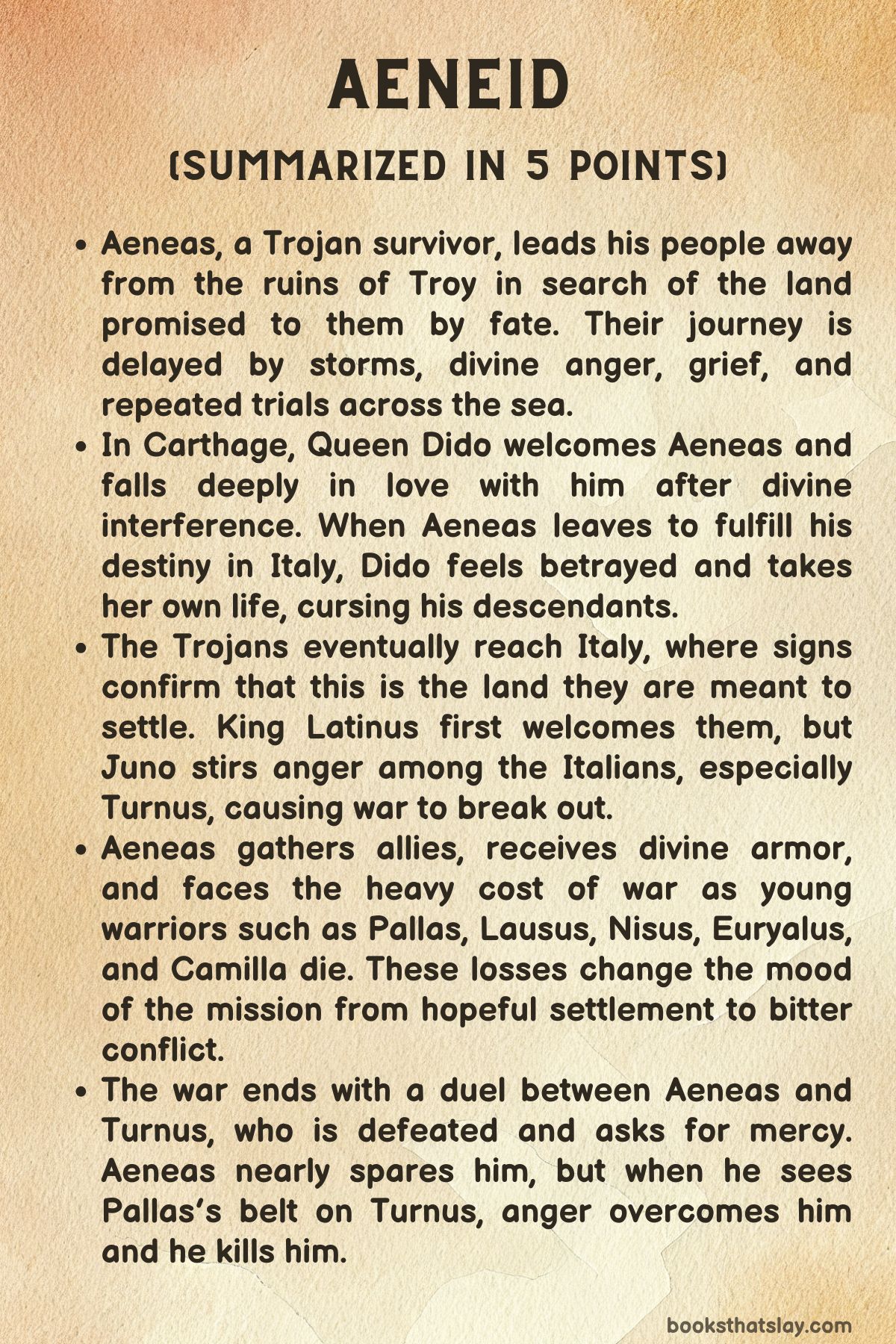
Aeneid begins with Aeneas and the Trojan survivors still wandering after the fall of Troy. They are trying to reach Italy, where fate has promised that Aeneas will found the people who will become the Romans.
Their journey is opposed by Juno, who hates the Trojans because of old insults and because she knows their descendants will one day destroy her beloved city, Carthage. She persuades Aeolus to release the winds against the Trojan fleet, and the storm scatters and damages their ships.
Neptune calms the sea, but the Trojans are forced onto the coast of Libya.
Aeneas hides his despair from his men and encourages them to endure. Meanwhile Venus, his mother, asks Jupiter why Aeneas suffers despite his destiny.
Jupiter assures her that fate has not changed: Aeneas will reach Italy, his descendants will rule, and Rome will rise to power. Venus then appears to Aeneas in disguise and tells him about Dido, queen of Carthage, who escaped from Tyre after her brother murdered her husband.
Venus protects Aeneas with a mist so he can enter Carthage unseen.
In the city, Aeneas sees Dido building a strong new kingdom. He also sees scenes from the Trojan War carved on a temple and is moved by the memory of his destroyed home.
Dido welcomes the shipwrecked Trojans with kindness and offers them aid or a place in Carthage. Venus, fearing that Juno may use Dido to delay Aeneas, sends Cupid disguised as Aeneas’s son Ascanius to make Dido fall in love with him.
At a feast, Dido asks Aeneas to tell the story of Troy’s fall.
Aeneas recounts how the Greeks, after ten years of war, pretended to sail away and left behind the wooden horse. The Trojans argued over whether to destroy it, but Sinon, a Greek spy, tricked them into believing it was a sacred offering.
When sea serpents killed the priest Laocoon and his sons after Laocoon warned against the horse, the Trojans took the event as a divine sign and dragged the horse into the city. That night, Greek warriors hidden inside opened the gates to the army.
Troy burned. Aeneas first rushed into battle, hoping to die fighting, but the ghost of Hector and later Venus reminded him that his duty was to save his family and the household gods.
He carried his father Anchises on his shoulders and led his son Ascanius by the hand, but his wife Creusa was lost in the chaos. Her ghost told him that he had another destiny and another marriage waiting in the west.
Aeneas gathered the survivors and left Troy behind.
He then tells Dido of the Trojans’ long search for a new home. They tried to settle in Thrace, but a terrible omen revealed the murdered Trojan prince Polydorus beneath the ground.
They sailed to Delos, where Apollo’s oracle told them to seek their ancient motherland. Anchises misunderstood this as Crete, but plague drove them away.
The household gods later revealed that Italy was the true destination. The Trojans faced storms, Harpies, and the prophecy that hunger would force them to eat their tables.
They visited a second Troy ruled by Helenus and Andromache, who warned Aeneas of dangers ahead and told him to consult the Sibyl at Cumae. In Sicily, Anchises died, a loss Aeneas calls his hardest trial.
Dido’s love for Aeneas grows until she neglects Carthage. Juno and Venus arrange for Aeneas and Dido to shelter together in a cave during a storm, and Dido treats the union as marriage.
Jupiter, seeing Aeneas forget his mission, sends Mercury to remind him that Italy, not Carthage, is his destiny. Aeneas prepares to leave, though he is pained by the decision.
Dido begs him to stay, accuses him of betrayal, and finally curses him and his descendants. After he sails away, she kills herself on a pyre with his sword, leaving behind a hatred that foreshadows Rome’s future conflict with Carthage.
The Trojans return to Sicily, where Aeneas holds funeral games for Anchises. The contests include racing, boxing, archery, and displays of horsemanship.
During the festivities, Juno sends Iris to stir the Trojan women, who are exhausted by years of wandering, into burning the ships. Jupiter sends rain to stop the fire, but some ships are lost.
Aeneas is advised to leave behind those who no longer wish to travel. Anchises appears in a dream and tells him to visit the Underworld before the final struggle in Italy.
Neptune promises Venus that the fleet will reach Italy safely, though one man must be sacrificed; the helmsman Palinurus falls into the sea.
At Cumae, Aeneas meets the Sibyl, who agrees to guide him into the Underworld after he finds the golden bough and buries his dead comrade Misenus. Venus helps him find the bough.
In the Underworld, Aeneas sees souls waiting for burial, the punished wicked, and the blessed dead in Elysium. He encounters Dido, who refuses to speak to him and returns to her first husband.
He then meets Anchises, who explains the journey of souls and shows him future Roman heroes. Aeneas sees that his suffering serves a vast historical purpose.
Anchises teaches him that Rome’s mission will be to rule with order, spare the humbled, and defeat the proud.
The Trojans finally reach Latium in Italy. King Latinus has been told by an oracle that his daughter Lavinia must marry a foreigner, though she has been promised to Turnus, a powerful local prince favored by Queen Amata.
The Trojans recognize the fulfillment of the Harpies’ prophecy when they eat the flatbread used as tables beneath their meal. Latinus receives their envoys peacefully and offers alliance, but Juno refuses to accept an easy settlement.
She sends the Fury Allecto to inflame Amata, Turnus, and the countryside. Ascanius is tricked into shooting a beloved pet deer, and violence breaks out.
Latinus refuses to open the gates of war, so Juno opens them herself.
As war begins, Aeneas seeks allies. The river god Tiber tells him to visit Evander, an Arcadian king living on the future site of Rome.
Evander welcomes him, tells him stories of the land, and places his son Pallas under Aeneas’s care. Venus persuades Vulcan to forge divine armor for Aeneas, including a shield decorated with future Roman history, though Aeneas cannot understand the scenes.
While Aeneas is away, Turnus attacks the Trojan camp. The young warriors Nisus and Euryalus try to sneak out to reach Aeneas but are killed after slaughtering sleeping enemies and taking spoils.
Their deaths deepen the grief and brutality of the war.
Aeneas returns with Etruscan allies. In battle, Turnus kills Pallas and takes his belt.
Aeneas, enraged, becomes merciless and cuts down enemies who plead for life. Juno briefly saves Turnus by luring him away with a false image of Aeneas.
Later, Aeneas kills Lausus, the noble son of the cruel Mezentius, and then kills Mezentius himself after the father returns in grief to avenge his son. The war pauses for burials, and pressure grows on Turnus to end the conflict by facing Aeneas alone.
The warrior Camilla leads the Italian cavalry with great success but is killed after being distracted by a soldier’s fine armor. Her death breaks the Latin defense.
Turnus finally agrees to single combat with Aeneas. A treaty is arranged: if Aeneas wins, Trojans and Latins will unite; if Turnus wins, the Trojans will leave.
Juno urges Turnus’s sister Juturna to delay his death, and she incites the Italians to break the truce. Aeneas is wounded but healed by Venus.
The battle resumes until Aeneas attacks the city itself. Queen Amata, believing Turnus dead, hangs herself.
Turnus, ashamed and unable to keep avoiding fate, calls for the duel.
Aeneas and Turnus fight before both armies. Turnus’s sword breaks, and Juturna helps him recover his true weapon.
Jupiter orders Juno to stop resisting fate. Juno accepts, on the condition that the Trojans lose their separate name and become part of the Latin people.
Jupiter agrees, promising a new race stronger than either side alone. Turnus is abandoned by divine help and wounded by Aeneas.
He admits defeat and asks only that his body be returned to his father. Aeneas nearly spares him, but then he sees Pallas’s belt on Turnus.
Remembering the young man entrusted to him, Aeneas kills Turnus in anger. The poem ends with Turnus’s soul going down to the dead.
Characters
Aeneas
Aeneas is the central figure of Aeneid, a survivor of Troy whose life is shaped by duty rather than personal desire. He is brave, but his heroism is different from the reckless glory-seeking of many warriors around him.
His defining quality is responsibility: he carries his father from burning Troy, protects his son, preserves the household gods, and accepts the burden of founding a future nation. Yet he is not emotionless.
He grieves for Troy, longs for peace, loves Dido, mourns Pallas, and is repeatedly shaken by loss. His tragedy is that fate demands sacrifices from him again and again.
By the end, his killing of Turnus shows the dark cost of war and duty. He becomes the founder figure Rome needs, but not without losing part of his gentleness.
Dido
Dido is one of the most powerful and tragic figures in the poem. She begins as a capable ruler who has escaped betrayal, founded Carthage, and built a thriving society through intelligence and discipline.
Her hospitality toward the Trojans shows her generosity and political confidence. Her love for Aeneas, however, gradually breaks the structure of her life.
What makes her tragedy so strong is that her emotional collapse is not simple weakness; she has already suffered abandonment, exile, and the murder of her husband. Aeneas’s departure reopens those wounds and leaves her politically exposed.
Her curse against Aeneas and his descendants turns private pain into historical hatred. Dido represents love wounded by destiny, and her death leaves a moral shadow over Aeneas’s mission.
Turnus
Turnus is Aeneas’s main human opponent, but he is not merely a villain. He is proud, courageous, passionate, and deeply attached to honor.
His claim to Lavinia and his place in Latium give him a real reason to feel threatened by Aeneas’s arrival. Juno and Allecto inflame his anger, but they do not invent it.
Turnus already carries the pride of a young warrior who believes his reputation and inheritance are being stolen. His great flaw is that he confuses personal honor with justice.
He often acts boldly, but his courage is mixed with rage, vanity, and poor judgment. His killing of Pallas becomes the act that seals his fate.
In defeat, however, he regains some dignity by accepting the outcome and asking only that his body be returned to his father.
Juno
Juno is the divine force of resistance throughout Aeneid. Her hatred of the Trojans comes from old wounds, offended pride, and fear for Carthage’s future.
She knows that fate cannot be completely overturned, yet she tries to delay it through storms, passion, madness, and war. Juno is not irrational in a simple sense; she sees clearly that the rise of Rome will mean the eventual ruin of peoples and cities she loves.
Her opposition gives the poem much of its conflict. She represents the pain of those crushed by destiny’s forward motion.
By the end, she cannot save Turnus or prevent Aeneas’s victory, but she negotiates one final condition: the Trojans must merge with the Latins rather than dominate them as Trojans. This makes her defeat partial rather than absolute.
Venus
Venus is Aeneas’s divine mother and protector. Her love for him is fierce, practical, and often anxious.
She intervenes to save him from danger, guides him when he is confused, secures divine armor for him, and pleads his case before Jupiter. Yet her protection is not always morally clean.
Her use of Cupid to make Dido fall in love with Aeneas helps protect her son, but it also contributes to Dido’s ruin. Venus embodies maternal care in a world where divine help often harms someone else.
She wants Aeneas to survive and fulfill his destiny, but she is also part of the machinery that turns personal lives into instruments of fate.
Jupiter
Jupiter stands above the other gods as the guardian of fate. Unlike Juno and Venus, he does not act mainly from personal attachment, though he is not without feeling.
His role is to confirm that Aeneas’s destiny remains fixed despite suffering, delay, and divine interference. He allows conflict to unfold, sometimes seeming distant from the human pain beneath his decrees.
His authority brings order, but it also raises difficult questions about justice. If Rome’s future is certain, then the deaths of Dido, Pallas, Turnus, and countless others seem both tragic and unavoidable.
Jupiter represents cosmic order, but that order is not gentle. It demands obedience from gods and mortals alike.
Anchises
Anchises is Aeneas’s father and one of the poem’s strongest symbols of memory, tradition, and inherited duty. In Troy, he first refuses to leave, showing his attachment to the past, but divine signs persuade him to accept exile.
Aeneas carrying Anchises on his shoulders is one of the poem’s clearest images of responsibility: the future literally bears the past. After his death, Anchises remains spiritually central.
In the Underworld, he shows Aeneas the future Roman line and explains the larger meaning of his struggle. Anchises helps transform Aeneas’s mission from survival into historical purpose.
He is not only a beloved father but also the voice of ancestral command.
Ascanius
Ascanius, also called Iulus, represents the future that Aeneas must protect. As Aeneas’s son, he gives personal urgency to the mission of founding a new homeland.
He is still young, but the poem repeatedly places him near moments of destiny: the flame on his head in Troy, the recognition of the fulfilled prophecy in Italy, and his first act of warfare during the siege. Ascanius is both a child and a political symbol.
Through him, Aeneas’s private family line becomes linked to Roman history. His youth also heightens the cost of war, since the adults around him are fighting to decide the world he will inherit.
Latinus
Latinus is the king of Latium, and his tragedy lies in knowing the right course but lacking the strength to enforce it. He receives clear signs that Lavinia should marry a foreigner, and he recognizes Aeneas as that destined man.
His instinct is toward peace, alliance, and lawful settlement. Yet he is surrounded by stronger passions: Amata’s anger, Turnus’s pride, Juno’s hostility, and the fury of the local population.
Latinus becomes a figure of weak authority, a ruler who understands fate but cannot control his kingdom. His failure allows private resentment to grow into public war.
He is not evil, but his hesitation has terrible consequences.
Lavinia
Lavinia is central to the conflict, though she speaks very little. She is less an active political actor than the human focus of competing claims: daughter, bride, royal heir, and symbol of Latium’s future.
Her silence reflects the limited power of women in the political world of the poem, where marriages decide alliances and wars. Yet her presence matters deeply.
The question of whom she will marry becomes the question of what kind of nation will emerge in Italy. Her blush before Turnus reveals emotion, but the poem does not let her shape events directly.
Lavinia represents the future that others fight to possess, define, and control.
Amata
Amata is Latinus’s queen and one of the first human figures in Italy to resist Aeneas’s settlement. Her preference for Turnus is personal, political, and emotional.
She wants Lavinia to marry the man already chosen, and she sees Aeneas as an intruder who threatens her family’s order. When Allecto infects her with madness, her anger becomes public disorder.
She leads the women of the city into frenzy and helps turn domestic resistance into civil conflict. Amata’s suicide after believing Turnus dead shows how completely she has tied her hopes to him.
She is a tragic example of fear turning into destruction.
Pallas
Pallas is Evander’s young son and Aeneas’s apprentice in war. He is noble, brave, and eager to prove himself, but he is also inexperienced.
His relationship with Aeneas adds emotional weight to the Italian war, because Aeneas becomes responsible for him in place of Evander. Pallas’s death at Turnus’s hands changes the moral temperature of the poem.
Until then, Aeneas fights for destiny and survival; after Pallas dies, grief and vengeance begin to rule him. Pallas represents youth sacrificed to the ambitions and conflicts of older generations.
His belt, taken by Turnus, becomes the final reminder that prevents mercy at the poem’s end.
Evander
Evander is a wise and hospitable king whose small Arcadian settlement stands on the future site of Rome. He links the heroic past with Rome’s coming greatness.
Unlike many rulers in the poem, he welcomes alliance without arrogance. His affection for Anchises helps him trust Aeneas, and his decision to send Pallas with him is both politically useful and deeply personal.
Evander’s grief after Pallas’s death is one of the clearest statements of war’s cost. He does not celebrate glory in the abstract; he feels the unbearable pain of a father who has outlived his son.
Through Evander, the poem gives tenderness and sorrow to the idea of alliance.
Mezentius
Mezentius is introduced as a cruel and impious ruler, hated by his own people for tyranny. He stands outside the moral and religious order that characters like Aeneas try to uphold.
Yet Virgil complicates him through his love for Lausus. Mezentius may be brutal, but he is not incapable of human attachment.
His grief after Lausus dies reveals a broken father who understands too late the harm his life has caused. His final request to be buried with his son gives him a tragic dignity.
Mezentius shows that even morally corrupt figures can possess intense personal love, and that war exposes both guilt and vulnerability.
Lausus
Lausus is one of the poem’s purest young warriors. He is loyal, brave, and devoted to his father, even though Mezentius does not deserve such devotion.
His decision to step between Aeneas and Mezentius is an act of filial love, but it is also tragically misguided. Aeneas recognizes Lausus’s nobility after killing him, which makes the death especially painful.
Lausus resembles Pallas in youth and courage, and both young men are destroyed by a war shaped by older powers. His death humanizes Mezentius and forces Aeneas into a moment of pity.
Lausus represents innocence bound to a flawed parent and lost through loyalty.
Camilla
Camilla is a rare female warrior whose identity is built around speed, independence, and devotion to Diana. Raised outside normal society, she rejects marriage and domestic expectation, choosing the life of a fighter.
Her skill in battle is extraordinary, and she terrifies male opponents who cannot easily accept being defeated by a woman. Yet her death comes through distraction: she is drawn toward the beautiful armor of an enemy.
This detail does not erase her strength, but it makes her human rather than untouchable. Camilla’s story highlights both admiration for female martial power and the limits placed on it by the poem’s world.
She dies as a heroic outsider, mourned by Diana and avenged by Opis.
Nisus and Euryalus
Nisus and Euryalus are remembered for loyalty, beauty, bravery, and tragic recklessness. Their bond is one of the most emotionally intense relationships in the poem.
Nisus wants to protect Euryalus, while Euryalus refuses to abandon him. Their night mission begins as an act of courage but becomes morally stained when they slaughter sleeping enemies and take spoils.
Euryalus’s shining helmet gives them away, suggesting that the desire for glory can become fatal. Their deaths are moving because of their devotion to one another and because Euryalus’s mother is left to grieve publicly.
They represent youthful heroism at its most loving and most vulnerable.
The Sibyl
The Sibyl is Aeneas’s guide into the Underworld and a voice of sacred knowledge. She is stern, practical, and touched by divine power.
Unlike those who comfort Aeneas, she pushes him forward and tells him what must be done. Her role is to move him from uncertainty into revelation.
She helps him pass through death’s realm, confront lost figures such as Dido, and reach Anchises. The Sibyl belongs to the border between human and divine, life and death, ignorance and knowledge.
She does not soften the truth for Aeneas, and through her guidance he gains the vision needed to continue.
Palinurus
Palinurus is Aeneas’s faithful helmsman, a figure of duty who dies so that the rest of the Trojans may reach Italy. His death is not heroic in the usual battlefield sense, but it is sacrificial.
He falls into the sea after Sleep overcomes him, survives briefly, and is then killed on shore. When Aeneas meets him among the unburied dead, Palinurus’s fate reveals the harshness of the divine bargain behind the Trojans’ safe arrival.
He represents the loyal servant whose life is spent in service to a mission larger than himself. His loss reminds readers that destiny advances through the deaths of individuals who may never see its fulfillment.
Mercury
Mercury acts as the messenger of divine command. His most important function is to remind Aeneas that private happiness cannot replace public destiny.
When he finds Aeneas helping to build Carthage, Mercury sharply redirects him toward Italy. He is not concerned with Dido’s feelings or Aeneas’s emotional conflict; he speaks for duty, movement, and obedience.
Mercury’s intervention changes the course of the poem by ending the Carthaginian episode and forcing Aeneas to choose fate over love. He represents the cold clarity of command when human beings are tempted to settle into comfort.
Allecto
Allecto is the Fury Juno summons to start the Italian war. She is not a character of balanced motive but a force of infection, rage, and social breakdown.
She enters households, dreams, and communities, turning fear into violence. Through Amata, Turnus, and the killing of the deer, she transforms a possible alliance into open bloodshed.
Her power lies in exaggerating existing tensions until they become uncontrollable. Allecto shows that war does not begin only with armies; it begins when resentment, fear, and wounded pride are given permission to rule.
Juturna
Juturna, Turnus’s divine sister, is driven by love and helplessness. She knows that fate is turning against her brother, yet she cannot stop trying to save him.
Her actions delay the duel, break the treaty indirectly, and keep Turnus away from Aeneas for a time. Unlike Juno, whose resistance is broad and political, Juturna’s resistance is intimate.
She acts because she cannot bear the death of someone she loves. Her final withdrawal is deeply painful because it marks the moment when even divine affection must surrender to fate.
She gives the poem one of its clearest portraits of love struggling against the inevitable.
Sinon
Sinon is the Greek deceiver whose false story persuades the Trojans to bring the wooden horse into their city. He is skilled at emotional manipulation, presenting himself as a victim so convincingly that the Trojans pity and trust him.
His success depends not only on his lies but also on Trojan kindness. Through Sinon, the poem shows how compassion can be exploited in war.
He is not physically powerful, but his words destroy Troy more effectively than weapons could have done from outside the walls. Sinon represents deceit as a military force.
Laocoon
Laocoon is the Trojan priest who correctly warns his people against the wooden horse. His insight makes him one of the few figures who sees the danger clearly, but truth does not save him.
The sea serpents that kill him and his sons are misread by the Trojans as proof that he was wrong, when in reality his warning was accurate. Laocoon’s death captures one of the poem’s cruelest patterns: signs from the divine world can be misunderstood, and human beings often interpret events according to what they already want to believe.
He represents ignored wisdom and the tragic failure of clear judgment.
Helenus
Helenus is the Trojan prophet who helps Aeneas understand the path ahead. Having survived Troy and built a smaller imitation of the lost city, he lives in a world of memory and partial restoration.
His prophecies give Aeneas practical guidance, but his life also shows what Aeneas must not do: remain fixed in a copy of the past. Helenus preserves Trojan identity, yet Aeneas must move beyond preservation toward transformation.
As a seer, Helenus connects suffering with knowledge. He cannot remove hardship from Aeneas’s path, but he can help him read its signs.
Andromache
Andromache embodies the grief of Troy after its destruction. Once the wife of Hector, she has endured enslavement, loss, and forced remarriage before finding a fragile new life with Helenus.
Her recreated Troy is touching but also sad, because it cannot truly restore what was lost. When she meets Aeneas, she responds as someone still living among memories.
Andromache’s presence reminds the reader that survival is not the same as healing. She represents mourning that has become a way of life, and her story helps clarify why Aeneas cannot simply rebuild Troy as it was.
Themes
Duty and Personal Desire
Aeneas’s life is shaped by the conflict between what he wants and what he must do. He wants to defend Troy, remain with his family, love Dido, protect his companions, and spare himself more suffering.
Yet each time he is pulled back toward a mission that demands obedience. Duty in Aeneid is not presented as easy moral superiority.
It is heavy, painful, and often cruel. Aeneas leaving Dido may be required by fate, but the poem does not pretend that the decision is emotionally clean.
His duty to the future causes immediate human damage. The same pattern appears when he accepts responsibility for Pallas and later responds to the boy’s death with vengeance.
The poem asks whether public destiny can justify private suffering. Aeneas’s greatness lies in endurance, but his obedience also changes him.
By the end, the man who once carried his father through flames kills a defeated enemy in anger. Duty builds nations, but it can also harden the person chosen to serve it.
Fate, Divine Power, and Human Freedom
Fate governs the poem’s world, but it does not remove conflict. The gods know that Aeneas is destined to reach Italy, yet Juno delays him, Venus protects him, Jupiter regulates events, and lesser divine figures interfere in storms, love, war, and prophecy.
Human beings act with passion and choice, but their choices unfold inside a larger design they rarely understand. This creates a world where freedom is real but limited.
Dido chooses death, Turnus chooses combat, Latinus chooses hesitation, and Aeneas chooses obedience, yet all are trapped within forces older and stronger than themselves. The gods often make human suffering worse by using mortals as pieces in their own disputes.
Juno cannot stop Rome’s future, but she can increase the cost of reaching it. Venus can protect Aeneas, but her protection harms Dido.
Fate gives history direction, while divine power creates delay, confusion, and pain. The result is a vision of destiny that is majestic but unsettling, because order arrives through grief.
War, Violence, and Moral Damage
War in the poem is not treated as simple glory. It can produce courage, loyalty, and public honor, but it also destroys families, corrupts judgment, and turns grief into brutality.
The fall of Troy shows war as terror: homes burn, sacred spaces are violated, the old are killed, and families are scattered. The Italian war begins from manipulated anger and broken trust, not from unavoidable necessity alone.
Once violence starts, it becomes difficult to control. Nisus and Euryalus begin with brave intentions but are carried into excessive slaughter.
Turnus seeks honor but becomes trapped by pride and rage. Aeneas himself, usually associated with duty and restraint, becomes frightening after Pallas dies.
He kills enemies who beg for mercy and finally kills Turnus after briefly considering compassion. The poem understands that war may be tied to the founding of states, but it refuses to make that founding innocent.
Victory does not erase the bodies left behind. Political order is born from violence that leaves lasting moral wounds.
Memory, Loss, and the Founding of a New Identity
The survivors of Troy carry their past with them, but they cannot simply restore it. Aeneas bears his father, his son, and the household gods out of the ruins, making memory a sacred duty.
Yet every attempt to rebuild Troy exactly fails or proves insufficient. The Trojans must move toward Italy, where they will eventually merge with the Latins and lose even their old name.
This creates a painful idea of identity: survival requires both remembrance and surrender. Characters respond to loss in different ways.
Andromache lives among replicas of Troy. Dido tries to build a new city after personal tragedy but is destroyed by renewed abandonment.
Aeneas must remember Troy without being imprisoned by it. The Underworld vision gives him a future large enough to carry the past forward, but that future also demands transformation.
The poem suggests that nations are founded not by pure beginnings, but by refugees, grief, compromise, and the reshaping of memory into a new collective life.