Adulthood Rites Summary, Characters and Themes
Adulthood Rites by Octavia E. Butler is the second novel in the Xenogenesis trilogy. It continues the story of humanity after nuclear war, when Earth’s survivors live under the control and care of the Oankali, an alien species that survives by trading genes with other life forms.
The novel focuses on Akin, the first male human-Oankali child born on Earth. Through him, Butler examines consent, identity, freedom, family, and the cost of survival. Akin belongs to both humans and Oankali, yet he is fully accepted by neither, making him the ideal voice to question what kind of future humanity should be allowed to have.
Summary
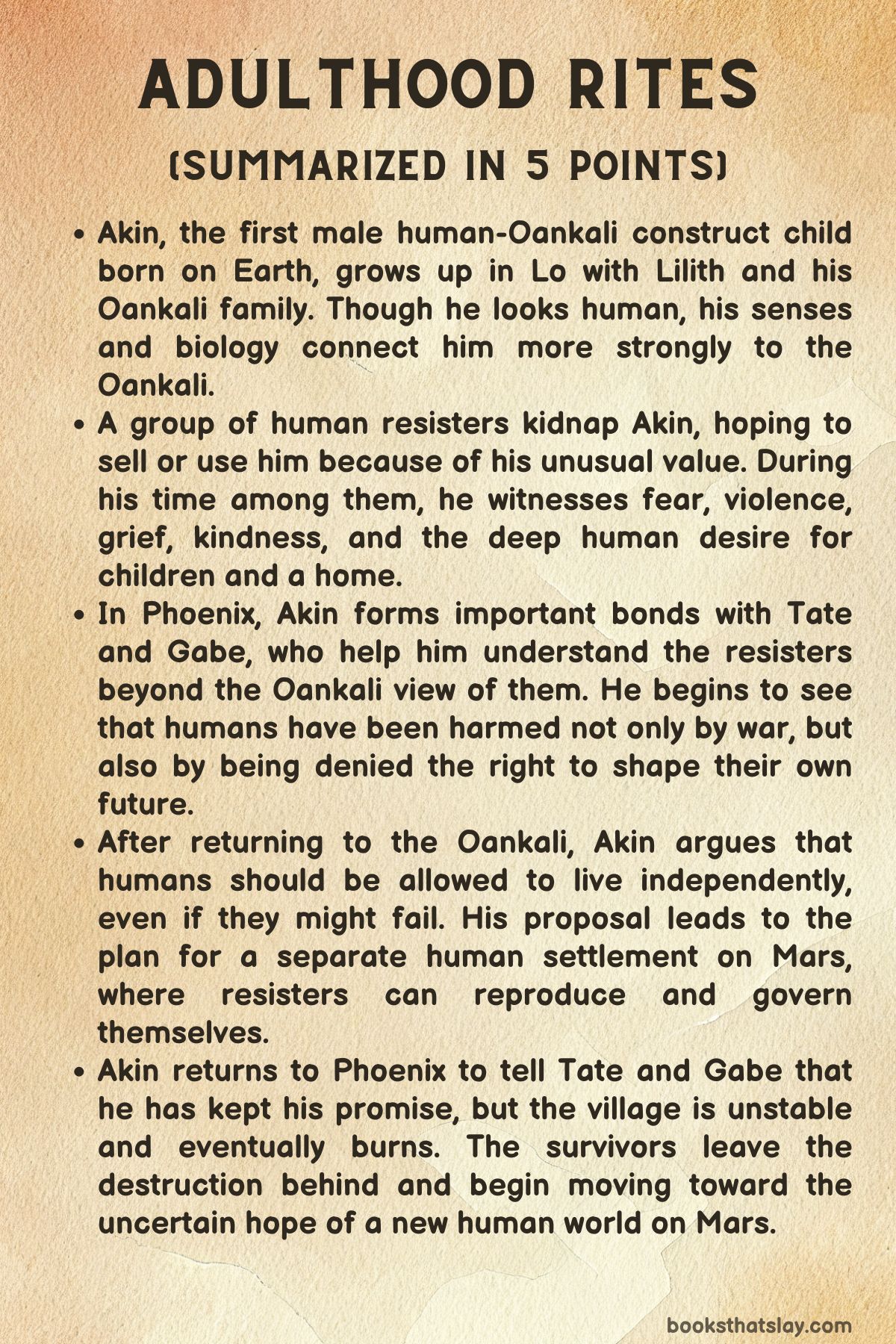
Adulthood Rites begins with the birth of Akin, the child of Lilith Iyapo and her Oankali family. Though he looks mostly human, he is genetically closer to the Oankali, the alien people who rescued the remains of humanity after nuclear destruction.
The Oankali have three sexes: male, female, and ooloi. The ooloi are able to read, heal, alter, and combine living bodies at a cellular level.
Akin’s earliest awareness comes through touch, taste, smell, and sound. Even as a baby, he learns quickly and senses the biology of those around him.
Akin grows in the village of Lo, surrounded by humans, Oankali, and construct children like himself. Lilith is his human mother, and Nikanj, an ooloi, is one of his parents.
He also has Oankali parents, including Ahajas and Dichaan. From the beginning, Akin’s life is shaped by his mixed nature.
He has a human face and body, but his tongue and senses allow him to read living things in ways humans cannot. He learns language early, recognizes people through taste and touch, and begins to understand that he is part of a family larger and stranger than ordinary human kinship.
Akin also learns about the divided human world. Some humans live with the Oankali and accept the new order, even if they do not always love it.
Others are resisters who reject Oankali control and want a purely human future. The Oankali have made unaltered humans sterile, believing that human intelligence combined with human hierarchical behavior will lead to extinction if humans are allowed to reproduce independently.
This decision creates bitterness, despair, and violence among the resisters, who feel that their future has been stolen.
One day Lilith meets Tino, a human man from the resister village Phoenix. Tino is suspicious at first, but he is drawn to Lo, to Lilith, and especially to Nikanj.
He has a past connection to the Oankali from the time when humans were being prepared to return to Earth. Tino chooses to stay in Lo and gradually becomes part of Akin’s family, acting as a father to him.
His presence helps Akin see the complexity of human feeling: attraction, resentment, curiosity, and need can exist together.
That fragile peace is broken when resister men attack while Tino and Akin are outside the village. Tino tries to protect Akin and is badly injured.
The attackers kidnap Akin, seeing him as valuable because of his human appearance and alien nature. Akin is taken away from Lo into the world of the resisters.
This abduction becomes the central event of his childhood, forcing him to learn about humans not from Oankali teaching, but from direct experience.
His captors are rough, frightened, and divided. Some treat him as property.
One tries to poison him, but Akin senses the danger and survives. During the chaos that follows, he escapes briefly, only to be found again by Galt, a red-haired man who treats him with more kindness than the others.
Akin decides Galt may be useful and reveals more of his intelligence. When a sick man dies in pain because the humans refuse or cannot seek Oankali help, Akin is disturbed.
He cannot understand why anyone would choose suffering over healing.
The men try to sell Akin. They pass through empty or changing settlements, including villages that have begun to accept the Oankali.
Akin sees how unstable resister life has become. Some people fear the Oankali, some secretly miss them, and some want the benefits of Oankali healing without surrendering human independence.
Akin also sees cruelty. Galt shoots a small animal Akin has been studying, and Akin kills it mercifully with his poisonous tongue.
Another captor, Iriarte, becomes possessive of Akin, wanting him as a reminder of his lost children.
Eventually Akin is brought to Phoenix, Tino’s home village. There he meets Gabriel Rinaldi and Tate, a married couple with authority in the community.
Akin trusts them more than his captors and asks them to buy him. His arrival becomes tangled with Tino’s history.
Tino’s parents appear, desperate for news of their son. To protect himself and perhaps others, Akin lies about who killed Tino, blaming a dead man instead of Damek, the true attacker.
Violence erupts before the sale can be settled. Mateo, Tino’s father, seeks revenge, and several of Akin’s captors are killed or wounded.
Akin is shaken by the sight of so many dead men, especially because he has come to understand them as individuals, even when they frightened or harmed him. He remains in Phoenix under the care of Tate and Gabe.
Over time, he becomes less a captive and more a strange child the village studies, fears, uses, and in some cases loves.
Akin spends about a year in Phoenix. He watches humans work, trade, make cloth, use money, tell stories, stage plays, argue, drink, grieve, and hope.
He learns that human life is not only violence and hierarchy. Humans long for children of their own, for homes, for memory, and for the right to shape their own fate.
Tate becomes especially important to him. Through her, Akin begins to understand that the Oankali have misjudged humans by giving them survival while denying them self-determination.
Two other construct children, Amma and Shkaht, are brought to Phoenix after being captured. Akin is excited to meet them and helps them communicate.
When the villagers travel to a ruined prewar city where salvagers gather, tensions rise around the girls’ tentacles. Some humans, led by Neci, discuss cutting the children’s tentacles while they are young.
Akin is horrified. Amma and Shkaht escape to avoid being mutilated, leaving Akin behind.
Their danger teaches him that human fear can turn quickly into torture, even against children.
Yet Akin does not give up on humans. He decides they need what the Oankali have denied them: a place where they can live without alien control, reproduce, build societies, and face the consequences of their own nature.
He begins to imagine an Akjai human group, like the Akjai among the Oankali: a people separate from the genetic trade. His idea is radical because the Oankali believe humans left alone will destroy themselves.
Akin believes that even if they fail, they deserve the freedom to try.
When the Oankali finally return for him, Akin learns that they deliberately left him in Phoenix so he could understand resister humans from the inside. Tino is alive, saved by the Oankali, but his connection to Phoenix has been weakened.
Akin returns to the Oankali, carrying what he has learned. He later goes to Chkahichdahk, the Oankali ship, as he nears metamorphosis.
There he feels alienated from his Oankali side, especially from his sibling Tiikuchahk, from whom he has been separated too long.
On the ship, Akin studies with the Akjai and meets Dehkiaht, an ooloi student. His attempted bond with Dehkiaht and Tiikuchahk is painful and incomplete, but it opens him further to Oankali life.
Akin argues for the resisters, insisting that humans should be given Mars as a home of their own. The Oankali debate the idea.
They doubt humans can survive their own contradictions, but they recognize that Akin has been shaped for this purpose: he is Oankali enough to be heard and human enough to understand what has been done to the resisters. At last, the Oankali agree to let humans settle Mars.
Before his metamorphosis makes him unrecognizable, Akin returns to Phoenix to tell Tate that he kept his promise. He finds the village damaged by guns, drinking, fear, and decay.
Tate is injured from a fall, and Akin tries to heal her, but Gabe interrupts, thinking Akin is harming her. The interruption injures Akin and triggers his metamorphosis.
While he changes, humans take turns sitting with him. News of Mars spreads, and villagers begin arguing over whether to accept the offer.
As Akin changes physically, some humans become more afraid of him, but others listen. Gabe and Tate grow more committed to helping him.
Then Neci, still driven by old hatred, sets fire to the house where Akin is staying. Gabe rescues him, and Tate waits outside Phoenix.
From a distance, they watch the village burn. Other survivors gather, including people connected to Akin’s past.
With Phoenix destroyed behind them, they begin walking toward the future Akin has won for them: a human settlement on Mars, uncertain and dangerous, but finally their own.
Characters
Akin
Akin is the central figure of Adulthood Rites, and his character is built around divided belonging. He is born looking human but is genetically and perceptually closer to the Oankali.
From infancy, he understands the world through touch, taste, scent, and biological sensing, which makes him different from ordinary human children even before he can speak clearly. His early intelligence is not just a sign of alien ability; it also makes him unusually vulnerable because adults project fear, value, curiosity, and hatred onto him.
Akin’s kidnapping becomes the experience that defines his moral growth. Among the resisters, he sees human cruelty, but he also sees loyalty, grief, craft, storytelling, love of children, and the desperate need for a real future.
Unlike many Oankali, he does not view humans only as flawed material to be corrected. He comes to understand their need for independence.
His greatest strength is his ability to hold two truths at once: humans are dangerous, and humans have been wronged. By arguing for a separate human future on Mars, Akin becomes a mediator between species, but not a neutral one.
He chooses justice over comfort and insists that survival without freedom is not enough.
Lilith Iyapo
Lilith remains one of the most emotionally complex human characters because she is both a survivor and a figure of suspicion. To the Oankali, she is valuable because she has adapted enough to live with them and help build a new future.
To many humans, she appears compromised because she has become part of the alien social and reproductive system. As Akin’s mother, she is protective, practical, and deeply aware of the dangers surrounding construct children.
She knows humans well enough to fear what resisters may do to a child like Akin, but she also knows the Oankali well enough to understand their manipulative patience. Lilith’s tragedy lies in the fact that she often sees more clearly than those around her but has limited power to change the system.
She loves her children and her Oankali family, yet she carries the burden of having been made into a bridge between humans and aliens without ever being fully forgiven by either side. Her advice to Akin shows her hard-earned wisdom: if he wants to help humans, he must first understand the Oankali deeply enough to persuade them.
Nikanj
Nikanj is one of Akin’s ooloi parents and represents both the intimacy and the unease of Oankali power. As an ooloi, Nikanj can heal, mate, alter bodies, and create bonds that humans find almost impossible to resist.
This makes Nikanj nurturing and invasive at the same time. It saves lives, including Tino’s, but it also participates in a system where consent is unstable because human bodies can be guided into dependency.
Nikanj’s relationship with Lilith and Tino shows how Oankali intimacy can be tender while still raising disturbing questions. Nikanj does not act out of cruelty; it genuinely cares for its family and uses its abilities to preserve life.
Yet its care comes from a worldview in which biological improvement can outweigh personal autonomy. Through Nikanj, the novel asks whether love can remain fully ethical when one being has overwhelming power over another’s body and desire.
Tino
Tino begins as a resister shaped by curiosity, loneliness, and dissatisfaction with the world he comes from. He leaves Phoenix because he wants to understand alternatives, and this makes him different from humans who reject the Oankali without ever facing their own needs honestly.
His attraction to Lilith and his pull toward Nikanj reveal the conflict many resisters deny: they fear the Oankali, but they also remember or desire the comfort, healing, and connection the Oankali provide. Tino’s adoption of a paternal role toward Akin gives him emotional importance beyond his function as a link to Phoenix.
His apparent death becomes one of Akin’s earliest lessons in violence, while his later survival demonstrates the Oankali ability to undo human damage in ways that feel miraculous and unsettling. Tino is also a sign of how human identity can be altered by Oankali contact.
When he no longer remembers Phoenix as others do, the cost of being saved becomes visible.
Tate
Tate is one of the most important human influences on Akin because she treats him neither simply as a monster nor merely as an object of value. Her feelings are conflicted: she fears the Oankali, remembers their touch, resents their control, and still feels the pull of what they can offer.
Her care for Akin is not simple acceptance at first, but it grows into trust and affection. Through Tate, Akin learns what resister humans most deeply want: not just survival, but children, continuity, and a home that belongs to them.
Tate’s relationship with Gabe also shows the strain resister life places on love. They are bound by shared purpose and history, but fear often stands between them and clear judgment.
When Akin returns with news of Mars, Tate’s willingness to listen shows that hope can survive even in people who have spent years resisting alien promises. She becomes one of the humans most capable of understanding that the Mars settlement is not a trick if humans claim it for themselves.
Gabriel Rinaldi
Gabriel, often called Gabe, is a leader in Phoenix and a character shaped by responsibility, fear, and pride. He is more thoughtful than many resisters, but he is still deeply conditioned to distrust the Oankali.
His first response to Akin is suspicion, yet he is also capable of fairness and even affection. Gabe’s importance lies in his struggle to distinguish protection from control.
He wants to protect Tate, Phoenix, and human independence, but that protective instinct sometimes leads him to violence or error, as when he interrupts Akin’s healing of Tate. His guilt afterward matters because it shows that he is not ruled only by hatred.
He can revise his judgment when faced with the consequences of his actions. By the end, Gabe’s decision to rescue Akin from the fire and support the journey toward Mars marks a major transformation.
He does not become free of fear, but he chooses a future over the ruins of old suspicion.
Dichaan
Dichaan is one of Akin’s Oankali parents and serves as a figure of guidance, discipline, and cultural expectation. He understands that Akin has spent too much time close to humans and that this has shaped his loyalties.
Unlike Lilith, who understands Akin’s human attachments from within, Dichaan sees them from the perspective of an Oankali parent concerned with development and belonging. He believes Akin must reconnect with his Oankali side before metamorphosis, and his decision to take Akin to the ship reflects the Oankali emphasis on biological and communal maturity.
Dichaan is not cruel, but he can underestimate the emotional force of Akin’s human experiences. His role shows the pressure placed on construct children to become useful members of Oankali society, even when their identities have been shaped by human suffering.
Ahajas
Ahajas is one of Akin’s Oankali parents and is closely connected to the early sense of family, birth, and sibling connection. Through her pregnancy, Akin first becomes aware of the sibling developing inside her, and that awareness helps establish how different Oankali kinship is from human kinship.
Ahajas represents the bodily closeness of Oankali family structures, where children, parents, siblings, and mates are connected through senses and exchanges far beyond ordinary speech. Her importance is quieter than Lilith’s or Nikanj’s, but she helps define the environment from which Akin is taken.
The loss of that environment makes his kidnapping more than a physical removal; it interrupts a biological and emotional process of belonging.
Tiikuchahk
Tiikuchahk, Akin’s sibling, represents the cost of Akin’s time among humans. The two should have shared a deeper bond, but Akin’s long absence from Lo leaves them emotionally distant.
Their strained relationship shows that Akin’s education among humans comes at a personal price. Tiikuchahk’s desire to become male and their hurt over the separation complicate the idea of sibling unity.
They are connected by origin but not by intimacy. This distance is painful because Oankali family identity depends heavily on connection, bodily recognition, and shared development.
Tiikuchahk is not simply a neglected sibling; they are proof that Akin cannot belong fully to one world without losing something in the other.
Dehkiaht
Dehkiaht is the ooloi student who becomes emotionally and sexually significant to Akin during his time on the Oankali ship. Their relationship is uncomfortable at first because Akin is reluctant, confused, and frightened by the demands of Oankali intimacy.
Dehkiaht’s inability to fully bind Akin and Tiikuchahk reveals that Oankali processes are powerful but not perfect. Akin’s unexpected possessiveness toward Dehkiaht also marks a turning point in his maturation.
He begins to experience forms of desire and attachment that connect him more strongly to Oankali adulthood. Dehkiaht is also important because it spreads Akin’s idea of an independent human settlement.
In this sense, Dehkiaht becomes both intimate partner and political ally, helping Akin’s private conviction become a matter for Oankali debate.
The Akjai Teacher
Akin’s Akjai teacher represents the purest Oankali perspective, untouched by human genetic exchange. This character is important because Akin expects opposition but finds a more complex response.
The Akjai teacher listens seriously, recognizes the logic of Akin’s argument, and understands that Akin has been shaped by experience in a way other Oankali have not. The teacher does not romanticize humans; it recognizes the risk of giving humans independence.
Yet it also accepts that Akin’s argument has ethical force. By supporting the Mars plan, the Akjai teacher helps shift the question from whether humans are safe to whether they have the right to choose their own future.
This makes the teacher one of the key figures in changing Oankali policy.
Amma and Shkaht
Amma and Shkaht are construct children whose arrival in Phoenix helps Akin see his own situation more clearly. Their presence gives him companionship and reminds him that he is not the only child caught between human fear and Oankali identity.
The threat that some humans may cut off their tentacles shows the violent consequences of disgust and panic. To the resisters who fear them, their bodies are signs of alien contamination.
To Akin, they are children who deserve protection, communication, and freedom. Their escape is an act of survival, and Akin’s decision not to go with them shows his growing maturity.
He wants safety, but he also understands that their best chance requires leaving him behind. Their storyline exposes how easily oppressed people can become cruel when they believe cruelty will restore control.
Galt
Galt is one of Akin’s captors and is notable because he is kinder than the others without being truly safe. His gentleness gives Akin a temporary sense that some humans may be approached, reasoned with, or trusted.
At the same time, Galt participates in Akin’s captivity and later shoots the agouti, an act that reveals the limits of his compassion. He may not be as openly brutal as Damek, but he still accepts ownership and punishment as part of his relationship to Akin.
Galt’s character matters because Butler does not divide humans neatly into kind victims and cruel villains. Galt can comfort a child and still help sell him.
Through him, Akin learns to judge people carefully, not by single gestures but by the larger pattern of their choices.
Iriarte
Iriarte is another captor whose relationship with Akin is shaped by grief and possession. He wants Akin to remain a reminder of his own lost children, which makes his attachment emotionally understandable but morally troubling.
He does not see Akin fully as himself; he sees him as a substitute for what has been taken from him. This makes Iriarte an example of how resister suffering can become another form of harm.
His grief does not make him innocent, but it prevents him from being one-dimensional. Akin’s exposure to Iriarte teaches him that humans often act out of wounds they cannot heal, especially in a world where the possibility of having children has been denied.
Damek
Damek is one of the clearest representatives of violent anti-Oankali hatred. He harms Tino and treats Akin with contempt, refusing to see him as a child deserving care.
His hostility is personal, physical, and degrading. Unlike characters who are conflicted, Damek seems more fully consumed by resentment.
Yet his presence is important because he shows the kind of human brutality that supports the Oankali argument against human independence. Akin cannot ignore people like Damek when he argues for the resisters.
Instead, he must argue that humans deserve freedom despite people like Damek, not because such people do not exist. Damek therefore becomes part of the moral difficulty at the center of Akin’s position.
Mateo
Mateo, Tino’s father, is driven by grief and revenge. His search for answers about Tino quickly becomes a need to punish those responsible.
When he attacks the captors, he acts from understandable pain, but the result is more bloodshed and more trauma for Akin. Mateo shows how love can become destructive when it is filtered through rage.
He is not simply a violent man; he is a father whose world has narrowed around loss. His actions also show the fragility of resister communities, where justice often becomes personal retaliation because stable systems of law and trust are weak or absent.
Neci
Neci is one of the most frightening human characters because her cruelty is justified in her own mind as defense. Her desire to cut the tentacles from construct children reveals a need to physically remove signs of alienness.
She sees the children’s bodies as threats rather than as living bodies with pain and personhood. Neci’s hatred does not fade with time; years later, she remains dangerous enough to set fire to the place where Akin is undergoing metamorphosis.
Her character shows how fear can harden into ideology. She is not merely afraid of the Oankali; she is committed to destroying what reminds her of them, even when that means attacking children or burning her own community’s future.
Sabina
Sabina plays a smaller but meaningful role in Akin’s education among humans. When she catches him tasting objects, their conversation becomes a moment of mutual curiosity.
Akin explains his way of learning, while Sabina helps him think about why human children put things in their mouths. This exchange matters because it shows Akin’s study of humanity at its most ordinary and humane.
Not all learning comes through violence, captivity, or political conflict. Some of it comes through simple questions about childhood, bodies, habits, and perception.
Sabina helps make Phoenix a place of instruction rather than only danger.
Yori
Yori, the doctor who watches over Akin during metamorphosis, represents human knowledge trying to meet alien biology. She has read about the process but has never witnessed it directly, so her role combines care, uncertainty, and observation.
Her presence shows that some humans are willing to learn rather than only react with fear. She cannot fully understand what is happening to Akin, but she accepts responsibility for staying near him during a dangerous transformation.
Yori’s character also shows that the Mars future will require practical people, not only dreamers and leaders. Human survival depends on those willing to observe, adapt, and care under unfamiliar conditions.
Gilbert Senn
Gilbert Senn appears near the end as a voice of resistance against Akin’s Mars plan. Armed and suspicious, he represents those humans who believe the offer of a new world must be another Oankali deception.
His suspicion is not baseless, because the Oankali have manipulated human bodies and choices before. Yet Gilbert’s readiness to threaten Akin also shows how distrust can block liberation when it becomes absolute.
He stands at the edge of a possible future and nearly rejects it because it comes through someone he cannot trust. His character adds realism to the ending: not all humans will accept Mars as hope.
Some will see it as exile, trickery, or defeat.
Joseph
Joseph is absent from the main action, but his memory matters because he belongs to Lilith’s past and to the painful history of human-Oankali contact. As Akin learns about him, Joseph becomes part of the legacy that shapes Lilith’s family.
His death is a reminder that the new world was built after terrible losses, and that Lilith’s relationships did not begin in peace. Joseph’s absence also deepens the emotional atmosphere around Akin’s birth.
The child is surrounded by parents and caretakers, yet he inherits griefs and conflicts from before his own life. In Adulthood Rites, even absent characters influence the living because memory shapes how each person understands love, loyalty, and betrayal.
Themes
Freedom, Consent, and the Right to Fail
Freedom in Adulthood Rites is not presented as a simple good that guarantees happiness. It is dangerous, unstable, and possibly fatal, but the novel insists that it still matters.
The Oankali save humanity from extinction, heal bodies, restore Earth, and offer a future through genetic union. Yet they also sterilize unaltered humans and deny them the right to reproduce on their own.
Their argument is practical: humans are intelligent and hierarchical, a combination the Oankali believe will eventually lead to self-destruction. Akin’s challenge to this logic is moral rather than merely scientific.
He does not deny that humans may fail. He argues that failure belongs to them if their lives are truly their own.
The Mars settlement becomes important because it gives humans a future not controlled by Oankali biology or supervision. It is not a perfect solution, since Mars is also a kind of separation from Earth, but it restores choice where choice has been withheld.
The novel treats consent as more than agreement under pressure. A person or species must be able to refuse, risk loss, and make mistakes.
Without that possibility, survival becomes another form of captivity.
Hybrid Identity and Divided Belonging
Akin’s body makes him a living argument about identity. He looks human enough to be desired, feared, bought, protected, and hated by humans, but his senses and biology connect him deeply to the Oankali.
This divided identity gives him insight, but it also isolates him. Among humans, he is never only a child; he is also a reminder of alien control.
Among the Oankali, he is never only one of them; his time with resisters gives him attachments and judgments that many Oankali find uncomfortable. His separation from Tiikuchahk shows the personal cost of becoming a bridge between worlds.
He gains knowledge of human longing, but loses the easy sibling bond he might have had. His journey to the ship intensifies this crisis because he begins to see the Oankali almost as humans see them: strange, frightening, and physically alien.
This moment matters because it proves that identity is shaped by experience, not only by genetics. Akin’s mixed nature does not automatically create harmony.
Instead, it creates conflict, responsibility, and loneliness. His power comes from the fact that he refuses to erase either side of himself, even when both sides cause him pain.
Human Contradiction and the Fear of Hierarchy
The Oankali’s judgment of humanity rests on what they call a contradiction: humans are intelligent and hierarchical. In their view, this combination makes humans inventive enough to create powerful tools and competitive enough to destroy themselves with those tools.
The ruined Earth appears to support this judgment. Phoenix also shows signs of the same problem on a smaller scale: violence, revenge, ownership, gendered control, suspicion, and the desire to dominate those who seem weaker or different.
Akin’s captivity exposes him to human hierarchy in direct form. He is treated as property, traded as a valuable object, and threatened because his body marks him as other.
Neci’s wish to mutilate construct children is another expression of hierarchy: she wants to restore human power by cutting away what she cannot control. Yet the novel does not allow the Oankali judgment to stand unchallenged.
Humans are also artists, parents, builders, teachers, doctors, actors, and friends. Their flaws are real, but so are their capacities for loyalty and change.
Akin’s defense of humans depends on this fuller vision. He does not claim humans are safe.
He claims they are more than their worst tendencies.
Family, Kinship, and Uncomfortable Intimacy
Family in the novel is biological, emotional, political, and often uneasy. Oankali families are built through bonds that include more than two parents and depend on ooloi mediation.
These bonds can be deeply loving, but they also challenge human ideas of privacy, desire, and consent. Lilith, Nikanj, Tino, Ahajas, Dichaan, and Akin form a family that offers care and belonging, yet its structure exists within a system many humans experience as coercive.
Tino’s relationship with Nikanj shows the complexity of Oankali intimacy: he is drawn to it, comforted by it, and changed by it. Akin’s relationships expand the meaning of family even further.
He has birth family in Lo, damaged sibling ties with Tiikuchahk, human caretakers in Phoenix, and later an emerging bond with Dehkiaht. Tate and Gabe are not his parents, but they become part of his emotional education.
The novel repeatedly asks what makes kinship real: blood, genes, touch, memory, care, or choice. Its answer is unsettled because each form of family carries both comfort and cost.
Akin’s final movement toward Mars suggests that the future of family must include chosen bonds, but also the freedom to form them without force.