Adult Children of Emotionally Immature Parents Summary and Analysis
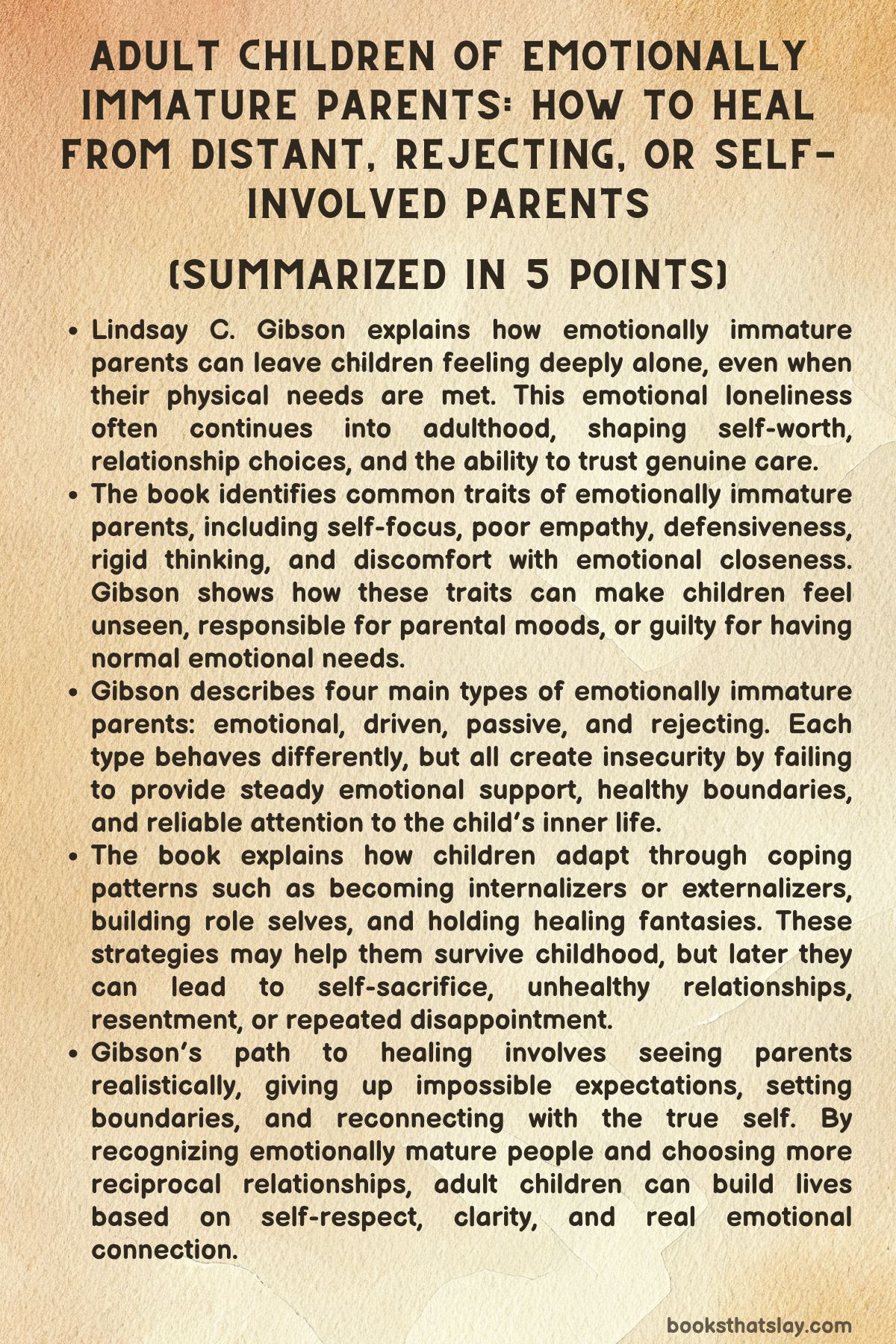
Adult Children of Emotionally Immature Parents: How to Heal from Distant, Rejecting, or Self-Involved Parents by Lindsay C. Gibson is a clear, practical psychology book about the long-term effects of being raised by parents who could not offer steady emotional closeness. Gibson explains how children can grow up feeling unseen even when their basic needs are met, and how that loneliness can shape adult relationships, self-worth, and coping habits.
The book helps readers recognize emotionally immature behavior, understand their own childhood adaptations, and build healthier expectations. Its central message is that healing begins when people stop blaming themselves for needs their parents could not meet.
Summary
The book explains how emotionally immature parents affect their children and how those children can recover a stronger, freer sense of self in adulthood. The book is less about accusing parents and more about helping adult children understand patterns that once felt confusing, painful, or personally shameful.
Gibson describes emotionally immature parents as people who avoid deep emotional connection, resist self-reflection, rarely take responsibility for hurtful behavior, and often put their own needs ahead of their children’s emotional reality.
The book begins by identifying a core wound: emotional loneliness. Children may receive food, shelter, education, and basic care, yet still feel deeply alone if their parents cannot respond to their feelings with warmth, curiosity, and reliability.
Because children do not have the language to name this lack, they often assume something is wrong with them. They may grow up feeling empty, anxious, overly responsible, or desperate for connection while also expecting rejection.
As adults, they can repeat familiar relationship patterns, choosing emotionally unavailable partners or trying to earn love through performance, cheerfulness, self-sacrifice, or silence.
Gibson contrasts emotionally mature and emotionally immature people. Mature people can reflect on themselves, tolerate emotional discomfort, admit mistakes, respect other perspectives, and sustain close relationships with empathy and fairness.
Emotionally immature people often react defensively, think in rigid or concrete ways under stress, and treat feelings as facts. They may be intelligent in practical matters but become unreasonable when emotions are involved.
They often lack the ability to see their children as separate people with independent needs, which leads to role reversal: the child becomes the listener, comforter, peacekeeper, or emotional caretaker.
A major idea in the book is that many emotionally immature parents do not harm their children with clear intent. Their behavior often comes from their own restricted emotional development.
They may have grown up in families that valued obedience over emotional openness, punished vulnerability, or treated feelings as weakness. As a result, they learned to defend against emotional closeness.
Their own childhood limitations do not erase the harm they caused, but understanding those roots helps adult children stop taking their parents’ reactions as proof of their own unworthiness.
Gibson describes what relationships with emotionally immature parents feel like from the child’s point of view. These relationships often lack reciprocity.
The parent expects attention but does not offer the same in return. Conversations turn back to the parent’s needs, moods, opinions, or grievances.
Children may learn to monitor the parent’s emotional state, avoid upsetting topics, or perform a role that keeps the household stable. The parent may demand closeness but reject genuine emotional honesty.
They may want loyalty, admiration, or obedience, yet become overwhelmed or hostile when the child expresses pain, anger, independence, or disagreement.
The author identifies four broad types of emotionally immature parents. Emotional parents are ruled by mood swings and intense reactions, making family members feel responsible for calming them.
Driven parents appear highly involved but focus on achievement, image, control, and improvement rather than emotional understanding. Passive parents may be pleasant or affectionate but fail to protect their children, avoid conflict, and stand by when harm occurs.
Rejecting parents keep emotional distance, show little interest in the child’s inner life, and may respond to needs with irritation or contempt. Though these types look different, all leave children feeling unseen, unsupported, or unsafe in emotional terms.
Children respond to these conditions in different ways. Gibson divides common coping styles into internalizers and externalizers.
Internalizers try to solve problems by looking within. They are reflective, sensitive, responsible, and often too willing to blame themselves.
They may become the “good” child, the helper, the listener, or the one who needs little. Externalizers look outside themselves for relief and tend to blame others, act impulsively, or expect someone else to fix their distress.
Gibson notes that many emotionally immature parents are externalizers, while many readers of the book are likely internalizers who have spent years carrying too much responsibility.
Internalizers receive special attention because they are often the children most wounded by emotional neglect and also the most likely to seek understanding. They need real emotional connection, but their families may treat that need as weakness or inconvenience.
Since they appear capable and self-sufficient, their parents may overlook them even more. Over time, internalizers may believe they must earn love through usefulness, sacrifice, or constant understanding of others.
They often attract emotionally needy people because they seem patient, wise, and giving. Yet these relationships can become one-sided, repeating the same old loneliness.
Gibson also explains two survival strategies: healing fantasies and role selves. A healing fantasy is the hope that if the child becomes good enough, successful enough, agreeable enough, or selfless enough, the parent will finally provide love and recognition.
A role self is the identity the child adopts to gain approval or reduce conflict. This role might be the achiever, caretaker, rebel, clown, helper, or invisible child.
These roles help children survive, but in adulthood they can block authentic self-expression. A person may spend years living according to what once kept them safe rather than what now feels true.
A turning point comes when the role self stops working. Gibson describes this as an awakening.
People may experience anxiety, depression, anger, exhaustion, panic, or a sense that life no longer fits. Rather than seeing these symptoms only as failure, Gibson presents them as signals that the true self is trying to emerge.
The true self is the inner sense of what one actually feels, wants, values, and knows. Healing requires listening to that self, especially when it carries anger, grief, dislike, fear, ambition, or desire that the family once rejected.
The book then offers practical ways to relate differently to emotionally immature parents. Gibson does not insist that readers cut off contact, though she recognizes that distance may sometimes be necessary.
Instead, she teaches detached observation: stepping back mentally during interactions and watching the parent’s behavior without being pulled into old reactions. She also recommends maturity awareness, which means accepting the parent’s limited emotional capacity and adjusting expectations.
Rather than seeking a deep relationship with someone unable to provide one, adult children can aim for manageable contact, clear boundaries, and specific outcomes.
This change requires giving up the fantasy that the parent will finally understand everything if only the adult child explains it perfectly. Gibson encourages readers to express themselves clearly when needed, but then let go of the need to control the parent’s response.
The goal is not to win emotional validation from an immature person but to stay grounded in one’s own reality. Readers are urged to manage interactions, redirect conversations, set limits, and stop performing childhood roles.
Freedom also involves recognizing the internalized parent voice. Many adult children carry harsh inner commentary that says they are selfish, dramatic, disloyal, lazy, or wrong for having needs.
Gibson explains that this voice may feel like truth, but it often reflects old parental judgments. Healing means questioning that voice and asking what one truly wants, feels, and believes.
Self-compassion becomes essential. When adults look back at their younger selves with kindness, they can finally grieve what was missing without blaming the child they once were.
In the final part of Adult Children of Emotionally Immature Parents, Gibson turns toward healthier relationships. Emotionally mature people are realistic, reliable, respectful, reciprocal, responsive, and capable of repair.
They listen, apologize, respect boundaries, accept influence, show empathy, and remain fairly consistent even under stress. For readers used to emotional deprivation, such people may first seem unfamiliar rather than exciting.
Gibson encourages readers to value steadiness over old chemistry, ask for help, express needs directly, and build relationships where mutual care is normal.
The book ends with a hopeful but honest message: self-discovery can be painful because it reveals what was missing, but it also gives people a second chance at life. By understanding emotional immaturity, adult children can stop chasing impossible approval, release roles that no longer serve them, and build lives based on authenticity, self-respect, and real connection.
Key People
Lindsay C. Gibson
Lindsay C. Gibson functions as the guiding intelligence of Adult Children of Emotionally Immature Parents. She is not a character in the story-driven sense, but she is the central voice shaping the reader’s understanding of emotional neglect, parental immaturity, and adult healing.
Her role is calm, explanatory, and corrective. She repeatedly moves the reader away from self-blame and toward clear recognition of family patterns.
Gibson’s authority comes from clinical experience, but her writing does not feel cold or distant. She presents emotional immaturity as a real limitation that causes real harm, while also making room for the idea that many parents were shaped by emotionally restrictive backgrounds of their own.
Her perspective is firm but not cruel. She wants readers to see their parents accurately, not demonize them.
Her main function is to give adult children the language they lacked in childhood. By naming emotional loneliness, role reversal, healing fantasies, internalizers, externalizers, and maturity awareness, she turns confusing personal pain into something understandable and workable.
Emotionally Immature Parents
Emotionally immature parents are the central figures around whom the book’s emotional and psychological conflict is organized. They are defined less by one personality type and more by a shared inability to offer reliable emotional connection.
These parents may provide food, shelter, education, and practical care, yet still fail to recognize their children’s inner lives. They often avoid emotional closeness, react defensively to criticism, resist accountability, and expect others to adjust to their moods or needs.
Their self-focus is not always simple selfishness; Gibson presents it as a sign of underdeveloped emotional capacity. They struggle to reflect on themselves, tolerate uncomfortable feelings, and respond with empathy when their children are hurt.
Their behavior teaches children to suppress needs, monitor parental moods, and perform roles that preserve family stability. The emotional immaturity of these parents creates a painful contradiction: the child is attached to them, wants love from them, and may keep hoping for change, but repeatedly receives dismissal, confusion, control, or distance instead.
Adult Children
The adult children in the book represent people who grew up physically cared for but emotionally unseen. Their defining wound is emotional loneliness, a feeling they often cannot name until adulthood.
As children, they may have believed their pain was proof that they were too sensitive, needy, selfish, or difficult. As adults, they often carry the same assumptions into relationships, choosing unavailable partners, hiding their needs, or working too hard to earn affection.
Gibson portrays these adult children as people who have often built competent lives while still carrying old emotional injuries. They may be successful, responsible, intelligent, and caring, yet still feel anxious, empty, or uncertain that anyone could truly care about them.
Their growth begins when they stop treating parental limitations as evidence of their own inadequacy. They learn that their longing for connection was normal, that their anger may be protective, and that their sadness points to real losses.
Their character journey is one of recognition, separation, and self-recovery.
Internalizers
Internalizers are among the most important psychological figures in the book. They are sensitive, reflective, responsible people who respond to emotional neglect by turning inward.
When something goes wrong, they ask what they can do differently. They try to understand others, improve themselves, and repair relationships.
These strengths make them thoughtful and emotionally perceptive, but they also make them vulnerable to one-sided relationships. Internalizers may take on too much guilt, assume responsibility for other people’s feelings, and believe that self-sacrifice will eventually earn love.
In childhood, they often appear self-sufficient, which causes emotionally immature parents to overlook them even more. Their ability to endure becomes mistaken for lack of need.
As adults, internalizers may attract needy or self-centered people because they seem patient, kind, and capable of endless emotional labor. Gibson presents internalizers with compassion, emphasizing that their sensitivity is not the problem.
The problem is that they learned to use their sensitivity against themselves, ignoring their own needs while trying to heal others.
Externalizers
Externalizers respond to emotional distress by looking outside themselves for solutions, blame, or relief. Unlike internalizers, who tend to self-examine, externalizers often act before reflecting.
They may blame others, demand rescue, seek comfort through impulsive behavior, or expect the environment to change rather than examining their own role in a problem. Gibson presents externalizing as a broad pattern, ranging from mild blame-shifting to severe exploitation.
Many emotionally immature parents fit this pattern because they avoid self-reflection and expect others to adapt to them. Externalizers are important because they help explain why some people remain stuck in repetitive emotional conflicts.
Their shame may appear briefly after a crisis, but instead of turning into growth, it often gets denied or projected. They may feel wronged rather than responsible.
Gibson does not present externalizers as incapable of growth, but she suggests that change usually requires a willingness to become more reflective. Without that willingness, externalizers can drain internalizers by making them carry the emotional burden of the relationship.
Emotional Parents
Emotional parents are one type of emotionally immature parent, marked by intense and unstable emotional reactions. Their moods dominate the household, and family members learn to watch them carefully.
Children raised by emotional parents often become highly alert to shifts in tone, expression, and atmosphere because the parent’s emotional state can determine the safety of the day. These parents may cry, rage, panic, collapse, or become dramatic in ways that make the child feel responsible for calming them.
Their emotional life is large but not necessarily deep or reflective. They feel strongly, but they do not always understand their feelings or manage them responsibly.
This creates a home where the child’s own emotions are pushed aside. The child learns that the parent’s distress comes first.
Over time, this can produce adults who are skilled at reading others but disconnected from their own needs. Emotional parents are powerful figures because they show how emotional intensity can exist without emotional maturity.
Driven Parents
Driven parents appear involved, ambitious, and invested in their children’s success, but their involvement often centers on achievement rather than emotional connection. They may push their children toward excellence, control their choices, correct their behavior, and measure worth through performance.
From the outside, they can look like dedicated parents because they are active in their children’s lives. Yet Gibson shows that this activity can hide a lack of real attunement.
Driven parents often fail to ask who the child is, what the child wants, or what the child feels. They focus on improvement, discipline, image, and results.
Their children may grow up feeling evaluated rather than accepted. Love begins to feel conditional, tied to success, obedience, or usefulness.
These parents can create adults who are hardworking but anxious, accomplished but unsure of their own desires. The driven parent’s tragedy is that they may think they are helping their child succeed while actually teaching the child that being loved depends on meeting someone else’s standards.
Passive Parents
Passive parents are emotionally immature in a quieter way. They may be affectionate, pleasant, playful, or easier to like than more controlling or rejecting parents, but they fail when protection, guidance, or active support is required.
Their weakness lies in avoidance. They may stand by while another parent mistreats the child, refuse to confront harmful behavior, or retreat from emotional intensity because it makes them uncomfortable.
Children often feel confused about passive parents because these parents may offer warmth in some moments while abandoning them in more serious situations. The child may love the passive parent and still know that this parent cannot be relied upon.
Gibson’s portrayal of passive parents is especially painful because their neglect may not look obvious. They do not always attack or reject the child directly, but their failure to act leaves the child alone with danger, conflict, or emotional pain.
Their passivity teaches children that love without protection is not enough.
Rejecting Parents
Rejecting parents are the most emotionally distant and harsh of the parent types Gibson describes. They communicate, directly or indirectly, that the child’s needs are unwanted or irritating.
They may avoid closeness, respond with anger when approached, show little curiosity about the child, or make the child feel like a burden. Their rejection can be active, through criticism and hostility, or quiet, through indifference and emotional absence.
Children of rejecting parents often grow up with a deep sense of being unwanted. They may learn to hide their needs, expect dismissal, and feel shame around wanting affection.
Rejecting parents are damaging because they strike at a child’s basic need to feel welcome in the world. A child depends on parents not only for survival but also for the emotional message that their existence matters.
When that message is missing, adult relationships can feel dangerous. The person may long for closeness while fearing that any request for care will drive others away.
David
David represents the child who grows up surrounded by family yet emotionally alone. His experience shows that loneliness is not simply the absence of people; it is the absence of meaningful emotional response.
In Gibson’s framework, David’s pain helps clarify the difference between practical family presence and true connection. He may have had people around him, but he did not have the kind of attuned emotional engagement that helps a child feel known.
His role in the book is to illustrate how emotional neglect can remain invisible from the outside. A family may look normal, functional, or even successful, while the child inside that family feels isolated.
David’s example helps readers understand why their childhood pain may be valid even if their basic physical needs were met. He represents the adult who must learn that emotional deprivation counts as a real wound.
Rhonda
Rhonda, like David, illustrates the lasting effects of childhood emotional isolation. Her experience emphasizes how a child can grow up without the emotional mirroring needed to develop secure self-worth.
Rhonda’s story matters because it shows how children often cannot identify what is missing. They may only feel an emptiness, a sense of being alone, or a belief that something about them is wrong.
As an adult, that vague childhood emptiness can shape relationship choices and emotional expectations. Rhonda represents people who are not necessarily dealing with obvious external deprivation but who still carry deep emotional hunger.
Through her, Gibson shows that children need more than caretaking; they need parents who notice, respond, and care about their inner lives.
Sophie
Sophie represents the adult child who unconsciously repeats familiar emotional patterns in romantic relationships. Her relationship with an emotionally unavailable partner mirrors her early experience with her mother.
This repetition is not presented as foolishness or weakness. Instead, Gibson shows that people often gravitate toward what feels familiar, even when it hurts.
Sophie’s role is important because she demonstrates how childhood emotional neglect does not stay confined to childhood. It becomes a template for what love feels like.
If love once meant distance, uncertainty, or the need to earn attention, adult relationships may recreate the same emotional climate. Sophie’s growth depends on recognizing that familiarity is not the same as safety.
Her example helps readers question the kind of chemistry that may actually be old pain returning in a new form.
Jake
Jake represents the adult who has learned to perform emotional ease instead of expressing real feelings. He believes he must act happy for his wife rather than reveal his authentic emotional state.
This shows how childhood conditioning can teach people that their true feelings are inconvenient, unsafe, or unacceptable. Jake’s behavior is not simple dishonesty; it is a survival pattern.
Somewhere along the way, he learned that connection depends on maintaining a role. His example reveals how emotionally neglected children may become adults who hide sadness, anger, uncertainty, or need in order to preserve relationships.
Jake’s struggle is the struggle to believe that honesty will not automatically lead to rejection. Through him, Gibson shows that emotional intimacy requires more than being physically present with someone.
It requires the courage to be real and the experience of being accepted in that reality.
Frida
Frida’s story reveals the extreme confusion caused by a parent who expects admiration despite having caused harm. Her father’s history of physical abuse clashes with his desire to be respected or idealized.
This contradiction captures a common feature of emotional immaturity: the parent wants the benefits of closeness without accountability for past behavior. Frida’s role in the book shows how adult children can be pressured to deny their own reality in order to protect a parent’s self-image.
Her father’s expectation forces her into an impossible position. If she honors her own memory, she risks being seen as disloyal.
If she protects him from the truth, she betrays herself. Frida represents the adult child who must learn that acknowledging harm is not cruelty.
It is a necessary step toward psychological freedom.
Ellie
Ellie’s experience centers on a mother who provides physical care but lacks empathy for emotional attachment. The example of losing beloved possessions without emotional consideration shows how a parent can meet practical duties while failing to understand the child’s inner world.
Ellie’s mother does not necessarily appear neglectful in obvious ways, yet her inability to value what matters to Ellie communicates emotional disregard. Ellie’s role is to show how children learn whether their feelings count.
When a parent treats a child’s treasured object, attachment, or grief as meaningless, the child may begin to doubt the legitimacy of their own emotional life. Ellie represents the quiet injuries caused by parental insensitivity.
Her story makes clear that emotional neglect often happens in ordinary moments, through dismissals that teach a child not to expect understanding.
Sarah
Sarah represents the child who receives rare moments of emotional connection and treasures them because they are so scarce. Her mother’s usual emotional distance makes occasional warmth feel precious.
This pattern can be especially powerful because inconsistency keeps hope alive. If a parent were always cold, the child might eventually stop expecting closeness, but rare tenderness can make the child keep trying.
Sarah’s experience shows how intermittent connection can bind adult children to unrealistic hopes. They remember the good moments and use them as evidence that the parent might someday become consistently loving.
Gibson uses this kind of example to explain why it can be so difficult to give up the healing fantasy. Sarah’s longing is understandable.
She is not chasing nothing; she is chasing the memory of something real but unreliable.
Elizabeth
Elizabeth’s mother is unpredictably available, creating anxiety and self-blame. Elizabeth represents the child who cannot form stable expectations because the parent’s emotional response changes without clear reason.
Sometimes the parent may seem reachable; at other times, distant or rejecting. This inconsistency teaches the child to search for explanations inside herself.
She may wonder what she did wrong, how she can be better, or what version of herself will make the parent stay emotionally present. Elizabeth’s role in the book highlights the damaging power of unpredictability.
Children need consistency to feel secure. When emotional availability comes and goes, they often become hypervigilant and self-critical.
Elizabeth’s story shows how a parent’s inconsistency can become the child’s lifelong anxiety.
Hannah
Hannah’s attempt to ask her mother a personal question reveals how emotionally immature parents can become overwhelmed by ordinary intimacy. Her mother’s reaction shows that even gentle emotional closeness may feel threatening to someone with limited emotional capacity.
Hannah represents the child who tries to build a deeper bond and discovers that the parent cannot tolerate it. This kind of moment can be confusing because the child may have approached with care, curiosity, or affection, only to meet discomfort or emotional collapse.
Hannah’s role is to show that failed intimacy is not always caused by the child’s approach. Sometimes the parent simply cannot handle being known or emotionally engaged.
This realization matters because it helps adult children stop blaming themselves for connection attempts that failed despite their sincerity.
Anthony
Anthony’s joyful greeting of his father ends in punishment after he accidentally knocks over a plant, making his story a sharp example of emotional suppression. His natural excitement is met not with understanding but with anger or discipline.
Anthony represents the child who learns that even positive emotions can be dangerous. Joy, enthusiasm, and affection become risky if they disturb an emotionally immature parent’s order or comfort.
This kind of experience can teach a child to shrink themselves, mute their reactions, and approach loved ones cautiously. Anthony’s story is powerful because it shows that emotional neglect is not limited to sadness being ignored.
It can also involve a child’s happiness being punished. His character illustrates the way families can train children out of spontaneity.
Brenda
Brenda represents the adult child who remains caught in a one-sided relationship with a self-centered parent. Her mother Mildred expects attention but shows little interest in Brenda’s life.
Brenda’s position is emotionally exhausting because she is expected to keep giving without receiving genuine curiosity or care in return. Her story shows how parent-child role reversal can continue far into adulthood.
Instead of the parent becoming a source of support, the adult child remains the audience, caretaker, or emotional container. Brenda’s experience also reveals why such relationships can feel so draining: the problem is not one unpleasant conversation, but a repeated absence of reciprocity.
Her role in Gibson’s argument is to show that emotional immaturity does not automatically soften with age. Adult children may need new boundaries even when parents are elderly.
Mildred
Mildred, Brenda’s mother, demonstrates persistent self-centeredness and poor emotional reciprocity. She expects attention but does not meaningfully ask about Brenda’s inner life.
As a character example, Mildred embodies the emotionally immature person who treats conversation as a stage for her own needs rather than a shared exchange. She may not see herself as cruel, but her lack of curiosity creates a lonely dynamic for Brenda.
Mildred is important because she shows how emotional immaturity can appear ordinary rather than dramatic. She does not need to rage or reject openly to cause harm.
Her steady refusal to engage with Brenda as a separate person is enough to maintain emotional deprivation. Through Mildred, Gibson shows how adult children can feel obligated to keep serving parents who remain uninterested in mutual connection.
Cynthia
Cynthia represents the adult child who seeks independence and is punished emotionally for it. When she pursues travel and separate interests, her mother Stella treats that independence as rejection.
Cynthia’s story illustrates enmeshment, where the parent experiences the child’s individuality as betrayal. Her desire to live her own life is normal, but the parent interprets it through insecurity.
Cynthia’s role is to show how emotionally immature parents may demand closeness while denying the child’s right to separateness. For children raised this way, independence can become tangled with guilt.
They may feel responsible for a parent’s loneliness, anger, or sense of abandonment. Cynthia’s growth requires recognizing that having her own life is not an act of cruelty.
It is a basic part of adulthood.
Stella
Stella, Cynthia’s mother, represents the parent who uses withdrawal and emotional punishment to resist a child’s independence. Her decision to sever contact when Cynthia travels reveals how emotionally immature parents can frame normal separation as personal injury.
Stella’s behavior is not rooted in healthy attachment but in a need to keep her daughter emotionally available on her terms. She wants closeness without respecting difference.
Her role in the book shows how enmeshment can masquerade as love. Stella may believe she is hurt because she cares, but her reaction denies Cynthia’s autonomy.
She demonstrates how parents with poor self-development may rely on their children to stabilize their identity. When the child steps away, the parent experiences it as a threat rather than a natural movement toward adulthood.
Jeff
Jeff’s experience with his father during homework reveals how a parent’s insecurity can turn a child’s struggle into a personal affront. When Jeff has difficulty, his father responds with verbal abuse rather than guidance.
Jeff represents the child whose normal learning process is made unsafe by a parent’s fragile self-esteem. Instead of receiving patience, he receives anger.
This teaches him that mistakes are dangerous and that needing help may trigger humiliation. Jeff’s story shows how driven or insecure parents can make children responsible for the parent’s sense of competence.
If the child struggles, the parent feels exposed and retaliates. Jeff’s role in the book is to highlight how emotional immaturity turns ordinary parenting moments into scenes of shame and fear.
Rodney
Rodney appears at first to be an internalizer because he tries to please his wife, but Gibson reveals that he secretly blames her for restricting his life. His character complicates simple categories.
Rodney shows that outward compliance does not always equal true self-reflection. A person may look accommodating while internally assigning responsibility to someone else.
This makes him an example of hidden externalizing. Rodney’s role is important because he reminds readers that coping styles are not always obvious.
Someone may appear passive, helpful, or agreeable while still avoiding ownership of their choices. His story also shows how resentment can build when people perform roles rather than speak honestly.
Rodney is not simply a victim of his circumstances; he participates in his unhappiness by refusing to fully face his own agency.
Ron
Ron is a lifelong internalizer who turns to substance misuse under severe stress, showing that coping styles can shift under pressure. His story is valuable because it prevents the book’s categories from becoming rigid labels.
Internalizers can externalize when overwhelmed, especially if their usual strategy of self-control and responsibility no longer works. Ron represents the person whose emotional burden becomes too heavy to carry privately.
His externalizing behavior does not erase his internalizing nature; rather, it shows what can happen when emotional needs are ignored for too long. Gibson uses examples like Ron to show that distress often seeks expression one way or another.
When people cannot ask for support, set limits, or acknowledge pain directly, they may seek relief through harmful substitutes.
Aileen
Aileen represents the person who begins to understand emotional breakdown as a sign of growth rather than failure. Through therapy, she learns to value self-understanding despite family disapproval.
Her connection to the idea of positive disintegration shows that emotional distress can mark the collapse of old, limiting patterns. Aileen’s character is important because she stands for the reader who feels guilty or frightened when family roles stop working.
Instead of seeing her distress as proof that she is broken, she begins to see it as evidence that her true self is trying to emerge. Her family may not approve of her self-examination, but that disapproval no longer has the same authority.
Aileen’s journey shows the courage required to choose inner truth over family comfort.
Virginia
Virginia’s panic attacks signal a deeper questioning of childhood beliefs about authority figures. She represents the person whose body reacts before the conscious mind fully understands what is changing.
Her panic is not random; it reflects a conflict between old conditioning and new awareness. If she was taught to obey, defer, or distrust her own perceptions, then questioning authority can feel threatening even when it is necessary.
Virginia’s role in the book shows how awakening often begins through symptoms. Anxiety can be a message that the old way of living no longer fits.
Her experience helps readers understand that healing is not always smooth or calm. Sometimes the first sign of freedom is discomfort.
Tilda
Tilda’s depression lifts after she acknowledges her true feelings toward her mother. Her story emphasizes the emotional cost of denying reality.
If a person is required to pretend love, gratitude, or closeness while actually feeling hurt, fear, dislike, or anger, the result can be deep psychological strain. Tilda represents the person who has suppressed unacceptable feelings in order to preserve a family image.
Her improvement shows that truth itself can be relieving, even when the truth is painful. Gibson uses this kind of example to show that negative feelings toward parents do not make someone bad.
They may be accurate responses to real experience. Tilda’s journey is about allowing emotional reality to exist without shame.
Jade
Jade learns to understand her anger as a response to neglected emotional needs rather than as a personal flaw. She represents one of the book’s central corrections: anger is not automatically destructive.
For children of emotionally immature parents, anger may have been forbidden, mocked, punished, or treated as selfish. As a result, they may fear their anger or convert it into guilt and depression.
Jade’s story shows anger as a signal of individuality and self-protection. It tells her where boundaries were crossed and where needs went unmet.
Her role is to help readers reconsider emotions they were taught to reject. By recognizing anger as meaningful, Jade begins to reclaim the part of herself that knows when something is wrong.
Mike
Mike finds greater happiness after giving up the fantasy that self-sacrifice will finally earn love. He represents the internalizer who has spent years trying to become lovable through effort, patience, and personal denial.
His healing comes when he realizes that sacrificing more will not transform an emotionally immature person into a responsive one. Mike’s story is significant because it shows the grief involved in giving up a healing fantasy.
The fantasy once offered hope, but it also kept him trapped. By abandoning it, he does not become uncaring; he becomes more honest.
Mike’s growth shows that love cannot be built by one person doing all the emotional work. His character reflects the painful but freeing movement from effort-based worth to self-respect.
Patsy
Patsy stops idealizing family members and begins to recognize her own emotional maturity. Her story shows how adult children often underestimate themselves while overvaluing the people who hurt or dismissed them.
Idealization can be a survival strategy, allowing the child to preserve attachment by imagining the family as wiser, stronger, or more loving than it actually is. Patsy’s growth comes from reversing that distortion.
She sees her family more clearly and also sees herself more accurately. Her role is important because healing is not only about identifying parental limitations; it is also about recognizing one’s own strengths.
Patsy represents the adult child who discovers that the emotional wisdom she kept seeking from others may already exist within herself.
Aaron
Aaron revises his values and begins actively pursuing opportunities rather than waiting to be recognized. He represents the person who has lived under the assumption that if he is good, patient, or deserving enough, someone will finally notice and reward him.
This belief often comes from childhood environments where love and recognition were scarce. Aaron’s development shows a shift from passive hope to active agency.
He stops organizing his life around delayed approval and starts making choices based on his own goals. His role in the book is to show how healing changes not only emotional understanding but behavior.
When people stop waiting for unavailable figures to validate them, they can begin participating in their own lives more fully.
Annie
Annie is one of the clearest examples of an adult child trying to reach an emotionally immature parent through honest communication. After her mother Betty makes a hurtful comment at a work award ceremony, Annie tries to explain the pain and seek repair.
Betty’s inability to respond leaves Annie confused, especially because Betty can show kindness in less intimate relationships. Annie represents the reader who has tried hard to make a parent understand.
Her story shows the limits of explanation when the listener lacks emotional maturity. Annie’s growth comes when she shifts from seeking transformation to practicing detached observation and realistic expectations.
In Adult Children of Emotionally Immature Parents, Annie’s example is crucial because it shows that freedom often begins when the adult child stops making their peace dependent on the parent’s insight.
Betty
Betty, Annie’s mother, demonstrates emotional disconnection in the face of her daughter’s vulnerability. Her hurtful public comment and later refusal to acknowledge Annie’s feelings show a lack of empathy and accountability.
Betty is especially instructive because she can appear kind in superficial settings, which confuses Annie. This contrast reveals that emotionally immature people may function well in low-intimacy relationships while failing in deeper ones.
Casual kindness does not necessarily mean emotional maturity. Betty’s role is to show why adult children often doubt themselves: if the parent can be pleasant elsewhere, the child wonders why closeness with them is so painful.
Gibson’s answer is that intimate emotional honesty may threaten the parent’s defenses. Betty cannot meet Annie where the relationship requires depth, repair, and humility.
Jason
Jason is a successful professor whose depression is connected to an internalized critical parent voice. His outer achievement contrasts with his inner suffering.
He has done well by social standards, yet he remains haunted by perfectionism and harsh self-judgment. Jason represents adults who carry their parents inside them long after leaving childhood homes.
The voice that criticizes him may sound like his own mind, but Gibson frames it as an absorbed parental message. His healing begins when he questions that voice rather than obeying it automatically.
Jason’s story shows that success does not erase emotional conditioning. A person can be accomplished and still feel driven by fear, shame, or the need to avoid criticism.
His development lies in learning to ask what he truly wants instead of living under inherited judgment.
Aisha
Aisha is a successful TV reporter whose depression improves after she suspends contact with her critical and mocking mother. Her story shows that distance from a harmful parent can sometimes be necessary for emotional health.
Aisha is not presented as cruel or ungrateful; she is someone whose nervous system and self-esteem have been worn down by repeated criticism. Her success does not protect her from the effects of maternal contempt.
This contrast is important because many adult children believe that achievement should make them immune to old wounds. Aisha’s experience proves otherwise.
Her decision to suspend contact represents self-protection rather than revenge. Through her, Gibson acknowledges that boundary-setting may need to be strong when a parent continues to cause harm.
Brad
Brad’s story centers on boundary-setting with an intrusive mother who overwhelms his home life. By asking her to move out, he prioritizes his health over her entitlement.
Brad represents the adult child who must confront the practical reality of boundaries, not just understand them intellectually. His situation shows that emotionally immature parents may assume access to their children’s time, space, labor, or attention.
Brad’s growth lies in recognizing that his home and well-being matter. He does not need to keep sacrificing himself to prove loyalty.
His character demonstrates how guilt can make reasonable limits feel harsh. By taking action, Brad shows that healing often requires concrete changes in living arrangements, contact, and expectations.
Rebecca
Rebecca exhausts herself trying to make her unhappy mother feel better. Her story illustrates excessive empathy, a pattern in which the adult child feels more distressed by another person’s problems than the person does.
Rebecca represents internalizers who confuse compassion with responsibility. She believes that if she tries hard enough, she can relieve her mother’s unhappiness.
Gibson shows that this effort becomes especially painful when the parent does not truly want change or cannot receive help. Rebecca’s role is to demonstrate the limits of emotional caretaking.
Her healing requires understanding that empathy should not become self-erasure. She can care without making herself responsible for another adult’s emotional life.
Holly
Holly is a federal investigator whose father shows little interest in her accomplishments and abruptly changes the subject. Her story shows the pain of being unseen by a parent even after becoming a capable adult.
Holly’s growth occurs when she learns to redirect the conversation and communicate her needs more clearly. She represents the adult child who no longer accepts invisibility as the only option.
Her father’s lack of interest is not treated as a reflection of her worth. Instead, it becomes a limitation in him that she can respond to differently.
Holly’s example is practical and empowering because it shows that adult children can interrupt old patterns in small but meaningful ways. She cannot make her father deeply interested, but she can stop disappearing automatically.
Analysis of Themes
Emotional Loneliness and the Need to Be Seen
Emotional loneliness sits at the center of the book’s understanding of childhood pain. The child of emotionally immature parents may live in a full house, attend school, receive meals, and appear cared for, yet still feel profoundly alone because no one responds to their inner life.
This loneliness is difficult to identify in childhood because children usually assume their family reality is normal. They do not think, “My parent lacks emotional maturity.” They think something closer to, “I am too needy,” “I should not feel this way,” or “I must be doing something wrong.” Gibson’s insight is that children require more than physical maintenance.
They need emotional recognition, curiosity, comfort, repair, and delight in who they are. When these are missing, the child grows around an emptiness that can follow them into adulthood.
This emptiness may appear as anxiety, depression, overachievement, fear of rejection, or attraction to unavailable people. The need to be seen does not vanish with age.
Adult children continue searching for the attunement they missed, often without realizing that their longing began in a relationship where love was present in form but absent in emotional depth.
Role Selves and the Loss of Authenticity
Children adapt to emotionally immature parents by creating versions of themselves that can survive the family environment. This role self may be obedient, entertaining, invisible, successful, self-sacrificing, rebellious, or endlessly helpful.
Its purpose is protection. The child studies what brings approval, reduces conflict, or prevents rejection, then slowly shapes a personality around those discoveries.
The tragedy is that the role self can become so familiar that the person mistakes it for identity. In adulthood, people may keep performing usefulness, cheerfulness, competence, or compliance even when no one is forcing them to do so.
They may feel guilty when they rest, ashamed when they need help, or frightened when they express anger. Gibson’s treatment of this theme is powerful because she does not present these roles as foolish.
They were intelligent adaptations to a painful situation. Yet what once protected the child can later imprison the adult.
Healing requires recognizing the difference between the self that was built for survival and the self that wants to live truthfully. This process can be unsettling because authenticity may initially feel disloyal, selfish, or unsafe.
Still, recovering the true self is essential for emotional freedom.
Healing Fantasies and the Pain of Realistic Acceptance
A healing fantasy is the private hope that one day the emotionally immature parent will finally become loving, understanding, apologetic, or proud in the way the child has always needed. This fantasy may take many forms: becoming successful enough to be valued, being patient enough to be loved, explaining clearly enough to be understood, or sacrificing enough to make the parent soften.
In the book, Gibson shows that these fantasies are not childish weaknesses. They are survival hopes created by children who could not afford to emotionally give up on their caregivers.
The problem is that the fantasy often survives into adulthood and keeps people trapped in repeated disappointment. Realistic acceptance is painful because it asks the adult child to stop organizing life around a parent’s imagined transformation.
Acceptance does not necessarily mean approving of the parent’s behavior or ending contact. It means seeing the parent’s limits clearly and making choices based on reality rather than longing.
This shift can bring grief, but it also returns power to the adult child. Energy once spent chasing impossible validation can be redirected toward self-respect, chosen relationships, and a life built on present truth.
Boundaries, Detachment, and Emotional Freedom
Boundaries in Gibson’s work are not presented as punishment but as a way to protect reality, individuality, and emotional health. Adult children of emotionally immature parents often struggle with boundaries because they were trained to prioritize the parent’s feelings, moods, and needs.
Saying no may feel cruel. Limiting contact may feel disloyal.
Refusing to explain endlessly may feel disrespectful. Yet without boundaries, the adult child remains vulnerable to old roles: caretaker, peacekeeper, audience, rescuer, or guilty child.
Gibson’s idea of detached observation gives readers a practical way to remain present without being emotionally captured. Instead of reacting from childhood fear, the adult child learns to notice the parent’s patterns with clarity.
This detachment is not coldness. It is the ability to stay connected to one’s own mind while interacting with someone who may be defensive, needy, dismissive, or controlling.
Emotional freedom grows when the adult child stops measuring success by whether the parent changes. The new goal is self-possession: knowing what one feels, choosing how much access others receive, and refusing to abandon oneself for the sake of family peace.
Boundaries make it possible to remain compassionate without becoming consumed.