ADHD 2.0 Summary and Analysis
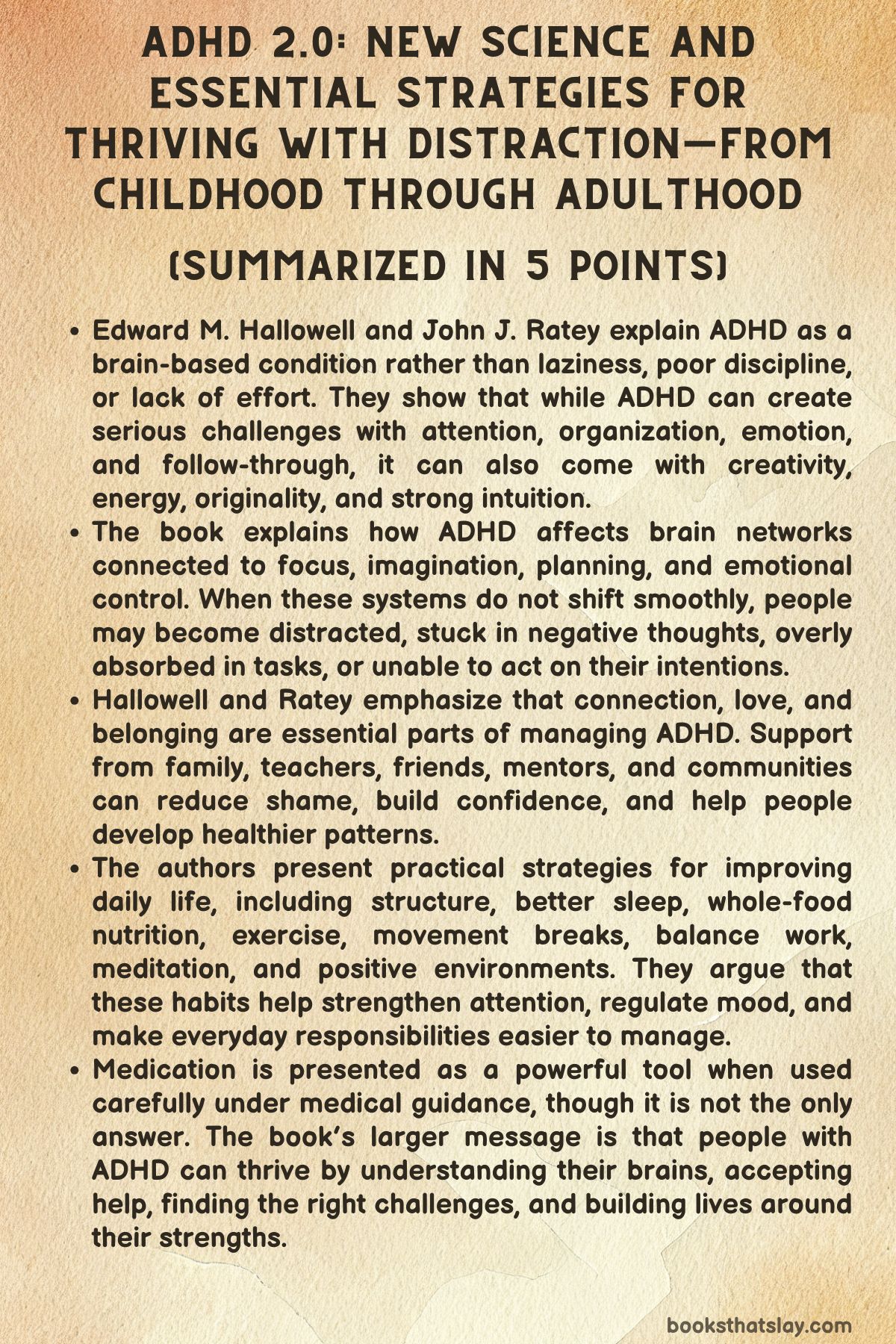
ADHD 2.0: New Science and Essential Strategies for Thriving with Distraction—From Childhood Through Adulthood by Edward M. Hallowell, written with John J. Ratey, is a practical guide to understanding ADHD through newer science, lived experience, and clinical insight. The book explains ADHD not as laziness or a character flaw, but as a brain-based condition with risks, strengths, and real paths toward improvement.
Hallowell and Ratey focus on attention, emotion, movement, connection, environment, medication, and personal strengths. Their message is hopeful but grounded: ADHD can be difficult, yet with the right strategies, support, and self-knowledge, people can build meaningful, productive, and joyful lives.
Summary
ADHD 2.0 presents ADHD as a misunderstood but highly manageable condition. Edward M. Hallowell and John J. Ratey write from the perspective of psychiatrists who have spent decades treating ADHD and who also live with ADHD themselves.
They explain that public understanding of the condition has changed greatly since their earlier work, but many myths remain. Some still believe ADHD affects only children, that it is invented by drug companies, or that it is simply an excuse for laziness.
The authors reject these ideas. They argue that ADHD is common, often lifelong, and can create serious risks when ignored.
At the same time, they insist that people with ADHD often have strong creativity, energy, intuition, imagination, and entrepreneurial ability.
The book begins by describing ADHD as a broad range of traits rather than a single, simple problem. People with ADHD may struggle with attention, organization, time management, boredom, impulsivity, restlessness, and follow-through.
Yet the same people may also show unusual originality, empathy, humor, generosity, independence, and intense focus when interested. The authors stress that ADHD is full of contradictions.
A person may be unable to start a routine task but work for hours with great intensity on something exciting. Someone may seem careless in one moment and deeply sensitive in another.
These patterns can be confusing to families, teachers, employers, and to the person with ADHD.
Hallowell and Ratey also introduce VAST, or variable attention stimulus trait, which resembles ADHD but is shaped strongly by modern life. Constant screens, fast information, social media, notifications, and overload can produce ADHD-like struggles even in people who do not meet the full diagnostic criteria.
This idea allows the authors to discuss attention problems as both medical and cultural. ADHD itself, they explain, is strongly influenced by genetics, though environment, stress, and injury can also matter.
A major part of the book explains what happens inside the ADHD brain. The authors describe two major brain networks: one tied to task-focused activity and another tied to imagination, memory, reflection, and wandering thought.
In many people, these networks switch on and off smoothly. In ADHD, the switching can be poorly regulated, so a person may drift into distraction when they need to act, or become locked into a task when they should stop.
This can create rumination, worry, unfinished plans, emotional storms, addiction risk, and a harsh self-image. The authors use examples of people who become trapped in negative thinking or so absorbed in one activity that they forget important responsibilities.
Even so, the authors emphasize that the brain can change. They rely on the idea of neuroplasticity: repeated habits and experiences can strengthen new pathways.
For a person stuck in worry or mental wandering, the goal is to activate the task-focused system through action. Reading, exercising, cooking, breathing, or even doing a small physical task can shift the brain out of unproductive loops.
On the other hand, if a person becomes too mechanical or emotionally shut down, warmth and connection can help restore balance.
The book gives special attention to the cerebellum, a part of the brain once associated mainly with balance and coordination. Hallowell and Ratey explain that newer research links the cerebellum to learning, emotional control, timing, and attention.
They compare it to a braking system that helps regulate thought, feeling, and action. This supports one of the book’s central images: the ADHD brain is like a race car with weak brakes.
The mind may be fast, powerful, and inventive, but it needs better control. Balance exercises, movement programs, and structured physical activities may help strengthen this system, though the authors are careful to note that not every promising method has been fully proven.
The story of Samuel, a boy in Shanghai, shows how support can change a child’s path. Samuel struggles with ADHD, and his mother seeks help from Hallowell.
Through encouragement, affection, education, school cooperation, positive reinforcement, and exercises, Samuel improves emotionally and academically. His progress shows that children with ADHD do not need shame or punishment; they need understanding, structure, and steady support.
Connection is another major theme. The authors argue that love and belonging are not extras; they are essential to health.
They discuss research on adverse childhood experiences and loneliness, showing how early pain and social isolation can damage long-term well-being. For families affected by ADHD, connection can be protective.
Hallowell draws from his own life, explaining that despite a difficult childhood, his bond with his grandmother helped him become resilient. The book also describes people like Peter, a struggling teenager who improved after discovering woodworking and receiving support from his family.
Once he felt seen and valued, his behavior and future changed.
The authors encourage readers to build connection in ordinary ways: eating with others, keeping in touch with friends, joining groups, spending time in nature, caring for pets, expressing gratitude, finding mentors, sharing worries, and seeking positive influences. Their advice is simple but firm: people with ADHD should not face life alone.
The book then turns to strengths. Hallowell and Ratey argue that ADHD treatment has too often focused only on deficits.
They believe people should look for their “right difficult,” meaning the kind of challenge that stretches them in a meaningful and energizing way. When people with ADHD find work, hobbies, or missions that fit their strengths, they may thrive.
The authors describe entrepreneurs, scientists, and creative people who found success after discovering the right path. They also warn that the craving for stimulation can become destructive when people choose the wrong challenge or refuse help.
Asking for help, they argue, is not weakness but wisdom.
Environment also matters. The authors recommend building a life that supports the ADHD brain instead of constantly fighting it.
Structure is essential: schedules, lists, reminders, routines, and rewards can reduce chaos. Children need clear expectations and free time.
Adults need systems that make daily life easier. At the same time, technology must be managed carefully because it can feed distraction and compulsive use.
Diet, sleep, positivity, and support are also part of a healthy environment. The authors advise eating whole foods and limiting processed and sugary foods.
They urge readers to treat sleep seriously, since poor sleep or sleep disorders can worsen or mimic ADHD symptoms. They recommend healthy sleep habits, including less screen stimulation at night.
They also encourage people to choose positive schools, workplaces, friends, and partners whenever possible. Since people with ADHD can be drawn toward chaotic situations, they should be intentional about their surroundings.
Exercise receives strong emphasis. Hallowell and Ratey present movement as one of the best natural tools for ADHD.
Exercise increases chemicals connected to focus, motivation, mood, and brain growth. It can help children settle into learning and help adults regulate emotion and attention.
The book includes examples of classrooms and programs where movement improved behavior and academic performance. Balance exercises, martial arts, yoga, meditation, jump rope, running, and daily physical activity are all presented as useful options.
The authors do not demand a single routine, but they recommend regular movement and accountability.
Medication is treated as powerful but often feared. The authors acknowledge public concern around ADHD drugs, but they argue that medication can greatly reduce suffering when properly prescribed and monitored.
Stimulants are the most common and often effective because they increase dopamine and norepinephrine, helping strengthen attention and self-control. Other medications may help people who do not respond well to stimulants or who struggle with emotional reactivity, irritability, or rejection-sensitive dysphoria.
The authors discuss side effects and stress the need for medical supervision. They also argue that treating ADHD can reduce the risk of later addiction, while untreated ADHD may increase it.
In the end, the book brings its ideas together into a hopeful framework. ADHD is not laziness, disrespect, or moral failure.
It is a brain difference that can cause real pain, but it can also carry real gifts. The authors do not offer one universal solution.
Instead, they ask readers to combine knowledge, connection, structure, exercise, environment, medication when appropriate, and personal strengths in a way that fits their own lives. Their final message is that no one kind of brain is best.
People with ADHD can stop trying to become someone else and instead learn how to guide their own minds with patience, help, and confidence.
Key People
Dr. Edward M. Hallowell
Dr. Edward M. Hallowell functions as both an authorial guide and a living example of the book’s central argument: ADHD is difficult, but it is not a dead end. His presence gives the work its personal force because he does not speak only as a clinician observing patients from a distance.
He speaks as someone who has experienced ADHD-related challenges in his own life, including the effects of dyslexia and a difficult childhood. This personal history makes his voice warmer and more practical, especially when he discusses the role of love, connection, and patient support.
Hallowell’s reflections on his grandmother, his early teacher, his family, and his patients show that he sees treatment as more than medication or diagnosis. For him, ADHD care requires dignity, encouragement, education, and a belief in the person’s hidden strengths.
In ADHD 2.0, he comes across as optimistic without denying the risks of ADHD. He wants readers to understand the science, but he also wants them to feel less ashamed and less alone.
Dr. John J. Ratey
Dr. John J. Ratey appears as Hallowell’s intellectual partner and a key voice behind the book’s scientific explanations, especially around exercise, brain function, movement, and motivation. Like Hallowell, Ratey has personal experience with ADHD, which gives his analysis a grounded quality.
He is especially important in the sections that explain how physical movement affects attention, mood, and self-regulation. His work emphasizes that ADHD is not only a problem of willpower or attitude; it is tied to brain systems that can be influenced by behavior, structure, and bodily activity.
Ratey’s clinical examples, including the story of David, show how losing exercise can worsen ADHD symptoms and how restoring movement can improve stability. He represents the book’s belief that the body and mind cannot be separated.
Through Ratey, the reader sees ADHD treatment as active and dynamic: running, balance, yoga, meditation, and regular exercise can become serious tools for managing attention and emotion.
Hank
Hank represents the person with ADHD who has become trapped in negative self-understanding. He is described as charming but brooding, someone who has tried treatment and then given up because he believes his darker moods are simply part of who he is.
His role is important because he shows how ADHD can become more damaging when a person mistakes symptoms for identity. Hank’s rumination, worry, and resignation illustrate how the mind can fall into repeated negative patterns.
The authors use him to show that understanding the brain’s ability to change can be life-altering. If Hank had known more about neuroplasticity and the interaction between different brain networks, he might have continued seeking help instead of accepting defeat.
He is not presented as weak; rather, he is someone who lacks the right framework. His character shows how dangerous hopelessness can be and how powerful it can be to learn that the mind can be trained toward healthier patterns.
Ron
Ron, Ratey’s uncle, is used to show how ADHD can affect everyday life in ways that seem careless from the outside but are better understood as failures of attention regulation. His repeated forgetfulness, including leaving his wife Gretchen at a store, reveals how absorbed a person with ADHD can become in a task.
Ron is not portrayed as cruel or indifferent. Instead, his behavior shows what happens when the brain’s task-focused system becomes so dominant that other responsibilities fade from awareness.
His attempt to send his daughter Renee to retrieve Gretchen, despite Renee not being fully licensed, deepens the example because it shows how ADHD can impair judgment in the moment. Ron’s story also shows how ADHD can remain unrecognized within families for years.
Only later, after a younger family member is diagnosed, does the family begin to understand Ron’s behavior differently. He represents the older generation of people whose ADHD may have gone unnamed and untreated.
Gretchen
Gretchen is not analyzed at length in the summary, but her presence is meaningful because she represents the family members who live with the consequences of another person’s ADHD. Being forgotten at a store is not merely a comic incident; it points to the emotional strain that ADHD can place on relationships.
Gretchen’s role reminds readers that ADHD does not exist only inside the individual. It affects spouses, children, parents, teachers, and coworkers.
Through her, the book quietly shows why education and diagnosis matter. Without understanding ADHD, a spouse might interpret forgetfulness as disrespect or lack of love.
With understanding, the same behavior can be seen as part of a neurological pattern that still needs accountability, structure, and management. Gretchen therefore stands for the need to include loved ones in the process of ADHD care.
Renee
Renee appears in Ron’s story as the daughter he tries to send to pick up Gretchen, even though she only has a learner’s permit. Her role is small, but it helps reveal the ripple effect of ADHD within a family.
Ron’s distracted decision-making places Renee in an inappropriate position, showing how ADHD symptoms can create confusion or unsafe choices when left unchecked. Renee’s presence also highlights how children in families affected by ADHD may be pulled into adult problems, sometimes because the adult is acting impulsively or failing to pause before making a decision.
She is less a developed character than a revealing figure in the example. Through her, the authors show that ADHD management is not simply about improving productivity; it is also about protecting relationships and making safer choices.
Dr. Russell Barkley
Dr. Russell Barkley appears as an authority whose research helps establish the seriousness of ADHD. His role is to counter the dismissive belief that ADHD is minor, exaggerated, or invented.
By citing Barkley’s warning about the dangers linked to ADHD, the authors underline that untreated ADHD can have severe consequences, including reduced life expectancy and increased risk of harmful outcomes. Barkley represents the evidence-based side of the book’s argument.
His presence strengthens the authors’ claim that ADHD deserves medical, social, and personal attention. He also helps balance the book’s optimism.
While Hallowell and Ratey often emphasize strengths, Barkley’s contribution reminds readers that celebrating ADHD traits should not lead to ignoring the real risks. His role is therefore corrective: he pushes the discussion away from both stigma and romanticization.
Professor John Gabrieli
Professor John Gabrieli represents the neuroscience behind the authors’ explanation of ADHD. His work helps connect symptoms such as distraction, negative self-perception, and poor follow-through to brain network activity.
Gabrieli’s role is important because he gives scientific support to experiences that many people with ADHD find hard to explain. When a person cannot shift from imagination to action, or when they repeatedly fail to complete tasks despite good intentions, the problem can be misunderstood as laziness.
Gabrieli’s research helps reframe such struggles as problems in brain regulation. His presence allows the book to move beyond personal anecdotes and into a more technical but accessible explanation of how attention works.
He supports one of the book’s main goals: helping readers replace shame with understanding.
Dr. Jeremy Schmahmann
Dr. Jeremy Schmahmann is central to the book’s discussion of the cerebellum. His research expands the reader’s understanding of this brain structure beyond balance and coordination.
By showing that the cerebellum also contributes to learning, emotion, timing, and attention, Schmahmann helps the authors explain why movement-based treatments may benefit people with ADHD. His idea of the cerebellum as a stabilizing system fits closely with the book’s image of the ADHD brain as powerful but in need of better brakes.
Schmahmann’s role is that of a scientific bridge between physical coordination and mental regulation. He helps justify the authors’ interest in balance exercises, movement programs, and cerebellar strengthening.
Through him, ADHD treatment becomes broader than talk therapy and medication, including the body’s role in shaping attention and self-control.
Frank Belgau
Frank Belgau appears as an innovator whose balance board becomes part of the book’s exploration of movement-based learning and ADHD support. His work is connected to the idea that balance and coordination exercises may help strengthen systems involved in attention and learning.
Belgau’s role is practical rather than theoretical. He represents the kind of experimental, hands-on approach that has attracted interest from parents, clinicians, and educators seeking alternatives or additions to traditional treatment.
At the same time, the authors’ discussion of such methods remains cautious. Belgau’s work reflects the promise of physical interventions, but it also sits within a wider field where some treatments need more research.
His presence shows the book’s openness to new strategies while still recognizing the need for evidence.
Robert Melillo
Robert Melillo is presented as a practitioner whose work with neurodivergent children connects to the book’s interest in brain-body interventions. His treatment program, associated with ideas about disconnection and development, fits with the authors’ belief that ADHD symptoms can improve when underlying regulatory systems are strengthened.
Melillo’s role is to show that some clinicians have built structured programs around movement, balance, and neurological development. The authors do not present him as the final authority, but they include him as part of a wider conversation about non-medication approaches.
His presence helps expand the reader’s view of ADHD treatment. Instead of seeing ADHD only as a condition treated at a desk or with a prescription, Melillo’s example suggests that the clinic, classroom, and body all matter.
Dr. Harold Levinson
Dr. Harold Levinson appears as a more controversial figure because he uses motion sickness medication to treat ADHD symptoms. His role is important because it allows the authors to show both curiosity and caution.
They acknowledge that Levinson has supporters and has reported success, but they also note that his methods have not been sufficiently studied for ADHD. He represents the many alternative or unconventional approaches that surround ADHD treatment.
Through Levinson, the book teaches readers not to dismiss every unfamiliar idea automatically, but also not to accept every claim without evidence. His inclusion shows the authors’ balanced attitude: they are interested in anything that might help patients, but they remain aware that hopeful stories are not the same as controlled scientific proof.
Lily
Lily, Samuel’s mother, is one of the most important caregiver figures in the book. She seeks help from Hallowell for her son and becomes an active part of his improvement.
Her role shows how much a parent’s attitude can affect a child with ADHD. Lily does not simply wait for a doctor or school to solve the problem.
She listens, follows guidance, supports Samuel emotionally, and helps create the conditions he needs to succeed. Her love is practical: it appears in persistence, advocacy, patience, and willingness to learn.
Lily also shows that parents often need education as much as children need treatment. Through her, the book demonstrates that ADHD management is a family process.
Her commitment helps transform Samuel’s experience from punishment and shame into growth and confidence.
Samuel
Samuel is a child with ADHD whose story demonstrates the combined power of affection, structure, advocacy, and targeted exercises. At first, he struggles with behavior and school performance, and his environment includes harsh discipline.
With Hallowell’s guidance and Lily’s support, Samuel begins to improve. His refusal to eat the chocolate he receives as a reward because it is “too important” shows how deeply meaningful success can be for a child who has often experienced failure or correction.
Samuel represents the child whose potential is hidden beneath symptoms. His story argues against punishment-based approaches and supports a model built on education, encouragement, and understanding.
In ADHD 2.0, Samuel becomes proof that when adults change the environment around a child, the child can begin to change too.
Dr. Vincent Felitti
Dr. Vincent Felitti appears through his research on adverse childhood experiences and their connection to later health problems. His work helps the authors show that emotional pain, trauma, and disconnection can shape physical and mental health across a lifetime.
Felitti’s role is especially important because families affected by ADHD may have higher levels of stress and adverse experiences. His research gives weight to the authors’ claim that love, connection, and belonging are not sentimental ideas but protective forces.
By including Felitti, the book places ADHD within a larger context of childhood experience, family systems, health, and resilience. He helps explain why treatment should not be limited to symptom control.
A person’s history, relationships, and sense of safety also matter.
Dr. Vivek Murthy
Dr. Vivek Murthy is used to support the book’s argument about loneliness and connection. His work on loneliness as a widespread health issue gives the authors a public health framework for what they observe clinically.
Murthy’s role is to show that disconnection is not just a private sadness; it can become a serious threat to well-being. For people with ADHD, who may experience rejection, misunderstanding, social failure, or shame, loneliness can be especially damaging.
Murthy’s presence strengthens the authors’ claim that belonging should be treated as a core part of healing. His contribution helps move the book away from a purely individual model of ADHD and toward a relational one, where community and human warmth are essential to thriving.
Kelli Harding
Kelli Harding appears in connection with research showing the protective effect of care and affection. Her work with obese rabbits is used to support the idea that love and attention can influence health outcomes.
Harding’s role in the book is to reinforce the biological importance of kindness. Her example helps translate the authors’ message about love into something concrete and research-based.
For readers who might see emotional support as secondary to medication or structure, Harding’s presence helps correct that view. She shows that the quality of care in an environment can affect the body and mind in measurable ways.
Her work supports the book’s larger argument that connection is a real treatment factor, not merely a comforting addition.
George Vaillant
George Vaillant is connected to the long-running Harvard study on adult development, which supports the book’s emphasis on relationships and love. His role is to provide historical and research-based confirmation that human connection is one of the strongest predictors of well-being.
Vaillant’s work helps the authors argue that success cannot be measured only by productivity, achievement, or symptom reduction. A person with ADHD may need tools for focus and organization, but they also need stable relationships and a sense of belonging.
Vaillant’s contribution gives the book a broader human perspective. ADHD management is not just about making the brain perform better; it is about helping the person live a fuller, healthier life.
Robert Waldinger
Robert Waldinger continues the work of the Harvard study and represents the ongoing evidence behind the book’s focus on love and connection. His presence shows that the importance of relationships is not an outdated or vague claim, but a continuing finding in long-term research.
Waldinger’s role reinforces the message that social bonds shape health and happiness over time. In the context of ADHD, this matters because many people with the condition carry memories of criticism, rejection, or failure.
Strong relationships can help repair that damage and provide the emotional safety needed for growth. Waldinger helps place ADHD care within a lifelong view of human development.
Gammy
Gammy, Hallowell’s grandmother, is one of the most emotionally significant figures in the book. She represents the healing power of early love and stable attachment.
Hallowell credits his bond with her as a major reason he was able to overcome the risks associated with a difficult childhood. Her role is not clinical or scientific, yet she is central to the book’s message.
Gammy shows that one loving adult can make a lasting difference in a child’s life. For a child with ADHD, who may be corrected, misunderstood, or punished often, such a relationship can protect the child’s self-worth.
Gammy embodies the kind of connection the authors urge readers to seek and provide: steady, accepting, and life-giving.
Bruce Alexander
Bruce Alexander appears through his idea of dislocation, or the loss of belonging. His role helps the authors connect ADHD, loneliness, addiction, and social environment.
Alexander’s work suggests that addiction and suffering are not only personal weaknesses but can arise from social disconnection. This fits the book’s view that people with ADHD are more vulnerable when isolated and more resilient when supported.
His concept of dislocation gives language to the pain of not fitting in, a common experience for people whose behavior has been criticized as strange, lazy, rude, or disruptive. Alexander’s role is to deepen the book’s social argument: healing requires more than treating the individual brain; it also requires restoring connection to people, place, purpose, and community.
Dav Pilkey
Dav Pilkey, creator of the Captain Underpants series, represents the creative child whose ADHD traits may be misunderstood before they are recognized as strengths. His experience of feeling ostracized shows the emotional cost of being different in school or childhood environments that reward conformity.
Pilkey’s role is powerful because his later success reframes traits that may once have been seen as problems. Imagination, humor, restlessness, and nonconformity can become creative assets when given room to develop.
He shows that a child who seems troublesome or unfocused may also possess unusual talent. His story supports the authors’ argument that ADHD should not be viewed only through deficits.
The same mind that struggles in one setting may flourish in another.
Peter
Peter is a teenager who struggles socially and academically before discovering woodworking. His story shows how finding the right environment and the right activity can change a person’s self-concept.
Before woodworking, Peter appears to be failing within the expectations of traditional school. Once his parents and Hallowell recognize his interest, he receives support, attends a vocational school, and gains access to a workshop.
This shift allows him to experience competence, pride, and belonging. Peter’s role is to show that success for a person with ADHD may require a different path rather than more pressure to fit the usual one.
His improvement is not magical; it comes from being seen accurately and supported practically. He represents the book’s belief that strengths must be discovered, respected, and built into daily life.
Hallowell’s First Grade Teacher
Hallowell’s first grade teacher represents the educator who notices a child’s struggle and responds with patience rather than shame. Her help with reading exercises becomes an example of how a supportive adult can influence a child’s future.
Because Hallowell also had dyslexia, school could have become a place of humiliation. Instead, this teacher offered guidance that helped him persist.
Her role reinforces the book’s repeated claim that children with ADHD and related learning differences need encouragement, structure, and kindness. She also stands as a contrast to punitive systems that mistake neurological difficulty for disobedience or laziness.
Her importance lies not in dramatic action, but in steady attention to a child who needed help.
Allen
Allen represents the person with ADHD who finds success through entrepreneurship. His story shows how traits that may cause difficulty in conventional settings can become advantages in self-directed work.
As a teenager, Allen begins creating businesses, eventually achieving long-term success after trying several ventures. He reflects the book’s belief that people with ADHD often thrive when they find stimulating, flexible, creative work.
Allen’s role is not to suggest that every person with ADHD should become an entrepreneur, but to show the value of matching a person’s temperament with the right challenge. His path supports the idea of finding the “right difficult,” a demanding pursuit that energizes rather than crushes the individual.
The Unnamed Professor
The unnamed professor who discovers physics almost by accident shows how strengths can sometimes be found through unexpected exposure. Attending a physics lecture on a date leads to a successful career, suggesting that people do not always know their gifts until they encounter the right field, teacher, or challenge.
This figure supports the book’s argument that talent discovery should be active and open-minded. For people with ADHD, traditional measures of ability may miss hidden strengths because boredom, poor structure, or low confidence can block performance.
The professor’s story shows that interest can unlock focus and direction. Once the mind finds something that truly engages it, achievement becomes far more possible.
Kathy Kolbe
Kathy Kolbe appears as the creator of the Kolbe Index, a tool the authors recommend for understanding how people naturally take action. Her role is connected to the book’s strength-based approach.
Rather than asking only what a person is bad at, Kolbe’s framework helps identify instinctive patterns of effort and problem-solving. This is especially useful for people with ADHD, who may have spent years hearing about their weaknesses.
Kolbe’s contribution helps readers think practically about careers, tasks, and environments that fit their natural style. Her role supports the authors’ belief that self-knowledge can reduce frustration.
When people understand how they work best, they can make better choices instead of constantly forcing themselves into unsuitable systems.
Jon
Jon represents the person with ADHD who craves extreme challenge and feels restless or anxious without it. His story shows the risky side of stimulation-seeking.
When ordinary life feels dull, a person may pursue nearly impossible tasks, stressful situations, or self-defeating patterns just to feel alive and engaged. Jon’s difficulty is not lack of ability; it is difficulty choosing the right kind of challenge and accepting help.
He shows how ADHD can drive people toward intensity even when that intensity harms them. His role warns readers that energy and ambition need guidance.
Without self-awareness and support, the desire for stimulation can become a trap rather than a strength.
Greg
Greg appears in a conversation with Hallowell about accepting help. His role is to represent resistance to support, a common pattern among people who equate help with weakness or loss of independence.
Hallowell challenges Greg’s thinking, encouraging him to see help as useful rather than humiliating. Greg’s character is important because many ADHD struggles worsen when people try to manage everything alone.
Pride, shame, or fear of dependence can prevent them from using tools, partners, coaches, doctors, or family support. Greg helps the authors make a practical point: accepting help is often the difference between repeated failure and meaningful progress.
His story reframes support as strategy.
Dr. Benjamin Feingold
Dr. Benjamin Feingold appears in the discussion of diet and ADHD. His elimination diet once attracted attention for helping some patients, though the authors note that he later fell out of favor with mainstream medical science for taking his claims too far.
Feingold’s role is to show both the promise and danger of dietary approaches. Food can affect mood, energy, and attention, but nutrition should not be treated as a simple cure-all.
His example allows the authors to recommend sensible dietary habits, such as eating whole foods and reducing sugar and processed foods, while warning against overconfident claims. Feingold represents the need for balance: diet matters, but evidence and moderation matter too.
David
David, a patient of Ratey, shows the power of exercise in managing ADHD symptoms. He is a successful professor and husband whose life becomes harder after a knee injury prevents him from running.
Without his usual exercise, his ADHD symptoms worsen, and he needs medication to stabilize until he can return to physical activity. David’s role clearly illustrates that exercise is not merely a lifestyle bonus for people with ADHD.
For some, it is a core regulatory tool. His story also shows how a change in routine or physical health can trigger symptoms that were previously managed.
David represents the book’s larger message that ADHD management often depends on daily habits that support the brain.
Allison Cameron
Allison Cameron is a teacher who brings exercise into the classroom for students with behavioral challenges, many of whom have ADHD. Her role shows how educators can change outcomes by changing the learning environment.
Instead of treating movement as a disruption, she uses it as preparation for learning. By allowing students to exercise at the beginning of class, she helps them become more focused and productive.
Cameron represents practical innovation in education. Her example challenges the traditional classroom model that expects children to sit still before they are ready to concentrate.
She shows that movement can be a path to discipline, not the opposite of it.
Tatsuo Okada
Tatsuo Okada is connected to the Spark Center, an afterschool program in Japan inspired by Ratey’s work on exercise and the brain. His role is to show that movement-based ADHD support can travel across cultures and educational systems.
The success and expansion of his program suggest that the principles in the book are not limited to one clinic or one country. Okada represents implementation: he takes ideas about exercise, focus, and child development and turns them into a structured program.
His presence strengthens the book’s argument that physical activity can be integrated into real-world systems for children who need support.
Lucy
Lucy is a student who uses jump rope before math homework to improve her focus and mood. Her story is small but memorable because it shows a simple, repeatable strategy that continues beyond school.
Lucy’s role is to demonstrate self-regulation in action. She learns that movement changes how she feels and how well she can work, then keeps using that knowledge as she grows older.
Unlike some examples involving doctors, programs, or classrooms, Lucy’s method is personal and accessible. She shows that ADHD management can begin with small habits.
Her story supports the authors’ advice that people should pay attention to how exercise makes them feel, because that feeling can become a lasting source of motivation.
Dan
Dan is a grandfather concerned about his grandson Steven, who has been diagnosed with ADHD. His role is that of an older family member trying to help when the child’s parents resist structure and medication.
Dan’s situation shows that ADHD affects the whole family system and that grandparents or extended relatives may sometimes become advocates. He also represents the frustration of seeing a child struggle while the adults closest to the child are unsure, resistant, or overwhelmed.
Through Dan, the authors explain when medication might be worth considering and why structure is especially important for children with ADHD. His concern gives the discussion of treatment a human frame.
Steven
Steven is Dan’s grandson, a child diagnosed with ADHD who struggles at home and school. His parents resist medication and do not provide enough structure, leaving him without the support he needs.
Steven represents children whose symptoms are recognized but not adequately addressed. His role shows that diagnosis alone is not enough.
A child needs routines, movement, guidance, and sometimes medication, depending on the situation. Steven’s story also highlights how parental fear of medication can delay help.
The authors do not present medication as mandatory for every child, but Steven’s case shows that refusing it without creating other forms of support can leave a child suffering unnecessarily.
William Dodson
William Dodson appears in the discussion of rejection-sensitive dysphoria, a painful emotional response associated with ADHD. His role is to help name a form of suffering that many people experience but may not understand.
By identifying and explaining rejection sensitivity, Dodson gives patients and clinicians a way to discuss sudden, intense emotional pain linked to criticism, rejection, or perceived failure. The authors note that simply knowing the term can help some people manage the experience better.
Dodson’s contribution supports the book’s larger effort to replace confusion and shame with language and understanding. His role is especially important for the emotional side of ADHD, which is often overlooked when the condition is reduced to attention and hyperactivity.
Analysis of Themes
ADHD as a Brain Difference, Not a Moral Failure
The book repeatedly challenges the idea that ADHD is caused by laziness, disrespect, weak discipline, or poor character. Hallowell and Ratey argue that ADHD is rooted in brain function, especially in the regulation of attention, motivation, emotion, and action.
This matters because moral judgment often makes ADHD worse. A child who is repeatedly called careless may grow into an adult who believes failure is part of their identity.
A worker who misses deadlines may be treated as irresponsible when the deeper issue is a faulty system for time, stimulation, and follow-through. The authors do not excuse harmful behavior, but they change the explanation behind it.
Once ADHD is understood as a brain-based condition, the response can shift from blame to strategy. Structure, movement, medication, sleep, connection, and support become tools rather than signs of weakness.
This theme also allows the authors to hold two truths together: ADHD can create serious risks, and people with ADHD can also possess remarkable creativity, energy, intuition, and originality. ADHD 2.0 asks readers to stop viewing ADHD through shame and start viewing it through understanding, responsibility, and practical care.
The Power of Connection and Belonging
Connection is treated as a central condition for healing, not as a soft or secondary concern. The authors show that loneliness, rejection, and adverse childhood experiences can damage health, confidence, and emotional stability, especially for people with ADHD who may already feel misunderstood.
Many people with ADHD grow up hearing that they are too much, too scattered, too disruptive, or not trying hard enough. Over time, these messages can create isolation and a defensive fear of being hurt.
Against this, the book presents love and belonging as protective forces. Hallowell’s relationship with his grandmother, Peter’s support from his family, Samuel’s progress through his mother’s care, and the research on long-term well-being all point toward the same idea: people function better when they feel seen, valued, and supported.
Connection also improves accountability. A person who has trusted relationships is more likely to ask for help, share worries, build routines, and recover from mistakes.
The theme does not suggest that love alone cures ADHD. Rather, love creates the emotional safety in which practical strategies can work.
Without belonging, even the best advice may not take root.
Movement as a Path to Focus and Emotional Control
Physical movement is presented as one of the most reliable ways to help the ADHD brain regulate itself. The authors connect exercise to neurotransmitters such as dopamine and norepinephrine, which influence motivation, attention, and alertness.
They also discuss brain-derived neurotrophic factor, which supports growth and healthier brain pathways. The message is clear: movement changes the brain’s operating conditions.
It can make focus more available, reduce emotional pressure, and help people transition into tasks that would otherwise feel impossible. The examples of David, Allison Cameron’s classroom, movement-based programs, balance exercises, martial arts, yoga, meditation, and Lucy’s jump rope routine all show different forms of the same principle.
The body can lead the mind toward readiness. This theme is especially important because many traditional environments punish movement, particularly in children.
A restless student may be told to sit still when movement is exactly what would help that student learn. The authors encourage readers to treat exercise not only as fitness but as a daily attention strategy.
Running, stretching, balancing, breathing, or taking a movement break can become a practical way to reset the brain.
Building a Life Around Strengths and Support
The book argues that managing ADHD is not only about reducing symptoms; it is also about finding the right life fit. Many people with ADHD struggle when forced into settings that demand long periods of stillness, routine paperwork, delayed rewards, or narrow forms of achievement.
Yet those same people may thrive in environments that reward creativity, urgency, independence, humor, problem-solving, physical action, or entrepreneurial thinking. The authors call attention to the need for the “right difficult,” a challenge that is demanding enough to engage the ADHD mind but not so chaotic that it becomes destructive.
This theme appears in the stories of Allen, the unnamed professor, Peter, Jon, and Greg. Some characters succeed after discovering their strengths; others struggle because they chase the wrong kind of stimulation or refuse help.
Support is therefore part of strength. Planners, reminders, medication, exercise partners, teachers, parents, doctors, coaches, and friends are not signs of inadequacy.
They are part of building an environment where ability can become real achievement. The book encourages readers to stop asking only how to fix weakness and start asking what conditions allow a person’s best qualities to show up consistently.