Where He Left Me Summary, Characters and Themes
Where He Left Me by Nicole Baart is a suspenseful, character-driven novel about what happens when love runs up against secrets that have been buried for years. Sadie Sheridan thinks she understands her husband, Felix Graham: a brilliant astronomy professor who prefers quiet, star-filled skies to crowded places.
But when they relocate to his remote family property in Washington’s North Cascades, the isolation starts to feel less like peace and more like a locked door. Felix disappears without explanation, and Sadie is forced to decide how far she’ll go to find the truth—and who else that truth might expose.
Summary
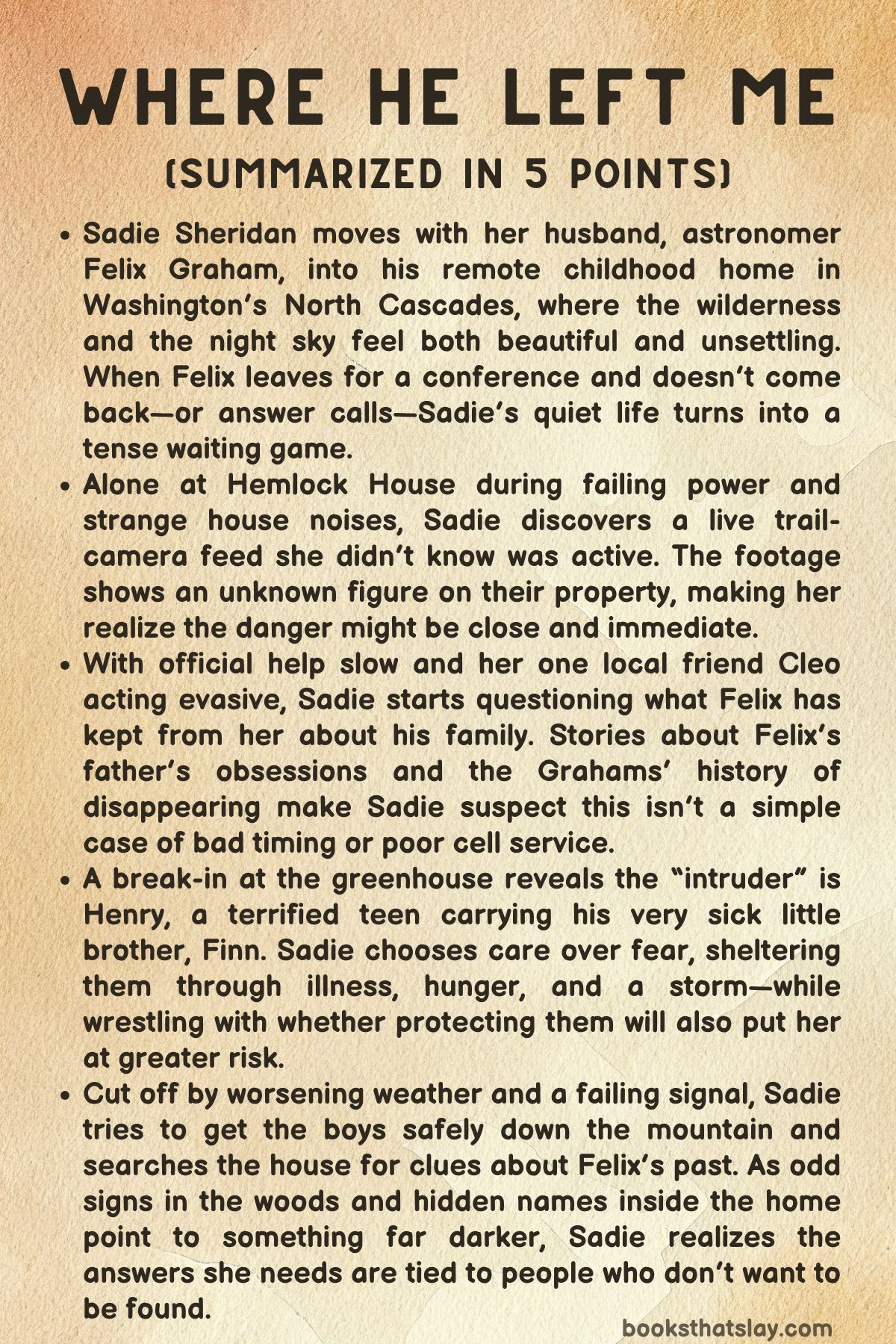
Sadie Sheridan wakes in the middle of the night at Hemlock House, the old Graham family home tucked deep in the North Cascades, after hearing a terrifying scream outside. Barefoot and shaking, she steps into the dark and is met by the vast forest pressing in on all sides.
Felix, her husband, finds her and explains it’s a fox calling during pupping season. He tries to soothe her, points her toward the clear sky, and promises he is staying right there with her.
The stars are brilliant, but to Sadie the sky feels indifferent. Even in his arms, she senses a shift—something unsettled since they moved to the mountain.
Months later, that unease becomes real. Felix leaves for a conference and is due back Sunday night.
Sadie prepares carefully: a special dinner, Felix’s late mother’s bone china, a dress he loves. The power flickers and then fails, leaving the house lit by candlelight and full of creaks and snaps that sound louder with every passing hour.
Felix doesn’t respond to her messages. By late evening, he’s still gone, and her worry sharpens into fear.
She tries calling; everything goes to voicemail. She checks his flight details and learns it landed on time.
That should have been reassuring. Instead, it makes his silence worse.
Searching for answers, Sadie enters Felix’s office, a room filled with high-end computers and astronomy materials, including images from the James Webb Space Telescope. While she digs through his work space, the computer monitor wakes with an alert that overrides the lock screen.
It’s a live trail-camera feed aimed at the greenhouse and the tree line—equipment Felix once dismissed as leftovers from his father’s paranoia. Sadie watches, frozen, as a figure moves between the trees.
A man steps into view and looks directly toward the camera, his eyes bright in infrared. He is not Felix.
The sense of being watched floods the house. With no sign of her husband and an unknown person on the property, Sadie spends the night hidden, barricading doors, turning off lights, and listening.
Morning brings daylight but not relief. Felix is still missing.
Sadie drives down the treacherous logging road into the small town of Requiem and goes to Trilogy, a café run by Cleo, the only person Sadie feels close to in the area. The place is crowded with holiday traffic, but Sadie’s attention stays on one thing: Felix didn’t come home.
Cleo reacts strangely—cool, dismissive, almost irritated—suggesting Sadie is overreacting. Outside, a park ranger who overhears them urges Sadie to report Felix missing and warns that storms in the Cascades can turn dangerous fast.
When Sadie mentions strangers near the property, the ranger cautions her that poachers can be armed. Snow is coming within days.
Back at Hemlock House, Sadie reports Felix missing to the Washington State Patrol, but the response is minimal. She throws herself into storm prep, trying to keep her fear busy: clearing gutters, draining faucets, securing the UTV, burning debris.
Small discoveries unsettle her anyway—like a large shed snakeskin near the house. Later, Cleo shows up with coffee and an apology, but her words land like a warning.
She tells Sadie that in the Graham family, people disappear and return on their own terms. Felix’s father, David, was known for strange obsessions and vanishing acts.
Felix’s mother and the children also had long absences. Cleo’s implication is clear: Felix may be choosing not to come back.
Sadie refuses to leave the house, convinced that if Felix returns, he’ll come here. She also realizes that if she wants answers, she may have to take them.
A separate memory shows how Sadie and Felix first moved toward each other. On a snowy night before Christmas at Newcastle University, Sadie is grading late when Felix appears in her doorway.
He’s awkward but kind, offering a small peace gesture: a printed image of Uranus from the James Webb Space Telescope because she missed seeing it through a telescope earlier. They talk about moons with Shakespearean names, about grief and distance, and about what family can cost you.
Their connection feels immediate, rooted in shared loss and quiet understanding.
In the present, about thirty hours into Felix’s disappearance, Sadie breaks a promise she made to him. She searches sealed areas of Hemlock House—spaces Felix insisted remain untouched after his father’s death and after the rupture with his sister, Gabrielle.
She gathers photo albums, papers, and notebooks, hoping for any clue. Then the trail-cam feed activates again.
The hooded figure returns and forces open the greenhouse. A moment later, the intruder appears carrying a limp body through the brush.
Sadie’s phone is dead, but instinct takes over. Armed with bear spray and a crowbar, she storms to the greenhouse, flips on the lights, and demands the person stop.
Under the bright glare, the “intruder” is revealed as a terrified teenage boy with a bruised face and filthy clothes. He calls himself Henry.
The limp person is his younger brother, Finn, feverish and barely responsive. Henry begs Sadie not to hurt them and forbids her from calling anyone, threatening to vanish into the mountain with Finn if she tries.
Sadie sees the reality: Finn is very sick, possibly with pneumonia, and Henry is running on fear and desperation. She agrees not to call, focuses on care, and brings quilts, water, medicine, and warm clothes.
The boys are skittish, communicating partly through a homemade sign language. Henry’s panic spikes whenever Sadie leaves the room, and when he thinks she might betray him, he lashes out—then crumples under the weight of it, trying to be strong for Finn.
As the storm worsens, water leaks into the greenhouse and forces a decision. Sadie insists they move Finn inside the house.
Henry agrees but keeps his guard up, and in the tense crossing he injures his ankle. Inside Hemlock House, Sadie feeds them and presses for details.
Henry says they’re trying to reach Requiem to meet an uncle, but he can’t provide a number. Sadie offers a plan: once the weather eases, she’ll drive them down the mountain.
Then their fragile calm cracks again. Finn wanders into Felix’s private study, fascinated by astronomy posters, a solar-system mobile, and images tied to Felix’s research.
Sadie explains brown dwarfs—objects not quite stars, not quite planets—and Finn lights up with interest. Henry, however, notices a framed photo of Sadie and Felix.
He touches Felix’s face in the picture, his expression hardening, and his reaction suggests he knows more than he’s admitting.
Sadie’s search for Felix continues alongside caring for the boys. A call to the San Diego hotel confirms Felix never stayed there.
The “conference” story is false. With the cell tower iced over and the property cut off, Sadie decides staying is too risky.
She and Henry prepare to take the Ranger UTV down old, unmarked trails once used by Felix’s father. They pack supplies, chain the tires, and move out into worsening snow, with Finn burning up against Sadie’s side.
On the trail they encounter disturbing signs: antlers screwed into trees and coated with glow paint, forming a field of silent markers. The sight feels like a warning.
They try to turn back, but in the whiteout they lose their way. Sadie steps out to find trail ribbons and stumbles upon a freshly torn animal carcass, evidence of predators nearby.
Henry drags her away, furious and frightened, and manages to locate a marker that gives them direction again.
The truth finally breaks open when Henry leads Sadie toward the person he’s been avoiding naming: his father, Benjamin Abbott. A confrontation erupts in the woods, and Benjamin appears with a shotgun, threatening, loud, and confident that fear will keep everyone in place.
Henry steps forward to draw his father’s attention away from Sadie. The struggle turns violent, and a shot is fired.
Benjamin falls, and law enforcement arrives in the aftermath, moving quickly to secure the scene.
Near Benjamin’s hidden shack, Felix is found alive—chained, weak, and badly mistreated. As Felix is taken to the hospital, the missing pieces come together.
Felix reveals that his sister Gabi had been trapped for years under Benjamin’s control, trying repeatedly to escape. She died during childbirth, and Felix had managed to care for the baby, Juliet, while planning a way out.
Benjamin captured Felix again before he could get everyone to safety. Henry and Finn were on the run because “home” meant returning to the man who terrorized them.
The aftermath is heavy: grief for Gabi, trauma for the boys, shock for Sadie, and guilt for Felix over how long the secrets stayed hidden. But the choices they make are clear.
Sadie commits to the children’s safety and future. Felix, recovering and changed, takes on daily care for Juliet and supports Henry and Finn as they begin to stabilize.
Healing is not quick and not neat, but slowly the household shifts from fear to structure—meals, warmth, small routines, and the first steps toward trust. As seasons turn, Sadie and Felix build a family out of what remains, carrying the losses with them while choosing, again and again, to stay.
Characters
Sadie Sheridan
Sadie is a central character whose journey revolves around navigating fear, isolation, and grief. At the beginning of Where He Left Me, Sadie is struggling with a deep sense of unease as she waits for her husband, Felix, to return from a conference.
Her anxiety grows as she senses something is amiss and begins investigating his absence. Sadie is depicted as strong and resourceful, finding ways to protect herself and those around her, such as barricading herself in the house after discovering an intruder on their property.
As the story progresses, Sadie’s complexity deepens, and she reveals her vulnerabilities. Her relationship with Felix is tested when she uncovers the truth about his family’s dark past.
Through it all, Sadie remains determined to find Felix, support him, and protect the children they now care for. Her growth is evident as she transforms from a fearful woman struggling with isolation to a compassionate and resilient figure, ready to build a future despite the haunting past.
Felix Graham
Felix plays a pivotal role in Where He Left Me, though his physical presence is often absent during key moments. He is initially portrayed as a loving and dependable husband, deeply involved in his scientific work with astronomy and the mystery surrounding his family’s secrets.
His sudden disappearance after attending a conference sparks Sadie’s fear, leading to the unraveling of hidden truths about his life and family. Felix’s strained relationship with his sister, Gabrielle, and his father’s obsessions with the supernatural come to light, showing the dark and complex family dynamics he’s been trying to escape.
His eventual return and the revelation of the harrowing events involving his family, including his captivity and his sister’s tragic death, shift Felix’s character. While initially distant and preoccupied with his work, Felix’s sense of guilt and responsibility for the safety of his family grows.
Ultimately, he becomes a devoted father, stepping into the role of a stay-at-home dad, supporting Sadie, and providing a sense of stability for the children, despite the emotional weight of the past.
Cleo
Cleo serves as one of Sadie’s few connections in the remote mountain town. Initially, Cleo appears as a supportive friend, offering Sadie a place to stay when she becomes concerned about Felix’s disappearance.
However, her responses to Sadie’s fears about Felix’s absence are dismissive, which complicates their relationship. Cleo’s indifference to the seriousness of the situation can be seen as a reflection of the town’s general attitude toward the Graham family’s eccentricities and the ongoing mystery surrounding Felix’s past.
She represents a form of normalcy that contrasts with the tension and danger Sadie experiences, yet she becomes a reliable figure as the story progresses, especially when she brings Sadie coffee as an apology. Though not a major character, Cleo’s role in Sadie’s life underscores the theme of isolation and the difficulty of seeking help in a small, disconnected community.
Henry Abbott
Henry’s introduction in Where He Left Me brings an intense layer of mystery and tension to the narrative. Initially, he is portrayed as a runaway teenager, hiding from an abusive father.
His actions are driven by a desire to protect his younger brother, Finn, while evading capture by their dangerous father. Henry’s complicated history with his family is slowly revealed through his interactions with Sadie and his efforts to care for Finn.
As the story progresses, Henry’s emotional fragility and deep-seated trauma become more apparent, particularly in his violent outbursts and the way he clings to a sense of control over his situation. Despite his rough exterior, Henry displays moments of vulnerability, especially in his relationship with Finn and his protective instincts toward him.
His ultimate act of defiance against his father showcases his desperation and the painful depths of his emotional scars. As Sadie and Henry’s relationship evolves, Henry begins to open up, revealing his past and his need for healing.
His transformation from a troubled and withdrawn teenager to someone capable of forming connections is a testament to his growth and the redemptive power of love and care.
Finn Abbott
Finn, Henry’s younger brother, represents innocence and vulnerability in the face of immense trauma. Though Finn is initially portrayed as weak and feverish, his silence and dependency on Henry speak volumes about his emotional state.
Finn’s backstory is less fleshed out than Henry’s, but his condition and the fact that he uses a homemade sign language with Henry suggest that he has endured significant hardship. Finn’s ability to bond with Sadie is gradual, and he begins to trust her as she helps care for him during their time at Hemlock House.
Despite his silence, Finn exhibits a quiet resilience, and his fascination with Felix’s astronomy research hints at a deep curiosity about the world. His relationship with Henry is complex, as he relies on him for survival, yet as the story unfolds, Finn begins to show signs of slowly processing the trauma he’s experienced.
His development is slower than Henry’s, but it highlights the ongoing process of healing for both brothers.
Benjamin Abbott
Benjamin Abbott, the boys’ father, emerges as a primary antagonist in Where He Left Me. His sinister presence casts a long shadow over the story, with his obsession with the supernatural and his abusive tendencies shaping the toxic environment Henry and Finn endure.
Benjamin’s violent and erratic behavior is initially hinted at through Henry’s description of him and is confirmed when he becomes a direct threat to Sadie. His deep control over his children and the physical and psychological torment he inflicts is revealed slowly, making his eventual confrontation with Sadie and Henry all the more harrowing.
His death at the hands of his son marks the culmination of the abusive cycle and serves as a pivotal moment in the story’s resolution. Although his character is portrayed mostly through his actions and their impact on others, Benjamin’s influence over his family is undeniable, making him a key figure in the novel’s exploration of trauma and survival.
Gabrielle (Gabi) Abbott
Though Gabrielle’s presence is more a part of the past, her story plays a crucial role in shaping Felix and Henry’s lives. Felix’s estranged relationship with Gabi and the mystery surrounding her tragic death add layers of complexity to his character.
Gabi’s escape attempt from their father’s clutches and the circumstances surrounding her death form part of the dark family history Felix and Henry are trying to move past. Gabi’s absence haunts Felix and serves as a driving force in his need to protect his family, even at the cost of his own safety.
Though she is never physically present in the narrative, Gabi’s impact on the characters—especially Felix—reverberates throughout the story, contributing to themes of family, loss, and the cycle of trauma.
Alice Sheridan
Alice, Sadie’s mother, represents the poignant theme of grief and the process of letting go. As Sadie navigates her complex relationship with Felix and her unfolding discovery of his family’s troubled past, Alice’s declining health serves as a subtle backdrop to Sadie’s emotional journey.
Alice is mostly seen through Sadie’s reflections and memories, as Sadie grapples with guilt and loss, particularly when she visits her mother’s care facility with Felix. Alice’s condition forces Sadie to confront her own fears about the fragility of life and the uncertainty of the future.
Despite her physical absence in the novel, Alice’s influence on Sadie’s character is deeply felt, especially in moments of reflection, where Sadie contemplates the connections between the people she loves and the choices they must make.
Themes
Isolation and Psychological Deterioration
The novel Where He Left Me explores isolation not merely as a physical condition but as a profound psychological state that corrodes perception, trust, and emotional stability. Sadie’s relocation to the remote North Cascades with Felix initially represents an act of devotion and reinvention—a chance to build a life removed from urban distractions.
Yet the isolation of Hemlock House transforms into an adversary of its own. Cut off from communication, surrounded by dark forests, and dependent on the unreliable presence of her husband, Sadie’s solitude amplifies every sound, movement, and absence into a potential threat.
Her fear of the encroaching wilderness mirrors her growing uncertainty about Felix’s secrets and the fragility of her own mental resilience. The house itself, creaking and shrouded in mystery, becomes a psychological labyrinth—each room a vessel of memory, loss, and paranoia.
Sadie’s attempts to maintain normalcy through rituals like preparing dinner or setting the table with bone china reveal her desperate grasp for order in an environment designed to unravel it. As she navigates the tension between rational fear and imagined danger, the novel paints isolation as both an external circumstance and an internal infection.
It shows how disconnection—from others, from truth, and even from oneself—can distort reality until it becomes indistinguishable from nightmare.
Secrets, Deception, and the Weight of the Past
Throughout Where He Left Me, the past operates as an invisible force shaping every decision, silence, and revelation. Felix’s family history—marked by his father’s obsessions, his sister’s disappearance, and a lineage of emotional estrangement—casts a long shadow over Sadie’s attempts to understand the man she loves.
The secrecy surrounding Felix’s “conference,” the locked rooms, and the trail cameras inherited from his father suggest that concealment is a generational trait. For Sadie, the discovery of hidden truths becomes a moral and emotional trial.
Her intrusion into Felix’s office and later his sealed rooms parallels her journey toward autonomy, as she refuses to remain complicit in ignorance. The revelation of Benjamin Abbott’s cruelty and the survival of Henry and Finn show how deception perpetuates cycles of trauma across families and generations.
Every concealed fact—whether motivated by guilt, fear, or love—creates collateral damage. Baart presents secrecy not as a tool for protection but as a corrosive mechanism that isolates people from one another and erodes empathy.
Even Felix, once seen as a victim of his family’s dysfunction, becomes part of the cycle when he hides the truth about his past. The theme underscores that love cannot thrive in darkness; transparency, however painful, is the only path to healing.
Love, Loss, and the Fragility of Connection
Love in Where He Left Me exists within the precarious boundaries of absence and uncertainty. Sadie and Felix’s relationship begins as a romantic ideal—two intellectuals drawn together by curiosity and emotional depth—but over time, their connection becomes fraught with unspoken fears and half-truths.
Sadie’s devotion transforms into endurance, and Felix’s affection becomes intertwined with guilt and secrecy. The disappearance tests the strength of their bond, forcing Sadie to confront whether love can survive without trust.
Simultaneously, the novel explores love in other, unexpected forms: Sadie’s instinctive care for Henry and Finn reveals her capacity for compassion even in terror, while Felix’s later role as a caregiver to Juliet and the boys demonstrates a redemptive evolution. The emotional landscape is shaped by loss—Sadie’s dead father and brother, her ailing mother, Felix’s lost family—and yet love endures through acts of protection, sacrifice, and forgiveness.
Baart suggests that love’s resilience is not in its perfection but in its persistence amid despair. It is a force that binds the broken, offering renewal not by erasing pain but by learning to live alongside it.
Trauma and the Cycle of Violence
Trauma in Where He Left Me is inherited, suppressed, and eventually confronted. Benjamin Abbott embodies the destructive legacy of control and abuse, using isolation and fear to dominate those around him.
His violence reverberates through generations—fracturing Gabi’s life, imprisoning Felix, and leaving Henry and Finn scarred in both body and spirit. The novel’s structure mirrors the cyclical nature of trauma: every revelation of the past ignites a new crisis in the present, suggesting that unacknowledged pain reproduces itself endlessly.
Sadie’s own trauma—her childhood loss, her mother’s decline, and the terror of Felix’s disappearance—makes her uniquely empathetic but also vulnerable. Her bond with Henry and Finn becomes an act of mutual healing, where care replaces cruelty and communication replaces silence.
Through these dynamics, the book exposes how survival often requires confronting inherited wounds rather than burying them. The final scenes, with the formation of a new, unconventional family, symbolize a break in the cycle.
Healing does not erase trauma but transforms it into understanding—a fragile hope born from recognizing pain’s continuity and refusing to pass it forward.
Nature and the Indifference of the Universe
The North Cascades, with their vast silence and unpredictable violence, serve as both setting and symbol in Where He Left Me. Nature’s immensity dwarfs human concerns, reflecting the cold indifference of the universe that Sadie perceives early on when she stares into the star-filled sky.
The forest is alive with echoes—fox screams, creaking trees, and snowstorms—that mirror the unpredictability of human emotion. The mountains’ beauty is inseparable from their danger, much like love and trust in the novel’s emotional terrain.
The recurring astronomical imagery, particularly Felix’s fascination with stars and brown dwarfs, emphasizes the tension between human fragility and cosmic permanence. While Felix finds meaning in studying the heavens, Sadie is unsettled by their distance, seeing in them a reminder of humanity’s insignificance.
Yet, by the novel’s end, the natural world becomes a quiet witness to resilience rather than despair. The same landscape that once represented isolation and threat becomes a backdrop for rebirth.
Baart thus uses nature as a moral and existential mirror—neutral, vast, and unyielding—against which human lives appear fleeting, yet capable of finding light even in the coldest night.