The Safekeep Summary, Characters and Themes
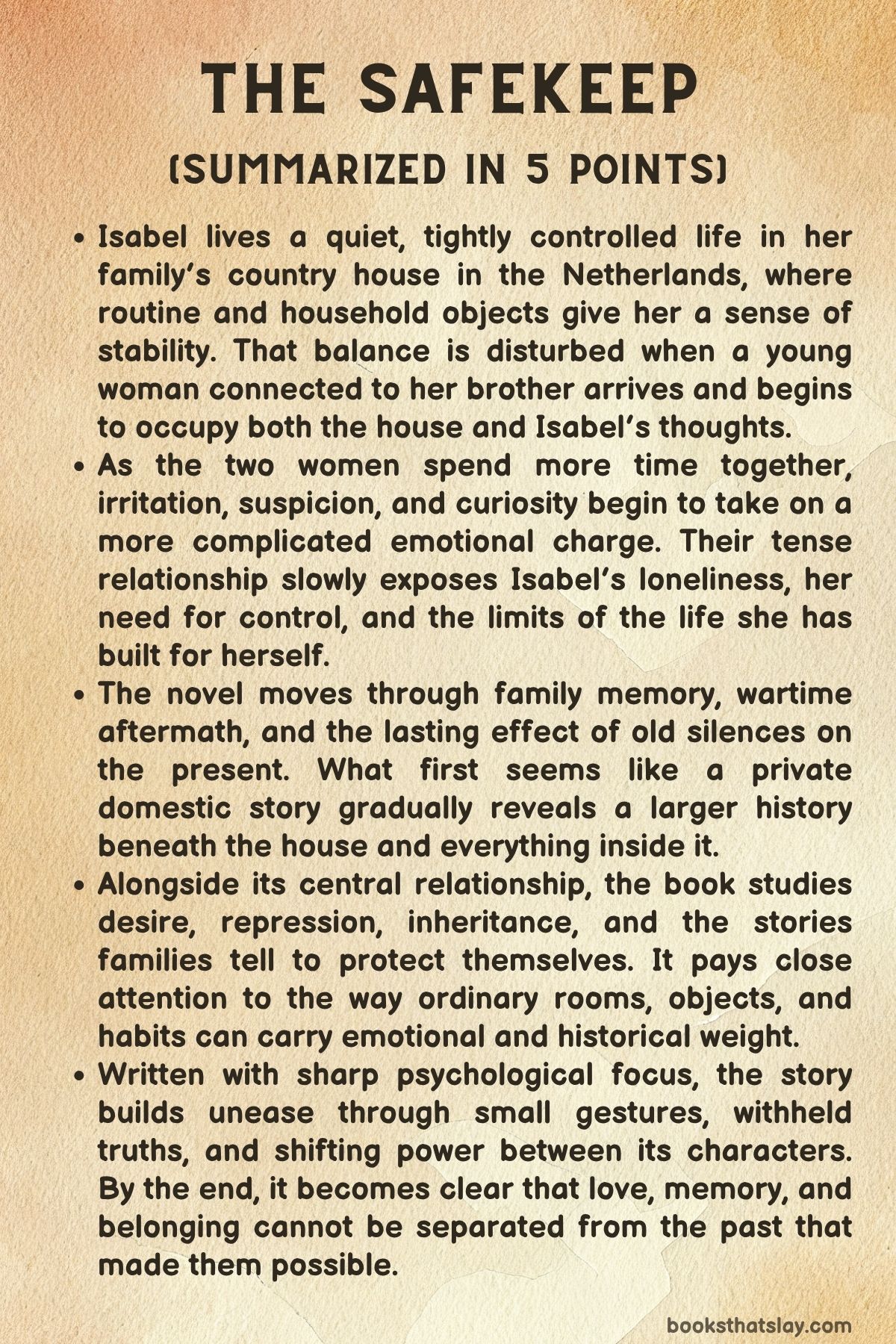
The Safekeep by Yael van der Wouden is a literary novel set in the Netherlands in the years after World War II, where private longing, family silence, and historical theft all shape the lives of its characters. At its center is Isabel, a guarded woman who lives in the country house her family occupied during the war.
Her ordered life is unsettled when Eva, her brother’s girlfriend, comes to stay. What begins as irritation and suspicion slowly shifts into desire, then into a painful reckoning with the house’s past. The novel studies possession, memory, guilt, and love with sharp emotional control and a steadily deepening sense of revelation.
Summary
Isabel lives alone in her family’s house in Zwolle, holding tightly to routine, order, and the objects left behind by her dead mother. She keeps the household carefully managed, pays close attention to furniture, silver, china, and other possessions, and finds comfort in their exact place and condition.
Her life is narrow but controlled. Her brothers, Louis and Hendrik, live elsewhere, and though she sees them, she remains emotionally distant from both.
Isabel’s attachment to the house is intense because it represents safety, inheritance, and the last structure left to her from childhood.
At a family dinner in The Hague, Louis brings his newest girlfriend, Eva. Isabel immediately dislikes her.
Eva seems too polished, too curious, too at ease. Isabel judges her appearance, her tone, and her behavior, and the evening becomes uncomfortable.
Yet Eva does not simply submit to Isabel’s disapproval. She answers back in subtle ways, revealing a harder, less decorative self beneath her outward charm.
Isabel leaves the night unsettled, but assumes that Eva, like Louis’s other girlfriends, will soon disappear.
Instead, Eva enters Isabel’s life more fully. Louis announces that he must leave for an extended period and expects Isabel to let Eva stay at the house while he is away.
Isabel resists, but Louis asserts his claim over the property and leaves Eva there. From the beginning, Eva’s presence disturbs the order Isabel depends on.
She touches things, asks questions, occupies space too comfortably, and refuses to follow Isabel’s unspoken rules. Isabel responds by watching her, guarding rooms, checking cupboards, and counting household items.
She becomes convinced that things are going missing. A teaspoon seems lost, then other small objects, and her anxiety grows until inventory itself becomes a ritual.
Eva unsettles Isabel in other ways as well. Isabel has been seeing a man named Johan, but she feels no real warmth toward him.
His attention makes her uneasy rather than happy, and the physical expectations attached to courtship feel oppressive and wrong. She has accepted this discomfort as something normal, partly because she has been told it is.
Eva’s arrival exposes that lie. Even while Isabel resents her, she is drawn to her voice, her movement, and her closeness.
Small encounters begin to carry an intensity Isabel cannot explain. A touch lingers.
A shared look becomes charged. Isabel’s efforts to maintain distance start to fail.
As Eva spends more time in the house, she also crosses into spaces Isabel considers sacred, especially the bedroom that belonged to Isabel’s mother. Isabel is outraged that Eva occupies it, yet Eva refuses to move.
Around this conflict, memories of Isabel’s childhood begin to surface. During the war, her family fled Amsterdam for the country house, where they survived famine and uncertainty.
Isabel remembers arriving in a fully furnished home and accepting it without fully asking where everything came from. She remembers strangers coming to the door and one disturbing visit after the war from two women who demanded the return of their belongings.
These memories have sat in her mind for years without being confronted directly, folded into the larger silence of family life.
Meanwhile, Isabel’s emotional life becomes more unstable. Eva criticizes her rigidity and asks what actually brings her joy.
The question shakes Isabel because she has organized her life around preservation, not pleasure. Her distrust of others has hardened into habit, and her identity is tied to guarding the house and everything in it.
Yet she cannot stop thinking about Eva. Their conflict becomes mixed with attraction.
After one especially tense evening, they kiss. The moment opens a door Isabel had never allowed herself to see clearly.
What she feels with Eva is immediate, frightening, and unmistakably real in a way her connection with Johan never is.
The relationship deepens after Hendrik and his partner Sebastian visit for a weekend. Their presence introduces a different model of intimacy, one Isabel has long judged and feared.
In earlier years she had discovered Hendrik’s secret love affair with a piano teacher and responded with moral disgust, echoing their mother’s harshness. The damage from that time still lingers between them.
Now, seeing Hendrik and Sebastian together, Isabel begins to understand what she denied for years. Eva and Isabel continue finding moments alone, and their attraction turns into a physical affair.
Isabel experiences both delight and terror. The house, once a place of stillness and control, becomes a place of hidden meetings, anticipation, and desire.
For a time, Isabel and Eva create a fragile private world. Their days take on warmth and ease.
Isabel relaxes her obsessive counting, and the fear that had defined her begins to loosen. Yet the relationship is shadowed by Louis’s absence and the knowledge that Eva is supposedly his partner.
Eva remains cautious, resistant to being seen publicly with Isabel, and careful about speaking of the future. Isabel wants permanence.
She wants Eva to choose her openly and to remain in the house. Eva, however, speaks in terms of necessity and survival rather than romance alone.
The illusion collapses when Louis calls to say he is returning and wants to end things with Eva because he has met someone else. Isabel expects this revelation to destroy Eva, but Eva is far less shaken than she is.
Their argument exposes how differently they understand their bond. Isabel imagines love as a reason to build a shared life.
Eva thinks in terms of security, power, and what can actually be held onto. Soon after, Isabel discovers Eva’s diary and realizes that Eva has indeed been taking items from the house.
The missing objects were not imagined. Eva has been reclaiming them.
When Isabel confronts her, the conflict becomes final and bitter. Eva leaves, and stolen items spill from her case as she goes.
Afterward Isabel becomes ill and emotionally shattered. Then she reads Eva’s diary and at last understands what has been hidden beneath everything.
Eva is Jewish. The house in Zwolle originally belonged to her family before they were deported during the Holocaust.
Her father died in the camps, her mother died after the war, and Eva grew up with loss, poverty, and the knowledge that other people were living among the possessions her family had been forced to leave behind. She had gone to the house once with her mother after the war and was denied entry.
Later, as an adult, she devised a plan: she met Louis deliberately, attached herself to him, and used him to gain access to the house so that she could recover what had been stolen. Her affair with Isabel began inside that plan, though it became more complicated than she intended.
This revelation transforms the novel. Isabel is forced to see that the home she treated as inherited sanctuary was built on dispossession.
The china, furniture, rooms, and keepsakes she guarded so fiercely were not simply family treasures. They were evidence of theft, denial, and moral failure.
She begins to question her relatives directly. Uncle Karel defends the acquisition of the house with evasions and self-justifying logic.
Aunt Rian reveals the same pattern in miniature, clinging to an item entrusted to her by a Jewish neighbor and refusing to admit wrongdoing. Isabel sees that her family’s comfort depended on stories people told themselves after the war so they would not have to reckon with what they had taken.
At the same time, Isabel begins to change personally. She cuts her hair, rejects Johan, and confronts Louis.
She finally admits, if not in full language then in action, that she will never live the life expected of her. She also starts to understand Hendrik with more humility.
Her earlier cruelty toward him becomes part of the same pattern of blindness that shaped her view of Eva and of the house itself. The process is painful because it requires Isabel to surrender the innocence she once claimed.
Eventually Isabel travels to Amsterdam to find Eva. She returns the diary and tries to speak honestly.
Eva is wary and angry, unwilling to trust her. Isabel asks whether what they shared had been real.
Eva answers in a way that makes clear both her hurt and her distrust: Isabel had seen only what she wanted to see. Isabel leaves without resolution.
Back in Zwolle, she continues living alone, but not as before. She notices the synagogue, reads the biblical line about a house of devotion for all people, and begins to imagine the house differently.
When Eva comes to the door one winter night, Isabel invites her in. She has gathered the remaining family belongings to return.
More importantly, she tells Eva that she has secured the house and wants Eva to have it because it is rightfully hers. This offer is not presented as a bargain for love but as an attempt at justice.
Still, Isabel also admits that she loves Eva and wants her to stay.
Eva accepts both the truth of that offer and the love within it. The novel closes with the two of them together in the house, not as owner and intruder, not as thief and guardian, but as women trying to make a different future inside a place marked by violence, memory, and return.
Characters
Isabel
Isabel is the emotional center of the novel and the character through whom the story’s deepest tensions are felt. She begins as a woman ruled by order, possession, and routine.
Her attachment to the house and its objects is not simply fussy or materialistic; it is the structure that holds her together. She has built a life around control because control feels safer than uncertainty, grief, desire, or memory.
Her close attention to teaspoons, plates, furniture, and locked cabinets shows how strongly she depends on physical things to create emotional security. She is lonely, but she has convinced herself that loneliness is the same thing as peace.
What makes Isabel such a strong character is that her harshness is never presented as simple cruelty. She can be cold, suspicious, snobbish, and unfair, yet these qualities grow from fear and repression rather than confidence.
She fears being displaced from the house, fears being judged, fears wanting the wrong thing, and fears any challenge to the version of the past she has accepted. She has inherited the emotional habits of a family that survived the war by refusing to look directly at certain truths.
That refusal has shaped her into a person who manages surfaces obsessively while avoiding the deeper meanings underneath them. Her suspicion that objects are disappearing is partly practical and partly psychological: she senses that something is slipping beyond her control, and that something is not only property but identity.
Her relationship to desire is one of the most important parts of her characterization. Isabel has accepted the courtship with Johan because it appears to offer a proper future, yet her body rejects him long before her mind allows itself to.
Around him she feels dread, nausea, stiffness, and fear, but she has been taught to read discomfort as normal. With Eva, by contrast, she experiences confusion that slowly becomes recognition.
The attraction frightens her because it reveals a self she has spent years suppressing. Her emotional life changes once she understands that what she feels is not an abstract disturbance but genuine erotic and romantic desire.
This gives the character both vulnerability and force, because her awakening is not presented as easy liberation but as a painful collapse of everything she has relied on.
Isabel’s moral journey is just as significant as her sexual awakening. At first she understands the house as rightful inheritance, a last defense against loss.
After reading Eva’s diary, she is forced to face the truth that her safety has been built on another family’s devastation. This knowledge destroys the innocence she has claimed for herself.
Her growth lies in the fact that she does not stop at shock or guilt. She begins to confront the people around her, to see the patterns of theft and self-justification in her family, and to act differently.
By the end, she becomes capable of offering restitution, of rejecting the future others planned for her, and of loving someone without reducing that person to a role inside her own needs. She remains intense and difficult, but she becomes more honest, more open, and more humane.
Eva
Eva enters the story as an outsider, and for much of the early narrative she is seen through Isabel’s hostile gaze. At first she appears decorative, performative, and slightly artificial, someone who knows how to soften or sharpen her manner depending on what a situation requires.
This first impression is important because it reflects how much of Eva is shaped by strategy. She is performing safety.
She has learned to move through the world by adjusting herself to other people’s expectations, and that performance is tied directly to survival. As the novel develops, it becomes clear that her adaptability is not superficial but hard-earned.
Eva is one of the most layered figures in the book because her charm, secrecy, sensuality, and deception all arise from the same buried history. She is not merely a disruptive presence in Isabel’s life; she is someone returning to the site of an original wound.
The house is not abstractly symbolic to her. It is the home from which her family was torn by the Holocaust, the place where her earliest belonging was destroyed, and the space that later became occupied by people who benefited from that loss.
Her stealing is morally complicated but emotionally lucid: she is reclaiming what was taken. The intensity with which she touches objects, remembers rooms, and identifies family belongings gives her actions a grave emotional logic.
She is not interested in theft for gain. She wants contact with a lost world and some form of justice in a world that has largely denied her one.
At the same time, Eva is not idealized. She manipulates Louis in order to gain access to the house, deceives Isabel, and withholds the full truth even after intimacy develops between them.
She can be sharp, mocking, and merciless, especially when she feels that Isabel has failed to understand the depth of what happened. Her refusal to become a simple victim is part of what makes her vivid.
She has anger, pride, cunning, and an instinct for self-protection. She does not trust sentimentality because sentimentality has never secured her safety.
That is why she speaks so often in terms of stability. Love matters to her, but security matters too, perhaps even more, because she knows what it means to have everything taken away.
Her relationship with Isabel is defined by both real feeling and profound asymmetry. Eva falls into an affair she did not plan, and the tenderness between them is real, but she never stops knowing what Isabel does not know.
That imbalance shapes every scene between them. She is drawn to Isabel’s vulnerability and perhaps to her capacity for transformation, yet she is also frustrated by Isabel’s blindness, her possessiveness, and her inability to understand the house beyond her own attachment to it.
Eva wants recognition, not only desire. When she accuses Isabel of seeing only what she wants to see, she identifies the central emotional problem between them.
By the end, her return matters because it suggests that she has chosen not merely forgiveness but the possibility of building something inside a place once marked only by theft and exclusion.
Hendrik
Hendrik serves as both Isabel’s brother and an important contrast to her. He is more socially fluid, more emotionally expressive, and less committed to the rigid household values that dominate Isabel’s life.
He teases, gossips, and often seems lighter than she is, but beneath that ease lies a history of rejection and pain. His presence in the novel reveals the cost of family intolerance long before Isabel fully understands her own condition.
As a younger man, he experienced desire openly enough to be discovered, and Isabel’s reaction to him then was one of judgment rather than compassion. That damage remains between them for years.
What makes Hendrik compelling is the mixture of resilience and hurt in his character. He has built a life for himself, found a partner, and created some distance from the family home, yet he has not become untouched by the past.
He still remembers who failed him and how. His relationship with Isabel is marked by affection, irritation, and old injury.
He understands her better than she realizes, and he also sees the limitations she refuses to see in herself. When he notices changes in her around Eva, he is perceptive, even playful, but there is also a quiet seriousness in the way he responds.
He knows what it means to want something that the world around you has tried to label shameful.
Hendrik also broadens the novel’s treatment of queerness. Through him, same-sex desire is shown not as a shocking exception but as a lived reality with its own tenderness, foolishness, and vulnerability.
His relationship with Sebastian is not symbolic decoration. It is a full bond shaped by care, companionship, and mutual understanding.
In this sense, Hendrik models a kind of emotional honesty that Isabel has not yet achieved. He may not always speak directly, but his life itself challenges the narrow framework she has inherited.
He is also important as a measure of Isabel’s growth. Her eventual ability to speak to him more openly, and to understand more of what he endured, becomes one sign that she is no longer sealed inside her old defenses.
Hendrik is not simply a side character who reflects the heroine; he is one of the people whose pain exposes the moral and emotional failures of the family structure. His wit and liveliness keep him from becoming tragic in a flat way, but the history beneath him gives his character real depth.
Louis
Louis is a deeply revealing figure because he represents entitlement without much self-examination. He moves through the world with the assumption that things will be made available to him: women, rooms, attention, family obedience, and eventually the house itself.
He does not need to be openly monstrous to be damaging. Much of his power comes from ordinary selfishness combined with social ease.
He is used to making decisions for others and assumes that his wishes will be treated as reasonable. When he installs Eva in Isabel’s house, he behaves as though he is simply exercising a right.
His treatment of women is especially important to his characterization. He collects romantic partners carelessly, loses interest quickly, and expects emotional fallout to be managed by others.
His relationship with Eva begins as another example of this pattern, but the irony is that he is the one being used for a larger purpose he does not understand. This does not make him sympathetic so much as limited.
He never grasps the historical weight of the situation around him. He sees the house as inheritance, Eva as a girlfriend, and Isabel as a sister who should adapt.
His understanding of the world is shallow because he benefits from not having to think more deeply.
Louis also embodies the continuity of postwar possession. He inherits the family story without questioning it and assumes that legal or familial transfer is enough to make ownership legitimate.
That attitude becomes especially striking once the truth about the house emerges. He is not the architect of the original theft, but he is the inheritor of its comfort.
The ease with which he speaks about futures, marriages, and property shows how thoroughly he has absorbed the family’s moral evasions. He is not reflective enough to challenge them.
As a character, Louis works well because he is believable. He is not a grand villain but a familiar kind of man whose charm and selfishness coexist.
His blindness is part of the novel’s critique. History is not preserved only through violent ideologues; it is also preserved through ordinary men who take what has been given to them and call it natural.
Sebastian
Sebastian plays a quieter role than some of the other major figures, but he has an essential function in the emotional and ethical structure of the novel. He is Hendrik’s partner, and through that relationship he represents a life organized around mutual care rather than repression.
He is warm, observant, and more emotionally articulate than many of the family members around him. When he speaks, he often brings a steadier moral clarity to the room.
He notices pain, asks difficult questions, and does not fully accept the family’s habits of silence.
His experience as a man of Algerian background living in Europe also adds another layer to the novel’s treatment of exclusion and prejudice. The restaurant scene in which he is treated with suspicion makes visible the casual racism of the social world the characters move through.
Isabel is forced to notice this, and that matters because part of her growth involves recognizing prejudices she once left unexamined. Sebastian’s presence thus widens the book’s moral frame beyond Isabel’s personal crisis.
He is not defined only by his relationship to Hendrik; he is also someone whose existence exposes other hierarchies and assumptions in postwar Dutch society.
Sebastian’s role in relation to Isabel is subtle but important. He tries to speak to her honestly, especially about grief and about Hendrik.
He recognizes that Isabel has been emotionally defended for a very long time, and he does not indulge that defensiveness. His challenge to her near the end carries weight because it is grounded in care rather than accusation.
He wants her to act with more kindness, and his voice helps move her toward greater self-awareness.
Though he has fewer scenes than some others, Sebastian leaves a strong impression because he brings gentleness without passivity. He is thoughtful, but he is not weak.
He sees clearly, loves steadily, and serves as an example of emotional maturity in a world where so many people live by evasion.
Johan
Johan is important less for his inner complexity than for what he reveals about Isabel’s relationship to heterosexual expectation, bodily discomfort, and coercion. He is the respectable option, the man who seems to offer a conventional future, and for that reason Isabel keeps trying to tolerate him.
Yet almost every scene with him is marked by unease. He pushes forward where Isabel withdraws, interprets reluctance as flirtation, and assumes that physical access is part of courtship.
His inability to recognize or respect her discomfort makes him a threatening figure even before he becomes openly aggressive.
The character works because he is not introduced as obviously dangerous. At first, he seems merely overeager, perhaps dull, perhaps too certain of his place.
But the more Isabel interacts with him, the more clearly his entitlement appears. He believes that attention given to him should lead somewhere.
He believes her hesitation is a game rather than a refusal. He treats her body as negotiable terrain.
In this way, Johan represents the pressure of social normalcy at its ugliest: the assumption that a woman should eventually accept what is expected of her.
Johan also helps clarify Isabel’s awakening. Her aversion to him is not a personal quirk or a nervous habit.
It is one of the clearest signs that the life arranged for her is fundamentally wrong for her. The contrast between Johan and Eva makes this impossible to ignore.
With Johan, Isabel feels trapped and unsafe. With Eva, even in fear, she feels alive.
Johan therefore functions as more than a failed suitor. He is the embodiment of a future built on denial.
When he later grows angry and insulting after rejection, the mask drops fully. He reveals the resentment beneath his courtship and shows how quickly wounded male entitlement can turn punitive.
He is not the novel’s central antagonist, but he is one of its clearest examples of how social power operates through ordinary intimacy.
Uncle Karel
Uncle Karel is crucial because he personifies the moral self-justification that allowed postwar theft to become normalized family history. He is one of the people most directly connected to the acquisition of the house, and when Isabel questions him, his defensiveness becomes immediately revealing.
He talks too much, explains too quickly, and insists on legality and practicality rather than ethics. His language is structured to protect himself from guilt.
He argues that the house was empty, that the original owners did not return, that circumstances excused what happened. These are the arguments of someone who has long rehearsed his innocence.
What makes Karel effective as a character is that he reflects a broader social mentality. He is not written as uniquely evil; he is written as representative of people who benefited from catastrophe and then turned that benefit into a family story of necessity.
He likely thinks of himself as sensible rather than cruel. That is part of the point.
The novel shows how theft survives through ordinary people who transform injustice into inheritance and then become indignant when the past is questioned.
Karel also matters because he helps break Isabel’s last protective illusions. Once she sees how quickly he retreats into excuses, she can no longer tell herself that the house’s history is morally neutral.
He forces the issue. Through him, the novel explores not just what was taken during the war, but how those who took it continued living with themselves afterward.
Aunt Rian
Aunt Rian functions as a smaller-scale counterpart to Karel. Her attachment to the oven dish entrusted to her by a Jewish neighbor reveals the same pattern of appropriation, denial, and self-congratulation that shapes the larger property history of the house.
She talks as if she were a person who managed hardship and deserved what came into her care, but beneath that self-image is a refusal to acknowledge that the object was never truly hers. Her defensiveness appears almost instinctive, suggesting that she has spent years preserving a story in which she is blameless.
Rian’s character is important because she shows that the moral failure in the novel is not confined to one dramatic act of taking over a house. It extends into domestic, ordinary, seemingly minor acts of keeping what belonged to people who were deported and murdered.
Her pettiness matters. It reveals how historical violence settles into everyday possession.
A dish in a kitchen and a house in the countryside belong to the same moral world.
She also deepens the novel’s portrait of social memory. Rian is not interested in truth if truth would require surrendering comfort or self-respect.
She prefers irritation to accountability. In that way, she becomes one more adult whom Isabel must see clearly if she is to break from the family’s habits of thought.
Neelke
Neelke is a smaller but meaningful character because she reveals Isabel’s class attitudes, suspicion, and need for control. Isabel watches her closely, assumes she may steal, and treats her less as a person than as a possible threat to the house.
This dynamic matters because it shows how Isabel’s fear turns into unjust accusation. Neelke becomes an easy target for anxieties Isabel cannot name properly.
Long before the truth about Eva is known, Isabel displaces fear onto someone with less power.
At the same time, Neelke brings warmth and ordinariness into the story. Her interactions with Eva show a different way of being in the house: more social, more relaxed, more alive.
The moments when she laughs, listens to music, or receives care from Eva create a contrast with Isabel’s rigid atmosphere. Through Neelke, the house briefly becomes a place of human exchange rather than anxious preservation.
Her eventual departure also carries symbolic weight. Isabel realizes that people move on, marry, leave, and form lives elsewhere.
Possession cannot freeze time. In that sense, Neelke helps illuminate Isabel’s deepest fear: not just losing objects, but being left alone by a world that continues without her.
Isabel’s Mother
Though she is dead before the main action unfolds, Isabel’s mother remains one of the strongest shaping forces in the novel. Her presence survives in objects, habits, standards, and emotional legacies.
Isabel has inherited not only her mother’s belongings but her worldview: restraint, judgment, hierarchy, and the refusal to speak openly about what is painful or improper. The house itself is full of her aftereffects.
She remains a governing absence.
The mother’s importance lies partly in what Isabel remembers and partly in what those memories fail to explain. She was a figure of authority during wartime upheaval, someone who kept the family moving and preserved a sense of order in chaos.
Yet she also participated in the silences and prejudices that made later reckoning so difficult. Her treatment of others, including Jews and her own son, shows that family survival was entangled with harshness and exclusion.
She becomes a link between private domestic authority and wider historical wrong.
For Isabel, the mother is both ideal and burden. She measures herself against the standards the mother left behind, especially in her care for the house, yet those same standards trap her.
Part of Isabel’s transformation involves moving beyond obedience to this dead authority. To change her life, she must stop treating her mother’s order as sacred truth.
Mary
Mary appears briefly, but her role is still useful. As Louis’s new girlfriend, she reinforces his pattern of moving easily from one woman to another without much reflection.
Her presence shortly after Eva’s departure highlights how disposable Louis considers his romantic attachments. For Isabel, Mary’s arrival during illness and emotional collapse deepens the sense of unreality around her.
Life continues in shallow social forms while she is confronting truths that have shattered her view of the house and her family.
Mary is not developed deeply, and that is fitting. She is less an individual psychological portrait than a sign of Louis’s continuity.
He remains essentially unchanged, replacing one woman with another and moving on without understanding the significance of what has occurred. Her role sharpens the contrast between Louis’s superficiality and the profound upheaval Isabel has undergone.
Themes
Possession, Theft, and the Illusion of Ownership
The house stands at the center of the novel not simply as a setting but as a contested moral space. Nearly every emotional conflict returns to the question of who has the right to claim a room, an object, a memory, or a future.
Isabel begins the story believing that care equals ownership. She polishes, counts, protects, locks away, and inventories the contents of the house, and from her point of view this devotion seems to justify her authority over them.
Her attachment is intense because these possessions form the structure of her identity. They connect her to her dead mother, preserve the order of her childhood, and protect her from the instability of the outside world.
Yet the novel gradually reveals that her sense of rightful ownership rests on a false foundation. The objects she cherishes were never simply family heirlooms in the uncomplicated way she imagines.
They are linked to wartime dispossession and to the suffering of those who were forced out, deported, and erased.
This theme gains much of its force from the way the narrative treats material things. Teaspoons, china, framed photographs, candle holders, toys, and furniture are never random decorative details.
They carry historical weight. Isabel’s fear that things are disappearing seems at first like a sign of her obsessive nature, but it also becomes the vehicle through which the truth comes to light.
Eva’s removal of objects from the house is first read as theft, then understood as recovery. That reversal is one of the most important moral movements in the novel.
It compels both Isabel and the reader to question what ownership actually means when legal possession has been built on violence and exclusion.
The novel also shows how easily theft can be softened by habit, inheritance, and polite family language. Uncle Karel and Aunt Rian represent a mindset in which keeping what belonged to others becomes normal over time.
They rely on excuses, technicalities, and emotional self-protection, turning opportunism into a story of necessity. This is what makes the theme so powerful: the novel does not present theft only as a single past act, but as an ongoing condition maintained by denial.
The house is not merely stolen property; it is a place where generations have lived comfortably inside a lie. By the end, possession is stripped of its innocence.
To own something is shown to be far more than having it in one’s hands. It involves history, power, and the willingness to face where it came from.
Desire, Shame, and the Discovery of the Self
Sexual desire in the novel is tied to fear, repression, bodily knowledge, and the painful process of self-recognition. Isabel has spent much of her life inside a rigid social script that tells her what she should want.
Johan represents that script in its most recognizable form: a respectable man, a possible marriage, a future that appears acceptable to others. Yet Isabel’s body rejects him almost from the beginning.
She feels nausea, dread, and physical discomfort in his presence, but because she has been trained to distrust her own instincts, she interprets these sensations as something ordinary or even necessary. This is one of the novel’s sharpest insights.
Shame does not always appear as open prohibition. Sometimes it appears as confusion so deep that a person cannot read her own body correctly.
Eva’s arrival changes that. Isabel’s attraction to her is immediate, though at first it takes the form of irritation, vigilance, and heightened awareness.
She notices Eva constantly, resents her nearness, and tries to control her movements, but beneath that tension is desire she does not yet know how to name. The novel handles this transformation with unusual psychological precision.
Isabel does not suddenly become free once she kisses Eva. Instead, she enters a period of emotional disorientation in which longing and fear exist side by side.
Her desire feels real, but it also threatens the entire structure of the self she has built. This gives the love story its depth.
It is not simply about hidden passion. It is about the collapse of an identity organized around denial.
The theme becomes richer through the contrast between Isabel and Hendrik. His earlier experience of queer desire was met with judgment and rejection, especially from within the family.
Isabel once participated in that judgment, repeating the very moral narrowness that has trapped her. As she moves toward a fuller understanding of herself, she is forced to confront not only her own repression but the harm she has done to others who lived more visibly outside accepted norms.
That connection prevents the novel from treating awakening as a purely private triumph. Desire is bound to history, family, and inherited systems of shame.
The relationship between Isabel and Eva also complicates the idea of liberation. Their intimacy is not simple release.
It is shaped by secrecy, unequal knowledge, guilt, jealousy, and the fact that Eva’s presence in the house has another purpose. Yet even within that difficulty, desire becomes a source of truth.
Isabel learns that the life expected of her is false, and that emotional numbness is not the same as virtue. The novel treats self-discovery as costly because it demands that she surrender old certainties, but it also shows that refusing such knowledge leads to a smaller, more fearful life.
Desire, in this sense, is not merely erotic. It is a force that exposes reality.
Postwar Silence, Memory, and Historical Guilt
The novel is deeply concerned with the way societies and families continue after atrocity without honestly accounting for what happened. Set in the postwar Netherlands, it examines not the immediate violence of the Holocaust but its afterlife in domestic spaces, inherited stories, and emotional habits.
Much of the book’s power comes from the fact that the central crime has already occurred before the narrative begins. The question is not whether injustice happened, but how ordinary people live among its remains.
Isabel’s house is the clearest expression of this problem. It appears stable, respectable, and carefully maintained, but underneath that surface lies displacement, loss, and deliberate forgetting.
The home is both refuge and evidence.
Memory in the novel is fragmented rather than fully voiced. Isabel recalls scattered details from childhood: arriving at a furnished house, hearing adults evade explanations, seeing women at the door asking for what was theirs.
These memories have never been allowed to form a complete moral picture. They survive as impressions without interpretation because the adults around her created a culture of silence.
That silence is not empty; it is active. It protects comfort.
It keeps property in the hands of those who acquired it. It prevents shame from becoming accountability.
By the time Isabel is an adult, this evasion has become ordinary enough to feel natural. She does not begin from a position of open cruelty so much as from a position of inherited blindness.
Eva’s diary breaks that silence. Through her account, the story restores history to what Isabel had experienced only as household order.
The house becomes legible again as a place of Jewish life interrupted by deportation and murder. The emotional force of this revelation lies partly in its intimacy.
Historical guilt is not discussed in abstract political language but through bedrooms, family objects, a child’s stuffed toy, and the memory of a mother turned away from her own front door. The novel insists that large-scale atrocity survives in these small material traces.
It is not over simply because the war has ended. It remains in what people kept, what they renamed, what they refused to return, and what they taught their children not to ask.
The older generation’s reactions sharpen this theme further. Karel and Rian do not respond to questions with grief or moral seriousness.
They become defensive, indignant, and self-excusing. Their posture reveals how postwar guilt can harden into self-protective storytelling.
They present themselves as practical people who did what they had to do, even when the facts suggest opportunism and ethical collapse. The novel is particularly strong in showing that historical guilt is not always dramatic in expression.
Often it survives as tone, refusal, impatience, and the insistence that the past should remain buried. Against this, the narrative places Isabel’s painful transformation.
Her growth matters because she chooses not to remain inside inherited silence. She begins to see that memory is not just recollection.
It is an ethical act. To remember properly is to let the past disturb the present.
Home as Refuge, Prison, and Possibility of Repair
The idea of home in the novel is unstable from the beginning. For Isabel, the house has long functioned as protection.
It gives her routine, privacy, and a boundary against a world she finds exhausting and threatening. Within its walls she can control objects, seasons, meals, and movement.
In that sense, home is her refuge. It is where she imagines herself most secure and most fully herself.
Yet the novel steadily reveals that this refuge is also a prison. Isabel’s life has narrowed around the house so completely that she has come to mistake stillness for safety and repetition for meaning.
She is sheltered there, but she is also trapped there, emotionally underdeveloped and isolated from forms of intimacy that might change her life.
Eva’s arrival disrupts this closed system. She moves through the house differently, opening its emotional atmosphere even as she threatens its order.
Through her, home becomes a site of conflict over space, memory, and belonging. One room in particular carries enormous weight: the bedroom that once belonged to Eva’s mother and that Isabel thinks of as her mother’s room.
This overlap captures the whole theme. A home is never just walls and furniture.
It is layered with competing histories, and those histories do not disappear simply because one family replaces another. The house contains two sets of claims, two maternal presences, two emotional geographies.
The tension between them makes it impossible to sustain a simple idea of domestic innocence.
At the same time, the novel refuses to treat home as irredeemable. Even after the truth is exposed, the house does not become only a monument to theft.
Instead, it becomes a place where repair might begin, though never cleanly or completely. Isabel’s final moral act is not to defend her place in the home at all costs, but to reimagine what it should mean.
She gathers the objects that remain, acknowledges Eva’s claim, and offers the house back. That gesture matters because it transforms home from a guarded possession into an ethical question.
Who should live here? What would justice look like in a place built on injustice?
Can love survive in a space shaped by historical wrongdoing?
The ending suggests that home can become something other than a site of exclusion, but only after truth has been faced. The biblical line about a house of devotion for all gives this transformation a wider significance.
A true home cannot be founded on denial. It must make room for history, grief, and the presence of those once pushed out.
In this way, the novel treats home as one of its richest symbols. It is refuge and captivity, inheritance and theft, loneliness and intimacy.
Most importantly, it becomes the place where private love and historical justice are forced into relation with one another.