Where’s Molly Summary, Characters and Themes
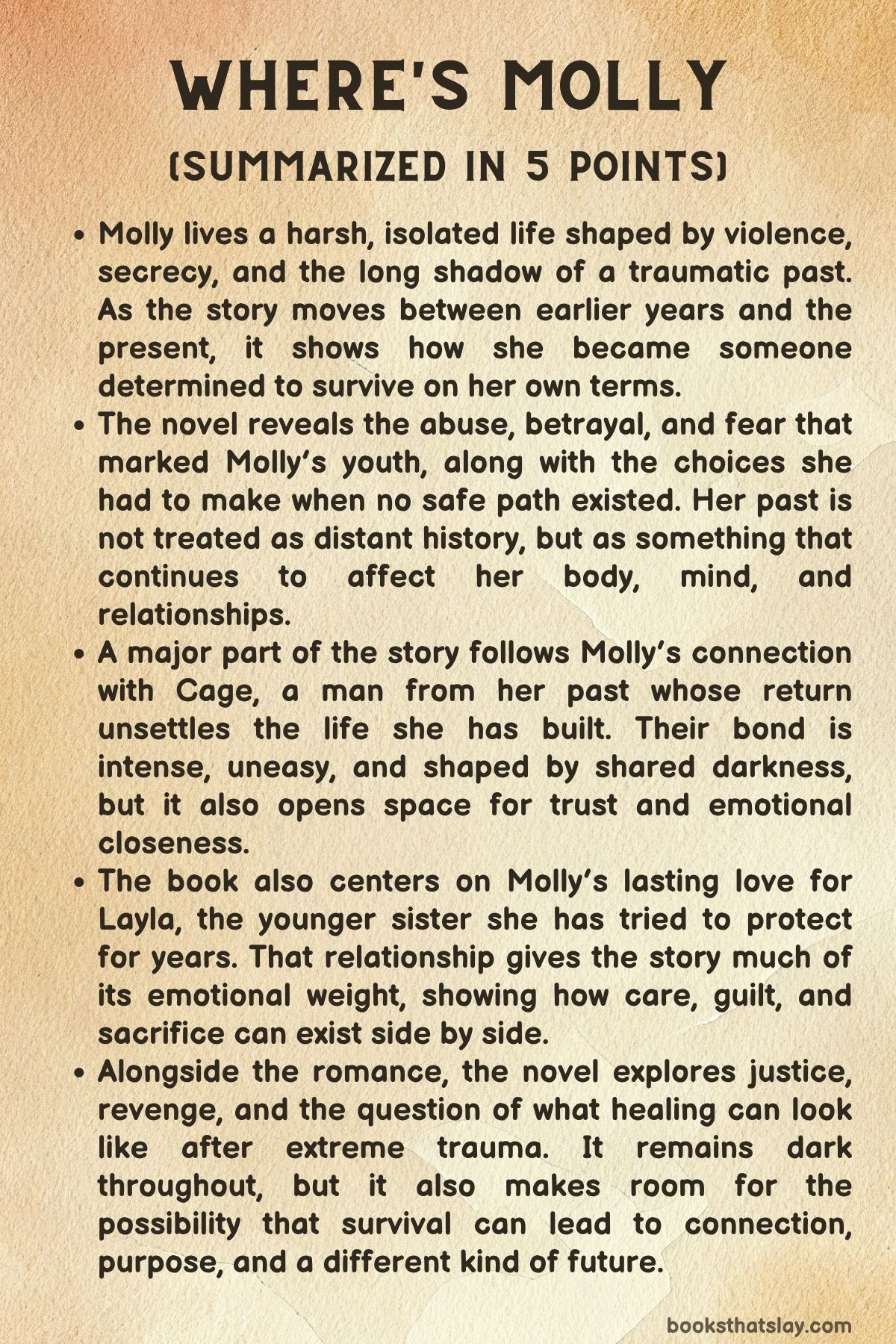
Where’s Molly by H.D. Carlton is a dark romance novella set in the Cat and Mouse world, positioned as a companion story that fills in the missing pieces of Molly Devereaux’s life. It follows a woman marked by years of abuse, trafficking, and loss as she tries to survive on her own terms.
The book moves between past and present to show how Molly escaped terrible violence, built a hard and lonely life, and found her way back to someone who sees all of her damage without turning away. It is both brutal and intimate, focused on survival, justice, and the possibility of love after lasting trauma.
Summary
Molly Devereaux lives a harsh and secretive life on an isolated farm, where she disposes of bodies for an underground group that targets sexual predators and abusers. Her methods are grisly, and she has learned to carry them out without hesitation.
In the present day, she is no longer the helpless girl she once was. She is capable, armed, and emotionally guarded, but her past is still close beneath the surface.
The novel makes it clear from the beginning that Molly’s life has been shaped by repeated violence, and that the person she has become was built through pain, fear, and necessity.
Years earlier, Molly was a teenage girl trapped in a home ruled by neglect, addiction, and abuse. Her parents depended on her to keep the household functioning while they spent their lives drunk or high.
She worked, bought supplies, and tried to protect her baby sister, Layla, from the danger surrounding them. Molly understood that her father was cruel and unstable, and she feared that Layla would eventually become another victim in that house.
When Molly went out on what seemed like a routine errand, her father handed her over to dangerous men. She tried to flee, but the threat of immediate violence forced her into their van, and her life changed completely.
Molly was taken into a trafficking operation run by Francesca and Rocco, where women were abused, sold, and hunted. During her captivity, Molly learned that survival depended on watching carefully, staying quiet when needed, and acting only when an opening appeared.
She also witnessed that not everyone around her was equally willing to serve the cruelty of the system. One of the men involved, Rio, had a reputation for allowing some girls a chance to escape.
When Molly finally made her move, she encountered him instead of a guard. She appealed to what remained of his conscience, and he let her go, though only that far.
Molly escaped alone into the wilderness, driven less by hope for herself than by her determination to reach Layla.
Her escape was long and punishing. She ran until her body was failing, then sought help from strangers.
A kind couple brought her inside and called the police, but Molly had become so conditioned by fear that even safety felt dangerous. She believed anyone who helped her would be harmed by the men hunting her, so she fled again.
She eventually learned that she had crossed into Oregon and tried to orient herself with only one clear goal in mind: get back to Layla. The need to save her sister was stronger than hunger, exhaustion, or fear.
When Molly finally returned home, she found only her father there. She got to Layla first and held the child she had fought so hard to reach.
But the reunion was interrupted by her father, who threatened to sell both sisters. In that confrontation, Molly learned her mother had died from an overdose, though the news brought little surprise.
The house had long since become a place beyond rescue. The truth of Molly’s childhood abuse also rises here with full force: her father had assaulted her for years, leaving bite scars across her body, and her mother, broken by her own damage and addiction, had failed to protect her.
In the struggle that followed, Molly killed her father. It was an act of terror, rage, and self-defense, and it ended one source of evil in her life.
To hide what she had done, she took his body to a pig farm and disposed of him there, beginning the pattern that would later define her work.
For several years after that, Molly tried to survive while caring for Layla. She worked under the table, stayed hidden, and did whatever she could to provide for them both.
But survival is not the same as stability, and Molly slowly came to accept that she could not give Layla the safe childhood she deserved. In one of the hardest choices of her life, she left Layla with a wealthy and loving family who could raise her properly.
Molly did not abandon her out of indifference. She did it because she loved her enough to step away when she believed her own presence would ruin Layla’s future.
That decision haunted her, but it also became one of the clearest signs of her strength and sacrifice.
As a young woman still hiding from her past, Molly drifted through dangerous jobs and unsafe living situations. She remained vulnerable because she had no money, no protection, and no identity that could keep her safe.
Eventually, she was contacted by Legion, an underground figure who offered her a chance to disappear and begin again. Suspicious at first, Molly nearly rejected the offer.
But she accepted and was directed toward a man named Cage, whose job was to help people vanish by creating new identities and routes out of bad situations.
Cage’s own history explains why he does this work. His sister, Olivia, was murdered after using a fake ID as a teenager, and that crime shaped the entire course of his life.
He began making better documents to help people avoid danger and eventually built a larger network of protection and escape. Behind his rough edges and criminal associations is a man driven by grief, loyalty, and a violent sense of justice.
When Molly entered his world years earlier, he saw her scars, understood that she had survived the worst kinds of harm, and wanted to help her without demanding that she explain every wound. Their connection quickly became physical, but it also gave Molly something new: sexual experiences shaped by consent, care, and choice.
Even so, Molly did not stay with Cage. She used the identity he created and left for Alaska, trying to build a new life far away.
But distance did not free her from longing, loneliness, or the ache of being separated from Layla. She eventually returned to Montana, bought the pig farm where she had once hidden her father’s body, and began working with Legion’s organization.
While another branch focused on disrupting trafficking, Molly’s side handled punishment and disposal. She turned the location tied to one of her most desperate acts into a place where abusers met their end.
It is a dark form of purpose, but it gives shape to her rage.
The present-day story begins to shift when Cage reenters Molly’s life during a routine delivery. Their attraction is immediate and unresolved, layered with old desire, unfinished feelings, and anger over the years apart.
Molly tries to hold him at a distance because she fears closeness, fears being known too fully, and believes that happiness may not be meant for her. Cage, however, is persistent.
He does not pretend Molly is easy, simple, or healed. He wants her exactly as she is, including the darkness.
As they reconnect, Molly begins to share the truth of her past in fuller detail. Cage responds not with disgust or pity but with fury toward those who hurt her.
Their bond deepens through sex, conversation, and small gestures that matter to Molly more than she expects. He brings her flowers, feeds her, stays with her, and folds her into parts of his life she never imagined joining.
She meets his mother, sees the tenderness beneath his menace, and learns more about Olivia, whose memory still shapes him. Their relationship is not gentle in a conventional sense, but it is built on recognition.
Each sees the other’s damage and does not flinch.
At the same time, Molly continues secretly watching Layla, now living as Emma with her adoptive family. She attends her soccer games from a distance, taking comfort in seeing that Layla is loved and thriving.
Cage supports her through these visits and through the painful question of whether she should reveal herself. Eventually, Molly does.
After a game, she approaches Layla and her parents, introduces herself as Layla’s sister, and leaves the decision in their hands. It is one of the bravest moments in the story because it risks a different kind of rejection: not violence, but the possibility that the person she sacrificed everything for may not want her.
The book closes with signs that Molly’s life may finally be opening instead of shrinking. Cage kills the last man connected to her abuse by Francesca and Rocco’s circle, giving Molly a sense of closure she never expected.
She tells Cage that she loves him, and the declaration feels earned by everything they have survived together. Soon after, Layla’s adoptive mother calls to say she understands more of Molly’s history now and that Layla wants to meet her.
For the first time in many years, Molly receives not just survival or revenge, but the possibility of family, love, and a future that belongs to her. The ending also leaves the door open for more, as a powerful visitor arrives needing help to disappear, linking Molly’s story back into the wider series.
Characters
Molly Devereaux
Molly is the emotional and moral center of Where’s Molly. She is introduced as someone who has survived years of abuse, trafficking, fear, and isolation, and every part of her character is shaped by that history.
What makes her compelling is that she is not presented as a simple victim or a straightforward avenger. She is both deeply wounded and fiercely capable.
Her present-day life shows a woman who has built control out of chaos. She handles violence with cold efficiency, keeps people at a distance, and lives according to rules that make sense to her, even when they would horrify others.
Beneath that hard exterior, though, she is still carrying terror, shame, and grief that never fully left her. Her survival has made her strong, but it has also made softness feel dangerous.
One of the most important parts of Molly’s character is her sense of responsibility. Even as a teenager, she is not thinking first about herself.
She is trying to care for Layla, manage her parents’ addictions, and prevent further harm inside the home. That protective instinct continues across the story and becomes one of her clearest defining traits.
Her love for Layla is one of the few stable truths in her life. It drives her escape, pushes her to return home, and later forces her into the devastating choice of leaving Layla with another family.
That decision reveals the depth of Molly’s character because it is not made out of weakness or abandonment. It is an act of painful love from someone who believes that staying would damage the child more than leaving ever could.
Molly’s relationship with her own body is also central to understanding her. She carries physical scars from the abuse she endured, and those marks hold shame, anger, and memory.
She does not experience intimacy lightly because intimacy has been shaped by violation for most of her life. This is why her connection with Cage matters so much to her arc.
He does not erase her trauma, but he gives her experiences of desire and sexual choice that belong to her rather than to her abusers. Even then, she is not suddenly healed.
She remains guarded, conflicted, and uneasy with being seen too clearly. Her growth is not about becoming carefree.
It is about allowing herself to believe that she is not beyond love, family, or peace.
What gives Molly depth is that she is morally hard to simplify. She kills, disposes of bodies, and works within a violent underground system, but the story frames these actions through the logic of her experience.
She is no longer willing to live at the mercy of monsters, and she channels that refusal into brutal action. Her violence is not random.
It comes from accumulated pain, survival training, and a hunger for justice in a world that never protected her. By the end, Molly stands as a character defined by endurance, sacrifice, and a slow, uneasy movement toward hope.
Cage
Cage is written as a dangerous man with a protective core, and much of his appeal comes from the contrast between his menace and his loyalty. He is someone who exists outside ordinary systems, forging identities, helping people vanish, and working alongside shadow organizations that punish predators when the law fails.
He is intimidating, possessive, and often intense, but the story makes it clear that his aggression is tied to a very personal moral code. He is not violent for the sake of spectacle.
He directs his rage toward abusers and traffickers, and his life’s work is built around preventing vulnerable people from being trapped the way his sister was.
His backstory gives shape to everything he does. The murder of Olivia is not just a sad event in his past; it is the foundation of his worldview.
It destroys his innocence early and convinces him that official systems cannot be trusted to protect the vulnerable. This is why he turns to fake documents, disappearances, and criminal networks.
In another kind of story, Cage might have become consumed only by vengeance, but here he channels grief into usefulness. He builds something functional out of tragedy.
He learns how to create escape routes for people who have none, and that makes him more than a brooding love interest. He becomes someone whose entire identity is tied to control, rescue, and retaliation.
In his relationship with Molly, Cage is at his most revealing. He is obsessed with her, but not in a shallow sense.
He is drawn to her because he sees how much she has endured and because he recognizes in her the same kind of damage that shaped him. He wants proximity, honesty, and permanence from her, often faster than she is comfortable with, and that intensity can make him feel overbearing.
Yet the emotional purpose of his character is not to dominate her into change. It is to stand in front of her belief that she is too broken for intimacy and refuse to accept it.
He does not ask Molly to become lighter, easier, or more socially acceptable. He wants all of her, including the anger, the scars, the nightmares, and the darkness she uses to survive.
Cage’s tenderness shows up in unusual forms. He brings gifts that reflect Molly’s taste and humor, remembers details that matter, includes her in his personal life, and offers protection in ways that are both practical and emotional.
His relationship with his mother also adds dimension to him. Around Winifred, he is not simply a threatening fixer.
He becomes a son with history, habits, and vulnerability. These touches prevent him from becoming one-note.
He is still obsessive and controlling at times, but he is also capable of warmth, grief, humor, and devotion. As a result, he functions as both Molly’s counterpart and her challenge: a man as damaged as she is, but more willing to claim love openly.
Layla
Layla is not the most present character on the page, but she is one of the most important figures in the story because she represents innocence, responsibility, and the possibility of a future untouched by the worst parts of Molly’s past. As a baby, she is the person Molly tries to save from the house ruled by addiction and abuse.
Later, as a teenager living under another name, she becomes the visible proof that Molly’s sacrifice mattered. Layla’s role is emotionally powerful because she is both deeply loved and mostly absent from Molly’s life, which turns her into a source of longing as much as a person.
What makes Layla significant is how much of Molly’s identity is tied to her. Molly’s choices are constantly measured against what will happen to Layla.
Her escape is driven by the need to return for her. Her years of struggle are spent trying to care for her.
Her greatest heartbreak comes from deciding she cannot raise her safely. In this way, Layla shapes the story even when she is not speaking.
She is the standard Molly uses to judge herself, often harshly. If Molly feels she has failed, it is usually because she thinks she failed Layla first.
At the same time, Layla also represents the life that escaped the cycle. She grows up with a loving adoptive family, with opportunities and stability that Molly never had.
This does not erase the pain of separation, but it gives the story an emotional counterweight. Layla is evidence that one good decision, even an agonizing one, can interrupt generations of damage.
When she becomes curious about Molly instead of rejecting her outright, that openness carries enormous meaning. It suggests that Molly may not be permanently excluded from love and family.
Layla is therefore both a daughter-like figure and a symbol of redemption.
Legion
Legion operates as a shadowy power in the background, but he is crucial to the structure of the story because he represents organized justice outside the law. He is less a traditional character study and more a force with influence, information, and reach.
Even so, his actions reveal a distinct personality. He is calculating, watchful, and pragmatic, but not indifferent.
He notices Molly when she is struggling, offers her a path out, and later gives her work that aligns with both her skill set and her rage. He functions as the person who recognizes that some survivors cannot be restored to ordinary life and instead need a place where their damage can be turned into something useful.
Legion’s importance lies in the fact that he sees Molly clearly without trying to sanitize her. He does not expect her to become respectable before she deserves help.
He understands that she carries violence in her and places her within a structure where that violence is directed at predators rather than at herself. In this sense, he becomes a facilitator of transformation.
He does not heal Molly, but he offers her purpose, resources, and a network that keeps her from being completely alone.
He also acts as a balancing figure between Molly and Cage. He knows both of them and seems to understand their bond better than either wants to admit at first.
His decisions imply that he sometimes manipulates events for what he believes will produce the right outcome. That adds ambiguity to him.
He may be protective, but he is never soft. He helps from the shadows and according to his own priorities.
His presence broadens the story’s world by showing that Molly’s journey is not happening in isolation but within a larger underground system built around punishment and rescue.
Winifred
Winifred adds warmth, humor, and a measure of normal human contact to a story filled with trauma and violence. As Cage’s mother, she reveals a side of him that might otherwise remain hidden.
Through her, he becomes less mythic and more personal. She knows how to tease him, unsettle him, and expose his emotional seriousness, especially when it comes to Molly.
That family dynamic matters because it places Molly in a social setting she is not used to navigating. Being accepted at Winifred’s table challenges Molly in a different way than physical danger does.
It asks her to sit inside ordinary affection and believe she belongs there.
Winifred’s character is effective because she is not written as falsely delicate or blindly cheerful. She has a sharp tongue, an observant eye, and a comfort with discomfort that suits the tone of the story.
She notices Molly’s anxiety, sees the visible marks on her face, and still treats her with directness rather than pity. That response matters.
Molly has spent much of her life being looked at as damaged, used, or threatening. Winifred instead receives her as a real person and, in doing so, opens a small but meaningful door into family life.
She also serves a narrative purpose beyond being likable. Winifred represents what Molly did not have growing up: a stable adult presence with humor, warmth, and enough strength to hold her ground.
Her acceptance is not a complete cure for Molly’s self-doubt, but it is one more piece of evidence that Molly is not beyond connection. Through Winifred, the story allows domestic life to exist alongside violence, which strengthens the emotional range of the character dynamics.
Rio
Rio appears for a limited stretch of the story, but his role is important because he introduces moral complexity into the trafficking world Molly is trying to escape. He is not innocent.
He participates in kidnappings and works within a brutal system. At the same time, he is portrayed as someone trapped inside that structure in his own way, especially through the implications of Francesca’s abuse and control over him.
This makes him neither a clean villain nor a straightforward ally.
His decision to let Molly go is a turning point. It does not redeem everything he has done, but it marks him as someone who has not been completely emptied of conscience.
That one act of mercy changes Molly’s future. He does not become a rescuer in the heroic sense, and he does not escort her to safety or offer protection beyond the doorway.
He simply creates an opening and allows her to take it. That restraint is important because it keeps his character credible within the world of the story.
He helps only as much as he can bear to risk.
Rio’s presence also reinforces one of the story’s broader ideas: systems of abuse corrupt everyone inside them, but not every person within such a system is identical. Some are monsters by choice, while others are damaged, compromised, or surviving in smaller and uglier ways.
Rio embodies that gray area. He is dangerous, but not dead inside, and that makes his brief role memorable.
Raymond Devereaux
Raymond is the clearest embodiment of personal evil in Molly’s early life. He is abusive, controlling, sexually violent, and utterly without paternal instinct.
He does not merely fail Molly as a father; he actively destroys the conditions in which childhood could exist. His presence explains the fear and disgust Molly carries in relation to home, family, and her own body.
He is the first man to teach her that power means violation, and the damage from that lesson lasts for years.
What makes Raymond especially horrifying is that his cruelty is both intimate and casual. He uses Molly, threatens Layla, enables trafficking, and treats human life as something to sell when it benefits him.
He is not written with tragic shading or redeeming traits because his role is to show what Molly had to survive before the wider criminal world even took her. The trafficking operation is monstrous, but Raymond prepares the ground for it by making betrayal the norm inside the home.
He turns the place that should protect children into the place that delivers them to predators.
His death is one of the most decisive moments in Molly’s development. Killing him is not simply revenge.
It is the first major act through which Molly takes power back in a direct and irreversible way. The act is bloody, chaotic, and born from desperation, but it ends the immediate threat he poses to both sisters.
Raymond’s character therefore matters not because he is layered in a sympathetic sense, but because he is the origin point of so much of Molly’s trauma and one of the first targets of her refusal to remain helpless.
Francesca and Rocco
Francesca and Rocco represent organized cruelty at its most systematic. They are not just violent individuals; they are architects of an environment where abuse is industrial, profitable, and normalized.
Through them, the story expands from domestic horror into the broader machinery of trafficking. Their role is to show that Molly’s suffering was not accidental or isolated.
It was part of a larger world in which people are commodified, hunted, and broken for entertainment and money.
Francesca stands out as especially chilling because she brings authority and calculation to the operation. Her cruelty is managerial.
She oversees, controls, and turns suffering into routine. That makes her frightening in a different way from more openly explosive male abusers.
Rocco, by contrast, carries the threatening force of direct physical domination. Together they create a structure of fear that extends beyond any single victim.
They are the reason Molly remains terrified even after escape, because they represent reach, retaliation, and a network large enough to find her again.
Their narrative function is also psychological. Even when they are not physically present, they continue to occupy space in Molly’s mind.
The fear of being found, sold again, or punished never fully leaves her. That is part of what makes trauma in the story feel ongoing rather than historical.
Francesca and Rocco are villains, but more than that, they are lasting conditions in Molly’s emotional world until the final loose ends connected to them are cut.
Silas
Silas provides texture to Cage’s world and gives the story moments of levity and social ease that would otherwise be scarce. He works with Cage and understands both the legal front of the business and the illegal one beneath it.
His presence confirms that Cage’s operations are not improvised chaos but part of a functioning, lived-in system. Silas knows Cage well enough to read him quickly, especially where Molly is concerned, and he often voices truths that Cage himself resists saying plainly.
As a character, Silas is useful because he softens scenes without weakening them. He can be amused, nosy, and perceptive, which allows him to act as a small pressure point on both Molly and Cage.
He notices their chemistry, speaks more openly than either of them would prefer, and helps create an atmosphere in which Molly is not treated as a fragile outsider. That matters because she is often most uncomfortable when people are too careful around her.
Silas instead responds to her as if she is already part of the world around Cage.
Though he does not carry the heavy emotional burden of the main pair, Silas contributes balance. He reminds the reader that loyalty can exist in ordinary, unromantic forms too.
Not every bond in the story is built on trauma or desire. Some are built on long-term trust, shared work, and the ability to stand beside dangerous people without being consumed by their darkness.
Margot and Colin
Margot and Colin are important because they embody the life Molly wanted for Layla but could never provide herself. As Layla’s adoptive parents, they stand for safety, consistency, and care.
Their role could easily have been written in a flat way, either as obstacles or as idealized replacements, but they work better than that because they carry understandable protectiveness. When Molly approaches them, they are cautious and defensive, which is exactly what responsible parents would be in that situation.
Their first duty is to Layla, and the story respects that.
Margot becomes especially significant near the end because she moves from assumption to understanding. At first, she seems to have interpreted Molly’s past through a simpler and harsher lens, imagining failure where there was actually trauma and sacrifice.
Once she learns more, her attitude changes. That change matters because it grants Molly something she rarely receives: a fair reading of her choices.
Margot does not erase boundaries or hand over easy acceptance, but she offers a path forward under conditions centered on Layla’s wellbeing. That response is generous without being unrealistic.
Colin’s role is quieter, but together they form the stable parental unit that Layla needed. They are important not because they replace Molly emotionally, but because they confirm that Molly’s sacrifice achieved what she hoped it would.
Through them, the story acknowledges that love can take the form of stepping aside so someone else can give a child what you cannot.
Themes
Survival as Identity
Survival in Where’s Molly is not treated as a temporary state that ends once immediate danger passes. It becomes the structure through which Molly understands herself, other people, and the world around her.
She does not move from victimhood into a neat phase of recovery where the past simply becomes memory. Instead, survival changes her habits, instincts, moral boundaries, and emotional responses so completely that it becomes part of her identity.
She learns early that safety is unstable, that authority cannot be trusted, and that hesitation can be fatal. Those lessons remain active in her long after she escapes trafficking and abuse.
Her guardedness, her ability to dispose of bodies, her refusal to rely easily on others, and her constant expectation of threat all come from a life in which surviving required extreme adaptation.
What makes this theme powerful is that the story refuses to romanticize resilience. Molly is strong, but that strength has been forced into existence by unbearable conditions.
Her competence is inseparable from what was done to her. She can read danger quickly, act decisively, and endure things that would break many people, but these qualities come at a cost.
They make ordinary softness difficult. They make comfort feel suspicious.
They leave her unable to fully trust peace when it appears. The novel shows that survival is often praised from the outside, yet from the inside it can feel like exhaustion, numbness, and permanent alertness.
Molly is alive, but being alive has required her to become someone who can handle horror without collapsing in front of it.
This theme also gains depth because survival is not limited to physical escape. Molly survives her childhood home, the trafficking network, poverty, loneliness, shame, and the emotional consequences of every decision she had to make afterward.
Even when no one is actively hunting her, she is still surviving memory, guilt, and the fear that she is permanently marked by her past. The story presents survival not as a triumphant finish line but as a long condition.
It asks what kind of person is created when endurance has to become a daily discipline. In doing so, it gives survival a harsh honesty.
It is not clean, noble, or uplifting in a simple way. It is messy, brutal, and exhausting, but it is also the reason Molly remains capable of choosing, fighting, and eventually allowing herself to hope.
Love After Damage
The relationship at the center of Where’s Molly is shaped by a difficult question: what does love look like for people whose understanding of intimacy has been damaged by violence, fear, and grief? The story does not present love as something soft enough to erase trauma by its mere presence.
Instead, it shows love as something that has to exist beside damage, not in denial of it. Molly’s past has taught her that closeness often leads to pain, control, or humiliation.
Her body has been used against her, her trust has been betrayed, and even the idea of being seen too clearly makes her uneasy. Because of this, affection is not immediately comforting to her.
It can be frightening, exposing, and emotionally disorienting. The novel treats that reaction seriously.
It does not shame her for resisting intimacy, nor does it pretend that one good connection can instantly repair years of abuse.
Cage becomes important within this theme because he is not written as a savior who arrives to transform Molly into an unscarred version of herself. He does not ask her to become simpler, sweeter, or more emotionally convenient.
He is drawn to her as she is, including the anger, suspicion, darkness, and bodily history she carries. That matters because it changes the terms of romance.
Love here is not based on innocence or on the fantasy of untouched purity. It grows through recognition.
Cage sees the damage and does not step back from it. Molly, in turn, begins to experience a form of intimacy that includes consent, boundaries, and desire that belongs to her rather than to those who harmed her.
This shift does not remove the past, but it gives her a different emotional language for closeness.
The theme becomes even stronger because both characters carry their own wounds. Cage’s life has also been shaped by brutality and loss, which means the relationship is not one-sided healing but mutual understanding between damaged people.
Their connection is intense and often unsettling, yet the emotional point is clear: love is possible even when a person is not neatly healed. The novel argues that damage does not disqualify someone from intimacy.
At the same time, it remains honest about how hard that intimacy can be. Molly still pulls away.
She still fears happiness. She still doubts whether she deserves to stay in something good.
Love, then, becomes not a cure but a practice of staying present despite fear. It is shown as something fierce, imperfect, and difficult, yet still real enough to offer a future where isolation no longer has the final word.
Justice Beyond the Law
The world of Where’s Molly is built on a deep distrust of legal and social systems, and that distrust gives force to the theme of justice outside official institutions. The story repeatedly shows that the people who should have protected the vulnerable either failed entirely or became part of the harm.
Molly is sold, abused, trafficked, and left to survive in spaces where law enforcement and social structures do not rescue her in any meaningful way. Cage’s history carries a similar lesson, as his sister’s murder reveals how power can be used to violate rather than defend.
Because of these experiences, the novel creates a moral universe in which underground systems arise to do what the formal world has refused to do. Legion and the violent work surrounding him are not presented as random criminality.
They are presented as a response to systemic failure.
This theme is central because it forces the reader to confront discomfort about punishment, morality, and legitimacy. The people targeted by Molly and her network are not framed as ambiguous offenders caught in gray areas.
They are rapists, traffickers, abusers, and exploiters who have escaped proper consequences or operated in places where official justice never reached them. The story channels rage toward these figures and imagines a structure where they are hunted, judged, and eliminated.
In that sense, justice becomes personal, physical, and irreversible. Molly’s work disposing of bodies is part of this logic.
She is not merely hiding crimes. She is participating in an alternative moral order where the monstrous are treated with the same mercilessness they inflicted on others.
At the same time, this theme is not entirely celebratory. There is an unsettling edge to the way justice operates in the novel, because it depends on secrecy, violence, and the concentrated power of those deciding who deserves punishment.
That tension gives the theme complexity. The story clearly wants the reader to feel satisfaction when predators are removed, but it also places that satisfaction in a world without transparency or due process.
This creates a disturbing but intentional contrast: if official structures are so broken that survivors must turn to underground executioners, then society itself has failed at a foundational level. The existence of Legion’s network becomes evidence of that failure.
Molly’s role within it also reflects how trauma can shape a person’s concept of justice. She does not believe in repair for certain crimes.
She believes in ending the threat. The novel therefore treats extralegal justice as both horrifying and emotionally understandable, making it one of its most provocative ideas.
Family, Separation, and Chosen Belonging
Family in Where’s Molly is never presented as an automatically safe or sacred structure. The novel begins by exposing how family can be the first place of betrayal, damage, and terror.
Molly’s parents do not protect her; they exploit, neglect, and fail her. Her father, especially, turns the home into the site of profound violation.
Because of this, the story breaks away from sentimental assumptions about blood ties. Biological connection alone means very little when those ties are poisoned by abuse.
This harsh view of family is one of the emotional foundations of the novel, because it explains why Molly grows up expecting closeness to come with danger.
That background makes the bond between Molly and Layla especially meaningful. Layla is the one blood relationship Molly treats as sacred, but even that bond is marked by pain because love does not guarantee the ability to remain together.
Molly’s decision to leave Layla with another family is one of the clearest expressions of the novel’s emotional maturity. It refuses the idea that love always looks like holding on.
In Molly’s case, love means stepping away so Layla can have safety, comfort, and stability. That separation becomes a wound Molly carries for years, but the story frames it as an act of maternal and sisterly devotion rather than abandonment.
Family here is defined not by possession, but by sacrifice.
This theme grows richer through the introduction of chosen belonging. Cage, Winifred, Legion, and even the adoptive family become part of a wider emotional network that challenges Molly’s belief that she has no place in ordinary human connection.
Winifred offers a form of maternal acceptance that Molly never had. Cage offers intimacy and emotional loyalty.
Layla’s adoptive parents, especially once they begin to understand Molly’s history, represent a model of care that Molly could not create on her own but can still be grateful for. These relationships suggest that family can be built through protection, recognition, and consistent care rather than through blood alone.
What makes the theme resonant is that it does not erase the sadness of what was lost. Molly cannot recover the childhood she should have had, and she cannot undo the years spent apart from Layla.
The novel does not pretend chosen bonds make those absences disappear. Instead, it shows that belonging can still be rebuilt in altered form.
A person damaged by their first family is not condemned to permanent exile from all forms of kinship. By the end, the possibility of meeting Layla again and openly loving Cage points toward a future where family becomes something Molly may finally enter without fear.
That movement from violation to chosen belonging gives the story much of its emotional weight.