Gray After Dark by Noelle W. Ihli Summary, Characters and Themes
Gray After Dark by Noelle West Ihli is a survival thriller about an Olympic biathlete whose discipline, endurance, and emotional wounds are tested after she is abducted in the Idaho wilderness.
Miley Petrowski enters the mountains hoping to rebuild her athletic career, but isolation places her in the path of two men who have hidden outside society for years. Her captivity becomes both a physical struggle and a battle to preserve her identity. Through Miley, Brent, and Rayna, the novel examines trauma, guilt, coercive control, patience, and the difficult process of reclaiming freedom after violence.
Summary
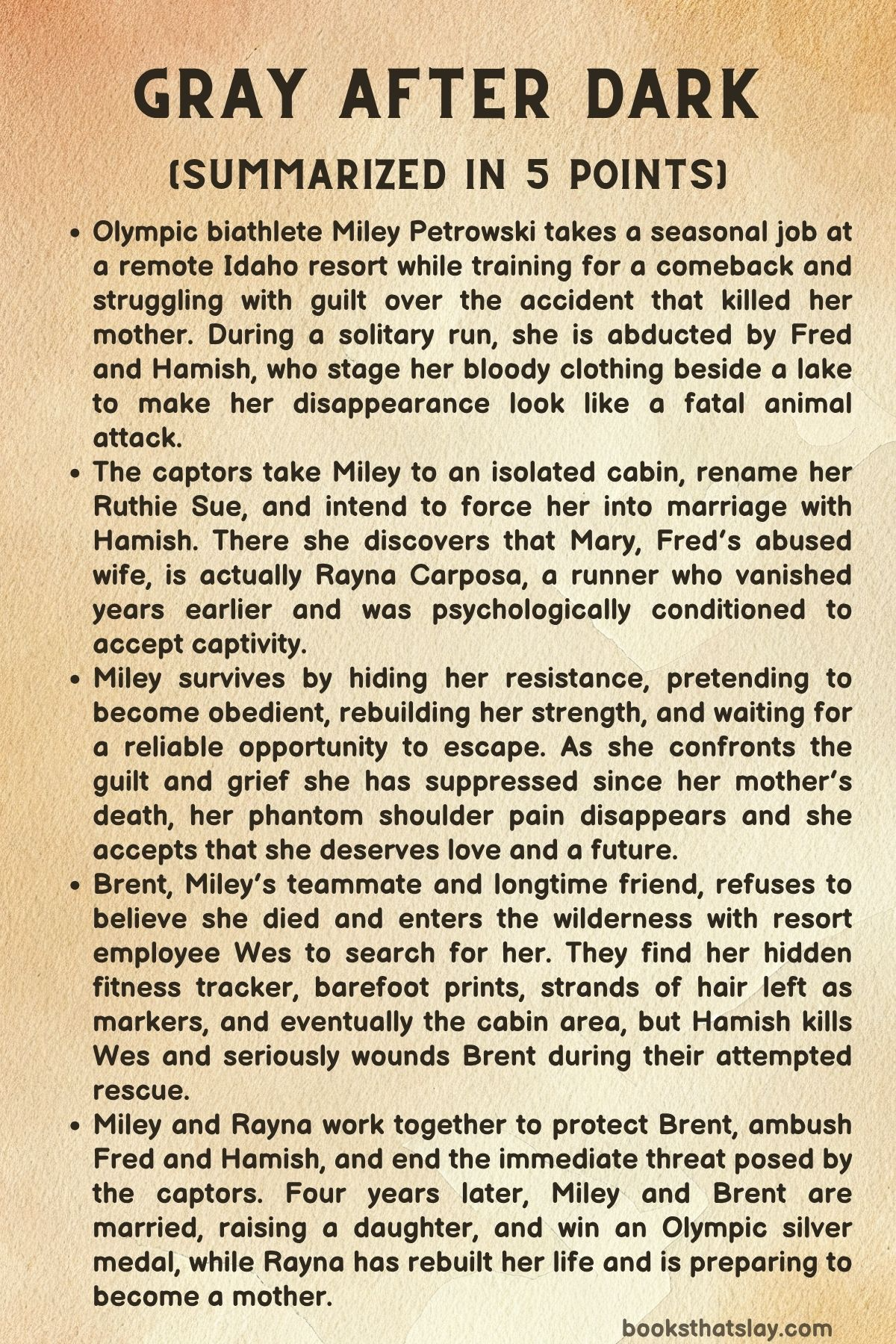
Miley Petrowski arrives at Hidden Springs Resort in the Frank Church Wilderness in June 2022, taking a seasonal kitchen job while training for the 2026 Winter Olympics. A talented biathlete, she is attempting to rebuild her career after a car accident killed her mother, Jane, and left Miley with recurring shoulder pain.
Doctors believe the pain is connected to unresolved trauma, but Miley rejects therapy and insists that greater physical strength will solve the problem. She also carries shame from the Beijing Olympics, where rushing her shots during a mixed-medley race cost her team a possible medal.
Her closest friend and teammate, Brent, has loved her since they were teenagers. Miley returns his feelings but refuses to acknowledge them because she believes love creates another opportunity for loss and that she does not deserve happiness after causing the accident that killed her mother.
At Hidden Springs, Miley becomes friendly with Wes, a young kitchen worker who understands the wilderness and warns her about bears. She ignores his concern and continues running alone to a secluded alpine lake, valuing the freedom and privacy it offers.
Jennifer, the resort owner, eventually tells Miley about Rayna Carposa, a nineteen-year-old employee who vanished years earlier while running in the same wilderness. Blood and torn clothing were found, leading investigators to believe Rayna had been killed by a bear, although her body was never recovered.
Miley recognizes the similarities between herself and Rayna but refuses to let the story control her choices. On her next free day, she runs to the lake despite worsening shoulder pain and enters the freezing water.
A terrified moose suddenly crashes into the lake and is shot by two armed men standing near Miley’s clothing. The older man, Fred, and his adult son, Hamish, begin firing around Miley when she attempts to swim away, forcing her back toward the shore.
Miley hides her fitness tracker inside her sports bra, hoping it might provide a clue if she disappears. She tries to escape between the two men, but Fred cuts her arm and Hamish captures her before she reaches the forest.
Fred throws the tracker into the lake, covers Miley’s clothes with blood, tears the fabric, and leaves her shoes behind. The scene is designed to resemble an animal attack, repeating the method once used to conceal Rayna’s disappearance.
The men chain Miley and force her barefoot through the wilderness. Fred renames her Ruthie Sue and explains that she must be broken before she can become Hamish’s wife, while Hamish treats her as a possession whose body belongs exclusively to him.
Miley realizes that open resistance will bring immediate violence, so she begins observing the men and exploiting the tension between them. She also pulls strands from her hair and leaves them along the trail, hoping someone searching for her will recognize the markers.
Back at Hidden Springs, Jennifer contacts Brent after Miley fails to report for work. Furious that the search began late, Brent drives through the night and joins Wes, Connor, and the other volunteers searching roads, trails, and lakes throughout the enormous wilderness.
Fred and Hamish eventually bring Miley to an isolated property containing a cabin, solar panels, storage sheds, weapons, and years of supplies. A thin woman called Mary lives there as Fred’s submissive wife and appears unsurprised that the men have returned with another captive.
Miley is chained to the living-room wall, suffering from infected feet, blood loss, dehydration, and worsening shoulder pain. Mary treats her with hostility at first, repeating Fred’s belief that obedience is the only path to peace.
Through careful questioning, Miley discovers that Mary is actually Rayna Carposa. Rayna became lost during a run, was found by Fred, and believed she was being rescued before he imprisoned, assaulted, and psychologically controlled her.
Years of violence, religious manipulation, isolation, miscarriages, and dependence have caused Rayna to reject her former identity. She insists that Rayna is dead and that Fred saved her, even while small acts of mercy reveal that her original compassion remains.
Mary cleans Miley’s infected wounds and applies a medicinal salve, allowing her to regain strength. Miley secretly exercises, studies the chains, learns the property’s layout, and tries to convince Mary that they could escape together.
Meanwhile, Brent remembers Miley mentioning that she swam during her runs and suggests searching alpine lakes. The searchers find Miley’s Jeep, follow a nearby trail, and discover her bloodied clothes and abandoned shoes at the shoreline.
Most of the authorities interpret the evidence as proof that Miley died in an animal attack. Brent refuses to accept that conclusion, especially after he and Wes return secretly and recover Miley’s fitness tracker from the water far from the staged scene.
Beyond the lake, they find a large boot print beside a smaller barefoot impression. As they continue through storms and rough terrain, they eventually discover strands of Miley’s blond hair placed deliberately along the route.
At the cabin, Miley pretends to accept Fred and Hamish’s beliefs. Her performance earns limited mobility, and Hamish chains her to Mary instead of keeping her attached to the wall.
While working together, Miley sees flashes of Rayna’s intelligence beneath Mary’s submissive behaviour. Rayna remembers her former family, education, and ambitions, but these memories also force her to confront the violence she has spent years redefining as rescue.
After Fred brutally beats Rayna, Miley persuades her to attempt an escape. The women slip from the cabin while chained together, but Rayna panics when the men begin searching and calls out to Hamish, betraying their location.
Fred and Hamish recapture them and subject Miley to severe punishment. Hamish proves that his occasional protection was never compassion when he accepts Fred’s invitation to beat Miley himself as preparation for becoming her husband.
Miley stops eating and begins surrendering physically, but Hamish threatens to kill her and abduct another woman. Realizing that death would only transfer the men’s violence to a new victim, Miley chooses to survive and resumes her performance as Ruthie Sue.
She remembers Brent’s criticism after Beijing: waiting for a clear shot is better than rushing and paying a penalty. Miley applies that lesson to captivity, deciding that she must eat, work, flatter Hamish, and delay escape until she has a genuine opportunity.
Weeks pass, and Fred permits Hamish to marry Miley in a crude ceremony outside the cabin. Hamish then assaults her, and Miley survives by mentally returning to memories of Jane, the mother she has avoided remembering because of her guilt.
The story reveals that eighteen-year-old Miley caused the fatal accident after becoming distracted while thinking about Brent. Jane had devoted her life to supporting Miley’s athletic ambitions, and Miley interpreted her mother’s death as proof that she no longer deserved love or success.
During the assaults, Miley imagines Jane responding to her guilt with forgiveness rather than condemnation. She accepts that one terrible mistake does not erase her worth and finally admits that she loves Brent.
When Hamish presses against Miley’s injured shoulder, she discovers that the pain has disappeared. Confronting the grief she had suppressed has released the physical symptom that years of training could not overcome.
Fred later corners Miley in a storage shed, causing a confrontation between him and Hamish. The growing rivalry convinces Miley that the household is becoming unstable and that another opportunity may soon appear.
When one of Rayna’s chickens disappears, Miley and Rayna search beyond the property without chains. Miley notices strips of bright yellow fabric tied to branches and realizes that someone has passed through the area and marked a route.
Brent and Wes, weakened after weeks in the wilderness, have also heard the missing chicken. They follow it and unexpectedly encounter Rayna and Miley, giving Miley the reunion she had nearly stopped believing was possible.
Their relief ends when Hamish arrives with a rifle. Miley claims Brent and Wes are ordinary campers, but Hamish grows suspicious, shoots Wes in the abdomen, and then fires at Brent when he charges.
Wes dies instantly, while Brent is struck in the chest and suffers a collapsed lung. Miley discovers that Brent still has a pulse and secretly tells him to remain motionless while she convinces Hamish that both men are dead.
Miley persuades Hamish to return to the cabin for Fred while she and Rayna clear the campsite. She seals Brent’s wounds with emergency supplies, positions him so he can breathe, and prepares to use his biathlon rifle.
Rayna finally rejects the identity imposed on her, declaring that Mary is dead and that she wants her former name, her family, and a future beyond Fred. Miley and Rayna decide that they cannot flee while Fred and Hamish remain free to return and kill Brent.
They create an ambush in which Rayna pretends Miley attacked her and escaped. Hidden behind a Douglas fir, Miley controls her breathing and waits until Fred steps into the open before shooting him.
Hamish uses Rayna as a shield and exchanges fire with Miley. Rayna fights back, allowing Miley to wound him, but Hamish escapes into the dark forest and moves toward the campsite where Brent lies helpless.
Rayna stops him with Wes’s bear spray, blinding him and separating him from his pistol. Miley hesitates before killing a wounded man, but Hamish’s continued claim that she belongs to him confirms that he would resume the violence if spared.
After Miley fires the final shot, she returns to Brent and finds his breathing rapidly worsening. Rayna offers to remain with him while Miley runs for help, giving her shoes, supplies, and directions.
Miley follows a dry streambed through the night until she finds the yellow strips Wes tied to the trees. The markers guide her back to the lake, where she discovers an ATV and rides the remaining distance to Hidden Springs.
Jennifer calls emergency services, and Miley accompanies a helicopter crew into the wilderness. Rayna’s fire leads them to the campsite, where Brent is still alive and receives emergency treatment.
Four years later, Miley and Brent win a silver medal together at the 2026 Milano Cortina Winter Olympics. They are married and have a two-year-old daughter named Jane, while Rayna has rebuilt her life and is expecting a child.
They continue living with the psychological effects of captivity, violence, and loss, but they face them together. The silver medal represents athletic achievement, yet survival, freedom, love, and the lives they reclaimed have become the victories that matter most.
Characters
Miley Petrowski
Miley is the central character of Gray After Dark, and her development is shaped by the conflict between physical discipline and emotional avoidance. As an elite biathlete, she has trained herself to endure pain, regulate her breathing, and continue moving when her body demands rest.
These abilities keep her alive after her abduction, but her athletic mentality initially contributes to her emotional isolation. She believes every problem can be overcome by greater effort, so she dismisses therapy, denies the psychological source of her shoulder pain, and treats grief as another weakness to suppress.
Miley’s guilt over her mother’s death influences nearly every decision she makes. She refuses Brent’s love, punishes herself for mistakes, and believes future happiness would dishonour the life Jane lost.
Captivity forces Miley to reconsider the meaning of strength. Direct resistance fails because Fred and Hamish control the weapons, chains, food, shelter, and terrain, so she learns to survive through observation, deception, emotional restraint, and carefully timed action.
Her decision to pretend to become Ruthie Sue does not represent surrender. It demonstrates her ability to preserve an inner identity while adapting her outward behaviour to the demands of dangerous people.
Miley also develops a broader sense of responsibility. When she learns that Fred and Hamish will simply abduct another woman if she dies, survival becomes an act of protection rather than personal self-preservation.
Her eventual acceptance of Jane’s imagined forgiveness releases the guilt she has carried for years. Once Miley accepts that she remains worthy of love, the phantom shoulder pain disappears, symbolizing the connection between her body and the emotions she refused to confront.
By the final confrontation, she combines patience, marksmanship, endurance, and emotional clarity. Her victory does not erase her trauma, but it allows her to reclaim ownership of her body, name, relationships, and future.
Brent
Brent is Miley’s teammate, closest friend, and emotional counterpart. He understands her competitive strengths and weaknesses because he has trained beside her since adolescence, yet his knowledge of her does not automatically allow him to reach the grief she keeps hidden.
His love is patient but imperfect. Before Miley disappears, he confesses his feelings because years of silence have become unbearable, but his declaration also frightens her because it challenges the emotional boundaries she uses for protection.
Brent’s response to Miley’s disappearance reveals both devotion and recklessness. He drives through the night, challenges official assumptions, enters the wilderness with limited supplies, and refuses to accept that the staged evidence at the lake proves her death.
His determination gives the search its momentum, but fear sometimes turns into anger. He blames Jennifer and Wes for delays, strikes Wes at the lake, and repeatedly pushes forward without fully considering hunger, weather, or exhaustion.
Over time, Brent learns the patience he once demanded from Miley. He accepts the need to hunt, rest, follow small clues, and control his emotions rather than allowing urgency to destroy his ability to help her.
His partnership with Wes also changes him. Brent initially sees Wes as an outsider who did not know Miley well enough to matter, but he eventually recognizes Wes’s courage, loyalty, and willingness to risk everything for her.
After being shot, Brent can no longer rescue Miley through action. His task becomes trusting her, controlling his breathing, and surviving long enough for her decisions to save him.
Within Gray After Dark, Brent represents love that remains present without demanding perfection. His survival and marriage to Miley show that their relationship becomes possible only after both learn that strength includes patience, dependence, vulnerability, and trust.
Rayna Carposa and Mary
Rayna is one of the most psychologically complex figures in the novel because she exists beneath an identity created through years of coercion. Before her disappearance, she was an intelligent young runner with a scholarship, a family, and ambitions beyond the wilderness.
Fred transforms her into Mary through isolation, assault, religious manipulation, repeated pregnancies, physical violence, and complete control over information. Calling herself Mary allows her to reinterpret captivity as marriage and Fred’s domination as rescue.
Her loyalty to Fred should not be mistaken for free choice. She has learned that obedience reduces immediate violence, while remembering Rayna forces her to confront the life, family, and opportunities taken from her.
This conditioning explains why she helps Miley but also betrays their first escape. Freedom requires Rayna to enter an unknown world, while captivity, however brutal, has become the only structure she understands.
Her attachment to the chickens reveals both tenderness and displacement. Unable to carry a pregnancy to term, she treats the animals as children and builds emotional meaning around caring for them.
Miley’s presence gradually challenges the beliefs supporting Mary’s identity. By naming Fred’s violence, discussing medical treatment, and reminding her that rescue does not require chains, Miley gives Rayna language for experiences she has been trained to deny.
Rayna’s transformation is not immediate or uncomplicated. She moves repeatedly between fear and courage, demonstrating how difficult it is for a victim of long-term control to reject an imposed reality.
Her declaration that Mary is dead marks the return of personal agency. By helping Miley treat Brent, confront the men, and guide rescuers back to the camp, Rayna becomes an active participant in her own liberation.
Fred
Fred is the architect of the captivity system at the isolated property. He presents himself as a self-sufficient man preserving religious values and an older social order, but these beliefs are tools used to justify domination, sexual violence, forced labour, and ownership.
He understands psychological control as a deliberate process. Fred believes women must be broken before they can be managed, so he uses renaming, isolation, physical punishment, starvation, shame, and dependence to destroy resistance.
His treatment of Rayna demonstrates that obedience never produces safety. Although she has spent years accepting his rules, he continues beating, assaulting, and threatening her whenever she displeases him.
Fred also trains Hamish to repeat his behaviour. He teaches his son that affection weakens authority and that masculinity depends upon controlling women through fear.
His ideology hides insecurity and entitlement. Fred fears losing control over his household, his son, and the women he regards as property, so any independent thought becomes a threat requiring punishment.
The rivalry between Fred and Hamish exposes the hypocrisy of their supposed family structure. Both men believe they are entitled to Miley, and their arguments concern possession rather than morality.
Fred’s death comes when Miley uses the qualities he underestimated: discipline, patience, intelligence, and marksmanship. He believes captivity has weakened her, but it has instead taught her to wait until she can act with precision.
Hamish
In Gray After Dark, Hamish is initially presented as less openly brutal than Fred, but the difference between them is largely one of method. He sometimes stops his father from injuring Miley, yet he intervenes because he considers her his possession and does not want Fred damaging what belongs to him.
His apparent awkwardness and occasional softness create moments in which Miley can manipulate him. However, these qualities never develop into empathy because Hamish accepts the central belief that women exist to obey men.
He desires Miley sexually and imagines marriage as complete authority over her body. Her wishes, identity, relationships, and suffering are irrelevant unless they affect his ownership.
Hamish’s conflict with Fred is not a moral rebellion. He wants to replace his father as the dominant man, prove that he can control Miley more effectively, and establish exclusive rights over her.
This becomes unmistakable when he accepts Fred’s invitation to beat her. The scene destroys any remaining suggestion that Hamish might become an ally and reveals how willingly he has absorbed his father’s violence.
Hamish is also dangerous because he combines entitlement with competence. He is a skilled hunter and shooter who knows the terrain, allowing him to pursue Miley strategically during the final confrontation.
Even after being blinded and disarmed, he continues calling Miley Ruthie Sue and promising to treat her well. His language shows that he remains incapable of recognizing her as an independent person.
Wes
Wes begins as a friendly Hidden Springs employee whose warnings Miley repeatedly dismisses. His knowledge of plants, animals, and wilderness conditions makes him appear cautious beside Miley’s confidence, but that caution later becomes essential to the search.
He is one of the first people at the resort to treat Miley as an individual rather than an Olympic celebrity or tragic figure. Their friendship is brief, yet he notices her habits, listens to her concerns, and refuses to assume she disappeared voluntarily.
Wes accepts Brent’s hostility because locating Miley matters more than defending his pride. Even after Brent strikes him at the lake, Wes volunteers to accompany him into the wilderness.
His practical skills balance Brent’s emotional urgency. Wes recognizes tracks, disturbed vegetation, weather dangers, food shortages, and the need to mark their return path.
The strips cut from his yellow shirt eventually guide Miley back to safety. His simple decision to mark the trees becomes one of the most important acts in the story.
Wes dies while responding to Brent’s signal and moving toward the rifle. His death carries lasting consequences because both Brent and Miley understand that their rescue depended upon his courage.
The epilogue honours his place in their lives by showing Wes’s mother caring for Miley and Brent’s daughter during the Olympic race. Wes does not survive to witness the outcome, but his loyalty remains part of the family created afterward.
Jane Petrowski
In Gray After Dark, Jane is physically absent from most of the story, yet her influence shapes Miley’s ambitions, guilt, memories, and eventual recovery. She worked long hours to support Miley’s training and treated her daughter’s athletic goals as worthy of sacrifice.
Miley remembers Jane as practical, observant, affectionate, and closely connected to nature. Her advice about wilderness navigation later helps Miley follow the streambed toward rescue.
The fatal accident transforms Jane’s love into a source of punishment within Miley’s mind. Because Miley was distracted before the crash, she interprets every memory of her mother as evidence of her own unworthiness.
During captivity, those memories begin changing. Miley imagines Jane responding not with blame but with compassion, reminding her that one mistake cannot cancel an entire life.
Jane’s remembered voice allows Miley to separate responsibility from permanent self-condemnation. Accepting her mother’s love enables Miley to recognize Brent’s love and imagine a future she previously believed she had forfeited.
Naming her daughter Jane shows that Miley no longer experiences remembrance only as pain. Her mother’s legacy becomes connected to continuity, family, forgiveness, and hope.
Jennifer
Jennifer initially appears strict, impatient, and overly controlling as the owner of Hidden Springs Resort. Her management style causes tension with Miley, particularly when work rules prevent Miley from calling Brent or following her preferred routine.
However, Jennifer’s concern about wilderness safety is rooted in Rayna’s disappearance. The loss continues to affect her, and Miley’s decision to ignore warnings forces Jennifer to confront the possibility that another employee may have vanished under similar circumstances.
Jennifer’s delayed response contributes to Brent’s anger, but the circumstances also reveal the uncertainty surrounding missing adults in remote areas. Miley’s independence and unpredictable running habits make it difficult for the resort staff to recognize immediately that something is wrong.
Once the danger becomes clear, Jennifer closes the resort, sends guests home, assists searchers, and carries visible guilt. Her actions show that she takes responsibility even when she cannot undo the early delay.
She becomes crucial again when Miley reaches the resort after escaping. Jennifer immediately contacts emergency services, provides care, and helps organize the rescue flight that saves Brent.
Connor
Connor in Gray After Dark, represents the official search effort and the limitations faced by authorities in vast wilderness areas. He coordinates volunteers, vehicles, aerial support, maps, and search routes while trying to allocate resources responsibly.
His caution frustrates Brent, who interprets every delay as abandonment. Connor must consider weather, exhaustion, safety, geography, and the possibility that the evidence indicates an animal attack.
He does not dismiss Brent cruelly, but he cannot base an official operation entirely on hope. The staged clothing and blood at the lake create a convincing explanation that directs investigators away from human involvement.
Connor’s role demonstrates why Fred’s method succeeds for so long. The wilderness is enormous, the tree canopy obstructs aircraft, and physical evidence can easily disappear under rain, vegetation, and animal activity.
Although Brent and Wes continue independently, the official search provides the initial map, personnel, and discovery of Miley’s Jeep. Connor therefore contributes to the rescue even though the most important evidence is eventually followed outside formal procedures.
Themes
Survival as Patience, Adaptation, and Control
Survival in Gray After Dark depends less upon constant aggression than upon knowing when to act, when to wait, and how to control fear. Miley initially approaches difficulties as an athlete who believes greater effort can overcome every obstacle, but captivity teaches her that movement without opportunity can make danger worse.
Her first escape attempts fail because she acts before she understands the men, terrain, chains, or property. Each failure produces greater violence, forcing her to replace impulsive resistance with observation and planning.
The lesson Brent gives after the Beijing race becomes the central principle of her survival. A few seconds spent controlling her breathing can create a clean shot, while rushing can cause a penalty from which recovery may be impossible.
Miley therefore turns obedience into camouflage. She eats, works, smiles at Hamish, accepts the name Ruthie Sue in public, and hides her physical recovery while protecting her true identity internally.
Brent undergoes a similar transformation during the search. His urgency drives him into the wilderness, but he must learn to rest, hunt, follow small signs, and accept delays rather than destroying himself before he reaches Miley.
The final ambush succeeds because Miley waits behind the tree until Fred enters the open. Her greatest athletic skill is no longer simply shooting accurately; it is controlling her body and emotions until action has the highest possible chance of success.
Trauma, Guilt, and the Return of Self-Worth
Miley’s shoulder pain represents the physical expression of grief she refuses to acknowledge. She believes accepting a psychological cause would make the suffering unreal, so she treats the pain as a weakness that can be defeated through training.
Her guilt over Jane’s death extends beyond responsibility for the accident. Miley convinces herself that she has lost the right to love Brent, enjoy success, or imagine a family.
This self-punishment allows the accident to continue defining her long after her physical injuries heal. Every athletic failure becomes evidence that her future was damaged permanently, while every possibility of happiness feels like a betrayal of her mother.
Captivity forces Miley to confront the memories she has avoided. When her body and freedom are controlled by Hamish, she retreats mentally to Jane and gradually imagines her mother responding with forgiveness.
The disappearance of the shoulder pain does not imply that trauma can always be solved through a single realization. Instead, it shows that Miley’s body has been carrying emotions she refused to process and that acknowledging grief can begin a genuine recovery.
Rayna’s trauma produces a different form of self-erasure. She survives by becoming Mary, accepting Fred’s explanations, and separating herself from the young woman who once had a family and ambitions.
Both women recover by reclaiming their names, desires, and imagined futures. Their freedom begins internally before the physical escape becomes possible.
Coercive Control and the Destruction of Identity
Fred does not rely only on chains and weapons to control the women. He creates an entire system designed to convince them that resistance is sinful, freedom is dangerous, obedience is protection, and male violence is a necessary form of correction.
Renaming is central to this system. Rayna becomes Mary, Miley becomes Ruthie Sue, and both names are meant to disconnect the women from their families, histories, ambitions, and former relationships.
Isolation strengthens the imposed identities because no outside person remains present to challenge Fred’s version of reality. Rayna has no access to medical knowledge, law, family, education, or alternative religious interpretations, leaving Fred as the only authority in her world.
Violence is unpredictable enough to produce constant fear but structured enough to appear conditional. Fred claims punishment will stop when obedience is complete, although Rayna’s experience proves that complete obedience never creates safety.
Hamish shows how coercive systems reproduce themselves. He learns that love means possession, kindness weakens authority, and marriage gives him unrestricted control over a woman’s body.
Miley resists identity destruction by separating performance from belief. She may answer to Ruthie Sue, wear the dress, and complete the chores, but privately she repeats that she remains Miley.
Rayna’s recovery begins when she recognizes that Mary was not her true identity but a survival mechanism. She can respect the part of herself that endured captivity without remaining trapped inside the identity Fred created.
Love, Responsibility, and Reclaimed Freedom
In Gray After Dark, love is initially associated with danger throughout the story. Miley avoids Brent because loving him would create the possibility of losing another person, while Rayna accepts Fred’s ownership because captivity has taught her to confuse control with protection.
Brent’s love is different because it does not depend upon Miley becoming weaker or more obedient. He searches for her not to possess her but because he respects her life, choices, strength, and continuing right to a future.
Miley’s decision to survive also expands beyond romantic love. She eats when she realizes that Fred and Hamish will abduct another woman if she dies, turning survival into responsibility toward an unknown future victim.
Her relationship with Rayna develops through conflict rather than easy loyalty. Miley feels betrayed, furious, and frightened by Rayna’s actions, yet she gradually understands that long-term terror has shaped Rayna’s behaviour.
Rayna later chooses to protect Brent, assist the ambush, confront Hamish, and remain behind while Miley seeks help. These choices demonstrate that freedom is not simply leaving the cabin; it is regaining the ability to act according to one’s own values.
Wes’s sacrifice adds another form of love based on friendship and moral commitment. He risks his life for someone he knew briefly because abandoning her would be wrong.
The final Olympic medal matters because Miley and Brent reach it together after reclaiming lives that violence nearly ended. Their marriage, daughter, friendship with Rayna, and continued healing show freedom as an ongoing life built through mutual care rather than a single escape.