Nowhere Burning Summary, Characters and Themes
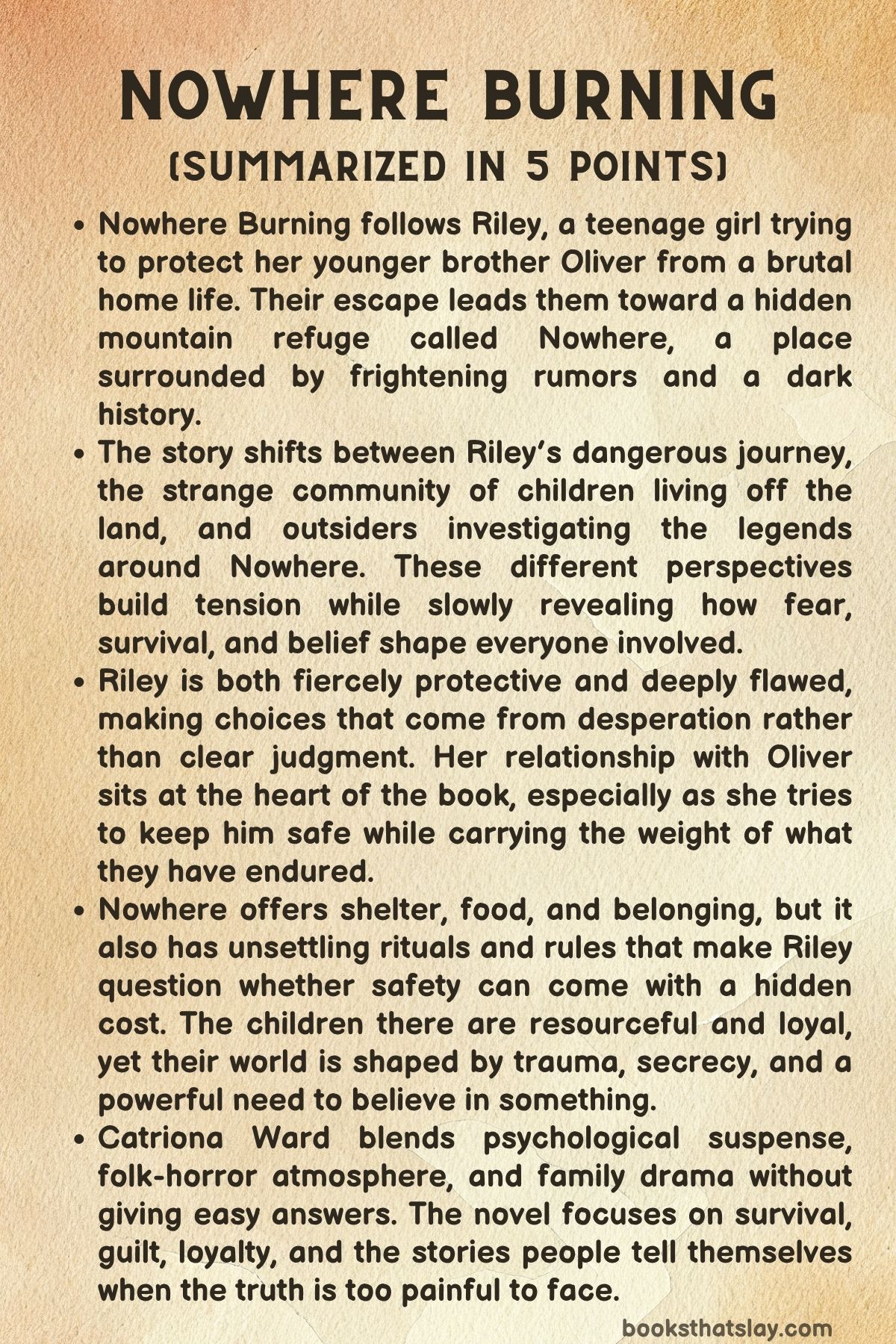
Nowhere Burning by Catriona Ward is a dark survival story about abuse, escape, belief, guilt, and the desperate ways children try to protect one another when adults fail them. The book follows Riley, a teenage girl who runs away with her starving younger brother Oliver after a violent act in their cousin’s house.
Their flight leads them to Nowhere, a hidden mountain refuge tied to a dead killer and a strange group of runaway children. What begins as a search for safety becomes a story about secrets, sacrifice, and the cost of belonging.
Summary
Riley lives in a house ruled by fear. She and her younger brother Oliver are under the control of their abusive cousin, who starves them, punishes them, and teaches Oliver that hunger, weakness, and disobedience are signs of a demon inside him.
Oliver is kept at home and denied a normal life, while Riley tries to keep them both alive by stealing milk and hiding what she has done. She has learned to think of death as something nearby, always waiting at the edge of the room.
One day Riley notices a strange figure following her. At first she thinks it is a dirty, short-haired boy, but the child later appears at her window and reveals herself as Noon, a girl from a hidden place in the mountains called Nowhere.
Noon tells Riley that runaway children live there and that Riley should bring Oliver. Riley is frightened because Nowhere was once the ranch of Leaf Winham, a notorious killer whose crimes still haunt the town.
Even so, Oliver’s suffering becomes impossible to ignore. When Riley finds him punishing himself in the basement because he believes Cousin’s lies about the demon, she decides they cannot wait for rescue.
Riley makes a plan. She cooks Cousin a large meal, poisons him with rat poison, steals her mother’s locket and Cousin’s gun, gathers food, and leaves with Oliver in the night.
The escape is dangerous from the start. Oliver is weak from starvation, the mountains are hard to navigate, and Riley believes something may be following them.
At an old cabin, a stranger approaches their camp. Panicked and convinced he means to harm her, Riley fires the gun.
The shot kills the stranger and accidentally wounds Oliver in the leg. Riley later realizes the young man was carrying a compass, not a knife.
Terrified of what she has done, she hides the body and keeps moving, even as Oliver’s wound gets worse.
At the same time, documentary makers Marc and Kimble are investigating stories about the children of Nowhere. They interview Annie, a woman who claims she was kidnapped by children, held near an old Ferris wheel, fed strange food, and bled every day.
They also uncover footage of a starving child stealing baby formula from a grocery dumpster. Their search leads them to Linus, a scarred hardware-store worker who survived Leaf Winham years earlier.
Marc and Kimble persuade Linus to guide them toward a hidden route into Nowhere.
Linus’s memories reveal the horror behind the place. Years earlier, as a young firefighter, he reached the burning Winham estate and found Adam Leahy injured in the woods.
Leaf Winham appeared helpful at first, but then showed his true nature. He drugged Adam and Linus, killed Adam, and cut Linus’s throat.
Leaf was later believed dead, but investigators found terrible evidence at Nowhere: hidden rooms, medical tools, drains, and photos connected to murdered boys. They never found the secret tunnel that might explain how people moved in and out of the property.
Riley and Oliver eventually collapse in the mountains after running out of food. Children from Nowhere find them and bring them into the hidden valley by zipline.
There Riley meets Noon, Midnight, Dawn, Cal, Everett, and other children who have built a rough but functioning home. They sleep in patched stables, grow food, hunt, and care for each other.
Oliver receives treatment and food, and Riley tries to prove herself useful through work. For the first time in years, safety seems possible.
But Riley is uneasy. The children treat Nowhere almost like a living force.
They send their breath toward the ruined house where Leaf Winham once lived, and Riley senses a kind of worship in their devotion to the land. She also realizes that the boy she shot in the mountains was Danny, Cal’s missing brother.
Afraid of being cast out or punished, she forces Oliver to stay silent by twisting Cousin’s old demon story into a new lie.
Riley tries to leave with Oliver, but escape is not simple. The zipline has been removed, a mountain lion is nearby, and Oliver is too ill to travel.
Noon confronts Riley and makes it clear that Riley really did kill Cousin. She also tells Riley that the children of Nowhere have all done violent things in order to survive.
Riley nearly runs anyway, but Oliver’s fever forces her to stay. When Cal and Everett carry him back, Riley begins to believe that she and Oliver might be able to belong there.
Outside the valley, Marc secretly finds the cliff above Nowhere and throws a note down into it before returning to Kimble and Linus. Later, while filming near the sealed gate, Marc calls out.
Someone fires near him and a voice screams for him and Kimble to run. They flee, shaken and excited, and Marc begins to connect that voice to sounds they heard near their camp.
Life inside Nowhere grows harsher. A blight and drought strike the valley.
Crops rot, animals disappear, fish die, and the children begin to starve. Noon decides they must raid the nearby town of Ault for supplies.
Before the raid, the children give Dawn their necklaces as promises that they will return. Riley gives Dawn her precious locket, believing it holds a picture of her father.
The raid brings food, but Noon has another purpose. She leads the group to the home of Alison, a woman who drugs her own children at night with fumes under plastic bags.
After Alison’s household is unconscious, the children kidnap her and bring her back to the ruined Nowhere House. Inside the burned shell of the house is a sunken indoor garden.
Alison is strapped to a chair and cut so her blood drips into the earth. Riley joins the chant asking for blood in the land.
The ritual appears to work: rain returns, animals reappear, and the valley begins to recover.
Riley’s role in the ritual changes her place among the children. After helping with Alison and defending the gate from outsiders, she and Oliver are given bone necklaces and accepted as part of Nowhere.
Riley grows closer to Cal, though he still searches for Danny. The fragile peace ends when Cal finds Danny’s remains along with one of Oliver’s socks.
Oliver admits that Riley shot Danny and claimed he was a demon.
The children turn against Riley. Noon destroys Riley’s locket, and it opens to reveal a shocking truth: Riley’s father was Adam Leahy, the man Leaf Winham killed just before Riley was born.
Riley is imprisoned, drugged with mushroom stew, judged by the group, and stripped of her necklace. Cal takes her to Nowhere House and straps her into the same bloodletting chair used for Alison.
Riley is cut and left to bleed into the land. In her terror and hallucination, she imagines Leaf feeding from her wound.
Then she sees a broken-antlered deer enter the house and understands there may be another route out. She chews through her restraints and finds a way through the house and underground passage.
Years later, Marc is revealed to be Oliver, now grown. His documentary with Kimble has had a hidden purpose.
His daughter Silvie needs a kidney donor, and Riley may be the only family match. Marc finds Riley still tied to Nowhere, caring for what she believes are the dead children.
During a storm, Riley leads him toward the old escape route but refuses to leave. Marc tells her the children died in a fire she set, but Riley insists they were already ghosts.
In the aftermath, Silvie receives Riley’s kidney and lives. Marc is left with grief, anger, gratitude, and uncertainty.
He cannot fully know whether Riley died, disappeared, or chose to remain with the place and the children she believed were hers. Nowhere Burning ends with that unresolved ache: Riley may have saved Oliver once, and Silvie later, but the cost of survival has marked them all.
Characters
Riley
Riley is the central figure of Nowhere Burning, and her character is shaped by fear, responsibility, guilt, and desperate love. As a teenage girl forced to care for Oliver under Cousin’s cruelty, she grows up believing that survival matters more than innocence.
Her early actions show both her courage and her moral confusion: she steals milk to keep Oliver alive, hides evidence, poisons Cousin, takes a gun, and flees into the mountains because she sees no other way to save her brother. Riley is not presented as simply heroic or simply guilty.
She is a child who has been cornered for so long that violence begins to feel like a tool of protection.
Her relationship with Oliver reveals the tenderness at the core of her character, but it also exposes how damaged she has become. Riley loves him deeply and repeatedly risks herself for him, yet she also manipulates him after Danny’s death by using Cousin’s “demon” lie against him.
This shows that Riley has absorbed some of the abusive logic she is trying to escape. She hates Cousin’s cruelty, but under pressure she repeats his methods of fear and control.
That contradiction makes her one of the most complex characters in the book: she is both protector and harm-doer, victim and participant, loving sister and unreliable moral guide.
At Nowhere, Riley wants safety, belonging, and forgiveness, but she is also suspicious of anything that looks like worship or surrender. She sees danger in the children’s devotion to the land and to Leaf Winham’s ruined house, yet she gradually becomes part of the same system when she joins in Alison’s bloodletting and accepts the idea that violence can restore life.
Her acceptance into the group gives her what she has always wanted, but it also costs her more of her moral certainty. Riley’s journey is not a clean escape from abuse; it is a movement from one distorted survival system into another.
By the end, Riley becomes almost inseparable from Nowhere itself. Her refusal to leave suggests that she has found a purpose, but it is a tragic and haunted one.
Whether she is caring for ghosts, memories, or the remains of her own guilt, Riley becomes a figure suspended between life and death, punishment and belonging. She gives a kidney that saves Silvie, which proves that her love and sacrifice are still real, but she does not return to ordinary life.
Riley’s character ultimately represents how trauma can make survival feel sacred, how love can become tangled with violence, and how difficult it is for a damaged child to know the difference between rescue and ruin.
Oliver
Oliver is Riley’s younger brother and one of the most vulnerable characters in the story. He has been starved, isolated, and emotionally controlled by Cousin, who teaches him that hunger, pain, and disobedience mean a demon lives inside him.
Because Oliver is kept “homeschooled” and cut off from normal life, his understanding of the world is shaped almost entirely by fear. He believes punishment is deserved, and this makes his suffering especially painful because he does not fully recognize that the adults around him are lying.
Oliver’s dependence on Riley gives their relationship emotional weight. Riley becomes his protector, parent, and guide, and he trusts her even when she makes dangerous choices.
His injury in the mountains after Riley accidentally shoots him deepens the tragedy of their escape. Riley’s attempt to protect him leads to further harm, and Oliver becomes the living reminder that survival does not erase consequence.
Even after reaching Nowhere, his body carries the cost of hunger, fear, and violence.
As the story later reveals, Oliver grows into Marc, which changes the reader’s understanding of his character. The frightened child who once believed in demons becomes a man who uses investigation, filming, and deception to return to the place that defined his childhood.
His adult identity shows that he survived physically, but not emotionally untouched. His search for Riley is tied to practical need because his daughter Silvie requires a kidney donor, yet it is also driven by unresolved grief, anger, and love.
As Marc, Oliver is still trying to understand what happened to him, what Riley did for him, and what she took from him.
Oliver’s character represents the long afterlife of childhood trauma. He escapes Nowhere, grows up, and becomes a father, but he cannot fully leave the past behind.
His adult grief is complicated because Riley saved him and hurt him, loved him and lied to him. Through Oliver, the book shows that survival is not the same as healing.
He lives, but he carries the burden of memory, and his final uncertainty about Riley leaves him caught between gratitude and resentment.
Cousin
Cousin is the first major source of terror in Riley and Oliver’s lives. He is abusive, controlling, and cruel, using starvation, forced labor, isolation, and religious or supernatural fear to dominate the children.
His treatment of Oliver is particularly brutal because he teaches the boy to interpret his own suffering as proof of inner evil. By making Oliver believe a demon is inside him, Cousin turns abuse into a false moral lesson, convincing his victim that pain is deserved.
Cousin’s power comes not only from physical cruelty but from psychological control. He controls food, movement, education, and belief.
He makes the home into a prison where Riley must become secretive and strategic just to keep Oliver alive. Because he is the immediate threat from which Riley escapes, his presence shapes many of her later choices.
Riley learns from him that survival may require deception, that power belongs to whoever controls the story, and that fear can make people obedient.
Although Cousin dies early in the action, his influence continues through Riley and Oliver. Riley poisons him to escape, but the emotional structure of his abuse follows them into the mountains and into Nowhere.
Oliver’s belief in demons does not disappear immediately, and Riley later uses that same belief to hide Danny’s death. In this way, Cousin remains important even after his death because his cruelty becomes a pattern that the children must struggle either to reject or repeat.
Noon
Noon is the strange girl who first appears to Riley as a dirty, short-haired “boy” and later reveals the path to Nowhere. She functions as a messenger, recruiter, leader, and moral challenger.
To Riley, Noon first seems like a possible rescuer because she offers a way out of Cousin’s house. Yet Noon also belongs to a world with its own violence, secrecy, and rituals.
Her invitation is both salvation and danger.
Within Nowhere, Noon is one of the strongest representatives of the children’s survival code. She understands that the children have done violent things to stay alive, and she does not pretend otherwise.
Unlike Riley, who tries to separate herself from what she has done, Noon often speaks with a harsh honesty. She recognizes Riley’s murder of Cousin and understands that innocence is not simple among children who have been forced to survive terrible circumstances.
Noon’s strength lies in her refusal to look away from ugly truths.
Noon also becomes one of Riley’s judges. When Riley’s killing of Danny is revealed, Noon turns against her and helps enforce the group’s punishment.
This makes Noon morally complicated. She can be compassionate, brave, and protective of the children, but she can also be ruthless when she believes the group has been betrayed.
Her loyalty is not to individual softness but to Nowhere and its laws. In the book, Noon represents the hard edge of survival communities: she offers belonging, but only to those who accept the group’s truth and consequences.
Cal
Cal is one of the Nowhere children who helps rescue Riley and Oliver from the mountains, and he becomes especially important because of his missing brother Danny. He is caring, capable, and emotionally open enough for Riley to grow close to him.
His early role suggests kindness and loyalty; he helps bring the starving siblings into the hidden valley and participates in the communal work that keeps the children alive. Through him, Nowhere appears not only frightening but also nurturing.
Cal’s love for Danny gives his character a deep emotional wound. He continues searching for his brother, and this search becomes the force that eventually exposes Riley’s hidden crime.
When he finds Danny’s remains along with Oliver’s Nana sock, the truth breaks the fragile trust between Riley and the group. Cal’s grief turns him from a possible companion for Riley into one of the people who delivers her punishment.
His reaction is severe, but it comes from betrayal and loss rather than simple cruelty.
Cal’s character shows how grief can harden love into judgment. He is not evil, but he is devastated, and in Nowhere devastation often becomes ritual action.
His closeness to Riley makes the revelation more painful because she has not merely lied to the group; she has lied to someone who might have loved or trusted her. Cal therefore represents the cost of Riley’s secrecy and the way hidden violence eventually returns to demand recognition.
Danny
Danny is mostly present through absence, but his role is crucial. He is the young man Riley shoots near the old cabin, mistaking him for a threat.
At first, Riley interprets him through fear. She believes he may hurt her, and her panic leads to a fatal mistake that also injures Oliver.
Only later does she discover that Danny was carrying a compass, not a knife. This discovery turns the shooting from self-defense into tragedy.
Danny’s death becomes the buried secret at the heart of Riley’s life in Nowhere. Because he is Cal’s missing brother, his absence haunts the group long before the truth is known.
The children’s concern for him shows that Nowhere, despite its violence, is also a place of real attachments. Danny is not just an anonymous victim; he is someone loved, searched for, and mourned.
As a character, Danny represents the innocent cost of Riley’s fear. He does not need many scenes to matter because the consequences of his death shape the entire middle and later movement of the story.
His remains expose Riley’s lie, destroy her fragile belonging, and force the children to judge her. Danny’s character reminds the reader that trauma explains Riley’s actions but does not erase the people harmed by them.
Marc
Marc is first presented as a documentary maker investigating the legends of Nowhere, but he is later revealed to be the adult Oliver. This revelation reshapes his entire role.
What initially appears to be professional curiosity becomes a personal return to the place of his childhood trauma. Marc’s filming, questioning, and secretive behavior are not simply the actions of an ambitious investigator; they are the actions of a survivor trying to recover something lost and solve something unresolved.
As an adult, Marc is practical and morally conflicted. His daughter Silvie needs a kidney donor, and Riley may be the only family match, so his search for Riley is driven by urgent love for his child.
At the same time, he is not emotionally neutral. Returning to Nowhere means confronting the sister who saved him, lied to him, and helped shape the trauma he still carries.
His anger and gratitude exist together, making his relationship with Riley painfully complicated.
Marc’s character also explores memory and uncertainty. He wants answers, but Nowhere resists clear explanation.
When Riley insists the children were already ghosts, Marc cannot fully accept or dismiss what she believes. His adult rationality is challenged by the strange emotional and possibly supernatural reality of the place.
By the end, Marc survives with Silvie, but he does not receive complete closure. He remains a man living with unanswered questions, which makes him one of the book’s most quietly tragic figures.
Kimble
Kimble is Marc’s documentary partner and an important part of the investigation into Nowhere. She helps pursue the story of the hidden children, interviews witnesses, and enters dangerous territory with Marc and Linus.
Her role is partly investigative, but she also functions as a contrast to Marc. While Marc’s connection to Nowhere is deeply personal and hidden, Kimble appears to approach it more as a frightening mystery and documentary subject.
Her presence helps show how outsiders consume stories of trauma. The legends of Nowhere are exciting, disturbing, and potentially valuable as a film, but for Marc they are not merely material.
Kimble’s involvement therefore highlights the difference between documenting horror and having lived inside it. She shares danger with Marc, yet she does not carry the same buried history.
Kimble is also important because she witnesses Marc’s secrecy and ambition. When Marc throws a note into Nowhere and pretends his camera failed, he deceives her as well as Linus.
This places Kimble in the position of someone close to the truth but not fully included in it. Her character helps maintain the tension between public investigation and private motive, showing how the search for Nowhere is never only about evidence.
Linus
Linus is a scarred hardware-store worker and survivor of Leaf Winham’s violence. His past as a young firefighter makes him one of the few adult characters who has directly encountered the horror connected to Nowhere House.
When he responded to the burning estate, found Adam, and then suffered Leaf’s attack, Linus became a living witness to events others only discuss through rumor, evidence, and legend.
His scars are physical proof of survival, but they also mark emotional damage. Linus knows that Leaf was not merely a distant criminal story; he experienced his cruelty firsthand.
His willingness to guide Marc and Kimble for money suggests a man whose trauma has left him worn down, perhaps cynical, perhaps desperate. He is not eager in a heroic sense.
He is pulled back toward the place that harmed him because the past remains unfinished and because survival has not necessarily brought peace.
Linus’s character adds credibility and dread to the story of Nowhere. Through him, the violence of the past enters the present.
He bridges the official history of the Winham estate and the living mystery of the hidden valley. His survival also contrasts with Adam’s death, reminding the reader that Leaf’s crimes left behind not only bodies but damaged witnesses who must continue living with what they saw.
Leaf Winham
Leaf Winham is the central figure of horror behind Nowhere’s history. He is a killer, manipulator, and predator whose estate becomes the physical and symbolic center of the story’s darkness.
Even when he is believed dead, his presence remains powerful. The secret rooms, medical instruments, drains, photographs, and hidden tunnels connected to him suggest a life built around control, secrecy, and violence.
Leaf’s relationship with Adam reveals his disturbing need for possession and observation. The secret staircase and peepholes show that Leaf’s intimacy is inseparable from surveillance and domination.
He speaks about darkness, control, breath, and underwater practice in ways that make ordinary affection feel corrupted. He does not simply kill; he studies, watches, prepares, and turns the home itself into a mechanism of power.
Yet Leaf’s influence extends beyond his own actions. The children of Nowhere send breath toward his ruined house and live in the shadow of his land.
Riley hallucinates him feeding from her wound, which suggests that he has become almost mythic, a figure of hunger attached to the place itself. Whether understood literally, psychologically, or symbolically, Leaf represents the way evil can outlive the person who committed it.
In Nowhere Burning, he is not only a murderer from the past; he is the dark inheritance that continues to shape the living.
Adam Leahy
Adam Leahy is Riley’s father, though this truth is hidden until later. His story adds emotional depth to Riley’s identity and links her directly to the history of Nowhere House.
Before his death, Adam lives with Leaf Winham and becomes entangled in an intense, uneasy relationship. His construction of secret passages and peepholes suggests both complicity and vulnerability.
He participates in the architecture of secrecy, but he is also one of the people trapped inside Leaf’s power.
Adam’s relationship with Leaf is unsettling because it mixes desire, dependence, fear, and denial. Even when warned by a police officer and reminded that his pregnant girlfriend Christie has reported him missing, Adam stays.
This does not make him foolish in a simple way; rather, it shows how manipulation and emotional attachment can distort judgment. Adam senses that something is wrong, including signs of possible burial or death, but he does not escape in time.
His death three days before Riley’s birth gives Riley’s story an inherited tragedy. She grows up without him, carrying a locket that she believes contains one truth but actually hides another.
When the locket reveals Adam’s identity, Riley’s personal history becomes inseparable from the violence of Nowhere. Adam represents the past that Riley never knew but cannot escape.
His choices, victimhood, and death shape her life before she is even born.
Dawn
Dawn is one of the children living in Nowhere and is especially associated with trust, innocence, and promises of return. Before the raid on Ault, the children give Dawn their necklaces as signs that they will come back.
Riley gives her the treasured locket, believing it contains a picture of her father. This moment makes Dawn a keeper of hope and attachment within the group.
Dawn’s role shows the emotional rituals that hold the children together. The necklaces are not just objects; they represent belonging, memory, and survival.
By receiving them, Dawn becomes a symbol of the home the children want to believe they have built. She is part of the softer side of Nowhere, the side that depends on care, trust, and shared meaning rather than fear alone.
At the same time, Dawn’s connection to the locket places her near one of the story’s major revelations. The object Riley gives away as a token of love later becomes evidence of hidden truth.
Dawn therefore stands at the intersection of innocence and discovery. Her character reminds the reader that even in a violent community, children continue to create ceremonies of love and loyalty.
Midnight
Midnight is one of the Nowhere children and takes part in the raid that leads to Alison’s kidnapping. Her use of horse chloroform shows that she is capable, practical, and accustomed to the harsh methods the children use to survive.
Like Noon, she belongs to the side of Nowhere that accepts violence as necessary when the group is threatened by hunger and collapse.
Midnight’s character helps show that the children are not passive victims. They organize, plan, raid, drug adults, and perform rituals.
This makes them frightening at times, but it also reflects how completely adult failure has shaped their world. They have built their own society because the outside world either abused, ignored, or failed them.
Although Midnight may not receive the same emotional focus as Riley, Noon, or Cal, her presence strengthens the communal identity of Nowhere. She is part of the group’s discipline and survival machinery.
Through characters like Midnight, the book shows that the children’s community is not a fantasy refuge; it is a wounded society with rules, roles, and a willingness to harm others in order to continue existing.
Everett
Everett is another child of Nowhere who helps rescue Riley and Oliver and later helps carry Oliver back when Riley tries to leave. His actions make him one of the more visibly caring members of the group.
He is physically helpful, dependable, and committed to the survival of the children around him. In a story filled with suspicion and betrayal, Everett’s practical assistance matters because it shows the genuine kindness that exists within Nowhere.
His character helps complicate the reader’s view of the hidden valley. Nowhere is not simply a cult-like danger or a magical refuge; it is both.
Everett’s care for Oliver shows that the community can heal and protect. The same place that later punishes Riley also saves her brother’s life.
Everett represents that contradiction through action rather than speech.
As part of the group, Everett also participates in the collective life that eventually turns against Riley. This does not erase his kindness, but it shows how individual decency can exist inside a harsh communal system.
Everett’s character demonstrates that the children are not easily divided into good and bad. They are damaged, loyal, and shaped by shared survival.
Alison
Alison is the woman kidnapped by the Nowhere children after they discover that she drugs her own children with fumes under plastic bags. She is a disturbing adult figure because she mirrors the abuse that many of the children have already suffered.
Her actions make her a target in the children’s moral world, where abusive adults may be punished, used, or sacrificed.
When Alison is taken to Nowhere House and bled into the earth, she becomes part of the story’s most unsettling ritual. The children treat her body as a means of restoring the land.
Riley’s participation in the chant marks a turning point, because she moves from horrified observer to active participant. Alison therefore serves as both a victim of the children and a perpetrator against her own children, making her role morally uncomfortable.
Her character raises one of the book’s central questions: what happens when victims become judges? The children punish someone who has harmed children, but their punishment is itself brutal and dehumanizing.
Alison’s presence forces the reader to confront the danger of a survival code built around revenge and sacrifice.
Annie
Annie is an adult witness who claims that children kidnapped her, bled her daily, fed her mushrooms and baby formula, and held her near a broken Ferris wheel. Her testimony gives the outside world a glimpse of the horror connected to the Nowhere children.
Through Annie, Marc and Kimble learn that the legends may be real and that the children’s survival practices have harmed outsiders.
Annie’s character is important because she shows the aftermath of encountering Nowhere from the perspective of someone who was not part of the children’s community. To the children, their actions may be necessary; to Annie, they are terrifying captivity and bodily violation.
Her story widens the moral frame of the novel by reminding the reader that the children’s suffering does not cancel the suffering they cause.
She also contributes to the documentary structure of the investigation. Annie’s account gives Marc and Kimble a human source, not just rumor or footage.
Her fear and memory make the mystery of Nowhere feel immediate and credible. As a character, she represents the outside victims of the hidden valley’s survival rituals.
Silvie
Silvie is Marc’s daughter, and although she appears mainly through her need for a kidney donor, her role is emotionally powerful. Her illness gives Marc’s return to Nowhere urgency and transforms the investigation into a deeply personal mission.
Marc is not only looking backward into trauma; he is trying to save his child’s future.
Silvie also creates a connection between Riley’s past and the next generation. Riley’s kidney saves her, which means Riley’s body becomes a source of life after so much death, violence, and guilt.
This act does not erase Riley’s wrongs, but it complicates her ending. She remains capable of sacrifice and love, even if she cannot fully return to ordinary human life.
Through Silvie, the story suggests that trauma can pass across generations, but so can survival. Marc carries the wounds of childhood, yet he fights for his daughter.
Riley, who once saved Oliver imperfectly, helps save Oliver’s child. Silvie represents continuation: the possibility that someone may live beyond the ruins that trapped the older characters.
Christie
Christie is Adam Leahy’s pregnant girlfriend and Riley’s mother. Her role is smaller, but her importance is significant because she links Riley to the life Adam left behind.
By reporting Adam missing, Christie shows concern and attachment, and she becomes part of the warning Adam ignores. Her pregnancy also gives Adam’s choices greater consequence, because his disappearance and death leave Riley fatherless before birth.
Christie’s character stands outside the darkness of Nowhere House but is deeply affected by it. She represents the ordinary life Adam might have returned to and the family that Leaf’s violence destroys before it can fully form.
Riley’s locket, which she believes contains a picture of her father, becomes a symbol of the incomplete inheritance Christie’s daughter receives.
Although Christie is not central in the active plot, she matters as part of Riley’s origin. Her presence reminds the reader that behind every disappearance is a life interrupted and people left waiting.
In Nowhere Burning, Christie represents the world damaged indirectly by Leaf Winham’s crimes: those who may not enter the house of horror but still lose someone to it.
Rick McFadyen
Rick McFadyen is Leaf Winham’s missing former lover, and his absence adds to the pattern of danger surrounding Leaf. The police officer’s questions about Rick suggest that Leaf’s violence did not begin with Adam or Linus.
Rick’s disappearance becomes part of the evidence that Leaf’s relationships are linked to control, secrecy, and death.
As a character, Rick functions mainly as a warning sign. He is a missing person whose fate casts suspicion over Leaf before the full horror is known.
His connection to Leaf shows that intimacy around Leaf is dangerous, especially for those who become emotionally or physically close to him. Rick’s absence helps build the sense that Nowhere House has swallowed people before.
Rick also deepens the theme of erased victims. He is not given the same emotional space as Riley or Adam, but his disappearance matters because it points to a larger history of harm.
He represents those whose stories are nearly lost, surviving only through questions, rumors, and investigation.
Themes
Survival and the Moral Cost of Escape
Survival in Nowhere Burning is not shown as clean or heroic; it is painful, frightened, and morally damaging. Riley’s choices grow out of abuse, hunger, and the urgent need to protect Oliver, yet those same choices pull her into violence and guilt.
Poisoning Cousin is not presented simply as justice, because Riley carries the fear of what she has done even after escaping him. Her later killing of Danny deepens this theme, showing how trauma can twist perception until an innocent stranger appears to be a threat.
The children of Nowhere also survive through acts that disturb ordinary ideas of right and wrong: theft, kidnapping, secrecy, punishment, and bloodletting. Their community exists because the outside world has failed them, but it also becomes a place where harm is repeated in the name of staying alive.
The story suggests that survival under cruelty can force children into choices no child should have to make, leaving them alive but deeply changed.
Abuse, Control, and the Lies Children Are Taught
Abuse works in the story not only through physical suffering but through language, belief, and control. Cousin keeps Riley and Oliver trapped by controlling food, education, movement, and even Oliver’s understanding of himself.
By teaching Oliver that hunger or disobedience means a demon lives inside him, Cousin turns a child’s natural fear into self-blame. This is one of the cruelest forms of control because Oliver begins to punish himself even when Cousin is not present.
Riley understands the lie, but she also learns to use it when she pressures Oliver to stay silent about Danny. That moment shows how abuse can be inherited through behavior, even by someone trying to protect another person.
Leaf Winham’s history reflects a darker version of the same pattern: domination disguised as care, intimacy, or belonging. The story shows that abuse does not end the moment someone escapes a house; its ideas can remain inside the mind and shape future choices.
Found Family and the Hunger to Belong
Nowhere offers Riley and Oliver something they have never truly had: food, care, protection, names, rituals, and a place among other children who understand suffering. This makes the hidden valley emotionally powerful because it answers a real need.
Riley wants safety for Oliver, but she also wants to stop being alone. The children’s shared work, necklaces, promises, and loyalty create the feeling of a chosen family, especially after years of neglect and fear.
Yet the same longing for belonging makes Riley vulnerable. Acceptance in Nowhere requires silence, obedience, and participation in acts she does not fully understand.
Once she becomes part of the group, she begins to excuse things that once frightened her. The theme becomes complicated because the community is both loving and dangerous.
It heals wounds, but it also demands loyalty at the cost of truth. Through Riley, the story shows how powerful belonging can be when someone has been starved of love.
Guilt, Memory, and Uncertain Truth
In Nowhere Burning, memory is unstable because trauma changes what people can bear to know. Riley’s memories are shaped by fear, guilt, hunger, injury, and later by isolation.
She hides Danny’s death from others and partly from herself, turning the truth into something she can survive. When Marc returns as an adult, the past is still unresolved because memory has become mixed with grief and need.
He wants Riley as a sister, as a possible kidney donor, and as the missing piece of his own childhood, but he cannot fully reach the truth of what happened to her. Riley’s belief that the dead children still need her may be madness, grief, devotion, or something supernatural.
The story refuses to make that answer simple. This uncertainty matters because guilt often does not produce clear memories; it produces repeated images, excuses, punishments, and dreams of repair.
The past remains alive, not because it is fully understood, but because no one can escape what it cost.