Of Blood And Fire Summary, Characters and Themes
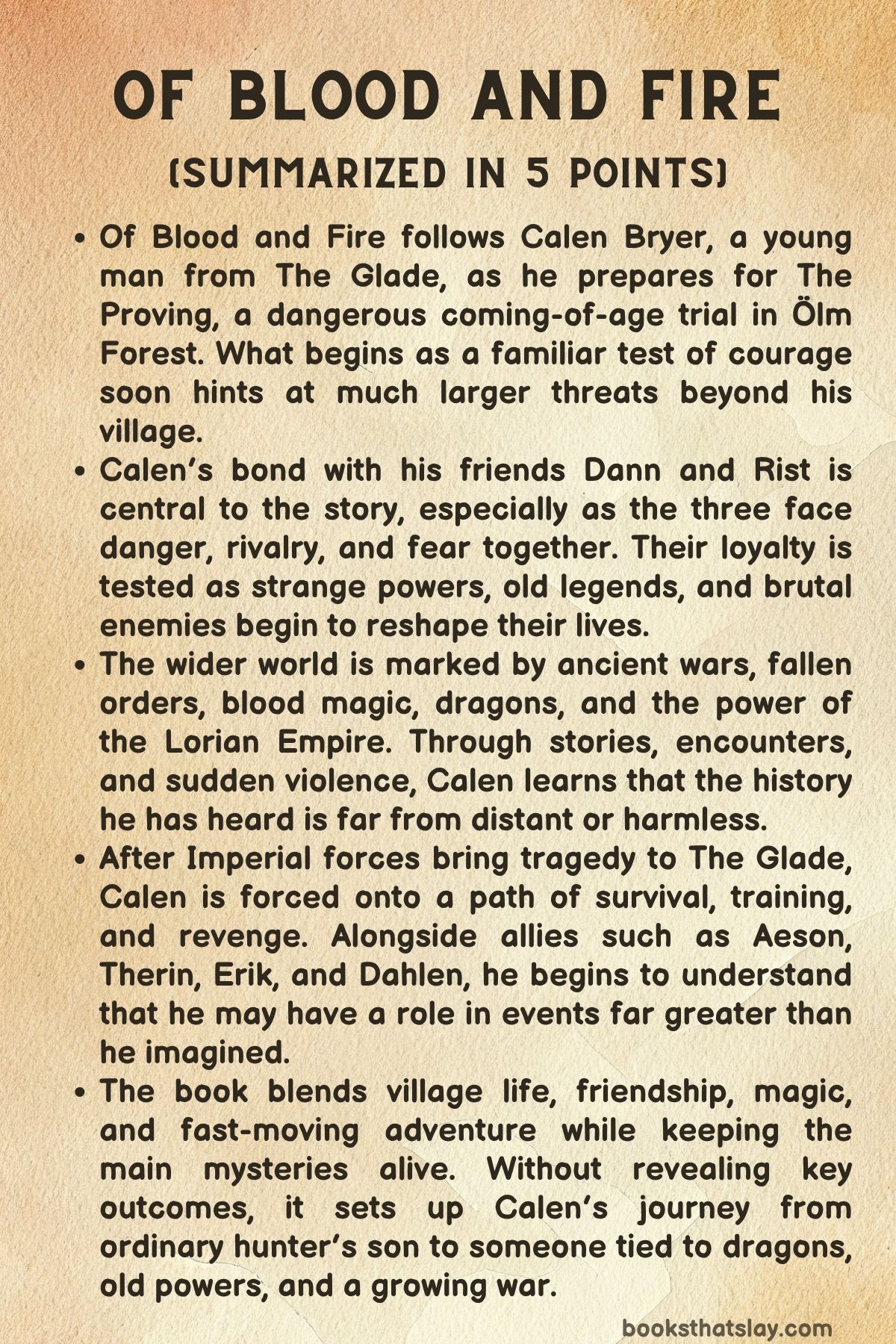
Of Blood And Fire by Ryan Cahill is an epic fantasy novel about ordinary people caught in the return of old powers, brutal empires, lost magic, and dragons. The story begins in a world shaped by ancient betrayal, war, and the fall of powerful orders, then follows Calen Bryer, a young man from The Glade whose quiet life is shattered.
What starts as a coming-of-age tale soon becomes a larger struggle involving the Lorian Empire, Uraks, magic, and a dragon bond that changes Calen’s future. The book mixes friendship, revenge, survival, and destiny in a classic high-fantasy setting. It’s the first book of The Bound and the Broken series.
Summary
In Of Blood And Fire, the story opens with Kallinvar and the Knights of Achyron arriving at the scene of a slaughter between men and Uraks. They find only one young man still clinging to life.
Kallinvar questions him about strength, duty, loyalty, and the cost of serving Achyron. The young man accepts the final Sigil, and Kallinvar presses it into his chest.
With that act, the order of Sigil Bearers is restored just before the Blood Moon, hinting that old powers are rising again.
Years later, the focus shifts to Calen Bryer, a young man living in The Glade with his father Vars, mother Freis, sister Ella, and his loyal wolfpine, Faenir. Calen is close to his friends Dann Pimm and Rist Havel, and all three are preparing for The Proving, a rite of passage that requires them to survive three nights in Ölm Forest and return with the pelt of a predator.
Calen feels the pressure of becoming a man and living up to the memory of his dead brother, Haem, whose shadow still hangs over his family.
Before The Proving, Calen, Dann, and Rist go hunting and encounter signs that something unnatural may be in the forest. They kill a large stag, but a clean wound along its side suggests it had already been attacked by something far more dangerous.
That night, at The Gilded Dragon, the elf storyteller Therin tells the villagers about the fall of The Order, the Draleid, the use of blood magic by Fane Mortem, and the rise of the Lorian Empire. These old stories seem distant to Calen, but they soon become connected to his own life.
Calen also struggles with ordinary concerns. He speaks awkwardly with Anya, while Dann drinks too much and causes trouble.
On the way home, Calen and Dann are ambushed and beaten by Kurtis Swett and Fritz Netley. Faenir drives the attackers away, and Ella, who has secretly been meeting Rhett Fjorn, helps bring aid.
These conflicts show the tensions within The Glade before far greater dangers arrive.
During The Proving, Calen, Dann, and Rist enter Ölm Forest and take shelter in a cave. Their test becomes deadly when a huge bear attacks them at night.
Dann wounds it with arrows, and Calen helps kill it by stabbing it in the neck. The bear’s pelt should secure their success, but trouble follows.
Fritz, Kurtis, and Dennet interfere with their camp, shoot at a kat, and accidentally wound Rist. Fritz then steals the bear pelt and forces the boys deeper into the forest.
Trying to find their way back, Calen, Dann, and Rist encounter Uraks. One kills a wolfpine, and another attacks them.
Calen manages to kill the smaller Urak with a spear, but the larger one overpowers the boys and nearly kills him. At the last moment, a burst of light burns the Urak to death.
Rist realizes that the power came from him, though he has no idea how he did it. The boys return to The Glade with the Urak’s head and are declared victors of The Hunt, but the event reveals that Rist carries a dangerous and rare gift.
Afterward, Calen, Dann, and Rist travel to Milltown to deliver weapons. There, Calen meets Erik and becomes involved in a confrontation with Imperial soldiers.
Fighting breaks out, and Calen kills a soldier. The boys flee with Erik, Aeson, and Dahlen, soon learning that they have become part of something much larger than a village dispute.
They meet surviving giants, including Asius, and discover that Aeson is transporting a rare dragon egg. Aeson warns that the empire will now come for Calen, but Calen, Dann, and Rist steal horses and race home to warn their families.
They are too late to save everything. In The Glade, the Imperial Inquisitor Rendall and the unnaturally skilled swordsman Farda confront Calen.
Vars tries to protect his son and is killed. Calen also learns that his mother and Ella are dead or presumed dead.
His home is destroyed, and his old life ends in a single brutal blow. Therin, Aeson, Erik, and Dahlen help Calen, Dann, and Rist escape.
Consumed by grief and anger, Calen agrees to travel with Aeson, but only if he is trained to fight and given a chance to take revenge.
Unknown to Calen, Ella is alive. She has fled with Rhett and heads toward Berona.
In Camylin, she sees more of the wider world and shows her kindness by helping a hungry boy. Rhett considers safer routes, knowing they may be in danger.
At the same time, Calen’s group also reaches Camylin, but Imperial forces and a terrifying creature known as a Fade are tracking them.
The city becomes a trap. Soldiers attack in the streets, forcing Calen, Dann, Erik, and Aeson to flee.
Rist falls behind, and Dahlen turns back to help him. Calen and Dann want to go back, but Aeson insists that stopping would doom them all.
They follow Erik to Oliver’s Apothecary, where he reveals a hidden entrance to a smuggling tunnel once used to bring Altwied blood into the city. Inside, Aeson creates magical light, proving to Calen and Dann that magic is real.
Meanwhile, Dahlen fights through soldiers while trying to protect Rist, who becomes weak and unable to keep moving. A robed creature appears and offers to spare Dahlen if he gives up Rist.
Dahlen refuses. The creature uses invisible force against him, and even when Dahlen stabs it through the chest, the wound does nothing.
The Fade knocks him unconscious and takes Rist.
Calen’s group reaches a camp outside the city, where Therin is waiting in poor condition. Dahlen returns alone, injured and ashamed, and explains that the Fade took Rist.
Calen lashes out, blaming him, until Dann calms him. Therin explains that Rist is connected to the Spark, the source of magic, which is likely why the Fade wanted him.
Aeson believes Rist will be taken to the High Tower in Berona, where the empire trains young magic users. Calen wants to rescue him immediately, but the others warn that such a mission would be nearly impossible.
That night, Calen hears a voice coming from the dragon egg. The words are in the Old Tongue and mean “Dragonbound by fire.” Aeson realizes that Calen is meant to become Draleid, bound in soul to a dragon.
When Calen touches the egg, fire surrounds it but does not burn him. The bond forms, and the egg soon hatches into a small white dragon with lavender eyes.
Calen can feel the dragon’s emotions in his mind, and the creature settles in his lap. He later names the dragon Valerys, inspired by the Old Tongue word for ice.
Because of this bond, Aeson insists that rescuing Rist must wait. Calen now has a responsibility that could change the fate of many people.
The group heads toward Belduar, hoping to find safety. Along the way, Therin begins teaching Calen about the Old Tongue and the Spark.
Calen learns to touch magic and freezes part of a stream, but he also discovers that magic drains the body and can become dangerously tempting.
Elsewhere, Farda Kyrana, a Lorian Justicar, begins hunting Calen more directly. He recruits Fritz Netley and plans to use Ella as bait, believing she may be heading north with Rhett toward Berona.
Farda sends men to watch the ports and works with the Fade, making clear that Calen, Rist, Ella, and the dragon are all caught in the empire’s net.
When Calen’s group learns that Belduar is blocked by a massive Lorian force, they take a dangerous route through the Darkwood. There, Uraks attack.
Calen fights with everything he has, using both his sword and his new magic to protect Dann and Valerys. Dann is badly wounded, and Valerys is struck down but survives.
Just when the group seems close to defeat, warriors in green cloaks arrive on great white stags and kill the Uraks with arrows. Their arrival saves Calen and his companions, ending this stage of the journey while opening the path to an even larger conflict.
Characters
Calen Bryer
Calen Bryer is the central young hero of Of Blood And Fire, and his character is built around the painful movement from ordinary village life into a wider world of violence, magic, empire, and loss. At the beginning of the book, Calen is still deeply rooted in The Glade, shaped by family, friendship, hunting, and the expectations surrounding The Proving.
He is brave, but not yet hardened; capable, but still uncertain about whether he can live up to the memory of his dead brother Haem. His early struggles show him as someone who wants to prove himself, yet he is not arrogant.
He carries self-doubt, awkwardness, loyalty, and a strong emotional dependence on the people closest to him.
Calen’s development becomes much darker after the Imperial attack on his home and the death of Vars. The boy who once worried about rites of passage is forced into a brutal conflict against the Lorian Empire.
His grief turns quickly into anger, and his desire for revenge becomes one of his strongest motivations. This makes him emotionally believable because he does not instantly become noble or composed after tragedy.
Instead, he becomes wounded, reactive, and sometimes unfair, especially when he lashes out at Dahlen after Rist is taken. His pain often overwhelms his judgment, but it also reveals how deeply he loves his friends and family.
His bond with Valerys marks a major turning point in the story. Through the dragon, Calen is no longer only a victim of Imperial violence; he becomes connected to ancient powers, forgotten histories, and a destiny larger than himself.
His ability to touch the Spark further complicates him, because power gives him hope but also danger. Calen’s character is therefore defined by conflict: grief against duty, revenge against responsibility, fear against courage, and humanity against the terrifying weight of becoming Dragonbound.
Dann Pimm
Dann Pimm is Calen’s loyal friend and one of the most emotionally grounding characters in the book. He often provides humor, warmth, and a sense of normal village life, especially in the earlier sections.
His drunken interruption during Calen’s awkward moment with Anya shows his immaturity, but it also makes him feel natural and believable as a young man from The Glade. He is not presented as perfect or heroic in a polished way; instead, his courage grows out of loyalty and instinct.
During The Proving, Dann proves that he is much more than comic relief. His quick action with the bow during the bear attack helps save the group, showing that he can remain useful under pressure.
Later, when danger becomes more serious and the boys are pursued by Imperial forces, Dann continues to stay beside Calen even when the world around them becomes increasingly frightening. His loyalty is especially important after Calen’s family is destroyed, because Dann becomes one of the few remaining pieces of Calen’s old life.
Dann’s role also becomes emotionally significant when he helps calm Calen after Rist is taken. Where Calen is fiery and grief-driven, Dann often acts as a stabilizing presence.
He may not fully understand magic, dragons, or the larger political conflict, but he understands friendship. His value lies in emotional steadiness, practical courage, and a deep unwillingness to abandon those he loves.
Rist Havel
Rist Havel is one of the most important characters because his quietness hides extraordinary potential. At first, he appears to be part of Calen’s close circle without seeming destined for special power.
He shares in the same village experiences, the same dangers of The Proving, and the same youthful fears as Calen and Dann. However, his accidental blast of light against the Urak reveals that he is connected to something far greater than he understands.
Rist’s relationship with the Spark makes him both powerful and vulnerable. Unlike Calen, whose bond with Valerys gives his destiny a visible symbol, Rist’s magic appears suddenly and mysteriously.
He does not control it, and this lack of control makes him a target. The Fade’s decision to take him shows that his power has value to the Empire or to darker forces working alongside it.
His weakness and collapse during the escape from Camylin also suggest that his connection to magic may be physically and emotionally dangerous.
Rist’s abduction changes the direction of the story. For Calen, Rist is not merely a magical asset or a possible wielder of the Spark; he is a friend who has been stolen.
This makes Rist central to the emotional stakes of the book. His character represents hidden power, innocence caught in political violence, and the terrifying idea that people with gifts may be hunted, controlled, or shaped by forces they do not yet understand.
Vars Bryer
Vars Bryer is Calen’s father and one of the strongest moral influences in Calen’s life. He represents discipline, strength, family responsibility, and practical wisdom.
His training of Calen before The Proving is not only physical preparation but also emotional shaping. Vars wants his son to be capable, but he also seems aware that strength is not only about fighting.
Through him, Calen inherits a model of courage tied to protection rather than pride.
Vars’s death at the hands of Imperial power is one of the defining tragedies of the book. His intervention during the confrontation with Rendall and Farda shows his instinct as a father: he stands between danger and his son even when the odds are impossible.
His death destroys Calen’s old world and transforms the Empire from a distant authority into a personal enemy. In that sense, Vars remains important even after his death, because Calen’s grief and rage are shaped by the memory of what Vars represented.
Freis Bryer
Freis Bryer, Calen’s mother, represents the warmth and domestic stability of The Glade before everything collapses. Though she is less active in the action-heavy parts of the story, her importance lies in what she symbolizes for Calen: home, safety, family, and the ordinary life that is violently taken from him.
Her presumed death deepens Calen’s sense of total loss and reinforces the cruelty of the Imperial attack.
Freis’s role also helps show that the destruction of The Glade is not only a political event or a plot device. It is a family tragedy.
Through her, the cost of Imperial violence becomes intimate. Calen does not simply lose a village or a way of life; he loses the emotional center that helped define who he was before revenge, dragons, and war entered his world.
Ella Bryer
Ella Bryer is Calen’s sister, and her survival gives the book a second emotional thread beyond Calen’s journey. At first, Ella is connected to the ordinary tensions of youth, secrecy, and romance through her relationship with Rhett Fjorn.
Her secret meetings with Rhett show that she has an independent life beyond her family’s expectations, and she is willing to take risks for the person she cares about.
After the attack on The Glade, Ella’s story becomes one of survival and separation. While Calen believes or fears that she is dead, she is actually alive and moving toward Berona with Rhett.
This creates dramatic tension because Ella becomes both a loved one to be recovered and a potential vulnerability. Farda’s plan to use her as bait shows that her importance is not only emotional but strategic.
She becomes a way for the Empire to manipulate Calen.
Ella’s kindness is also shown when she helps a hungry boy in Camylin. This moment matters because it preserves her humanity in a dangerous world.
Unlike characters driven by vengeance, politics, or ancient power, Ella’s instinct is still compassion. Her presence broadens the book by showing another form of courage: the courage to remain decent while displaced, frightened, and hunted.
Faenir
Faenir, Calen’s wolfpine, is more than an animal companion. He represents loyalty, instinct, and the bond between Calen and the natural world of The Glade.
His presence gives Calen protection before Calen himself fully understands the scale of the dangers around him. When Kurtis and Fritz ambush Calen and Dann, Faenir’s intervention saves them, showing that his loyalty is active and fierce.
Faenir also helps connect Calen to a life before dragons and magic. Before Valerys becomes the great symbol of Calen’s destiny, Faenir is already a companion rooted in trust and affection.
He reflects Calen’s closeness to home, family, and wilderness. In a story where many bonds are broken by violence, Faenir’s loyalty stands out as pure and immediate.
Haem Bryer
Haem Bryer is Calen’s dead brother, but his presence still weighs heavily on Calen’s identity. Haem functions as a memory and a standard that Calen fears he cannot meet.
Even though he is not physically present in the main events, he shapes Calen’s insecurity before The Proving. Calen’s concern about living up to Haem suggests that his brother was admired, perhaps idealized, within the family.
Haem’s importance lies in emotional pressure. He represents the past Calen cannot change and the version of strength Calen thinks he must match.
This makes Calen’s growth more layered, because he is not only trying to survive external dangers; he is also trying to overcome internal comparison. Haem’s memory contributes to Calen’s fear of failure, but it also pushes him toward courage.
Therin
Therin is one of the most important mentor figures in the book. As an elf storyteller, he carries history, memory, and knowledge that most people in The Glade do not fully understand.
His tale of The Order, the Draleid, blood magic, Ilnaen, and the Lorian Empire opens a much larger world behind the village setting. Through Therin, the past becomes alive and relevant rather than distant legend.
Therin’s role expands after Calen leaves The Glade. He is not merely a teller of old stories; he is connected to the deeper truths of magic and ancient conflict.
His exhaustion at the camp outside Camylin suggests that he pays a physical or spiritual cost for what he does. When he explains Rist’s connection to the Spark and later teaches Calen about magic and the Old Tongue, he becomes a guide into a dangerous inheritance.
Therin is wise, but he is not detached. He cares about Calen and the others, and his knowledge is practical as well as historical.
He helps translate the meaning of “Dragonbound by fire,” teaches Calen the word that inspires Valerys’s name, and warns through instruction that magic is draining and addictive. His character represents the burden of memory and the responsibility of passing knowledge to those who may not be ready but must learn anyway.
Aeson
Aeson is a major guide and protector figure, and his character is defined by secrecy, urgency, and responsibility. He enters Calen’s life through the conflict at Milltown, where the presence of the dragon egg reveals that he is involved in matters far beyond ordinary rebellion.
Aeson understands the stakes of the Empire’s pursuit before Calen does, and he repeatedly pushes the group toward survival even when Calen’s emotions demand immediate action.
Aeson can seem harsh because he often chooses the larger mission over personal feeling. This is clearest when he insists that Calen and Dann must keep moving after Rist falls behind.
His decisions are painful, but they are not careless. Aeson understands that hesitation can get everyone killed.
His practicality contrasts with Calen’s grief-driven loyalty, creating tension between experience and youth.
His knowledge of dragons, magic, and the Draleid makes him essential to Calen’s transformation. When Calen bonds with Valerys, Aeson recognizes the meaning of the event and shifts the group’s priorities accordingly.
He is not simply protecting a boy; he is protecting a Dragonbound future that may matter to the fate of the world. In Of Blood And Fire, Aeson represents the difficult discipline of choosing duty when emotion demands something else.
Erik
Erik is introduced through the confrontation with Imperial soldiers and quickly becomes part of Calen’s escape from the ordinary world. He is resourceful, practical, and familiar with hidden networks of survival.
His knowledge of Oliver’s Apothecary and the secret tunnel beneath Camylin shows that he understands the underground routes and concealed histories of resistance.
Erik’s character adds a grounded, streetwise element to the group. While Aeson is associated with ancient responsibilities and Therin with memory and magic, Erik is tied to movement, tactics, and survival in occupied spaces.
He knows where to go, how to hide, and how to use forgotten passages. This makes him especially valuable during the escape through Camylin.
He also helps widen Calen’s understanding of the world. Through Erik, Calen sees that resistance to the Empire is not abstract.
It exists in people, routes, hidden doors, smuggling histories, and dangerous choices. Erik is a bridge between village innocence and organized defiance.
Dahlen
Dahlen is one of the most courageous and morally firm characters in the story. His defining moment comes when he turns back to protect Rist during the escape from Camylin.
This act shows that he is not ruled only by survival logic. He is willing to risk himself for someone vulnerable, even when the situation is almost hopeless.
His confrontation with the Fade reveals both his bravery and the terrifying limits of ordinary strength. Dahlen refuses to hand over Rist, attacks the creature, and even manages to stab it, but the wound has no effect.
This moment is important because it shows that Dahlen has courage without illusion. He fights even when courage is not enough to win.
His defeat is not a failure of character; it is evidence of the unnatural power opposing them.
Dahlen’s return without Rist creates emotional conflict with Calen. Calen’s grief makes him blame Dahlen, but Dahlen’s reaction shows that he has already suffered for what happened.
When he punches Calen after being shoved, the moment exposes the strain on everyone in the group. Dahlen is not a cold warrior; he is wounded, exhausted, and burdened by guilt.
His character represents loyalty tested by impossible circumstances.
Valerys
Valerys, the white dragon with lavender eyes, is one of the most significant figures because she changes Calen’s identity and future. Her hatching transforms the dragon egg from an object of pursuit into a living bond.
The moment Calen touches the egg and fire surrounds it without harming him establishes that their connection is not ordinary ownership or companionship. It is spiritual, magical, and deeply personal.
Valerys is young and vulnerable, which creates an interesting contrast with the immense power dragons are expected to represent. She is not immediately a weapon or a symbol of dominance.
She curls into Calen’s lap, senses and shares emotions, and must be protected during danger. This vulnerability forces Calen to become responsible in a new way.
He cannot think only of revenge or rescuing Rist; he must also protect the life now bound to his own.
Her name, drawn from the Old Tongue word connected to ice, reflects both beauty and power. Valerys also awakens a new emotional dimension in Calen because their bond allows him to feel her presence in his mind.
She represents destiny, ancient return, and the fragile beginning of something that could reshape the conflict with the Empire.
Kallinvar
Kallinvar appears in the opening as a figure of ancient duty and solemn purpose. His arrival at the massacre with the Knights of Achyron immediately places him in a world of war, sacrifice, and fading orders.
He is not presented as a simple rescuer; instead, he questions the dying young man about strength, duty, moral uncertainty, and loyalty. This reveals that Kallinvar values inner conviction as much as physical survival.
His decision to offer the final Sigil gives him a ceremonial and almost mythic role. He restores the full order of Sigil Bearers before the Blood Moon, suggesting that he understands the importance of preparation before a coming crisis.
Kallinvar’s character is defined by responsibility to something larger than himself. He acts at the edge of death and history, making choices that connect individual sacrifice to the survival of an order.
Farda Kyrana
Farda Kyrana is one of the most dangerous antagonistic figures because he combines Imperial authority with personal menace. As a Lorian Justicar, he is not merely a soldier following orders; he represents the Empire’s disciplined machinery of pursuit and punishment.
His confrontation with Calen in The Glade, alongside Rendall, marks him as part of the force that destroys Calen’s home and drives him into exile.
Farda is especially threatening because he thinks strategically. His recruitment of Fritz Netley shows that he is willing to use local resentment and personal betrayal as tools.
His plan to use Ella as bait reveals his cruelty and his understanding of emotional leverage. He does not need to overpower Calen directly if he can manipulate the people Calen loves.
His connection with the Fade makes him even more ominous. It suggests that his authority is tied not only to Imperial law but also to darker, unnatural forces.
Farda stands at the intersection of military pursuit, political control, and supernatural danger. He is a villain shaped by control, calculation, and ruthless purpose.
Rendall
Inquisitor Rendall represents the oppressive face of the Lorian Empire within The Glade. His presence during the confrontation with Calen signals that the Empire’s reach is official, invasive, and deadly.
As an Inquisitor, he carries the implication of investigation, judgment, and punishment, making him more than a battlefield enemy.
Rendall’s importance lies in how he helps turn Calen’s private life into a matter of Imperial violence. His arrival brings the machinery of power directly into Calen’s home.
Alongside Farda, he becomes part of the moment that destroys Calen’s family and forces Calen onto the path of flight and revenge. He may not be as individually developed as Farda, but he is important as a symbol of institutional cruelty.
The Fade
The Fade is one of the most terrifying beings in the book because it is mysterious, unnatural, and nearly impossible to fight by ordinary means. Its appearance during Dahlen and Rist’s escape changes the scale of danger.
Soldiers can be killed, evaded, or outmaneuvered, but the Fade operates with a different kind of power. It uses invisible force, ignores a stab through the chest, and takes Rist with chilling confidence.
The Fade’s offer to spare Dahlen if he surrenders Rist reveals intelligence and cruelty. It does not act like a mindless monster.
It negotiates, threatens, and understands the value of its target. This makes it more frightening because it combines supernatural resilience with purposeful action.
Its interest in Rist suggests that those connected to the Spark are being hunted or collected for a larger design.
As an antagonist, the Fade embodies fear of the unknown. It is not simply part of the Empire’s army, yet it works alongside Imperial interests.
Its presence implies that the conflict surrounding Calen, Rist, and Valerys is far older and darker than a political rebellion.
Fritz Netley
Fritz Netley is a deeply unpleasant character whose cruelty grows from local bullying into active collaboration with Imperial power. Early in the story, he helps ambush and beat Calen and Dann, showing cowardice, resentment, and a desire to dominate those he dislikes.
During The Proving, his theft of the bear pelt and his role in forcing Calen, Dann, and Rist deeper into danger reveal that his malice can have deadly consequences.
Fritz becomes more dangerous when Farda recruits him. At that point, his personal hostility becomes useful to a larger system of oppression.
He gives information about Ella and helps the Empire track Calen through emotional vulnerability. This makes Fritz worse than a simple bully.
He becomes a traitor to his own community, willing to serve violent authority for revenge, fear, or self-interest.
His character shows how ordinary cruelty can feed greater evil. Fritz does not need ancient magic or Imperial rank to cause harm.
His bitterness, selfishness, and willingness to betray others make him a human extension of the Empire’s reach.
Kurtis Swett
Kurtis Swett functions as one of the early local antagonists in Calen’s life. Alongside Fritz, he ambushes Calen and Dann, showing that danger exists even within the familiar world of The Glade.
He is not associated with the grand historical conflicts at first, but his violence helps establish that cruelty and cowardice are present long before the Empire’s full force arrives.
During The Proving, Kurtis again contributes to the danger surrounding Calen’s group. By shooting at the kat and helping create the chaos that wounds Rist, he shows reckless aggression.
Kurtis is not careful, honorable, or brave in a meaningful sense. He is dangerous because he acts from spite and panic, and others suffer for it.
Dennet
Dennet is part of the group with Fritz and Kurtis during The Proving, and his role reflects the danger of following cruel people. He participates in the reckless attack on the kat, which leads to Rist being wounded, and he is therefore part of the chain of events that forces Calen, Dann, and Rist into deeper danger.
Dennet may not stand out as strongly as Fritz, but his presence matters because he shows how group cowardice and aggression can become life-threatening.
His character represents complicity. Even if he is not the main instigator, he is still part of the harm done.
In a book where loyalty is one of the major virtues, Dennet belongs to the opposite pattern: the weak loyalty of boys who follow bullies and make dangerous choices together.
Rhett Fjorn
Rhett Fjorn is important because of his relationship with Ella and his role in her survival after the destruction of The Glade. At first, his secret meetings with Ella place him within a familiar pattern of young love and hidden rebellion.
However, after violence reaches the village, his relationship with Ella becomes far more serious. He is no longer just a romantic interest; he becomes her companion in flight.
Rhett’s concern about safer travel routes shows that he is cautious and practical. He does not appear reckless in the same way as some of the younger men around Calen.
His journey toward Berona with Ella gives him a protective role, though Ella is not merely passive beside him. Together, they represent a quieter survival story running parallel to Calen’s more violent path.
Anya
Anya’s role is smaller, but she helps reveal Calen’s ordinary emotional life before tragedy overtakes him. His awkward conversation with her at The Gilded Dragon shows that he is still a young man dealing with embarrassment, attraction, and social uncertainty.
This moment matters because it humanizes Calen before he becomes tied to revenge, magic, and dragons.
Anya also represents the life Calen might have continued living if The Glade had remained untouched. Her presence belongs to the world of markets, taverns, conversations, and youthful possibility.
Because that world is later shattered, even a minor character like Anya helps deepen the sense of what Calen loses.
Fane Mortem
Fane Mortem is a historical figure whose influence reaches into the present through Therin’s storytelling. His use of blood magic and his role in the fall of The Order make him a symbol of corrupted power.
He represents what happens when magic becomes domination, destruction, and betrayal rather than duty or protection.
Although he belongs mainly to the remembered past, Fane Mortem shapes the atmosphere of the book’s larger conflict. His actions are tied to the destruction of Ilnaen and the rise of the Lorian Empire, meaning that present suffering is rooted in old betrayals.
He stands as a warning that power without moral restraint can reshape history in catastrophic ways.
Asius
Asius, one of the surviving giants, helps widen the world beyond The Glade and the Lorian Empire’s immediate violence. His presence proves that the old races and older powers have not fully vanished.
Meeting Asius and the other giants pushes Calen into a larger reality where myth, history, and living beings overlap.
Asius also helps create a sense of scale. Calen’s problems begin personally, with village rivalries and family grief, but characters like Asius show that the conflict involves peoples and histories much older than Calen.
His survival suggests endurance, memory, and the persistence of ancient strength in a world dominated by Imperial power.
Themes
Duty and the Burden of Choice
Duty in Of Blood And Fire is shown as something heavier than obedience because it often demands action before certainty arrives. Kallinvar’s questioning of the dying young man sets the tone for a world where strength is not only measured by power, but by the willingness to accept responsibility even when the moral path is unclear.
Calen faces a similar burden as his life moves from village concerns to war, empire, magic, and loss. At first, duty means proving himself, protecting his friends, and living up to the memory of Haem.
Later, it becomes far more painful: warning his family, surviving after their deaths, protecting Valerys, and deciding whether to chase after Rist despite impossible odds. The theme gains force because duty is rarely clean.
Aeson’s insistence that Calen leave Rist behind is practical, but emotionally cruel. Calen’s anger shows that duty to one friend can conflict with duty to the larger mission.
The story presents duty as a test of character, not because the right answer is always clear, but because every choice leaves a mark.
Grief, Rage, and the Loss of Innocence
Calen’s journey is shaped by the violent destruction of the life he once understood. In The Glade, his worries are deeply personal and ordinary: The Proving, Anya, rivalry, family expectations, and the shadow of his dead brother.
These concerns matter because they make his later suffering sharper. When the empire reaches his home, killing Vars and tearing apart his family, Calen is forced into a world where childhood safety no longer exists.
His grief does not make him noble at once; it makes him furious, reckless, and hungry for revenge. This gives the theme emotional honesty.
Loss does not instantly create wisdom. It can create blame, as seen when he turns on Dahlen after Rist is taken.
It can also create numbness, shown when Calen kills during the escape and freezes afterward. The book treats grief as a force that changes identity.
Calen is not simply leaving home for adventure; he is carrying the ruins of home with him, and that pain shapes every decision he makes.
Friendship, Loyalty, and Sacrifice
The friendships between Calen, Dann, and Rist are tested through danger long before they understand the scale of the conflict around them. Their bond begins in familiar acts of loyalty: hunting together, defending one another, surviving The Proving, and standing together against threats from both cruel peers and deadly creatures.
As the danger grows, friendship becomes less about companionship and more about sacrifice. Dann risks himself in the bear attack and later suffers terrible wounds in the Darkwood.
Rist saves Calen through a burst of hidden magic he does not yet understand. Dahlen’s decision to turn back for Rist shows that loyalty can demand immediate courage, even when success is unlikely.
Calen’s response to Rist’s capture proves how deeply loyalty drives him, but it also shows the danger of loyalty when ruled by rage. He wants rescue at any cost, while others see the risk to the group.
In Of Blood And Fire, friendship is not sentimental comfort; it is a bond tested by fear, injury, abandonment, and the painful limits of what one person can do for another.
Power, Magic, and Moral Responsibility
Power in the story is never treated as harmless. Magic, bloodlines, Sigils, dragon bonds, and imperial force all carry consequences.
The history told by Therin shows how power can become corruption when used for domination, especially through blood magic and empire-building. In contrast, Calen and Rist discover power without preparation, which creates fear as much as wonder.
Rist’s connection to the Spark saves his friends, but it also makes him a target. Calen’s bond with Valerys gives him purpose and strength, yet it also changes his priorities and places others in danger.
Therin’s lessons make clear that magic drains the body and tempts the user, suggesting that power can become addictive if not controlled. The Lorian Empire represents power without moral restraint: soldiers, Inquisitors, Justicars, and Fades use fear to hunt, punish, and possess.
Against this, Calen must learn that gaining strength is not enough. His desire for revenge may help him survive, but unless guided by responsibility, it risks making him resemble the forces he hates.