Yumi and the Nightmare Painter Summary, Characters and Themes
Yumi and the Nightmare Painter by Brandon Sanderson is a standalone fantasy novel set in the Cosmere, blending romance, mystery, and otherworldly adventure. The story follows two young people—Nikaro, known as Painter, and Yumi, a spiritual prodigy—who live in very different worlds but are mysteriously drawn together.
Painter protects his city by confronting shadowy nightmares with the power of art, while Yumi carries the burden of summoning spirits through rigid ritual. Both feel trapped by expectations they did not choose. When their lives become intertwined, they must learn to trust each other, confront terrifying truths, and discover what it means to create, to love, and to be free.
Summary
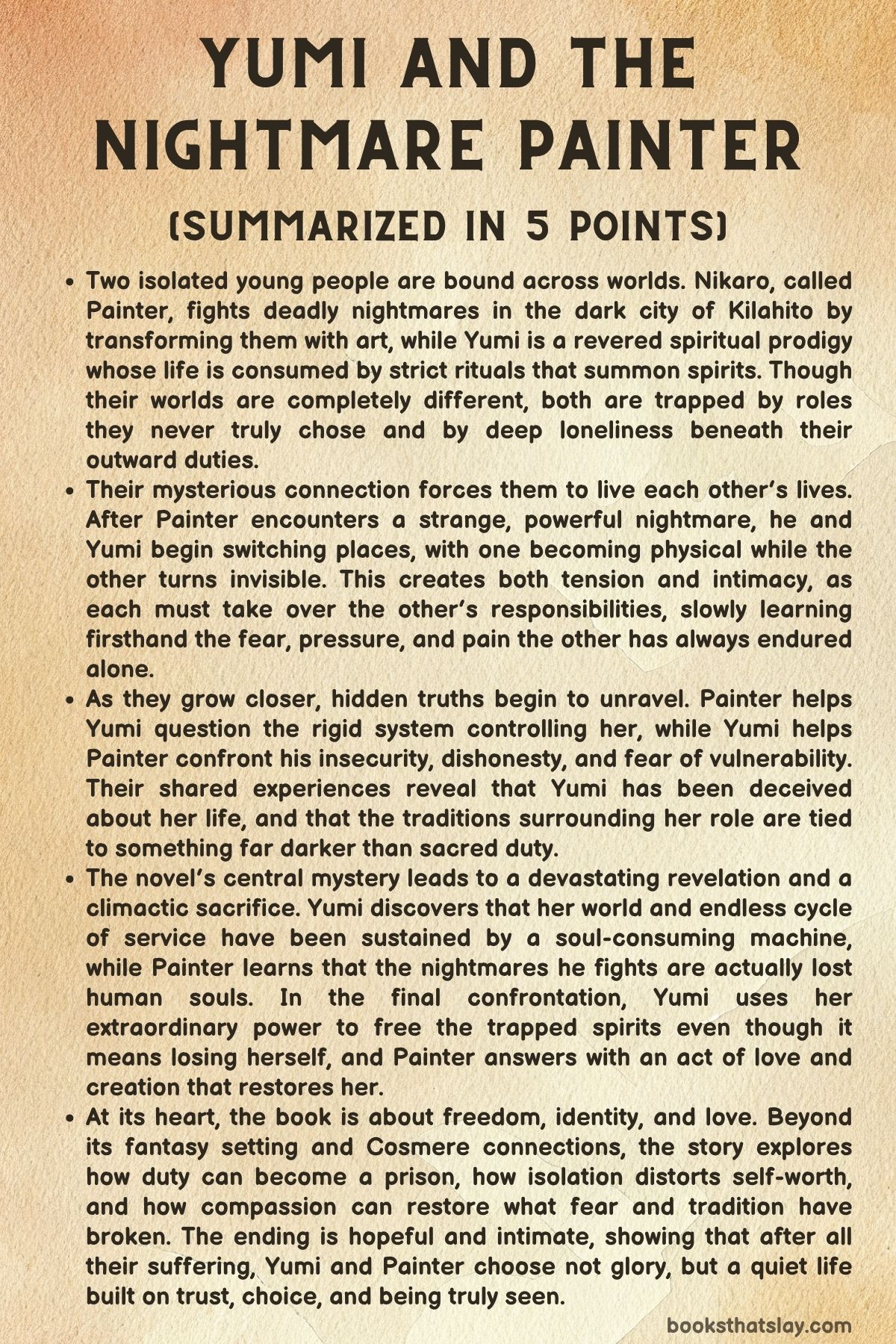
Nikaro, a nineteen-year-old nightmare painter in the city of Kilahito, patrols the rain-drenched streets under glowing lines of teal and magenta hion. His work is to neutralize nightmares that emerge from the black shroud surrounding the city.
With a brush and ink, he paints forms that reshape these horrors into harmless objects. Though skilled, he isolates himself, constantly doubting his worth and painting only simple bamboo, much to his foreman’s frustration.
Lonely and insecure, he struggles to find belonging even among peers like Akane and Tojin, who treat him kindly but remain distant.
In another world, Yumi, a yoki-hijo chosen at birth, lives in a rigid cycle of rituals and duty. Her life is controlled by attendants and her strict warden, Liyun.
She spends her days stacking rocks into delicate formations that summon glowing spirits, who then provide blessings to the villagers. She sustains entire communities but at the cost of her health and freedom.
Though revered, she feels imprisoned by duty and longs to experience ordinary joys like attending a festival. One day, she pushes herself beyond her limits, summoning an unprecedented number of spirits, leaving her exhausted and faint.
Their worlds collide when Painter confronts a stable nightmare—something far more dangerous than usual—that attacks a child. Though he temporarily binds it, he is struck unconscious by a strange force.
He awakens in Yumi’s world, mistaken for her by her attendants. Yumi, invisible to others, believes he is a spirit, while Painter realizes something has tied them together.
They awkwardly navigate this connection, with Painter forced to perform Yumi’s rituals while she guides him. When they return to his world, the roles reverse: Yumi takes his place while he becomes incorporeal.
Both are forced to cooperate, sharing each other’s struggles, fears, and duties.
Their bond deepens through these shared experiences. Painter insists on small freedoms in Yumi’s world, challenging her rigid structure.
Yumi learns that other yoki-hijo live freer lives, information Liyun deliberately withheld. She feels betrayed but also empowered to question her life.
Together, they spy on scholars using a strange machine that manipulates spirit energy. Their daring escape on a floating tree gives them a fleeting sense of freedom, even as danger looms.
In Painter’s city, Yumi sees firsthand the horrors of nightmares and realizes the weight of his duty. When they confront a massive nightmare feeding on an old woman’s dreams, Yumi freezes in terror, but her scream startles the creature into fleeing.
Painter remains calm, teaching her that courage is not the absence of fear but acting despite it. Meanwhile, his reputation suffers when Yumi unintentionally reveals his insecurities to Akane, forcing him to admit the truth about his exaggerated heroism.
Their relationship is strained, but they continue forward together.
The truth of their connection is revealed when they confront Liyun’s nightmare form. Yumi learns she has been trapped for centuries, her life a repeating cycle sustained by a massive machine in Torio City.
The shroud, nightmares, and her endless duties are the result of this machine feeding on souls and imprisoning yoki-hijo. The Dreamwatch, the supposed protectors of Kilahito, dismiss Painter’s warnings about the coming nightmare invasion, leaving him devastated.
But his estranged friends rally around him when he confesses his mistakes and shares the truth. For the first time, he is no longer alone.
Yumi discovers her entire town is artificial, maintained by the machine, and that Liyun herself is a twisted remnant of a soul enslaved by it. Realizing her imprisonment, she breaks free into the shroud, witnessing the prisons of other trapped yoki-hijo.
Painter, meanwhile, gathers dozens of painters to face the nightmare horde threatening the city. In the brutal battle that follows, he discovers that nightmares are actually the lost souls of people.
By painting them as they once were, he restores them to humanity, including Liyun, proving his revelation.
Yumi, in Torio City, confronts the great machine. Knowing it cannot be destroyed by force, she uses her unmatched artistry to draw spirits away from it.
Her creation surpasses anything she has ever done, and one by one the spirits abandon the machine, leaving it powerless. She understands that destroying it will also unravel her existence, yet she continues, sacrificing herself to free thousands of souls.
Painter, devastated, responds by painting her true form. His love and intent pull her back from dissolution, giving her the right to live again.
With the machine destroyed, the shroud vanishes, and sunlight returns. The nightmares cease, the cities begin to heal, and the people are freed.
Yumi and Painter, no longer bound by duty alone, choose to remain together. They keep their extraordinary experiences a secret, embracing a quiet life where love and companionship mean more than honor or reputation.
Their journey ends not with grand displays of power, but with the simple joy of being together, proving that creation, compassion, and trust can reshape even the darkest realities.
Characters
Painter (Nikaro)
Painter, whose true name is Nikaro, is a nineteen-year-old nightmare painter in Yumi and the Nightmare Painter. He lives in Kilahito, a city veiled in eternal darkness and haunted by nightmares that emerge from the black shroud.
Painter’s duty is to capture these nightmares using his brush and ink, transforming them into harmless shapes. Despite his skill, he is plagued by self-doubt and loneliness, clinging to a solitary lifestyle even as he longs for genuine companionship.
His repeated reliance on painting bamboo demonstrates both his comfort in familiar patterns and his resistance to growth, making him a figure of untapped potential. Painter’s inner struggles often mirror the oppressive shadows of his city—he is haunted by feelings of insignificance and guilt over his failures, particularly the lies he has told to maintain appearances.
Over time, his journey transforms him from a withdrawn young man into someone who embraces vulnerability, connection, and ultimately, heroism. His ability to see the humanity within nightmares and restore their true forms marks his growth not only as a painter but as a compassionate leader.
Yumi
Yumi, the yoki-hijo of Torio, lives a life defined by ritual and reverence. From birth, she has been set apart as a miracle worker chosen to summon and command spirits through her intricate stone-stacking ceremonies.
Though admired by her people and burdened with extraordinary responsibilities, she feels suffocated by the unyielding routines enforced by her warden, Liyun. Yumi yearns for freedom, to laugh and live as an ordinary girl, yet she accepts her role with grace even as it drains her physically and emotionally.
Her devotion to perfection has left her both admired and tragically isolated, as every element of her existence is controlled and ceremonial. Over centuries—unbeknownst to her until later—she has been trapped in a cycle of repeating days, which has sharpened her artistry to an unparalleled level.
Yumi’s character embodies the tension between duty and desire, and her eventual embrace of choice, love, and independence makes her transformation profound. Her willingness to sacrifice herself for others, even at the cost of her own existence, highlights her innate selflessness, while her decision to live and love with Painter showcases her newfound autonomy.
Liyun
Liyun, Yumi’s warden, represents both the harsh voice of tradition and the twisted remnants of a lost soul. In her living role, she enforces the strict rituals that govern Yumi’s every moment, shaping her into an obedient servant of duty.
Cold, exacting, and unyielding, she embodies the oppressive weight of expectation. Yet beneath this façade lies tragedy: she is revealed to be a nightmare herself, bound by the ancient machine that consumed Torio’s people.
Her nightly existence as a nightmare highlights her suffering and corruption, but also her lingering sense of loyalty to the ideals she once served. Liyun’s character is layered—simultaneously antagonist and victim, oppressor and prisoner.
Through her, the novel critiques blind adherence to tradition while also evoking sympathy for those who become trapped by it. Her redemption, restored to her human form by Painter, underscores the theme of compassion and recognition of shared humanity.
Design
Design, a Cryptic spren disguised as the owner of The Noodle Pupil, adds both levity and wisdom to the narrative. With her playful demeanor and sly intelligence, she serves as a grounding presence in Painter’s life, offering him both food and a space for reflection.
Though seemingly secondary, she plays a vital role in nudging Painter toward self-awareness, highlighting his insecurities and potential with wry observations. Design represents the importance of companionship and mentorship, even in subtle forms, and her presence bridges the extraordinary with the mundane.
She provides comic relief, but her function is deeper—reminding both Painter and the reader that self-worth is not found in isolation but in connection with others.
Akane, Tojin, Masaka, and Izzy
Painter’s fellow nightmare painters—Akane, Tojin, Masaka, and Izzy—embody the camaraderie and social life that he longs for yet resists. At first, they appear as reminders of his alienation, gathering together while Painter isolates himself.
However, as the story progresses, they come to represent redemption and the power of trust. When Painter admits his failures and seeks their help against the nightmare invasion, they choose to believe in him despite his past mistakes.
Their willingness to stand by him demonstrates that friendship can be repaired through honesty and humility. They may not receive the same depth of focus as Painter and Yumi, but they are essential in showing the shift from isolation to community that defines Painter’s arc.
Themes
Duty and Burden of Responsibility
The narrative of Yumi and the Nightmare Painter consistently highlights the suffocating weight of responsibility placed upon both Yumi and Painter. Their roles, though vastly different in practice, share a common foundation in self-sacrifice for the sake of others.
Yumi is stripped of her individuality from childhood, transformed into a living ritual whose identity revolves entirely around her function as a yoki-hijo. Her life is consumed by ceremonies and obligations that leave her physically exhausted and emotionally stunted, while any personal longing is dismissed as selfishness.
Painter, on the other hand, shoulders a responsibility that lacks recognition. He patrols dangerous streets and prevents nightmares from overwhelming his city, yet he remains dismissed by his peers, berated by his superior, and caught in a cycle of self-doubt.
In both cases, duty becomes not just a calling but a cage. The narrative explores how obligation—whether celebrated or ignored—can strip away human fulfillment when it is not balanced with compassion, understanding, and personal agency.
The story reveals that the nobility of duty is only meaningful when it allows space for growth and choice, otherwise it corrodes into suffocating weight that isolates rather than connects.
Loneliness and Isolation
At its heart, the book captures the quiet anguish of loneliness. Yumi is idolized, revered, and yet utterly alone.
She lives surrounded by attendants, but none of them see her as a person—they see only the ceremonial figure she represents. The same ritual that gives her status also ensures that she is fundamentally cut off from friendship and intimacy.
Painter, conversely, exists in the middle of a bustling city, with colleagues and acquaintances nearby, yet he isolates himself out of insecurity and shame. He desires to belong but fears rejection, which leads him to retreat further into solitude.
Their forced connection exposes how deeply both characters crave companionship and how painful the absence of understanding can be. The novel insists that loneliness is not solved simply by proximity to others—it requires being truly seen and accepted.
By gradually offering each other authenticity and trust, Yumi and Painter begin to break the silence of their isolation, showing that even the heaviest loneliness can be undone through genuine human connection.
Identity and Self-Worth
A central thread in Yumi and the Nightmare Painter is the search for identity beyond imposed roles. Yumi’s selfhood is buried beneath layers of ritual and obedience, leaving her unsure of her own desires.
She struggles to understand who she is apart from the pedestal on which she has been placed. Painter similarly wrestles with self-perception, believing himself inadequate both as a nightmare painter and as a person.
His fixation on bamboo paintings symbolizes his fear of risk and originality, trapping him in stagnation. Both characters are defined externally—Yumi by her warden and her people, Painter by his peers and the expectations of the Dreamwatch—yet both find those definitions hollow.
Their relationship forces them to confront these insecurities and begin shaping their own sense of self. By the end, their growth is evident: Yumi learns she is more than a tool for spirits, and Painter discovers his art holds meaning not only in its technical execution but in the intention and truth it conveys.
The book argues that self-worth must come from within, not from rigid structures or the fleeting approval of others.
Tradition Versus Change
The clash between rigid tradition and the possibility of reform plays a pivotal role in the story. Yumi’s world is dominated by ritual, with every movement and word dictated by ceremonial obligation.
The revelation that most other yoki-hijo live with greater freedoms—visiting families, setting their own pace, even retiring—shatters her carefully upheld worldview. Liyun’s withholding of this truth exposes how tradition can be twisted into a tool of control, used to justify suffering in the name of sacred duty.
Painter’s situation parallels this, as he labors under the rigid hierarchy of the painters and the dismissive elite of the Dreamwatch, who cling to established authority while ignoring the urgent threats at their doorstep. Both characters find themselves trapped within systems that resist change, even when those systems clearly fail.
Their journey reveals the danger of blind adherence to tradition and underscores the need for reform that respects both heritage and humanity. By choosing to challenge what is presented as immutable, they open paths toward freedom and genuine progress.
Sacrifice and Redemption
Sacrifice becomes the crucible through which Yumi and Painter transform. Yumi sacrifices her freedom daily, yet her ultimate act of self-destruction—choosing to dismantle the machine despite knowing it will erase her—demonstrates her willingness to give everything for the liberation of others.
Painter, who begins the story riddled with doubt and self-centered fear, grows into someone capable of sacrificial love, risking himself to confront nightmares and finally painting not to prove his worth but to restore the lost humanity of those consumed by the shroud. Their sacrifices are not one-sided acts of martyrdom but reciprocal gestures that reshape them both.
Redemption emerges as the reward: Painter redeems his failures and insecurities by embracing courage and truth, while Yumi’s centuries of imprisonment culminate in an act that frees her people and ultimately grants her a restored life. The novel suggests that sacrifice, when born from love rather than coercion, has the power to redeem and to create new beginnings where despair once reigned.
Love and Human Connection
While much of the novel unfolds within a backdrop of ritual, nightmares, and looming catastrophe, its emotional core rests in the relationship between Yumi and Painter. Their connection begins with misunderstanding and conflict, yet over time it becomes a source of healing for both.
Through shared vulnerability, they begin to restore one another’s fractured identities. Yumi softens Painter’s self-loathing with empathy, while he reveals to her a life beyond rigid ritual.
Their growing intimacy is not portrayed as a sudden, sweeping force but as a slow, stumbling progression marked by mistakes, forgiveness, and trust. By the climax, their bond becomes the force that challenges despair and reshapes reality itself.
Painter’s act of painting Yumi back into existence symbolizes love as a creative, life-giving power—one that asserts presence and permanence against annihilation. The novel’s conclusion affirms that love, though imperfect and fragile, endures as the most powerful antidote to despair, binding individuals not through duty or tradition but through mutual choice and affirmation.