See You at the Summit Summary, Characters and Themes
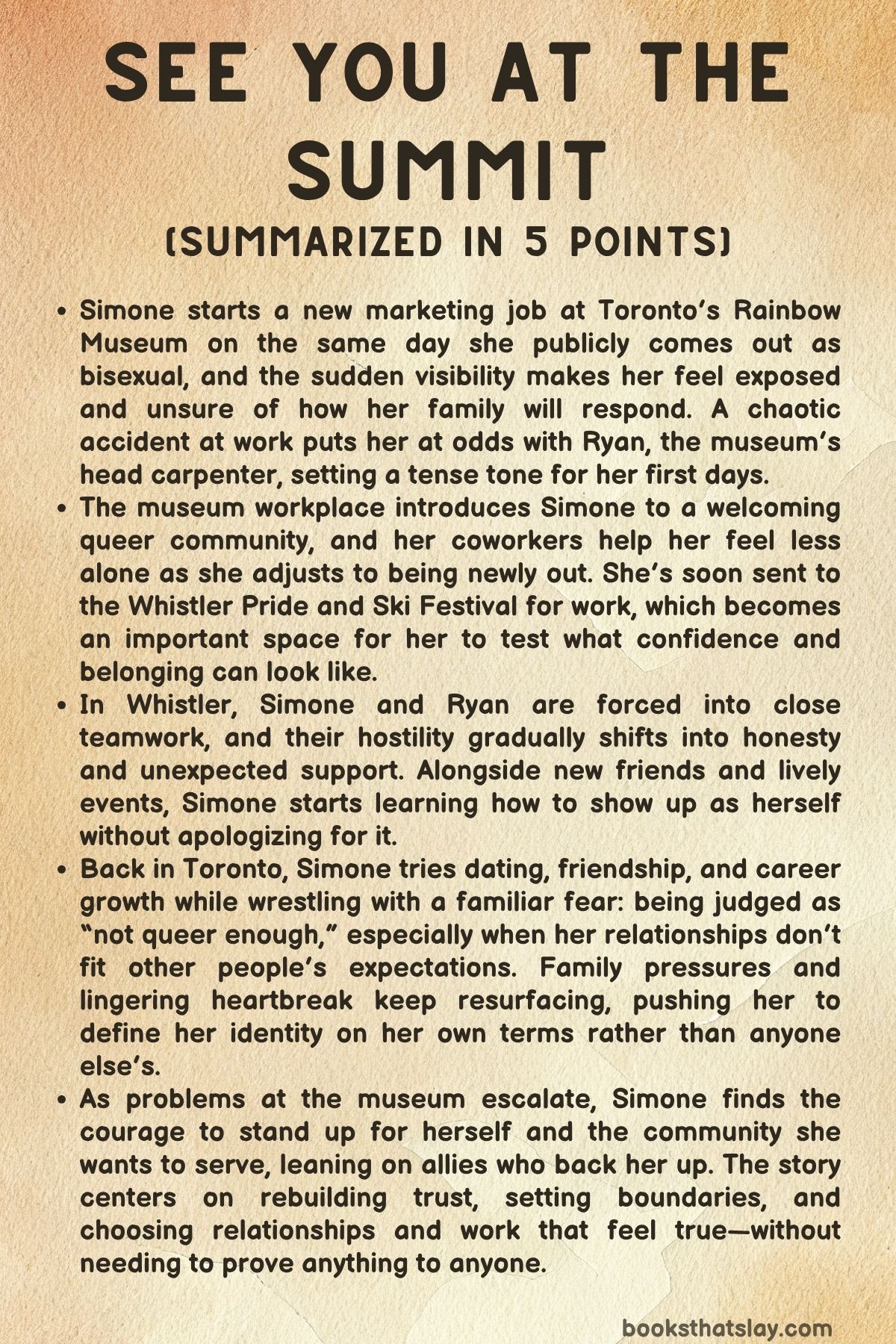
See You at the Summit by Jordyn Taylor is a contemporary romance set in Toronto and Whistler that follows Simone, a careful, anxious marketing professional who comes out as bisexual on Instagram the same day she starts a dream job at the Rainbow Museum, a queer culture attraction preparing to open. Her new workplace offers community and visibility, but also exposes the messy parts of being newly out—family pressure, insecurity, and the fear of not “counting” as queer.
When Simone’s first-day mistake injures the museum’s head carpenter, Ryan Foley, their rocky start turns into a partnership, then something deeper, as Pride events, workplace politics, and old wounds push them to choose honesty, boundaries, and the kind of love that can hold complexity.
Summary
Simone wakes up to a bitterly cold January morning in Toronto and decides to do two things at once: announce her new job at the Rainbow Museum and come out as bisexual. She posts the message on Instagram after rewriting it repeatedly, then immediately regrets it.
Instead of taking the streetcar, she walks through the freezing streets, imagining her image-conscious mother’s reaction. At the museum in the Gay Village, Simone tries to steady herself with an oversized cold brew and the distraction of a first-day check-in.
The museum’s front area is stark and monochrome, but a neon rainbow sign directs visitors into a bright atrium full of playful features meant for photos. Simone waits for her new boss, Frankie Marlow, while her phone lights up with supportive messages from friends.
Then her mother texts: “Call me.” Simone panics and looks for privacy to make the call before her meeting. She slips through a covered archway into a back room and accidentally knocks over large wooden pieces from an installation in progress.
The collapse shatters delicate parts of a giant dragonfly centerpiece, and the head carpenter, Ryan Foley, gets hurt when it falls.
Simone’s attempt to help only makes things worse. She steps on fragile wooden details and breaks more of the work, then spills cold brew all over Ryan’s shirt while trying to get closer.
Ryan reacts with sharp anger and humiliation. He refuses her help and tells her to leave.
His words about her “fancy desk job” sting, and Simone flees, already feeling like she has destroyed her fresh start before it begins.
Frankie arrives and welcomes Simone warmly. When she admits what happened, he stays composed and moves forward, introducing her to the museum’s design and mission.
The tour shows off themed photo rooms, a hallway that highlights queer Canadian history, and conference spaces named for queer icons. Simone meets staff who are openly queer and comfortable—Nina in communications, Seth in social media, and others who treat queerness as normal rather than a secret.
Seth helps her get set up on Slack and pulls her into playful team channels. Despite her panic, Simone feels a surprising sense of ease around them.
Frankie gives Simone a major assignment right away: represent the Rainbow Museum at the Whistler Pride and Ski Festival at the end of January, where the museum will run selfie stations for publicity. Simone is newly out and terrified of being visible, but she says yes because she wants to keep her promise to herself: stop hiding.
Simone’s fear has roots. In high school she assumed she was straight, and in university she explained away her attraction to women as drunken mistakes.
Her mother, Kathy, had always had strong ideas about what Simone should be—polished, impressive, uncomplicated. At Simone’s previous job, she grew close to Bree Park, an openly lesbian engineer.
After layoffs hit their company, Simone and Bree crossed a line and began a relationship that was both physical and emotional. Over time Simone fell hard, but when Bree asked how Simone identified, Simone panicked.
She insisted she was straight and tried to reduce their relationship to “just sex.” Bree was devastated. She admitted she had been planning to ask Simone to be her girlfriend, then ended things.
The breakup cracked Simone open. Eventually, alone in the shower, she finally said the truth out loud: she was bi.
She applied for the Rainbow Museum job and promised she would be out by day one.
On her second day at the museum, Simone runs into Ryan again in a cramped elevator. Her apology goes nowhere.
He stays distant and hostile, treating her like a problem he wants to avoid. Simone throws herself into work anyway.
In a meeting about Whistler, Frankie tears apart Phillip’s simplistic designs for the selfie stations and dismisses them abruptly, setting a tense tone Simone doesn’t yet understand. Simone leans on Lucy LaFrance from finance, who is friendly, blunt, and refreshingly honest.
Lucy challenges Simone’s attempt to interpret her mother’s reaction as “just worry,” pointing out that it still contains discomfort with Simone being queer. Lucy invites Simone out to queer karaoke on Monday night.
At karaoke, Simone is nervous at first, but the crowd’s warmth and Seth’s fearless confidence loosen something in her. She ends up singing along to “Mamma Mia,” laughing through her nerves.
The experience hits her harder than she expects. Surrounded by queer joy and zero judgment, Simone starts to cry, not from sadness but from relief.
In the bathroom she meets Kenzie, a bold goth woman who flirts with her. Later, Simone and Kenzie kiss on the dance floor.
It’s messy and impulsive and exactly what Simone wanted: proof that she can be out in public without disaster.
The next morning Simone is energized enough to challenge Ryan instead of shrinking away from him. At a coffee shop she pays for his drink and needles him about his earlier insult.
When she realizes he ordered the same maple spice latte she likes, she teases him harder, and for a moment his icy attitude cracks. Ryan sends stunning 3D renderings for Whistler’s photo setups—work that’s polished, creative, and far beyond what Simone expected from someone who acts like he hates everyone.
Simone contacts recommended contractors, but none can take the job. Frankie’s solution is blunt: Ryan will go to Whistler with Simone and build the sets himself.
Simone hates the idea of being stuck with him on a Pride trip, but she refuses to let his mood ruin what she sees as her first big step into being openly queer.
Whistler’s airport and village are packed with Pride signage, rainbow flags, and excited travelers. Simone’s mood lifts—until she faces the two-hour drive with Ryan.
He’s curt, but he surprises her by loading both her suitcases without complaint. Simone tries cheerful small talk and gets clipped answers.
She calls her brother Matt to distract herself. Matt explains their mother told the family she cried after Simone’s Instagram post.
Matt offers real support, and he suggests their mother’s control may come from her own regrets about sacrificing her legal career. He tells Simone that he and his wife Megan are in her corner.
Simone hangs up feeling steadier, and she realizes Ryan heard everything without saying a word.
On the drive, Simone accidentally triggers Ryan’s breakup-song playlist through the car audio. Ryan panics, shuts it down, and demands she disconnect his phone.
The reaction tells Simone there’s a raw wound under his anger. She tries to relate by mentioning her own breakup and coming out, but he goes quiet.
When they reach Whistler, they split up so Ryan can set up the first selfie station.
At the welcome party, Simone sees Ryan’s installation: a rainbow staircase framed by balloon clouds. It’s genuinely impressive.
When she compliments him, he reacts with suspicion, as if he expects her to be mocking him. Simone, exhausted from trying to win basic civility, tells him she’ll stop offering praise and leaves to focus on her work and meeting people.
She texts Lucy about a charming Australian ski instructor named Margot who invited her into a guide group for the week. Simone hopes Margot might be a romantic possibility.
The next day Simone skis with Margot’s group and meets Glen, Phoenix, and a couple named Luis and Roberto. Margot is magnetic, but Simone’s hopes drop when Margot introduces her girlfriend, Thea.
Still, Simone enjoys the mountain, the soft snow, and the easy companionship. For the first time she feels like she’s living inside her own life rather than performing it.
At a retro dance party, Simone tries to ignore Ryan, but he approaches and asks to talk. He offers an awkward apology and admits he’s been going through something heavy.
Simone doesn’t let him off the hook; she tells him her panic on day one was tied to her mother’s call, her coming-out fear, and the sense that she might lose everything if her family rejected her. Ryan admits he’s miserable and doesn’t know how to get out of it.
Simone decides they should stop fighting each other and invites him to ski with Margot’s group.
On the mountain Ryan and Simone begin to talk like normal people. Ryan congratulates her on coming out, and Simone explains she wants a “queer holiday” that feels exciting and free.
Ryan admits that upbeat people can make him feel worse, and he lashes out because he’s drowning in his own head. Later, at drag bingo, Glen almost wins a vacation prize but ties with another contestant.
Because Glen’s hip is injured, Ryan volunteers to do the dance-off. Simone is stunned when Ryan turns out to be a great dancer.
He doesn’t win, but the group is delighted, and Ryan’s stiffness loosens in their teasing.
At an après-ski bonfire, Ryan admits he’s starting to believe his life might not stay terrible. He tells Simone he grew up with two moms and has always felt at home in queer spaces.
Simone shares how unfamiliar queerness was in her childhood home, and how that absence shaped her fear. Buzzed and bold, Simone asks Ryan to be her wingman so she can meet women.
He agrees.
At a club Simone tries a clumsy flirtation using a museum tote bag and a marketing pitch. It flops.
Embarrassed, she admits she doesn’t know how to flirt with women. Ryan suggests she practice on him, pretending he’s a cute girl at the bar.
They roleplay, and Ryan demonstrates how to make it feel personal—eye contact, a gentle touch, a slower tone. The exercise turns charged, especially when Ryan tells Simone her eyes are stunning.
They get interrupted by a guest question, and Simone ends the practice, insisting she needs to focus on women. But the tension doesn’t disappear.
That night Simone dreams about Ryan and wakes unsettled. She wanted this trip to be about women, not about wanting the grumpy carpenter who keeps surprising her.
The next day she keeps her distance. While riding the chairlift she drops her phone into the trees below.
The area is dangerous, but Simone is determined to retrieve it. Ryan insists on coming.
The search forces them into a steep, terrifying run. In the trees they locate the phone by triggering a loud alarm and listening for it.
Ryan finds it buried in snow, and Simone rushes toward him and trips. They tumble together into a tree well, laughing breathlessly as they try to disentangle.
Simone’s screen is cracked but the phone still works. Ryan offers to take her wherever she needs to go for repairs, and the closeness between them feels less like an accident and more like momentum.
Back in Toronto, Simone tries to date women and goes to the Rainbow Museum’s launch party with Erica, a woman she’s on a second date with. Simone introduces Erica to her coworkers, but she’s tense and distracted.
When Ryan arrives in semiformal clothes, Simone’s nerves spike. Erica cheerfully labels herself as Simone’s second date, while Simone struggles with what she wants.
Ryan’s reaction is tight and controlled, and he soon excuses himself. Simone panics in the bathroom, and Lucy corners her until Simone admits the truth: she and Ryan hooked up in Whistler, it was the best sex she’s had, and she can’t stop thinking about him.
Simone also confesses her fear that people will use Ryan as proof she’s “basically straight.” Lucy shuts that down and tells Simone her bisexuality is real.
Simone ends things with Erica kindly but honestly, admitting she doesn’t feel the romantic connection she’s looking for. Then she calls Ryan and meets him in the museum’s basement workshop.
Ryan admits seeing her with a date hurt because he can’t stop thinking about her either. Simone tells him she ended things with Erica because she wants to see what a real relationship with Ryan could be.
Ryan warns he can’t handle another intense night that leads nowhere. Simone says she doesn’t want nowhere.
They kiss and decide to go on an actual date.
Ryan takes Simone to his friend Dom’s brewery, the Common Loon. Simone tries Ryan’s favorite IPA and hates it, but she enjoys the warmth of the place, Dom’s teasing affection for Ryan, and the brewery’s orange cat.
They end up at Ryan’s apartment, which doubles as a woodworking shop. He makes peppermint tea, gives her comfortable clothes, and they fall asleep together.
The next morning they wake tangled up and have sex again, then spend a weekend cooking, eating, and staying close until it feels like they’ve built a tiny world.
On March 11 Simone turns thirty. Her parents call and unexpectedly say they’re proud of her.
At the museum her friends celebrate her, and Ryan shows up with pink peonies and dinner plans. He asks her to be his girlfriend.
Simone says yes, and she notices his phone wallpaper is now a wood tone she loves, a quiet sign that he pays attention.
Work, however, starts to sour. Frankie announces a Pride Month plan called a queer makeover extravaganza, with styling, haircuts, tattoos, and portraits.
Simone is excited but uneasy when she hears how the plan is being handled. Outside the museum, Simone and Ryan kiss, and a group of young men in line make snide comments about “straights.” Simone’s shame rises fast and she pulls Ryan away, shaken by how quickly she can still feel judged.
Simone meets Ryan’s moms at the brewery. Paula is warm and booming; Claire is quieter and harder to read.
Simone tries to make a good impression, but she’s unsettled when she learns more about Ryan’s past. Dom reveals that Ryan didn’t just lose a girlfriend—Victoria cheated on him with Travis, Ryan’s best friend.
Ryan later confirms it, describing how both betrayal and humiliation lodged in him. Simone begins to understand why he can turn cold when he senses risk.
As the weeks pass, Simone’s insecurity shifts into obsession with being seen as queer. She spirals into trying to look “bi enough,” worried that dating a man will erase her in other people’s eyes.
At Seth’s house party, she overcorrects by flirting aggressively with Vanessa, Seth’s roommate, and gets shut down hard. Ryan, triggered by the possibility of secrets, demands honesty.
Simone finally admits she’s terrified people will assume she’s straight and that she doesn’t belong anywhere. Ryan reassures her and they reconnect, but the issue doesn’t vanish.
Then Bree texts Simone again, reopening old feelings and old shame. Soon after, Simone and Ryan’s relationship implodes into a brutal argument.
Ryan becomes sarcastic and accusatory, convinced Simone wants a break so she can return to Bree. Simone tells him he doesn’t understand what it’s like to be bi and doubted from all sides.
Ryan snaps back about loyalty, and when Simone doesn’t immediately soothe him, he declares no one loves him and storms out. Simone is left sobbing, and Bree’s cheerful update about committing to long distance with her girlfriend only makes Simone feel smaller.
Simone drags herself back to work, where she finds another kind of betrayal. Lucy is furious because Frankie refuses to approve overtime for hourly staff needed for the upcoming museum event.
In a meeting, Simone finally raises a thoughtful concern: the word “queer” can still feel like a slur to some older community members, and the event name might need reconsideration. Frankie shuts her down sharply.
Afterward, Simone notices Frankie left his Slack connected to the conference room monitor. Messages pop up between Frankie and Seth, mocking Simone’s bisexuality and calling her “basically straight.” Simone takes a photo, turns off the monitor, and flees in tears, convinced she’s been judged as an impostor by people she trusted.
Simone works from home for days, claiming illness. When she finally goes out, she runs into Glen from Whistler.
Glen tells her about his nonprofit, Loving Minds, which is struggling after a sponsor acquisition. Simone offers to explore museum support, and during tea she breaks down about Ryan and about feeling erased as a bisexual woman.
Glen shares his own history of loving a man who died during the AIDS crisis, later marrying a woman, and living with the way people question bisexuality. He tells Simone she is queer regardless of who she dates and invites her to a bi/pan support group.
Simone FaceTimes Lucy, admits she wasn’t sick, and shows her the photo of Frankie’s messages. Lucy is furious and protective.
Simone confronts Seth privately. Seth apologizes, admits Frankie talks badly about everyone, and says he struggles to push back.
Simone accepts the apology but doesn’t excuse the harm. Soon Simone, Lucy, and Seth compare notes and realize Frankie keeps blaming finance and the board to avoid spending.
Seth reveals more damning evidence: Frankie is secretly investing in a problematic hookup app called Crushr and promising Seth a raise for silence. The three decide they need to get out, and Simone proposes something better than complaint: organize their own Pride fundraiser to support Loving Minds.
They spend weeks planning a charity karaoke night to kick off Pride Month. The day before the event, the venue has a major water main break and becomes unusable.
Panic hits. Simone scrambles for alternatives and keeps running into dead ends until Dom offers the Common Loon as an emergency space.
Simone realizes Ryan likely helped behind the scenes.
The next morning Frankie attacks Simone over messages, accusing her of prioritizing the fundraiser over museum work. Simone is done.
She quits on the spot, naming his biphobia and hypocrisy without apologizing for existing. She tells Seth and Lucy she’s leaving and will see them at the brewery.
That night the fundraiser comes together with desserts, prizes, karaoke, and a big crowd. Simone’s family shows up in support.
She gives an opening speech about Loving Minds and about being a bisexual woman who has felt doubted and erased. In the middle of it, Ryan walks in.
After Glen speaks, Simone and Ryan step outside. Ryan apologizes for how he treated her and tells her he started therapy for betrayal trauma.
He says he wants another chance only if he can be a better partner. Simone shares that she joined a support group and is learning too.
They admit they still love each other and kiss, then go back inside holding hands. Dom confirms Ryan was the one who helped save the event by alerting him.
Simone and Ryan return to his apartment and reconnect with more honesty than before. In the months that follow, the fundraiser’s success opens a new path for Simone: she ends up working at Loving Minds.
Seth later sends evidence to the Rainbow Museum board, and Frankie is removed as CEO. Simone grows closer to Ryan’s moms and works on boundaries with her own parents.
In the epilogue, a year later, Simone is back in Whistler with Ryan and friends for a wedding. On the chairlift and at the summit, she feels steadier in who she is—bisexual, loved, and no longer willing to shrink for anyone’s comfort.
Characters
Simone
Simone is the story’s emotional engine: a competent, high-achieving marketing professional whose public confidence masks years of private avoidance. Her Instagram post—announcing both a new job and her bisexuality—shows how carefully she tries to control perception, even while craving authenticity.
Much of her arc is about untangling identity from performance: she has learned to survive by being “the right kind” of daughter, employee, and partner, and that habit makes her treat queerness as something to manage rather than inhabit. Her early mistakes at the museum—the dragonfly disaster, the panicked lying-by-omission, the compulsive self-monitoring—aren’t just clumsiness; they’re the consequences of a life spent anticipating judgment.
Simone’s fear of not being “queer enough” becomes a central wound, intensified when she falls for a man and worries her bisexuality will be erased by other people’s assumptions. What makes her compelling is that she does not simply “come out” and become healed; she has to rebuild self-trust, learn boundaries, and stop outsourcing her identity to other people’s approval.
By the end, Simone’s growth looks like steadier self-definition: she chooses values—community care, honesty, mutual repair—over image management, and she becomes someone who can hold complexity without apologizing for it.
Ryan Foley
Ryan begins as an antagonist in the most human way: he’s in pain, and pain makes him sharp. As the head carpenter, he’s a builder—literal and emotional—and See You at the Summit uses that vocation to highlight his core traits: precision, pride in craft, and a protective instinct over what he creates.
His hostility toward Simone after the workshop accident reads as righteous anger, but it’s also misdirected grief; he’s already carrying betrayal trauma from losing both a partner and a best friend, so new disruptions feel like proof that people will wreck what matters to him and walk away. Ryan’s guardedness is not just brooding romance scaffolding; it’s a coping strategy that has calcified into defensiveness.
When he finally speaks plainly—about misery, about how upbeat people can feel like an accusation, about loyalty—he becomes a character whose rough edges are inseparable from his earnestness. Importantly, Ryan is comfortable in queer spaces because of his family, which contrasts with Simone’s late entry; that difference creates friction but also gives him a stabilizing perspective.
His best quality is not that he becomes “nicer,” but that he takes accountability: therapy, honest conversations, and a willingness to rebuild trust rather than demand reassurance. Ryan’s love story is therefore not just chemistry; it’s a slow demonstration that he can be a safe partner when he chooses repair over suspicion.
Frankie Marlow
Frankie is a charismatic figure who initially looks like an ideal queer-space leader: welcoming, stylishly confident, and fluent in the language of inclusion. That surface competence makes his later behavior more unsettling, because his harm isn’t clumsy ignorance—it’s calculated workplace power.
He uses aesthetic progressivism as cover for control, dismissing concerns when they threaten his authority and redirecting blame onto contractors, finance, or the board. Frankie’s biphobia is especially damaging because it’s paired with proximity: he oversees a museum built around queer pride while privately reducing bisexuality to a joke and treating Simone as an impostor.
He also demonstrates a particular kind of modern opportunism by investing in a problematic hookup app while posturing as community-minded leadership. Frankie functions as the story’s institutional antagonist, showing how queer spaces can still reproduce gatekeeping and exploitation when leadership values optics over people.
His removal later isn’t just plot justice; it reinforces the idea that “belonging” must be practiced ethically, not merely branded.
Kathy
Kathy is a portrait of parental love tangled with control. She frames her reaction to Simone’s bisexuality as fear for her child’s safety, which contains a grain of truth while also serving as a socially acceptable mask for discomfort.
Kathy’s most consistent priority is how things “look,” and she treats Simone’s identity as a public-facing asset or liability. The “Proud Mom” performance at family brunch captures her contradiction: she can embrace visible symbols of support while still policing the version of queerness she finds easiest to understand or show off.
Her competitiveness with neighbors and her fixation on having a “visibly queer” child expose that her pride can be self-serving, rooted in status rather than empathy. Kathy is not written as irredeemable, but as someone whose unresolved resentment—career sacrifice, personal compromises, unmet expectations—spills into motherhood as micromanagement.
Simone’s boundary work with Kathy is therefore not just about sexuality; it’s about refusing to be curated.
George
George is the quieter counterweight to Kathy’s intensity. He reads as fundamentally pragmatic and relationally grounded: he cares more about Simone’s wellbeing than about category labels, and he is willing to name what Kathy won’t admit.
His explanation of Kathy’s sudden Pride obsession gives Simone a key insight—her mother’s behavior is less about Simone and more about competition and image—allowing Simone to reframe shame as manipulation rather than truth. George’s support is not dramatic, but it’s stabilizing: he models a kind of parental acceptance that doesn’t require spectacle.
In a story where public performance often distorts intimacy, George represents the possibility of love that is simple, not strategic.
Matt
Matt’s role is small but emotionally pivotal because he expands Simone’s sense of being held by family. His call during the Whistler drive shows he can move past the sibling distance and show up with tenderness when it matters.
Matt offers Simone a psychological lens on Kathy—resentment and sacrifice—without weaponizing it, which helps Simone feel less alone in her lifelong experience of being molded. He also normalizes Simone’s future by talking about bringing his kids to the museum, quietly affirming that her bisexuality is not a rupture in family continuity.
Matt is a bridge character: he links Simone’s old world with her new one, making “coming out” feel less like exile.
Megan
Megan appears briefly, but her inclusion matters as an extension of Matt’s support system. She represents the family unit that could have been judgmental but isn’t; by standing with Matt, she helps shift Simone’s expectations of what relatives will do when confronted with queerness.
Megan’s presence in Matt’s reassurance functions like a vote of confidence from the wider family, not just from one sibling.
Bree Park
Bree is Simone’s first major mirror: someone openly lesbian and emotionally clear about what she wants, which forces Simone to confront the cost of denial. Bree’s heartbreak is not simply a romantic obstacle; it’s the narrative consequence of Simone using “straight” as armor and treating intimacy as something she can compartmentalize.
Bree’s decision to end things after Simone insists the relationship is “just sex” establishes an ethical baseline: queerness isn’t only about desire, it’s also about honesty and respect. Later, Bree’s text from a happier place underscores that Simone’s growth is not dependent on Bree returning; Bree becomes proof that people can heal and move on, even if Simone is still learning.
Bree’s presence sharpens the central tension—identity as truth versus identity as performance—because Bree refuses to participate in Simone’s self-erasure.
Lucy LaFrance
Lucy is the story’s most consistent source of grounded affirmation. She normalizes queer life through everyday details—wife, cats, casual openness—offering Simone a model of belonging that doesn’t require perfection.
Lucy’s support is not sentimental; it’s clear-eyed, sometimes blunt, and therefore trustworthy. She challenges Kathy’s “concern” narrative, reassures Simone that bisexuality is real even when others doubt it, and becomes an anchor when Simone spirals.
Lucy also shows integrity in workplace conflict: she’s furious about overtime refusals, refuses to accept scapegoating, and ultimately joins Simone and Seth in choosing ethics over proximity to power. Lucy represents chosen family at its best: celebratory, protective, and unwilling to let Simone shrink herself to be accepted.
Seth
Seth embodies queer community energy—playful Slack channels, karaoke bravado, social glue—and he initially makes the Rainbow Museum feel safe for Simone. That’s why his later complicity with Frankie lands as a betrayal: Seth’s warmth coexists with conflict avoidance and a desire to stay liked by authority.
His apology matters because it isn’t framed as instant redemption; he admits he struggles to push back, revealing the everyday mechanisms that allow workplace harm to persist even in progressive spaces. Seth’s evolution is subtle but meaningful: he chooses to cooperate with Lucy and Simone, shares evidence, and later helps bring accountability to the board.
He becomes a character study in how good intentions are not enough, and how allyship inside a community still requires courage.
Nina
Nina functions as a competent, openly queer colleague who contributes to the museum’s atmosphere of representation. She’s part of the ensemble that initially reassures Simone that she’s entered a workplace where queerness is normal rather than exceptional.
Nina’s role in meetings and marketing discussions shows professionalism inside queer community work, countering the idea that Pride spaces are only social. Even without extensive personal backstory, Nina strengthens the setting’s credibility and underscores that Simone is not alone in navigating identity at work.
Phillip
Phillip is a minor but telling workplace figure: he’s caught in Frankie’s blunt dismissiveness and becomes evidence of Frankie’s leadership style—public critique, abrupt shutdowns, and performance-based management. Phillip’s presence highlights that Frankie’s cruelty isn’t reserved for Simone; Frankie uses humiliation as a tool, which helps explain why others, like Seth, rationalize staying quiet.
Phillip’s function is less about his inner life and more about how organizations normalize disrespect until someone refuses it.
Kenzie
Kenzie is a burst of chaotic confidence at a moment when Simone desperately needs proof that public queer joy is possible. Their dance-floor makeout isn’t framed as soulmate romance; it’s initiation, an embodied experience of being out without catastrophe.
Kenzie’s goth-loud energy contrasts with Simone’s carefulness and allows Simone to borrow bravery for a night. As a character, Kenzie symbolizes low-stakes queer possibility—fun, desire, visibility—helping Simone replace fear with lived memory.
Margot
Margot is a warm, flirtatious guide into Whistler’s Pride environment. She compliments Simone, invites her into a group, and models an easy social confidence that Simone wants to grow into.
The reveal that Margot has a girlfriend punctures Simone’s romantic hope, but it also reframes Margot as something else: a friendly doorway into community rather than a conquest. Margot’s insistence on safety when Simone wants to ski a dangerous run shows responsible leadership; she’s fun, but she’s not reckless.
She ultimately represents the kind of queer companionship that isn’t romantic yet still nourishing.
Thea
Thea’s brief appearance matters primarily as reality check and texture. By being Margot’s girlfriend, she quietly dismantles Simone’s assumption that attention automatically means availability.
Thea adds to the sense that queer community is full of real relationships, not just flirtation, and her presence keeps Whistler from feeling like a fantasy playground designed only for Simone’s self-discovery.
Glen
Glen is one of the most important supporting characters because he gives Simone a lineage. He’s kind, social, and community-oriented, but his deeper purpose is testimonial: he has lived through eras of queer history that carry both trauma and resilience.
His story—loving a man lost in the AIDS crisis, later marrying a woman, experiencing bi erasure and grief—validates Simone’s experience with authority, not just reassurance. Glen offers something Simone cannot give herself yet: permission to be complex without losing legitimacy.
By inviting her to a bi/pan support group and partnering through Loving Minds, Glen turns affirmation into structure. He helps Simone convert personal pain into community action, which is one of the clearest pathways from insecurity to belonging.
Loving Minds
Although not a person, Loving Minds operates like a character-shaped force in Simone’s life: it gives her a mission that aligns with her values and provides a counterpoint to the museum’s performative inclusion. Through Loving Minds, See You at the Summit argues that queer care is not only identity affirmation but also material support—funding, events, connection, continuity.
Loving Minds becomes the place where Simone’s queerness and competence meet without contradiction, and that integration is part of her healing.
Phoenix
Phoenix adds vibrancy and regional diversity to the Whistler group, reinforcing the festival’s feeling as a gathering of different queer lives. As a friendly peer, Phoenix contributes to Simone’s expanding sense of community—people she can laugh with, ski with, and exist around without explanation.
Phoenix’s main narrative function is to make Pride feel populated and real, not a two-person stage for the romance plot.
Luis and Roberto
Luis and Roberto provide warmth and international texture, showing queerness as global and communal rather than limited to Simone’s Toronto bubble. As a couple, they also represent a visible, settled form of queer partnership that Simone can witness up close—helpful for someone whose earlier life lacked queer examples.
Their presence subtly counters Simone’s fear that queer life is only struggle; it can also be ordinary companionship.
Hank
Hank appears as Ryan’s drag-bingo dance-off “opponent,” but his real function is to facilitate a turning point in group perception. Because the crowd chooses Hank, Ryan’s performance becomes an act of courage that doesn’t need external victory to matter.
Hank helps create the moment where Ryan is seen differently—by Simone and by the group—as someone capable of joy and showmanship, not just cynicism.
Dom
Dom is a steady figure of chosen-family infrastructure. As Ryan’s friend and brewery owner, he provides a social home base that feels warm, lived-in, and safe—complete with the resident cat.
Dom’s teasing familiarity with Ryan hints at Ryan’s capacity for closeness outside romance, which matters because it shows Ryan is not emotionally isolated by nature; he’s wounded, not empty. Dom’s role in saving the fundraiser venue also makes him a quiet agent of repair, using resources and relationships to support community action without demanding credit.
Loonie
Loonie, the brewery’s orange cat, is a small detail that functions emotionally like a soft landing. The cat’s presence makes Dom’s space feel domestic and calming, and it helps underline the story’s shift from high-alert anxiety to moments of uncomplicated comfort.
Loonie is part of how Simone experiences Ryan’s world as gentle rather than intimidating.
Paula
Paula, one of Ryan’s moms, is warm and boisterous, offering Simone an immediate sense of welcome that contrasts sharply with Simone’s careful navigation of Kathy. Paula represents a kind of parental queerness that is casual, protective, and unashamed, which gives Simone an alternative model of “family” that doesn’t revolve around appearances.
Her energy helps normalize Ryan’s background and underscores why queer spaces are natural to him.
Claire
Claire, Ryan’s other mom, is more reserved, and Simone reads that reserve as judgment—revealing Simone’s sensitivity rather than proving Claire is unkind. Claire’s quieter presence provides realism: not all acceptance looks exuberant, and Simone has to learn not to interpret every neutral expression as condemnation.
Claire functions as a mirror for Simone’s hypervigilance, pushing Simone toward a more grounded reading of other people’s reactions.
Victoria
Victoria is a largely offstage character whose impact is enormous because she is the origin point of Ryan’s betrayal trauma. Her cheating is not framed as moral spectacle so much as a rupture that reprograms Ryan’s sense of safety.
Through Victoria, the story explores how betrayal can become an interpretive filter: Ryan starts scanning for proof that intimacy equals humiliation. Victoria’s role is therefore thematic—she explains why Ryan fears being the last to know, why secrecy triggers panic, and why he needs therapy to stop reliving that wound in new relationships.
Travis
Travis, Ryan’s former best friend, intensifies the betrayal by adding friendship loss to romantic loss. His involvement is why Ryan’s injury isn’t just heartbreak; it’s also social destabilization.
Being betrayed by a friend creates a particular paranoia: if even your inner circle can turn, then trust feels naïve. Travis’s offstage presence explains Ryan’s sensitivity to perceived triangulation—especially when Bree reappears—and why Ryan’s conflict style escalates toward accusations.
Erica
Erica is a kind, emotionally mature figure who inadvertently becomes a test of Simone’s honesty. As Simone’s second-date companion, Erica represents the path Simone thought she wanted: focusing on dating women and building a queer narrative that feels externally legible.
Erica’s ease with Simone’s coworkers and her graceful response to being let down reveal her as secure and generous, not a disposable “wrong choice.” Her presence forces Simone to confront a hard truth: Simone’s desire for women is real, but so is her love for Ryan, and choosing Ryan does not invalidate her queerness. Erica’s calm exit also highlights Simone’s growth—Simone ends things directly rather than ghosting or hiding behind confusion.
Holly
Holly appears briefly as someone Erica connects with, and that small detail keeps Erica from being framed as merely Simone’s collateral damage. By giving Erica an immediate new social connection, the story emphasizes that queer community is expansive, and endings do not have to be catastrophic to be valid.
Vanessa
Vanessa is a sharp, necessary boundary. When Simone, in a spiral of performative bisexuality, flirts too intensely, Vanessa names the dynamic and refuses it.
Her bluntness is a wake-up call: Simone’s insecurity has started turning other people into props for her identity signaling. Vanessa therefore functions as ethical feedback from the community—an insistence that bisexuality doesn’t require proof, but it also doesn’t excuse treating people as evidence.
Barista Joe
Joe is a small but telling presence during Simone’s lowest point. His hint at something stronger reads as a moment of temptation toward numbing, and Simone’s awkward decline shows her fragility and restraint.
Joe helps sketch the atmosphere of Simone’s collapse: when you’re raw, even ordinary interactions can feel like edges you might fall off. He’s less a character with an arc and more a snapshot of how vulnerability makes the world feel charged.
Jason
Jason is mentioned as part of the family pushback against Kathy’s bisexuality erasure during brunch. His function is to widen Simone’s circle of support and to show that Kathy’s narrative isn’t universally accepted within the family.
Even a brief supportive voice matters in a story where Simone has long expected family to side with the “image” story.
Jeff
Jeff appears in Glen’s history and represents a generation marked by loss during the AIDS crisis. Jeff’s presence is important not for plot, but for perspective: he grounds the story’s contemporary questions about identity labels and belonging in a deeper history of survival and grief.
Through Jeff, the narrative quietly reminds the reader that queer community support structures exist because people had to build them.
Rose
Rose, Glen’s later wife, complicates simplistic narratives about sexuality by embodying a life that included different kinds of love without canceling earlier truths. Her inclusion reinforces the central argument that bisexuality and fluid experience are not contradictions, and loving across genders can be authentic rather than confused.
Rose’s death also reinforces Glen’s authority when he tells Simone that love and loss do not invalidate identity.
The Murrays
The Murrays are peripheral but symbolically significant because they reveal Kathy’s social motivation. Their queer son and his husband become a mirror Kathy can’t stop looking into, turning Simone’s sexuality into competitive display.
As a narrative device, the Murrays show how “allyship” can become status-seeking, and how community acceptance can be distorted by the desire to be seen as the best, most progressive parent on the block.
Themes
Owning identity when other people want to define it for you
Simone’s decision to come out publicly and immediately regret it captures how identity can feel less like an internal truth and more like a high-stakes announcement that others will grade. Her mother’s reaction makes that pressure sharper: Kathy frames her discomfort as “concern,” but the effect is still control—Simone is asked to manage her mother’s feelings, to soften the message, to make her queerness less disruptive.
That dynamic echoes a lifetime of being shaped into a “perfect daughter,” where love comes with conditions and performance. The story shows how that kind of upbringing trains Simone to treat her own desires as negotiable.
Even before she says “I’m bi” out loud, she has learned to keep the parts of herself that might provoke judgment tucked away, and that habit doesn’t vanish just because she posts on Instagram.
What makes the struggle painful is that the policing comes from multiple directions. Straight spaces assume she is straight until proven otherwise, and queer spaces sometimes measure her legitimacy by who she dates.
Simone ends up trying to “show” bisexuality through signals—clothes, flirting, the kind of public affection she displays—because she fears invisibility more than she fears being wrong. The casual cruelty of “basically straight” talk at work exposes how quickly bisexuality gets treated as a temporary phase or a marketing-friendly label rather than a real orientation.
In See You at the Summit, identity is not presented as a simple self-label that fixes everything. It is shown as something Simone must protect, repeat, and defend, even when she is exhausted—until she learns that her life cannot be built around convincing an audience.
The turning point arrives when she finds community that does not require proof. Glen’s perspective and the bi/pan support group offer the relief of being believed, and that belief becomes fuel for Simone to choose herself more consistently—at home, at work, and in love.
Conditional acceptance and the cost of “support” that’s really about image
Kathy’s behavior illustrates a particular kind of parental response that can look positive on the surface while still denying the child full personhood. She cries, asks for patience, insists she’s afraid Simone will be hurt by the world—yet the conversation centers Kathy’s anxiety, not Simone’s truth.
Later, the “PROUD MOM” display and the rainbow decorations seem like a breakthrough until the motivation is revealed: competitiveness, appearance, social standing, and the desire to present a family narrative that earns praise. Simone’s sexuality becomes a prop in someone else’s self-story, and that is a different kind of harm than outright rejection.
It teaches Simone that acceptance can be revoked if it stops looking the way others expect. When Simone arrives with Ryan, Kathy reacts as if bisexuality is an embarrassing inconsistency rather than a stable reality.
The message is clear: the family can celebrate queerness when it is legible and marketable, but they struggle when it complicates the aesthetic they want to project.
This theme repeats in the workplace. Frankie’s museum brand is rainbow-bright, but his leadership is opportunistic and dismissive.
He wants Pride optics, social media wins, and influencer marketing, while refusing basic support for staff and mocking bisexuality behind Simone’s back. The institution’s public-facing mission is inclusion; the internal culture becomes a test of who is safe to devalue.
That contrast shows how “support” can be hollow when it is driven by reputation rather than respect. Simone’s pain is not only that people misunderstand her; it’s that they feel entitled to use her identity for their own purposes while denying her dignity in private.
Simone’s growth involves recognizing that she cannot earn genuine acceptance by performing gratitude for inadequate love. She begins to see the difference between people who celebrate her to look good and people who show up when it costs something—Matt’s quiet reassurance, Lucy’s blunt honesty, Glen’s understanding, and eventually Ryan’s willingness to do real work on himself.
The fundraiser becomes a symbolic counterpoint to Kathy’s image-based Pride: it is community support that is practical, messy, and sincere, built around care rather than display.
Trust after betrayal and the hard work of becoming a safe partner
Ryan’s sharpness at the beginning can look like simple rudeness, but the story gradually frames it as self-protection that has calcified into habit. His past betrayal—partner and best friend—creates a worldview where closeness is dangerous and uncertainty is intolerable.
That fear shows up in how quickly he assumes Simone’s intentions are insincere, how he reads neutral moments as threats, and how he tries to control ambiguity by pushing her away first. Simone, on the other hand, comes from a different kind of wound: she learned to hide parts of herself to avoid conflict and to keep peace.
When these two patterns collide, their relationship turns into a pressure chamber. Simone’s instinct to withhold and Ryan’s instinct to accuse both grow from fear, but they produce the same outcome—erosion of safety.
Their big argument exposes how old pain can recruit the present moment into a reenactment. Ryan is not just reacting to Simone; he is reacting to a script where he is always about to be replaced or humiliated.
Simone is not just defending herself; she is defending her right to be complex without being punished for it.
The story treats repair as something more demanding than apologies. Ryan’s shift becomes credible when he starts therapy and names his betrayal trauma instead of using it as a weapon.
Simone’s shift becomes credible when she stops pleading for validation and starts building sturdier boundaries—at work, with her parents, and in her romantic decisions. They both learn that love is not proved through intensity, sex, or dramatic reunions.
It is proved through predictability, accountability, and the ability to stay present during discomfort. The fundraiser reconciliation matters because it is tied to changed behavior: Ryan quietly helps save the event rather than making a grand gesture for praise, and Simone invites him back only when she has also done work on her own insecurity.
Trust is presented as a practice. It is the daily choice to speak plainly, to listen without building a case, to ask for reassurance without demanding surrender, and to separate fear from fact.
The relationship succeeds not because they stop having triggers, but because they become more honest about them and more responsible for them.
Building a chosen community that protects you when systems fail
Simone’s early experience at the Rainbow Museum offers the rush of belonging: Slack channels, queer coworkers, a workplace that appears aligned with her identity. That initial warmth is important because it shows how powerful a safe environment can feel to someone newly out.
Yet the story refuses the easy fantasy that queer-coded spaces are automatically safe. Workplace hierarchy, ambition, and cruelty can exist anywhere, and the harm can be worse when it comes from people who are “supposed” to understand.
Frankie and Seth’s mocking messages hit Simone with a specific kind of isolation: if even here she can be dismissed as “basically straight,” where does she fit? The museum’s rainbow branding becomes a reminder that inclusion can be commodified, turning community into a marketing strategy and Pride into a product.
Against that backdrop, Simone’s real support system forms through relationships built on consistent care rather than shared aesthetics. Lucy’s friendship is not soft; it is direct and sometimes uncomfortable, but it is anchored in loyalty.
Glen’s kindness is not performative; it is informed by lived loss and by a wide view of love that includes contradiction. Dom’s last-minute venue rescue shows how community networks function like infrastructure—quiet connections that hold people up when official structures collapse.
The charity karaoke night becomes the clearest expression of this theme: it is created by people who refuse to wait for permission, who solve problems in real time, who prioritize need over optics, and who make room for imperfect stories. Simone gives a speech as a bisexual woman not to persuade critics, but to tell the truth in a room that can hold it.
That shift—from proving herself to sharing herself—marks a new kind of belonging.
This community-building also becomes Simone’s path out of institutional harm. She quits rather than shrink, and she moves toward work that aligns with her values at Loving Minds.
The story suggests that systems may fail you even when they wear the right symbols, but people can still build something sturdier together. Chosen community is not simply a comforting backdrop; it is an engine of change.
It helps Simone survive family tension, recover from workplace betrayal, and rebuild her relationship on healthier terms. By the end, her sense of home is less about any single place or label and more about the network of people who make her feel seen without demanding she simplify herself.